
Conditional Processing Computer Organization and Assembly Languages YungYu

Conditional Processing Computer Organization and Assembly Languages Yung-Yu Chuang 2005/11/03 with slides by Kip Irvine

Announcements • Midterm exam: Room 103, 10: 00 am-12: 00 am next Thursday, open book, chapters 1 -5. • Assignment #2 is online.

Assignment #2 CRC 32 checksum unsigned int crc 32(const char* data, size_t length) { // standard polynomial in CRC 32 const unsigned int POLY = 0 x. EDB 88320; // standard initial value in CRC 32 unsigned int reminder = 0 x. FFFF; for(size_t i = 0; i < length; i++){ // must be zero extended reminder ^= (unsigned char)data[i]; for(size_t bit = 0; bit < 8; bit++) if(reminder & 0 x 01) reminder = (reminder >> 1) ^ POLY; else reminder >>= 1; } return reminder ^ 0 x. FFFF; }
Boolean and comparison instructions • • CPU Status Flags AND Instruction OR Instruction XOR Instruction NOT Instruction Applications TEST Instruction CMP Instruction

Status flags - review • The Zero flag is set when the result of an operation equals zero. • The Carry flag is set when an instruction generates a result that is too large (or too small) for the destination operand. • The Sign flag is set if the destination operand is negative, and it is clear if the destination operand is positive. • The Overflow flag is set when an instruction generates an invalid signed result. • Less important: – The Parity flag is set when an instruction generates an even number of 1 bits in the low byte of the destination operand. – The Auxiliary Carry flag is set when an operation produces a carry out from bit 3 to bit 4
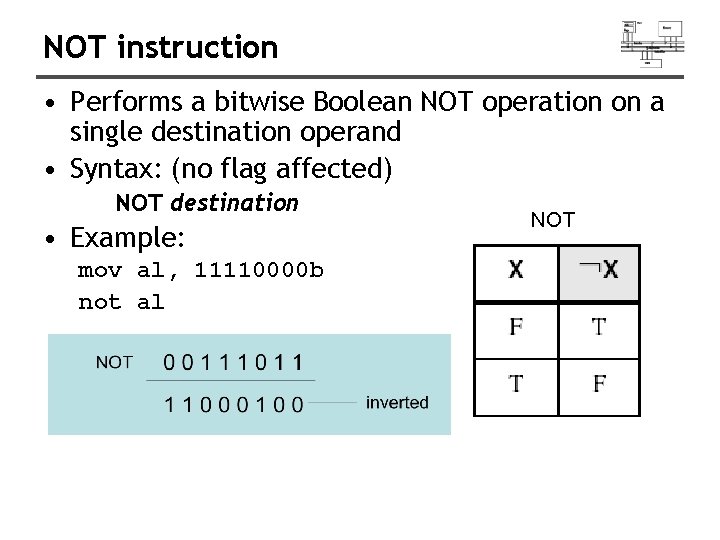
NOT instruction • Performs a bitwise Boolean NOT operation on a single destination operand • Syntax: (no flag affected) NOT destination • Example: mov al, 11110000 b not al NOT
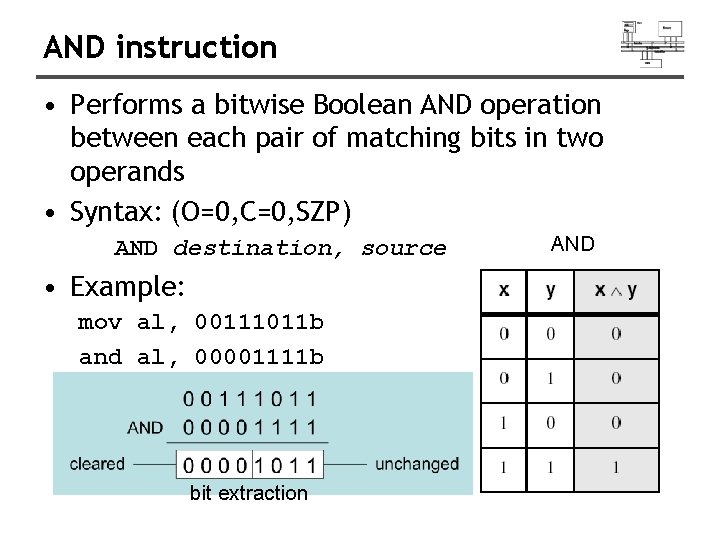
AND instruction • Performs a bitwise Boolean AND operation between each pair of matching bits in two operands • Syntax: (O=0, C=0, SZP) AND destination, source • Example: mov al, 00111011 b and al, 00001111 b bit extraction AND
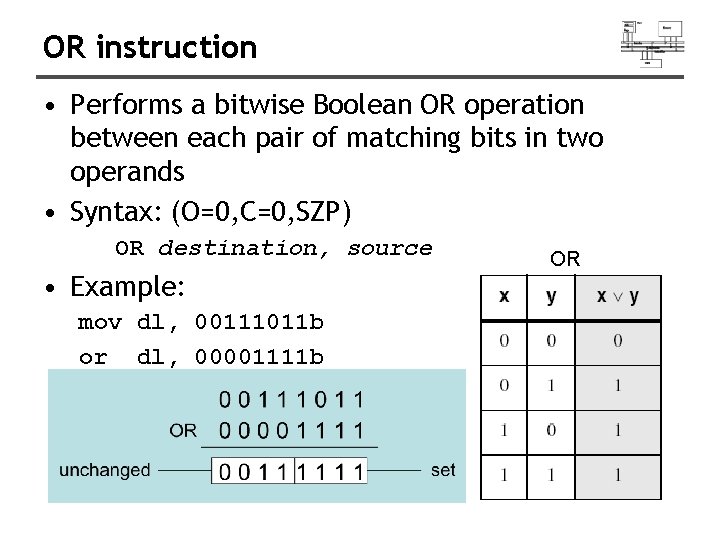
OR instruction • Performs a bitwise Boolean OR operation between each pair of matching bits in two operands • Syntax: (O=0, C=0, SZP) OR destination, source • Example: mov dl, 00111011 b or dl, 00001111 b OR
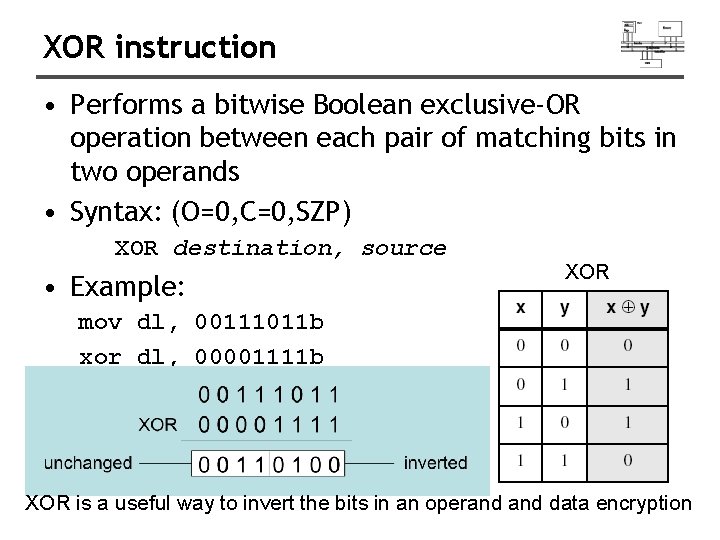
XOR instruction • Performs a bitwise Boolean exclusive-OR operation between each pair of matching bits in two operands • Syntax: (O=0, C=0, SZP) XOR destination, source • Example: XOR mov dl, 00111011 b xor dl, 00001111 b XOR is a useful way to invert the bits in an operand data encryption
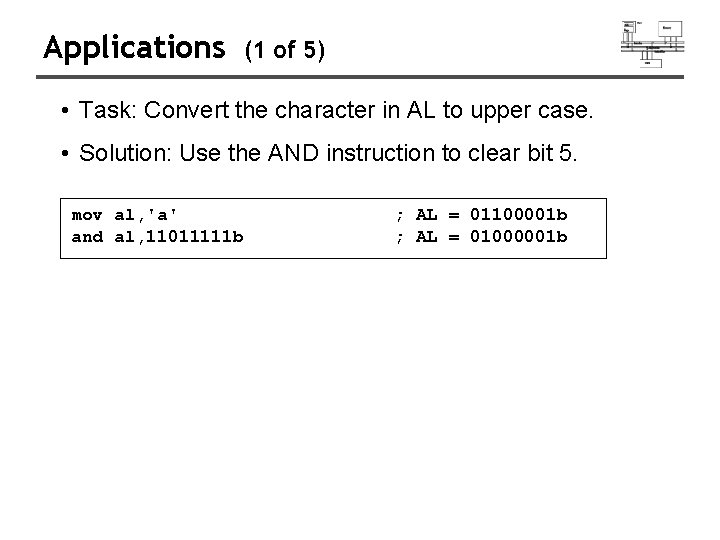
Applications (1 of 5) • Task: Convert the character in AL to upper case. • Solution: Use the AND instruction to clear bit 5. mov al, 'a' and al, 11011111 b ; AL = 01100001 b ; AL = 01000001 b
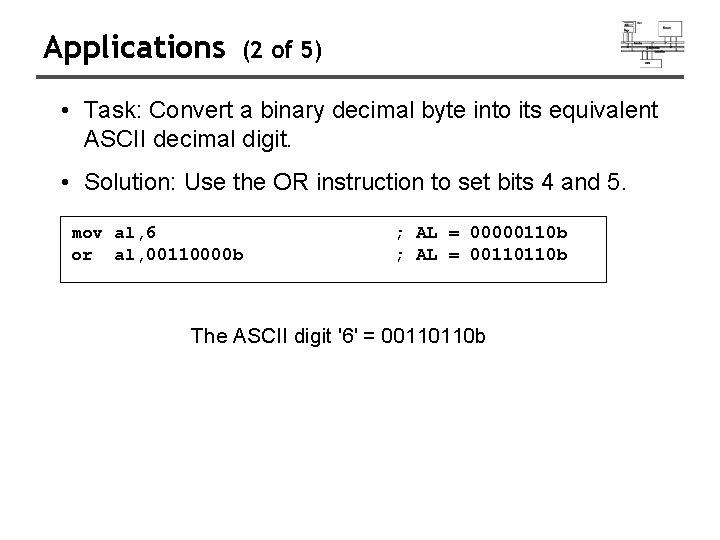
Applications (2 of 5) • Task: Convert a binary decimal byte into its equivalent ASCII decimal digit. • Solution: Use the OR instruction to set bits 4 and 5. mov al, 6 or al, 00110000 b ; AL = 00000110 b ; AL = 00110110 b The ASCII digit '6' = 00110110 b
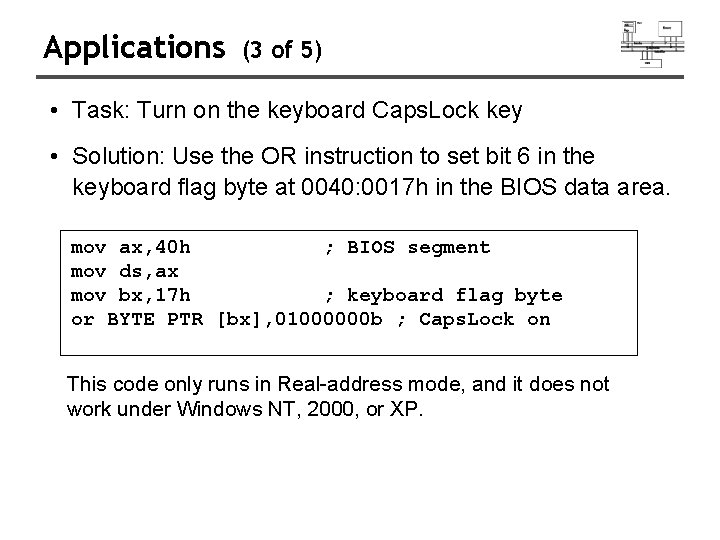
Applications (3 of 5) • Task: Turn on the keyboard Caps. Lock key • Solution: Use the OR instruction to set bit 6 in the keyboard flag byte at 0040: 0017 h in the BIOS data area. mov ax, 40 h ; BIOS segment mov ds, ax mov bx, 17 h ; keyboard flag byte or BYTE PTR [bx], 01000000 b ; Caps. Lock on This code only runs in Real-address mode, and it does not work under Windows NT, 2000, or XP.
Applications (4 of 5) • Task: Jump to a label if an integer is even. • Solution: AND the lowest bit with a 1. If the result is Zero, the number was even. mov ax, word. Val and ax, 1 jz Even. Value ; low bit set? ; jump if Zero flag set
Applications (5 of 5) • Task: Jump to a label if the value in AL is not zero. • Solution: OR the byte with itself, then use the JNZ (jump if not zero) instruction. or al, al jnz Is. Not. Zero ; jump if not zero ORing any number with itself does not change its value.
TEST instruction • Performs a nondestructive AND operation between each pair of matching bits in two operands • No operands are modified, but the flags are affected. • Example: jump to a label if either bit 0 or bit 1 in AL is set. test al, 00000011 b jnz Value. Found • Example: jump to a label if neither bit 0 nor bit 1 in AL is set. test al, 00000011 b jz Value. Not. Found
CMP instruction (1 of 3) • Compares the destination operand to the source operand – Nondestructive subtraction of source from destination (destination operand is not changed) • Syntax: (OSZCAP) CMP destination, source • Example: destination == source mov al, 5 cmp al, 5 ; Zero flag set • Example: destination < source mov al, 4 cmp al, 5 ; Carry flag set
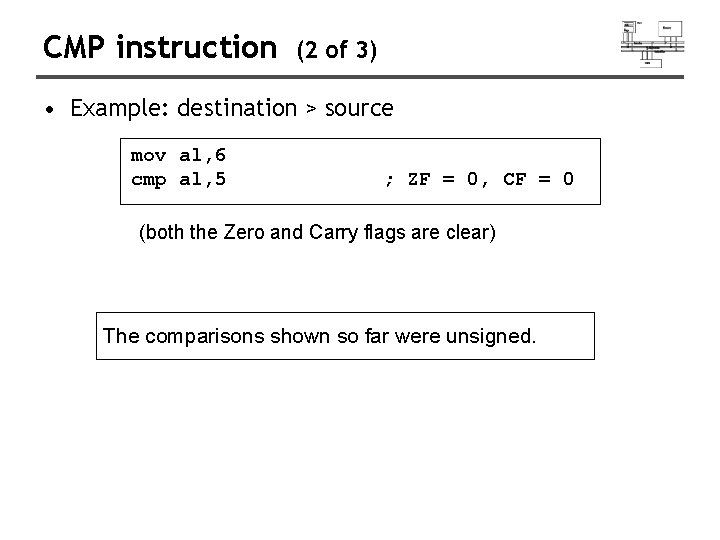
CMP instruction (2 of 3) • Example: destination > source mov al, 6 cmp al, 5 ; ZF = 0, CF = 0 (both the Zero and Carry flags are clear) The comparisons shown so far were unsigned.
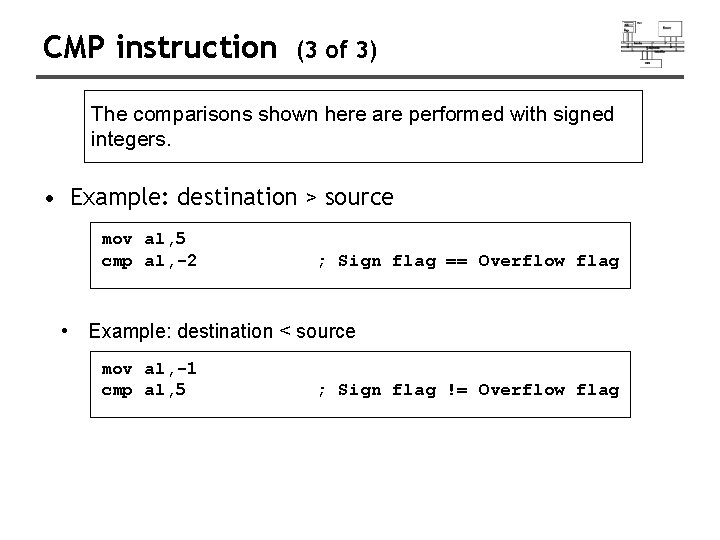
CMP instruction (3 of 3) The comparisons shown here are performed with signed integers. • Example: destination > source mov al, 5 cmp al, -2 ; Sign flag == Overflow flag • Example: destination < source mov al, -1 cmp al, 5 ; Sign flag != Overflow flag
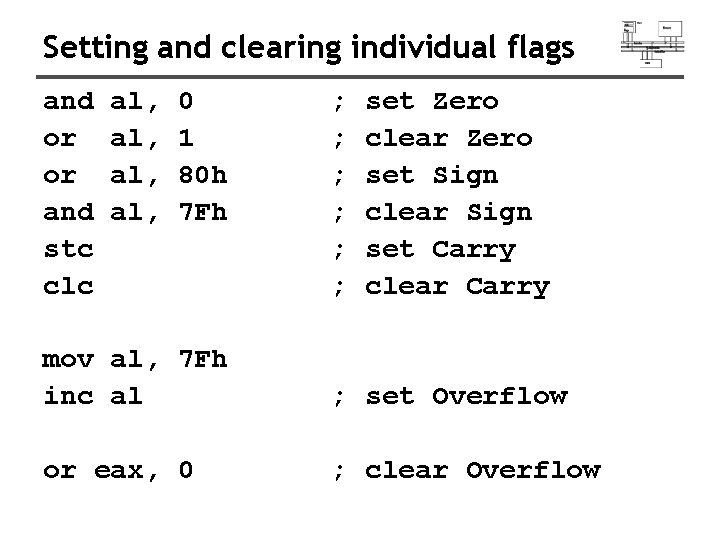
Setting and clearing individual flags and or or and stc clc al, al, 0 1 80 h 7 Fh ; ; ; set Zero clear Zero set Sign clear Sign set Carry clear Carry mov al, 7 Fh inc al ; set Overflow or eax, 0 ; clear Overflow
Conditional jumps
Conditional structures • There are no high-level logic structures such as if-then-else, in the IA-32 instruction set. But, you can use combinations of comparisons and jumps to implement any logic structure. • First, an operation such as CMP, AND or SUB is executed to modified the CPU flags. Second, a conditional jump instruction tests the flags and change the execution flow accordingly. CMP AL, 0 JZ L 1 : L 1:
Jcond instruction • A conditional jump instruction branches to a label when specific register or flag conditions are met Jcond destination • 1. 2. 3. 4. Four groups: (some are the same) based on specific flag values based on equality between operands based on comparisons of unsigned operands based on comparisons of signed operands
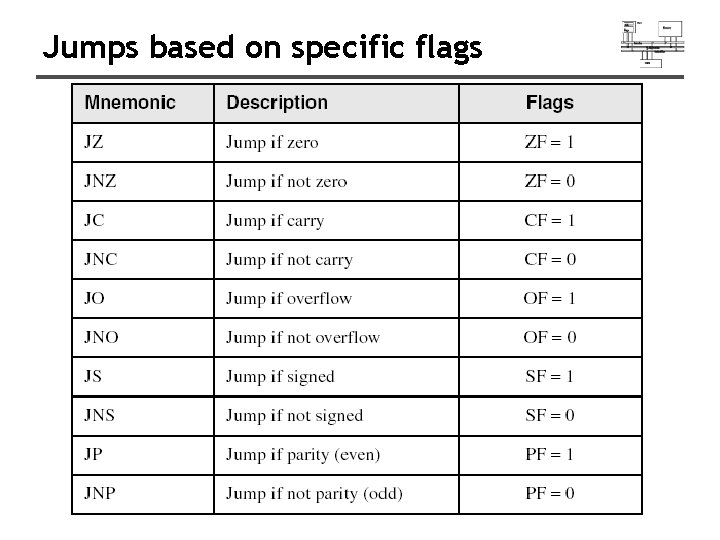
Jumps based on specific flags
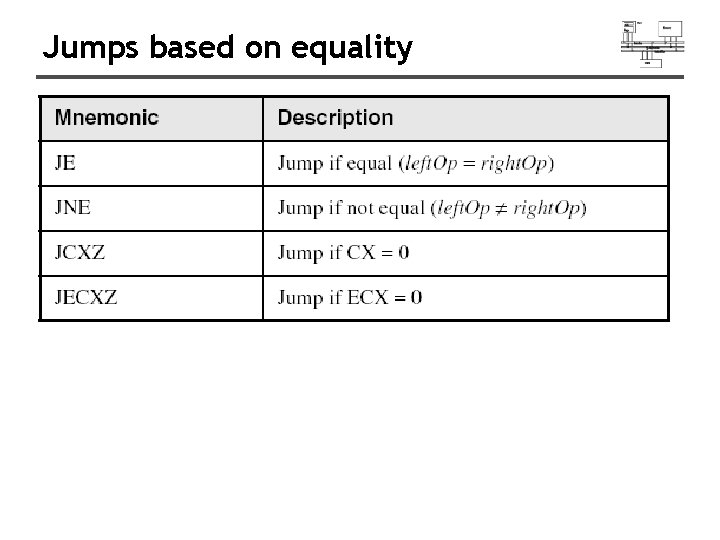
Jumps based on equality
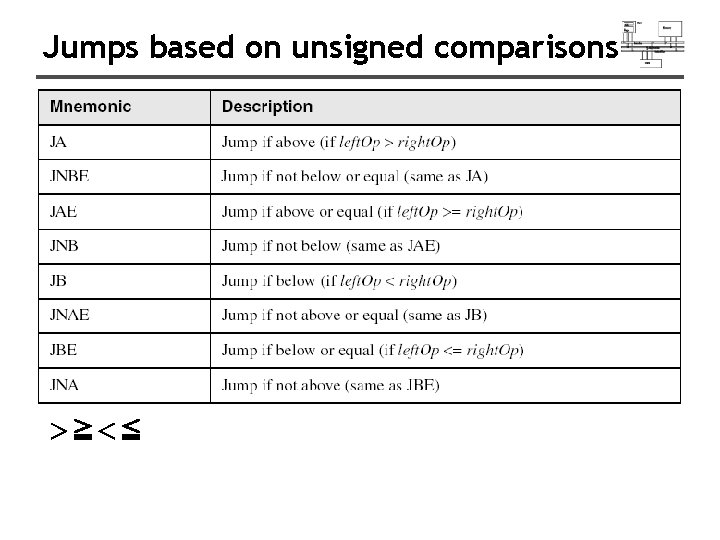
Jumps based on unsigned comparisons >≧<≦
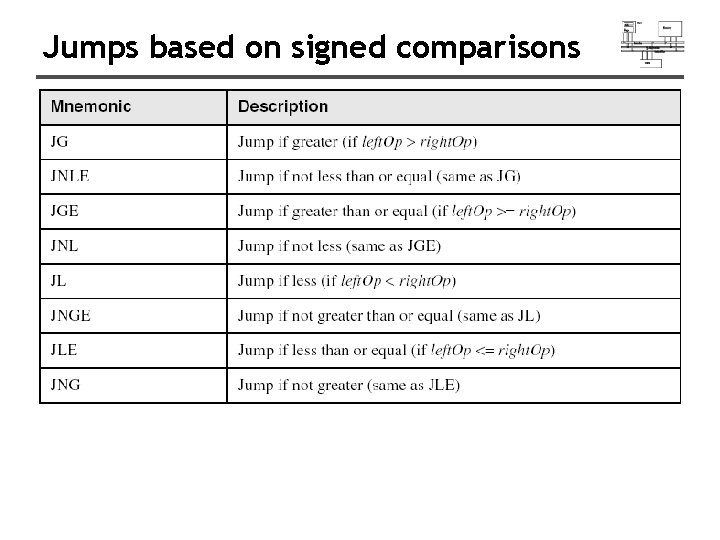
Jumps based on signed comparisons
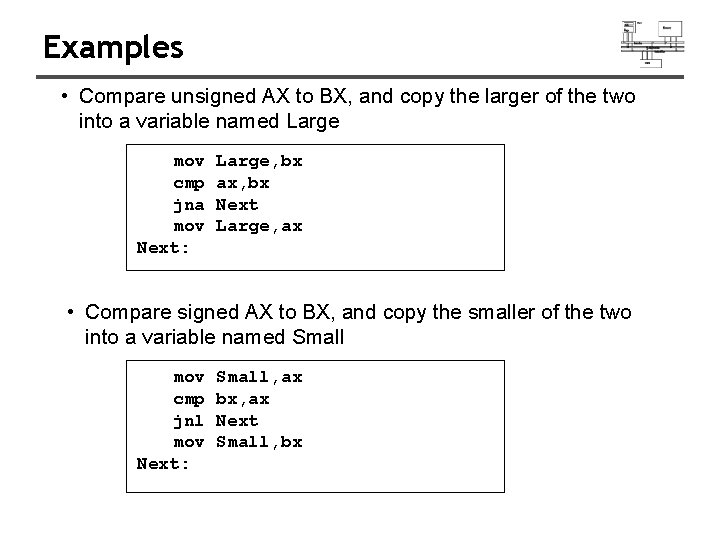
Examples • Compare unsigned AX to BX, and copy the larger of the two into a variable named Large mov cmp jna mov Next: Large, bx ax, bx Next Large, ax • Compare signed AX to BX, and copy the smaller of the two into a variable named Small mov cmp jnl mov Next: Small, ax bx, ax Next Small, bx
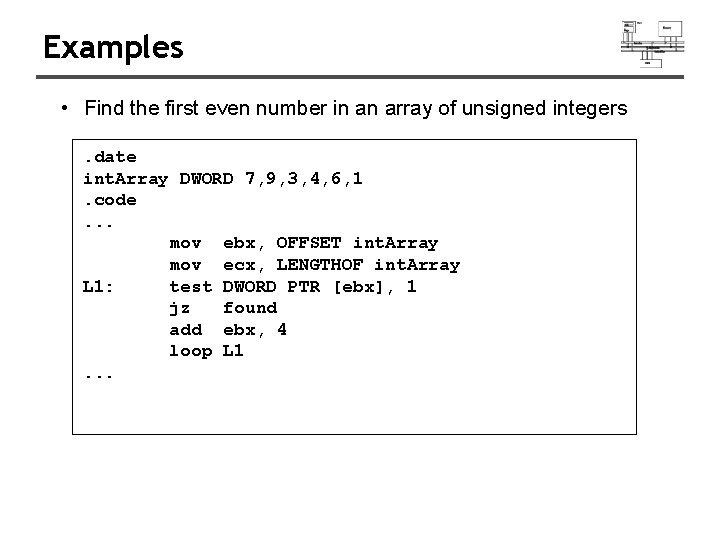
Examples • Find the first even number in an array of unsigned integers. date int. Array DWORD 7, 9, 3, 4, 6, 1. code. . . mov ebx, OFFSET int. Array mov ecx, LENGTHOF int. Array L 1: test DWORD PTR [ebx], 1 jz found add ebx, 4 loop L 1. . .
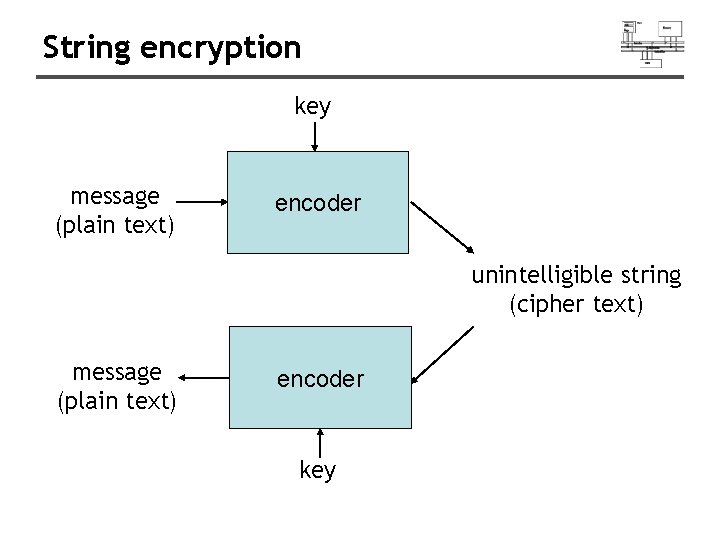
String encryption key message (plain text) encoder unintelligible string (cipher text) message (plain text) encoder key
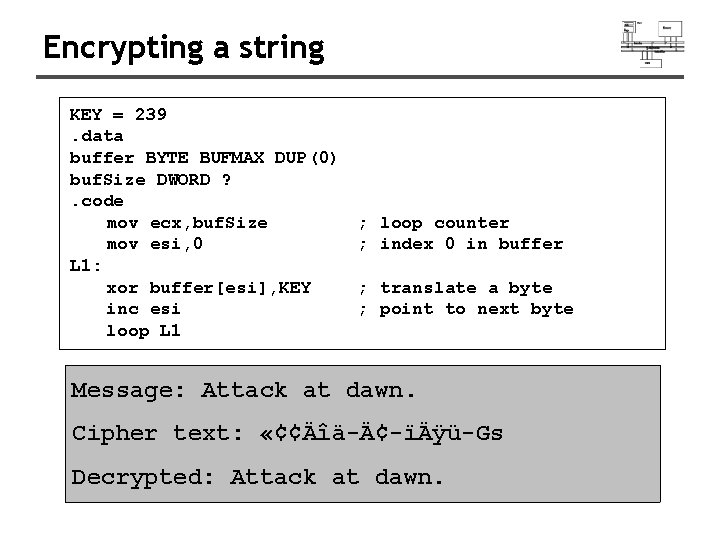
Encrypting a string KEY = 239. data buffer BYTE BUFMAX DUP(0) buf. Size DWORD ? . code mov ecx, buf. Size mov esi, 0 L 1: xor buffer[esi], KEY inc esi loop L 1 ; loop counter ; index 0 in buffer ; translate a byte ; point to next byte Message: Attack at dawn. Cipher text: «¢¢Äîä-Ä¢-ïÄÿü-Gs Decrypted: Attack at dawn.
Conditional loops
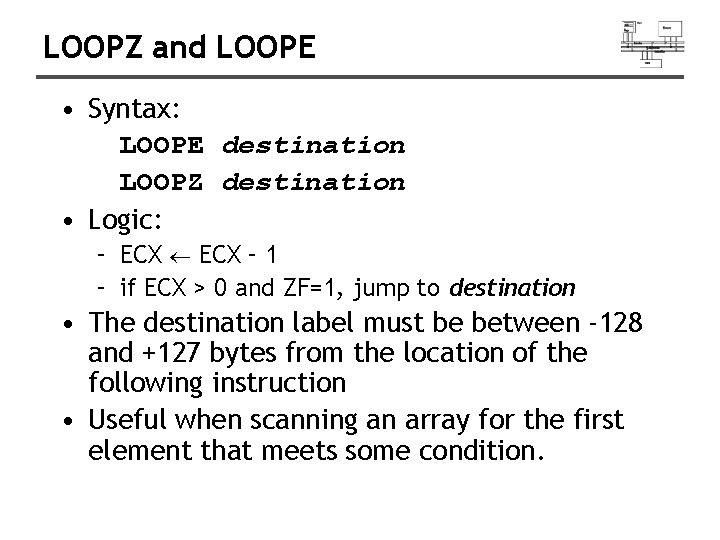
LOOPZ and LOOPE • Syntax: LOOPE destination LOOPZ destination • Logic: – ECX – 1 – if ECX > 0 and ZF=1, jump to destination • The destination label must be between -128 and +127 bytes from the location of the following instruction • Useful when scanning an array for the first element that meets some condition.
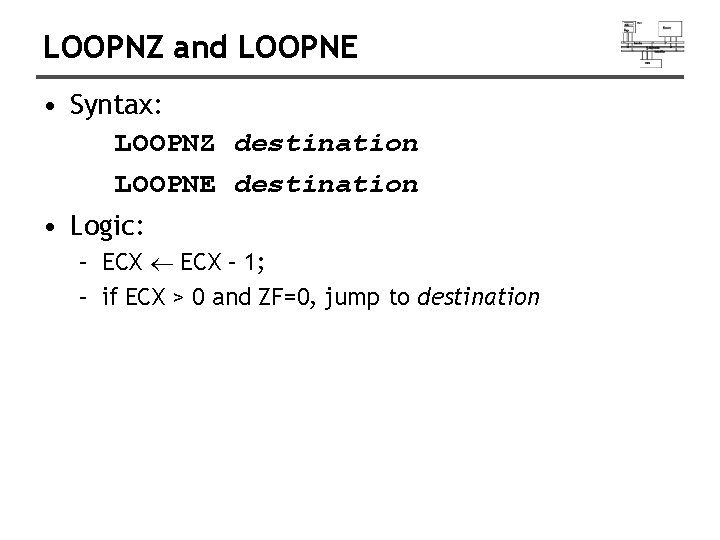
LOOPNZ and LOOPNE • Syntax: LOOPNZ destination LOOPNE destination • Logic: – ECX – 1; – if ECX > 0 and ZF=0, jump to destination
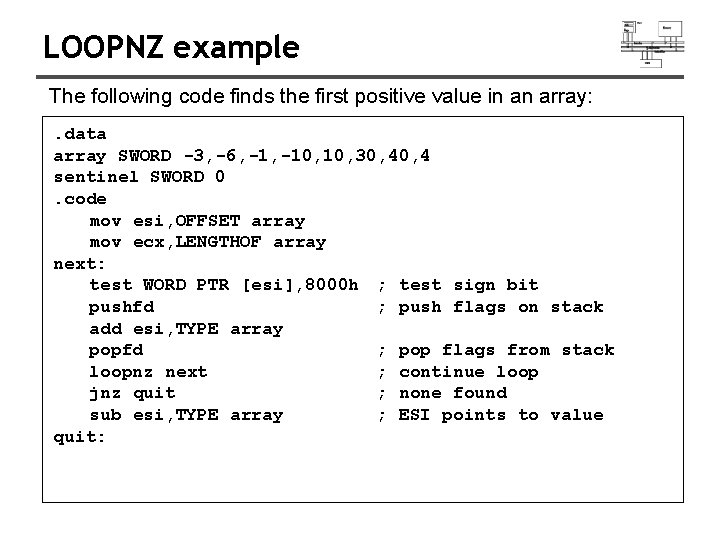
LOOPNZ example The following code finds the first positive value in an array: . data array SWORD -3, -6, -10, 10, 30, 4 sentinel SWORD 0. code mov esi, OFFSET array mov ecx, LENGTHOF array next: test WORD PTR [esi], 8000 h ; test sign bit pushfd ; push flags on stack add esi, TYPE array popfd ; pop flags from stack loopnz next ; continue loop jnz quit ; none found sub esi, TYPE array ; ESI points to value quit:
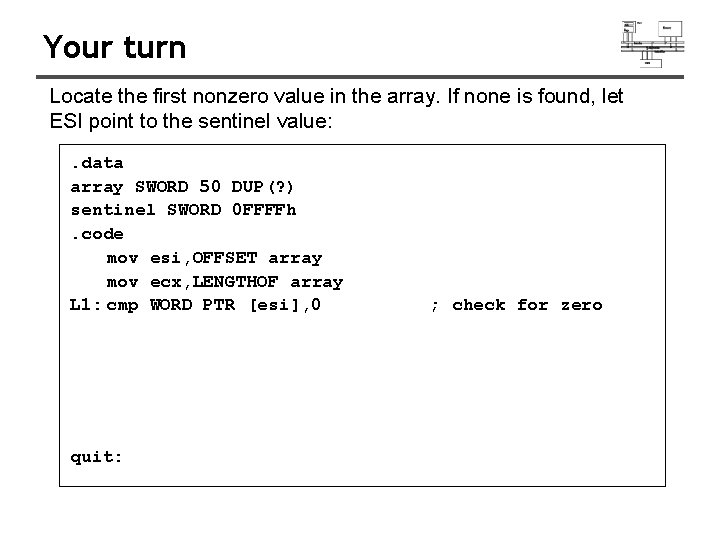
Your turn Locate the first nonzero value in the array. If none is found, let ESI point to the sentinel value: . data array SWORD 50 DUP(? ) sentinel SWORD 0 FFFFh. code mov esi, OFFSET array mov ecx, LENGTHOF array L 1: cmp WORD PTR [esi], 0 quit: ; check for zero
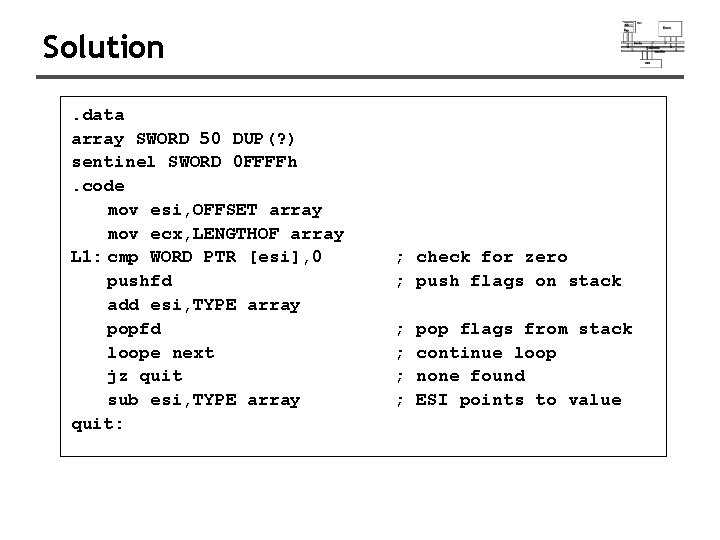
Solution. data array SWORD 50 DUP(? ) sentinel SWORD 0 FFFFh. code mov esi, OFFSET array mov ecx, LENGTHOF array L 1: cmp WORD PTR [esi], 0 pushfd add esi, TYPE array popfd loope next jz quit sub esi, TYPE array quit: ; check for zero ; push flags on stack ; ; pop flags from stack continue loop none found ESI points to value
Conditional structures
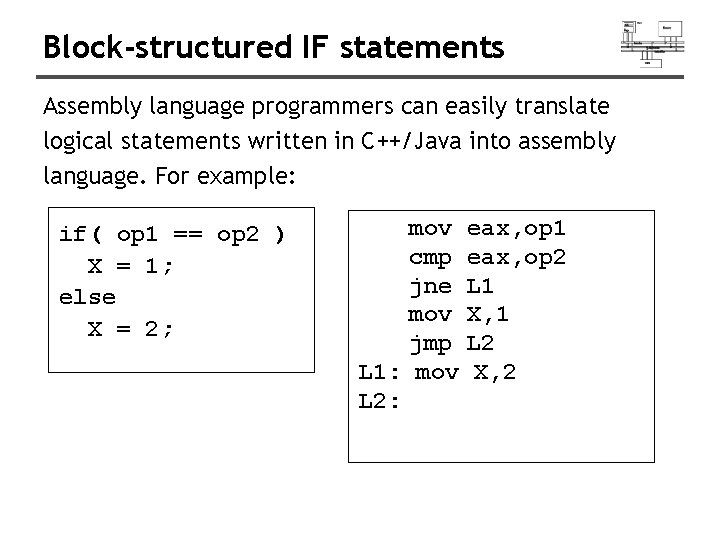
Block-structured IF statements Assembly language programmers can easily translate logical statements written in C++/Java into assembly language. For example: if( op 1 == op 2 ) X = 1; else X = 2; mov cmp jne mov jmp L 1: mov L 2: eax, op 1 eax, op 2 L 1 X, 1 L 2 X, 2
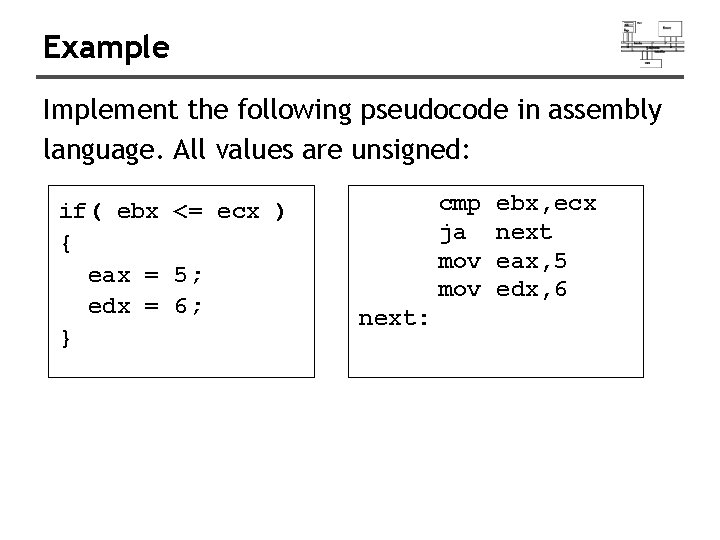
Example Implement the following pseudocode in assembly language. All values are unsigned: if( ebx <= ecx ) { eax = 5; edx = 6; } cmp ja mov next: ebx, ecx next eax, 5 edx, 6
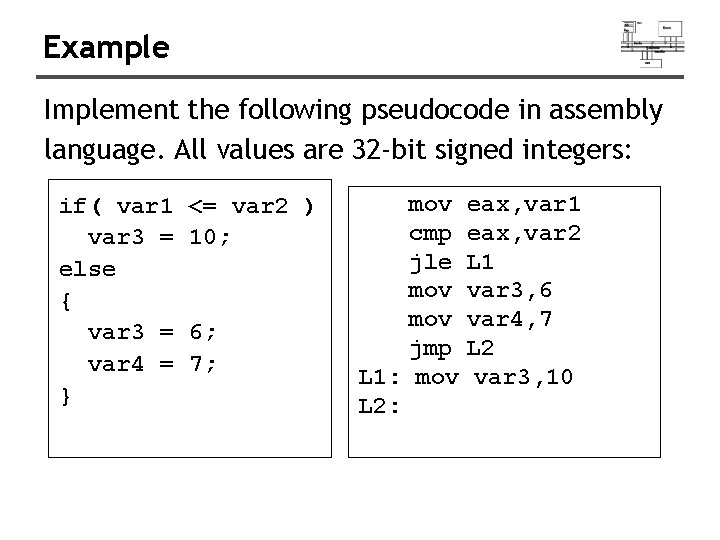
Example Implement the following pseudocode in assembly language. All values are 32 -bit signed integers: if( var 1 var 3 = else { var 3 = var 4 = } <= var 2 ) 10; 6; 7; mov cmp jle mov jmp L 1: mov L 2: eax, var 1 eax, var 2 L 1 var 3, 6 var 4, 7 L 2 var 3, 10
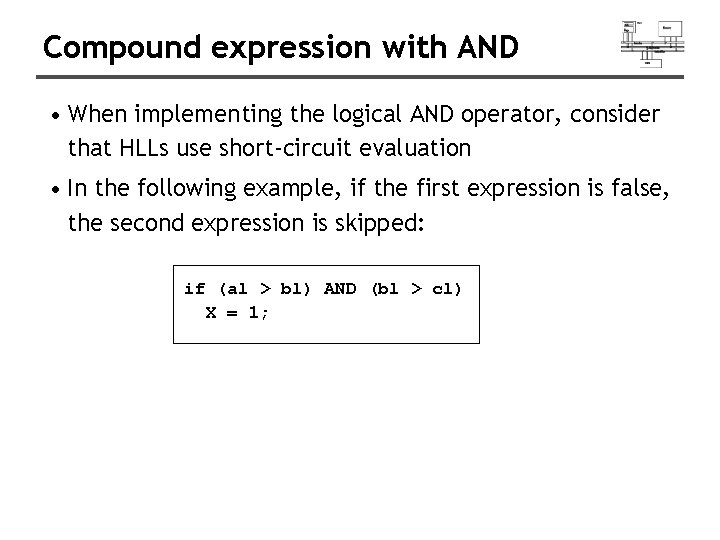
Compound expression with AND • When implementing the logical AND operator, consider that HLLs use short-circuit evaluation • In the following example, if the first expression is false, the second expression is skipped: if (al > bl) AND (bl > cl) X = 1;
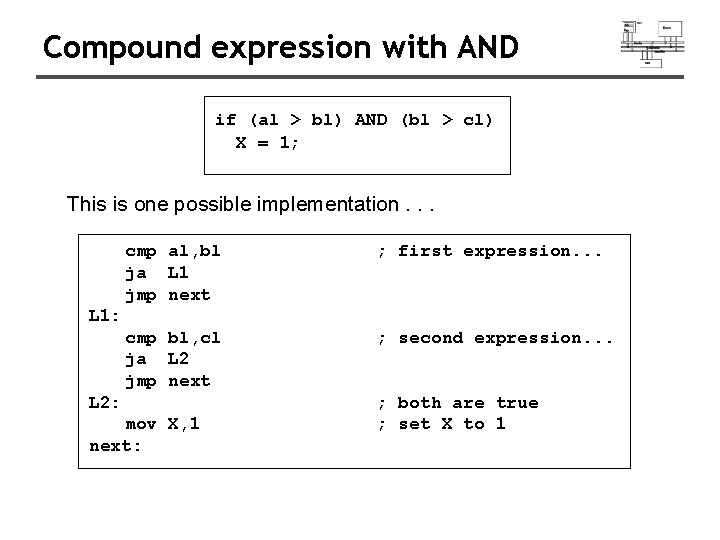
Compound expression with AND if (al > bl) AND (bl > cl) X = 1; This is one possible implementation. . . cmp al, bl ja L 1 jmp next ; first expression. . . cmp bl, cl ja L 2 jmp next ; second expression. . . L 1: L 2: mov X, 1 next: ; both are true ; set X to 1
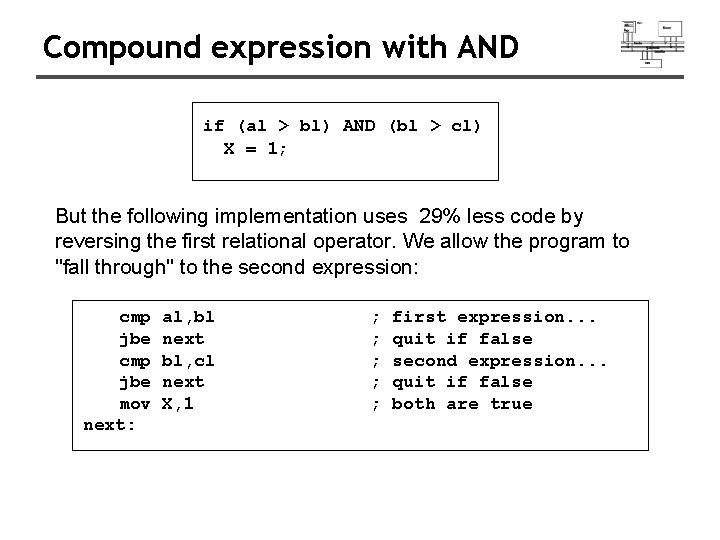
Compound expression with AND if (al > bl) AND (bl > cl) X = 1; But the following implementation uses 29% less code by reversing the first relational operator. We allow the program to "fall through" to the second expression: cmp jbe mov next: al, bl next bl, cl next X, 1 ; ; ; first expression. . . quit if false second expression. . . quit if false both are true
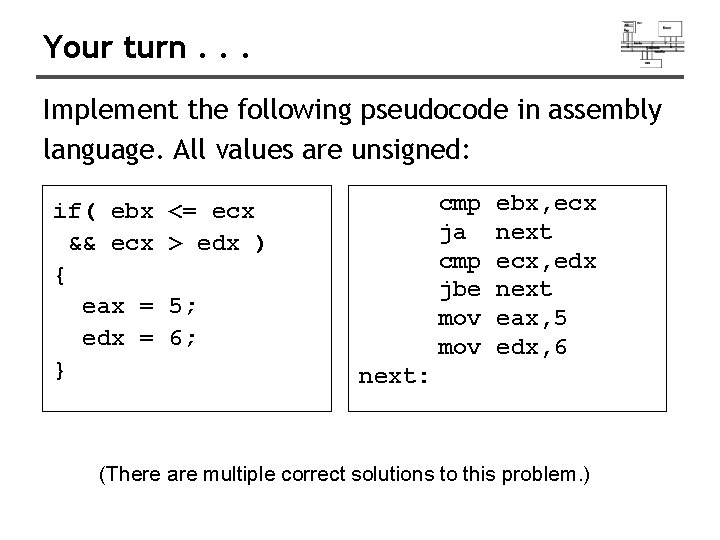
Your turn. . . Implement the following pseudocode in assembly language. All values are unsigned: if( ebx && ecx { eax = edx = } cmp ja cmp jbe mov <= ecx > edx ) 5; 6; ebx, ecx next ecx, edx next eax, 5 edx, 6 next: (There are multiple correct solutions to this problem. )
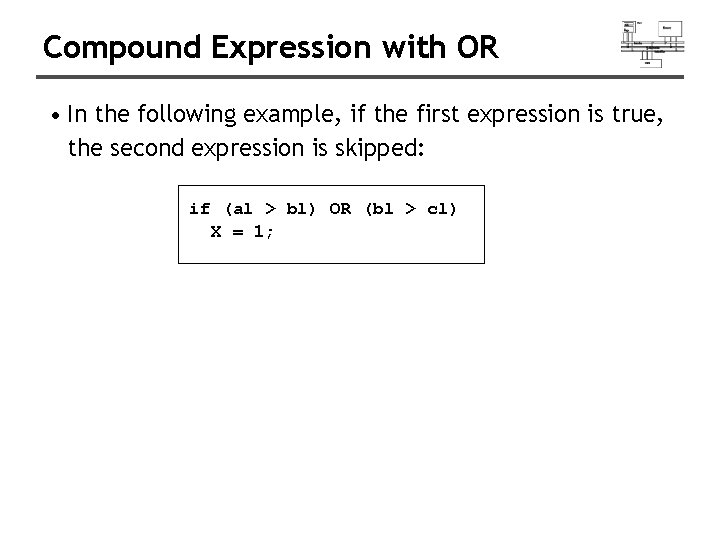
Compound Expression with OR • In the following example, if the first expression is true, the second expression is skipped: if (al > bl) OR (bl > cl) X = 1;
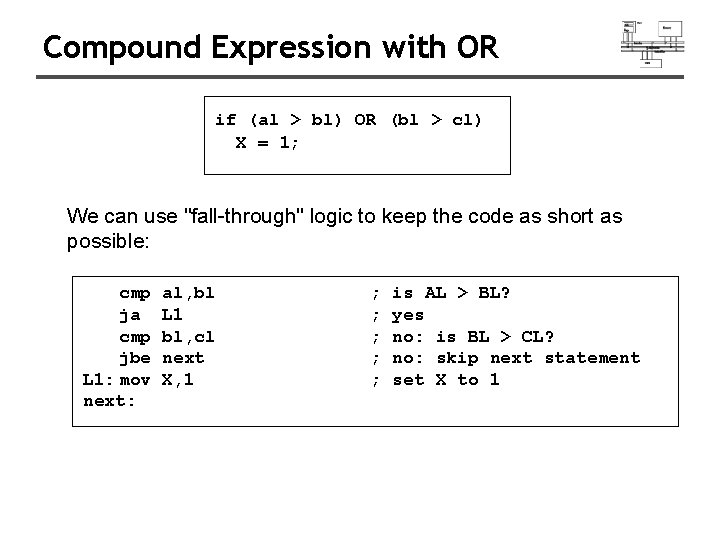
Compound Expression with OR if (al > bl) OR (bl > cl) X = 1; We can use "fall-through" logic to keep the code as short as possible: cmp ja cmp jbe L 1: mov next: al, bl L 1 bl, cl next X, 1 ; ; ; is AL > BL? yes no: is BL > CL? no: skip next statement set X to 1
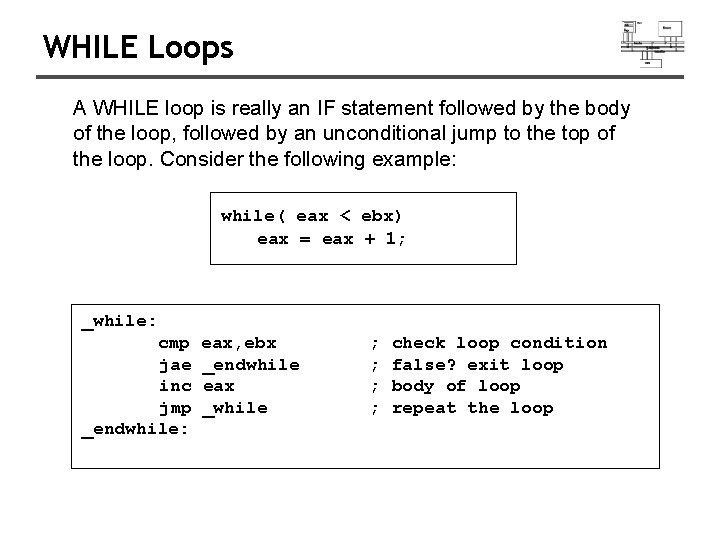
WHILE Loops A WHILE loop is really an IF statement followed by the body of the loop, followed by an unconditional jump to the top of the loop. Consider the following example: while( eax < ebx) eax = eax + 1; _while: cmp jae inc jmp _endwhile: eax, ebx _endwhile eax _while ; ; check loop condition false? exit loop body of loop repeat the loop
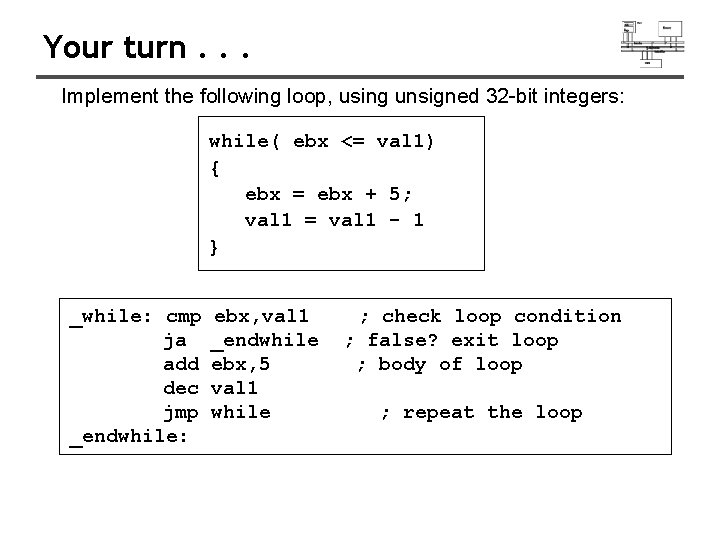
Your turn. . . Implement the following loop, using unsigned 32 -bit integers: while( ebx <= val 1) { ebx = ebx + 5; val 1 = val 1 - 1 } _while: cmp ja add dec jmp _endwhile: ebx, val 1 _endwhile ebx, 5 val 1 while ; check loop condition ; false? exit loop ; body of loop ; repeat the loop
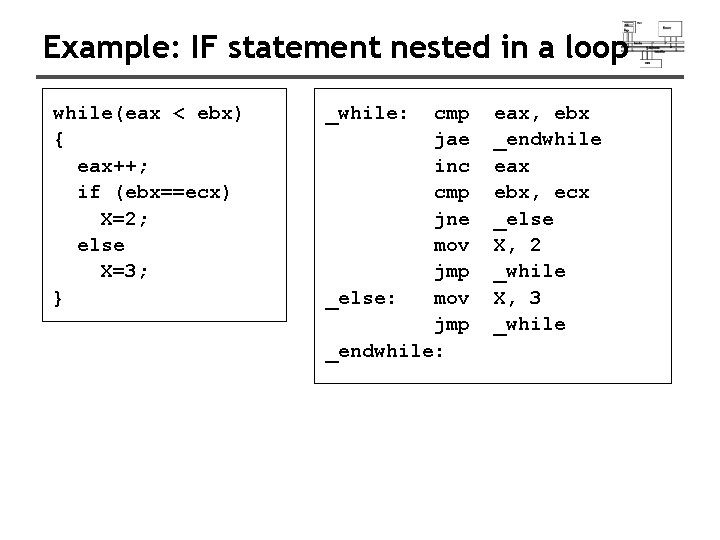
Example: IF statement nested in a loop while(eax < ebx) { eax++; if (ebx==ecx) X=2; else X=3; } _while: cmp jae inc cmp jne mov jmp _else: mov jmp _endwhile: eax, ebx _endwhile eax ebx, ecx _else X, 2 _while X, 3 _while
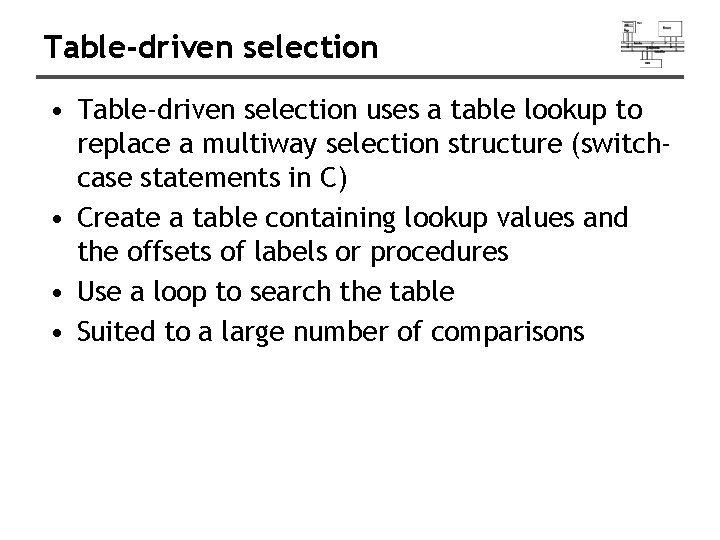
Table-driven selection • Table-driven selection uses a table lookup to replace a multiway selection structure (switchcase statements in C) • Create a table containing lookup values and the offsets of labels or procedures • Use a loop to search the table • Suited to a large number of comparisons
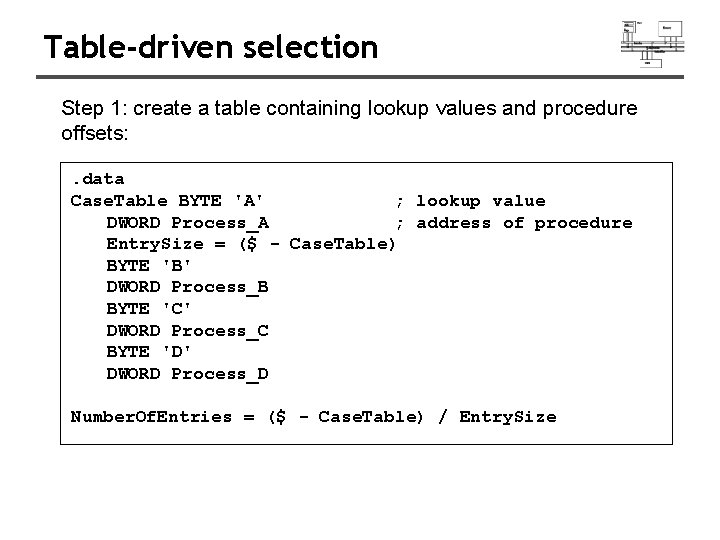
Table-driven selection Step 1: create a table containing lookup values and procedure offsets: . data Case. Table BYTE 'A' ; lookup value DWORD Process_A ; address of procedure Entry. Size = ($ - Case. Table) BYTE 'B' DWORD Process_B BYTE 'C' DWORD Process_C BYTE 'D' DWORD Process_D Number. Of. Entries = ($ - Case. Table) / Entry. Size
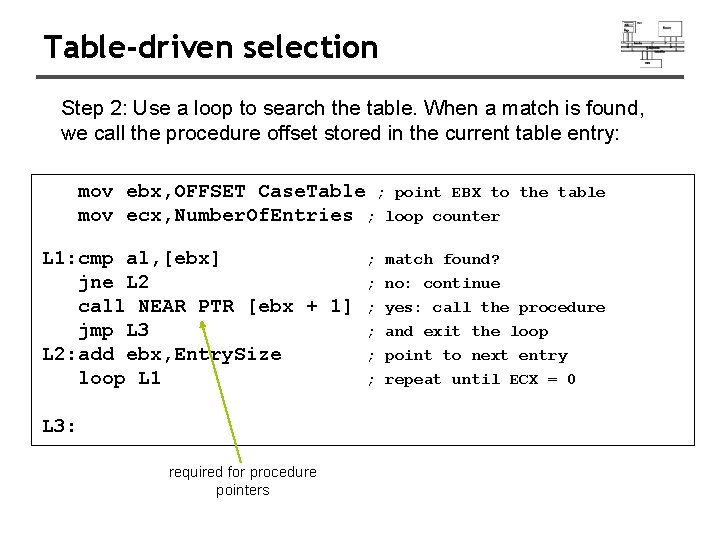
Table-driven selection Step 2: Use a loop to search the table. When a match is found, we call the procedure offset stored in the current table entry: mov ebx, OFFSET Case. Table ; point EBX to mov ecx, Number. Of. Entries ; loop counter L 1: cmp al, [ebx] jne L 2 call NEAR PTR [ebx + 1] jmp L 3 L 2: add ebx, Entry. Size loop L 1 L 3: required for procedure pointers ; ; ; the table match found? no: continue yes: call the procedure and exit the loop point to next entry repeat until ECX = 0
Application: finite-state machines • A finite-state machine (FSM) is a graph structure that changes state based on some input. Also called a statetransition diagram. • We use a graph to represent an FSM, with squares or circles called nodes, and lines with arrows between the circles called edges (or arcs). • A FSM is a specific instance of a more general structure called a directed graph (or digraph). • Three basic states, represented by nodes: – Start state – Terminal state(s) – Nonterminal state(s)
Finite-state machines • Accepts any sequence of symbols that puts it into an accepting (final) state • Can be used to recognize, or validate a sequence of characters that is governed by language rules (called a regular expression)
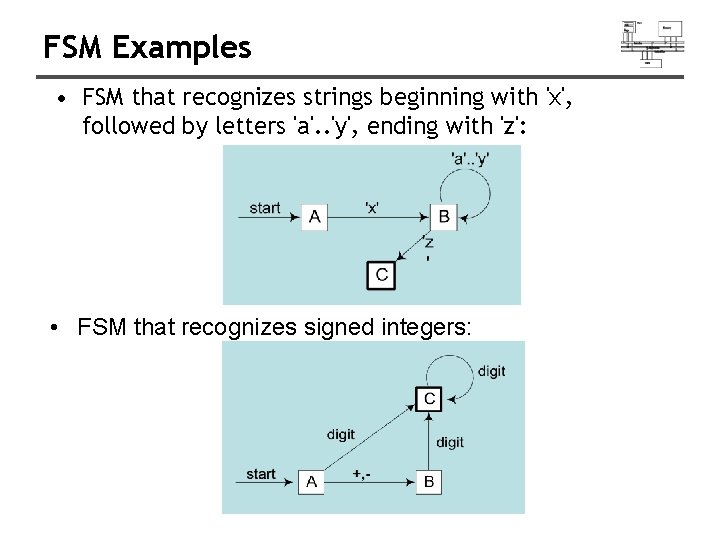
FSM Examples • FSM that recognizes strings beginning with 'x', followed by letters 'a'. . 'y', ending with 'z': • FSM that recognizes signed integers:
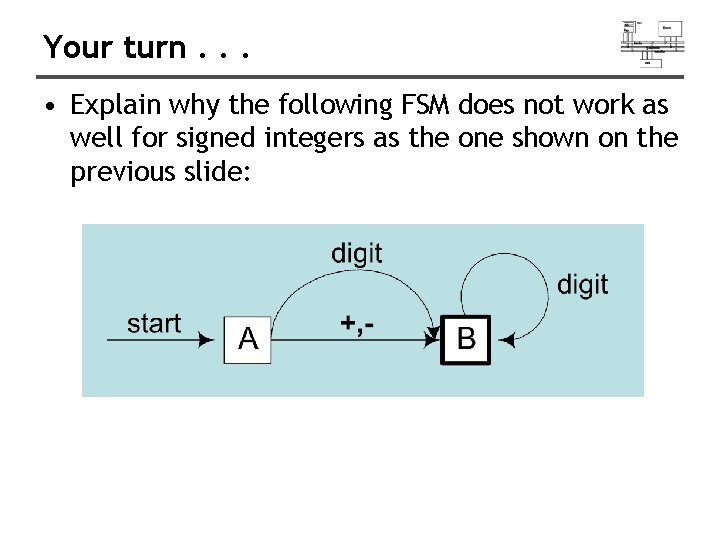
Your turn. . . • Explain why the following FSM does not work as well for signed integers as the one shown on the previous slide:
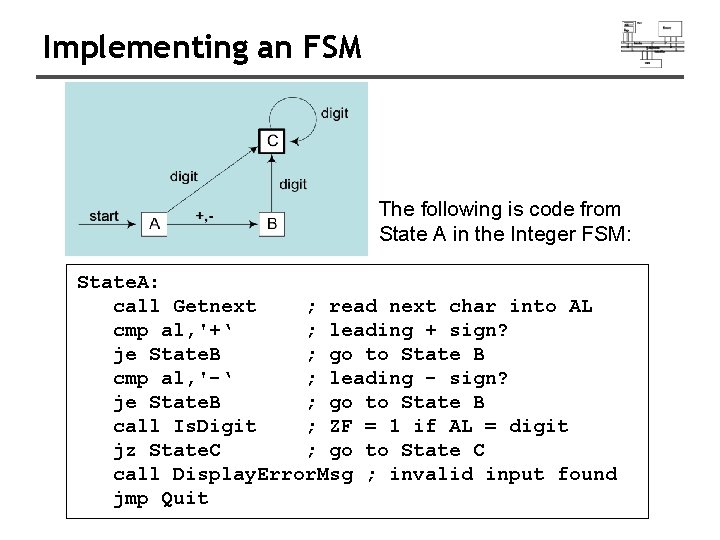
Implementing an FSM The following is code from State A in the Integer FSM: State. A: call Getnext ; read next char into AL cmp al, '+‘ ; leading + sign? je State. B ; go to State B cmp al, '-‘ ; leading - sign? je State. B ; go to State B call Is. Digit ; ZF = 1 if AL = digit jz State. C ; go to State C call Display. Error. Msg ; invalid input found jmp Quit
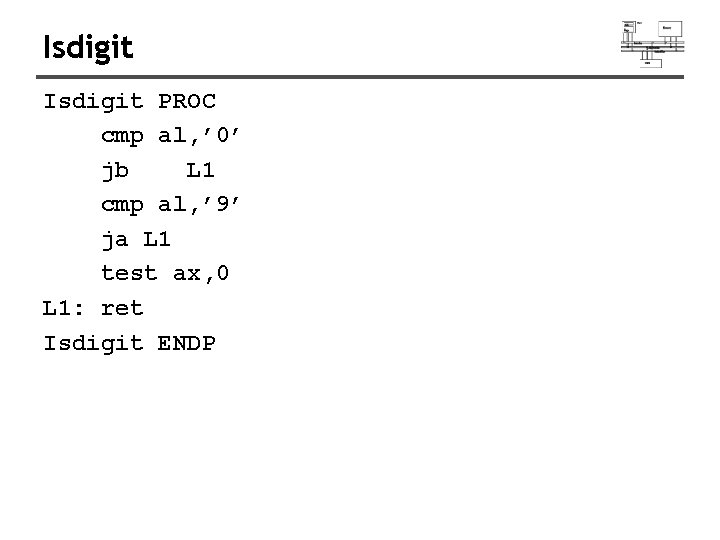
Isdigit PROC cmp al, ’ 0’ jb L 1 cmp al, ’ 9’ ja L 1 test ax, 0 L 1: ret Isdigit ENDP
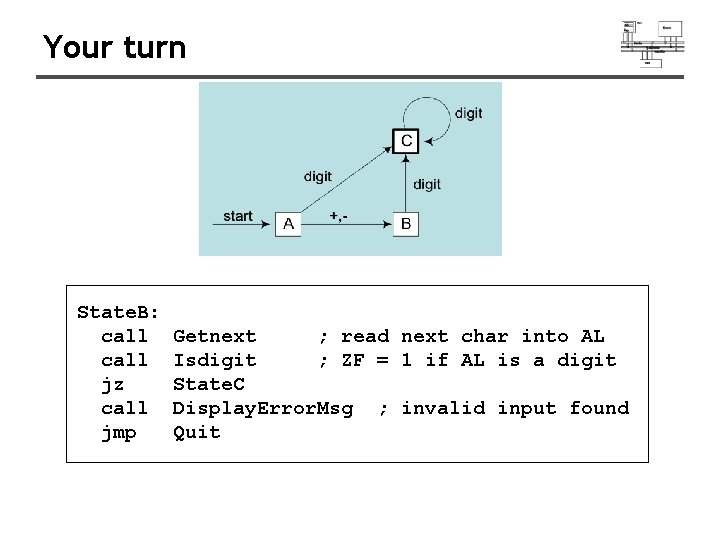
Your turn State. B: call jz call jmp Getnext ; read next char into AL Isdigit ; ZF = 1 if AL is a digit State. C Display. Error. Msg ; invalid input found Quit
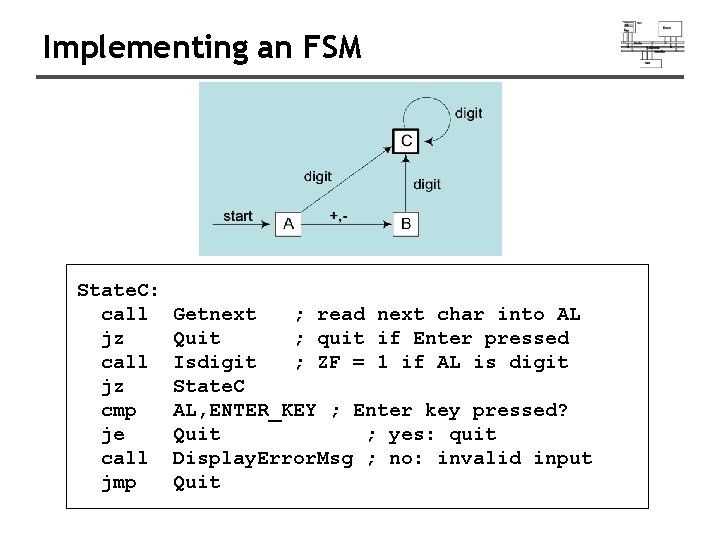
Implementing an FSM State. C: call jz cmp je call jmp Getnext ; read next char into AL Quit ; quit if Enter pressed Isdigit ; ZF = 1 if AL is digit State. C AL, ENTER_KEY ; Enter key pressed? Quit ; yes: quit Display. Error. Msg ; no: invalid input Quit
![Finite-state machine example • [sign]integer. [integer][exponent] sign → {+|-} exponent → E[{+|-}]integer](http://slidetodoc.com/presentation_image_h/1e402868422cce7737de8a5a3eb9ac5c/image-61.jpg "Finite-state machine example • [sign]integer. [integer][exponent] sign → {+|-} exponent → E[{+|-}]integer")
Finite-state machine example • [sign]integer. [integer][exponent] sign → {+|-} exponent → E[{+|-}]integer
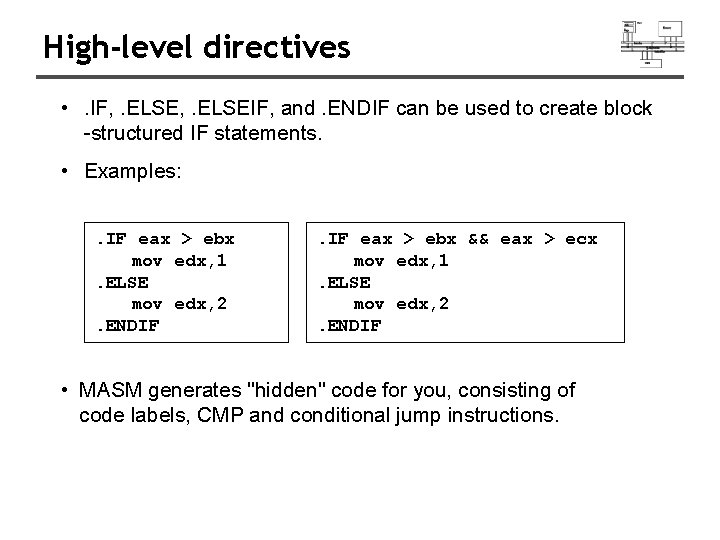
High-level directives • . IF, . ELSEIF, and. ENDIF can be used to create block -structured IF statements. • Examples: . IF eax > ebx mov edx, 1. ELSE mov edx, 2. ENDIF . IF eax > ebx && eax > ecx mov edx, 1. ELSE mov edx, 2. ENDIF • MASM generates "hidden" code for you, consisting of code labels, CMP and conditional jump instructions.
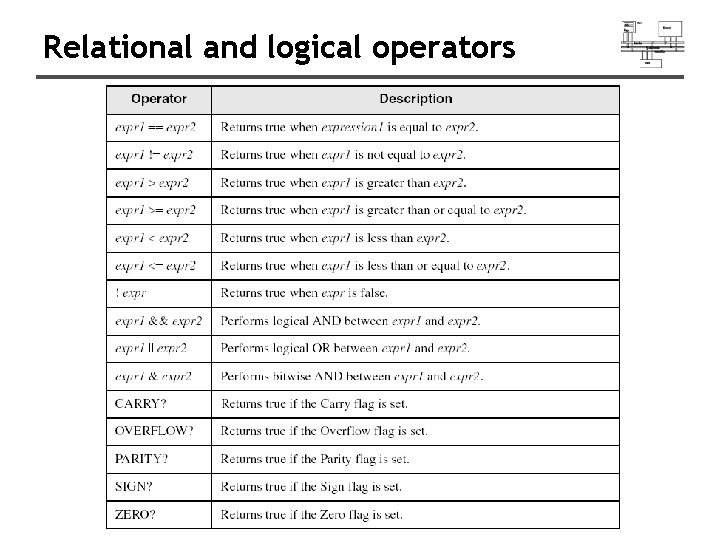
Relational and logical operators
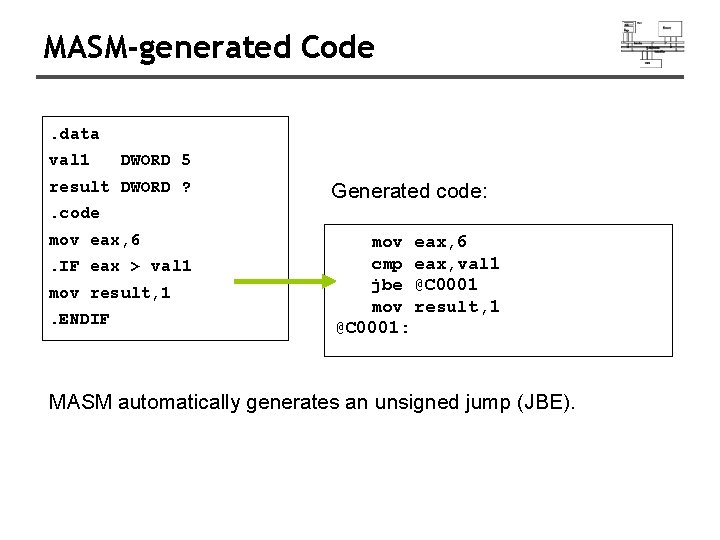
MASM-generated Code. data val 1 DWORD 5 result DWORD ? Generated code: . code mov eax, 6. IF eax > val 1 mov result, 1. ENDIF mov eax, 6 cmp eax, val 1 jbe @C 0001 mov result, 1 @C 0001: MASM automatically generates an unsigned jump (JBE).
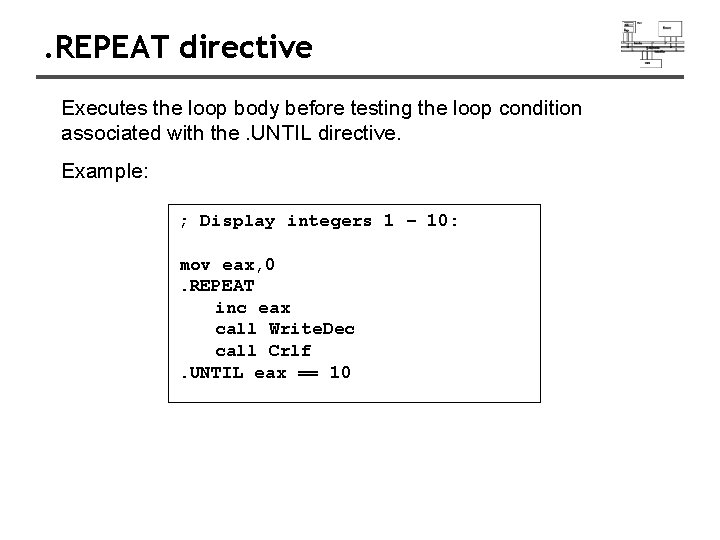
. REPEAT directive Executes the loop body before testing the loop condition associated with the. UNTIL directive. Example: ; Display integers 1 – 10: mov eax, 0. REPEAT inc eax call Write. Dec call Crlf. UNTIL eax == 10
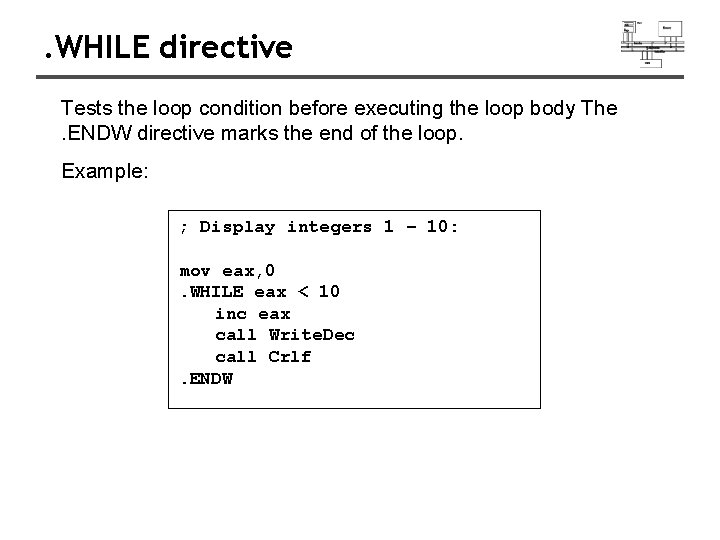
. WHILE directive Tests the loop condition before executing the loop body The. ENDW directive marks the end of the loop. Example: ; Display integers 1 – 10: mov eax, 0. WHILE eax < 10 inc eax call Write. Dec call Crlf. ENDW
- Slides: 66