
Conditional Probability Warm Up A card is drawn
Conditional Probability
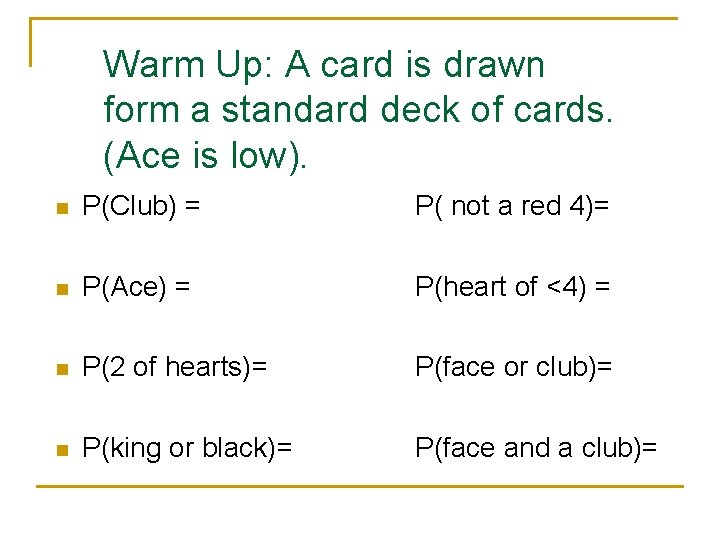
Warm Up: A card is drawn form a standard deck of cards. (Ace is low). n P(Club) = P( not a red 4)= n P(Ace) = P(heart of <4) = n P(2 of hearts)= P(face or club)= n P(king or black)= P(face and a club)=
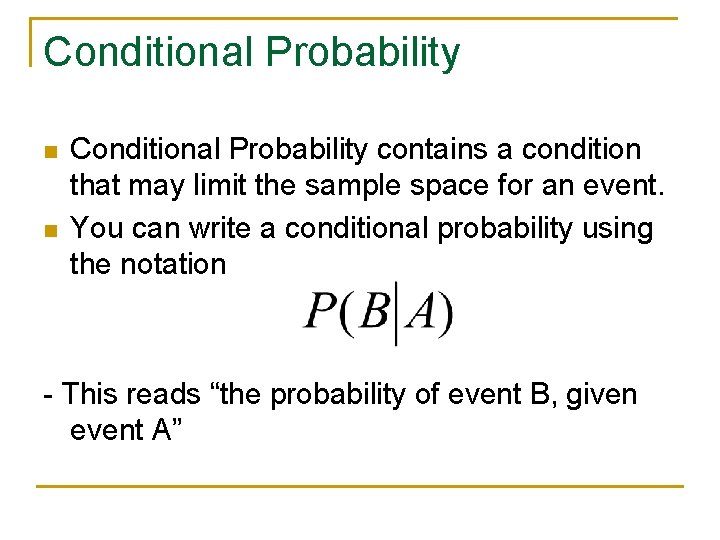
Conditional Probability n n Conditional Probability contains a condition that may limit the sample space for an event. You can write a conditional probability using the notation - This reads “the probability of event B, given event A”
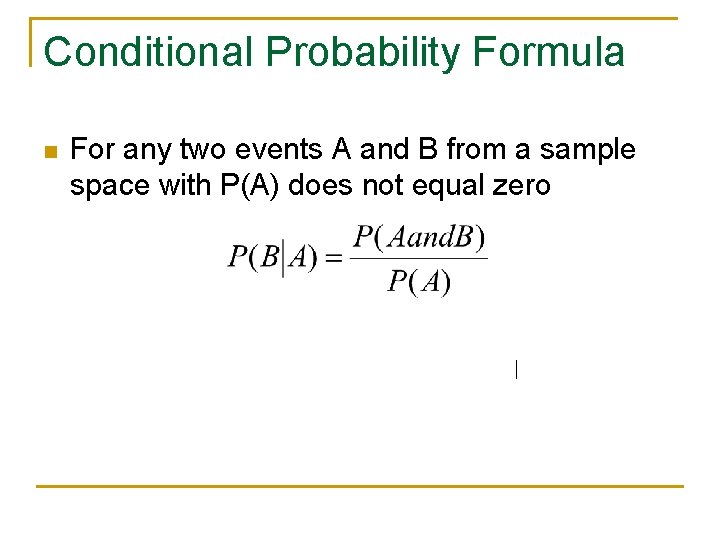
Conditional Probability Formula n For any two events A and B from a sample space with P(A) does not equal zero
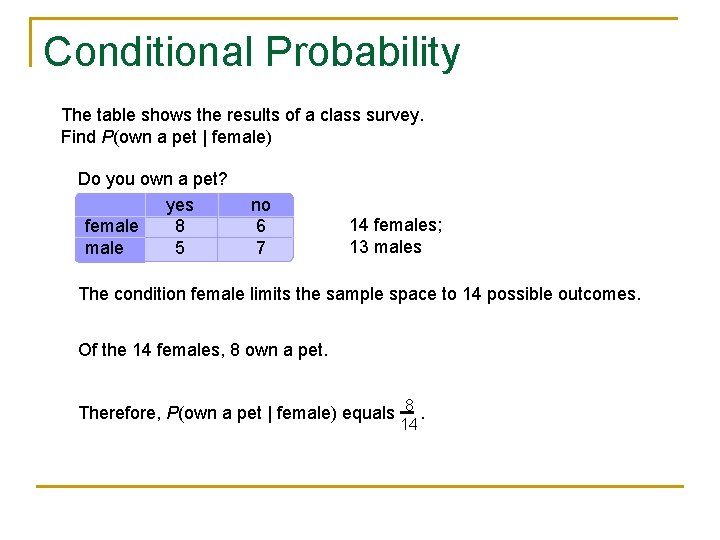
Conditional Probability The table shows the results of a class survey. Find P(own a pet | female) Do you own a pet? yes female 8 male 5 no 6 7 14 females; 13 males The condition female limits the sample space to 14 possible outcomes. Of the 14 females, 8 own a pet. Therefore, P(own a pet | female) equals 8. 14
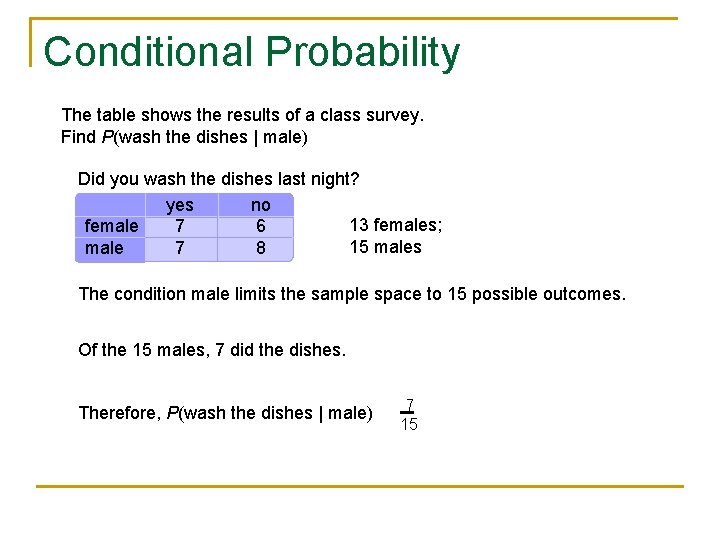
Conditional Probability The table shows the results of a class survey. Find P(wash the dishes | male) Did you wash the dishes last night? yes no 13 females; female 7 6 15 males male 7 8 The condition male limits the sample space to 15 possible outcomes. Of the 15 males, 7 did the dishes. Therefore, P(wash the dishes | male) 7 15
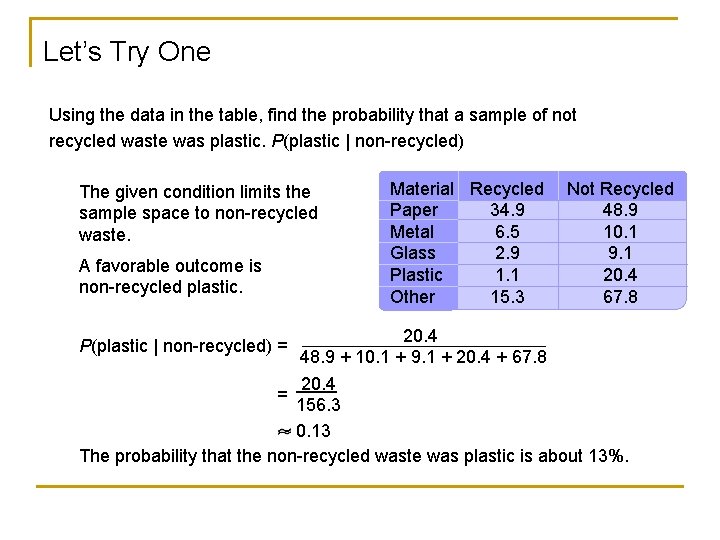
Let’s Try One Using the data in the table, find the probability that a sample of not recycled waste was plastic. P(plastic | non-recycled) The given condition limits the sample space to non-recycled waste. A favorable outcome is non-recycled plastic. Material Recycled Paper 34. 9 Metal 6. 5 Glass 2. 9 Plastic 1. 1 Other 15. 3 Not Recycled 48. 9 10. 1 9. 1 20. 4 67. 8 20. 4 48. 9 + 10. 1 + 9. 1 + 20. 4 + 67. 8 20. 4 = 156. 3 0. 13 The probability that the non-recycled waste was plastic is about 13%. P(plastic | non-recycled) =
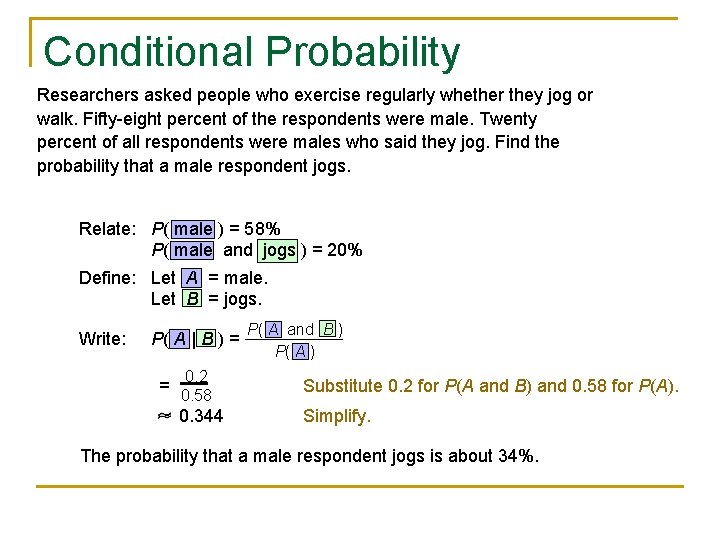
Conditional Probability Researchers asked people who exercise regularly whether they jog or walk. Fifty-eight percent of the respondents were male. Twenty percent of all respondents were males who said they jog. Find the probability that a male respondent jogs. Relate: P( male ) = 58% P( male and jogs ) = 20% Define: Let A = male. Let B = jogs. Write: P( A | B ) = = P( A and B ) P( A ) 0. 2 0. 58 Substitute 0. 2 for P(A and B) and 0. 58 for P(A). 0. 344 Simplify. The probability that a male respondent jogs is about 34%.
- Slides: 8