
Conditional Probability Skill 17 Objectives Understand relative conditional

Conditional Probability Skill 17
Objectives • Understand relative conditional probabilities. • Find conditional probabilities based on a table. • Understand explain conditional probabilities

Example-Conditional Probability A real number value on the line segment is chosen at random. The line segment has single digit intervals that are grouped together. What is the probability it is between 8 and 24? 3 6 Solution: 9 12 15 18 21 24 Favorable Segment = | 8 – 24 | = 16 Total Length = | 3 – 24 | = 21 P(8 through 24) = 16/21
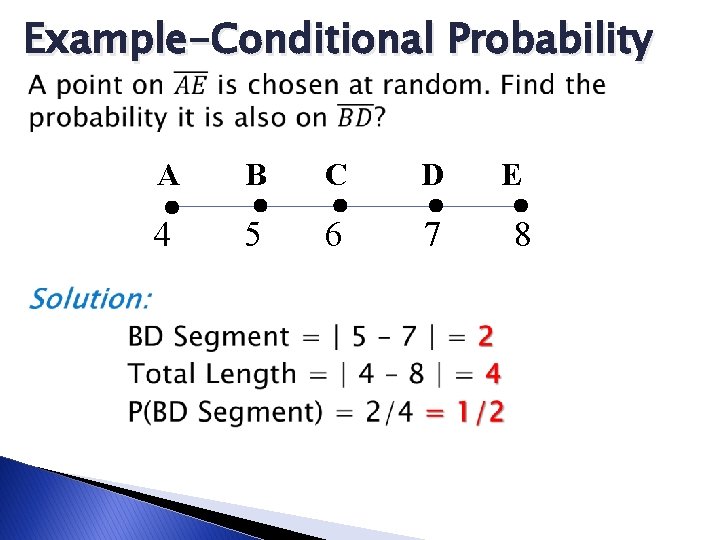
Example-Conditional Probability A B C D 4 5 6 7 E 8
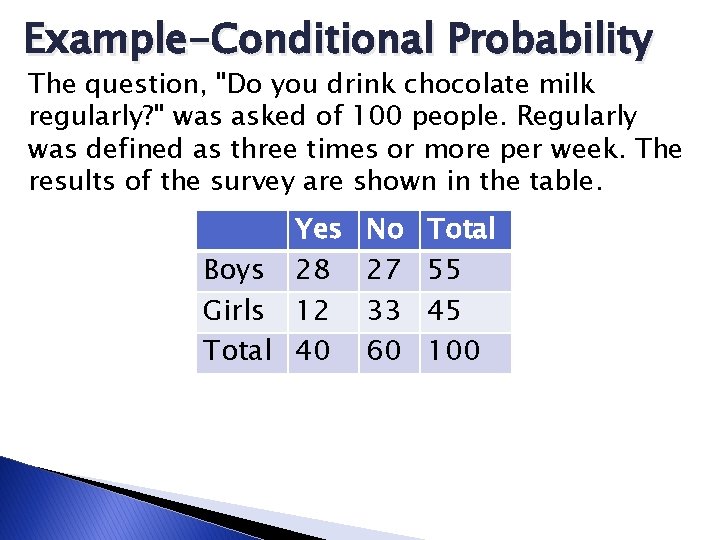
Example-Conditional Probability The question, "Do you drink chocolate milk regularly? " was asked of 100 people. Regularly was defined as three times or more per week. The results of the survey are shown in the table. Yes Boys 28 Girls 12 Total 40 No 27 33 60 Total 55 45 100
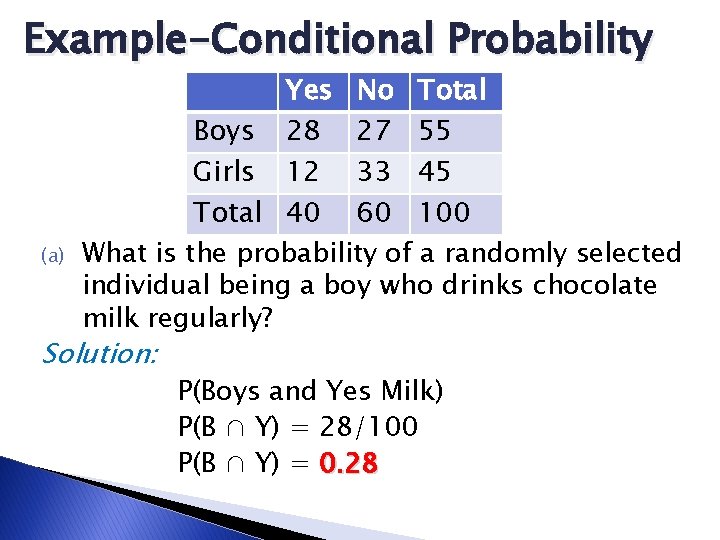
Example-Conditional Probability Yes No Total Boys 28 27 55 Girls 12 33 45 Total 40 60 100 (a) What is the probability of a randomly selected individual being a boy who drinks chocolate milk regularly? Solution: P(Boys and Yes Milk) P(B ∩ Y) = 28/100 P(B ∩ Y) = 0. 28
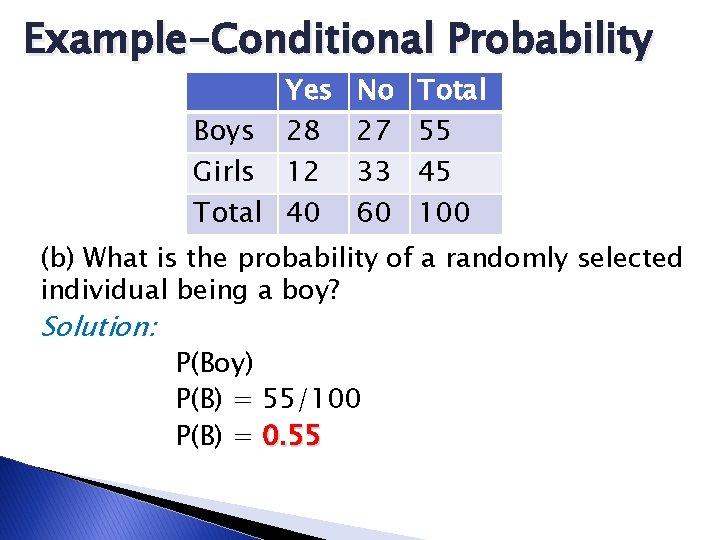
Example-Conditional Probability Yes Boys 28 Girls 12 Total 40 No 27 33 60 Total 55 45 100 (b) What is the probability of a randomly selected individual being a boy? Solution: P(Boy) P(B) = 55/100 P(B) = 0. 55
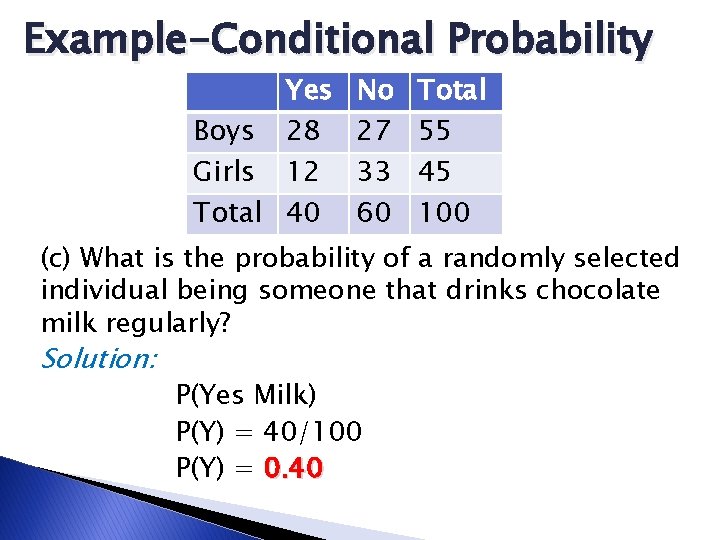
Example-Conditional Probability Yes Boys 28 Girls 12 Total 40 No 27 33 60 Total 55 45 100 (c) What is the probability of a randomly selected individual being someone that drinks chocolate milk regularly? Solution: P(Yes Milk) P(Y) = 40/100 P(Y) = 0. 40
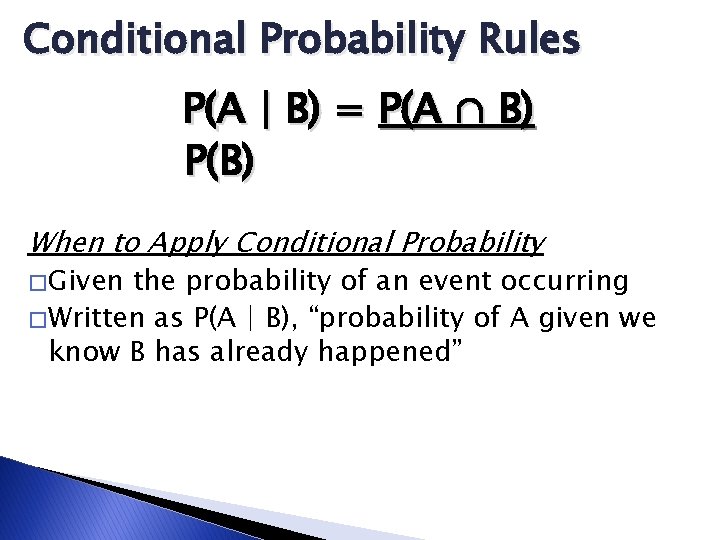
Conditional Probability Rules P(A | B) = P(A ∩ B) P(B) When to Apply Conditional Probability � Given the probability of an event occurring � Written as P(A | B), “probability of A given we know B has already happened”
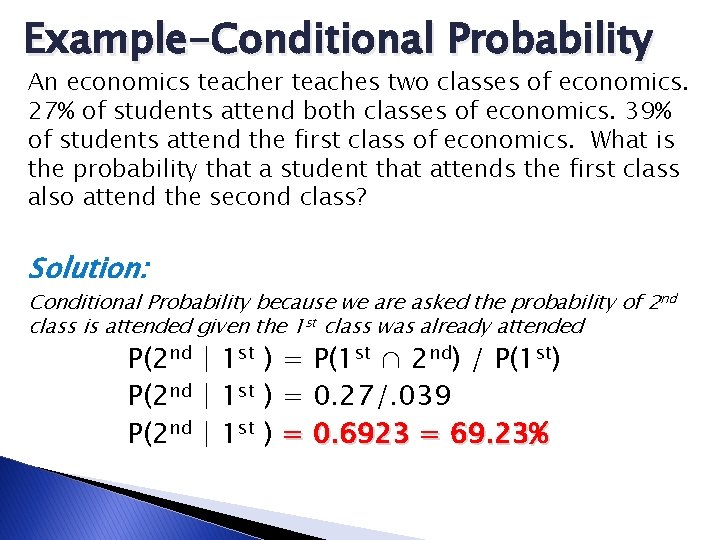
Example-Conditional Probability An economics teacher teaches two classes of economics. 27% of students attend both classes of economics. 39% of students attend the first class of economics. What is the probability that a student that attends the first class also attend the second class? Solution: Conditional Probability because we are asked the probability of 2 nd class is attended given the 1 st class was already attended P(2 nd | 1 st ) = P(1 st ∩ 2 nd) / P(1 st) P(2 nd | 1 st ) = 0. 27/. 039 P(2 nd | 1 st ) = 0. 6923 = 69. 23%
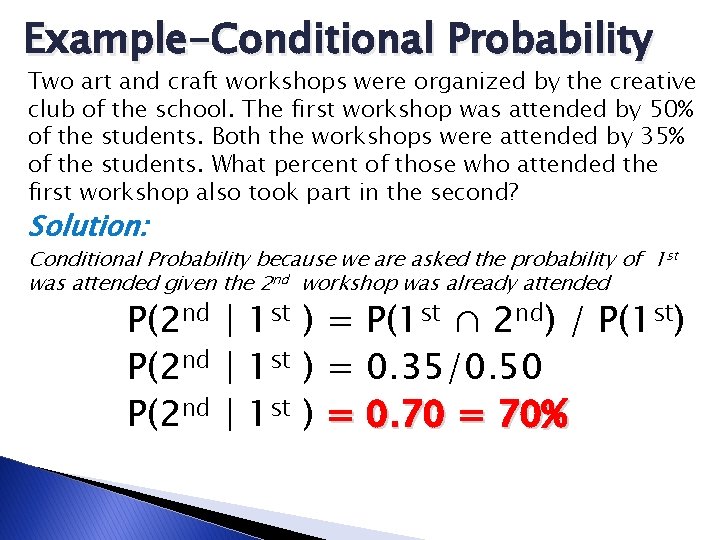
Example-Conditional Probability Two art and craft workshops were organized by the creative club of the school. The first workshop was attended by 50% of the students. Both the workshops were attended by 35% of the students. What percent of those who attended the first workshop also took part in the second? Solution: Conditional Probability because we are asked the probability of 1 st was attended given the 2 nd workshop was already attended P(2 nd | 1 st ) = P(1 st ∩ 2 nd) / P(1 st) P(2 nd | 1 st ) = 0. 35/0. 50 P(2 nd | 1 st ) = 0. 70 = 70%
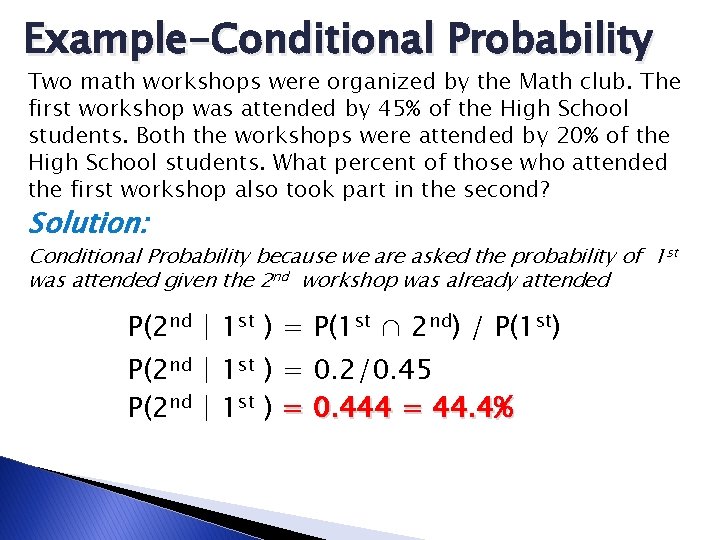
Example-Conditional Probability Two math workshops were organized by the Math club. The first workshop was attended by 45% of the High School students. Both the workshops were attended by 20% of the High School students. What percent of those who attended the first workshop also took part in the second? Solution: Conditional Probability because we are asked the probability of 1 st was attended given the 2 nd workshop was already attended P(2 nd | 1 st ) = P(1 st ∩ 2 nd) / P(1 st) P(2 nd | 1 st ) = 0. 2/0. 45 P(2 nd | 1 st ) = 0. 444 = 44. 4%
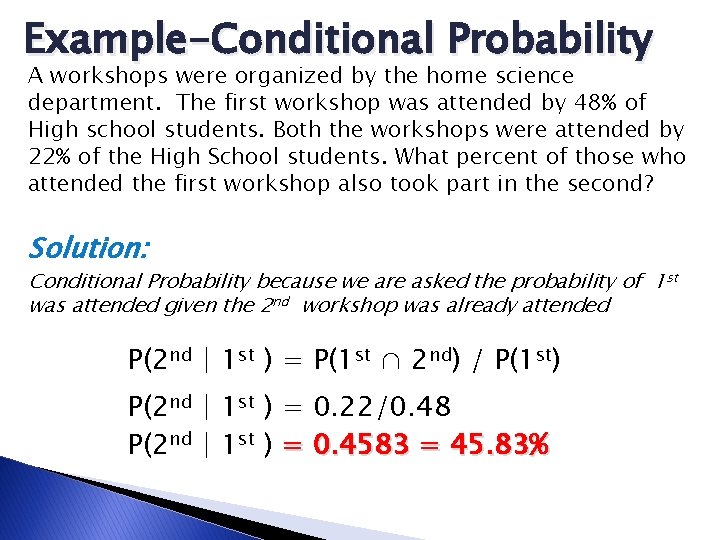
Example-Conditional Probability A workshops were organized by the home science department. The first workshop was attended by 48% of High school students. Both the workshops were attended by 22% of the High School students. What percent of those who attended the first workshop also took part in the second? Solution: Conditional Probability because we are asked the probability of 1 st was attended given the 2 nd workshop was already attended P(2 nd | 1 st ) = P(1 st ∩ 2 nd) / P(1 st) P(2 nd | 1 st ) = 0. 22/0. 48 P(2 nd | 1 st ) = 0. 4583 = 45. 83%
17: Conditional Probability � Summarize � Questions? � Homework ◦ Worksheet Notes
- Slides: 14