
CONDITIONAL PROBABILITY Consider two events A and B
CONDITIONAL PROBABILITY Consider two events, A and B. Suppose we know that B has occurred. This knowledge may change the probability that A will occur. We denote by P(A|B) the conditional probability of event A given that B has occurred.
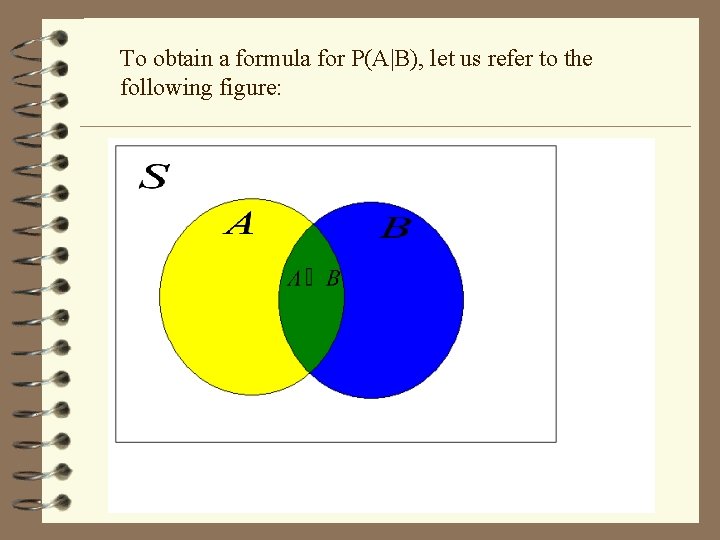
To obtain a formula for P(A|B), let us refer to the following figure:
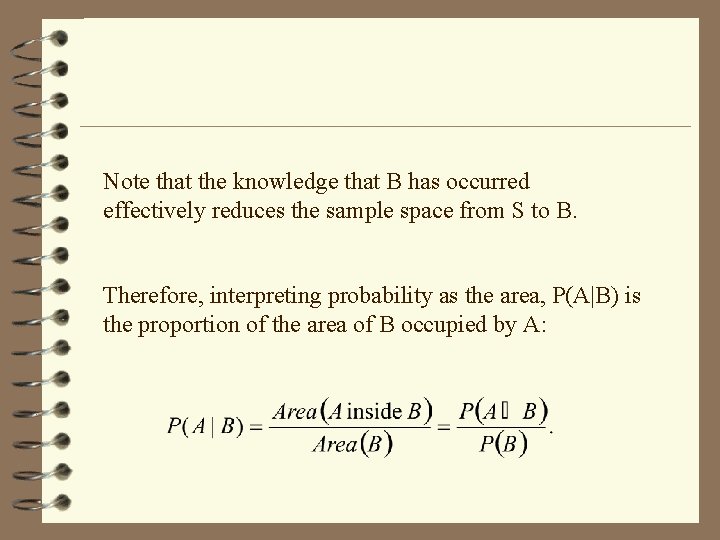
Note that the knowledge that B has occurred effectively reduces the sample space from S to B. Therefore, interpreting probability as the area, P(A|B) is the proportion of the area of B occupied by A:
Example- Tossing Two Dice: Conditional Probability An experiment consists of tossing two fair dice which has a sample space of 6 x 6=36 outcomes. Consider two events: A={Sum of dice is 4 or 8} and B={Sum of dice is even}
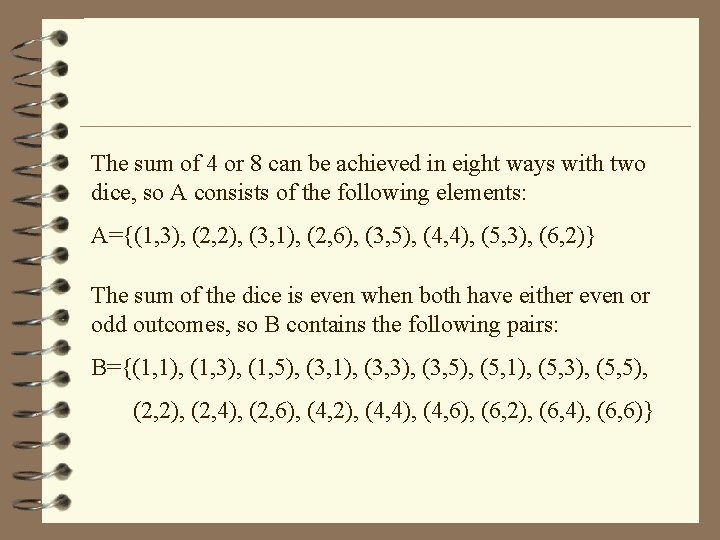
The sum of 4 or 8 can be achieved in eight ways with two dice, so A consists of the following elements: A={(1, 3), (2, 2), (3, 1), (2, 6), (3, 5), (4, 4), (5, 3), (6, 2)} The sum of the dice is even when both have either even or odd outcomes, so B contains the following pairs: B={(1, 1), (1, 3), (1, 5), (3, 1), (3, 3), (3, 5), (5, 1), (5, 3), (5, 5), (2, 2), (2, 4), (2, 6), (4, 2), (4, 4), (4, 6), (6, 2), (6, 4), (6, 6)}
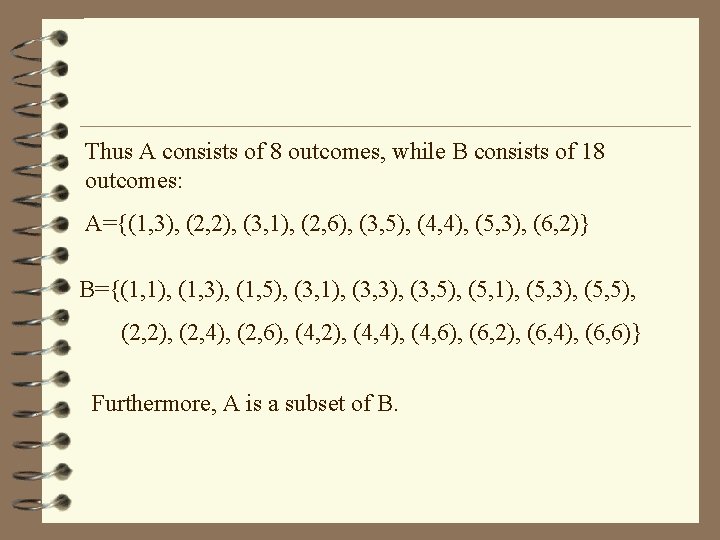
Thus A consists of 8 outcomes, while B consists of 18 outcomes: A={(1, 3), (2, 2), (3, 1), (2, 6), (3, 5), (4, 4), (5, 3), (6, 2)} B={(1, 1), (1, 3), (1, 5), (3, 1), (3, 3), (3, 5), (5, 1), (5, 3), (5, 5), (2, 2), (2, 4), (2, 6), (4, 2), (4, 4), (4, 6), (6, 2), (6, 4), (6, 6)} Furthermore, A is a subset of B.
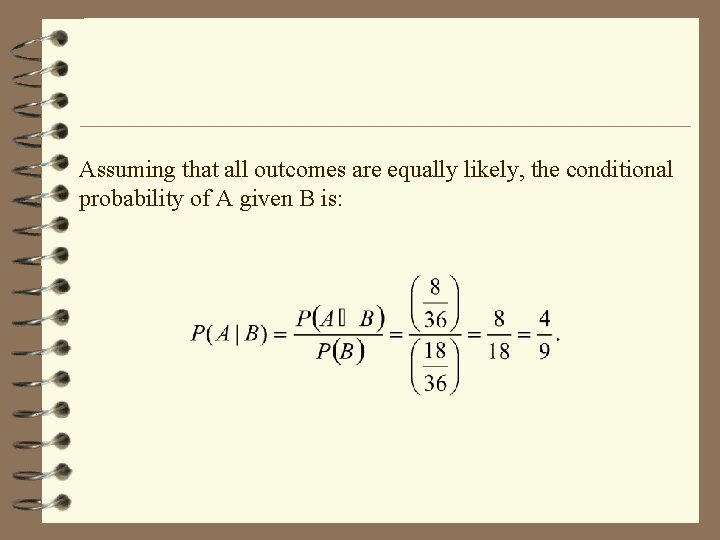
Assuming that all outcomes are equally likely, the conditional probability of A given B is:
- Slides: 7