
Conditional Generative Adversarial Networks JiaBin Huang Virginia Tech
Conditional Generative Adversarial Networks Jia-Bin Huang Virginia Tech ECE 6554 Advanced Computer Vision
Today’s class • Discussions • Review basic ideas of GAN • Examples of conditional GAN • Experiment presentation by Sanket
Why Generative Models? • Excellent test of our ability to use highdimensional, complicated probability distributions • Simulate possible futures for planning or simulated RL • Missing data • Semi-supervised learning • Multi-modal outputs • Realistic generation tasks (Goodfellow 2016)
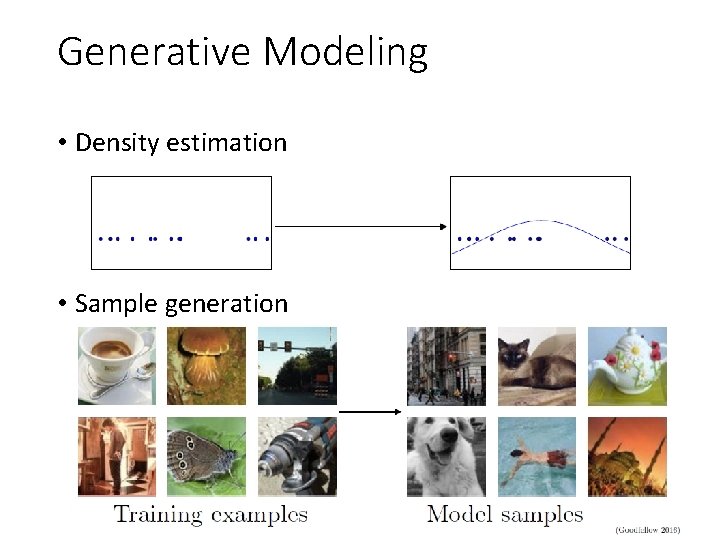
Generative Modeling • Density estimation • Sample generation

Adversarial Nets Framework
Training Procedure • Use SGD-like algorithm of choice (Adam) on two minibatches simultaneously: • A minibatch of training examples • A minibatch of generated samples • Optional: run k steps of one player for every step of the other player. (Goodfellow 2016)
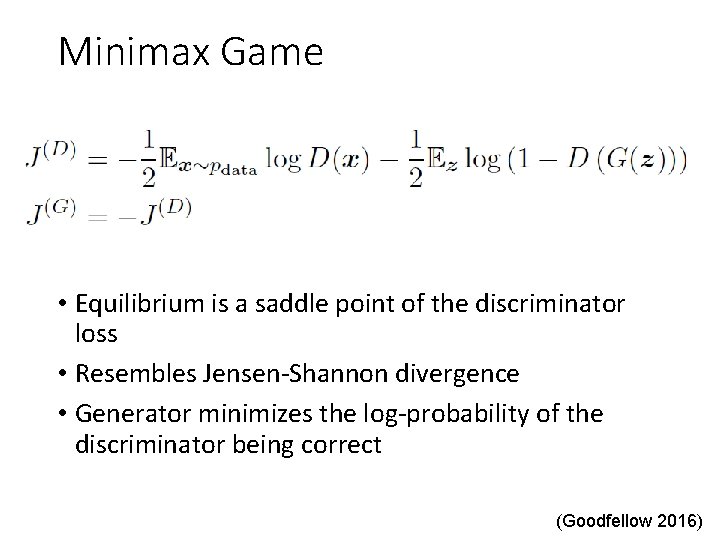
Minimax Game • Equilibrium is a saddle point of the discriminator loss • Resembles Jensen-Shannon divergence • Generator minimizes the log-probability of the discriminator being correct (Goodfellow 2016)
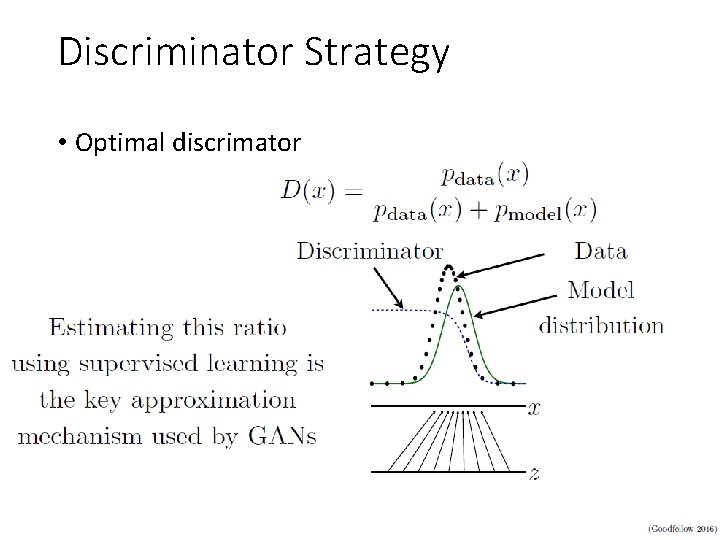
Discriminator Strategy • Optimal discrimator
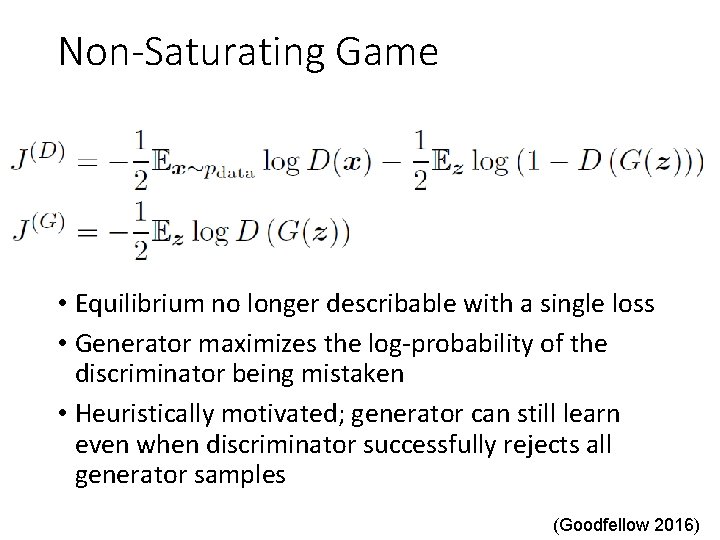
Non-Saturating Game • Equilibrium no longer describable with a single loss • Generator maximizes the log-probability of the discriminator being mistaken • Heuristically motivated; generator can still learn even when discriminator successfully rejects all generator samples (Goodfellow 2016)
Review: GAN • GANs are generative models that use supervised learning to approximate an intractable cost function • GANs can simulate many cost functions, including the one used for maximum likelihood • Finding Nash equilibria in high-dimensional, continuous, nonconvex games is an important open research problem
![Conditional GAN • Learn P(Y|X) [Ledig et al. CVPR 2017]](http://slidetodoc.com/presentation_image_h/d5a5983580c52cd8f4e82648ca4d33e9/image-11.jpg "Conditional GAN • Learn P(Y|X) [Ledig et al. CVPR 2017]")
Conditional GAN • Learn P(Y|X) [Ledig et al. CVPR 2017]
![Image Super-Resolution • Conditional on low-resolution input image [Ledig et al. CVPR 2017]](http://slidetodoc.com/presentation_image_h/d5a5983580c52cd8f4e82648ca4d33e9/image-12.jpg "Image Super-Resolution • Conditional on low-resolution input image [Ledig et al. CVPR 2017]")
Image Super-Resolution • Conditional on low-resolution input image [Ledig et al. CVPR 2017]
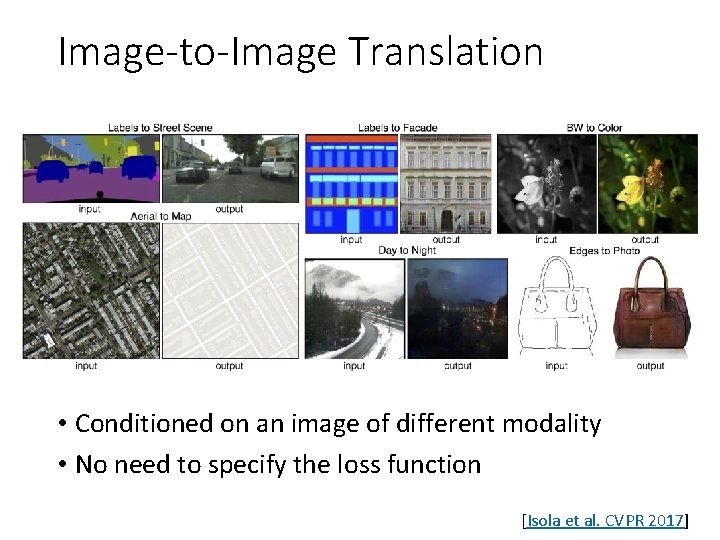
Image-to-Image Translation • Conditioned on an image of different modality • No need to specify the loss function [Isola et al. CVPR 2017]
![[Isola et al. CVPR 2017]](http://slidetodoc.com/presentation_image_h/d5a5983580c52cd8f4e82648ca4d33e9/image-14.jpg "[Isola et al. CVPR 2017]")
[Isola et al. CVPR 2017]
![Label 2 Image [Isola et al. CVPR 2017]](http://slidetodoc.com/presentation_image_h/d5a5983580c52cd8f4e82648ca4d33e9/image-15.jpg "Label 2 Image [Isola et al. CVPR 2017]")
Label 2 Image [Isola et al. CVPR 2017]
![Edges 2 Image [Isola et al. CVPR 2017]](http://slidetodoc.com/presentation_image_h/d5a5983580c52cd8f4e82648ca4d33e9/image-16.jpg "Edges 2 Image [Isola et al. CVPR 2017]")
Edges 2 Image [Isola et al. CVPR 2017]
![Generative Visual Manipulation [Zhu et al. ECCV 2016]](http://slidetodoc.com/presentation_image_h/d5a5983580c52cd8f4e82648ca4d33e9/image-17.jpg "Generative Visual Manipulation [Zhu et al. ECCV 2016]")
Generative Visual Manipulation [Zhu et al. ECCV 2016]
![[Zhu et al. ECCV 2016]](http://slidetodoc.com/presentation_image_h/d5a5983580c52cd8f4e82648ca4d33e9/image-18.jpg "[Zhu et al. ECCV 2016]")
[Zhu et al. ECCV 2016]
![Text 2 Image [Reed et al. ICML 2016]](http://slidetodoc.com/presentation_image_h/d5a5983580c52cd8f4e82648ca4d33e9/image-19.jpg "Text 2 Image [Reed et al. ICML 2016]")
Text 2 Image [Reed et al. ICML 2016]
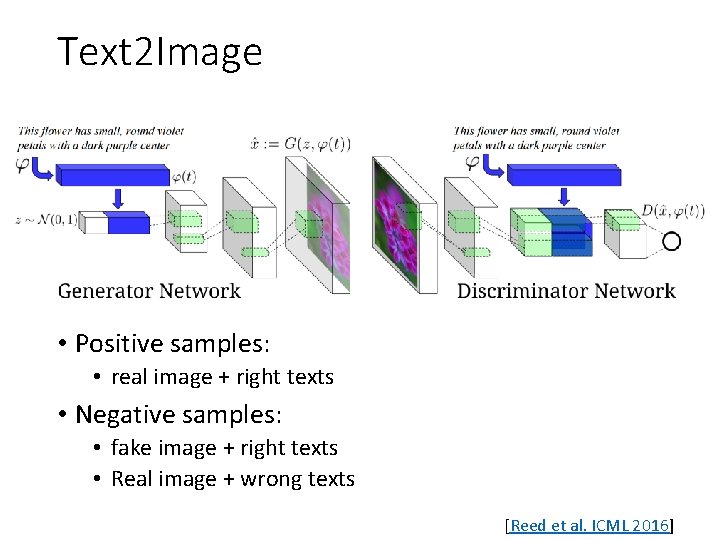
Text 2 Image • F • Positive samples: • real image + right texts • Negative samples: • fake image + right texts • Real image + wrong texts [Reed et al. ICML 2016]
![Stack. GAN [Zhang et al. 2016]](http://slidetodoc.com/presentation_image_h/d5a5983580c52cd8f4e82648ca4d33e9/image-21.jpg "Stack. GAN [Zhang et al. 2016]")
Stack. GAN [Zhang et al. 2016]
![Plug & Play Generative Networks [Nguyen et al. 2016]](http://slidetodoc.com/presentation_image_h/d5a5983580c52cd8f4e82648ca4d33e9/image-22.jpg "Plug & Play Generative Networks [Nguyen et al. 2016]")
Plug & Play Generative Networks [Nguyen et al. 2016]
![Video GAN • Videos http: //web. mit. edu/vondrick/tinyvideo/ [Vondrick et al. NIPS 2016]](http://slidetodoc.com/presentation_image_h/d5a5983580c52cd8f4e82648ca4d33e9/image-23.jpg "Video GAN • Videos http: //web. mit. edu/vondrick/tinyvideo/ [Vondrick et al. NIPS 2016]")
Video GAN • Videos http: //web. mit. edu/vondrick/tinyvideo/ [Vondrick et al. NIPS 2016]
![Generative Modeling as Feature Learning [Vondrick et al. NIPS 2016]](http://slidetodoc.com/presentation_image_h/d5a5983580c52cd8f4e82648ca4d33e9/image-24.jpg "Generative Modeling as Feature Learning [Vondrick et al. NIPS 2016]")
Generative Modeling as Feature Learning [Vondrick et al. NIPS 2016]
![Shape modeling using 3 D Generative Adversarial Network [Wu et al. NIPS 2016]](http://slidetodoc.com/presentation_image_h/d5a5983580c52cd8f4e82648ca4d33e9/image-25.jpg "Shape modeling using 3 D Generative Adversarial Network [Wu et al. NIPS 2016]")
Shape modeling using 3 D Generative Adversarial Network [Wu et al. NIPS 2016]
Things to remember • GANs can generate sharp samples from highdimensional output space • Conditional GAN can serve as general mapping model X->Y • No need to define domain-specific loss functions • Handle one-to-many mappings • Handle multiple modalities
- Slides: 26