
Conditional and iterative statements 01204111 Computer and Programming
- Slides: 70
Conditional and iterative statements 01204111 – Computer and Programming
Agenda • Boolean expressions • Conditional statements • Iterative statements 2
Boolean Expressions • A Boolean expression is an expression whose value is either True or False. • Examples: Ø Ø Do you want the coffee? (yes/no) Is x greater than 10? (yes/no) Have you found the answer? (yes/no) Does 5 divide 153? (yes/no) 3
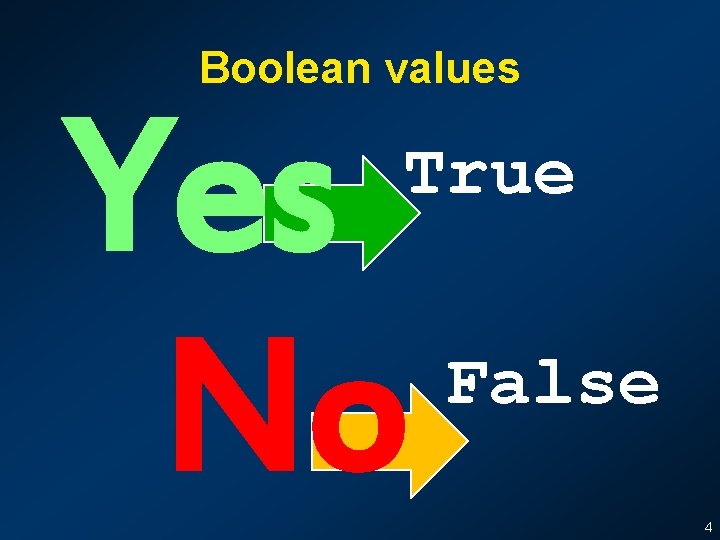
Boolean values Yes No True False 4
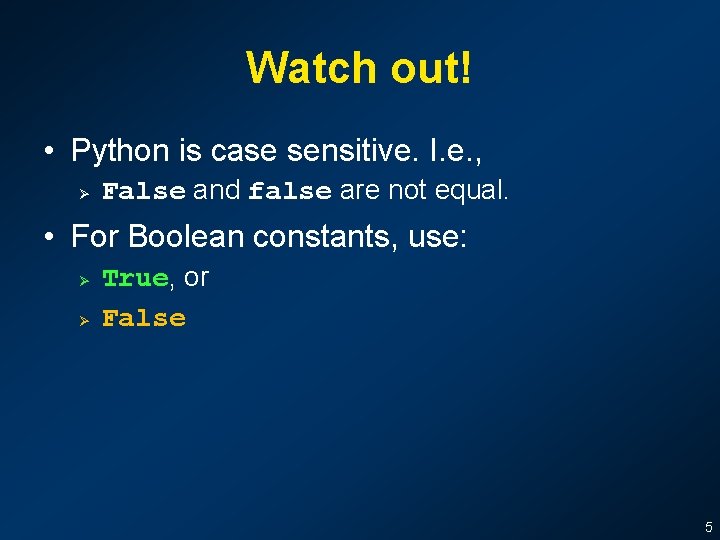
Watch out! • Python is case sensitive. I. e. , Ø False and false are not equal. • For Boolean constants, use: Ø Ø True, or False 5
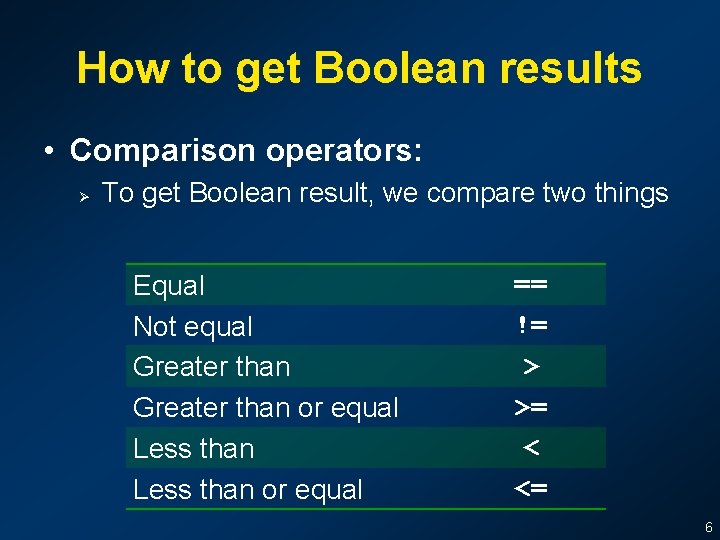
How to get Boolean results • Comparison operators: Ø To get Boolean result, we compare two things Equal Not equal Greater than or equal Less than or equal == != > >= < <= 6
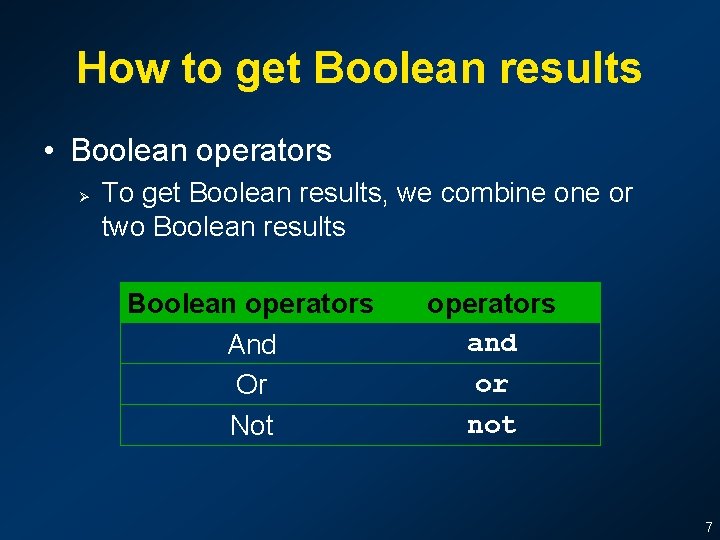
How to get Boolean results • Boolean operators Ø To get Boolean results, we combine or two Boolean results Boolean operators And Or Not operators and or not 7
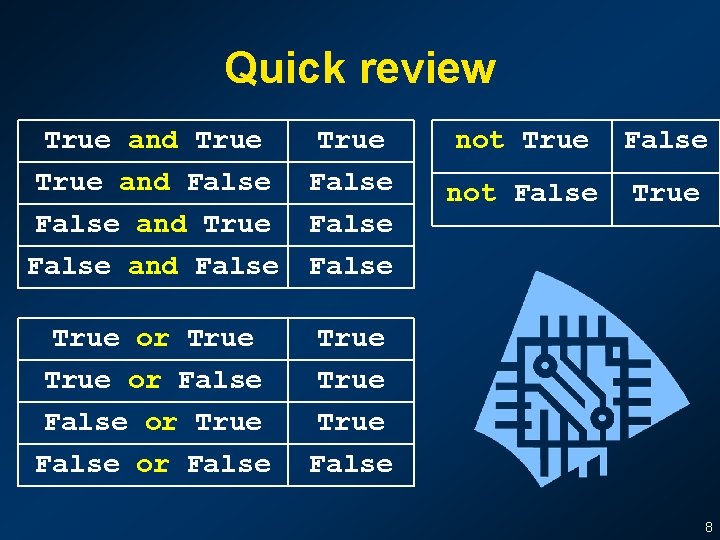
Quick review True and False and True False and False True or False or True False or False not True False not False True 8
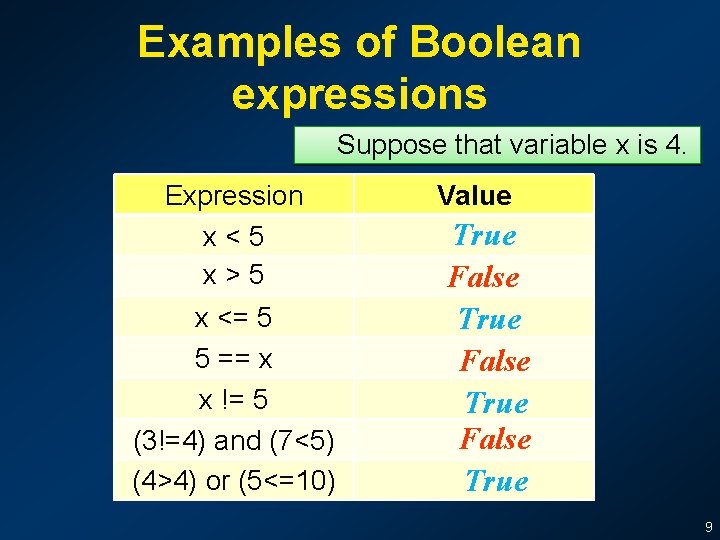
Examples of Boolean expressions Suppose that variable x is 4. Expression x<5 x>5 x <= 5 5 == x x != 5 (3!=4) and (7<5) (4>4) or (5<=10) Value True False True 9
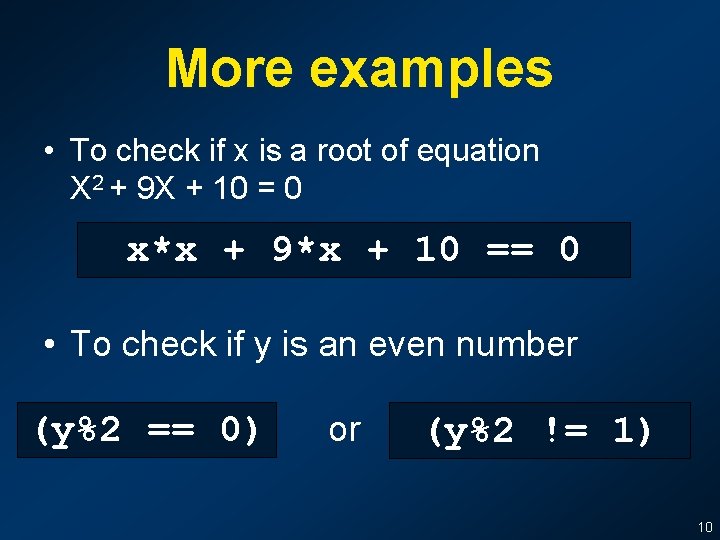
More examples • To check if x is a root of equation X 2 + 9 X + 10 = 0 x*x + 9*x + 10 == 0 • To check if y is an even number (y%2 == 0) or (y%2 != 1) 10
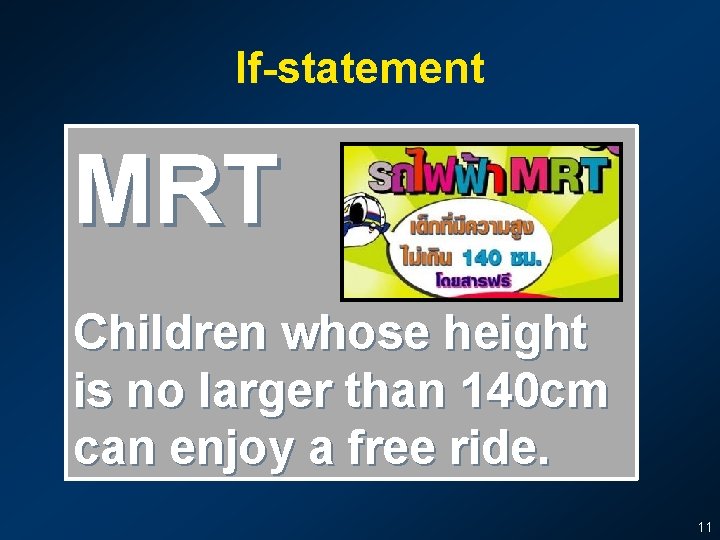
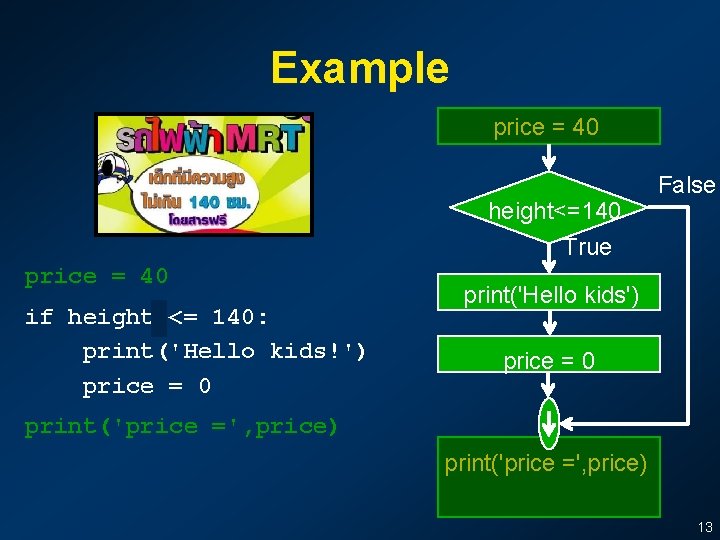
If-statement MRT Children whose height is no larger than 140 cm can enjoy a free ride. Source: http: //www. ryt 9. com/s/prg/774090 11
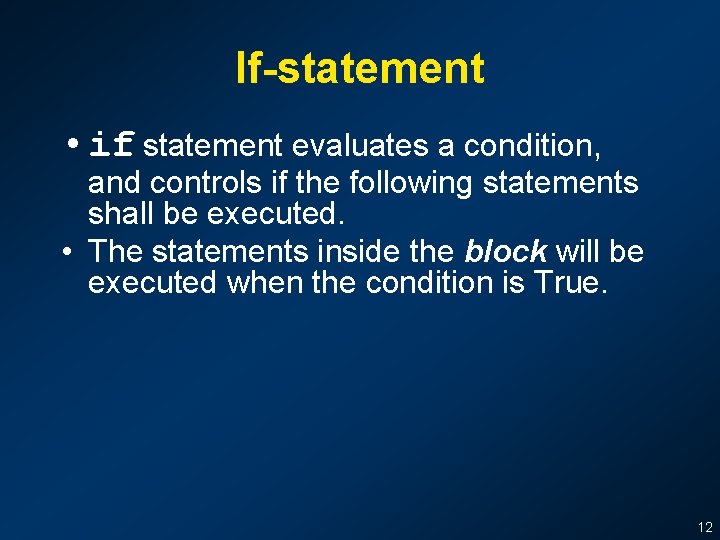
If-statement • if statement evaluates a condition, and controls if the following statements shall be executed. • The statements inside the block will be executed when the condition is True. 12
Example price = 40 height<=140 False True price = 40 if height <= 140: print('Hello kids!') price = 0 print('Hello kids') price = 0 print('price =', price) 13
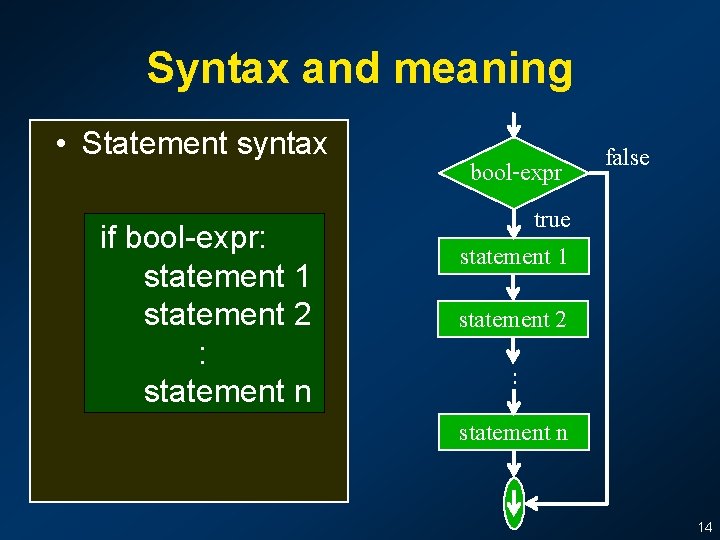
Syntax and meaning • Statement syntax if bool-expr: statement 1 statement 2 : statement n bool-expr false true statement 1 statement 2 : statement n 14
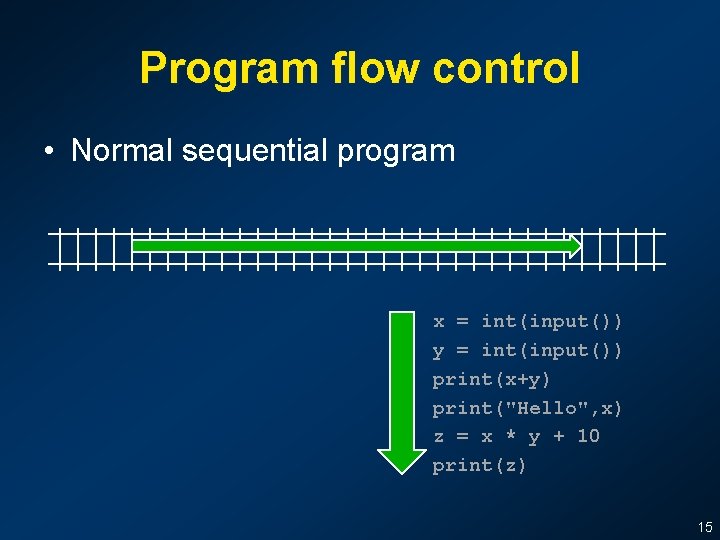
Program flow control • Normal sequential program x = int(input()) y = int(input()) print(x+y) print("Hello", x) z = x * y + 10 print(z) 15
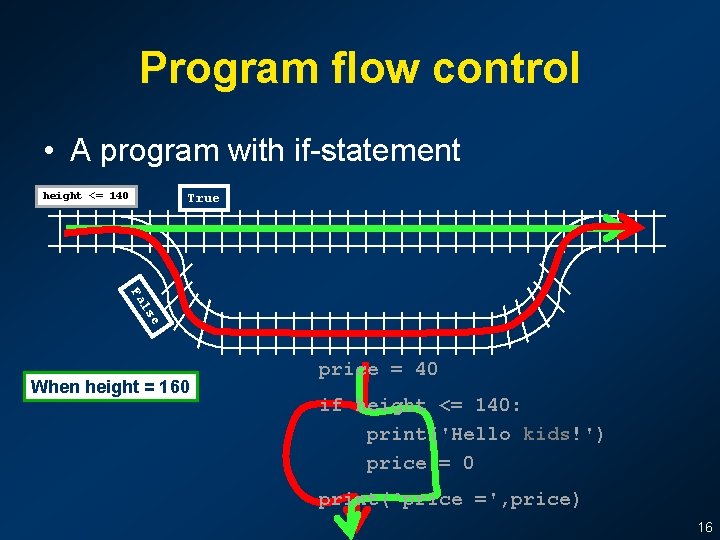
Program flow control • A program with if-statement height <= 140 True e ls Fa When height = 160 120 price = 40 if height <= 140: print('Hello kids!') price = 0 print('price =', price) 16
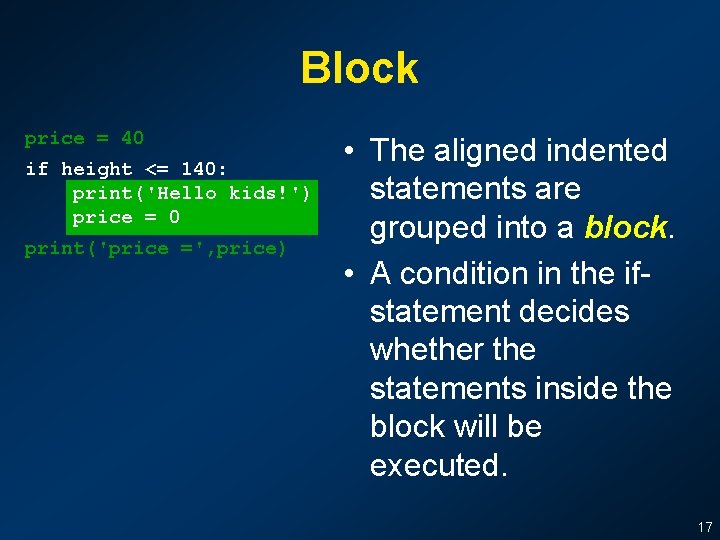
Block price = 40 if height <= 140: print('Hello kids!') price = 0 print('price =', price) • The aligned indented statements are grouped into a block. • A condition in the ifstatement decides whether the statements inside the block will be executed. 17
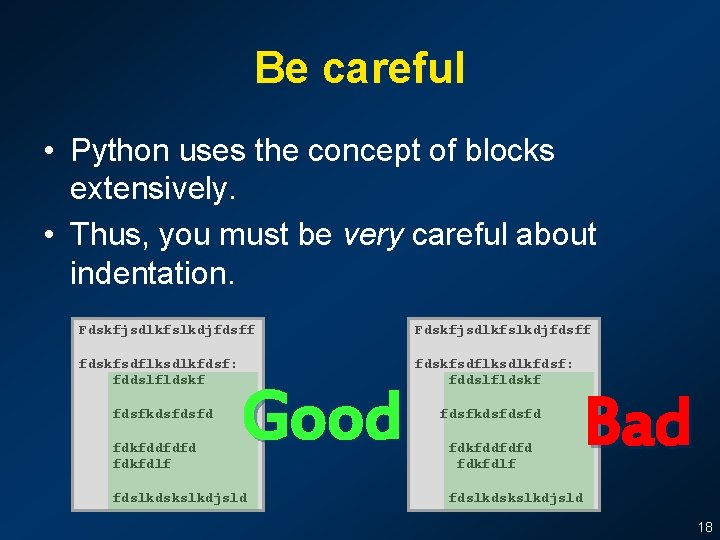
Be careful • Python uses the concept of blocks extensively. • Thus, you must be very careful about indentation. Fdskfjsdlkfslkdjfdsff fdskfsdflksdlkfdsf: fddslfldskf fdsfkdsfdsfd fdkfddfdfd fdkfdlf Good fdslkdskslkdjsld fdsfkdsfdsfd fdkfddfdfd fdkfdlf Bad fdslkdskslkdjsld 18
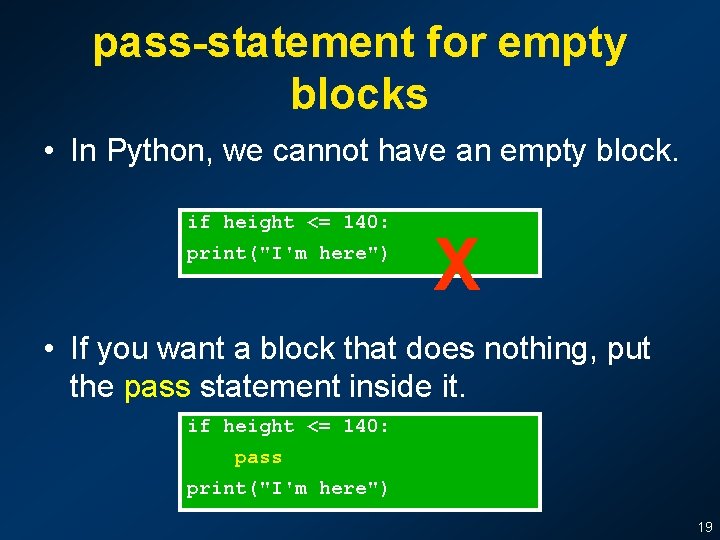
pass-statement for empty blocks • In Python, we cannot have an empty block. if height <= 140: print("I'm here") X • If you want a block that does nothing, put the pass statement inside it. if height <= 140: pass print("I'm here") 19
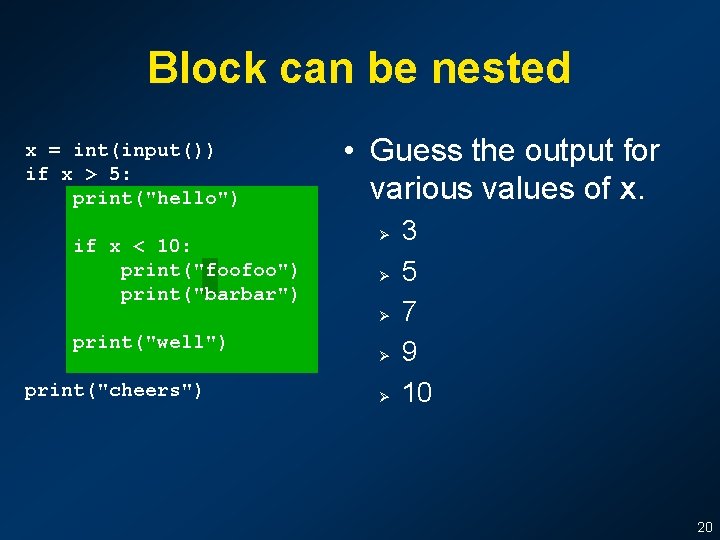
Block can be nested x = int(input()) if x > 5: print("hello") if x < 10: print("foofoo") print("barbar") • Guess the output for various values of x. Ø Ø Ø print("well") print("cheers") Ø Ø 3 5 7 9 10 20
Final words • Indented block is a distinctive feature of Python. Ø It is one of the reason people like Python. • Be careful about indentation and blocks. 21
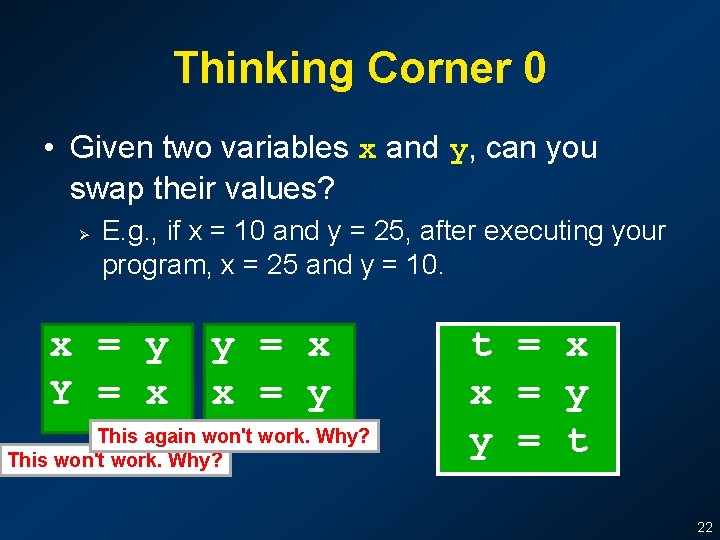
Thinking Corner 0 • Given two variables x and y, can you swap their values? Ø E. g. , if x = 10 and y = 25, after executing your program, x = 25 and y = 10. x = y Y = x y = x x = y This again won't work. Why? This won't work. Why? t = x x = y y = t 22
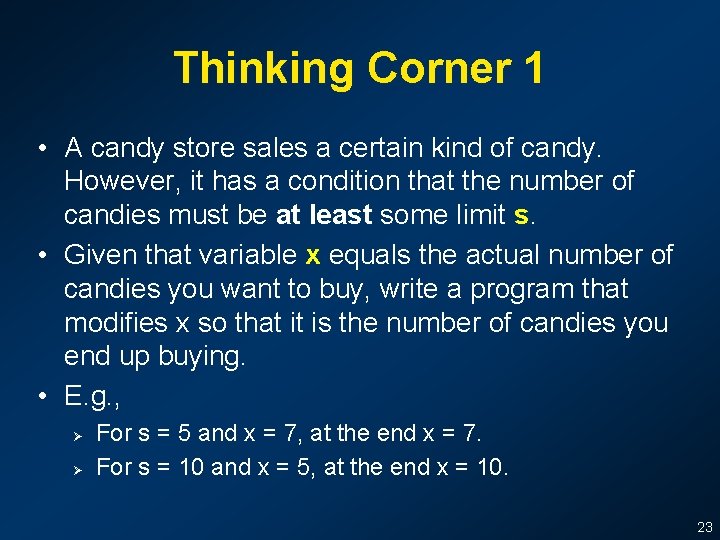
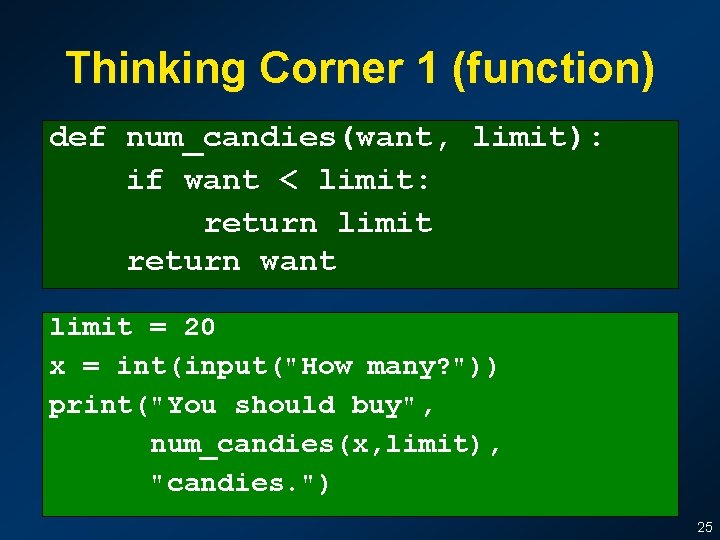
Thinking Corner 1 • A candy store sales a certain kind of candy. However, it has a condition that the number of candies must be at least some limit s. • Given that variable x equals the actual number of candies you want to buy, write a program that modifies x so that it is the number of candies you end up buying. • E. g. , Ø Ø For s = 5 and x = 7, at the end x = 7. For s = 10 and x = 5, at the end x = 10. 23
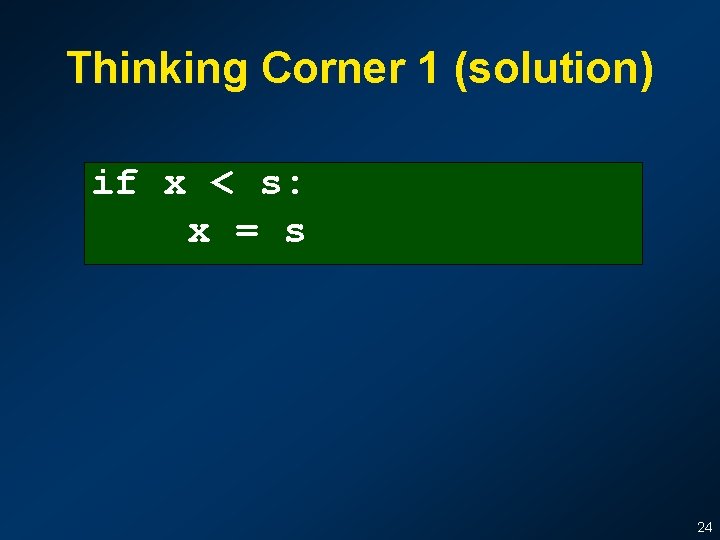
Thinking Corner 1 (solution) if x < s: x = s 24
Thinking Corner 1 (function) def num_candies(want, limit): if want < limit: return limit return want limit = 20 x = int(input("How many? ")) print("You should buy", num_candies(x, limit), "candies. ") 25
if – else statements Source: http: //splinedoctors. com/2009/02/hurry-up-and-choose/ 26
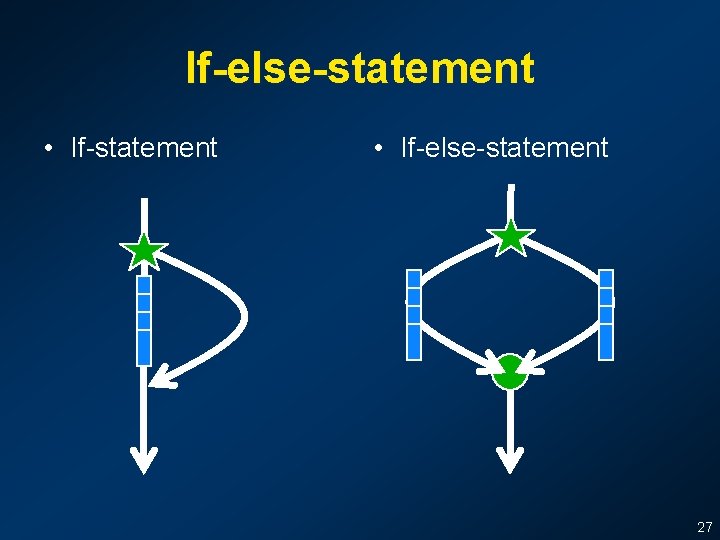
If-else-statement • If-statement • If-else-statement 27
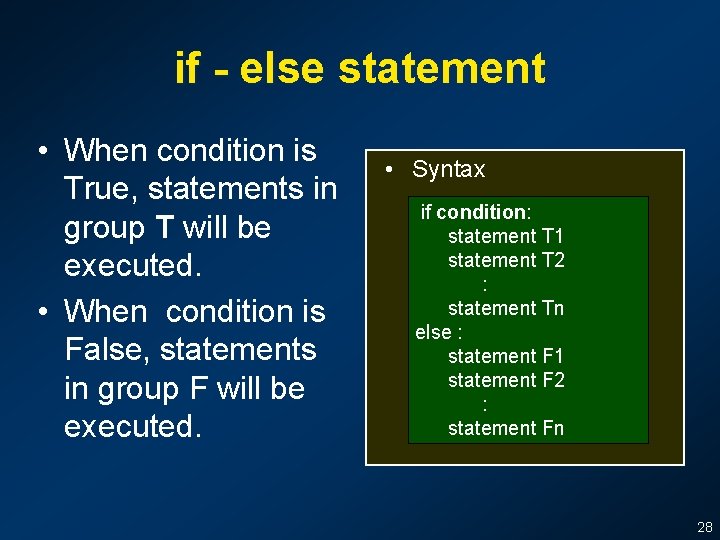
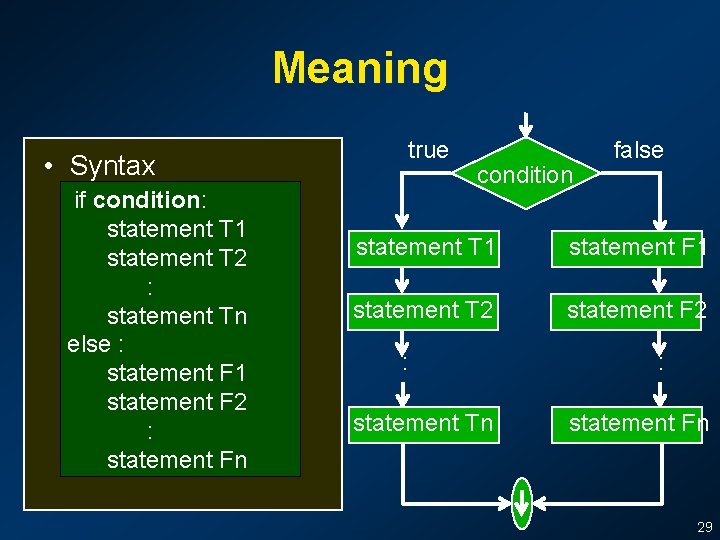
if - else statement • When condition is True, statements in group T will be executed. • When condition is False, statements in group F will be executed. • Syntax if condition: statement T 1 statement T 2 : statement Tn else : statement F 1 statement F 2 : statement Fn 28
Meaning true • Syntax if condition: statement T 1 statement T 2 : statement Tn else : statement F 1 statement F 2 : statement Fn condition false statement T 1 statement F 1 statement T 2 statement F 2 : statement Tn : statement Fn 29
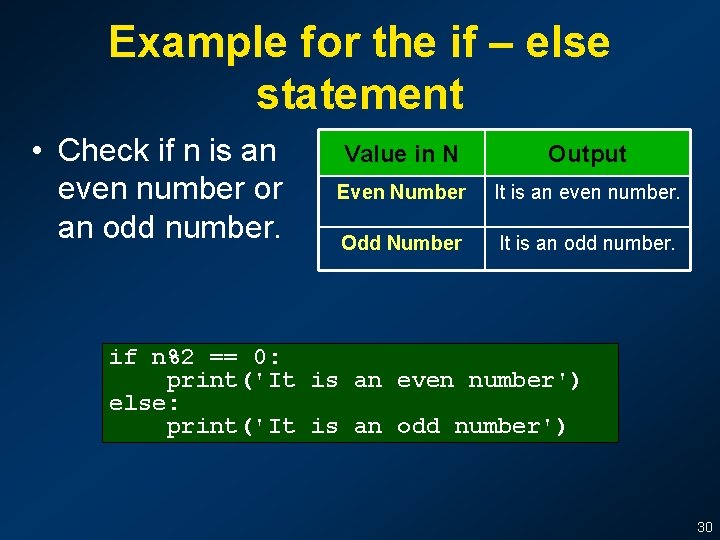
Example for the if – else statement • Check if n is an even number or an odd number. Value in N Output Even Number It is an even number. Odd Number It is an odd number. if n%2 == 0: print('It is an even number') else: print('It is an odd number') 30
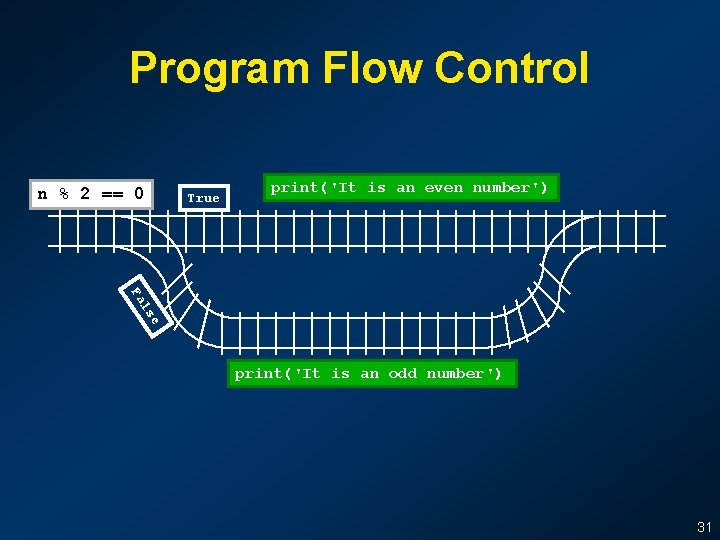
Program Flow Control n % 2 == 0 True print('It is an even number') e ls Fa print('It is an odd number') 31
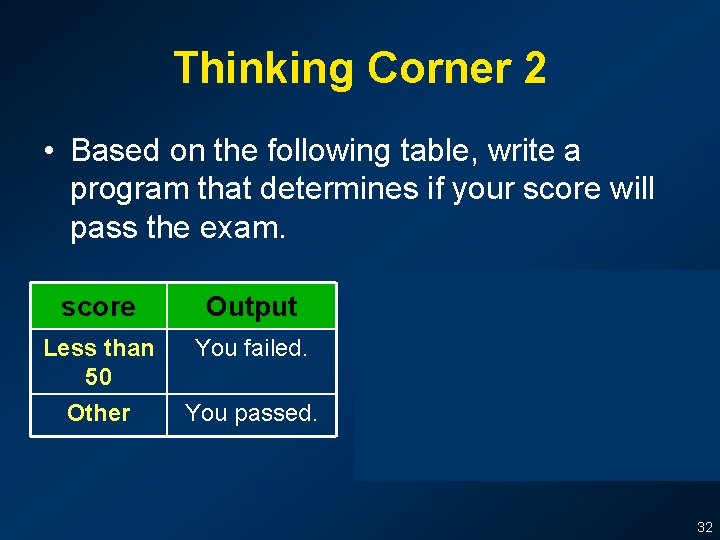
Thinking Corner 2 • Based on the following table, write a program that determines if your score will pass the exam. score Output Less than 50 You failed. Other You passed. if score<50: print('You failed. ') else: print('You passed. ') 32
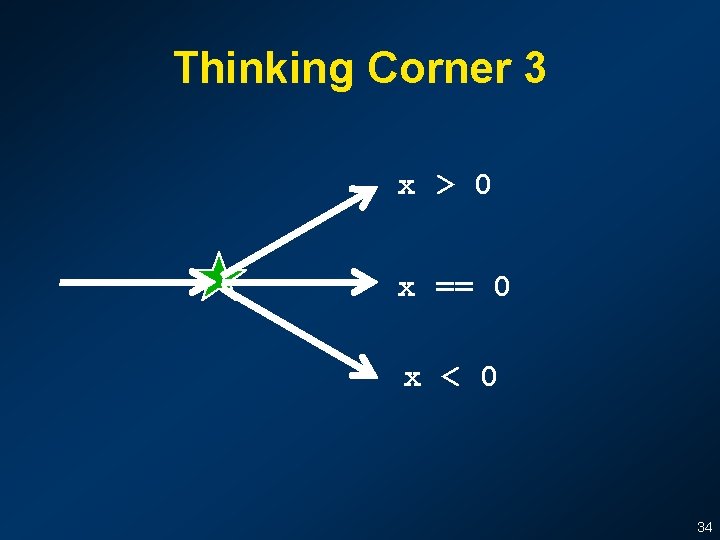
Thinking Corner 3 • Write a program that reads an integer and then tells if it is a positive integer, a negative integer, or a zero. 33
Thinking Corner 3 x > 0 x == 0 x < 0 34
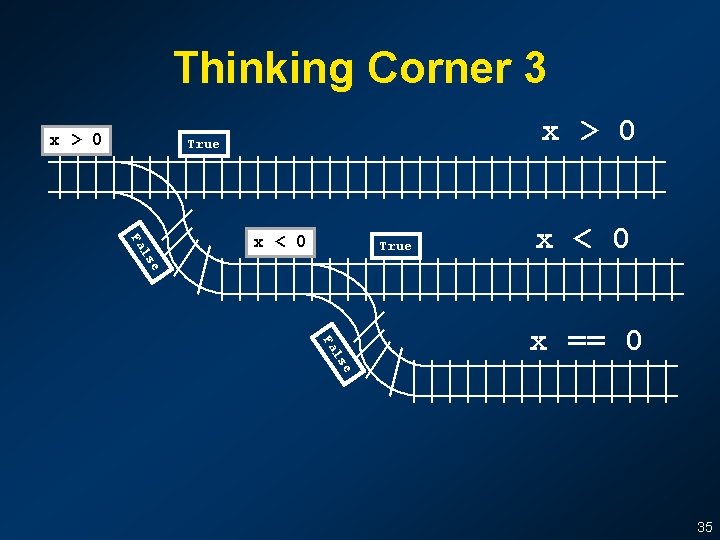
Thinking Corner 3 x > 0 True x < 0 e ls Fa x == 0 35
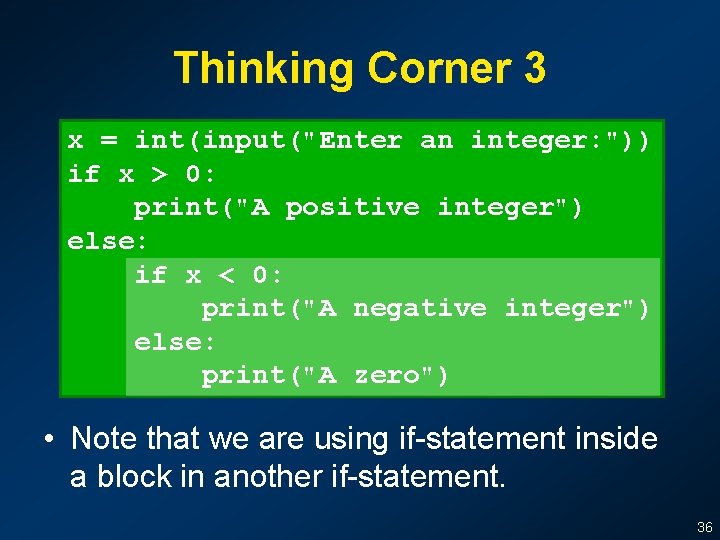
Thinking Corner 3 x = int(input("Enter an integer: ")) if x > 0: print("A positive integer") else: if x < 0: print("A negative integer") else: print("A zero") • Note that we are using if-statement inside a block in another if-statement. 36
Nested if-statement • An if-statements is just a kind of statements, so we can write it in a block inside another if-statement 37
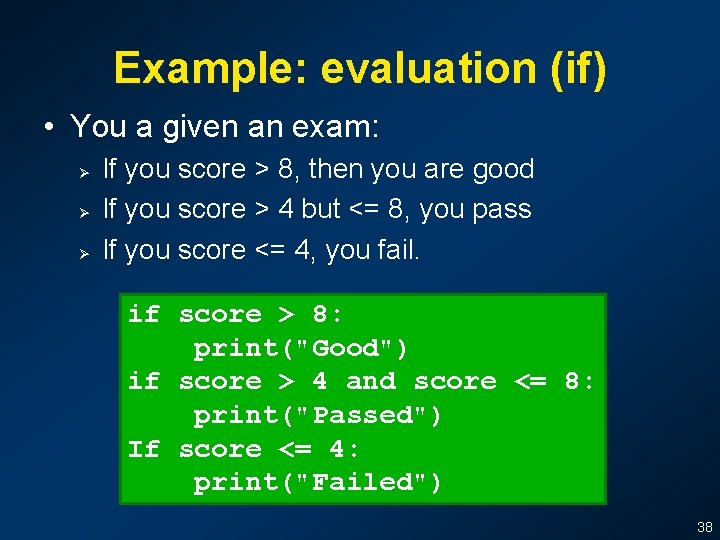
Example: evaluation (if) • You a given an exam: Ø Ø Ø If you score > 8, then you are good If you score > 4 but <= 8, you pass If you score <= 4, you fail. if score > 8: print("Good") if score > 4 and score <= 8: print("Passed") If score <= 4: print("Failed") 38
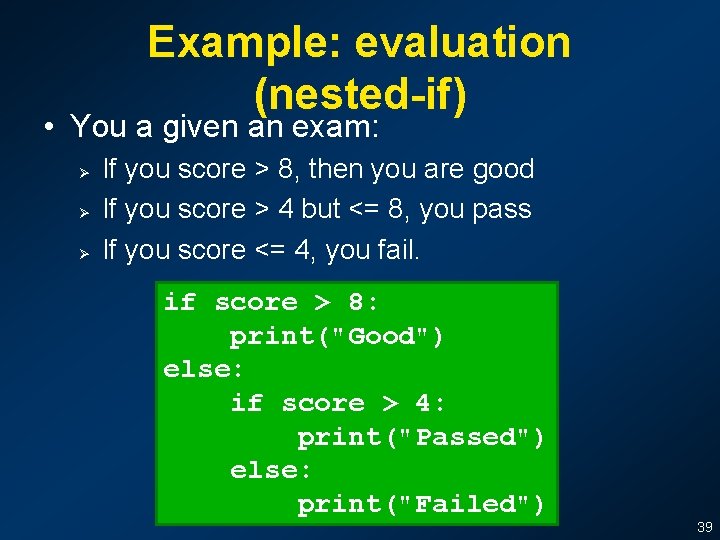
Example: evaluation (nested-if) • You a given an exam: Ø Ø Ø If you score > 8, then you are good If you score > 4 but <= 8, you pass If you score <= 4, you fail. if score > 8: print("Good") else: if score > 4: print("Passed") else: print("Failed") 39
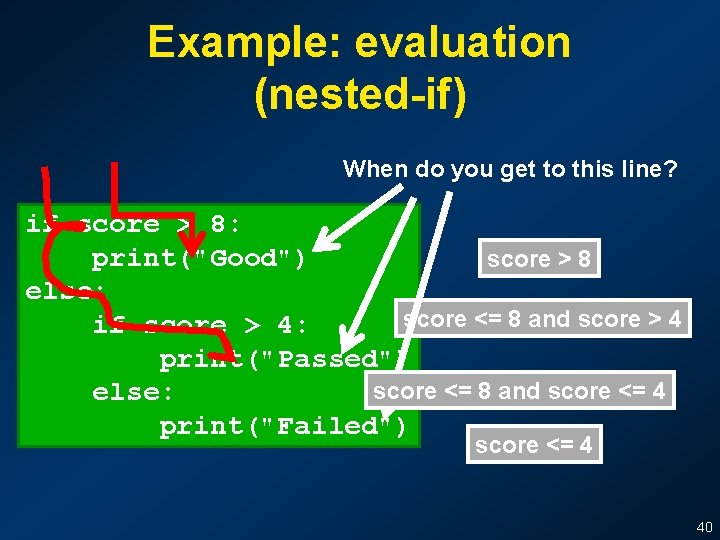
Example: evaluation (nested-if) When do you get to this line? if score > 8: print("Good") score > 8 else: score <= 8 and score > 4 if score > 4: print("Passed") score <= 8 and score <= 4 else: print("Failed") score <= 4 40
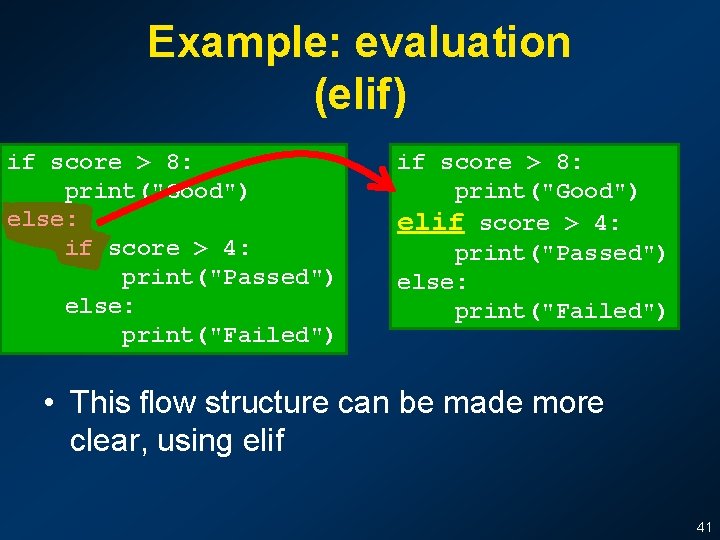
Example: evaluation (elif) if score > 8: print("Good") else: if score > 4: print("Passed") else: print("Failed") if score > 8: print("Good") elif score > 4: print("Passed") else: print("Failed") • This flow structure can be made more clear, using elif 41
if – else statements Source http: //www. flickr. com/photos/29104098@N 00/285609610/ 42
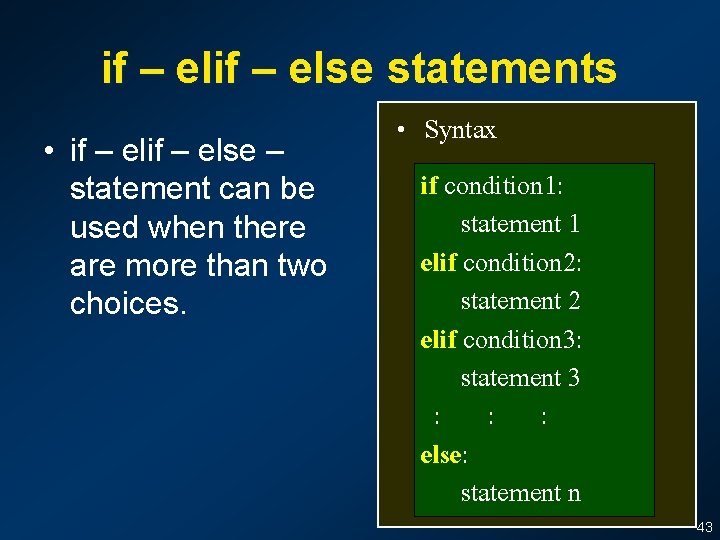
if – else statements • if – else – statement can be used when there are more than two choices. • Syntax if condition 1: statement 1 elif condition 2: statement 2 elif condition 3: statement 3 : : : else: statement n 43
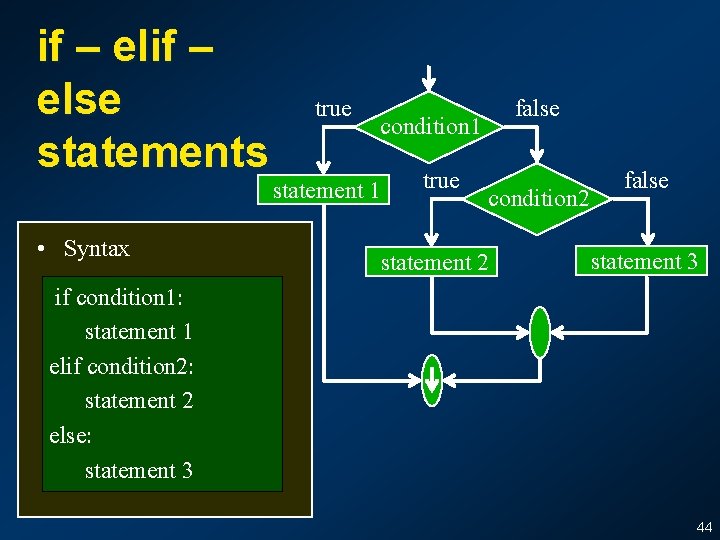
if – else true condition 1 false statements true. statement 1 • Syntax if condition 1: statement 1 elif condition 2: statement 2 else: statement 3 false condition 2 . statement 3 44
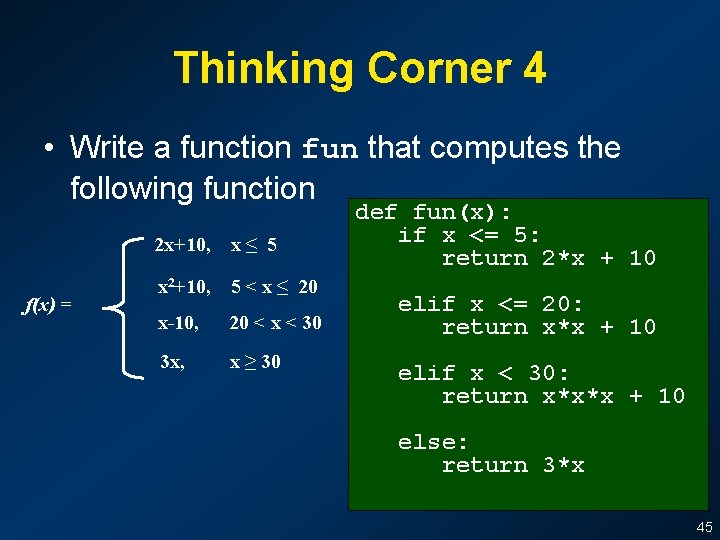
Thinking Corner 4 • Write a function fun that computes the following function 2 x+10, x ≤ 5 f(x) = x 2+10, 5 < x ≤ 20 x-10, 20 < x < 30 3 x, x ≥ 30 def fun(x): if x <= 5: return 2*x + 10 elif x <= 20: return x*x + 10 elif x < 30: return x*x*x + 10 else: return 3*x 45
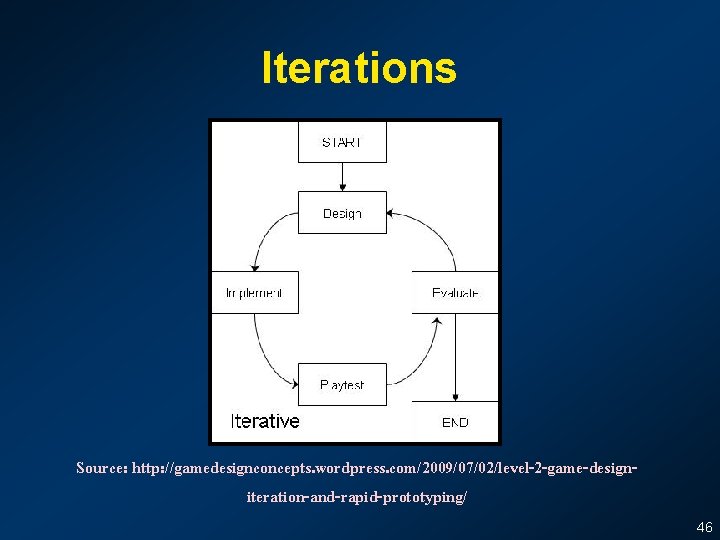
Iterations Source: http: //gamedesignconcepts. wordpress. com/2009/07/02/level-2 -game-designiteration-and-rapid-prototyping/ 46
Repetitive work • Computers are very good at doing repetitive work. • But how can we "program" them to do so? 47
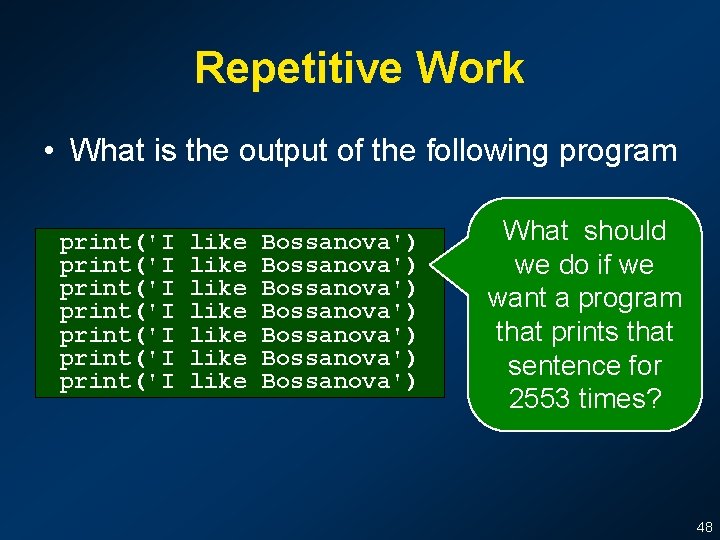
Repetitive Work • What is the output of the following program print('I print('I like like Bossanova') Bossanova') What should we do if we want a program that prints that sentence for 2553 times? 48
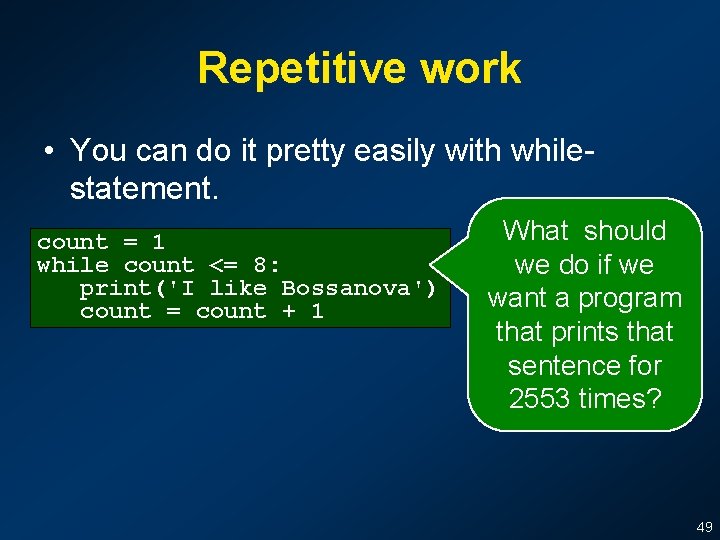
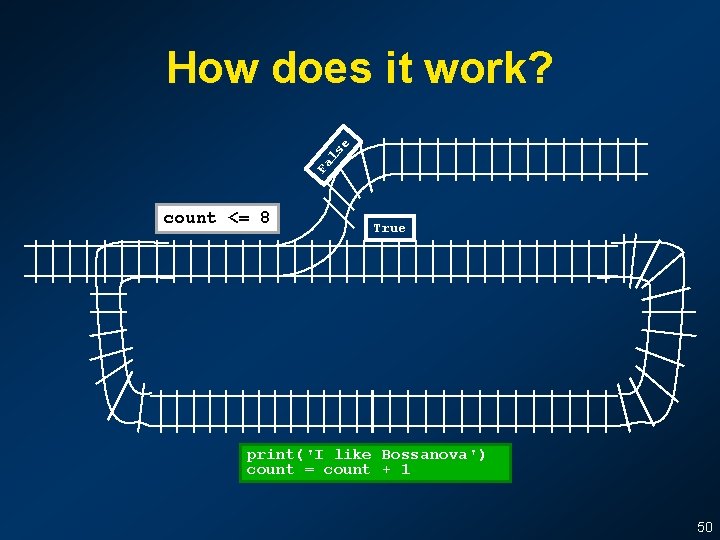
Repetitive work • You can do it pretty easily with whilestatement. count = 1 while count <= 8: print('I like Bossanova') count = count + 1 What should we do if we want a program that prints that sentence for 2553 times? 49
Fa ls e How does it work? count <= 8 True print('I like Bossanova') count = count + 1 50
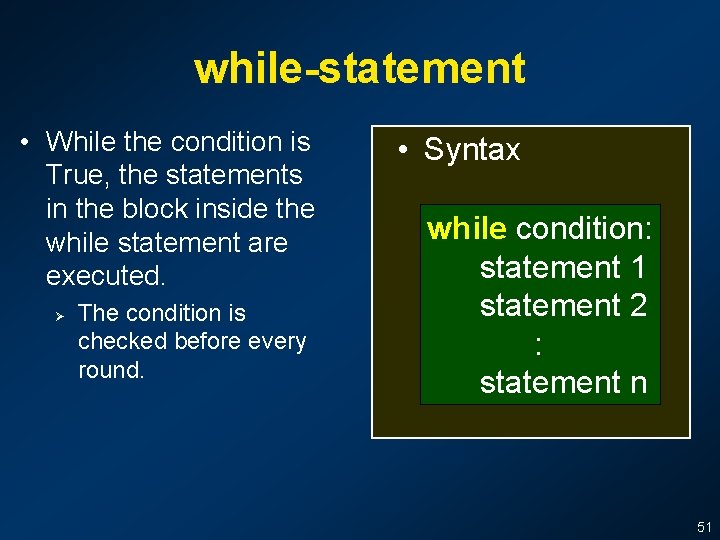
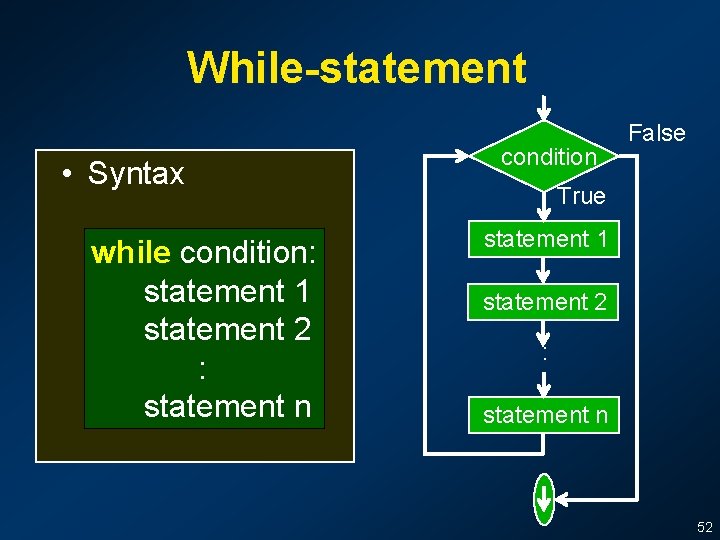
while-statement • While the condition is True, the statements in the block inside the while statement are executed. Ø The condition is checked before every round. • Syntax while condition: statement 1 statement 2 : statement n 51
While-statement • Syntax while condition: statement 1 statement 2 : statement n condition False True statement 1 statement 2 : statement n 52
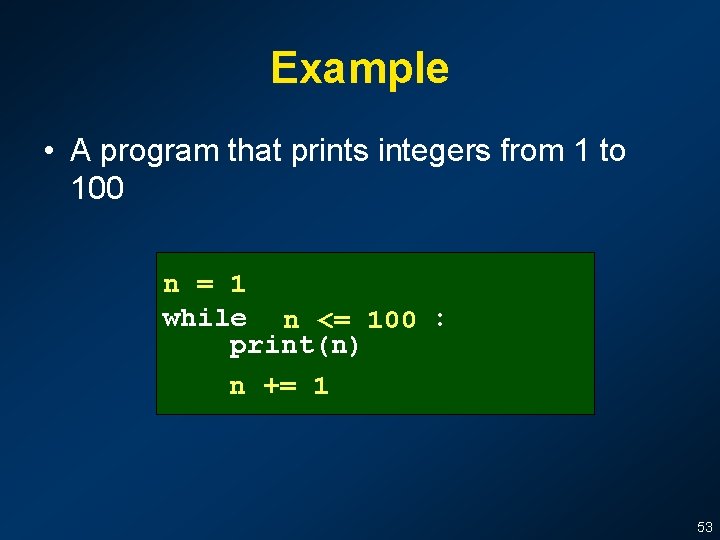
Example • A program that prints integers from 1 to 100 n = 1 while n <= 100 : print(n) n += 1 53
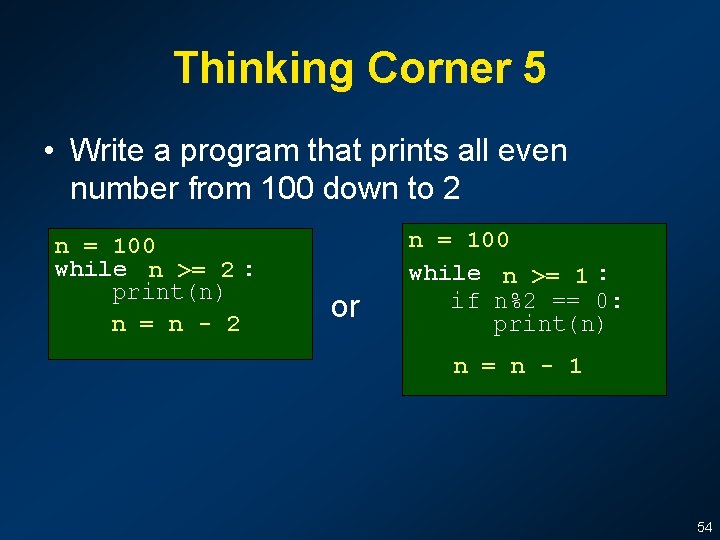
Thinking Corner 5 • Write a program that prints all even number from 100 down to 2 n = 100 while n >= 2 : print(n) n = n - 2 or n = 100 while n >= 1 : if n%2 == 0: print(n) n = n - 1 54
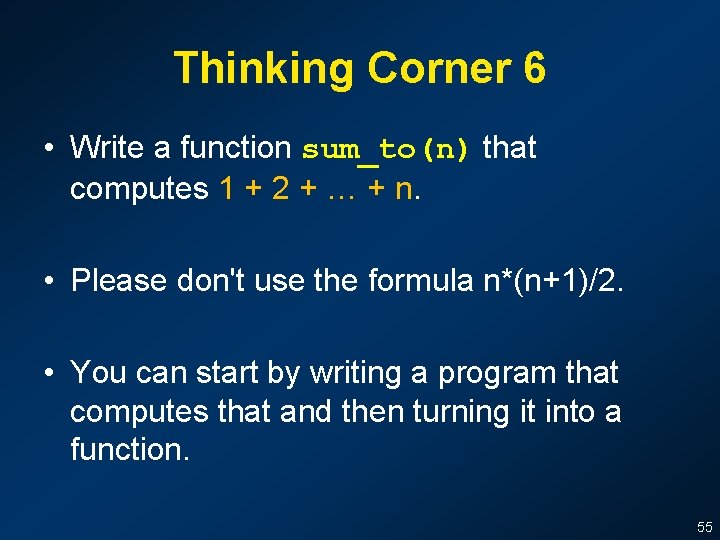
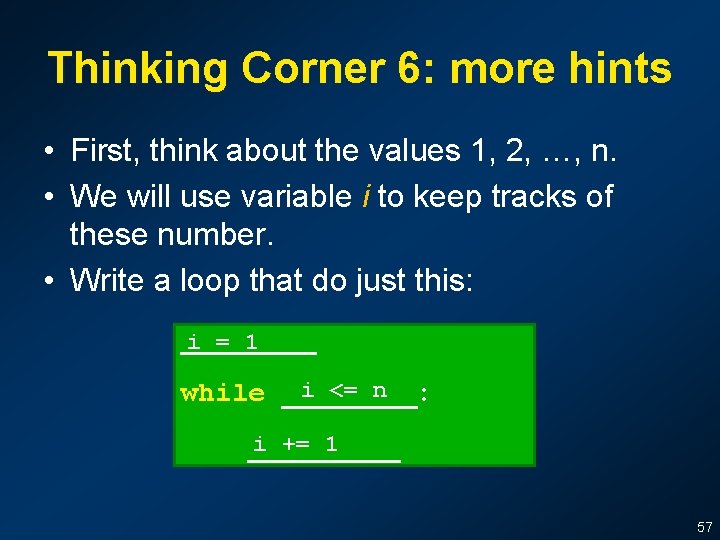
Thinking Corner 6 • Write a function sum_to(n) that computes 1 + 2 + … + n. • Please don't use the formula n*(n+1)/2. • You can start by writing a program that computes that and then turning it into a function. 55
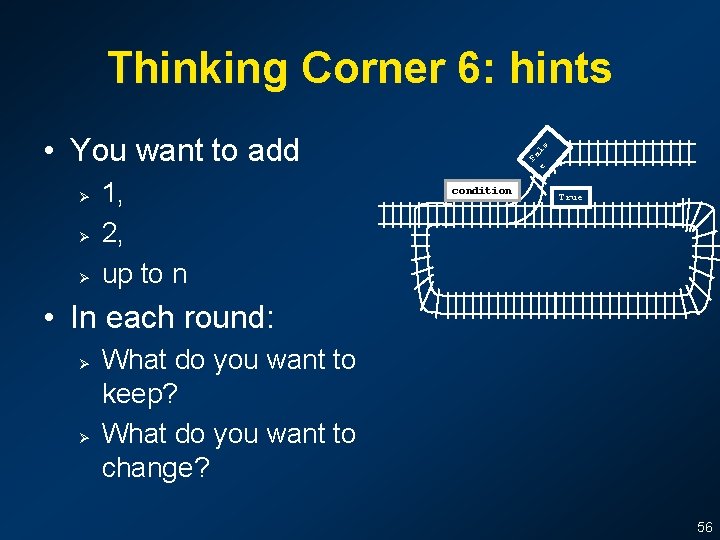
Thinking Corner 6: hints Ø Ø Ø 1, 2, up to n e Fa ls • You want to add condition True • In each round: Ø Ø What do you want to keep? What do you want to change? 56
Thinking Corner 6: more hints • First, think about the values 1, 2, …, n. • We will use variable i to keep tracks of these number. • Write a loop that do just this: ____ i = 1 i <= n while ____: i += 1 _____ 57
Thinking Corner 6: more and more hints • What do you want to do with i. Ø Keep the summation • You will need a variable for it. 58
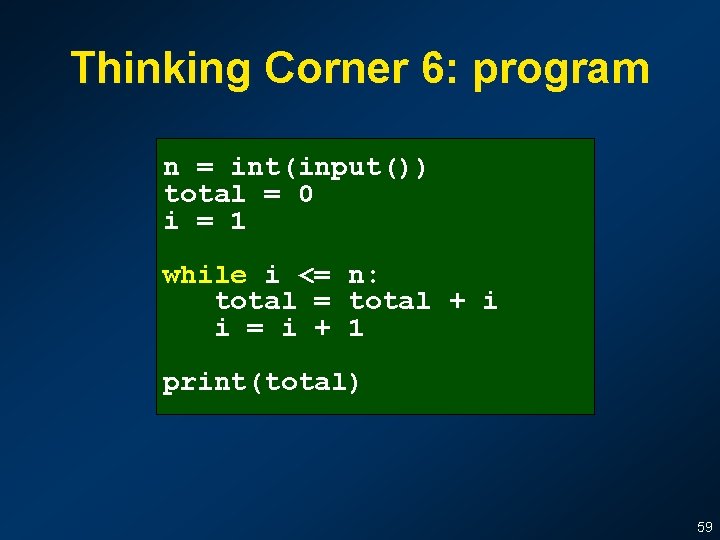
Thinking Corner 6: program n = int(input()) total = 0 i = 1 while i <= n: total = total + i i = i + 1 print(total) 59
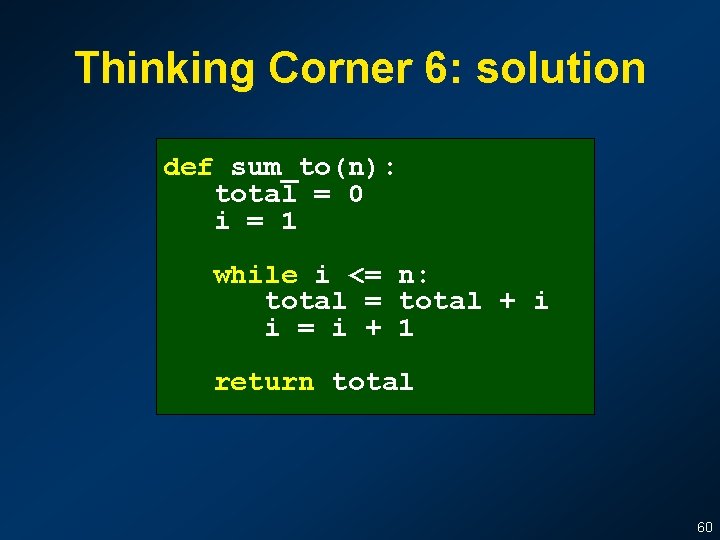
Thinking Corner 6: solution def sum_to(n): total = 0 i = 1 while i <= n: total = total + i i = i + 1 return total 60
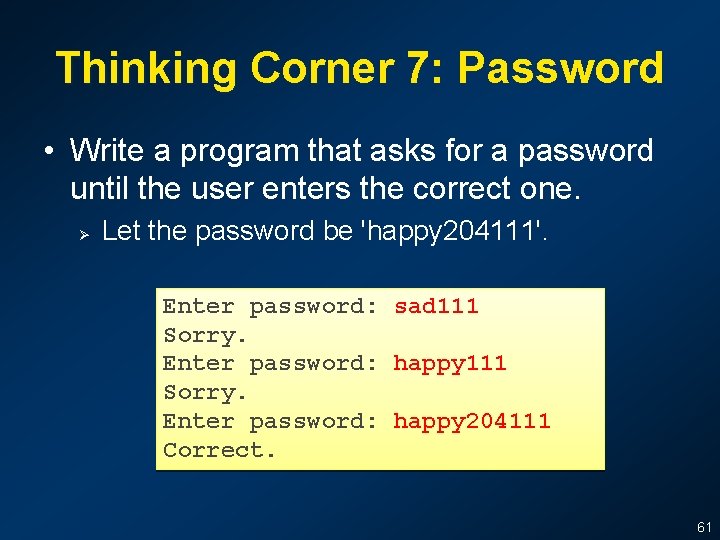
Thinking Corner 7: Password • Write a program that asks for a password until the user enters the correct one. Ø Let the password be 'happy 204111'. Enter password: sad 111 Sorry. Enter password: happy 204111 Correct. 61
Thinking Corner 7: hints • Answer the following questions: Ø Ø Ø What condition do keep your loop going? What do you want to do in each iteration? What do you have to do before checking the first condition? 62
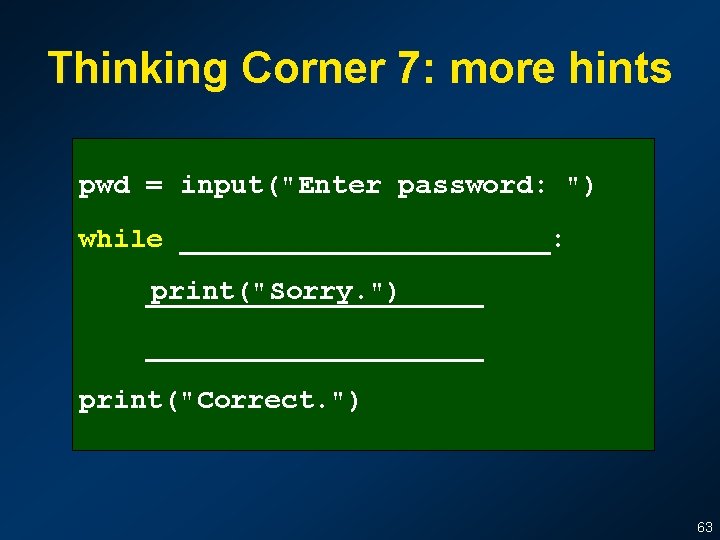
Thinking Corner 7: more hints pwd = input("Enter password: ") while ___________: print("Sorry. ") ____________________ print("Correct. ") 63
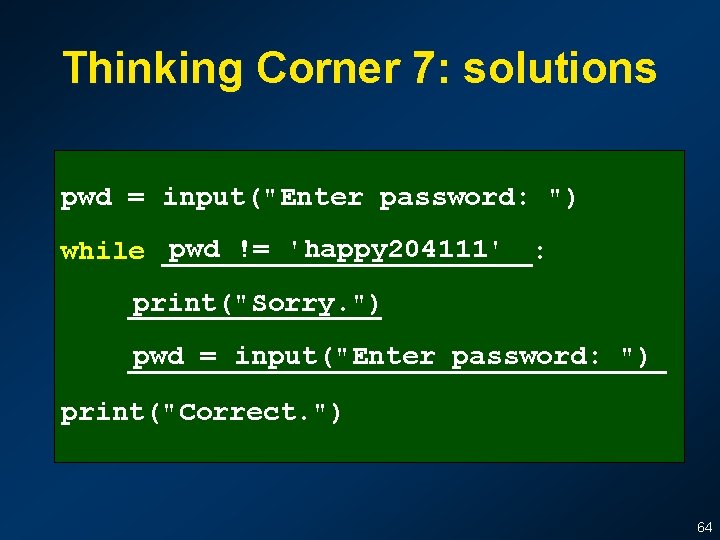
Thinking Corner 7: solutions pwd = input("Enter password: ") pwd != 'happy 204111' while ___________: print("Sorry. ") ________ pwd = input("Enter password: ") ________________ print("Correct. ") 64
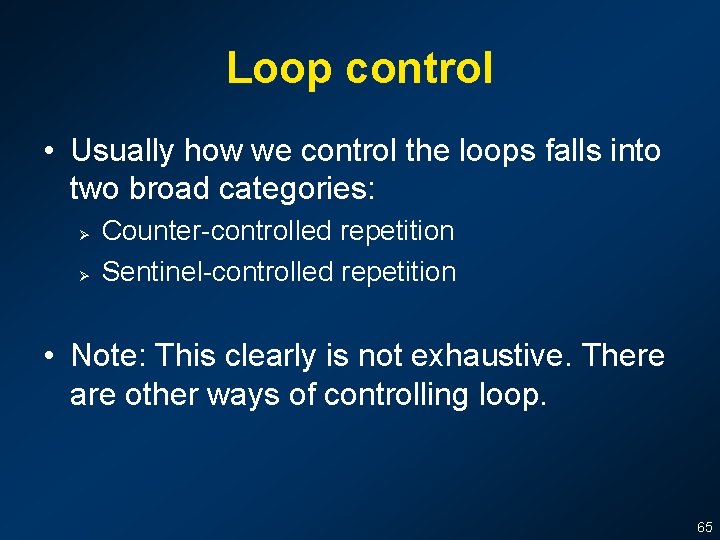
Loop control • Usually how we control the loops falls into two broad categories: Ø Ø Counter-controlled repetition Sentinel-controlled repetition • Note: This clearly is not exhaustive. There are other ways of controlling loop. 65
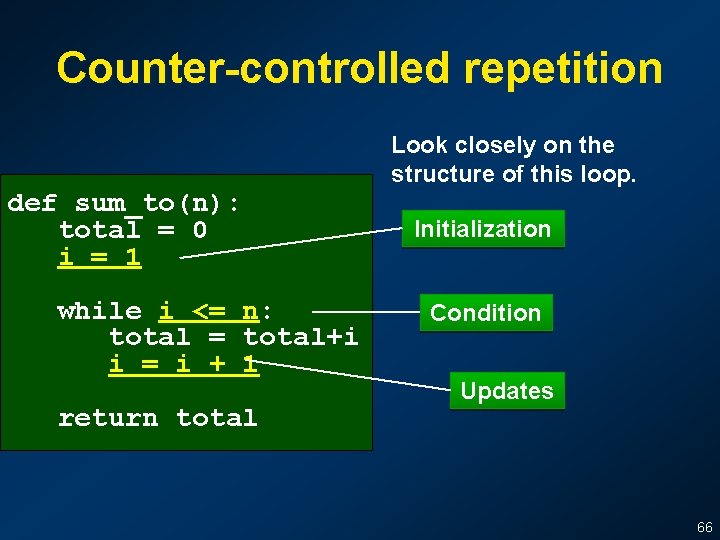
Counter-controlled repetition Look closely on the structure of this loop. def sum_to(n): total = 0 i = 1 while i <= n: total = total+i i = i + 1 return total Initialization Condition Updates 66
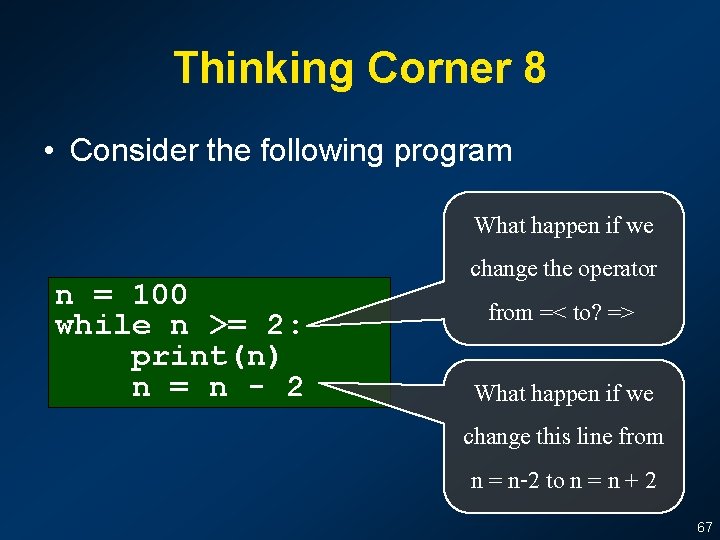
Thinking Corner 8 • Consider the following program n = 100 while n >= 2: print(n) n = n - 2 What happen if we change the operator from =< to? => What happen if we change this line from n = n-2 to n = n + 2 67
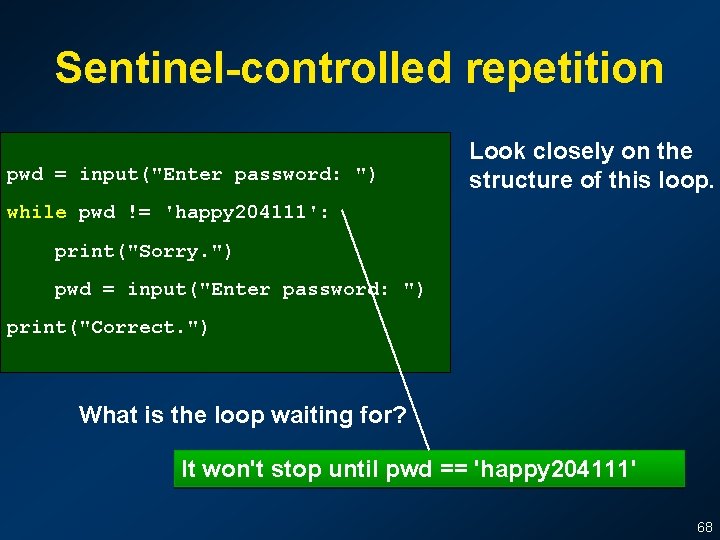
Sentinel-controlled repetition pwd = input("Enter password: ") Look closely on the structure of this loop. while pwd != 'happy 204111': print("Sorry. ") pwd = input("Enter password: ") print("Correct. ") What is the loop waiting for? It won't stop until pwd == 'happy 204111' 68
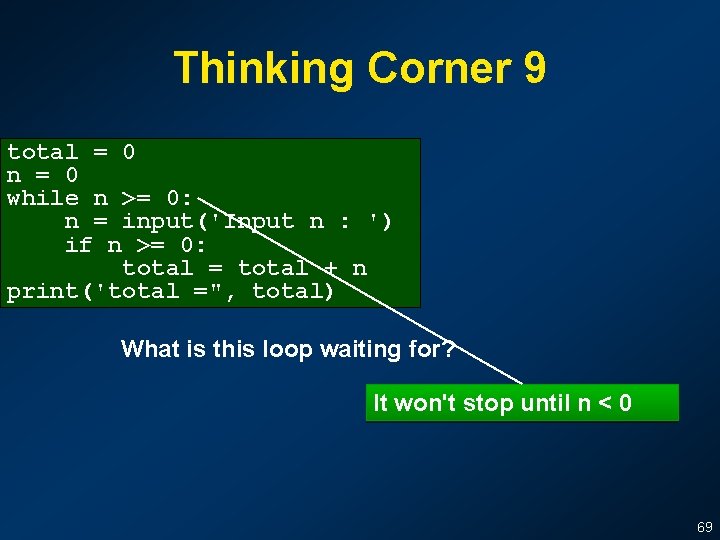
Thinking Corner 9 total = 0 n = 0 while n >= 0: n = input('Input n : ') if n >= 0: total = total + n print('total =", total) What is this loop waiting for? It won't stop until n < 0 69
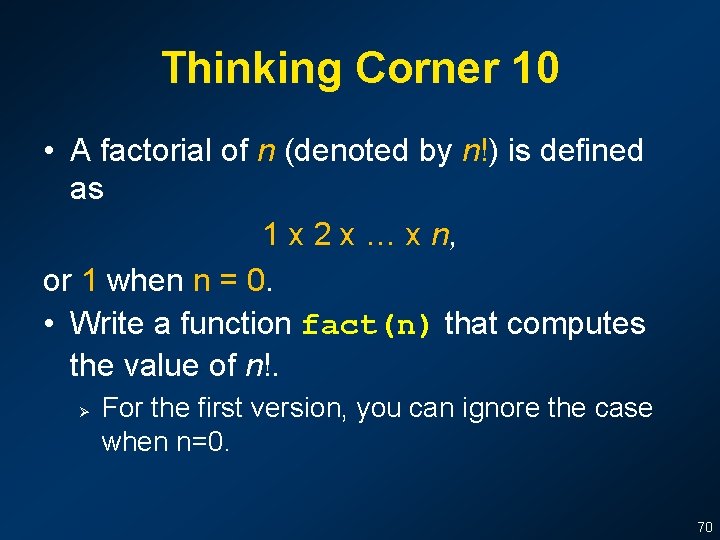
Thinking Corner 10 • A factorial of n (denoted by n!) is defined as 1 x 2 x … x n, or 1 when n = 0. • Write a function fact(n) that computes the value of n!. Ø For the first version, you can ignore the case when n=0. 70