
Condition Variables Questions answered in this lecture How
Condition Variables Questions answered in this lecture: How can threads enforce ordering across operations? How can thread_join() be implemented? How can condition variables be used to support producer/consumer apps?
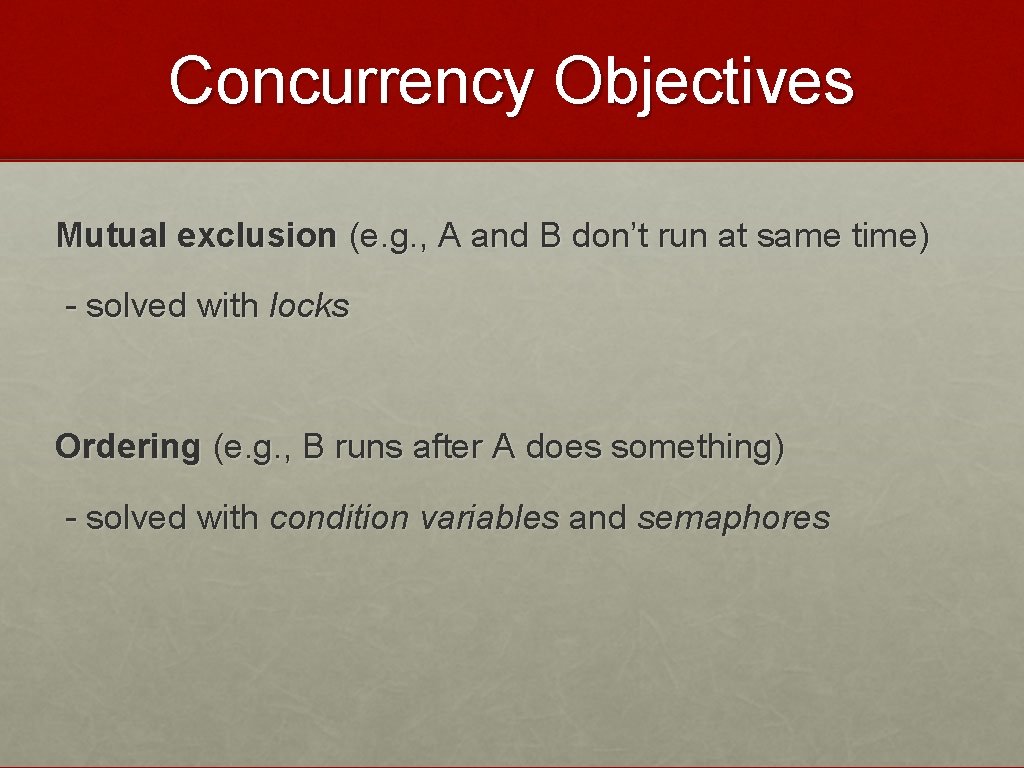
Concurrency Objectives Mutual exclusion (e. g. , A and B don’t run at same time) - solved with locks Ordering (e. g. , B runs after A does something) - solved with condition variables and semaphores

Condition Variables • There are many cases where a thread wishes to check whether a condition is true before continuing its execution. • Example: • A parent thread might wish to check whether a child thread has completed. • This is often called a join().
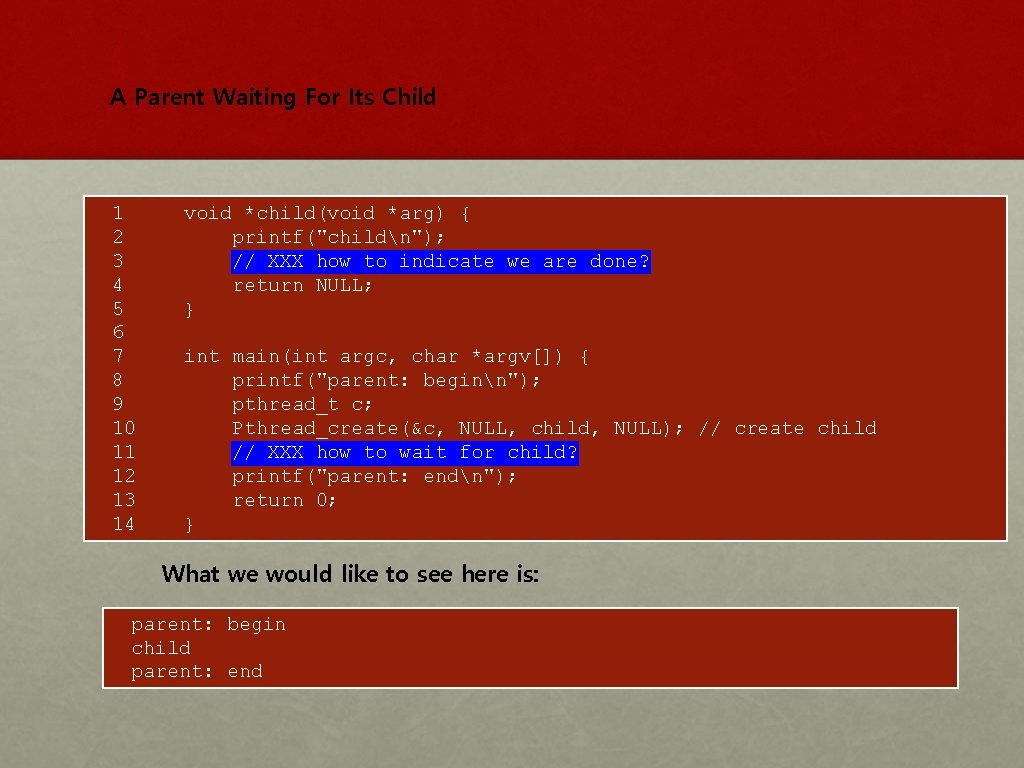
A Parent Waiting For Its Child 1 2 3 4 5 6 7 8 9 10 11 12 13 14 void *child(void *arg) { printf("childn"); // XXX how to indicate we are done? return NULL; } int main(int argc, char *argv[]) { printf("parent: beginn"); pthread_t c; Pthread_create(&c, NULL, child, NULL); // create child // XXX how to wait for child? printf("parent: endn"); return 0; } What we would like to see here is: parent: begin child parent: end
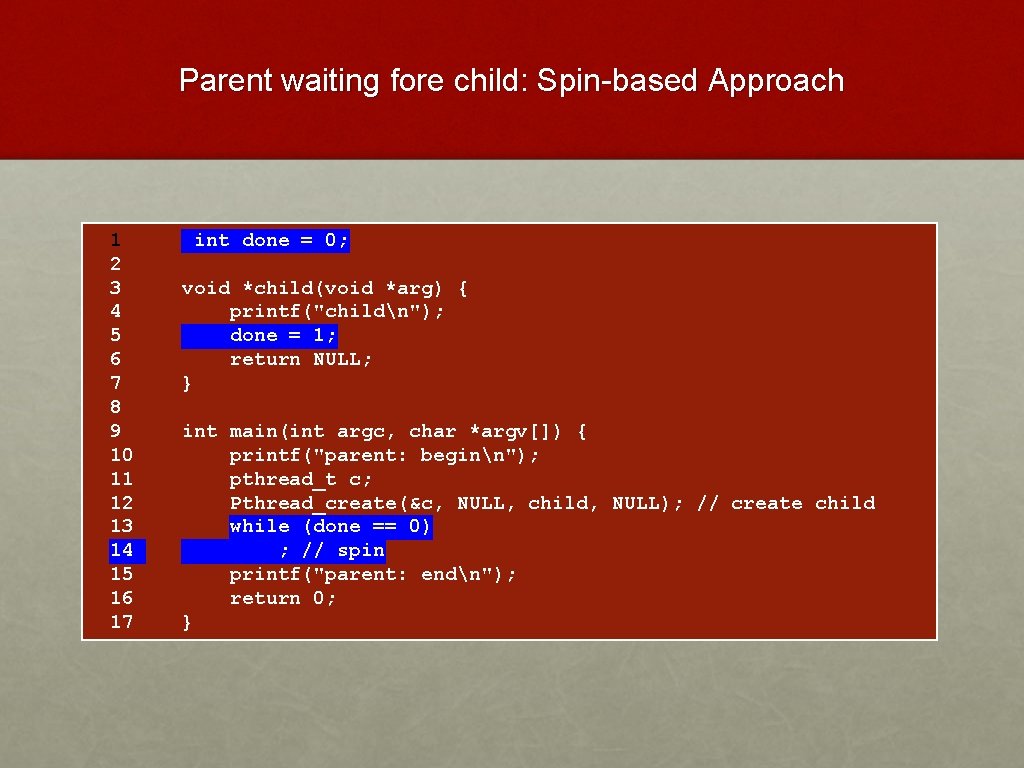
Parent waiting fore child: Spin-based Approach 1 2 3 4 5 6 7 8 9 10 11 12 13 14 15 16 17 int done = 0; void *child(void *arg) { printf("childn"); done = 1; return NULL; } int main(int argc, char *argv[]) { printf("parent: beginn"); pthread_t c; Pthread_create(&c, NULL, child, NULL); // create child while (done == 0) ; // spin printf("parent: endn"); return 0; }
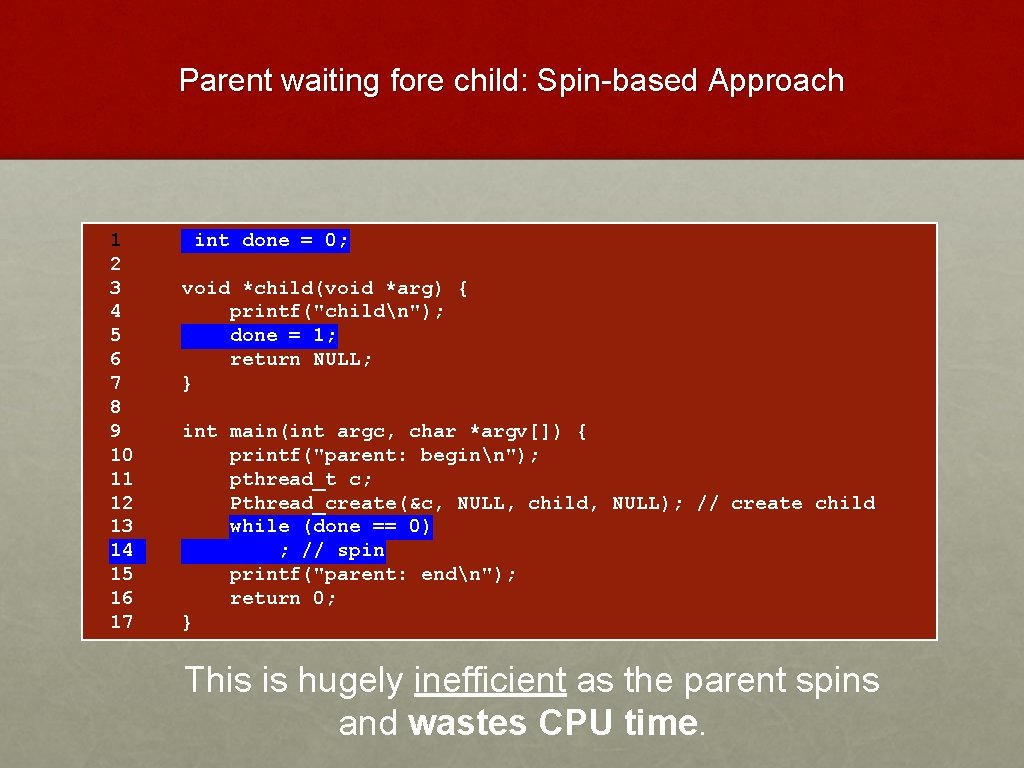
Parent waiting fore child: Spin-based Approach 1 2 3 4 5 6 7 8 9 10 11 12 13 14 15 16 17 int done = 0; void *child(void *arg) { printf("childn"); done = 1; return NULL; } int main(int argc, char *argv[]) { printf("parent: beginn"); pthread_t c; Pthread_create(&c, NULL, child, NULL); // create child while (done == 0) ; // spin printf("parent: endn"); return 0; } This is hugely inefficient as the parent spins and wastes CPU time.
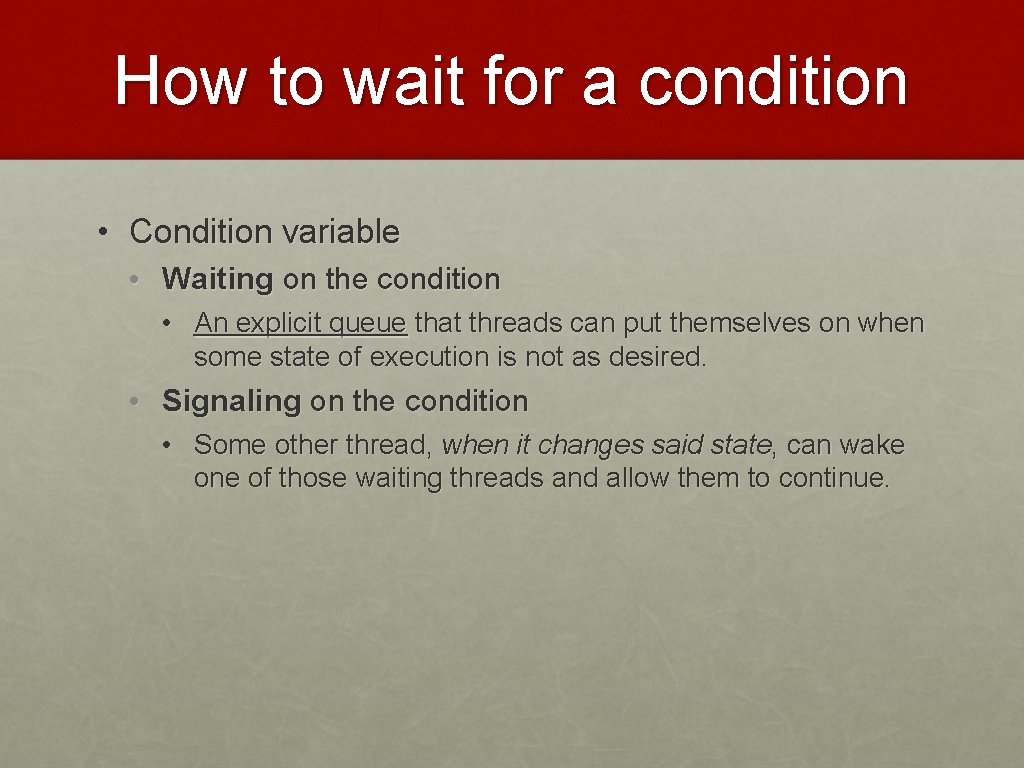
How to wait for a condition • Condition variable • Waiting on the condition • An explicit queue that threads can put themselves on when some state of execution is not as desired. • Signaling on the condition • Some other thread, when it changes said state, can wake one of those waiting threads and allow them to continue.
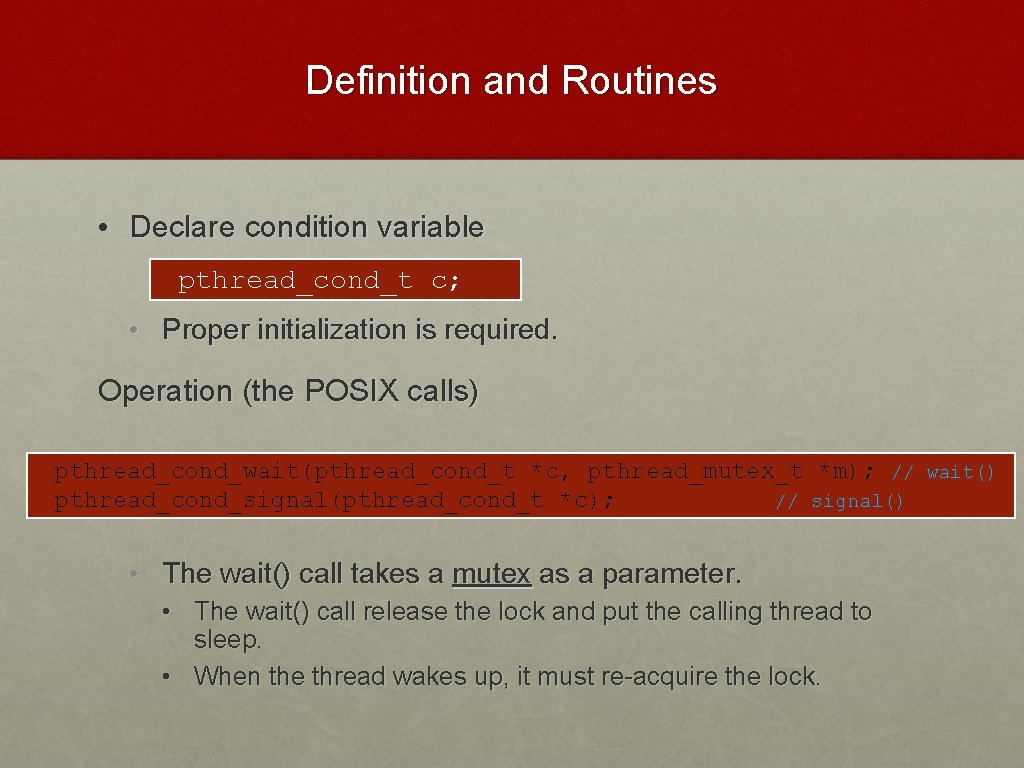
Definition and Routines • Declare condition variable pthread_cond_t c; • Proper initialization is required. Operation (the POSIX calls) pthread_cond_wait(pthread_cond_t *c, pthread_mutex_t *m); // wait() pthread_cond_signal(pthread_cond_t *c); // signal() • The wait() call takes a mutex as a parameter. • The wait() call release the lock and put the calling thread to sleep. • When the thread wakes up, it must re-acquire the lock.
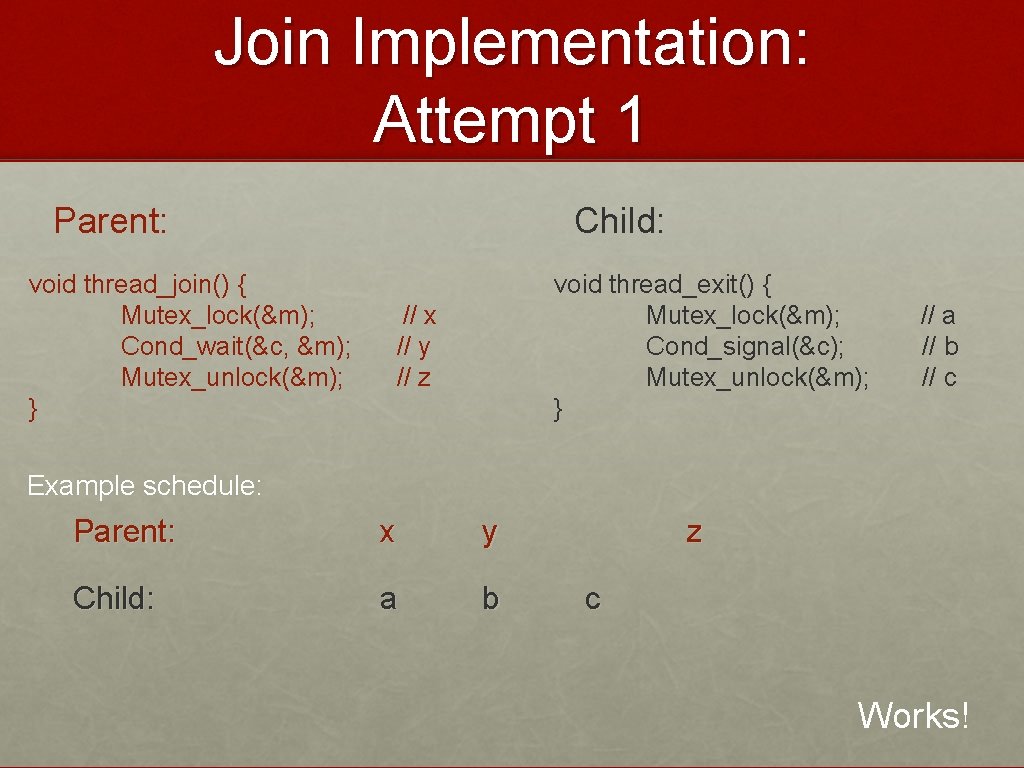
Join Implementation: Attempt 1 Parent: void thread_join() { Mutex_lock(&m); Cond_wait(&c, &m); Mutex_unlock(&m); } Child: void thread_exit() { Mutex_lock(&m); Cond_signal(&c); Mutex_unlock(&m); } // x // y // z // a // b // c Example schedule: Parent: x y Child: a b z c Works!
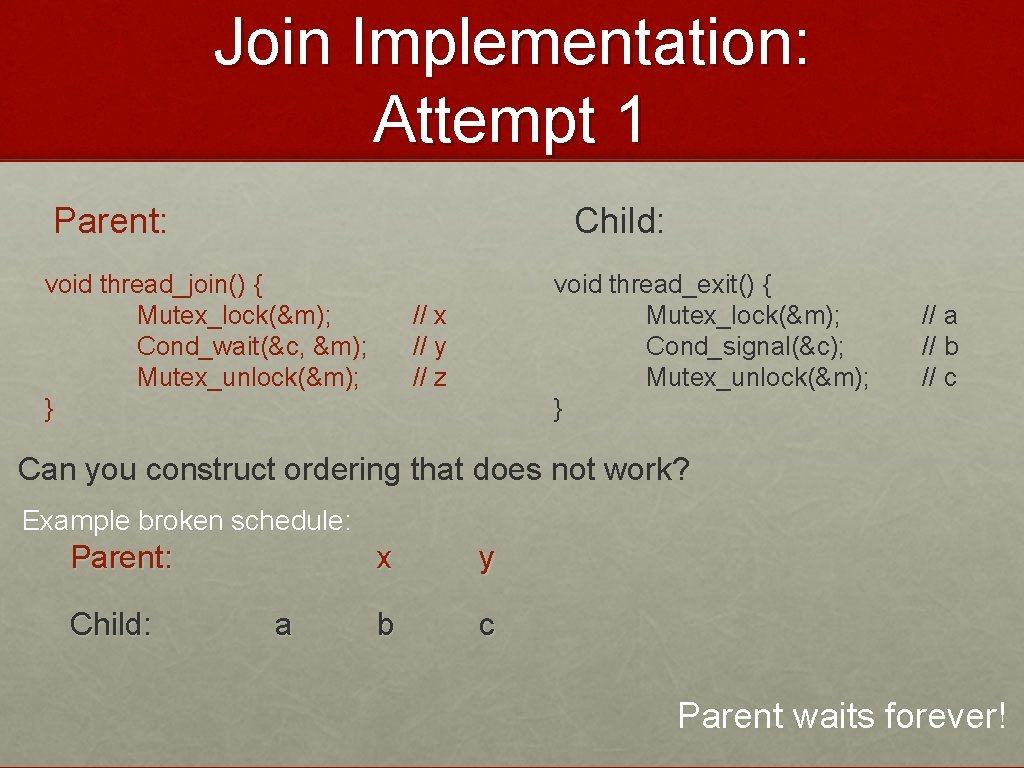
Join Implementation: Attempt 1 Parent: Child: void thread_join() { Mutex_lock(&m); Cond_wait(&c, &m); Mutex_unlock(&m); } void thread_exit() { Mutex_lock(&m); Cond_signal(&c); Mutex_unlock(&m); } // x // y // z // a // b // c Can you construct ordering that does not work? Example broken schedule: Parent: Child: a x y b c Parent waits forever!
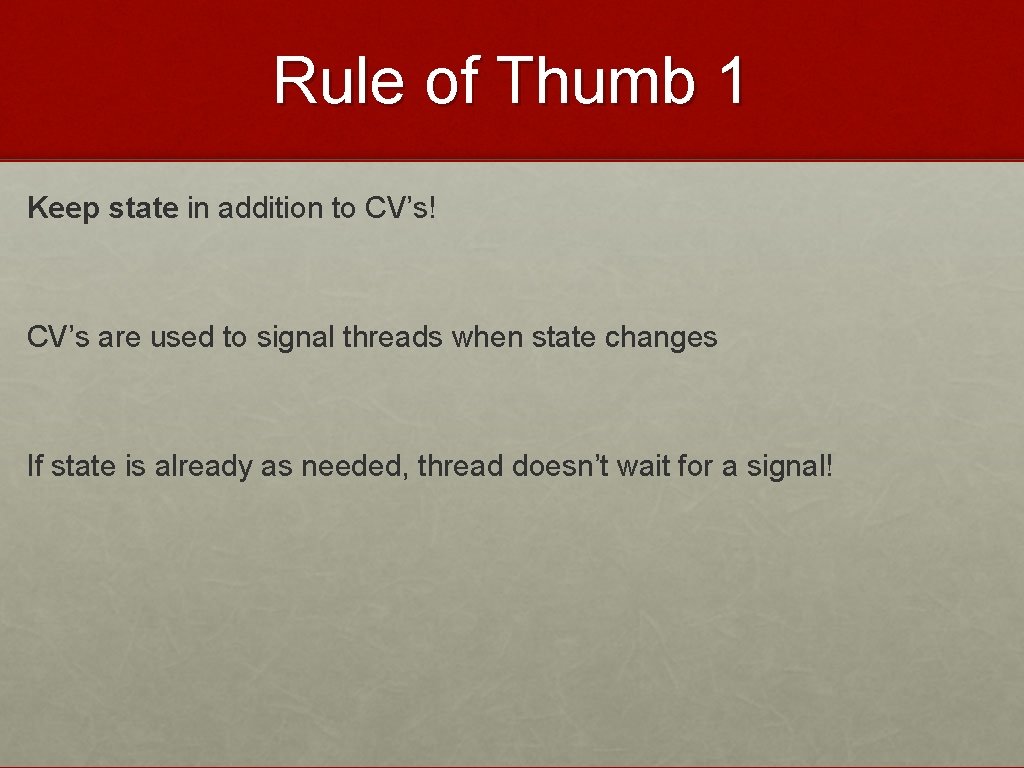
Rule of Thumb 1 Keep state in addition to CV’s! CV’s are used to signal threads when state changes If state is already as needed, thread doesn’t wait for a signal!
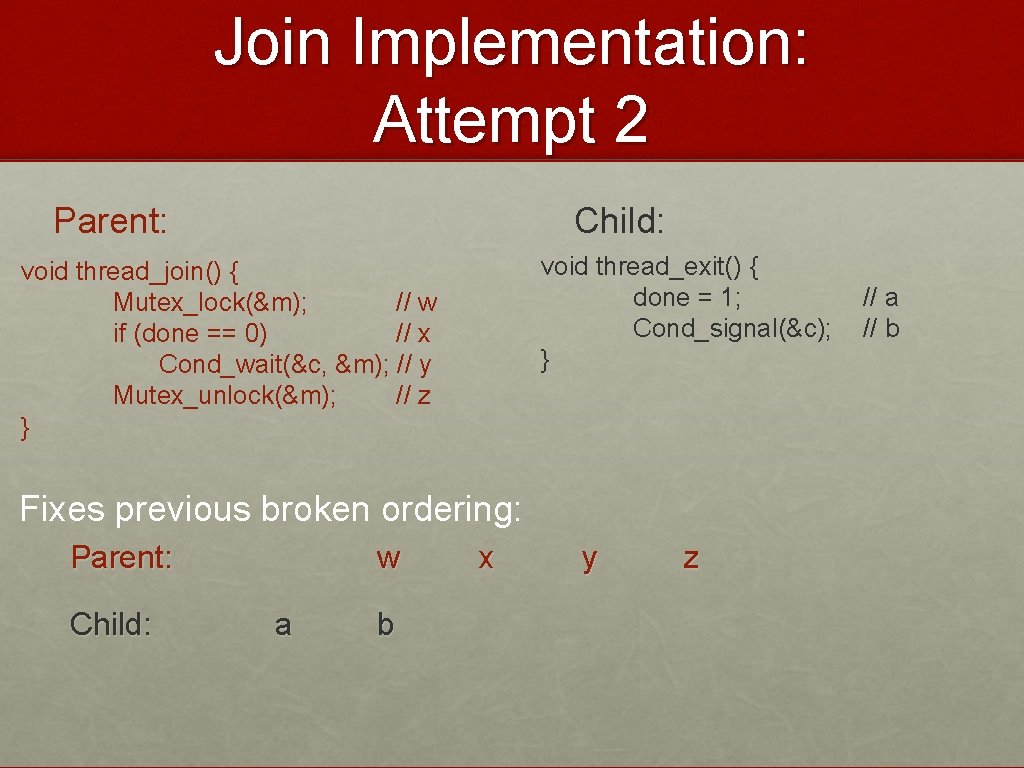
Join Implementation: Attempt 2 Parent: Child: void thread_exit() { done = 1; Cond_signal(&c); } void thread_join() { Mutex_lock(&m); // w if (done == 0) // x Cond_wait(&c, &m); // y Mutex_unlock(&m); // z } Fixes previous broken ordering: Parent: Child: w a b x y z // a // b
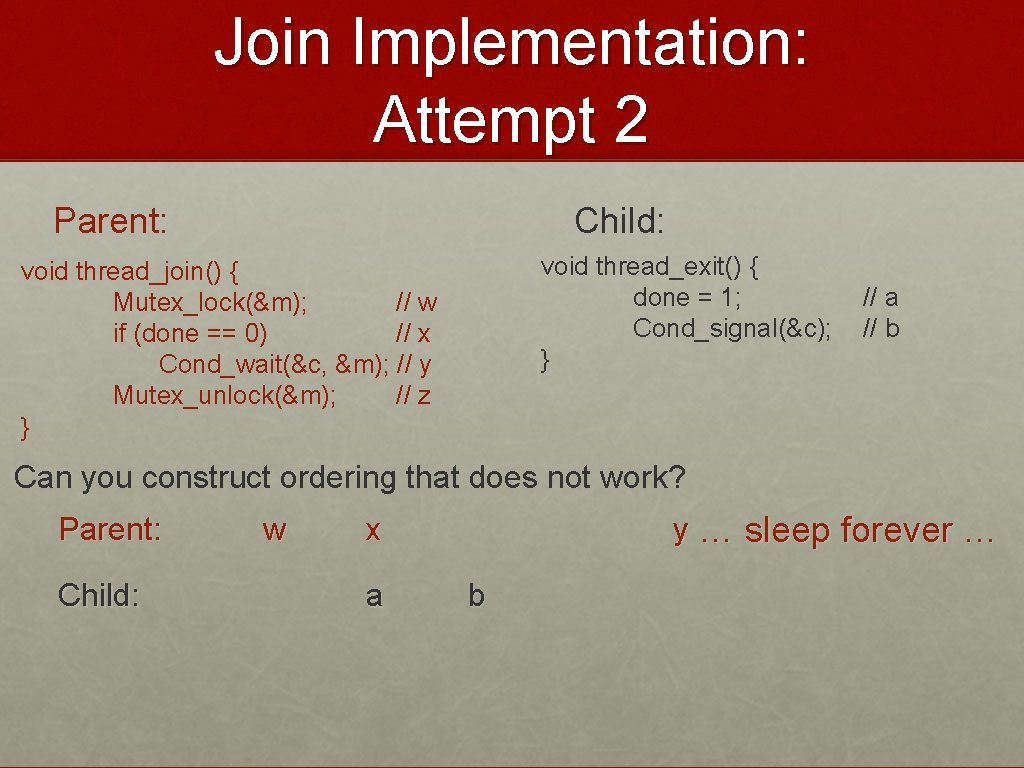
Join Implementation: Attempt 2 Parent: Child: void thread_exit() { done = 1; Cond_signal(&c); } void thread_join() { Mutex_lock(&m); // w if (done == 0) // x Cond_wait(&c, &m); // y Mutex_unlock(&m); // z } // a // b Can you construct ordering that does not work? Parent: Child: w y … sleep forever … x a b
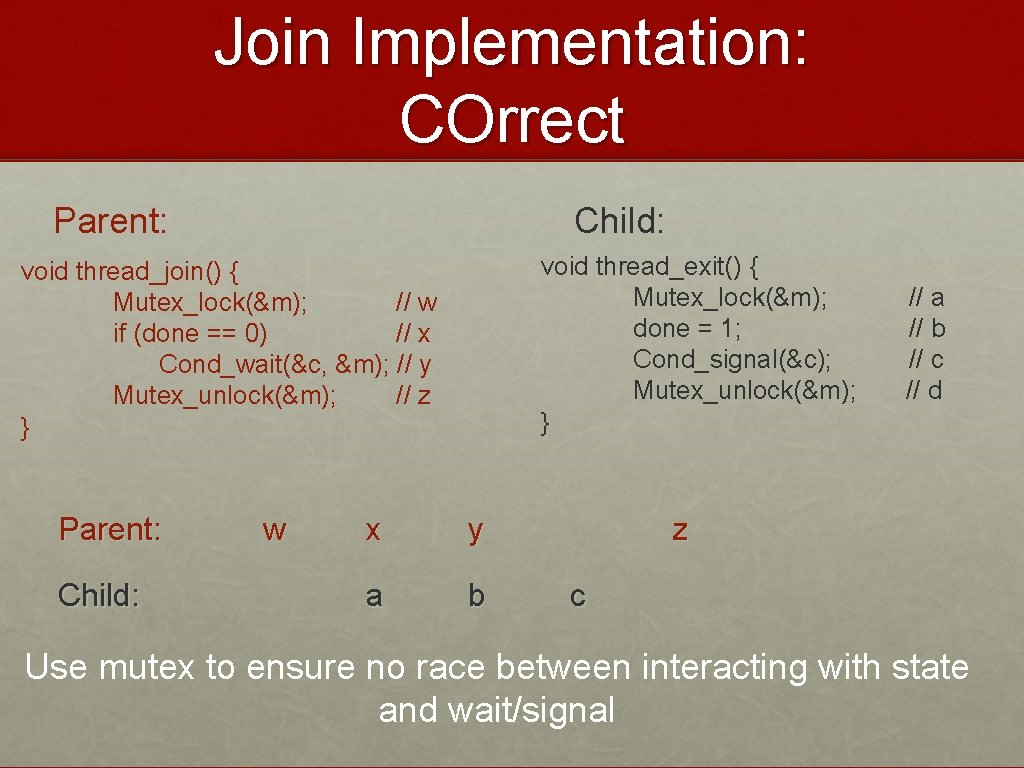
Join Implementation: COrrect Parent: Child: void thread_exit() { Mutex_lock(&m); done = 1; Cond_signal(&c); Mutex_unlock(&m); } void thread_join() { Mutex_lock(&m); // w if (done == 0) // x Cond_wait(&c, &m); // y Mutex_unlock(&m); // z } Parent: Child: w x y a b // a // b // c // d z c Use mutex to ensure no race between interacting with state and wait/signal
Producer/Consumer Problem
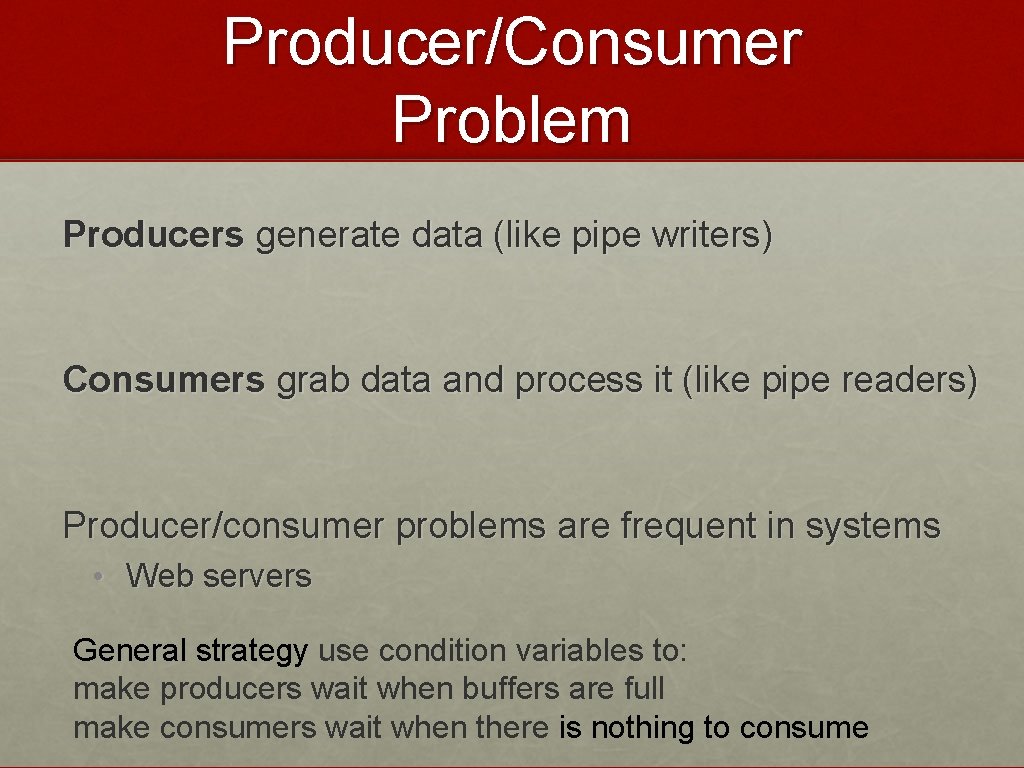
Producer/Consumer Problem Producers generate data (like pipe writers) Consumers grab data and process it (like pipe readers) Producer/consumer problems are frequent in systems • Web servers General strategy use condition variables to: make producers wait when buffers are full make consumers wait when there is nothing to consume
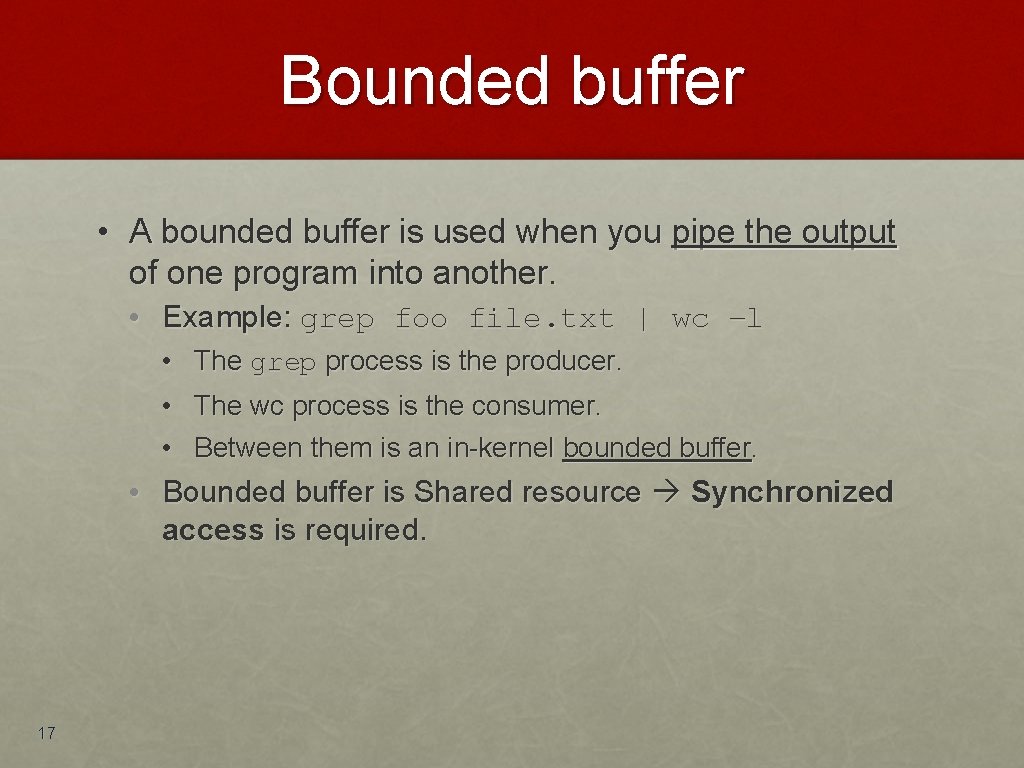
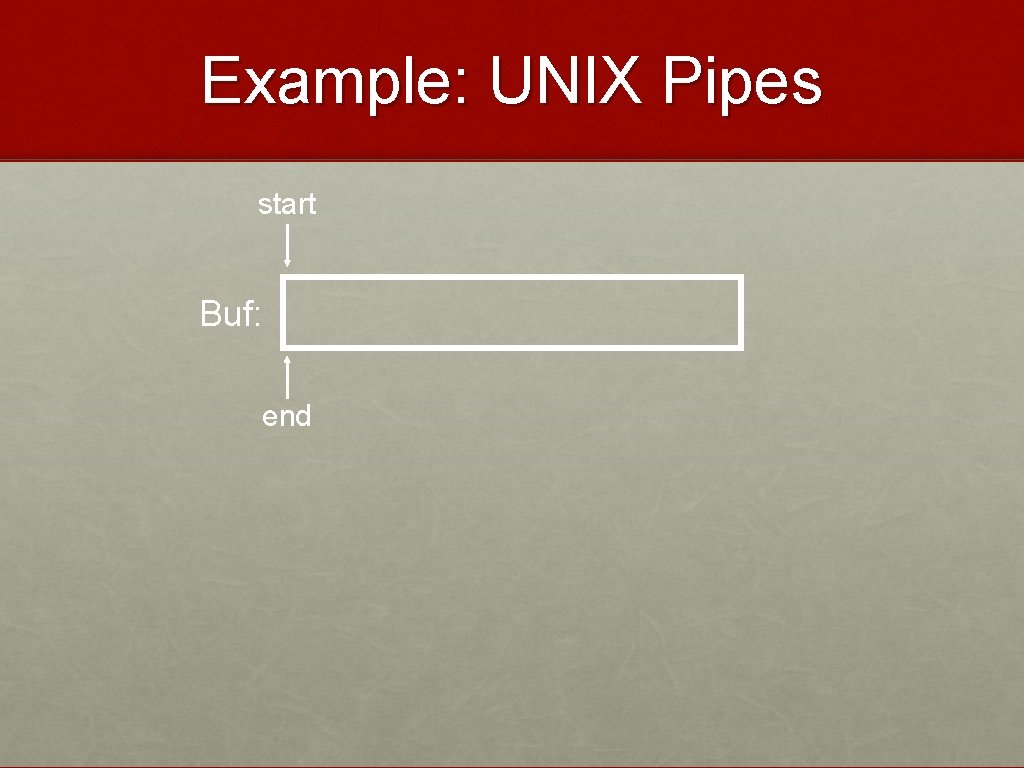
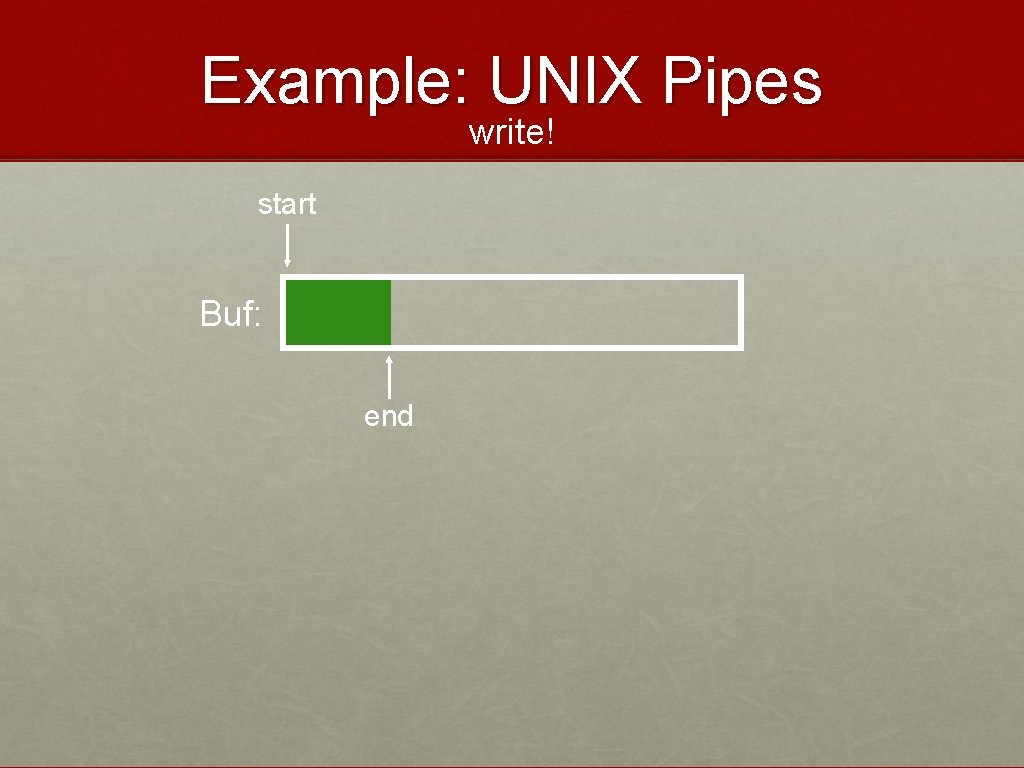
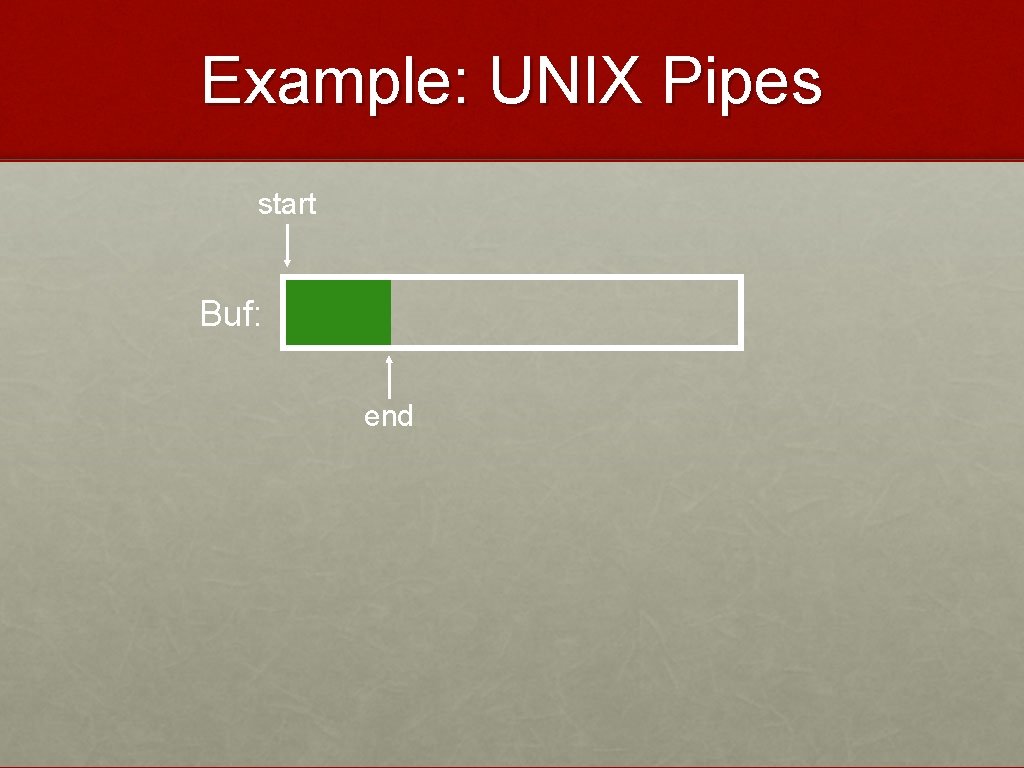
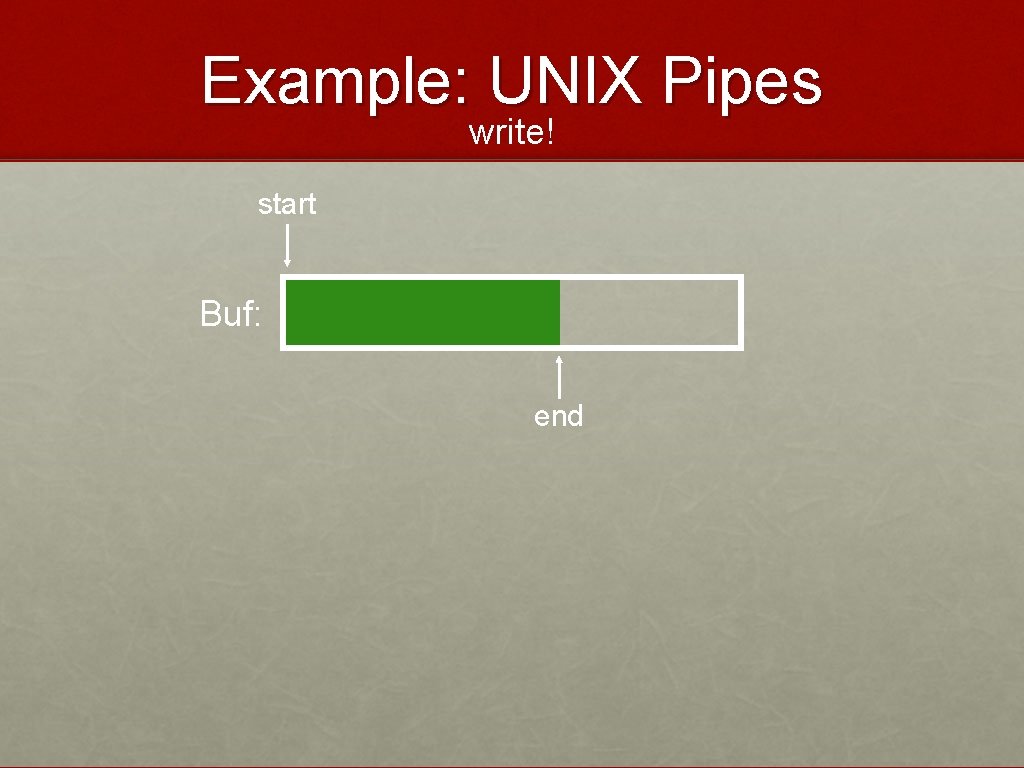
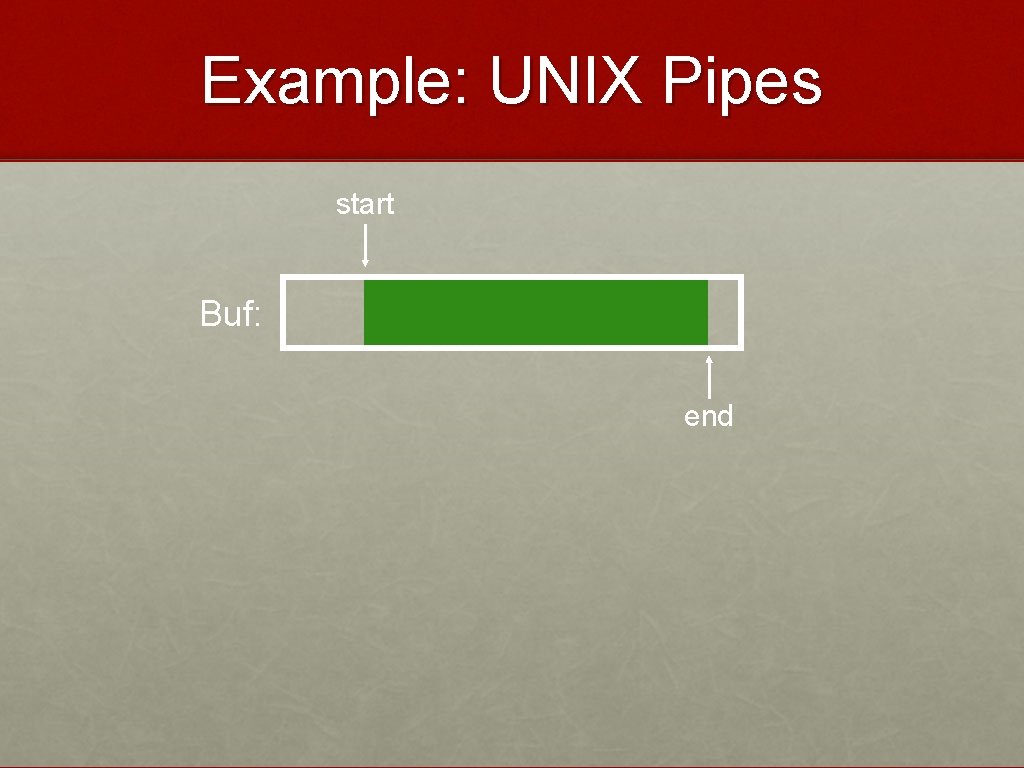
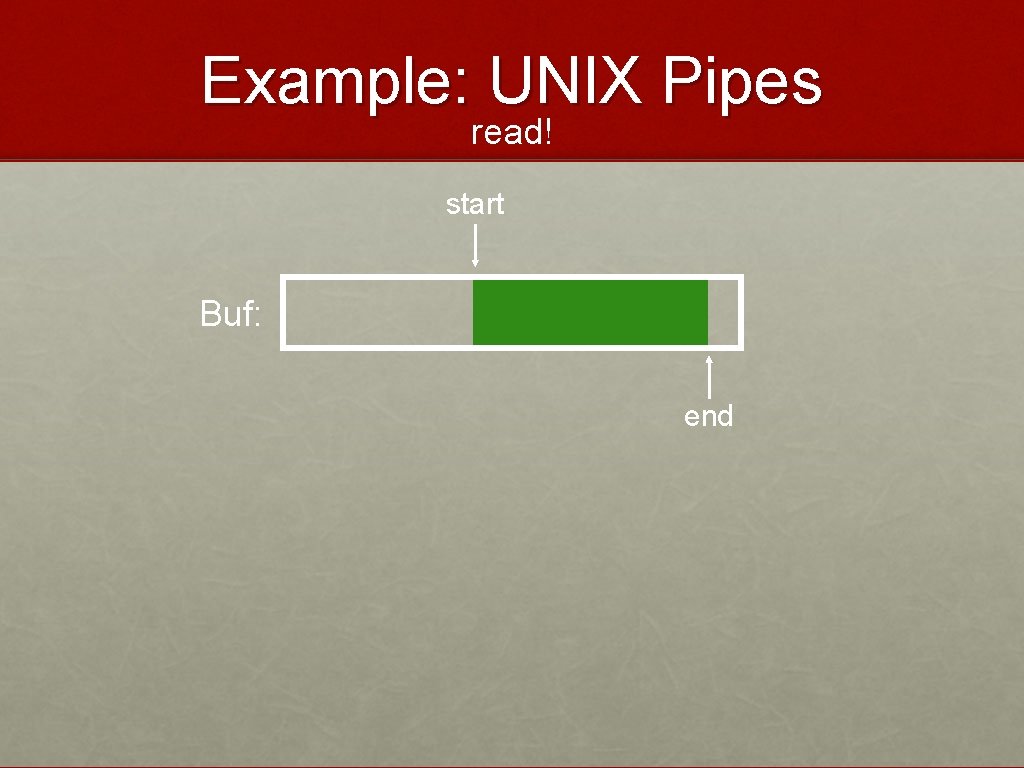
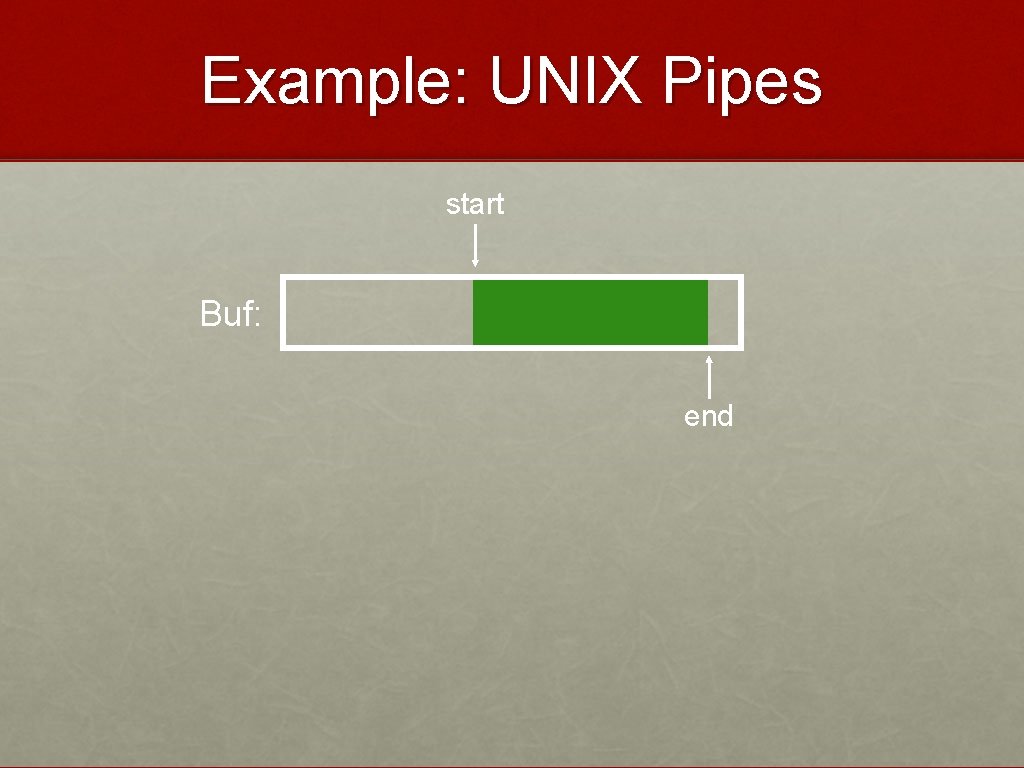
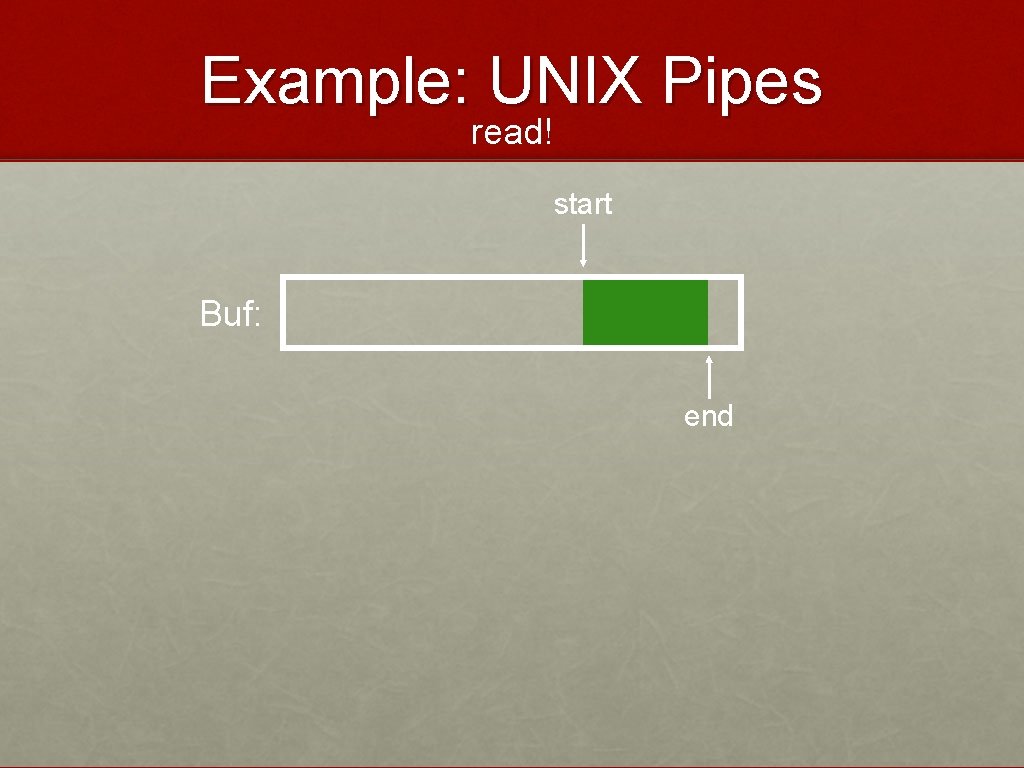
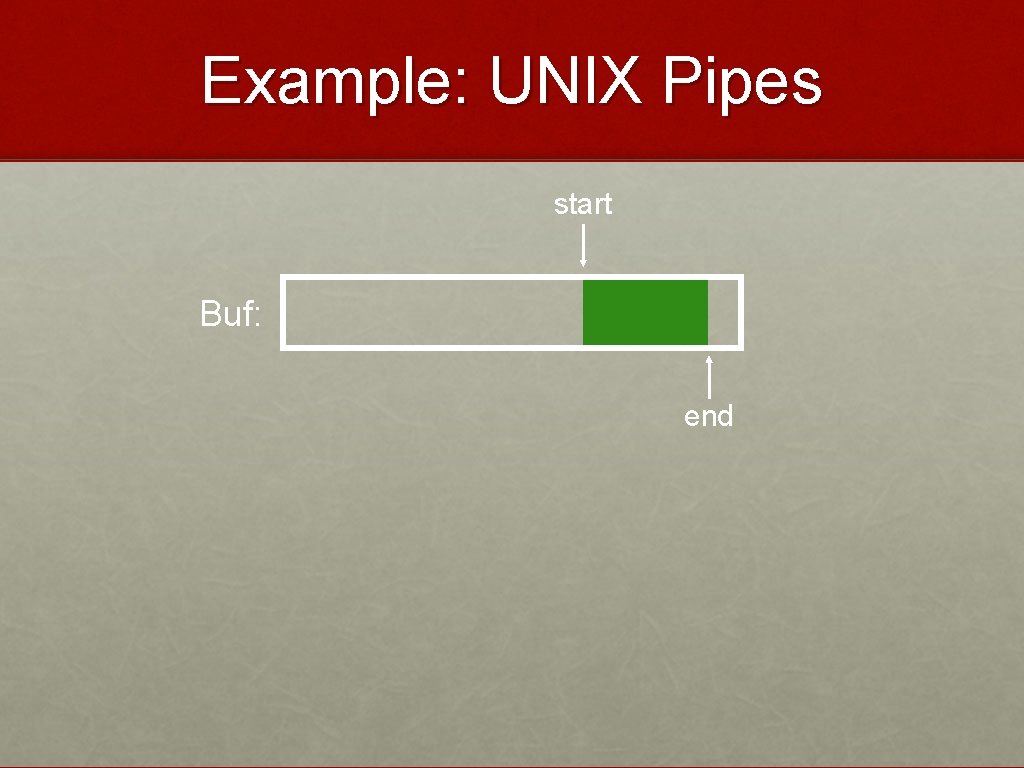
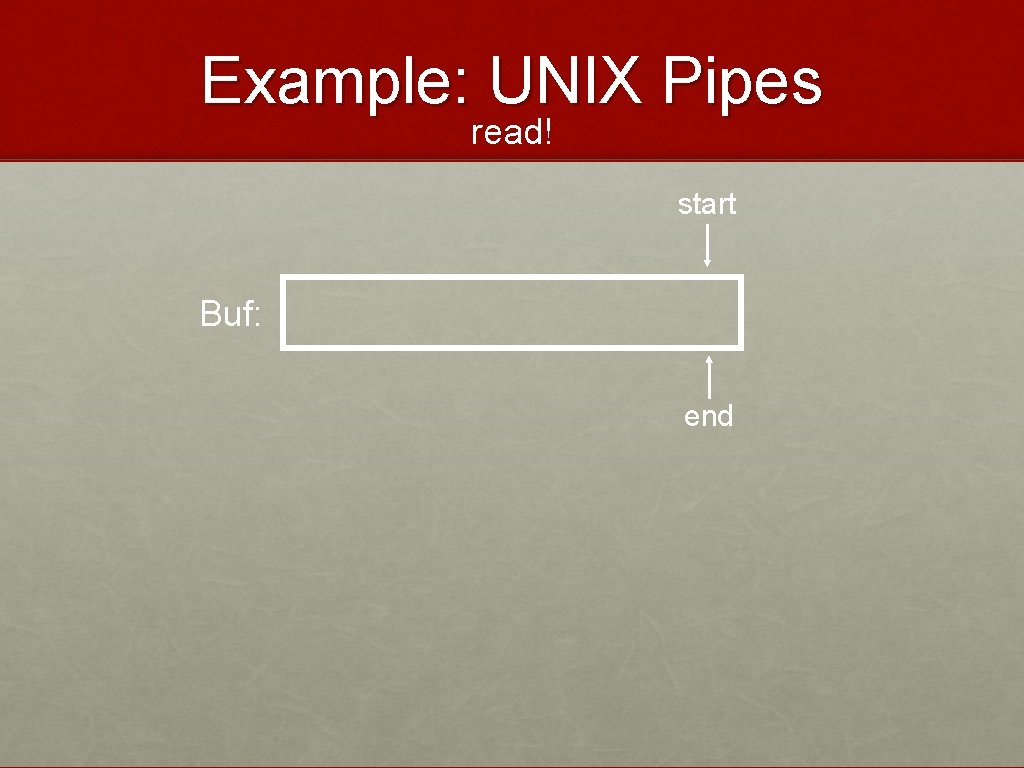
Bounded buffer • A bounded buffer is used when you pipe the output of one program into another. • Example: grep foo file. txt | wc –l • The grep process is the producer. • The wc process is the consumer. • Between them is an in-kernel bounded buffer. • Bounded buffer is Shared resource Synchronized access is required. 17
Example: UNIX Pipes start Buf: end
Example: UNIX Pipes write! start Buf: end
Example: UNIX Pipes start Buf: end
Example: UNIX Pipes write! start Buf: end
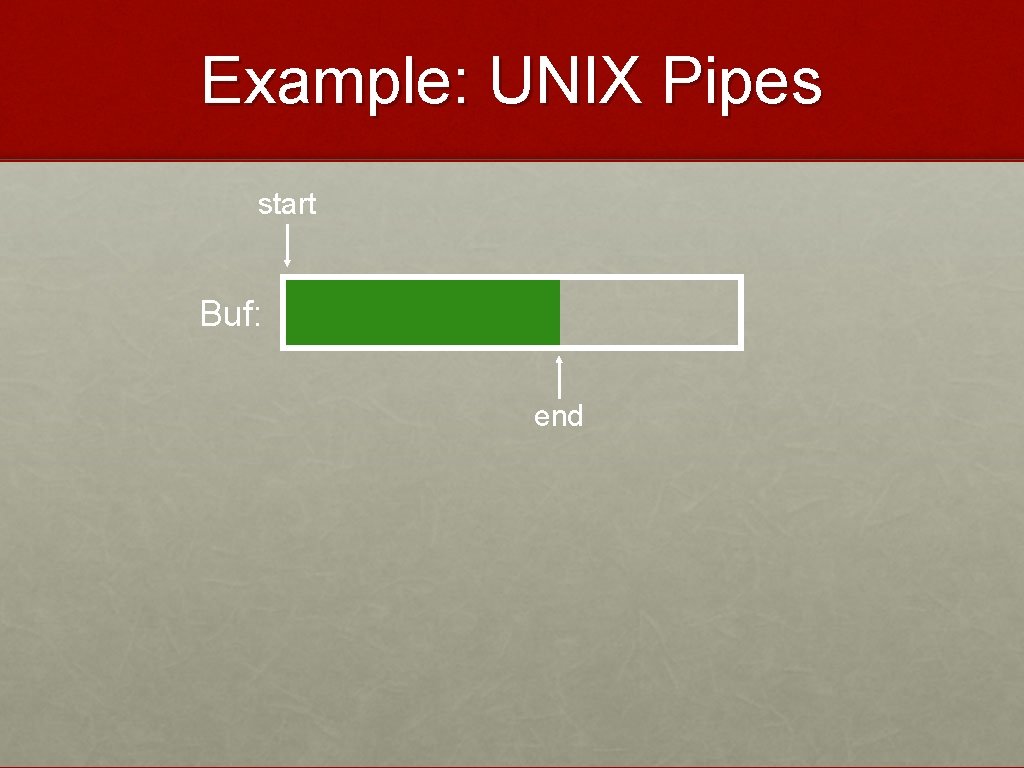
Example: UNIX Pipes start Buf: end
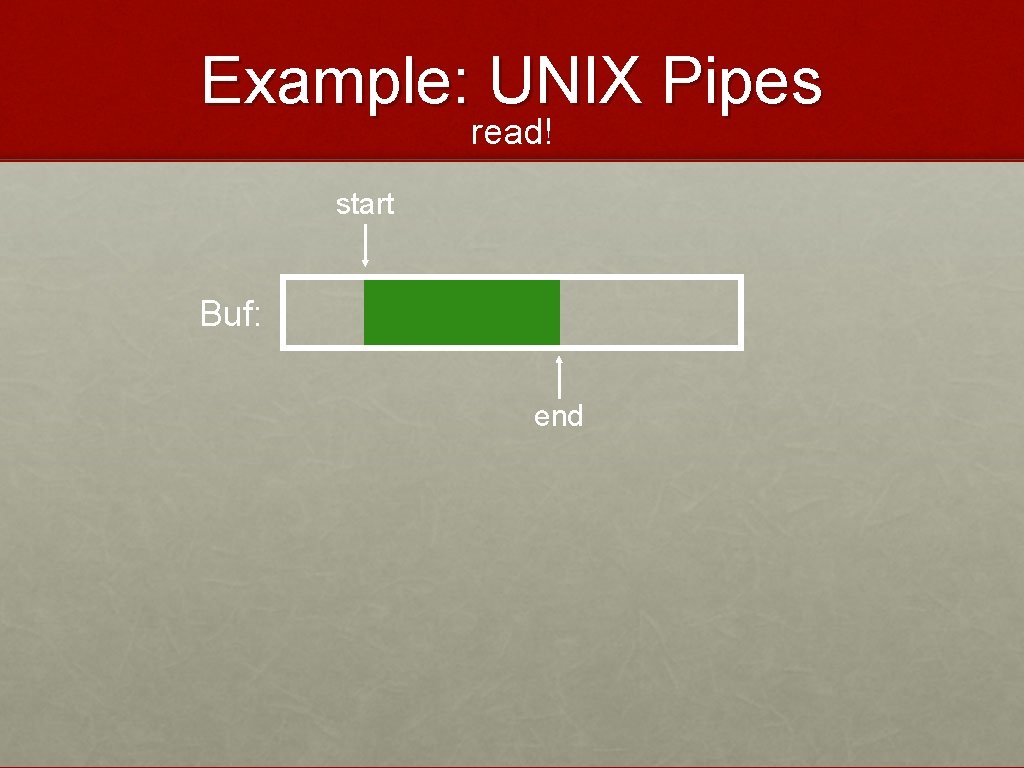
Example: UNIX Pipes read! start Buf: end
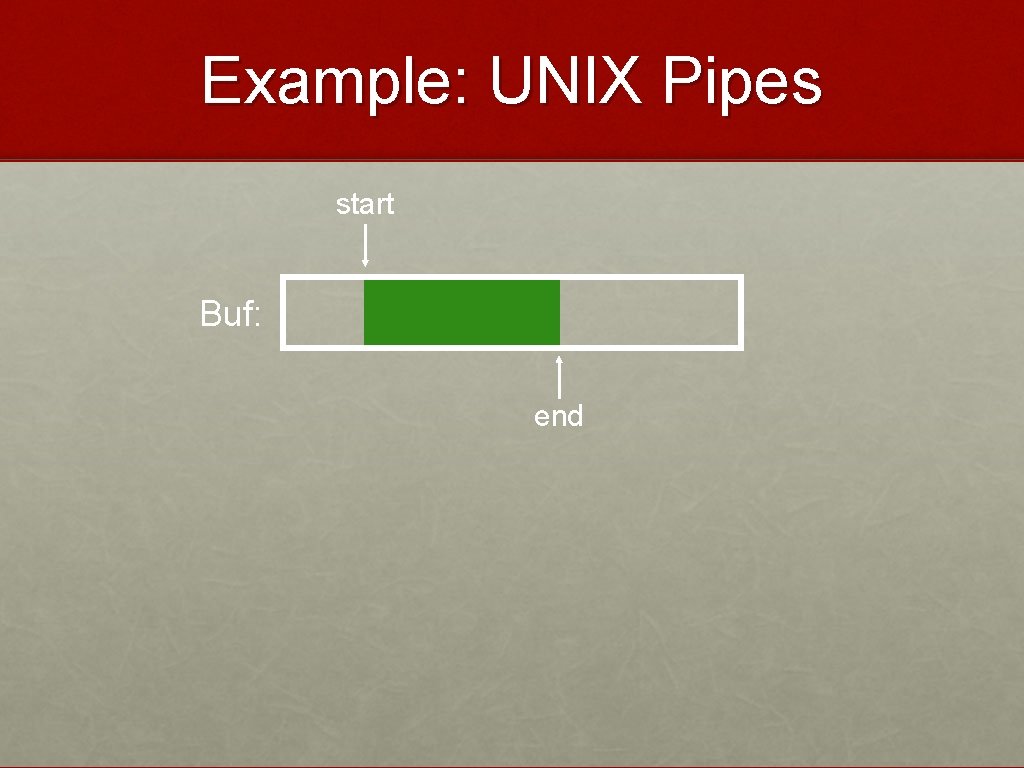
Example: UNIX Pipes start Buf: end
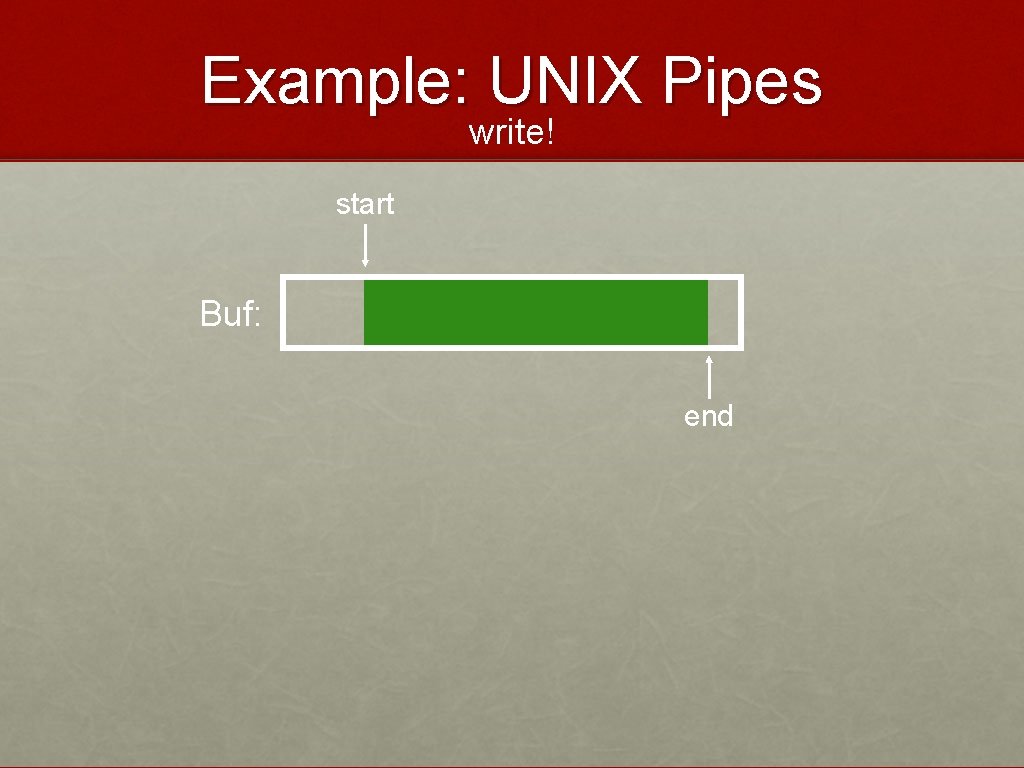
Example: UNIX Pipes write! start Buf: end
Example: UNIX Pipes start Buf: end
Example: UNIX Pipes read! start Buf: end
Example: UNIX Pipes start Buf: end
Example: UNIX Pipes read! start Buf: end
Example: UNIX Pipes start Buf: end
Example: UNIX Pipes read! start Buf: end
Example: UNIX Pipes read! start Buf: end note: readers must wait
Example: UNIX Pipes start Buf: end
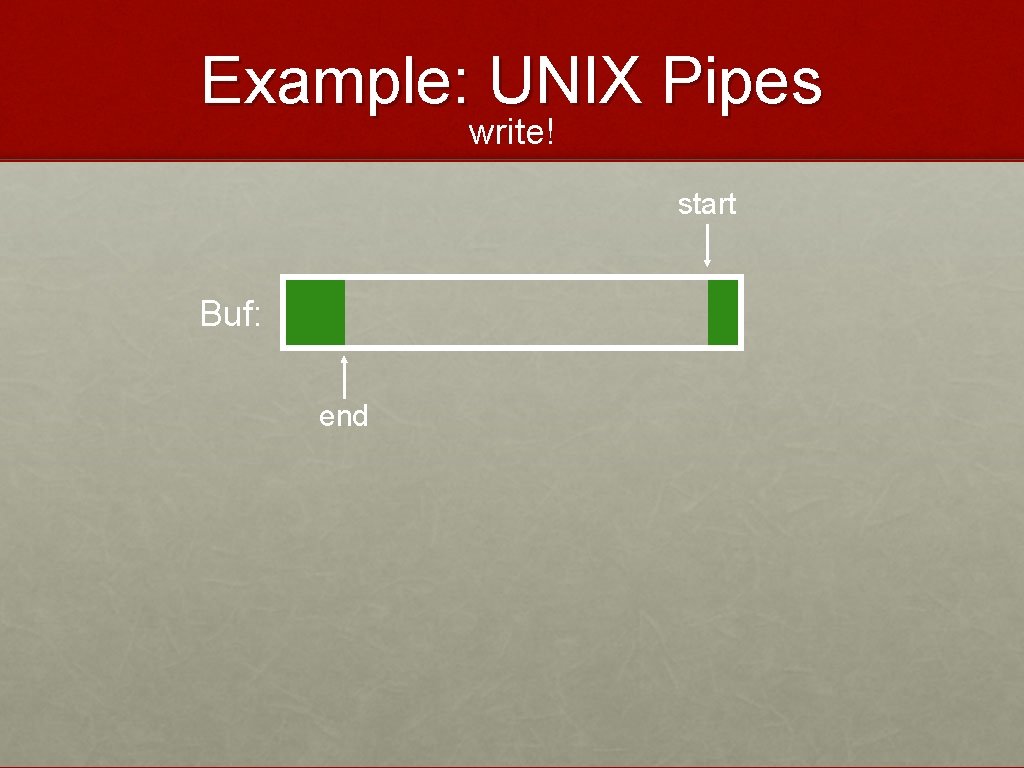
Example: UNIX Pipes write! start Buf: end
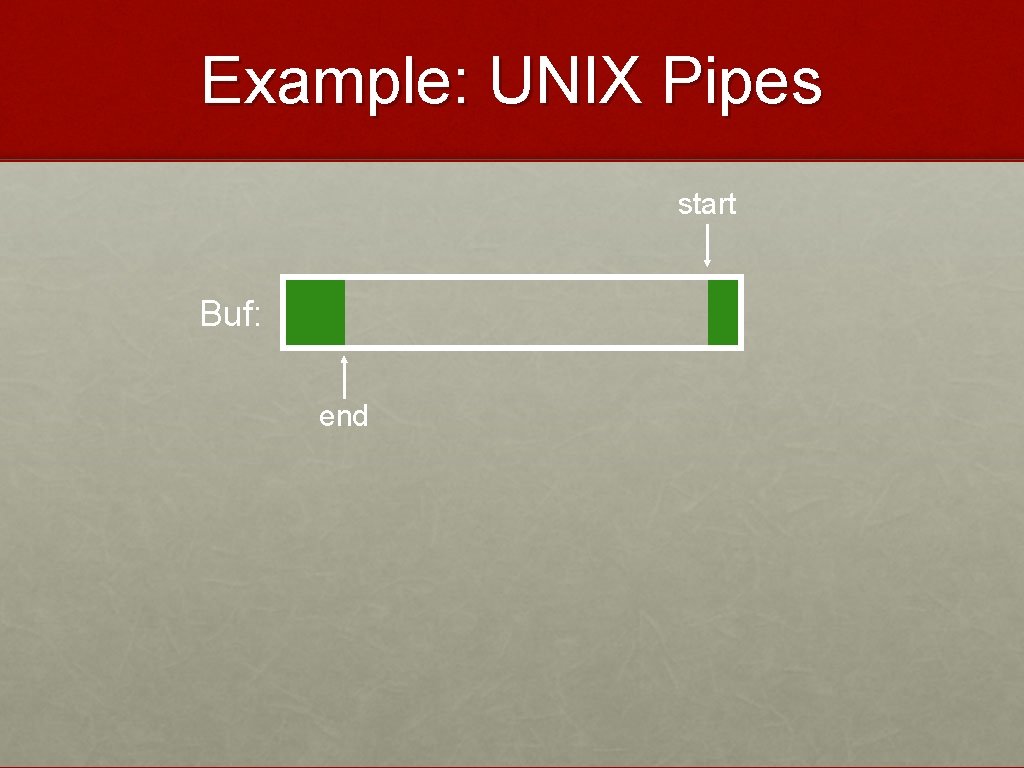
Example: UNIX Pipes start Buf: end
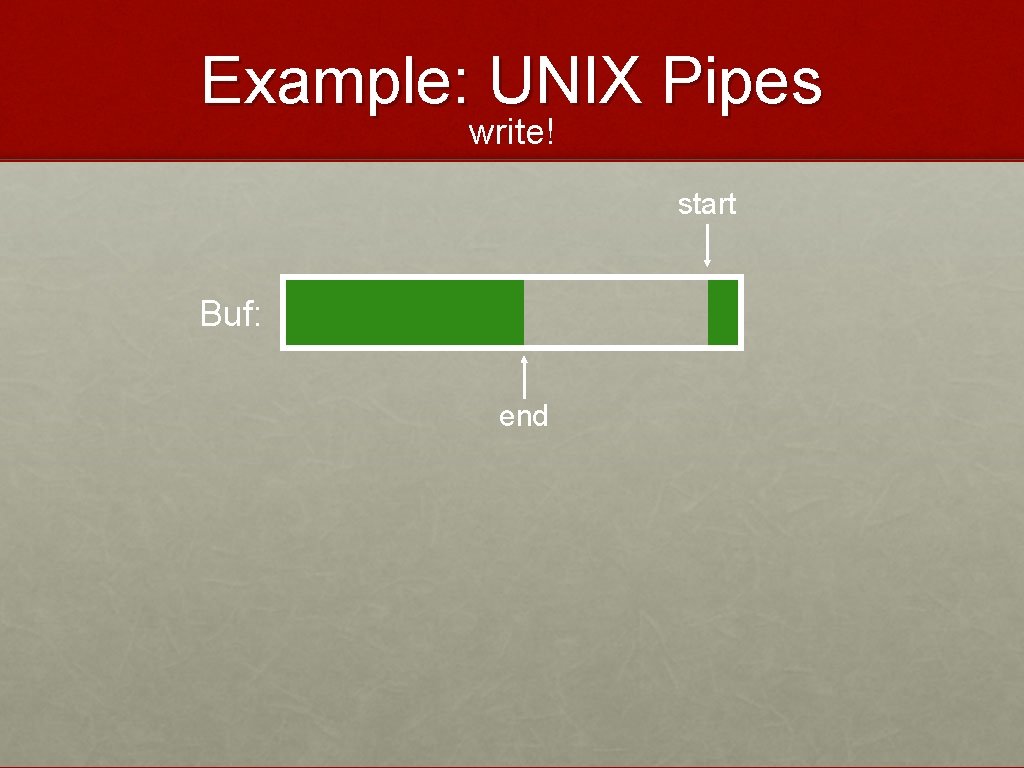
Example: UNIX Pipes write! start Buf: end
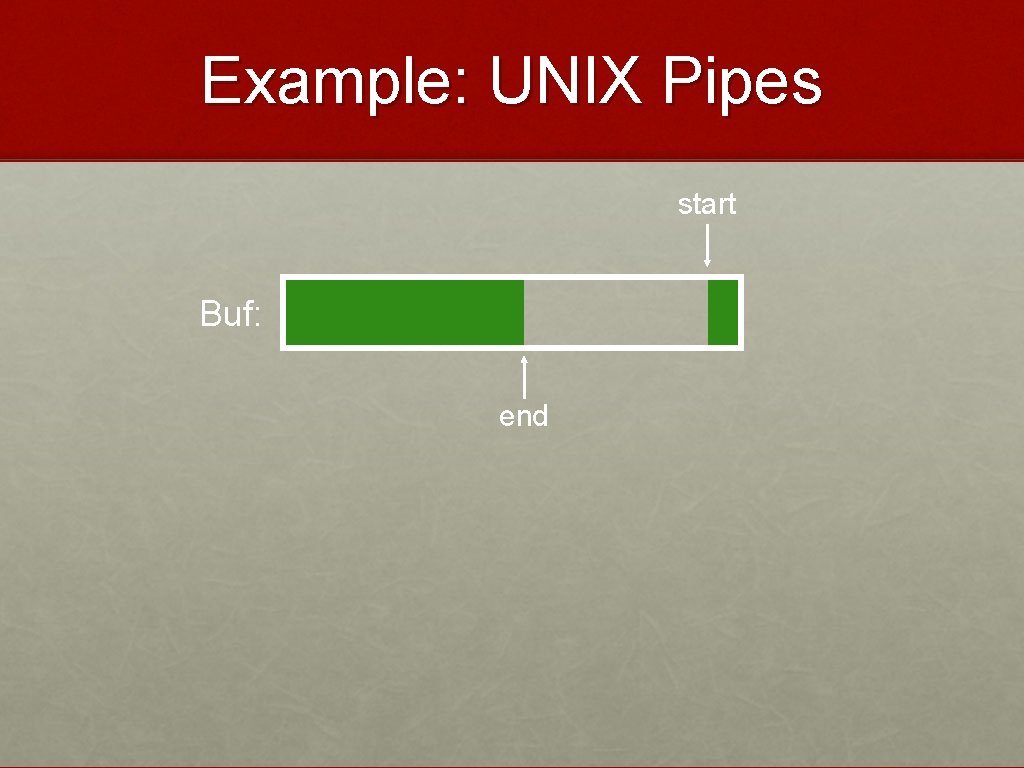
Example: UNIX Pipes start Buf: end
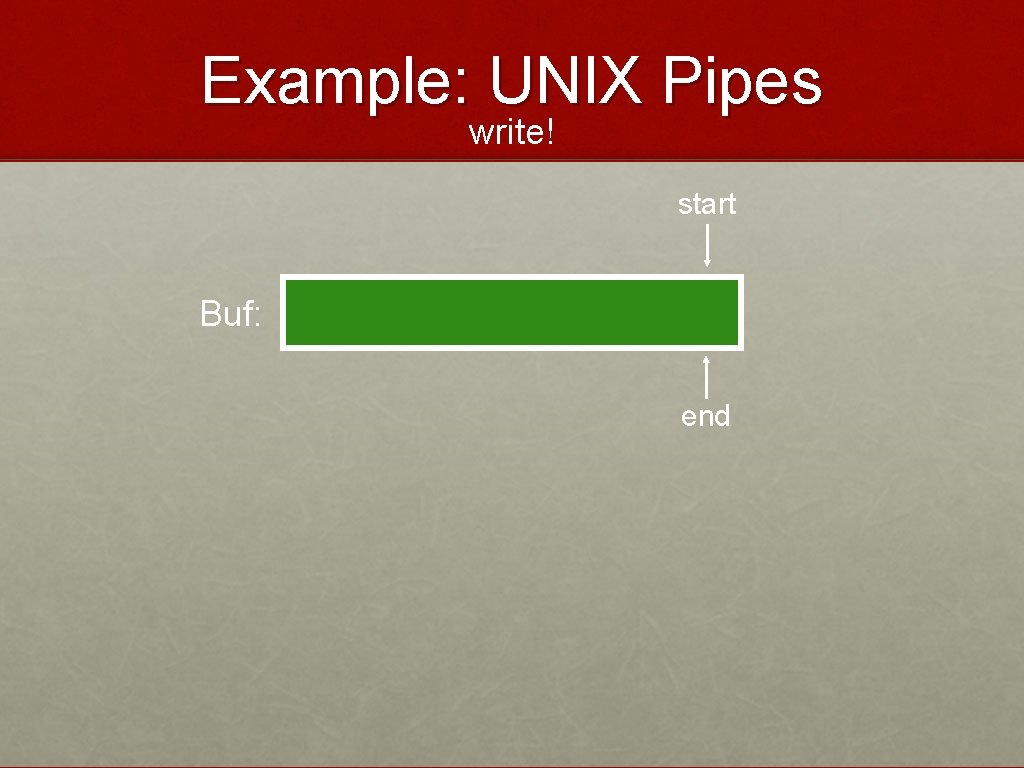
Example: UNIX Pipes write! start Buf: end
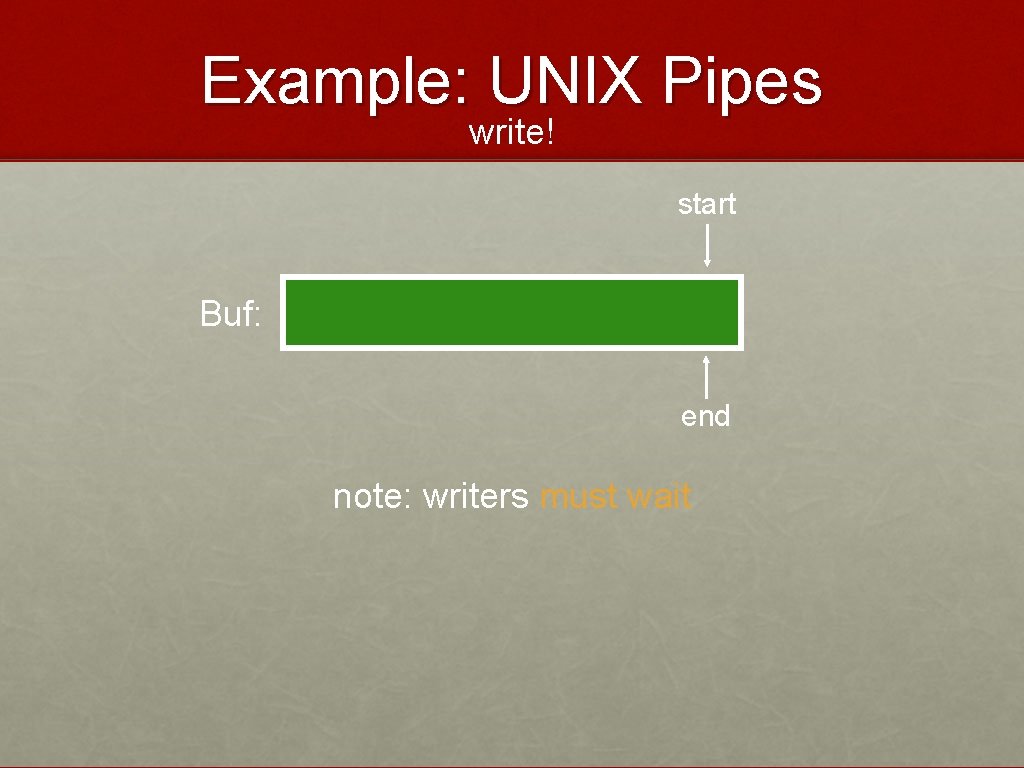
Example: UNIX Pipes write! start Buf: end note: writers must wait
Example: UNIX Pipes start Buf: end
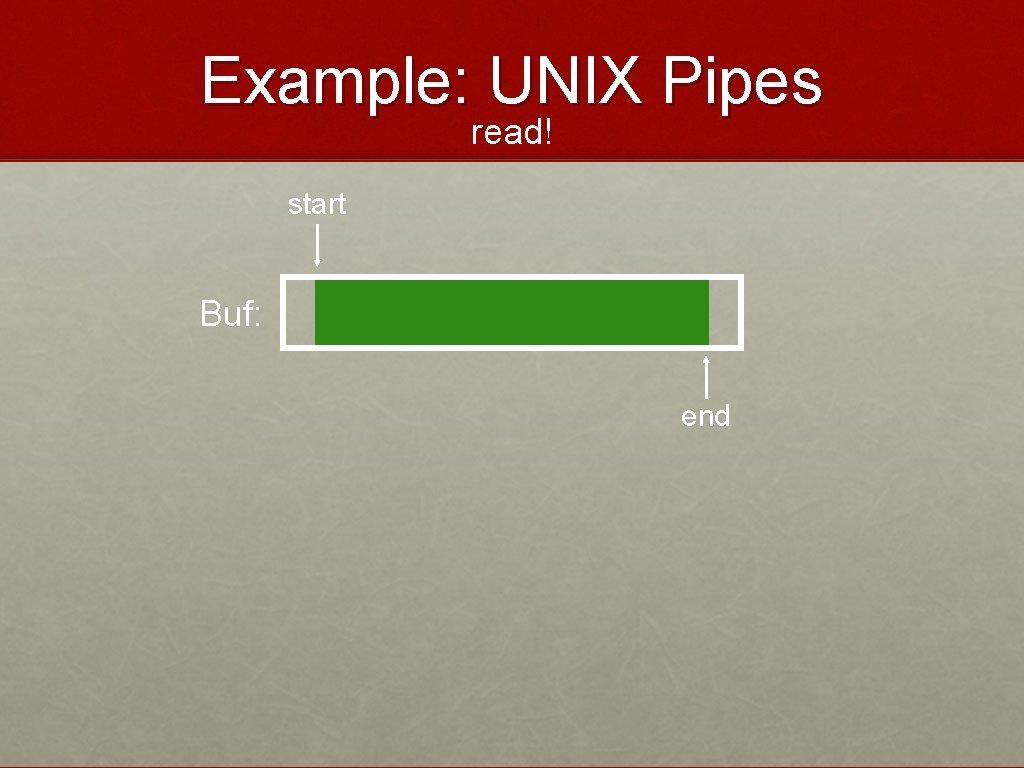
Example: UNIX Pipes read! start Buf: end
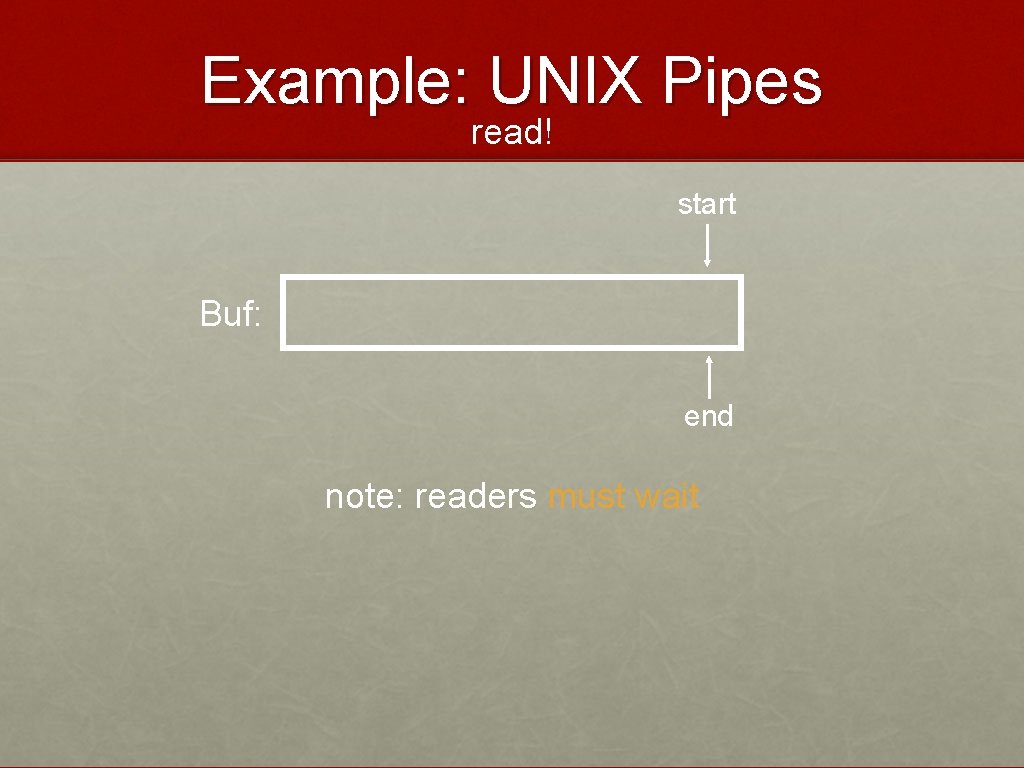
Implementation - reads/writes to buffer require locking - when buffers are full, writers must wait - when buffers are empty, readers must wait
Implementation Start with easy case: • • • 1 producer thread 1 consumer thread 1 shared buffer to fill/consume (max = 1) Numfill = number of buffers currently filled Examine slightly broken code to begin…
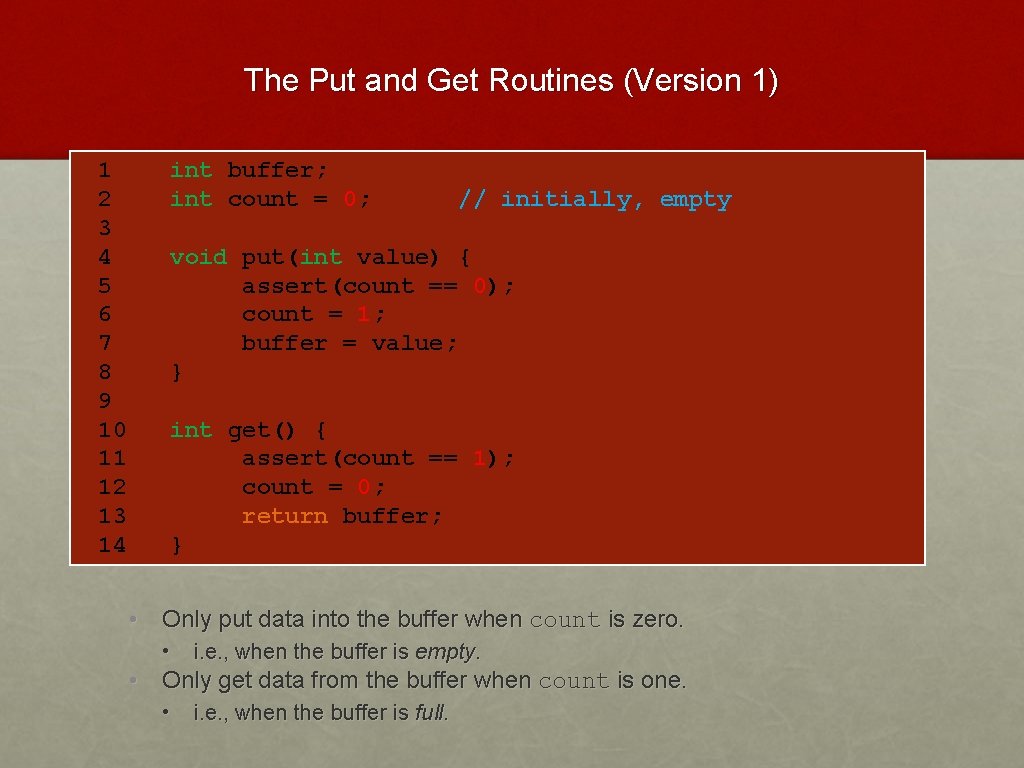
The Put and Get Routines (Version 1) 1 2 3 4 5 6 7 8 9 10 11 12 13 14 int buffer; int count = 0; // initially, empty void put(int value) { assert(count == 0); count = 1; buffer = value; } int get() { assert(count == 1); count = 0; return buffer; } • Only put data into the buffer when count is zero. • i. e. , when the buffer is empty. • Only get data from the buffer when count is one. • i. e. , when the buffer is full.
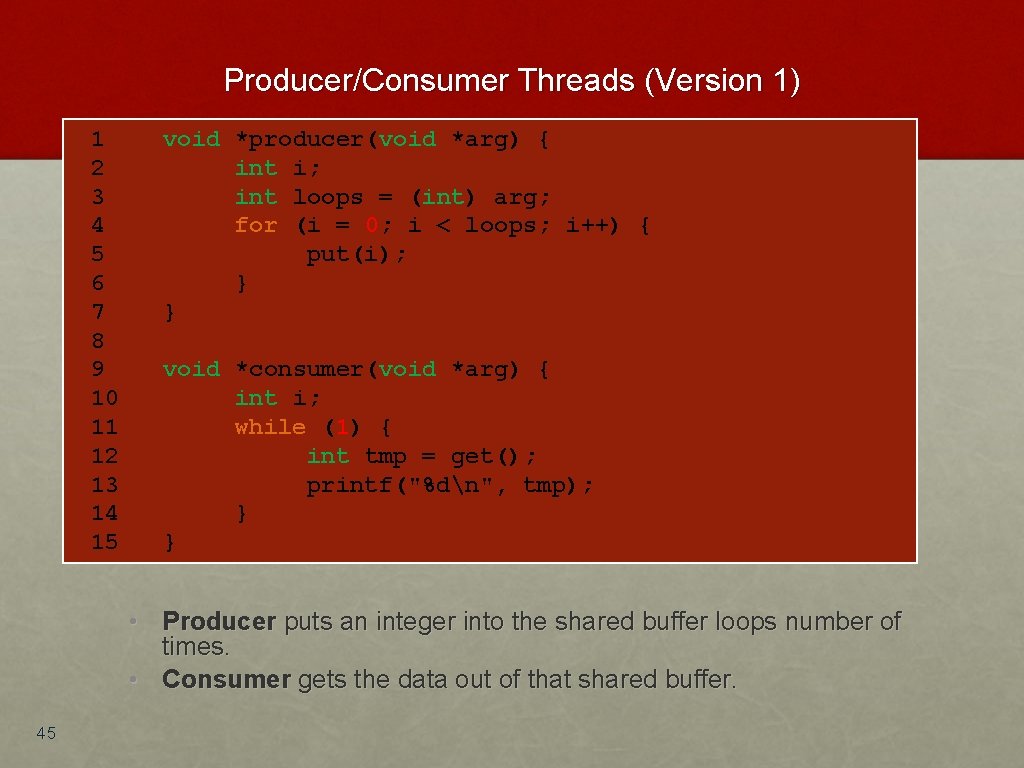
Producer/Consumer Threads (Version 1) 1 2 3 4 5 6 7 8 9 10 11 12 13 14 15 void *producer(void *arg) { int i; int loops = (int) arg; for (i = 0; i < loops; i++) { put(i); } } void *consumer(void *arg) { int i; while (1) { int tmp = get(); printf("%dn", tmp); } } • Producer puts an integer into the shared buffer loops number of times. • Consumer gets the data out of that shared buffer. 45
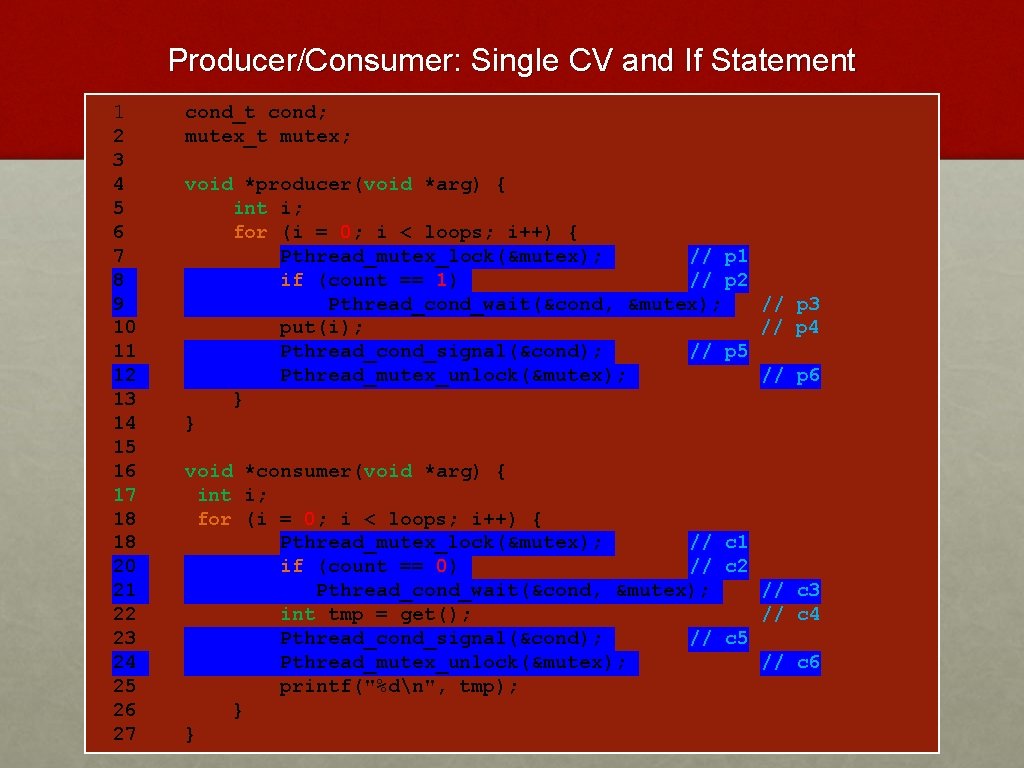
Producer/Consumer: Single CV and If Statement 1 2 3 4 5 6 7 8 9 10 11 12 13 14 15 16 17 18 18 20 21 22 23 24 25 26 27 cond_t cond; mutex_t mutex; void *producer(void *arg) { int i; for (i = 0; i < loops; i++) { Pthread_mutex_lock(&mutex); // p 1 if (count == 1) // p 2 Pthread_cond_wait(&cond, &mutex); // p 3 put(i); // p 4 Pthread_cond_signal(&cond); // p 5 Pthread_mutex_unlock(&mutex); // p 6 } } • A single condition variable cond associated lock mutex void *consumer(void *arg) { int i; for (i = 0; i < loops; i++) { Pthread_mutex_lock(&mutex); // c 1 if (count == 0) // c 2 Pthread_cond_wait(&cond, &mutex); // c 3 int tmp = get(); // c 4 Pthread_cond_signal(&cond); // c 5 Pthread_mutex_unlock(&mutex); // c 6 printf("%dn", tmp); } }
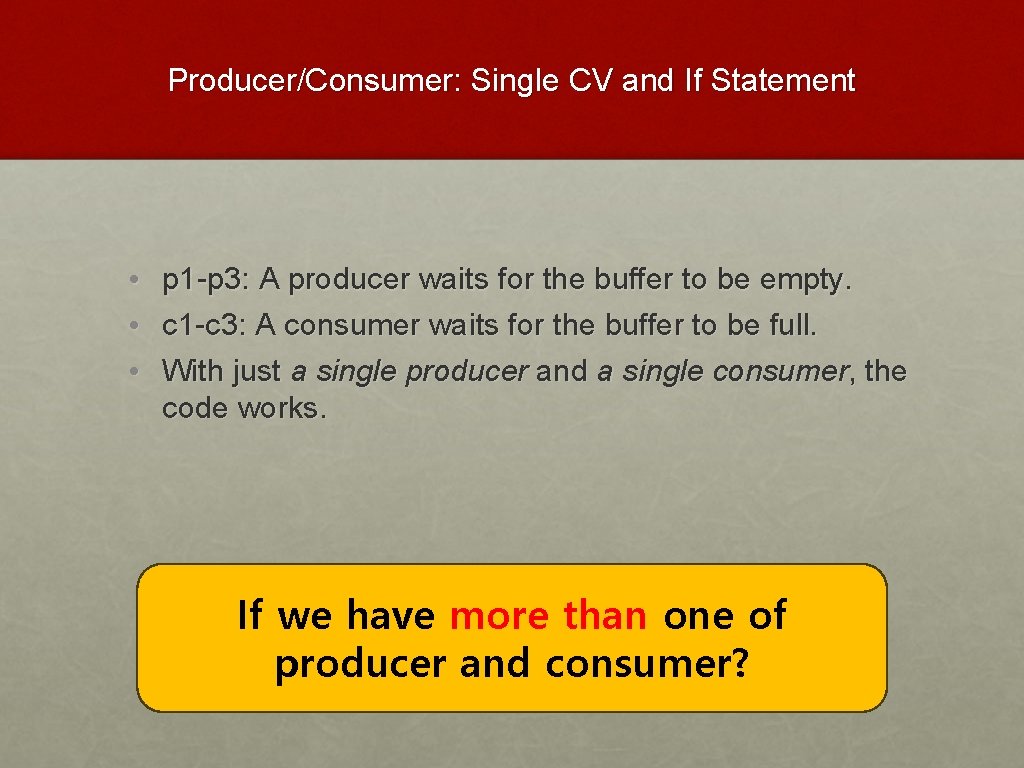
Producer/Consumer: Single CV and If Statement • • • p 1 -p 3: A producer waits for the buffer to be empty. c 1 -c 3: A consumer waits for the buffer to be full. With just a single producer and a single consumer, the code works. If we have more than one of producer and consumer?
What about 2 consumers? Can you find a problematic timeline with 2 consumers (still 1 producer)?
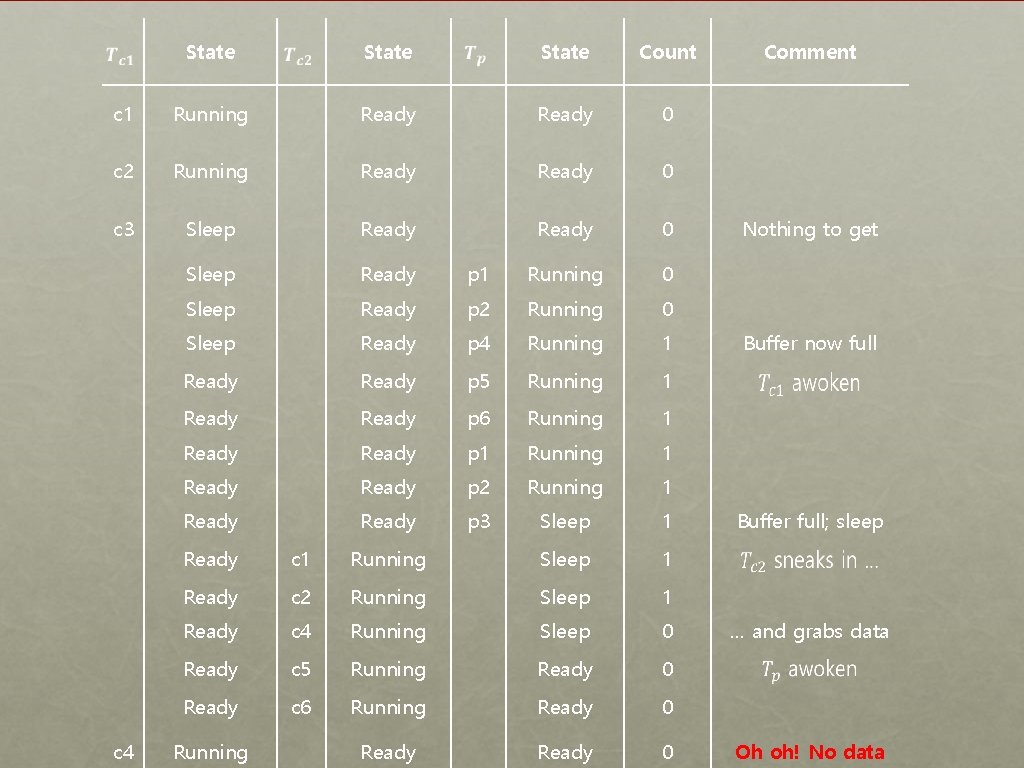
State Count c 1 Running Ready 0 c 2 Running Ready 0 c 3 Sleep Ready 0 Sleep Ready p 1 Running 0 Sleep Ready p 2 Running 0 Sleep Ready p 4 Running 1 Ready p 5 Running 1 Ready p 6 Running 1 Ready p 1 Running 1 Ready p 2 Running 1 Ready p 3 Sleep 1 c 4 Ready c 1 Running Sleep 1 Ready c 2 Running Sleep 1 Ready c 4 Running Sleep 0 Ready c 5 Running Ready 0 Ready c 6 Running Ready 0 Running Comment Nothing to get Buffer now full Buffer full; sleep … and grabs data Oh oh! No data
Thread Trace: Broken Solution (Version 1) •
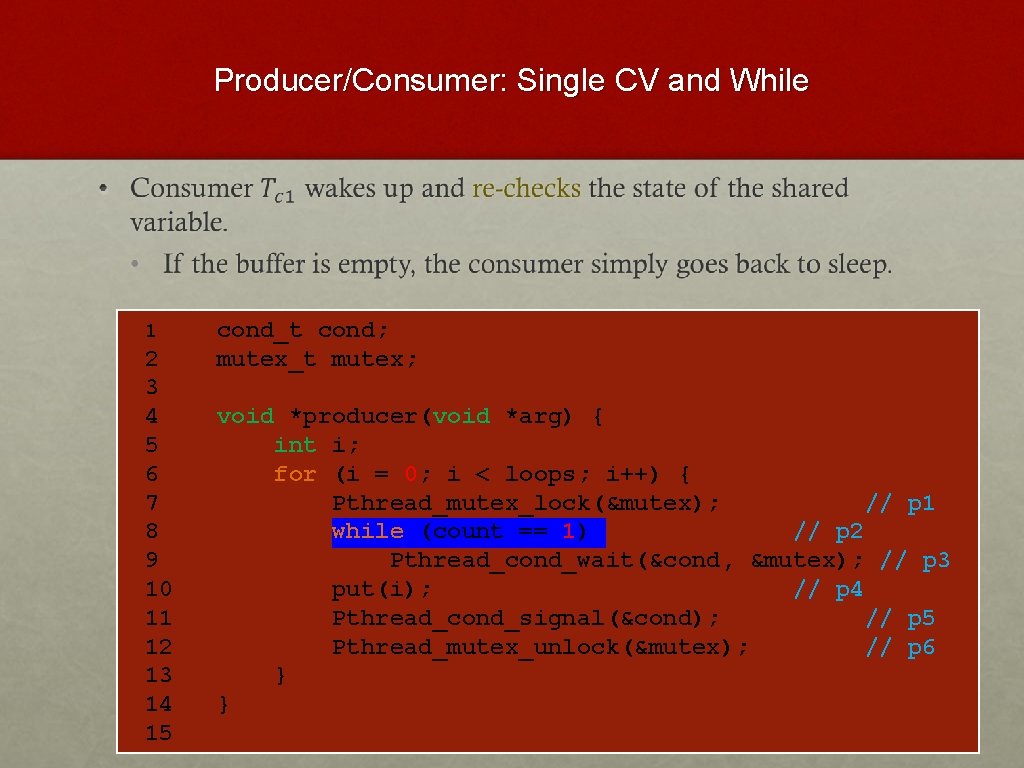
Producer/Consumer: Single CV and While • 1 2 3 4 5 6 7 8 9 10 11 12 13 14 15 cond_t cond; mutex_t mutex; void *producer(void *arg) { int i; for (i = 0; i < loops; i++) { Pthread_mutex_lock(&mutex); // p 1 while (count == 1) // p 2 Pthread_cond_wait(&cond, &mutex); // p 3 put(i); // p 4 Pthread_cond_signal(&cond); // p 5 Pthread_mutex_unlock(&mutex); // p 6 } }
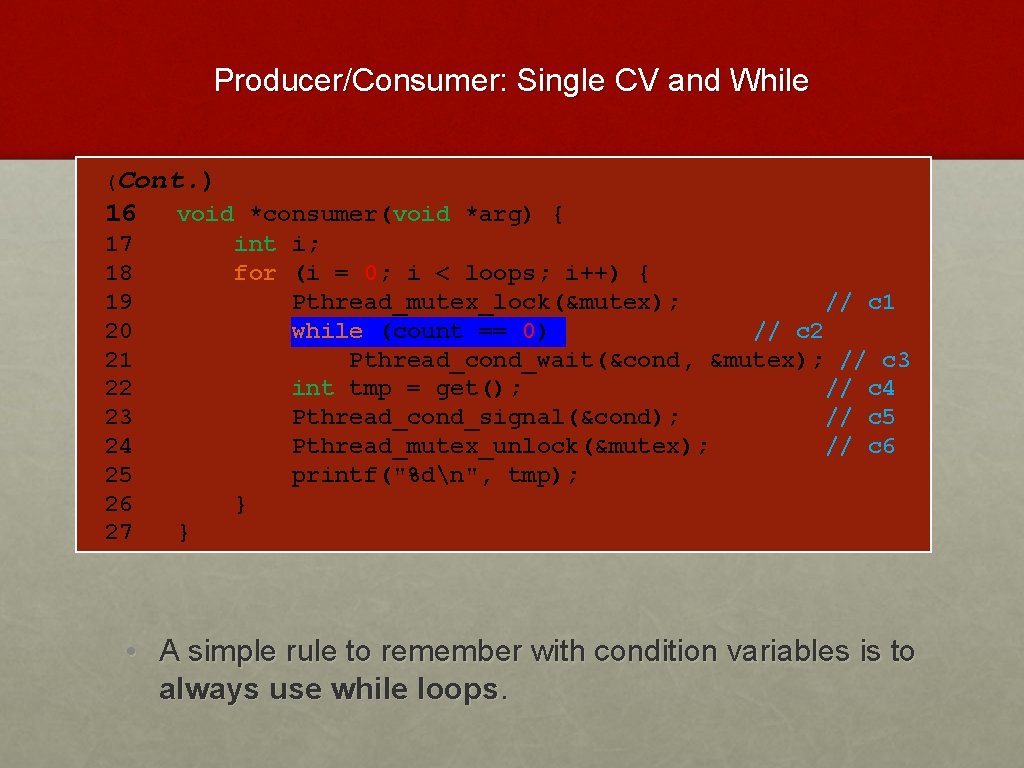
Producer/Consumer: Single CV and While (Cont. ) 16 17 18 19 20 21 22 23 24 25 26 27 void *consumer(void *arg) { int i; for (i = 0; i < loops; i++) { Pthread_mutex_lock(&mutex); // c 1 while (count == 0) // c 2 Pthread_cond_wait(&cond, &mutex); // c 3 int tmp = get(); // c 4 Pthread_cond_signal(&cond); // c 5 Pthread_mutex_unlock(&mutex); // c 6 printf("%dn", tmp); } } • A simple rule to remember with condition variables is to always use while loops.
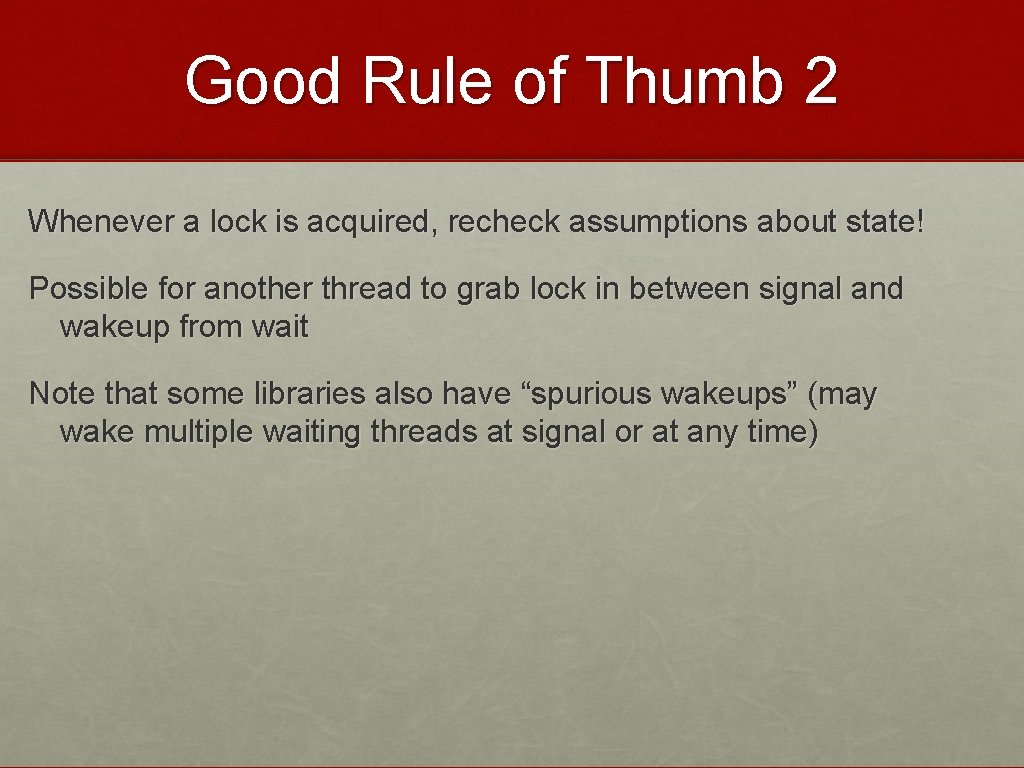
Good Rule of Thumb 2 Whenever a lock is acquired, recheck assumptions about state! Possible for another thread to grab lock in between signal and wakeup from wait Note that some libraries also have “spurious wakeups” (may wake multiple waiting threads at signal or at any time)
What about 2 consumers? Can you find a problematic timeline with 2 consumers (still 1 producer)?
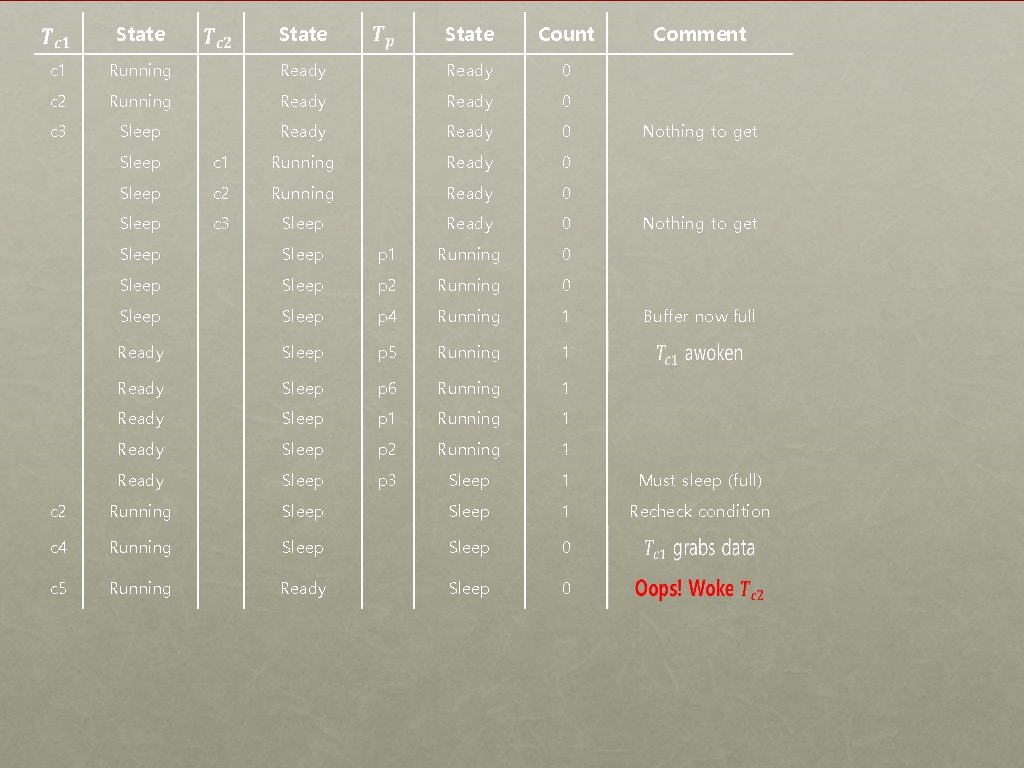
State Count c 1 Running Ready 0 c 2 Running Ready 0 c 3 Sleep Ready 0 Sleep c 1 Running Ready 0 Sleep c 2 Running Ready 0 Sleep c 3 Sleep Ready 0 Comment Nothing to get Sleep p 1 Running 0 Sleep p 2 Running 0 Sleep p 4 Running 1 Ready Sleep p 5 Running 1 Ready Sleep p 6 Running 1 Ready Sleep p 1 Running 1 Ready Sleep p 2 Running 1 Ready Sleep p 3 Sleep 1 Must sleep (full) c 2 Running Sleep 1 Recheck condition c 4 Running Sleep 0 c 5 Running Ready Sleep 0 Buffer now full
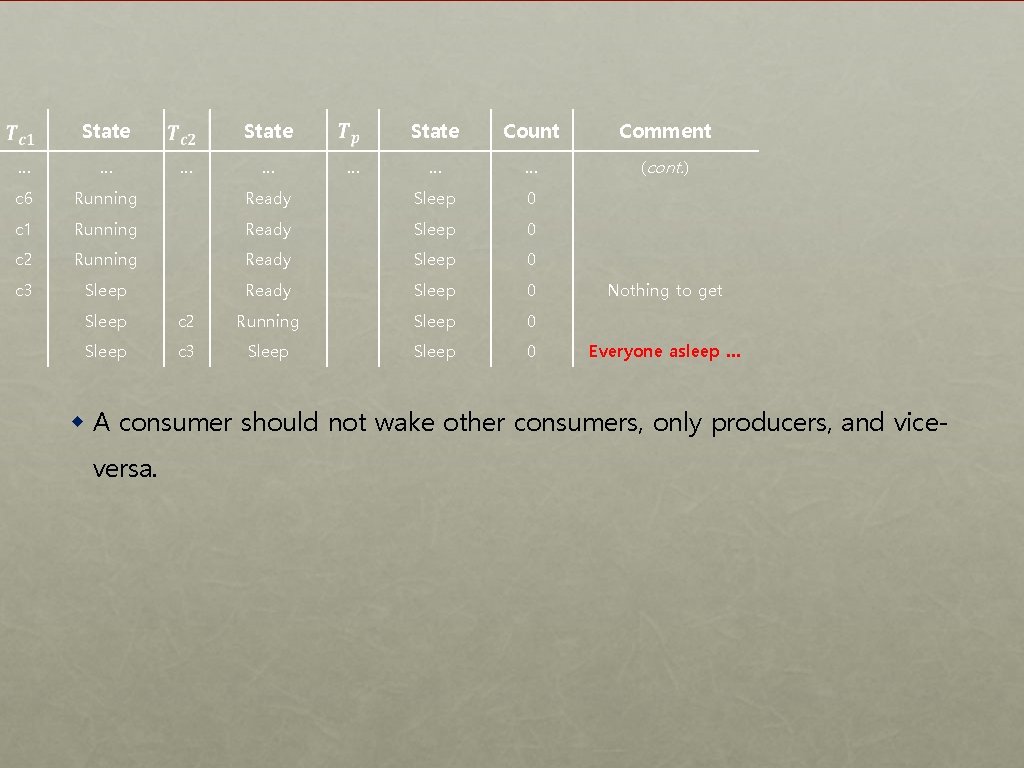
State … … … State Count Comment … … (cont. ) … … c 6 Running Ready Sleep 0 c 1 Running Ready Sleep 0 c 2 Running Ready Sleep 0 c 3 Sleep Ready Sleep 0 Sleep c 2 Running Sleep 0 Sleep c 3 Sleep 0 Nothing to get Everyone asleep … A consumer should not wake other consumers, only producers, and viceversa.
The single Buffer Producer/Consumer Solution • Use two condition variables and while • Producer threads wait on the condition empty, and signals fill. • Consumer threads wait on fill and signal empty. 57
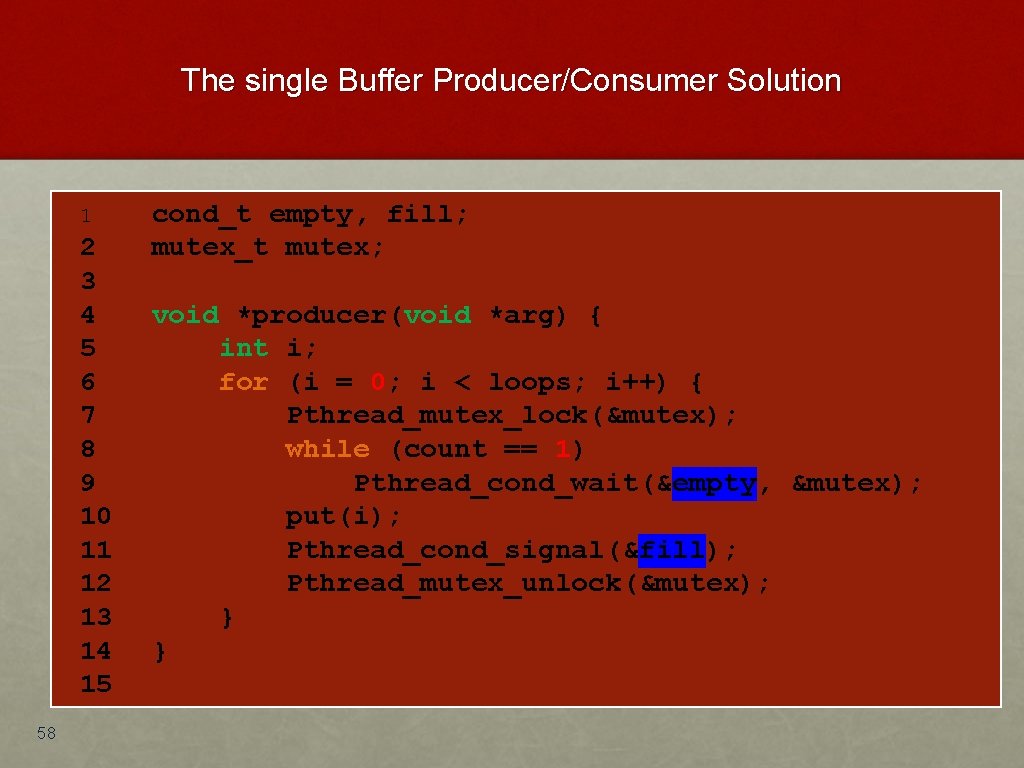
The single Buffer Producer/Consumer Solution 1 2 3 4 5 6 7 8 9 10 11 12 13 14 15 58 cond_t empty, fill; mutex_t mutex; void *producer(void *arg) { int i; for (i = 0; i < loops; i++) { Pthread_mutex_lock(&mutex); while (count == 1) Pthread_cond_wait(&empty, &mutex); put(i); Pthread_cond_signal(&fill); Pthread_mutex_unlock(&mutex); } }
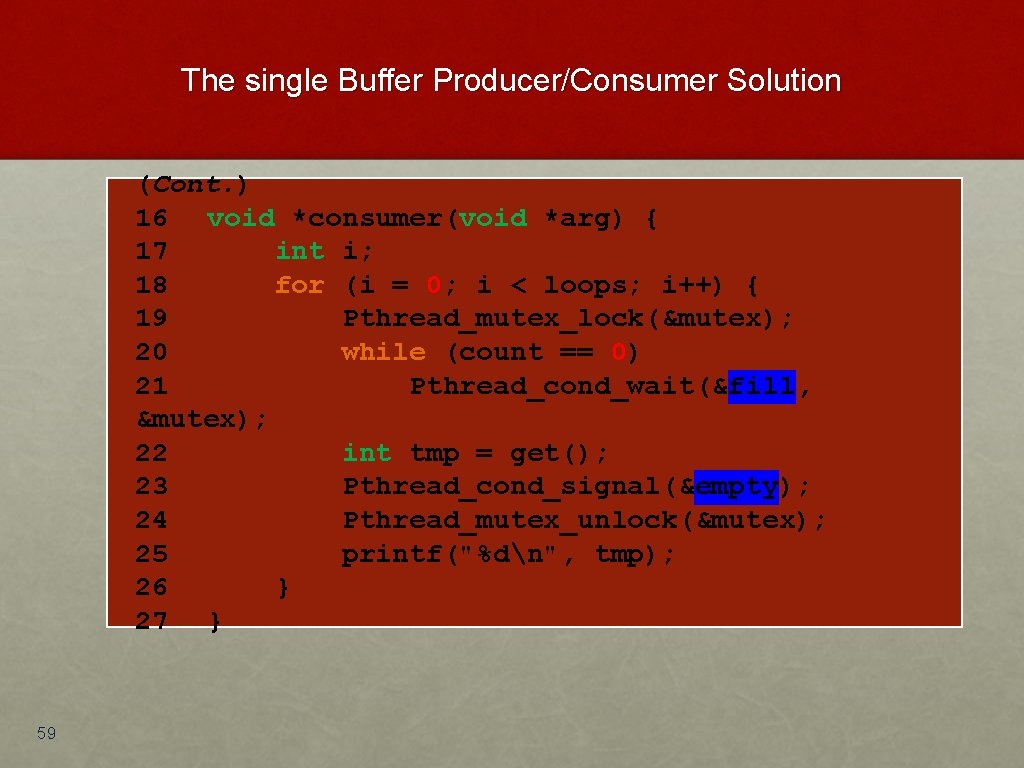
The single Buffer Producer/Consumer Solution (Cont. ) 16 void *consumer(void *arg) { 17 int i; 18 for (i = 0; i < loops; i++) { 19 Pthread_mutex_lock(&mutex); 20 while (count == 0) 21 Pthread_cond_wait(&fill, &mutex); 22 int tmp = get(); 23 Pthread_cond_signal(&empty); 24 Pthread_mutex_unlock(&mutex); 25 printf("%dn", tmp); 26 } 27 } 59
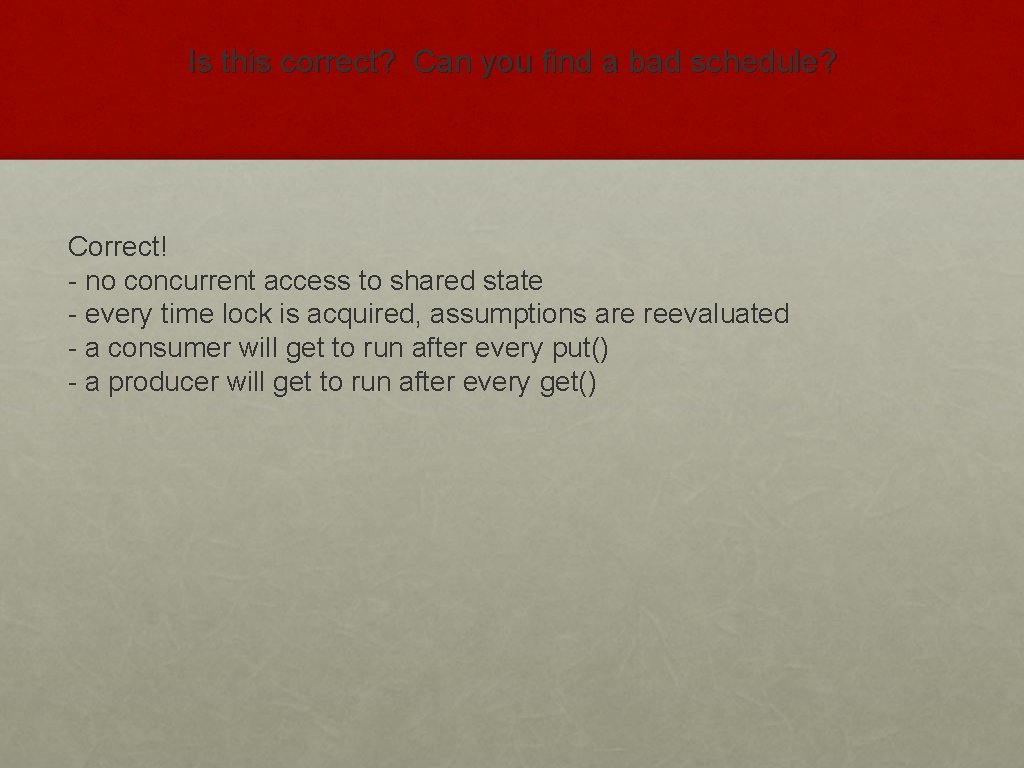
Is this correct? Can you find a bad schedule? Correct! - no concurrent access to shared state - every time lock is acquired, assumptions are reevaluated - a consumer will get to run after every put() - a producer will get to run after every get()
The Final Producer/Consumer Solution • More concurrency and efficiency Add more buffer slots. • Allow concurrent production or consuming to take place. • Reduce context switches. 61
![Add more buffer slots 1 int buffer[MAX]; 2 int fill = 0; intconcurrency use](http://slidetodoc.com/presentation_image_h2/51fa659fe8d0045f08034e45dc79c49f/image-62.jpg "Add more buffer slots 1 int buffer[MAX]; 2 int fill = 0; intconcurrency use")
Add more buffer slots 1 int buffer[MAX]; 2 int fill = 0; intconcurrency use = 0; • 3 More and efficiency Add more 4 int count = 0; 5 buffer slots. 6 • Allow void concurrent put(int value) { production or consuming to take place. 7 buffer[fill] = value; context switches. 8 • Reduce fill = (fill + 1) % MAX; 9 count++; 10 } 11 12 int get() { 13 int tmp = buffer[use]; 14 use = (use + 1) % MAX; 15 count--; 16 return tmp; 17 } The Final Put and Get Routines
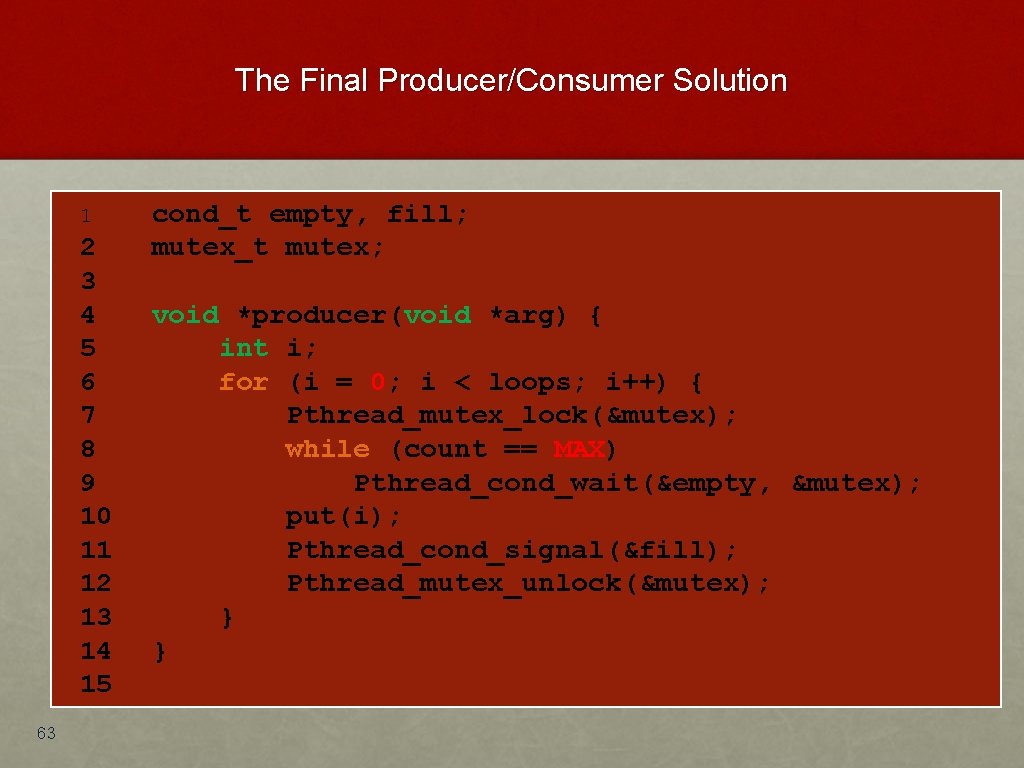
The Final Producer/Consumer Solution 1 2 3 4 5 6 7 8 9 10 11 12 13 14 15 63 cond_t empty, fill; mutex_t mutex; void *producer(void *arg) { int i; for (i = 0; i < loops; i++) { Pthread_mutex_lock(&mutex); while (count == MAX) Pthread_cond_wait(&empty, &mutex); put(i); Pthread_cond_signal(&fill); Pthread_mutex_unlock(&mutex); } }
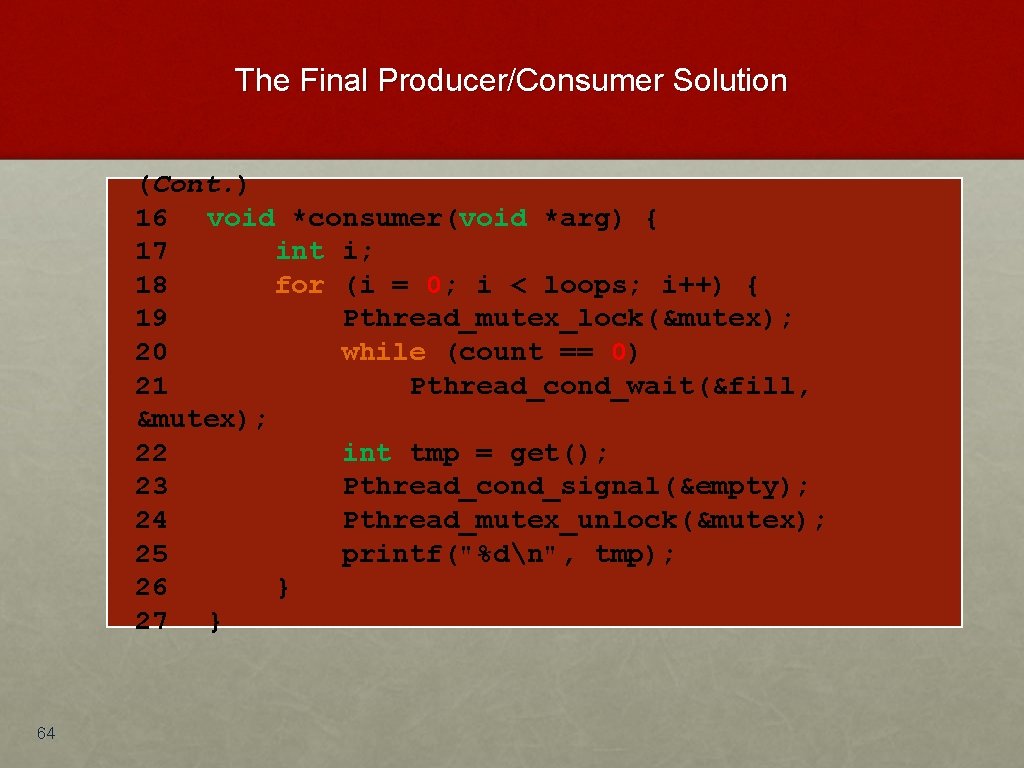
The Final Producer/Consumer Solution (Cont. ) 16 void *consumer(void *arg) { 17 int i; 18 for (i = 0; i < loops; i++) { 19 Pthread_mutex_lock(&mutex); 20 while (count == 0) 21 Pthread_cond_wait(&fill, &mutex); 22 int tmp = get(); 23 Pthread_cond_signal(&empty); 24 Pthread_mutex_unlock(&mutex); 25 printf("%dn", tmp); 26 } 27 } 64
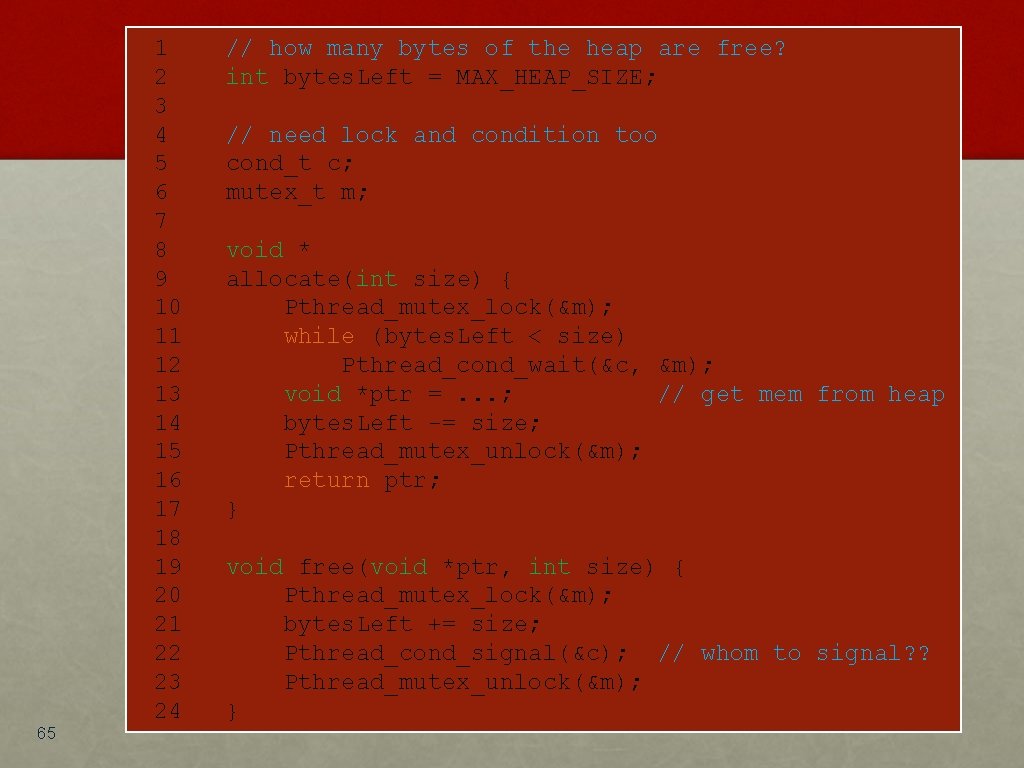
65 1 2 3 4 5 6 7 8 9 10 11 12 13 14 15 16 17 18 19 20 21 22 23 24 // how many bytes of the heap are free? int bytes. Left MAX_HEAP_SIZE; Covering= Conditions (Cont. ) // need lock and condition too cond_t c; mutex_t m; void * allocate(int size) { Pthread_mutex_lock(&m); while (bytes. Left < size) Pthread_cond_wait(&c, &m); void *ptr =. . . ; // get mem from heap bytes. Left -= size; Pthread_mutex_unlock(&m); return ptr; } void free(void *ptr, int size) { Pthread_mutex_lock(&m); bytes. Left += size; Pthread_cond_signal(&c); // whom to signal? ? Pthread_mutex_unlock(&m); }
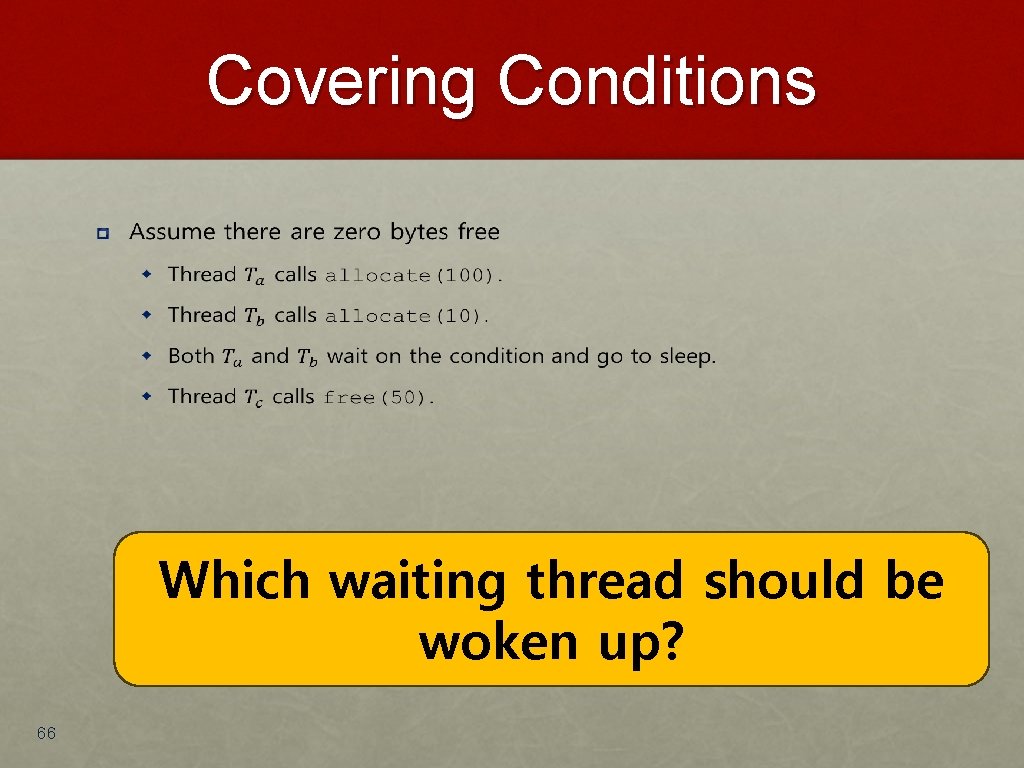
Covering Conditions • Which waiting thread should be woken up? 66
How to wake the right thread? wake all the threads!
Covering Conditions (Cont. ) • Solution (Suggested by Lampson and Redell) • Replace pthread_cond_signal() with pthread_cond_broadcast() • • • 68 Wake up all waiting threads. Cost: too many threads might be woken. Threads that shouldn’t be awake will simply wake up, recheck the condition, and then go back to sleep.
Summary: rules of thumb for CVs Keep state in addition to CV’s Always do wait/signal with lock held Whenever thread wakes from waiting, recheck state
- Slides: 69