
Concussion Prevention A Parents Guideline What is a
- Slides: 12
Concussion Prevention A Parents Guideline
What is a Concussion? What is a concussion? A concussion is a traumatic brain injury that causes changes in how the brain functions, leading to signs and symptoms that can emerge immediately or in the hours or days after the injury. It is possible for symptoms to take up to 7 days to appear. What causes a concussion? A concussion may be caused by a jarring impact to the head, face, neck or body, with an impulsive force transmitted to the head, that causes the brain to move rapidly and hit the walls of the skull (for a visual description of how a concussion occurs, consult https: //cdn. hockeycanada. ca/hockeycanada/Hockey-Programs/Safety/Concussion/Infographic/english. html
How Can I Keep My Children or Teens Safe? Sports are a great way for children and teens to stay healthy and can help them do well in school. To help lower your children’s or teens’ chances of getting a concussion or other serious brain injury, you should: Ø Help create a culture of safety for the team Ø Emphasize the importance of reporting concussions and taking time to recover from one. Ø Ensure that they follow their coach’s rules for safety and the rules of the sport. Ø Tell your children or teens that you expect them to practice good sportsmanship at all times. Ø When appropriate for the sport or activity, teach your children or teens that they must wear a helmet to lower the chances of the most serious types of brain or head injury. There is no “concussion-proof” helmet. Even with a helmet, it is important for children and teens to avoid hits to the head.
How Can I Spot a Possible Concussion? Children and teens who show or respect one or more of the signs and symptoms listed below—or simply say they just “don’t feel right” after a bump, blow or jolt to the head or body—may have a concussion or other serious brain injury. Signs Observed by Parents: Appears dazed or stunned. Forgets an instruction, is confused about an assignment or position, or is unsure of the game, score or opponent. Moves clumsily. Loses consciousness (even briefly). Shows mood, behavior or personality changes. Cannot recall events prior to or after a hit or fall.
How Can I Spot a Possible Concussion Continued… Symptoms Reported by Children and Teens Headache or “pressure” in head. Nausea or vomiting Balance problems or dizziness, or double or blurry vision. Bothered by light or noise. Feeling sluggish, hazy, foggy or groggy. Confusion or concentration or memory problems. Just not “feeling right” or “feeling down”.
What Are Some More Serious Danger Signs to Look Out For? Call 9 -1 -1 right away if after a bump, blow, or jolt to the head or body, he or she has one or more of these RED FLAG signs: One pupil larger than the other. Drowsiness or inability to wake up. A headache that gets worse and does not go away. Slurred speech, weakness, numbness or decreased coordination. Vomiting or nausea, convulsions, or seizures (shaking or twitching). Unusual behavior, increased confusion, restlessness, combative or agitation. Loss of consciousness (passed out/knocked out). Even a brief loss of consciousness should be taken seriously. Deteriorating conscious state. Neck pain or tenderness.
Important Information Children and teens who continue to play while having concussion symptoms or who return to play too soon— while the brain is still healing—have a greater chance of getting another concussion. A repeat concussion that occurs while the brain is still healing from the first injury can be very serious and can affect a child or teen for a lifetime. It can even be fatal. If your child or teen has sustained a concussion outside of school, it is imperative the school is informed and TCDSB Concussion Protocol followed.
What Should I Do If My Child or Teen Has a Possible Concussion? As a parent, if you think your child or teen may have a concussion, you should: 1. Remove your child or teen from play. 2. If your child shows Red Flag symptoms, call 9 -1 -1. 3. Only a Health care provider should assess a child or teen for a possible concussion. 4. Discuss with your child or teen’s school (Collaborative Team) the Concussion Protocol and steps need to Return to Learn and Return to Physical Activity.
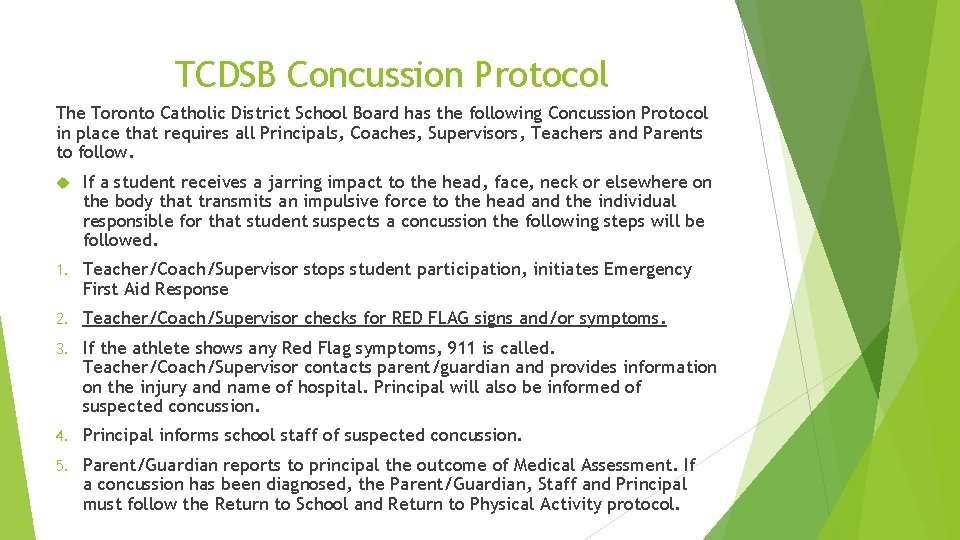
TCDSB Concussion Protocol The Toronto Catholic District School Board has the following Concussion Protocol in place that requires all Principals, Coaches, Supervisors, Teachers and Parents to follow. If a student receives a jarring impact to the head, face, neck or elsewhere on the body that transmits an impulsive force to the head and the individual responsible for that student suspects a concussion the following steps will be followed. 1. Teacher/Coach/Supervisor stops student participation, initiates Emergency First Aid Response 2. Teacher/Coach/Supervisor checks for RED FLAG signs and/or symptoms. 3. If the athlete shows any Red Flag symptoms, 911 is called. Teacher/Coach/Supervisor contacts parent/guardian and provides information on the injury and name of hospital. Principal will also be informed of suspected concussion. 4. Principal informs school staff of suspected concussion. 5. Parent/Guardian reports to principal the outcome of Medical Assessment. If a concussion has been diagnosed, the Parent/Guardian, Staff and Principal must follow the Return to School and Return to Physical Activity protocol.
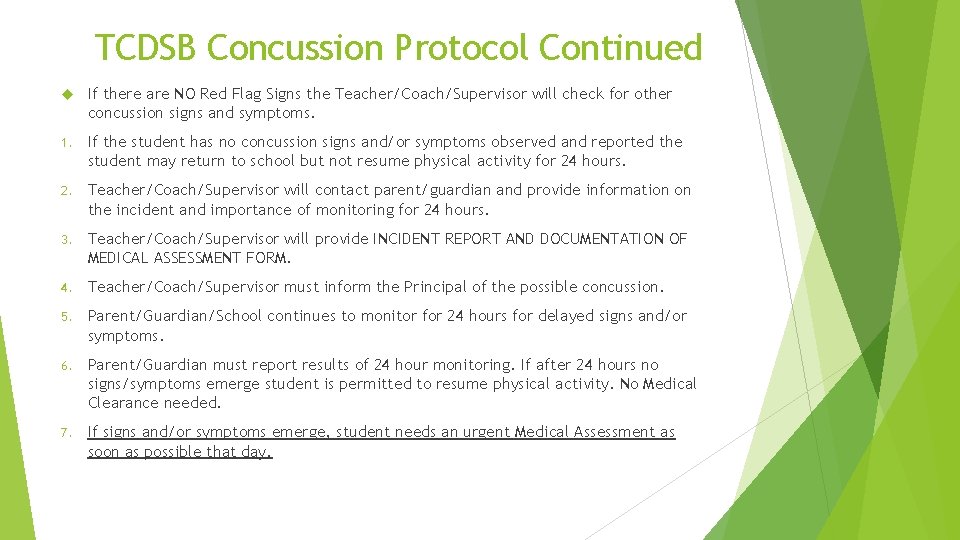
TCDSB Concussion Protocol Continued If there are NO Red Flag Signs the Teacher/Coach/Supervisor will check for other concussion signs and symptoms. 1. If the student has no concussion signs and/or symptoms observed and reported the student may return to school but not resume physical activity for 24 hours. 2. Teacher/Coach/Supervisor will contact parent/guardian and provide information on the incident and importance of monitoring for 24 hours. 3. Teacher/Coach/Supervisor will provide INCIDENT REPORT AND DOCUMENTATION OF MEDICAL ASSESSMENT FORM. 4. Teacher/Coach/Supervisor must inform the Principal of the possible concussion. 5. Parent/Guardian/School continues to monitor for 24 hours for delayed signs and/or symptoms. 6. Parent/Guardian must report results of 24 hour monitoring. If after 24 hours no signs/symptoms emerge student is permitted to resume physical activity. No Medical Clearance needed. 7. If signs and/or symptoms emerge, student needs an urgent Medical Assessment as soon as possible that day.
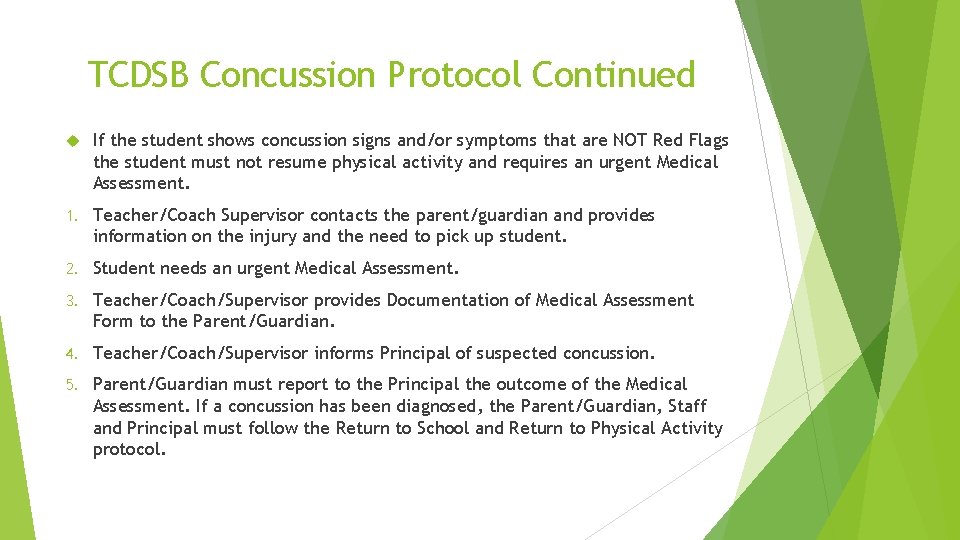
TCDSB Concussion Protocol Continued If the student shows concussion signs and/or symptoms that are NOT Red Flags the student must not resume physical activity and requires an urgent Medical Assessment. 1. Teacher/Coach Supervisor contacts the parent/guardian and provides information on the injury and the need to pick up student. 2. Student needs an urgent Medical Assessment. 3. Teacher/Coach/Supervisor provides Documentation of Medical Assessment Form to the Parent/Guardian. 4. Teacher/Coach/Supervisor informs Principal of suspected concussion. 5. Parent/Guardian must report to the Principal the outcome of the Medical Assessment. If a concussion has been diagnosed, the Parent/Guardian, Staff and Principal must follow the Return to School and Return to Physical Activity protocol.
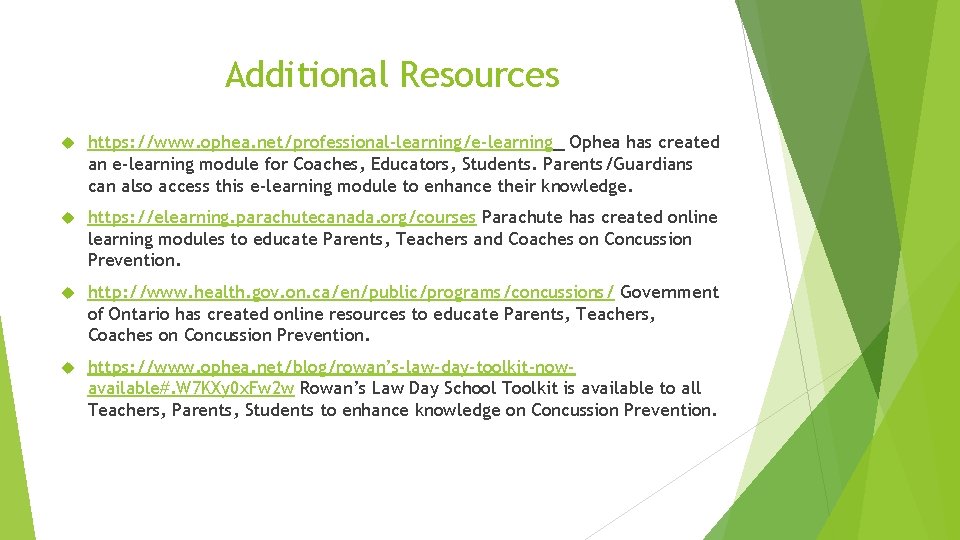
Additional Resources https: //www. ophea. net/professional-learning/e-learning Ophea has created an e-learning module for Coaches, Educators, Students. Parents/Guardians can also access this e-learning module to enhance their knowledge. https: //elearning. parachutecanada. org/courses Parachute has created online learning modules to educate Parents, Teachers and Coaches on Concussion Prevention. http: //www. health. gov. on. ca/en/public/programs/concussions/ Government of Ontario has created online resources to educate Parents, Teachers, Coaches on Concussion Prevention. https: //www. ophea. net/blog/rowan’s-law-day-toolkit-nowavailable#. W 7 KXy 0 x. Fw 2 w Rowan’s Law Day School Toolkit is available to all Teachers, Parents, Students to enhance knowledge on Concussion Prevention.