
Concurrent Models of Computation Edward A Lee Robert
Concurrent Models of Computation Edward A. Lee Robert S. Pepper Distinguished Professor, UC Berkeley EECS 219 D: Concurrent Models of Computation Fall 2011 Copyright © 2011, Edward A. Lee, All rights reserved Week 1: Process Networks
Logistics Class web page: http: //embedded. eecs. berkeley. edu/concurrency Project Paper (and paper review) Homework Reading Technology: l l Ptolemy II Java Eclipse La. Te. X Lee 01: 2
Homework ¢ ¢ Issued roughly every two weeks Will leverage a common technology base: l Java l Eclipse l Ptolemy ¢ II First assignment is on the web Lee 01: 3
Project ¢ ¢ ¢ Conference (workshop) paper quality expected Papers will be “submitted” and “reviewed” by you Presentations will be workshop like Teams up to two are encouraged Leveraging the technology base is encouraged Many project suggestions are on the web l In almost all cases, I have a fairly clear idea of how to start. Come talk to me if one of these looks interesting Lee 01: 4
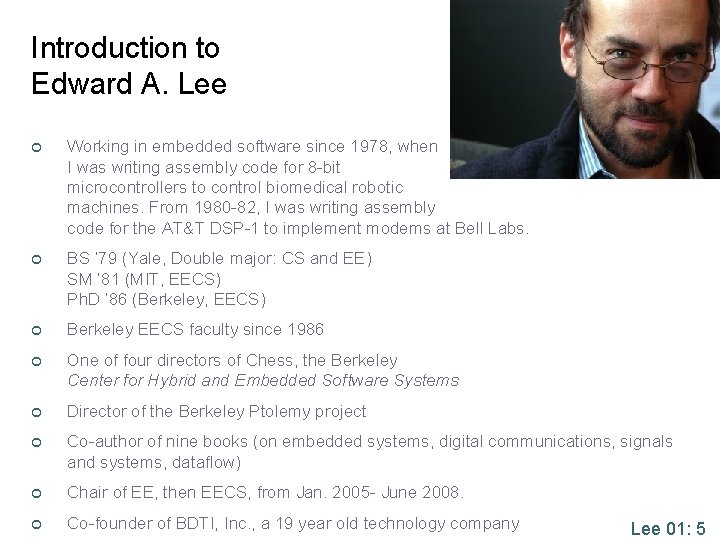
Introduction to Edward A. Lee ¢ Working in embedded software since 1978, when I was writing assembly code for 8 -bit microcontrollers to control biomedical robotic machines. From 1980 -82, I was writing assembly code for the AT&T DSP-1 to implement modems at Bell Labs. ¢ BS ’ 79 (Yale, Double major: CS and EE) SM ’ 81 (MIT, EECS) Ph. D ’ 86 (Berkeley, EECS) ¢ Berkeley EECS faculty since 1986 ¢ One of four directors of Chess, the Berkeley Center for Hybrid and Embedded Software Systems ¢ Director of the Berkeley Ptolemy project ¢ Co-author of nine books (on embedded systems, digital communications, signals and systems, dataflow) ¢ Chair of EE, then EECS, from Jan. 2005 - June 2008. ¢ Co-founder of BDTI, Inc. , a 19 year old technology company Lee 01: 5

Who are you? Lee 01: 6
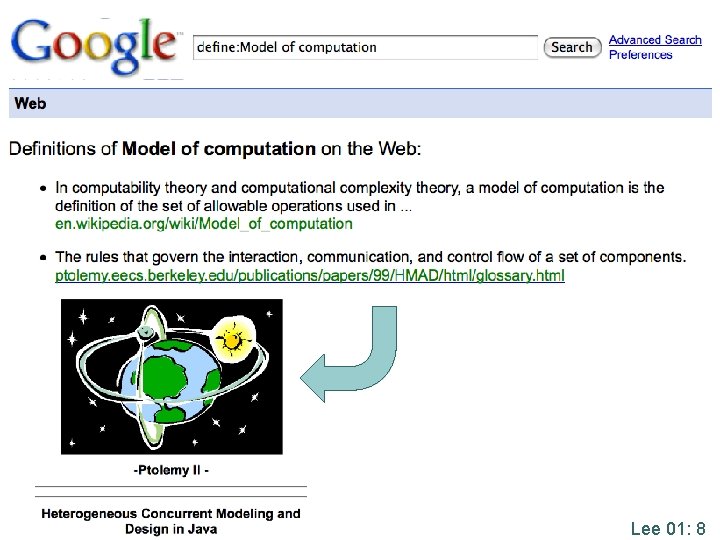
Model of Computation NIST: “A formal, abstract definition of a computer. ” Examples: Turing machine, random access machine, primitive recursive, cellular automaton, finite state machine, … Wikipedia (on 1/18/09): “the definition of the set of allowable operations used in computation and their respective costs. ” “In model-driven engineering, the model of computation explains how the behaviour of the whole system is the result of the behaviour of each of its components. ” Lee 01: 7
Lee 01: 8
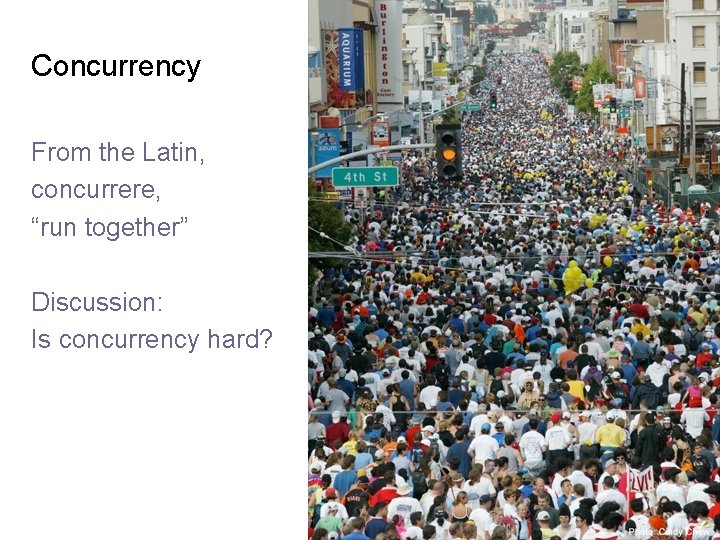
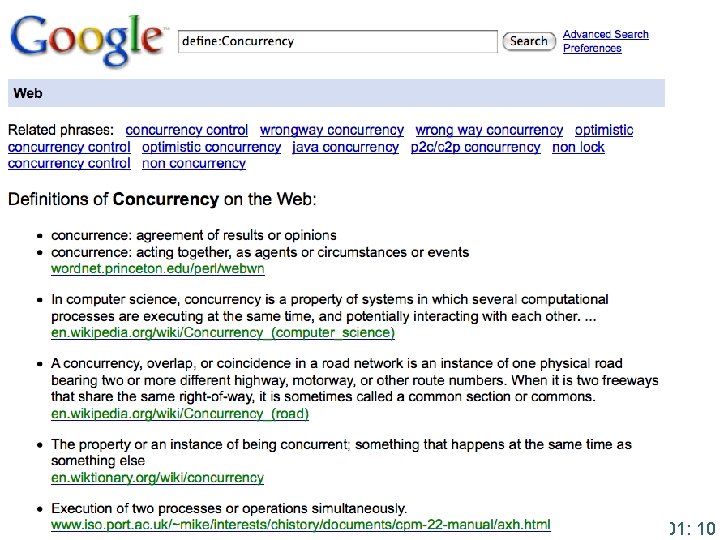
Concurrency From the Latin, concurrere, “run together” Discussion: Is concurrency hard? Lee 01: 9
Lee 01: 10
Potential Confusion • • Concurrent vs. parallel Concurrent vs. nondeterminate Lee 01: 11
Kahn Process Networks (PN) A Concurrent Model of Computation (Mo. C) • • A set of components called actors. Each representing a sequential procedure. Where steps in these procedures receive or send messages to other actors (or perform local operations). Messages are communicated asynchronously with unbounded buffers. A procedure can always send a message. It does not need to wait for the recipient to be ready to receive. Messages are delivered reliably and in order. When a procedure attempts to receive a message, that attempt blocks the procedure until a message is available. Lee 01: 12
Coarse History ¢ Semantics given by Gilles Kahn in 1974. l ¢ More limited form given by Kahn and Mac. Queen in 1977. l ¢ Solves an undecidable problem. Debate over validity of this policy, Geilen and Basten 2003. l ¢ Kosinski [1978], Stark [1980 s], … Bounded memory execution given by Parks in 1995. l ¢ Blocking reads and nonblocking writes. Generalizations to nondeterministic systems l ¢ Fixed points of continuous and monotonic functions Relationship between denotational and operational semantics. Many related models intertwined. l Actors (Hewitt, Agha), CSP (Hoare), CCS (Milner), Interaction (Wegner), Streams (Broy, …), Dataflow (Dennis, Arvind, …). . . Lee 01: 13
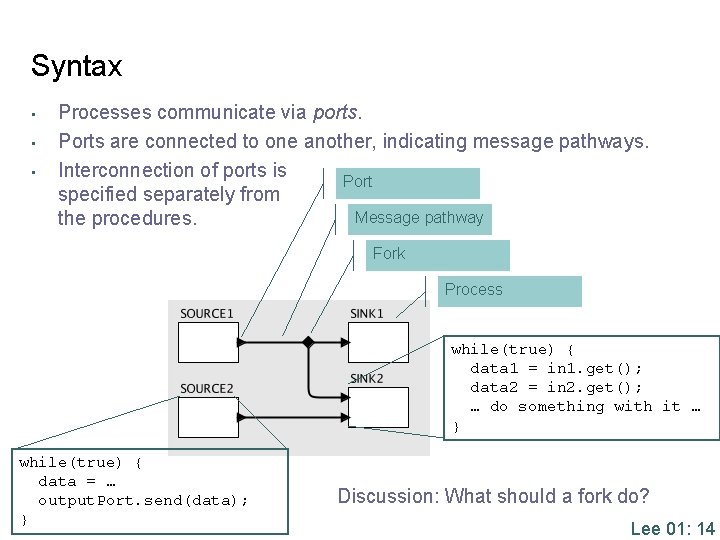
Syntax • • • Processes communicate via ports. Ports are connected to one another, indicating message pathways. Interconnection of ports is Port specified separately from Message pathway the procedures. Fork Process while(true) { data 1 = in 1. get(); data 2 = in 2. get(); … do something with it … } while(true) { data = … output. Port. send(data); } Discussion: What should a fork do? Lee 01: 14
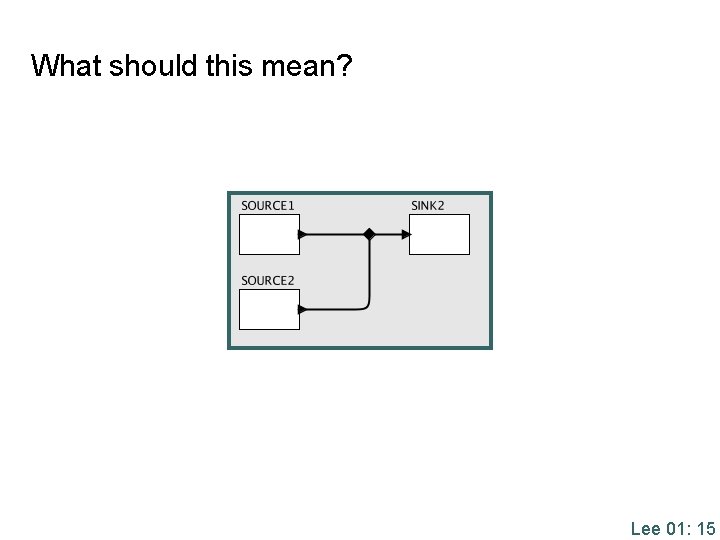
What should this mean? Lee 01: 15
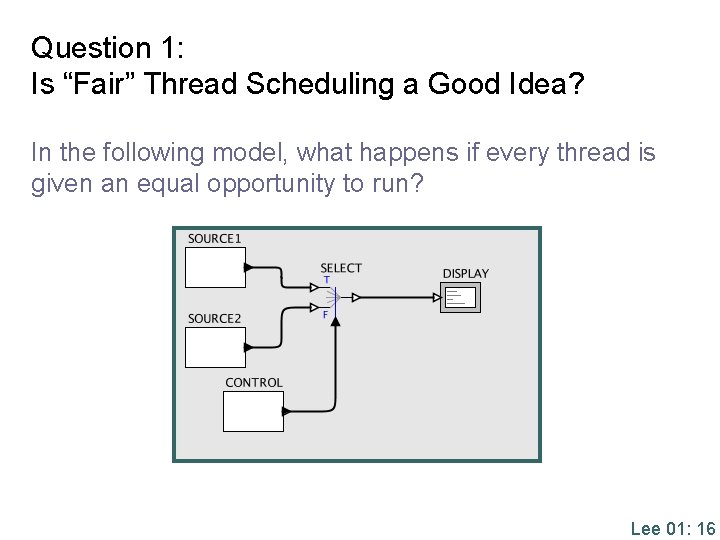
Question 1: Is “Fair” Thread Scheduling a Good Idea? In the following model, what happens if every thread is given an equal opportunity to run? Lee 01: 16
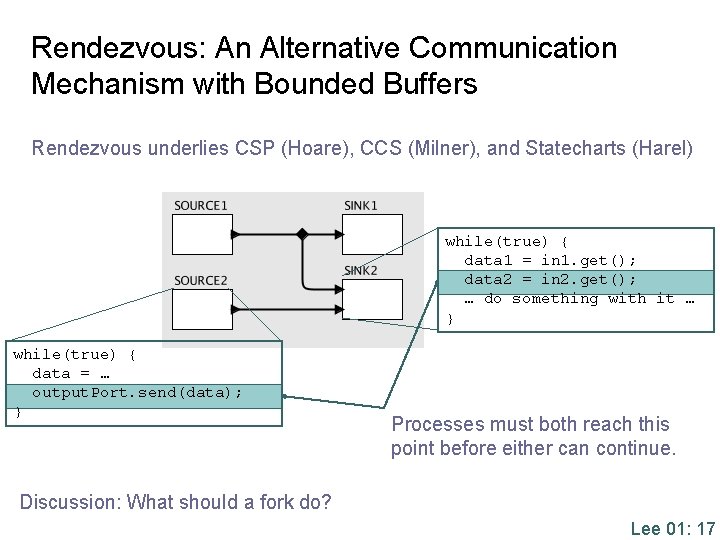
Rendezvous: An Alternative Communication Mechanism with Bounded Buffers Rendezvous underlies CSP (Hoare), CCS (Milner), and Statecharts (Harel) while(true) { data 1 = in 1. get(); data 2 = in 2. get(); … do something with it … } while(true) { data = … output. Port. send(data); } Processes must both reach this point before either can continue. Discussion: What should a fork do? Lee 01: 17
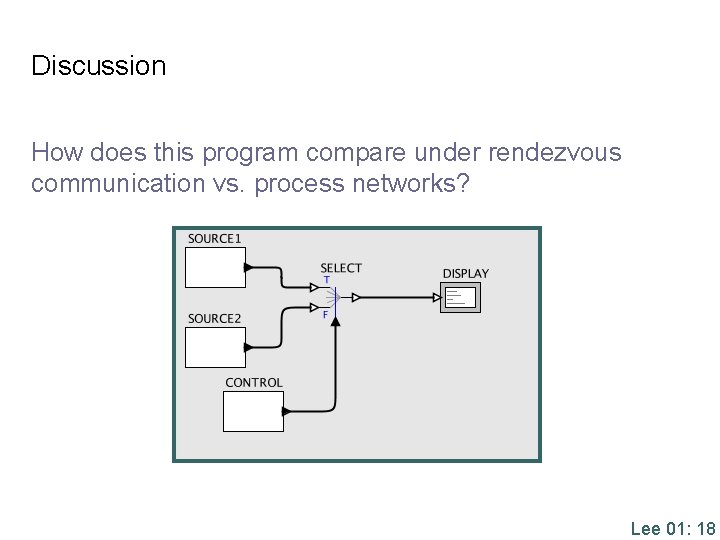
Discussion How does this program compare under rendezvous communication vs. process networks? Lee 01: 18
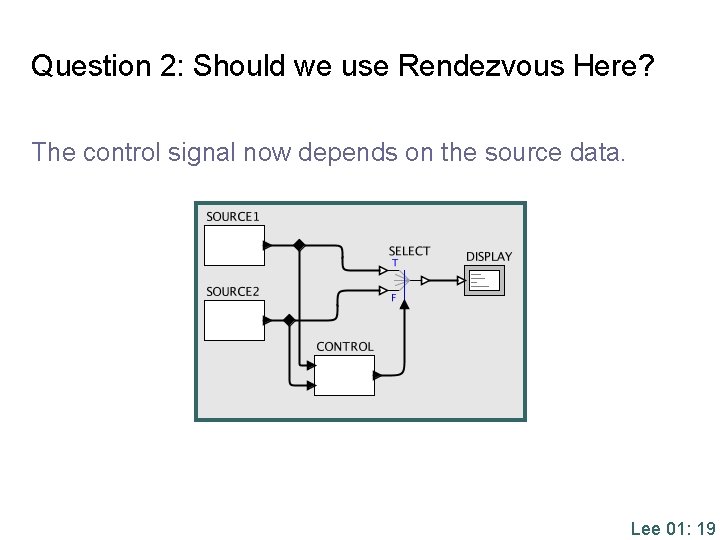
Question 2: Should we use Rendezvous Here? The control signal now depends on the source data. Lee 01: 19
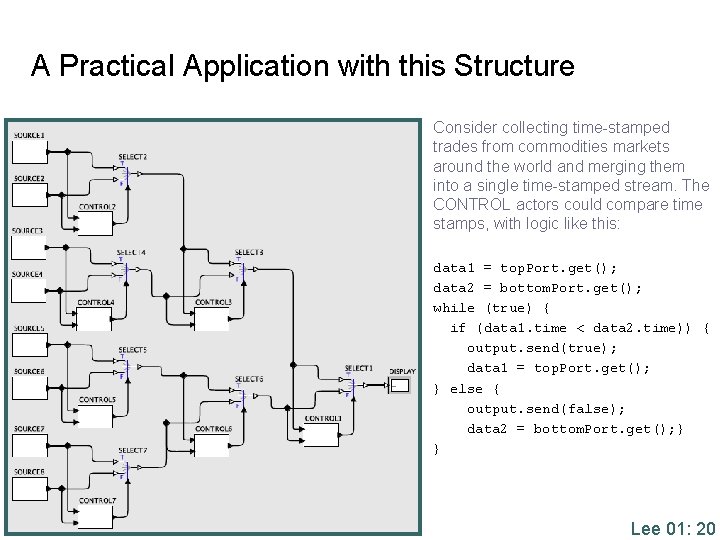
A Practical Application with this Structure Consider collecting time-stamped trades from commodities markets around the world and merging them into a single time-stamped stream. The CONTROL actors could compare time stamps, with logic like this: data 1 = top. Port. get(); data 2 = bottom. Port. get(); while (true) { if (data 1. time < data 2. time)) { output. send(true); data 1 = top. Port. get(); } else { output. send(false); data 2 = bottom. Port. get(); } } Lee 01: 20
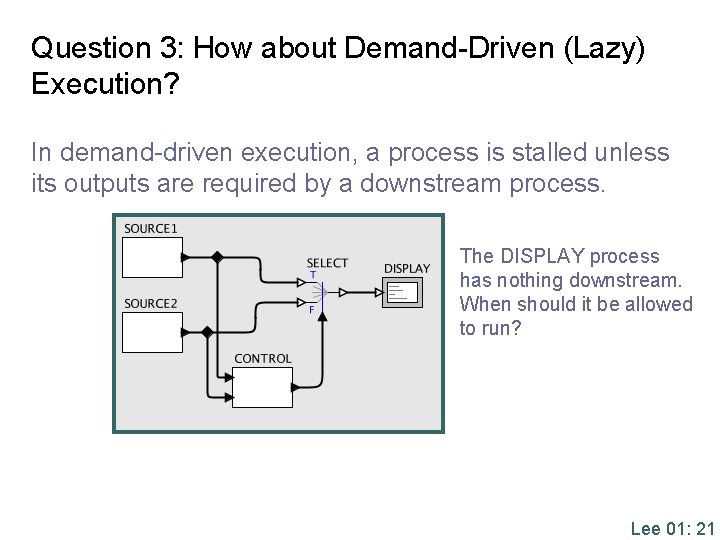
Question 3: How about Demand-Driven (Lazy) Execution? In demand-driven execution, a process is stalled unless its outputs are required by a downstream process. The DISPLAY process has nothing downstream. When should it be allowed to run? Lee 01: 21
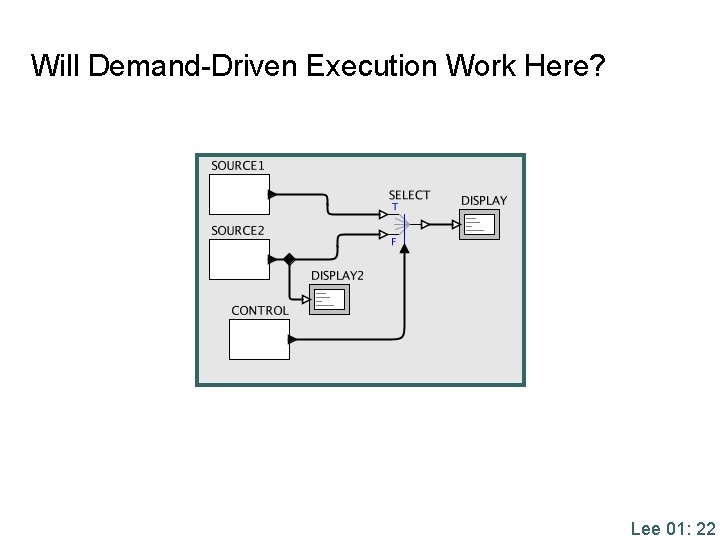
Will Demand-Driven Execution Work Here? Lee 01: 22
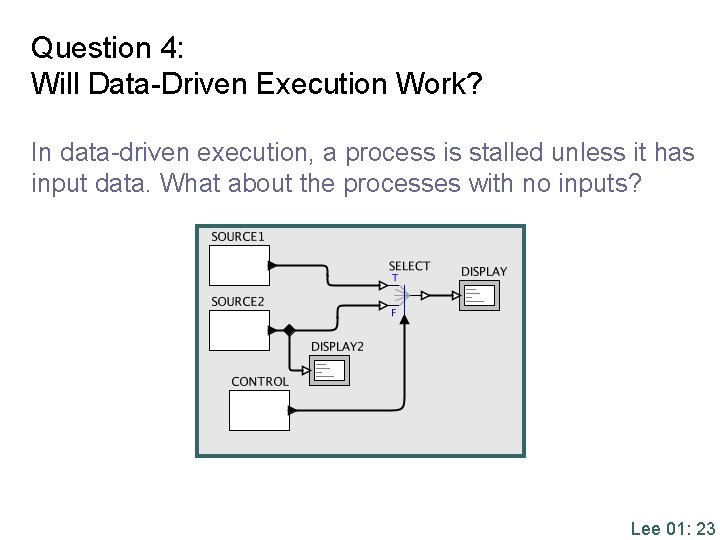
Question 4: Will Data-Driven Execution Work? In data-driven execution, a process is stalled unless it has input data. What about the processes with no inputs? Lee 01: 23
Things are not looking good… We have ruled out: • Fair execution. • Rendezvous communication. • Demand-driven execution. • Data-driven execution. For all the examples given so far, there is an obvious execution policy that does what we want. Is there a general policy that will always deliver that obvious policy? Are there models for which the policy is not so obvious? Lee 01: 24
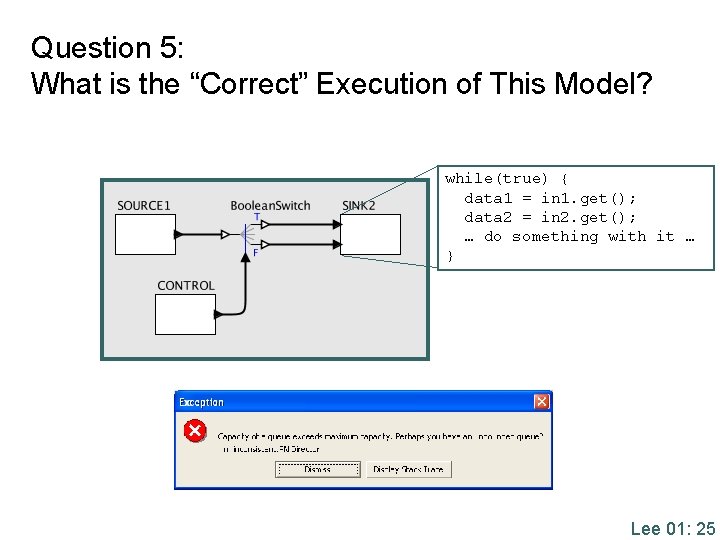
Question 5: What is the “Correct” Execution of This Model? while(true) { data 1 = in 1. get(); data 2 = in 2. get(); … do something with it … } Lee 01: 25
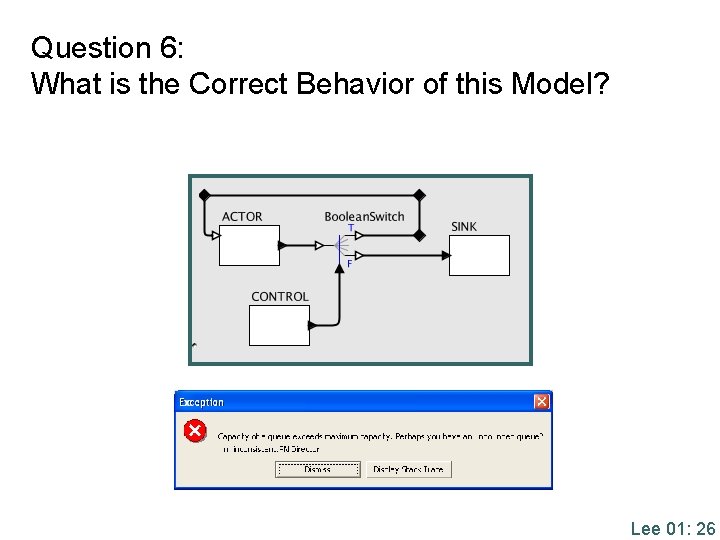
Question 6: What is the Correct Behavior of this Model? Lee 01: 26
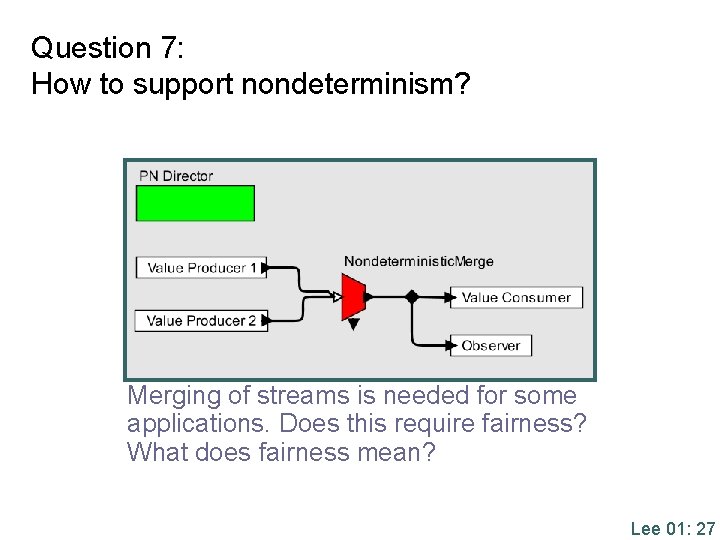
Question 7: How to support nondeterminism? Merging of streams is needed for some applications. Does this require fairness? What does fairness mean? Lee 01: 27
Properties of PN (Two Big Topics) ¢ Assuming “well-behaved” actors, a PN network is determinate in that the sequence of tokens on each arc is independent of the thread scheduling strategy. l Making ¢ this statement precise, however, is nontrivial. PN is Turing complete. l Given only boolean tokens, memoryless functional actors, Switch, Select, and initial tokens, one can implement a universal Turing machine. l Whether a PN network deadlocks is undecidable. l Whether buffers grow without bound is undecidable. Lee 01: 28
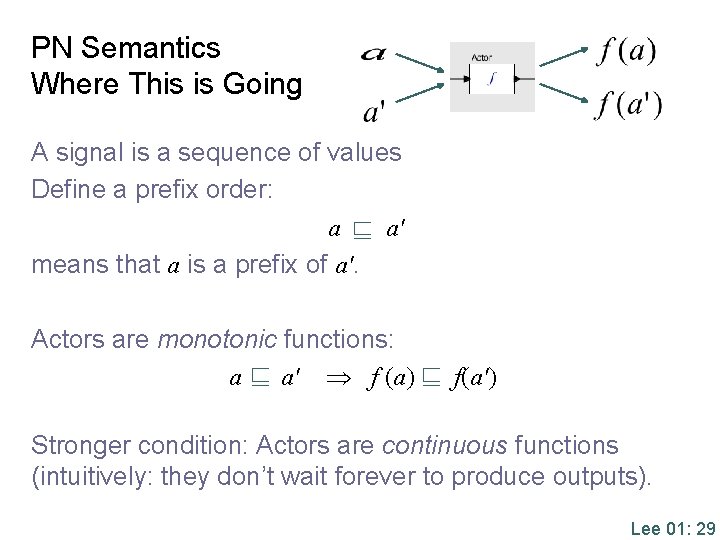
PN Semantics Where This is Going A signal is a sequence of values Define a prefix order: a a' means that a is a prefix of a'. Actors are monotonic functions: a a' f (a) f(a') Stronger condition: Actors are continuous functions (intuitively: they don’t wait forever to produce outputs). Lee 01: 29
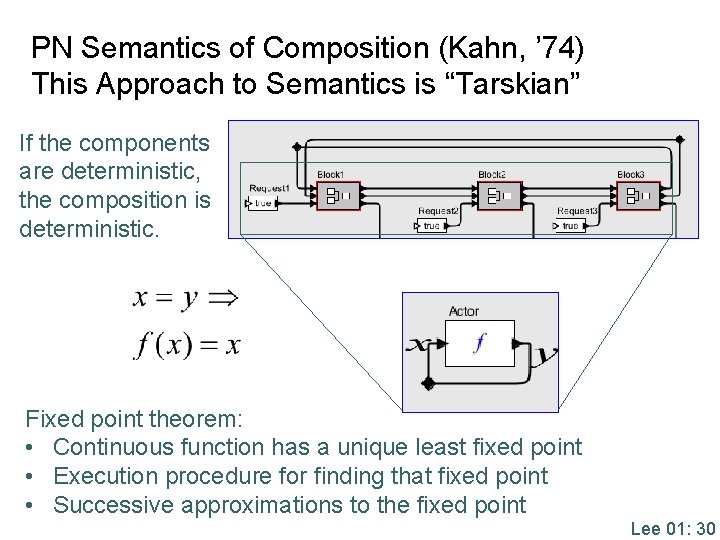
PN Semantics of Composition (Kahn, ’ 74) This Approach to Semantics is “Tarskian” If the components are deterministic, the composition is deterministic. Fixed point theorem: • Continuous function has a unique least fixed point • Execution procedure for finding that fixed point • Successive approximations to the fixed point Lee 01: 30
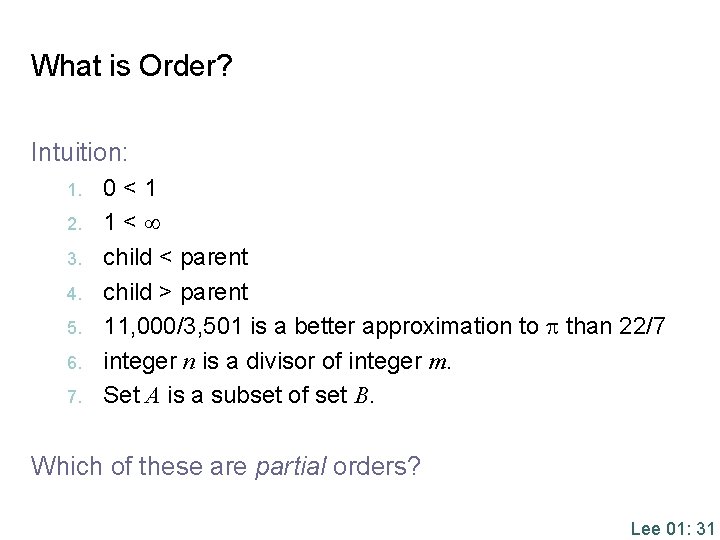
What is Order? Intuition: 1. 2. 3. 4. 5. 6. 7. 0<1 1< child < parent child > parent 11, 000/3, 501 is a better approximation to p than 22/7 integer n is a divisor of integer m. Set A is a subset of set B. Which of these are partial orders? Lee 01: 31
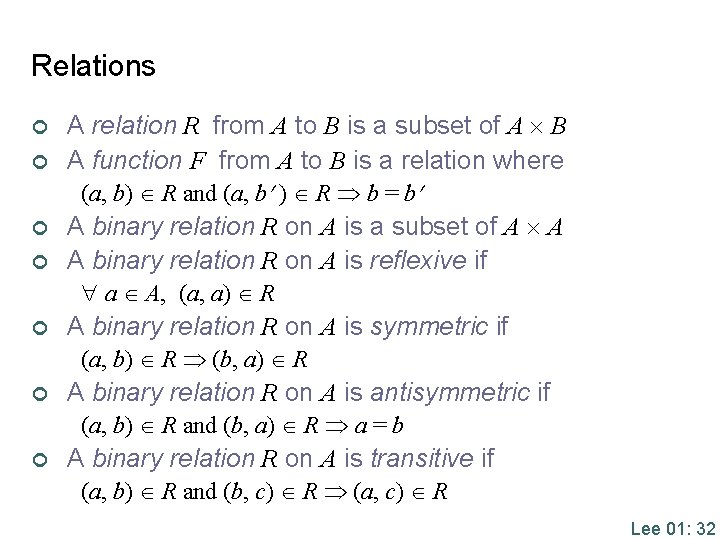
Relations ¢ ¢ A relation R from A to B is a subset of A B A function F from A to B is a relation where (a, b) R and (a, b ) R b = b A binary relation R on A is a subset of A A A binary relation R on A is reflexive if a A, (a, a) R ¢ A binary relation R on A is symmetric if (a, b) R (b, a) R ¢ A binary relation R on A is antisymmetric if (a, b) R and (b, a) R a = b ¢ A binary relation R on A is transitive if (a, b) R and (b, c) R (a, c) R Lee 01: 32
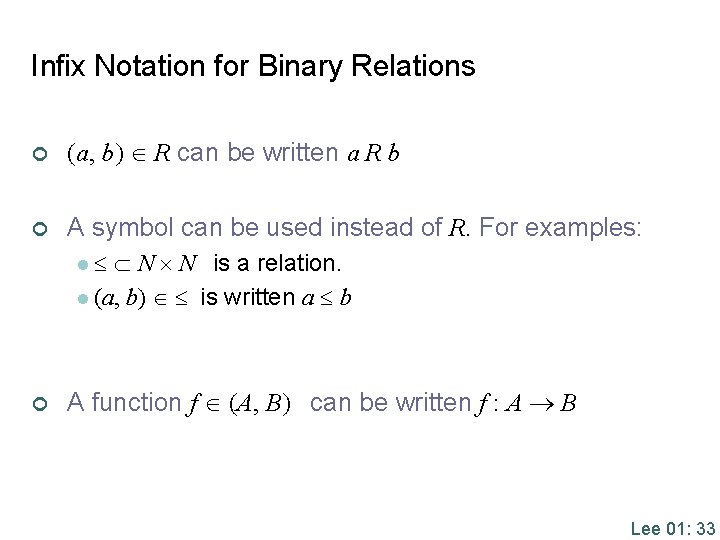
Infix Notation for Binary Relations ¢ (a, b) R can be written a R b ¢ A symbol can be used instead of R. For examples: l N N is a relation. l (a, b) is written a b ¢ A function f (A, B) can be written f : A B Lee 01: 33
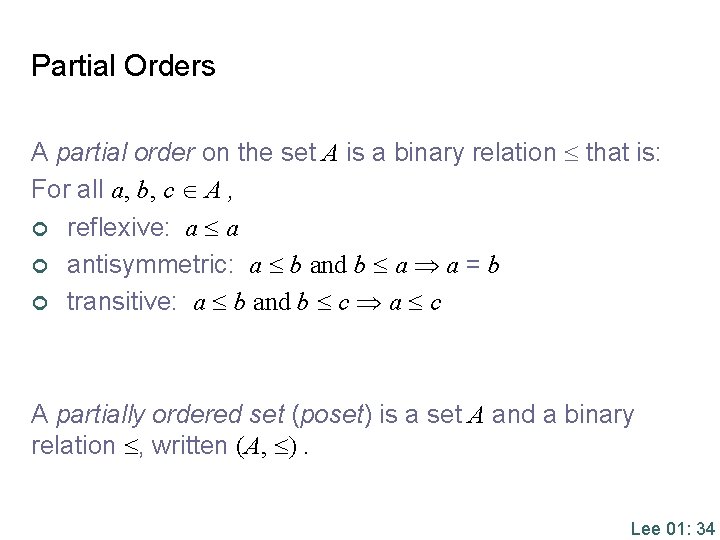
Partial Orders A partial order on the set A is a binary relation that is: For all a, b, c A , ¢ reflexive: a a ¢ antisymmetric: a b and b a a = b ¢ transitive: a b and b c a c A partially ordered set (poset) is a set A and a binary relation , written (A, ). Lee 01: 34
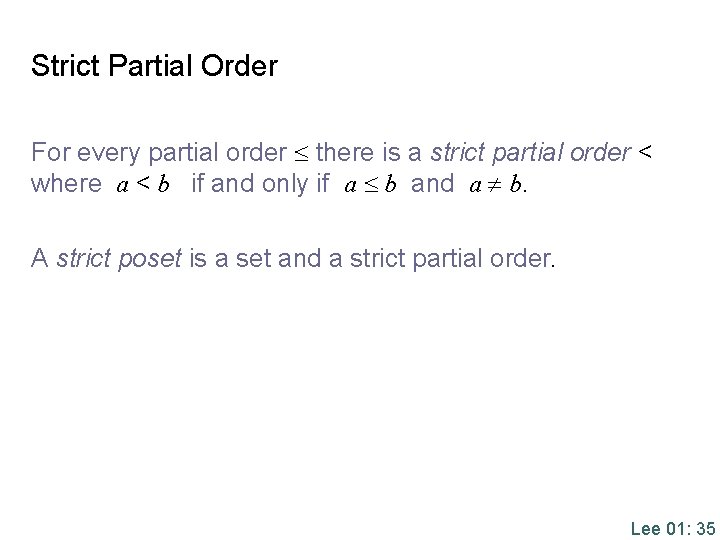
Strict Partial Order For every partial order there is a strict partial order < where a < b if and only if a b and a b. A strict poset is a set and a strict partial order. Lee 01: 35
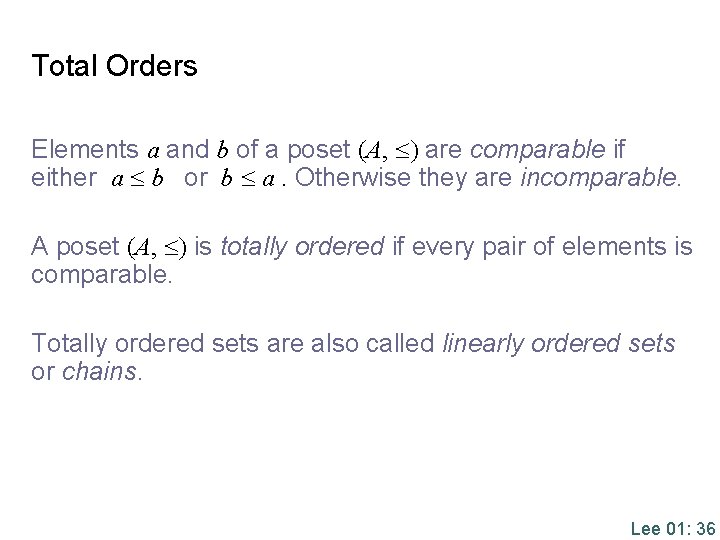
Total Orders Elements a and b of a poset (A, ) are comparable if either a b or b a. Otherwise they are incomparable. A poset (A, ) is totally ordered if every pair of elements is comparable. Totally ordered sets are also called linearly ordered sets or chains. Lee 01: 36
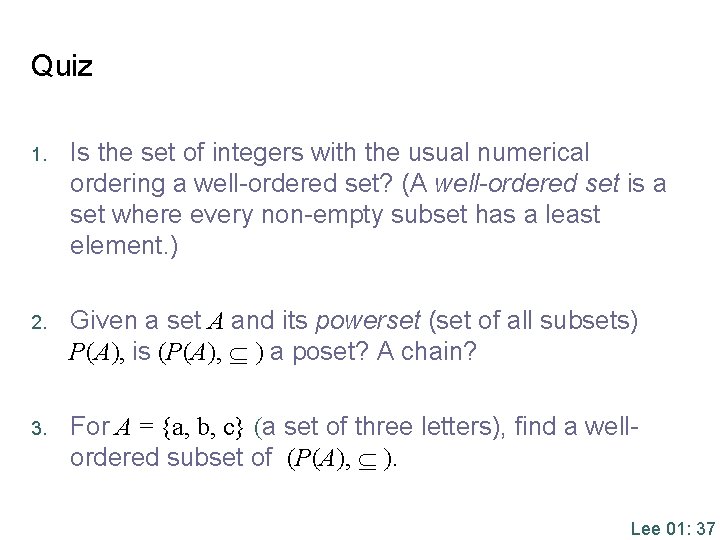
Quiz 1. Is the set of integers with the usual numerical ordering a well-ordered set? (A well-ordered set is a set where every non-empty subset has a least element. ) 2. Given a set A and its powerset (set of all subsets) P(A), is (P(A), ) a poset? A chain? 3. For A = {a, b, c} (a set of three letters), find a wellordered subset of (P(A), ). Lee 01: 37
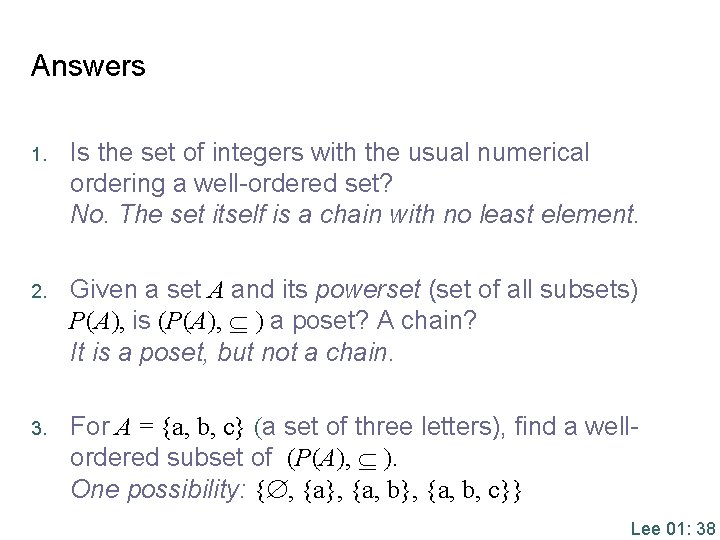
Answers 1. Is the set of integers with the usual numerical ordering a well-ordered set? No. The set itself is a chain with no least element. 2. Given a set A and its powerset (set of all subsets) P(A), is (P(A), ) a poset? A chain? It is a poset, but not a chain. 3. For A = {a, b, c} (a set of three letters), find a wellordered subset of (P(A), ). One possibility: { , {a}, {a, b, c}} Lee 01: 38
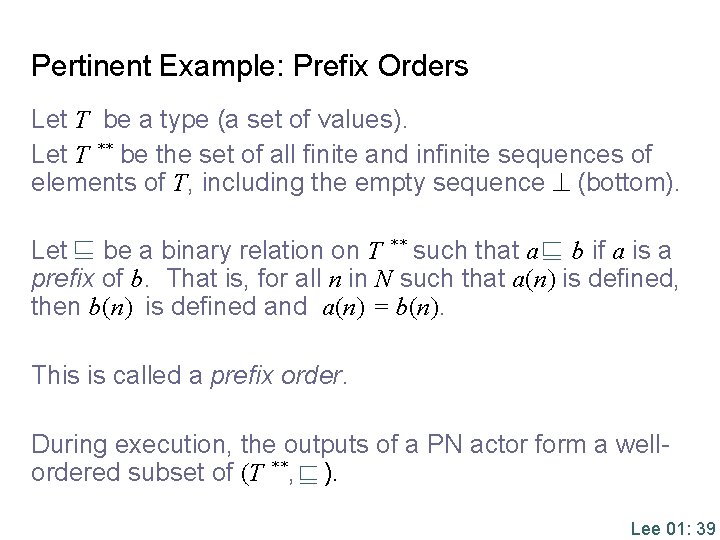
Pertinent Example: Prefix Orders Let T be a type (a set of values). Let T ** be the set of all finite and infinite sequences of elements of T, including the empty sequence (bottom). Let be a binary relation on T ** such that a b if a is a prefix of b. That is, for all n in N such that a(n) is defined, then b(n) is defined and a(n) = b(n). This is called a prefix order. During execution, the outputs of a PN actor form a wellordered subset of (T **, ). Lee 01: 39
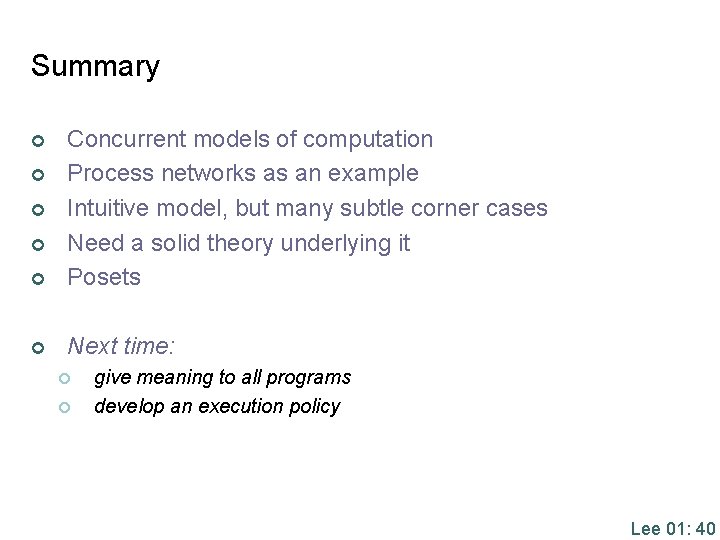
Summary ¢ Concurrent models of computation Process networks as an example Intuitive model, but many subtle corner cases Need a solid theory underlying it Posets ¢ Next time: ¢ ¢ ¢ give meaning to all programs develop an execution policy Lee 01: 40
- Slides: 40