
Concurrent Garbage Collection Presented by Roman Kecher GC
Concurrent Garbage Collection Presented by Roman Kecher GC Seminar, Tel-Aviv University 1 23 -Dec-14

Outline � General concurrent GC concepts � Incremental, mostly concurrent, “on-the-fly” collections � The lost object problem � Tricolor invariants � Barrier techniques for concurrent GC � Complete enumeration of techniques � Efficient implementation through card tables � Summary 2 23 -Dec-14
Outline � General concurrent GC concepts � Incremental, 3 mostly concurrent, “on-the-fly” collections 23 -Dec-14
Concurrent GC �A concurrent GC is essentially a collector running in parallel to the mutator (in different threads) � It may stop the mutator at some points, to synchronize etc � Different �A from what we have seen by now collector must be able to operate incrementally � We will describe a number of different collection types � Suffering from similar limitations � Eventually leading to the concurrent collection 4 23 -Dec-14
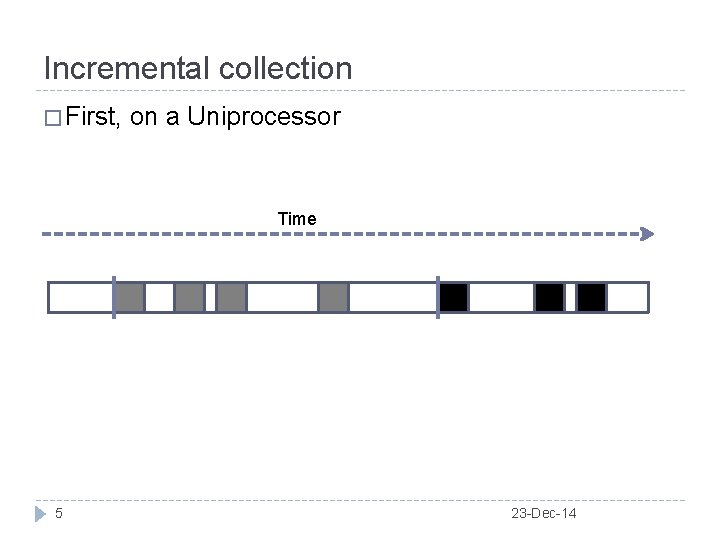
Incremental collection � First, on a Uniprocessor Time 5 23 -Dec-14
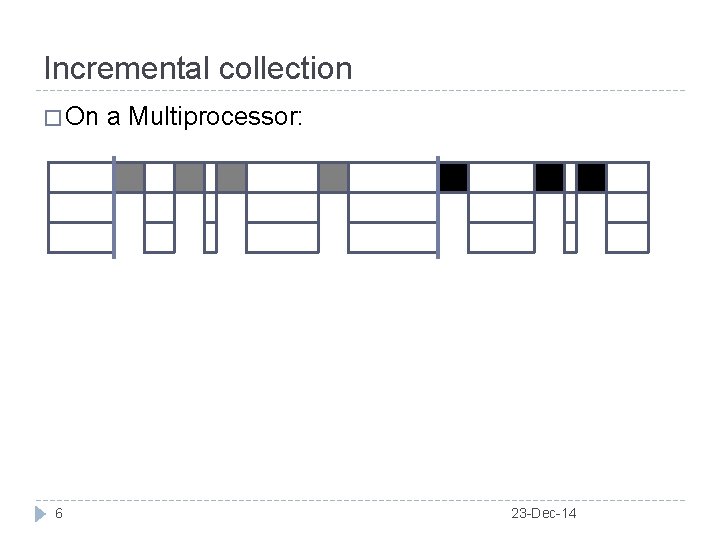
Incremental collection � On 6 a Multiprocessor: 23 -Dec-14
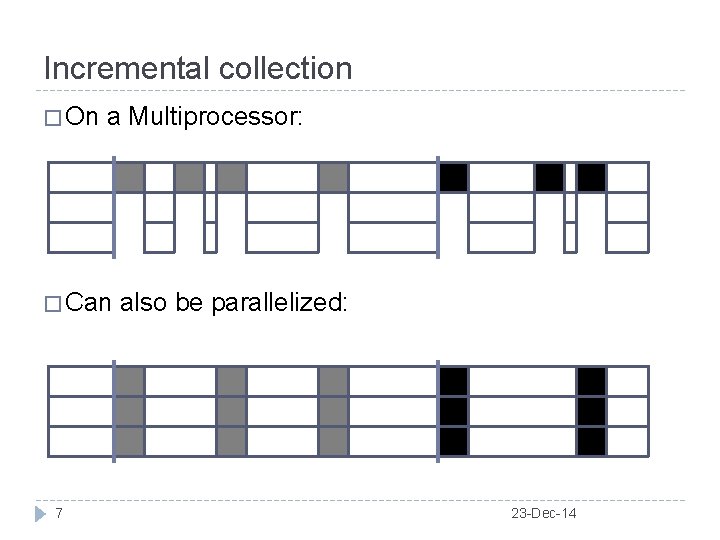
Incremental collection � On a Multiprocessor: � Can 7 also be parallelized: 23 -Dec-14
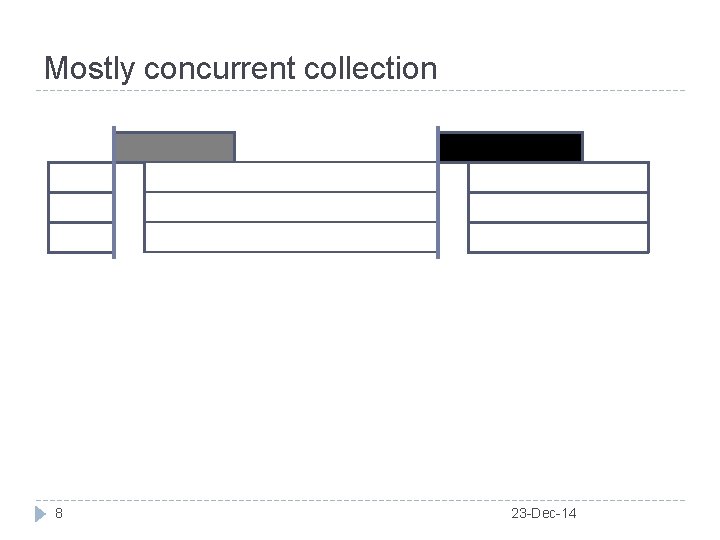
Mostly concurrent collection 8 23 -Dec-14
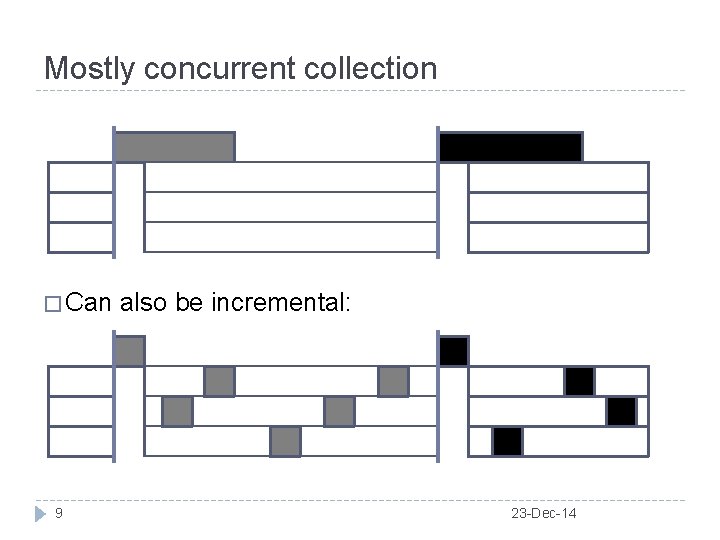
Mostly concurrent collection � Can 9 also be incremental: 23 -Dec-14
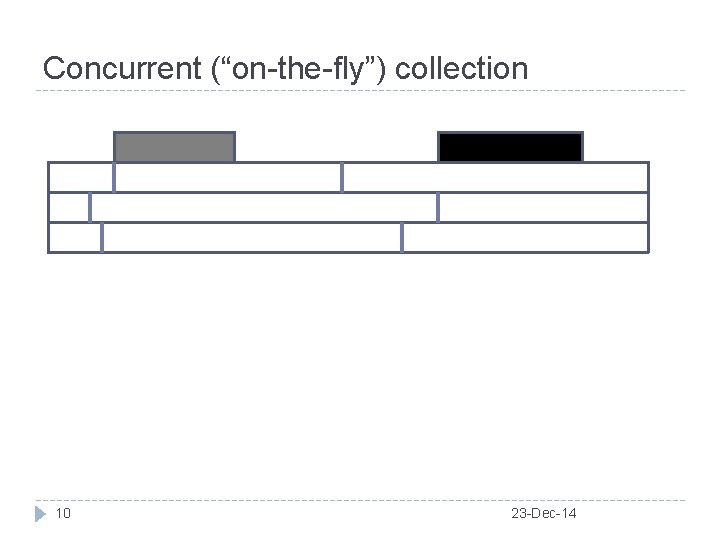
Concurrent (“on-the-fly”) collection 10 23 -Dec-14
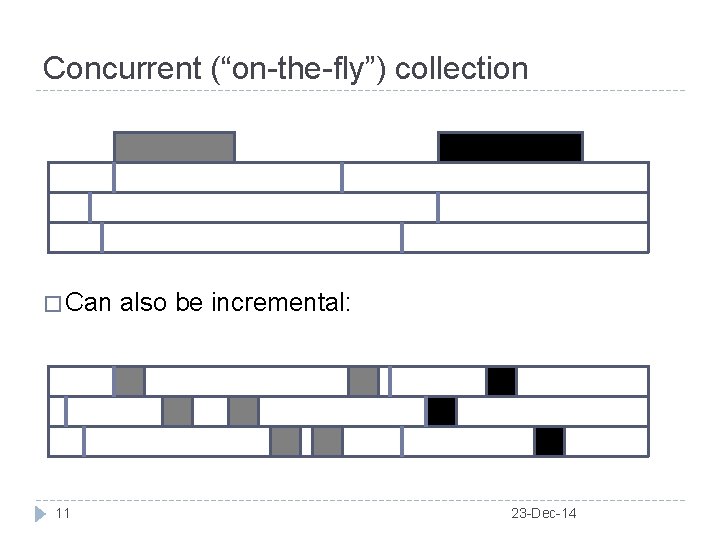
Concurrent (“on-the-fly”) collection � Can 11 also be incremental: 23 -Dec-14
Correctness of concurrent collection � Safety � Retains � May at least all reachable objects leave “floating garbage” � Liveness � Collector 12 must eventually complete its collection cycle 23 -Dec-14
Atomicity � Each collector and mutator operation will be specified as operating atomically � Without loss of generality, can consider only a single mutator and a single collector � Actual implementation of the concurrency control � Left to the discretion of the implementer � Possibilities discussed in the “Concurrency Preliminaries” chapter 13 23 -Dec-14
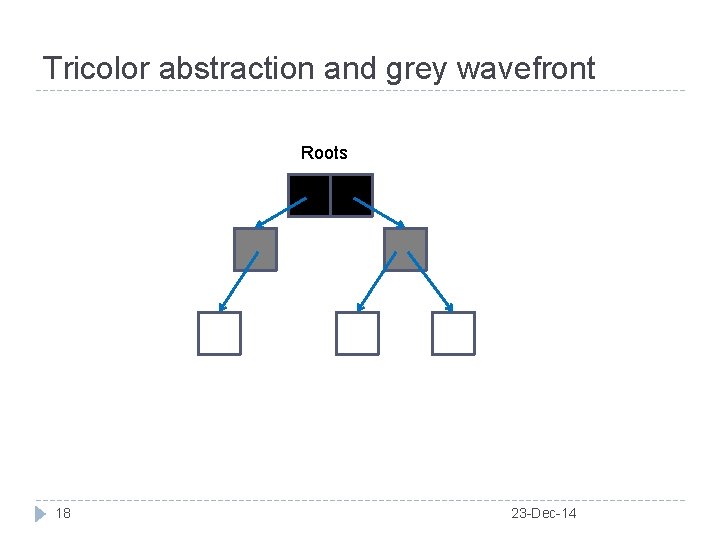
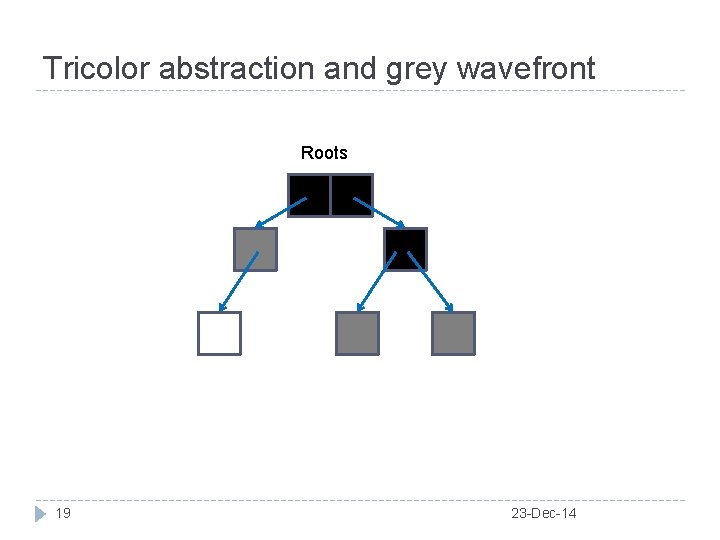
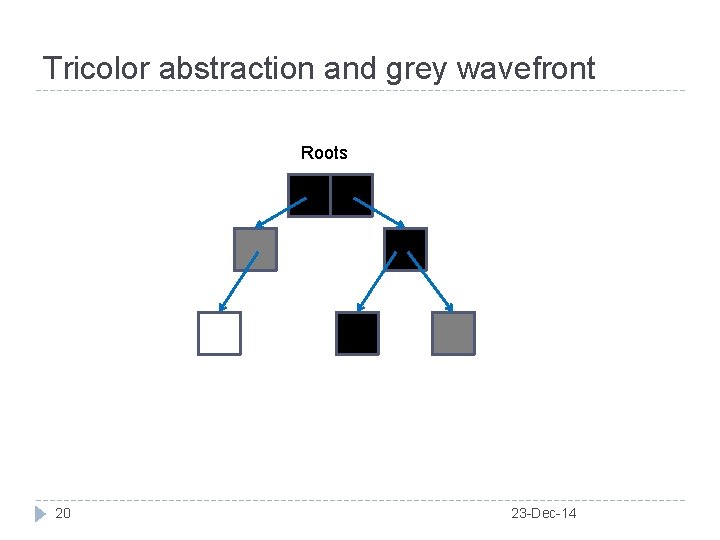
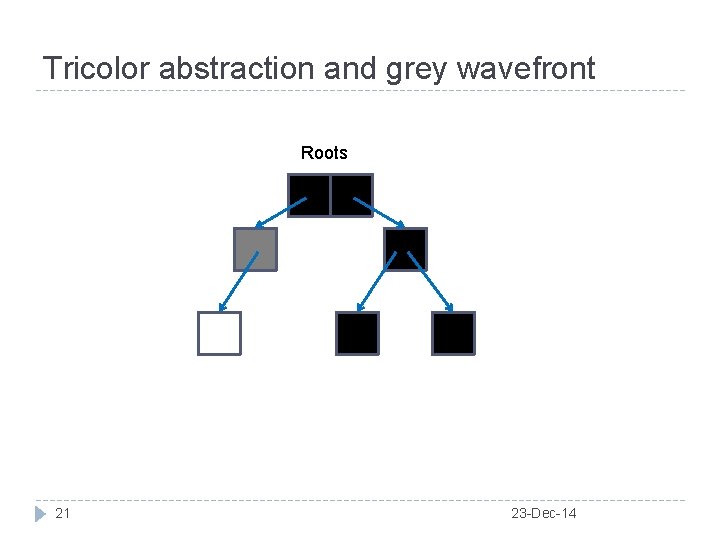
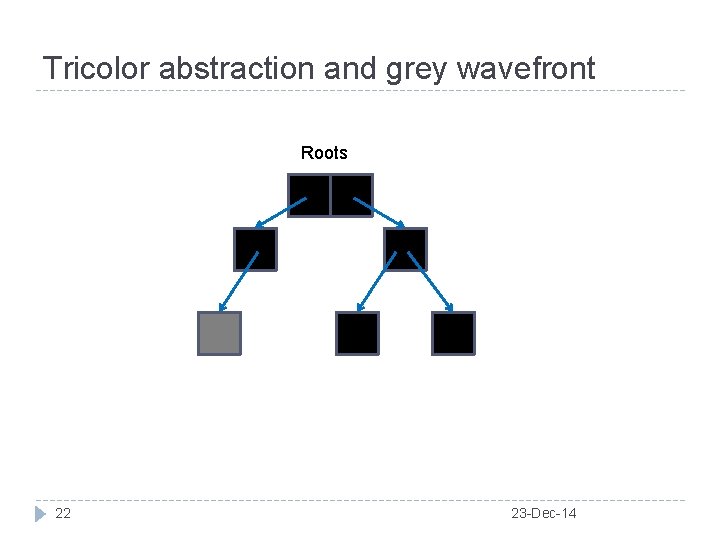
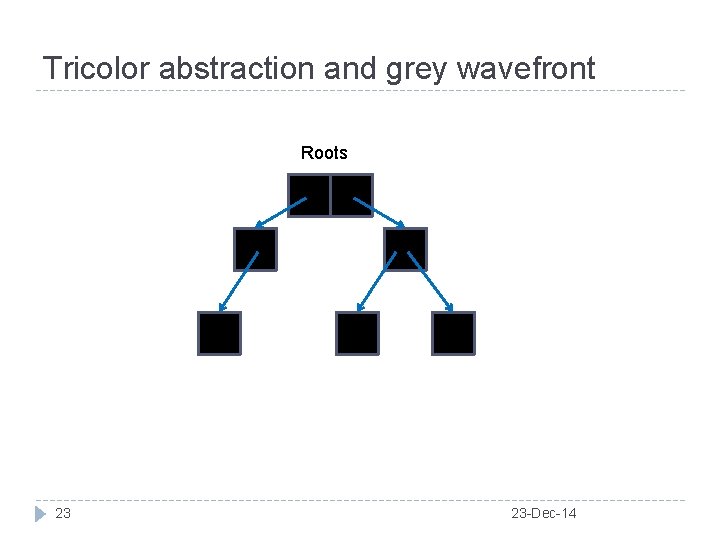
Revisiting the tricolor abstraction � White objects � Have not (yet) been reached by the collector � Considered garbage at the end � Grey objects � Have been reached but not yet fully processed (may still point to white objects) � Black objects � Have been fully processed (don’t point to white objects immediately after the scan) 14 23 -Dec-14
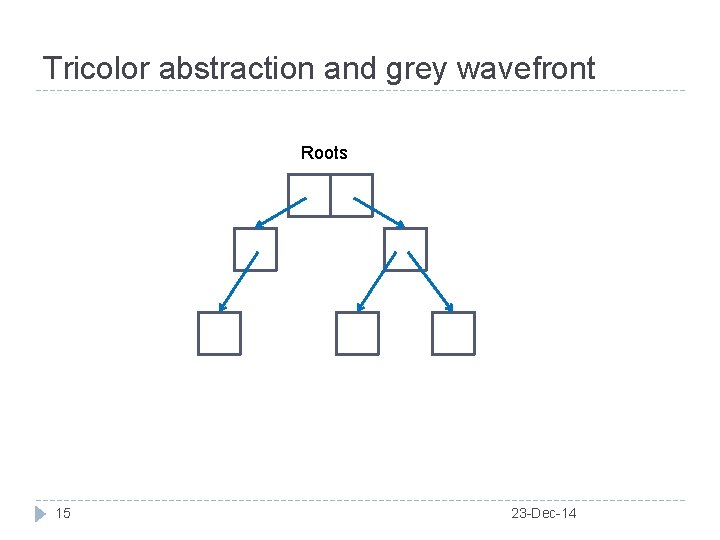
Tricolor abstraction and grey wavefront Roots 15 23 -Dec-14
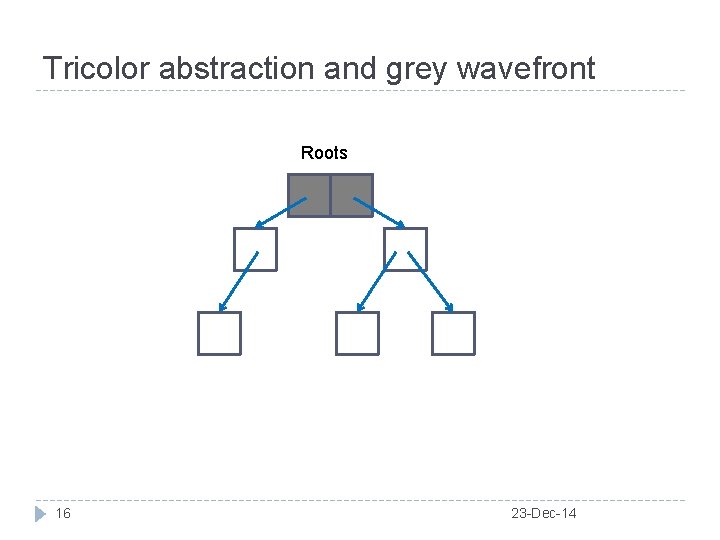
Tricolor abstraction and grey wavefront Roots 16 23 -Dec-14
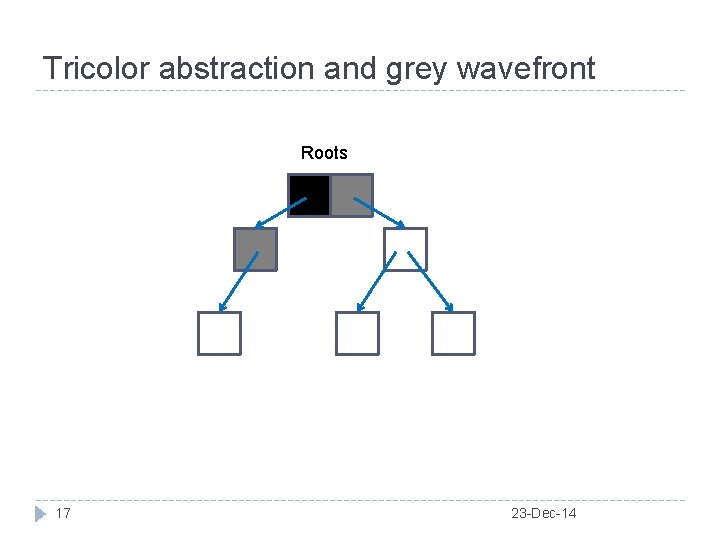
Tricolor abstraction and grey wavefront Roots 17 23 -Dec-14
Tricolor abstraction and grey wavefront Roots 18 23 -Dec-14
Tricolor abstraction and grey wavefront Roots 19 23 -Dec-14
Tricolor abstraction and grey wavefront Roots 20 23 -Dec-14
Tricolor abstraction and grey wavefront Roots 21 23 -Dec-14
Tricolor abstraction and grey wavefront Roots 22 23 -Dec-14
Tricolor abstraction and grey wavefront Roots 23 23 -Dec-14
The grey wavefront � The boundary between black and white objects � Works great when there is no interleaving of collector and mutator � Recall the definition of a write operation: � atomic Write(src, i, new): old src[i] new 24 23 -Dec-14
Outline � General concurrent GC concepts � Incremental, mostly concurrent, “on-the-fly” collections � The lost object problem 25 23 -Dec-14
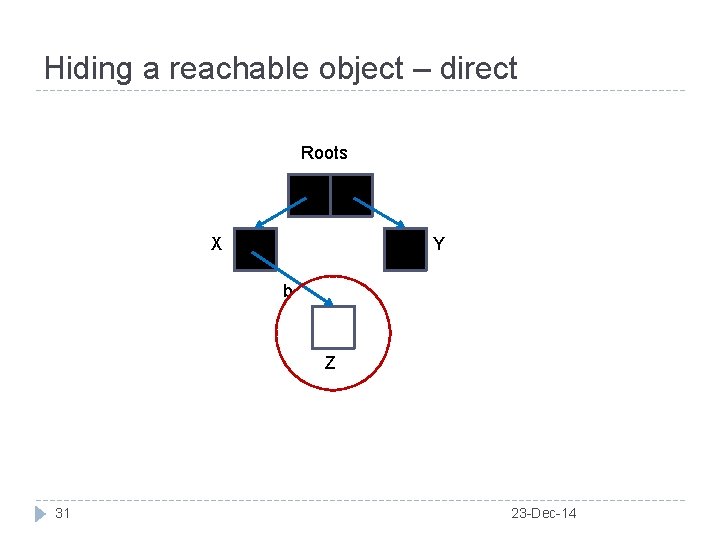
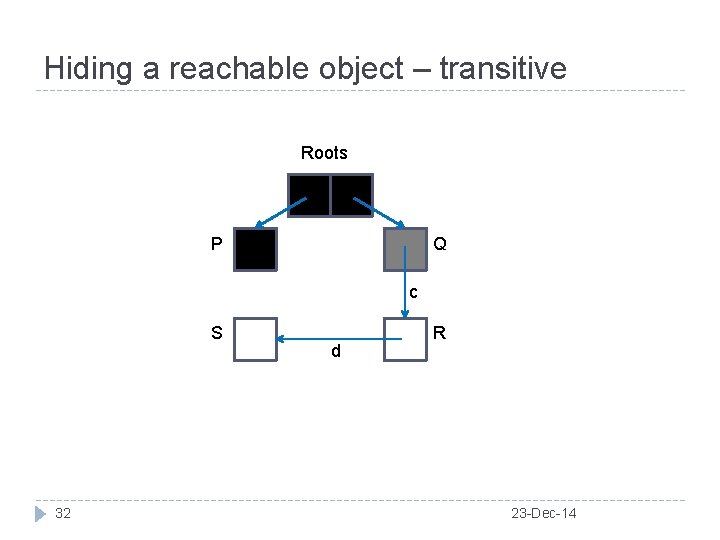
The lost object problem � Mutator can insert an object behind the wavefront �A reference to a white object is taken (ahead of the wavefront) � Moved to a black object (behind the wavefront) � Original path(s) to it deleted � Two examples: � Direct � The link to the object itself is deleted � Transitive �A 26 link on the path to the object is deleted 23 -Dec-14
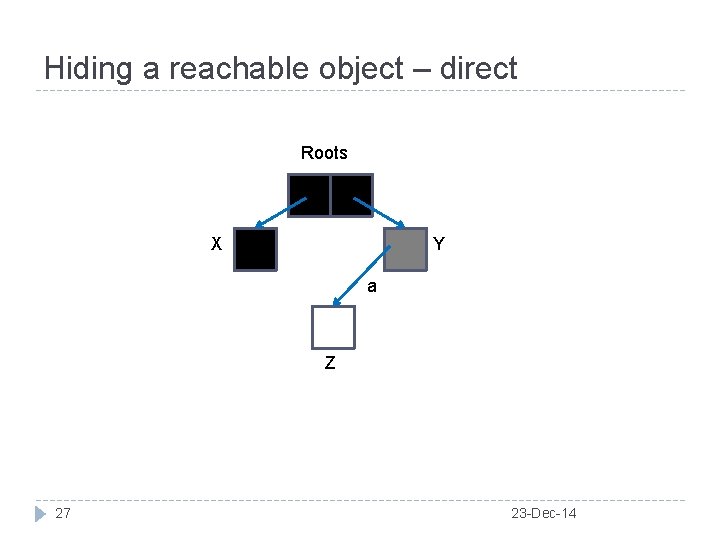
Hiding a reachable object – direct Roots X Y a Z 27 23 -Dec-14
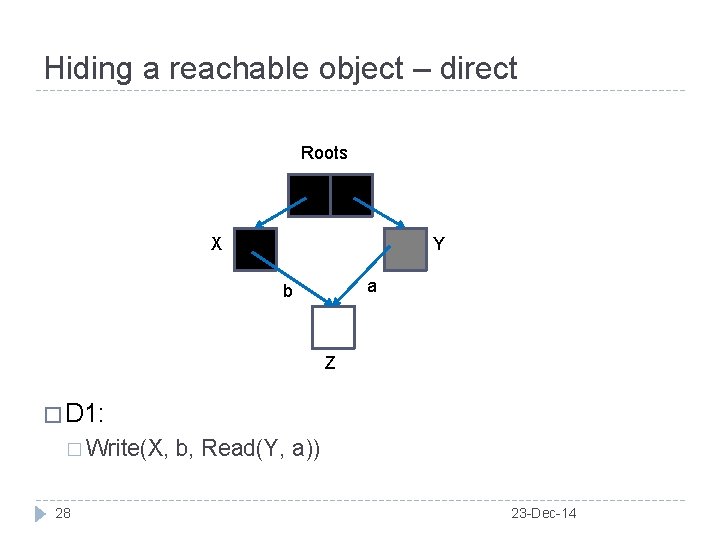
Hiding a reachable object – direct Roots X Y a b Z � D 1: � Write(X, 28 b, Read(Y, a)) 23 -Dec-14
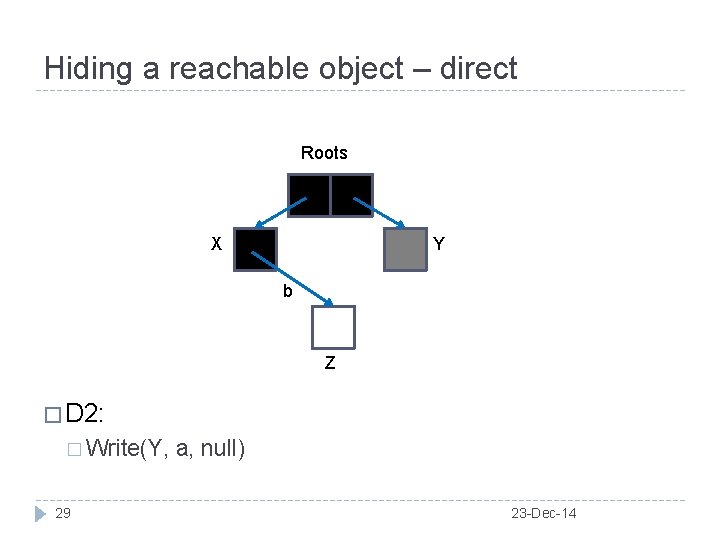
Hiding a reachable object – direct Roots X Y b Z � D 2: � Write(Y, 29 a, null) 23 -Dec-14
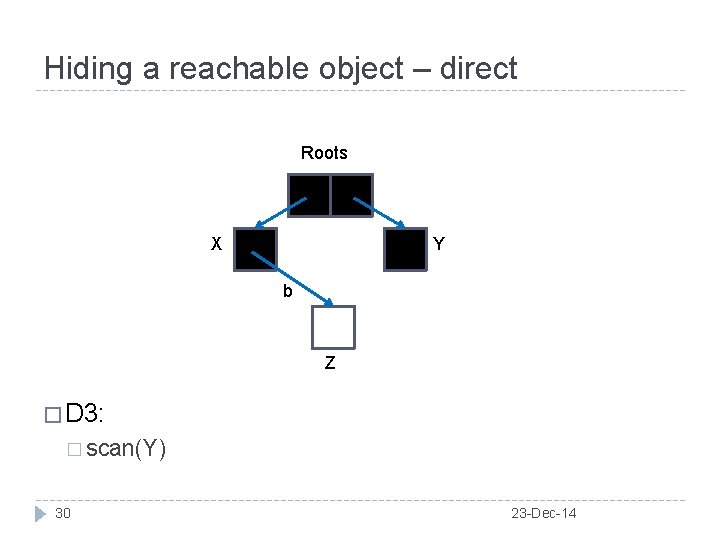
Hiding a reachable object – direct Roots X Y b Z � D 3: � scan(Y) 30 23 -Dec-14
Hiding a reachable object – direct Roots X Y b Z 31 23 -Dec-14
Hiding a reachable object – transitive Roots P Q c S 32 d R 23 -Dec-14
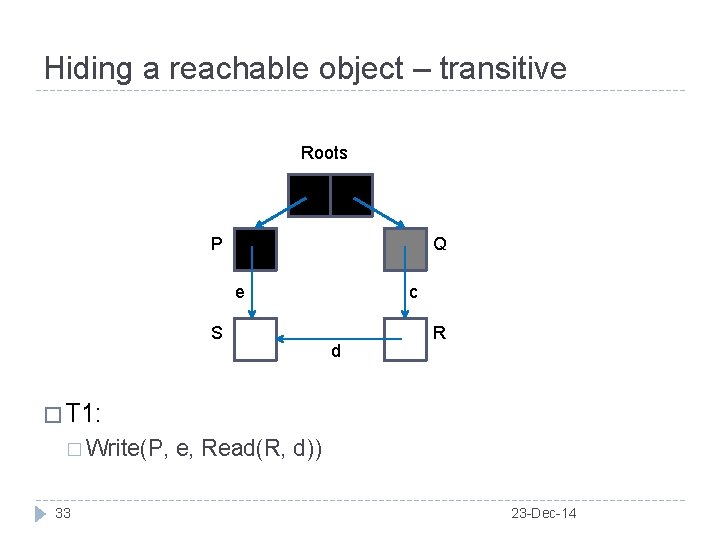
Hiding a reachable object – transitive Roots P Q e S c d R � T 1: � Write(P, 33 e, Read(R, d)) 23 -Dec-14
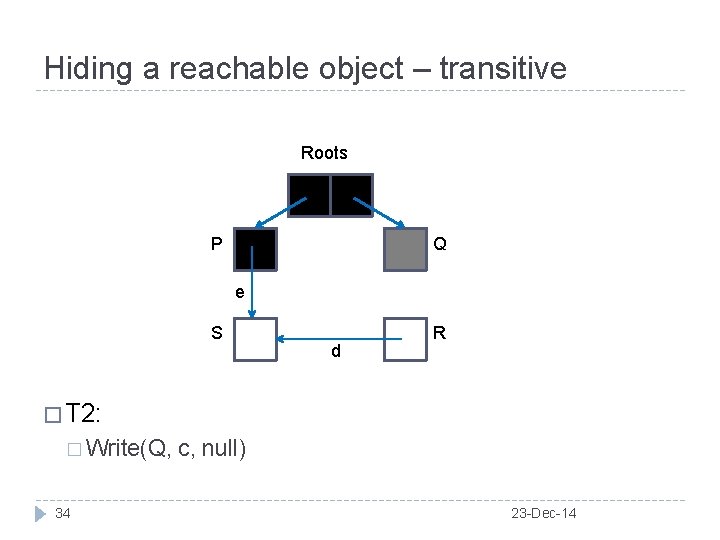
Hiding a reachable object – transitive Roots P Q e S d R � T 2: � Write(Q, 34 c, null) 23 -Dec-14
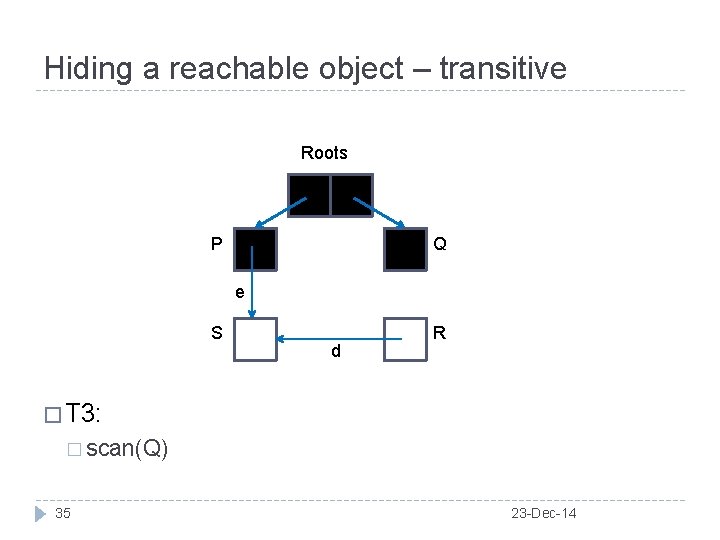
Hiding a reachable object – transitive Roots P Q e S d R � T 3: � scan(Q) 35 23 -Dec-14
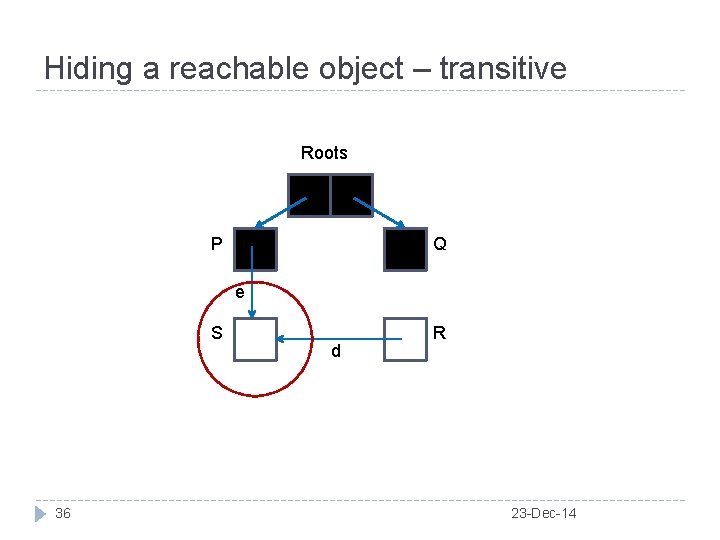
Hiding a reachable object – transitive Roots P Q e S 36 d R 23 -Dec-14
Outline � General concurrent GC concepts � Incremental, mostly concurrent, “on-the-fly” collections � The lost object problem � Tricolor invariants 37 23 -Dec-14
![Losing objects Wilson [1994] states that an object can be lost only if the](http://slidetodoc.com/presentation_image_h/35eb91b48bf167163977964acddac3e4/image-38.jpg "Losing objects Wilson [1994] states that an object can be lost only if the")
Losing objects Wilson [1994] states that an object can be lost only if the following two conditions hold: 1. Mutator stores a pointer to a white object into a black object, and 2. All paths from grey objects to that white object are destroyed 38 23 -Dec-14
Not losing any objects � Must ensure that both conditions don’t hold simultaneously � Weak tricolor invariant: � All white objects pointed to by black objects are “grey protected” � (reachable from some grey object, directly or through a white chain) � This invalidates the secondition � Strong � There � 39 This tricolor invariant: are no pointers from black objects to white objects invalidates both conditions 23 -Dec-14
Maintaining the invariants � Our examples: � Wrote a pointer to a white object in a black object (D 1/T 1) � Broke the strong invariant � Deleted all paths from grey objects to that white object (D 2/T 2) � Broke the weak invariant � Therefore, a black object pointed to a (presumed garbage) white object, violating correctness � Solutions 40 will have to operate at one of these steps 23 -Dec-14
Tradeoffs in the solution space � Solution properties � Precision: amount of “floating garbage” � Efficiency: throughput � Atomicity: degree of concurrency � Example: �A stop-the-world collector obtains: � Maximal precision � No concurrency with the mutator � Finer grained atomicity increases concurrency, at the expense of possibly accuracy and/or overhead of atomic operations 41 23 -Dec-14
Mutator color � Consider � Grey the mutator itself an object mutator � Has not yet been scanned by the collector, or � Roots have been scanned but have to be rescanned � Black Mutator � Scanned by the collector; roots won’t be rescanned � Under strong invariant: roots don’t point to white objects � Under weak invariant: can hold white objects IF “grey protected” 42 23 -Dec-14
Nuances of mutator color � Mutator color has implications for collection termination � If a grey mutator is permitted, it may be necessary to halt all mutator threads for a final scan of the roots � Real on-the-fly collectors distinguish among multiple mutator threads � Because they do not stop all at once to sample roots � Therefore, must operate with mutators of different colors � Also, may separate the roots to different groups (black/grey) � For 43 example, by stack frames 23 -Dec-14
Allocation color � Mutator � Must color influences color of allocated memory satisfy the invariant that applies given the mutator color � Grey mutator can allocate white objects � Black mutator can not allocate white objects � Unless it knows that the reference will be stored ahead of wavefront � Allocating black objects is always safe � If an object is allocated grey/black, it will not be reclaimed in the current allocation cycle 44� Even if reference dropped right away 23 -Dec-14
Short recap � Tricolor � Weak invariant types invariant � Every white object pointed by a black object, is “grey protected” � Strong � No invariant pointers from black objects to white objects � Mutator � Grey color mutator � Some � Black � All 45 of the roots haven’t been scanned yet mutator roots scanned 23 -Dec-14
Incremental update solutions � Address T 1/D 1 mutations (adding a white pointer to a black object) � Conservatively treat a white object inserted behind the wavefront as alive � Increase (increment) the set of objects known to be live � Use write barrier to re-color source/destination to prevent black to white pointers � Can � Thus, 46 use a read barrier to load references to a black mutator preserve the strong invariant 23 -Dec-14
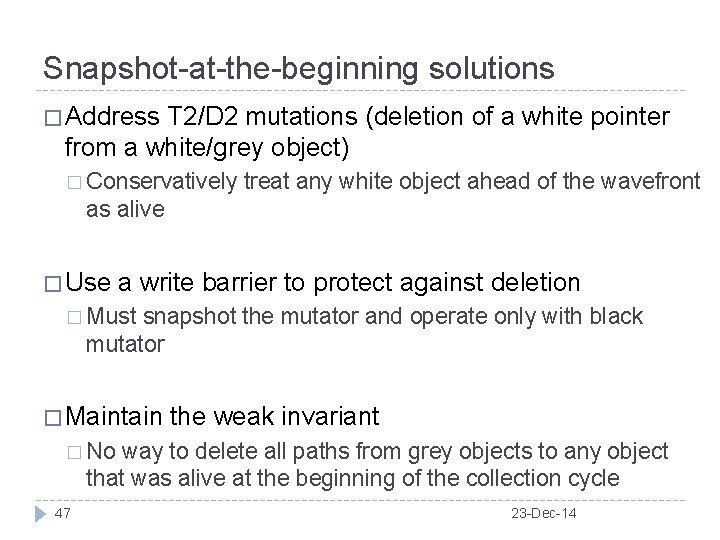
Snapshot-at-the-beginning solutions � Address T 2/D 2 mutations (deletion of a white pointer from a white/grey object) � Conservatively treat any white object ahead of the wavefront as alive � Use a write barrier to protect against deletion � Must snapshot the mutator and operate only with black mutator � Maintain the weak invariant � No way to delete all paths from grey objects to any object that was alive at the beginning of the collection cycle 47 23 -Dec-14
Outline � General concurrent GC concepts � Incremental, mostly concurrent, “on-the-fly” collections � The lost object problem � Tricolor invariants � Barrier techniques for concurrent GC � Complete 48 enumeration of techniques 23 -Dec-14
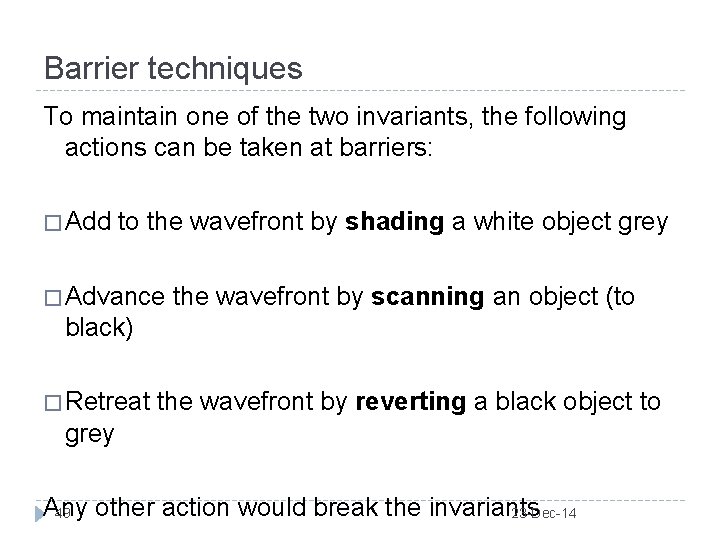
Barrier techniques To maintain one of the two invariants, the following actions can be taken at barriers: � Add to the wavefront by shading a white object grey � Advance the wavefront by scanning an object (to black) � Retreat the wavefront by reverting a black object to grey Any other action would break the invariants 49 23 -Dec-14
![Grey mutator incremental update (v 1) � Steele [1975, 1976] � atomic Write(src, i,](http://slidetodoc.com/presentation_image_h/35eb91b48bf167163977964acddac3e4/image-50.jpg "Grey mutator incremental update (v 1) � Steele [1975, 1976] � atomic Write(src, i,")
Grey mutator incremental update (v 1) � Steele [1975, 1976] � atomic Write(src, i, ref): src[i] ref if is. Black(src) if is. White(ref) revert(src) 50 23 -Dec-14
![Grey mutator incremental update (v 1) � Steele [1975, 1976] � atomic Write(src, i,](http://slidetodoc.com/presentation_image_h/35eb91b48bf167163977964acddac3e4/image-51.jpg "Grey mutator incremental update (v 1) � Steele [1975, 1976] � atomic Write(src, i,")
Grey mutator incremental update (v 1) � Steele [1975, 1976] � atomic Write(src, i, ref): src[i] ref if is. Black(src) if is. White(ref) revert(src) � Maintains � No � Most 51 the strong invariant black to white pointers exist precise barrier, at the cost of progress 23 -Dec-14
![Grey mutator incremental update (v 2) � Boehm et al [1991] � atomic Write(src,](http://slidetodoc.com/presentation_image_h/35eb91b48bf167163977964acddac3e4/image-52.jpg "Grey mutator incremental update (v 2) � Boehm et al [1991] � atomic Write(src,")
Grey mutator incremental update (v 2) � Boehm et al [1991] � atomic Write(src, i, ref): src[i] ref if is. Black(src) revert(src) 52 23 -Dec-14
![Grey mutator incremental update (v 2) � Boehm et al [1991] � atomic Write(src,](http://slidetodoc.com/presentation_image_h/35eb91b48bf167163977964acddac3e4/image-53.jpg "Grey mutator incremental update (v 2) � Boehm et al [1991] � atomic Write(src,")
Grey mutator incremental update (v 2) � Boehm et al [1991] � atomic Write(src, i, ref): src[i] ref if is. Black(src) revert(src) � Less precise � Uses virtual memory dirty bits to record modifications � Stop-the-world to rescan dirty pages 53 23 -Dec-14
![Grey mutator incremental update (v 3) � Dijkstra et al [1976, 1978] � atomic](http://slidetodoc.com/presentation_image_h/35eb91b48bf167163977964acddac3e4/image-54.jpg "Grey mutator incremental update (v 3) � Dijkstra et al [1976, 1978] � atomic")
Grey mutator incremental update (v 3) � Dijkstra et al [1976, 1978] � atomic Write(src, i, ref): src[i] ref if is. Black(src) shade(ref) 54 23 -Dec-14
![Grey mutator incremental update (v 3) � Dijkstra et al [1976, 1978] � atomic](http://slidetodoc.com/presentation_image_h/35eb91b48bf167163977964acddac3e4/image-55.jpg "Grey mutator incremental update (v 3) � Dijkstra et al [1976, 1978] � atomic")
Grey mutator incremental update (v 3) � Dijkstra et al [1976, 1978] � atomic Write(src, i, ref): src[i] ref if is. Black(src) shade(ref) � Original version even removed the condition check � In order to relax (remove) atomicity � And the original-original version. . 55 23 -Dec-14
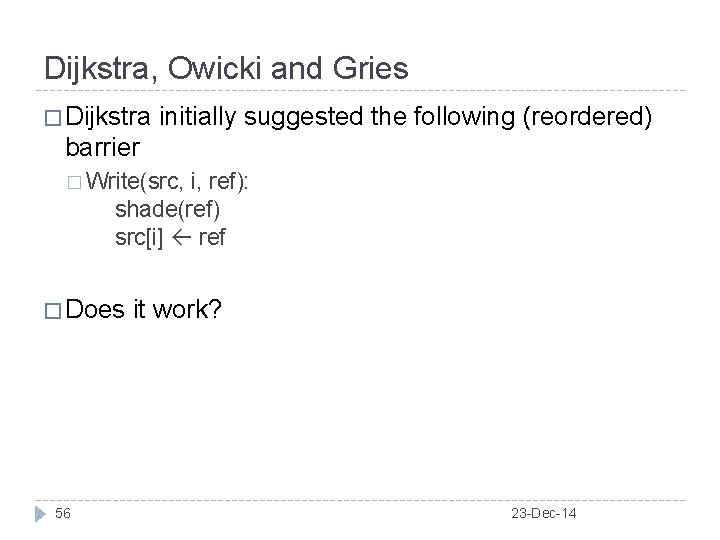
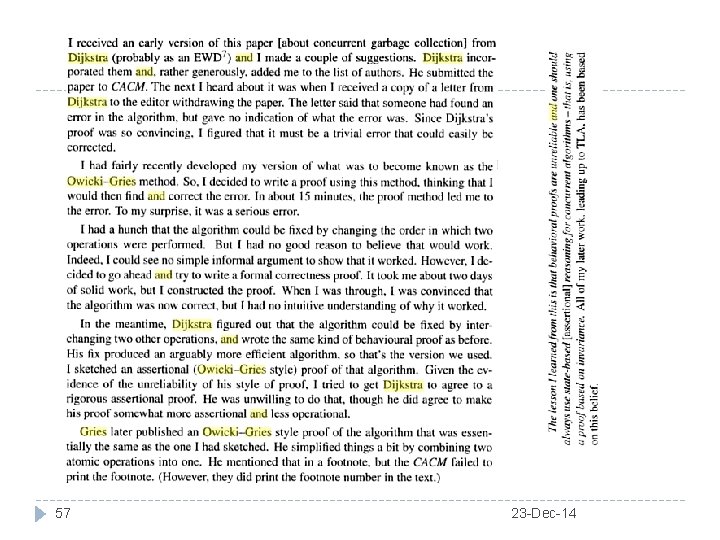
Dijkstra, Owicki and Gries � Dijkstra initially suggested the following (reordered) barrier � Write(src, i, ref): shade(ref) src[i] ref � Does 56 it work? 23 -Dec-14
57 23 -Dec-14
![Black mutator incremental update (v 1) � Baker [1978] � atomic Read(src, i): ref](http://slidetodoc.com/presentation_image_h/35eb91b48bf167163977964acddac3e4/image-58.jpg "Black mutator incremental update (v 1) � Baker [1978] � atomic Read(src, i): ref")
Black mutator incremental update (v 1) � Baker [1978] � atomic Read(src, i): ref src[i] if is. Grey(src) ref shade(ref) return ref 58 23 -Dec-14
![Black mutator incremental update (v 1) � Baker [1978] � atomic Read(src, i): ref](http://slidetodoc.com/presentation_image_h/35eb91b48bf167163977964acddac3e4/image-59.jpg "Black mutator incremental update (v 1) � Baker [1978] � atomic Read(src, i): ref")
Black mutator incremental update (v 1) � Baker [1978] � atomic Read(src, i): ref src[i] if is. Grey(src) ref shade(ref) return ref � Maintains the strong invariant (after snapshotting mutator) � No pointers from black to white � Supports 59 a copying-collector 23 -Dec-14
![Black mutator incremental update (v 2) � Appel et al [1988] � atomic Read(src,](http://slidetodoc.com/presentation_image_h/35eb91b48bf167163977964acddac3e4/image-60.jpg "Black mutator incremental update (v 2) � Appel et al [1988] � atomic Read(src,")
Black mutator incremental update (v 2) � Appel et al [1988] � atomic Read(src, i): if is. Grey(src) scan(src) return src[i] 60 23 -Dec-14
![Black mutator incremental update (v 2) � Appel et al [1988] � atomic Read(src,](http://slidetodoc.com/presentation_image_h/35eb91b48bf167163977964acddac3e4/image-61.jpg "Black mutator incremental update (v 2) � Appel et al [1988] � atomic Read(src,")
Black mutator incremental update (v 2) � Appel et al [1988] � atomic Read(src, i): if is. Grey(src) scan(src) return src[i] � Less precise (more coarse-grained) than before � Uses virtual memory page protection mechanisms to trap � Trapped instruction continues after scanning 61 23 -Dec-14
![Black mutator snapshot-at-the-beginning � Abraham and Patel [1987] and Yuasa [1990] � atomic Write(src,](http://slidetodoc.com/presentation_image_h/35eb91b48bf167163977964acddac3e4/image-62.jpg "Black mutator snapshot-at-the-beginning � Abraham and Patel [1987] and Yuasa [1990] � atomic Write(src,")
Black mutator snapshot-at-the-beginning � Abraham and Patel [1987] and Yuasa [1990] � atomic Write(src, i, ref): if is. Grey(src) || is. White(src) shade(src[i]) src[i] ref 62 23 -Dec-14
![Black mutator snapshot-at-the-beginning � Abraham and Patel [1987] and Yuasa [1990] � atomic Write(src,](http://slidetodoc.com/presentation_image_h/35eb91b48bf167163977964acddac3e4/image-63.jpg "Black mutator snapshot-at-the-beginning � Abraham and Patel [1987] and Yuasa [1990] � atomic Write(src,")
Black mutator snapshot-at-the-beginning � Abraham and Patel [1987] and Yuasa [1990] � atomic Write(src, i, ref): if is. Grey(src) || is. White(src) shade(src[i]) src[i] ref � Maintains the weak invariant � White objects that were alive at the beginning are grey protected � Less precise of all � Initially 63 wasn’t conditioned (used virtual memory COW) 23 -Dec-14
![Black mutator hybrid barrier � Pirinen [1998] � atomic Read(src, i): if is. White(src)](http://slidetodoc.com/presentation_image_h/35eb91b48bf167163977964acddac3e4/image-64.jpg "Black mutator hybrid barrier � Pirinen [1998] � atomic Read(src, i): if is. White(src)")
Black mutator hybrid barrier � Pirinen [1998] � atomic Read(src, i): if is. White(src) shade(src[i]) return src[i] � atomic Write(src, i, ref): if is. Grey(src) shade(src[i]) src[i] ref 64 23 -Dec-14
![Black mutator hybrid barrier � Pirinen [1998] � atomic Read(src, i): if is. White(src):](http://slidetodoc.com/presentation_image_h/35eb91b48bf167163977964acddac3e4/image-65.jpg "Black mutator hybrid barrier � Pirinen [1998] � atomic Read(src, i): if is. White(src):")
Black mutator hybrid barrier � Pirinen [1998] � atomic Read(src, i): if is. White(src): shade(src[i]) return src[i] � atomic Write(src, i, ref): if is. Grey(src): shade(src[i]) src[i] ref � Maintains � Actually the weak invariant every black to white pointer has a direct grey father 65 23 -Dec-14
![Completeness of barrier techniques � Pirinen [1998] claims that this is the complete list,](http://slidetodoc.com/presentation_image_h/35eb91b48bf167163977964acddac3e4/image-66.jpg "Completeness of barrier techniques � Pirinen [1998] claims that this is the complete list,")
Completeness of barrier techniques � Pirinen [1998] claims that this is the complete list, other than possible short-circuiting/coarsening: � Scanning instead of shading � Scan origin in a deletion barrier rather than shading deleted �. . � The given barrier techniques cover the minimum requirements to maintain their invariants 66 23 -Dec-14
Outline � General concurrent GC concepts � Incremental, mostly concurrent, “on-the-fly” collections � The lost object problem � Tricolor invariants � Barrier techniques for concurrent GC � Complete enumeration of techniques � Efficient implementation through card tables 67 23 -Dec-14
Concurrent write barrier mechanisms � Write barriers must detect and record all grey objects � To be inspected (and traced) by the collector � Mutators and collectors will access such data concurrently � Must � One way is to add these grey objects to a log � Which � Another 68 work correctly and efficiently we explored before (Chapter 13; queues etc) solution is using card tables 23 -Dec-14
Card tables �A card table holds one byte for every 512 bytes of memory � Marking only the dirty blocks � In our case, the card table is the work list of the collector � Mutators mark dirty blocks and collectors scan them for grey objects � They do it repeatedly; the collector’s job is to make all the cards clean in order to complete marking phase � Might require stop-the-world period to keep mutator from constantly updating 69 23 -Dec-14
Outline � General concurrent GC concepts � Incremental, mostly concurrent, “on-the-fly” collections � The lost object problem � Tricolor invariants � Barrier techniques for concurrent GC � Complete enumeration of techniques � Efficient implementation through card tables � Summary 70 23 -Dec-14
Summary � The solution space is huge � Strong/weak tricolor invariants � Grey/black mutators � Many different barrier flavors to consider � Will be useful in the following chapters � There is no free-lunch � Concurrent/incremental garbage collectors require synchronization and possibly do more work overall � But this is in order to reduce observable pause times � Which 71 is important in many situations 23 -Dec-14
- Slides: 71