
Concurrency Control and Recovery In real life users
- Slides: 31
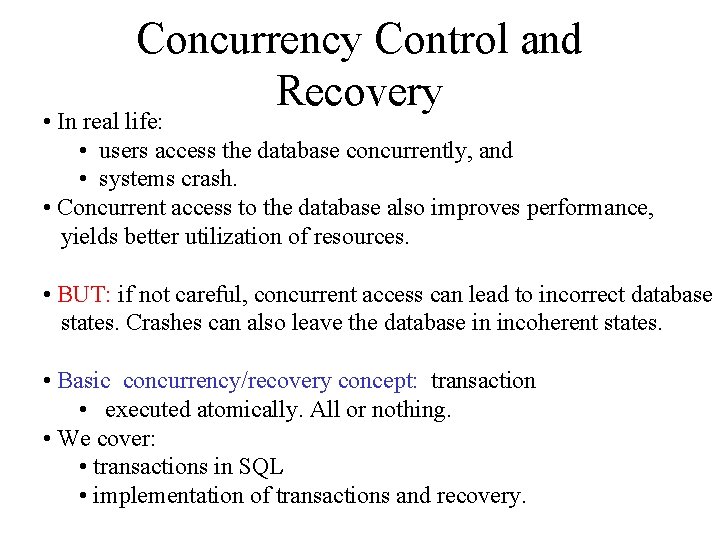
Concurrency Control and Recovery • In real life: • users access the database concurrently, and • systems crash. • Concurrent access to the database also improves performance, yields better utilization of resources. • BUT: if not careful, concurrent access can lead to incorrect database states. Crashes can also leave the database in incoherent states. • Basic concurrency/recovery concept: transaction • executed atomically. All or nothing. • We cover: • transactions in SQL • implementation of transactions and recovery.
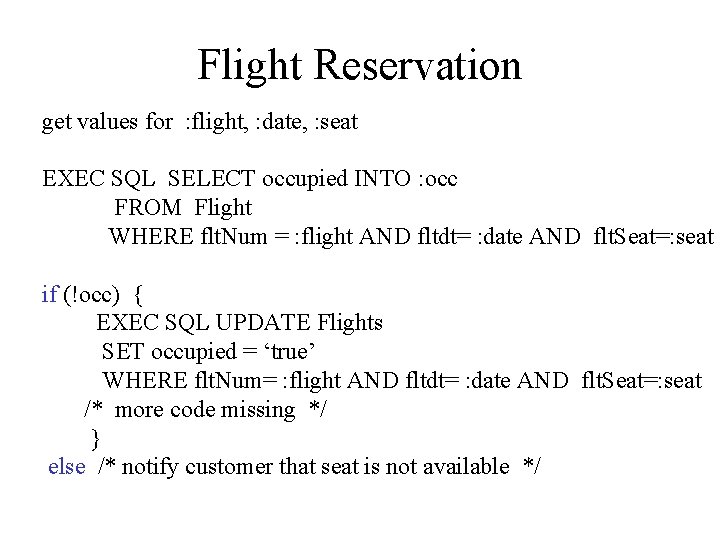
Flight Reservation get values for : flight, : date, : seat EXEC SQL SELECT occupied INTO : occ FROM Flight WHERE flt. Num = : flight AND fltdt= : date AND flt. Seat=: seat if (!occ) { EXEC SQL UPDATE Flights SET occupied = ‘true’ WHERE flt. Num= : flight AND fltdt= : date AND flt. Seat=: seat /* more code missing */ } else /* notify customer that seat is not available */
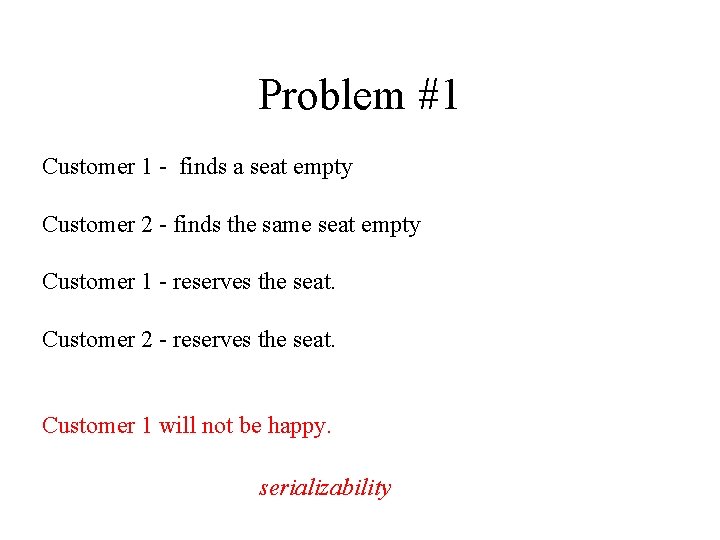
Problem #1 Customer 1 - finds a seat empty Customer 2 - finds the same seat empty Customer 1 - reserves the seat. Customer 2 - reserves the seat. Customer 1 will not be happy. serializability
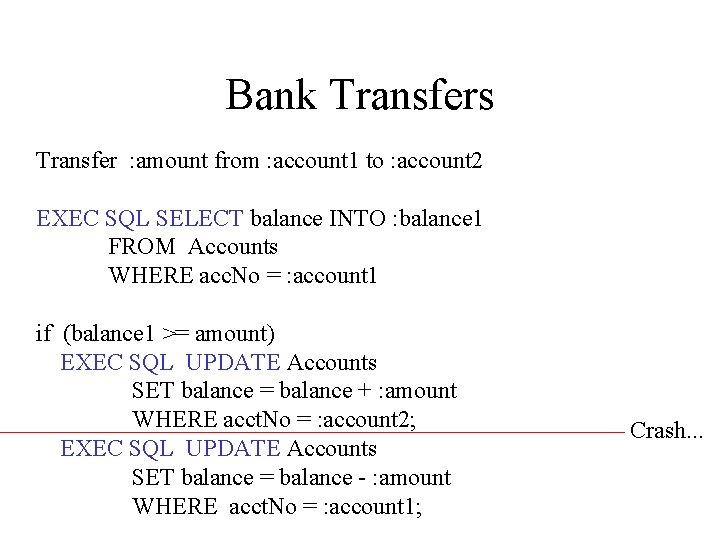
Bank Transfers Transfer : amount from : account 1 to : account 2 EXEC SQL SELECT balance INTO : balance 1 FROM Accounts WHERE acc. No = : account 1 if (balance 1 >= amount) EXEC SQL UPDATE Accounts SET balance = balance + : amount WHERE acct. No = : account 2; EXEC SQL UPDATE Accounts SET balance = balance - : amount WHERE acct. No = : account 1; Crash. . .
Transactions The user/programmer can group a sequence of commands so that they are executed atomically and in a serializable fashion: • Transaction commit: all the operations should be done and recorded. • Transaction abort: none of the operations should be done. In SQL: • EXEC SQL COMMIT; • EXEC SQL ROLLBACK; Easier said than done. . .
ACID Properties Atomicity: all actions of a transaction happen, or none happen. Consistency: if a transaction is consistent, and the database starts from a consistent state, then it will end in a consistent state. Isolation: the execution of one transaction is isolated from other transactions. Durability: if a transaction commits, its effects persist in the database.
How Do We Assure ACID? Concurrency control: Guarantees consistency and isolation, given atomicity. Logging and Recovery: Guarantees atomicity and durability. If you are going to be in the logging business, one of the things that you’ll have to do is learn about heavy equipment. -- Robert Van. Natta Logging History of Columbia County
More on SQL and Transactions Read only transactions: • if the transaction is only reading, we can allow more operations in parallel. EXEC SQL SET TRANSACTION READ ONLY; The default is: SET TRANSACTION READ WRITE;
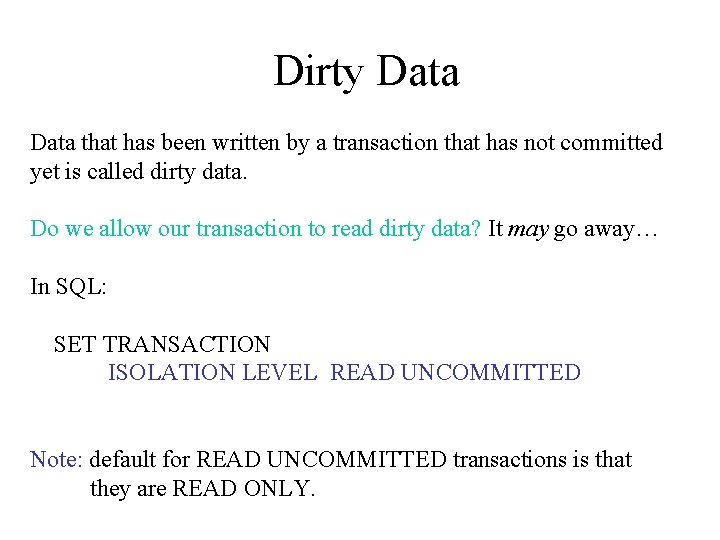
Dirty Data that has been written by a transaction that has not committed yet is called dirty data. Do we allow our transaction to read dirty data? It may go away… In SQL: SET TRANSACTION ISOLATION LEVEL READ UNCOMMITTED Note: default for READ UNCOMMITTED transactions is that they are READ ONLY.
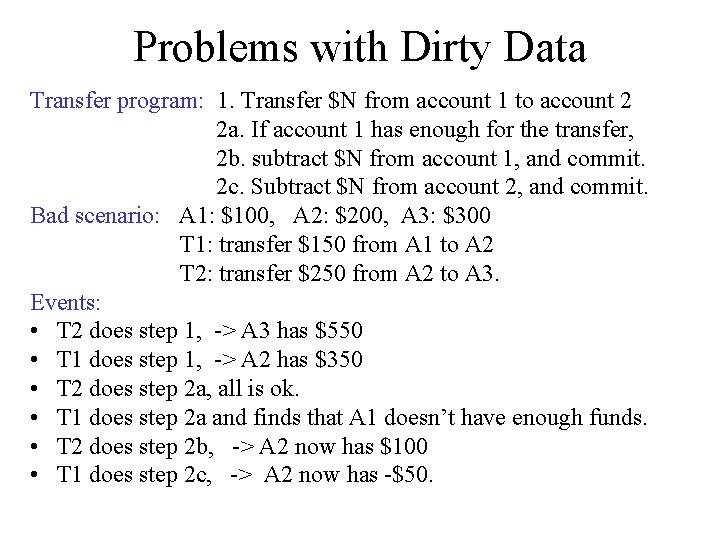
Problems with Dirty Data Transfer program: 1. Transfer $N from account 1 to account 2 2 a. If account 1 has enough for the transfer, 2 b. subtract $N from account 1, and commit. 2 c. Subtract $N from account 2, and commit. Bad scenario: A 1: $100, A 2: $200, A 3: $300 T 1: transfer $150 from A 1 to A 2 T 2: transfer $250 from A 2 to A 3. Events: • T 2 does step 1, -> A 3 has $550 • T 1 does step 1, -> A 2 has $350 • T 2 does step 2 a, all is ok. • T 1 does step 2 a and finds that A 1 doesn’t have enough funds. • T 2 does step 2 b, -> A 2 now has $100 • T 1 does step 2 c, -> A 2 now has -$50.
Concurrency Control Methods • Schedules • Serial schedules • Serializable schedules • Locking • Lock manager • 2 Phase Locking • Deadlocks: • Prevention • Detection
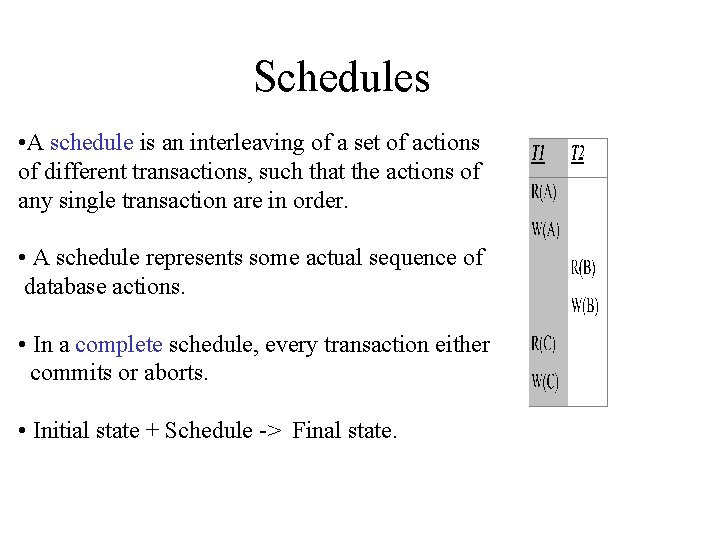
Schedules • A schedule is an interleaving of a set of actions of different transactions, such that the actions of any single transaction are in order. • A schedule represents some actual sequence of database actions. • In a complete schedule, every transaction either commits or aborts. • Initial state + Schedule -> Final state.
Acceptable Schedules Serial schedules: • The transactions run one at a time from beginning to completion. • Note: there are many possible serial schedules. Each one is OK. The DBMS does not provide any guarantee in which order concurrently submitted transactions are executed. Serializable schedules: • Final state is what some serial schedule would have produced.
Aborted Transactions Slight modification to the definition: A schedule is serializable if it is equivalent to a serial schedule of committed transactions. • As if the aborted transactions never happened. Two issues to consider w. r. t. aborted transactions: • how does one undo the effect of a transaction? • What if another transaction sees the effects of an aborted one?
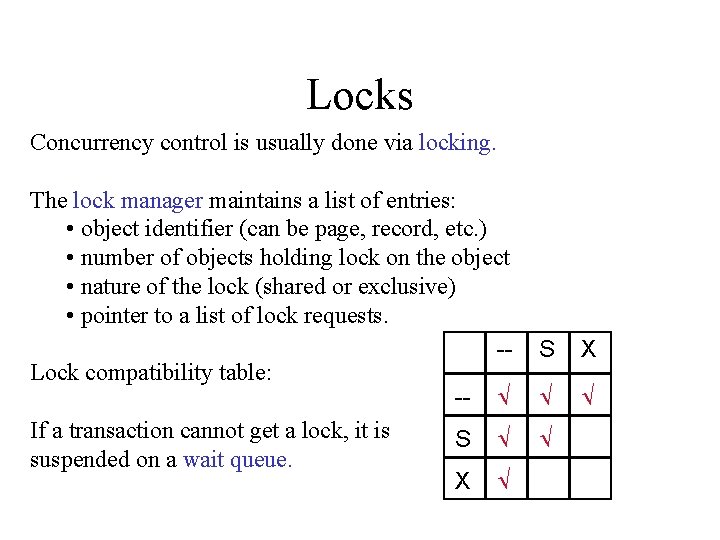
Locks Concurrency control is usually done via locking. The lock manager maintains a list of entries: • object identifier (can be page, record, etc. ) • number of objects holding lock on the object • nature of the lock (shared or exclusive) • pointer to a list of lock requests. -Lock compatibility table: -- Ö If a transaction cannot get a lock, it is S Ö suspended on a wait queue. X Ö S X Ö Ö Ö
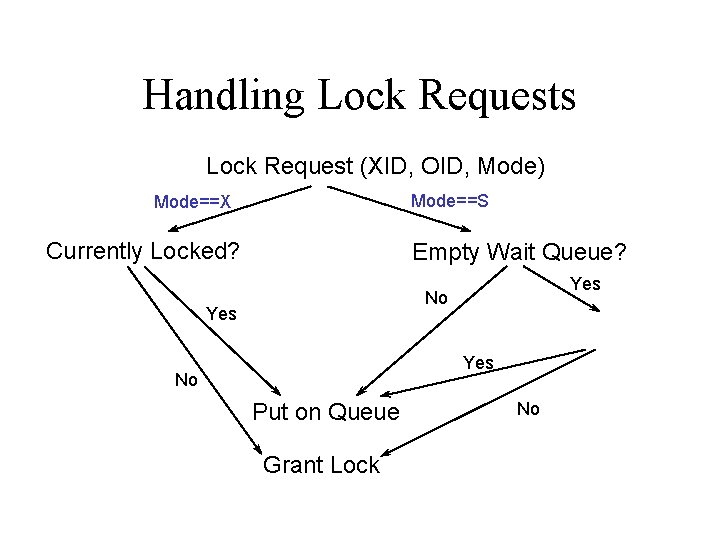
Handling Lock Requests Lock Request (XID, OID, Mode) Mode==S Mode==X Currently Locked? Empty Wait Queue? Yes No Put on Queue Grant Lock No
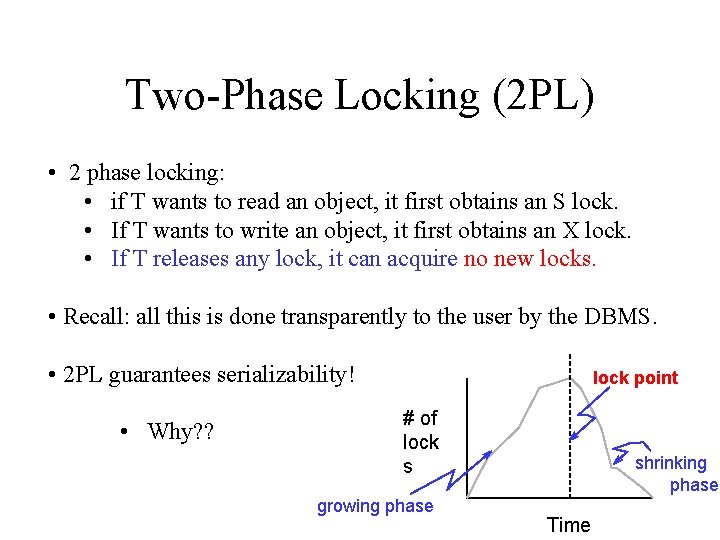
Two-Phase Locking (2 PL) • 2 phase locking: • if T wants to read an object, it first obtains an S lock. • If T wants to write an object, it first obtains an X lock. • If T releases any lock, it can acquire no new locks. • Recall: all this is done transparently to the user by the DBMS. • 2 PL guarantees serializability! • Why? ? lock point # of lock s growing phase shrinking phase Time
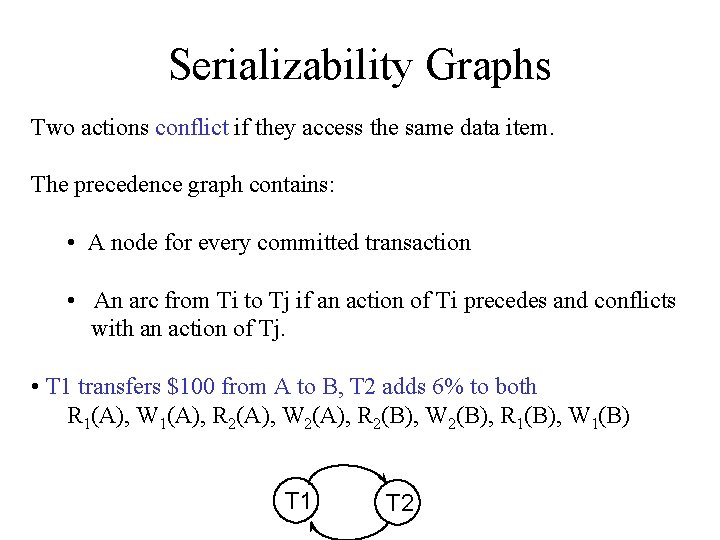
Serializability Graphs Two actions conflict if they access the same data item. The precedence graph contains: • A node for every committed transaction • An arc from Ti to Tj if an action of Ti precedes and conflicts with an action of Tj. • T 1 transfers $100 from A to B, T 2 adds 6% to both R 1(A), W 1(A), R 2(A), W 2(A), R 2(B), W 2(B), R 1(B), W 1(B) T 1 T 2
Conflict Serializability • 2 schedules are conflict equivalent if: – they have the same sets of actions, and – each pair of conflicting actions is ordered in the same way. • A schedule is conflict serializable if it is conflict equivalent to a serial schedule. – Note: Some serializable schedules are not conflict serializable! • Theorem: A schedule is conflict serializable iff its precedence graph is acyclic. • Theorem: 2 PL ensures that the precedence graph will be acyclic!
Deadlocks Suppose we have the following scenario: • T 1 asks for an exclusive lock on A • T 2 asks for an exclusive lock on B • T 1 asks for a shared lock on B • T 2 asks for a shared lock on A Both T 1 and T 2 are waiting! We have a DEADLOCK. Possible solutions: • Prevent deadlocks to start with, or • Detect when they happen and do something about it.
Deadlock Prevention • Give each transaction a timestamp. “Older” transactions have higher priority. • Assume Ti requests a lock, but Tj holds a conflicting lock. We can follow two strategies: • Wait-die: if Ti has higher priority, it waits; else Ti aborts. • Wound-wait: if Ti has higher priority, abort Tj; else Ti waits. • Note: after aborting, restart with original timestamp! Both strategies guarantee deadlock-free behavior!
An Alternative to Prevention • In theory, deadlock can involve many transactions: T 1 waits-for T 2 waits-for T 3. . . waits-for T 1 • In practice, most “deadlock cycles” involve only 2 transactions. • Don’t need to prevent deadlock! What’s the problem with prevention? • Allow it to happen, then notice it and fix it. Deadlock detection.
Deadlock Detection • Lock Manager maintains a “Waits-for” graph: • Node for each transaction. • Arc from Ti to Tj if Tj holds a lock and Ti is waiting for it. • Periodically check graph for cycles. • “Shoot” some transaction to break the cycle. • Simpler hack: time-outs. T 1 made no progress for a while? Shoot it.
Detection Versus Prevention • Prevention might abort too many transactions. • Detection might allow deadlocks to tie up resources for a while. – Can detect more often, but it’s time-consuming. • The usual answer: – Detection is the winner. – Deadlocks are pretty rare. – If you get a lot of deadlocks, reconsider your schema/workload!
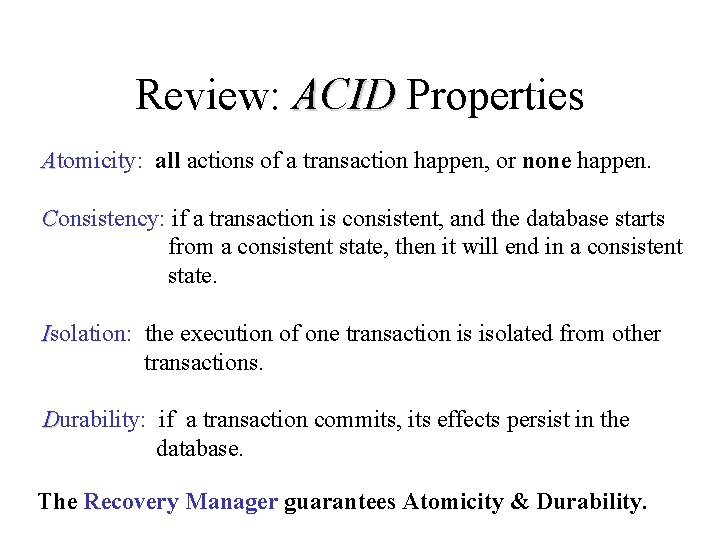
Review: ACID Properties Atomicity: all actions of a transaction happen, or none happen. Consistency: if a transaction is consistent, and the database starts from a consistent state, then it will end in a consistent state. Isolation: the execution of one transaction is isolated from other transactions. Durability: if a transaction commits, its effects persist in the database. The Recovery Manager guarantees Atomicity & Durability.
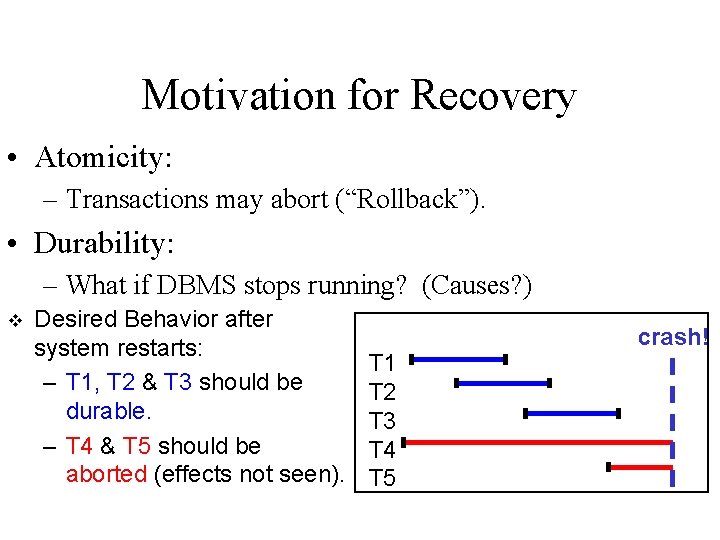
Motivation for Recovery • Atomicity: – Transactions may abort (“Rollback”). • Durability: – What if DBMS stops running? (Causes? ) v Desired Behavior after system restarts: – T 1, T 2 & T 3 should be durable. – T 4 & T 5 should be aborted (effects not seen). T 1 T 2 T 3 T 4 T 5 crash!
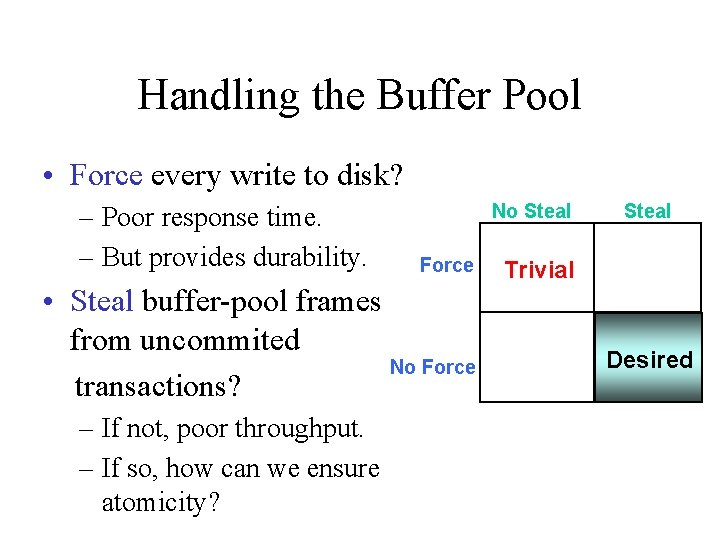
Handling the Buffer Pool • Force every write to disk? – Poor response time. – But provides durability. No Steal Force • Steal buffer-pool frames from uncommited No Force transactions? – If not, poor throughput. – If so, how can we ensure atomicity? Steal Trivial Desired
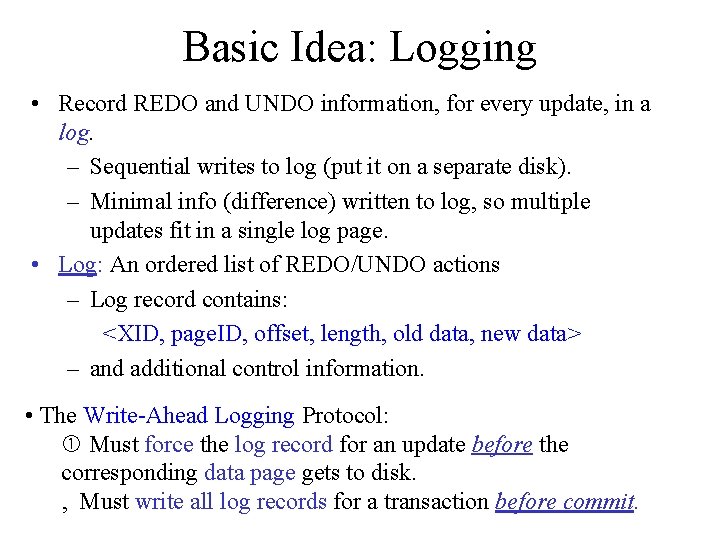
Basic Idea: Logging • Record REDO and UNDO information, for every update, in a log. – Sequential writes to log (put it on a separate disk). – Minimal info (difference) written to log, so multiple updates fit in a single log page. • Log: An ordered list of REDO/UNDO actions – Log record contains: <XID, page. ID, offset, length, old data, new data> – and additional control information. • The Write-Ahead Logging Protocol: Must force the log record for an update before the corresponding data page gets to disk. ‚ Must write all log records for a transaction before commit.
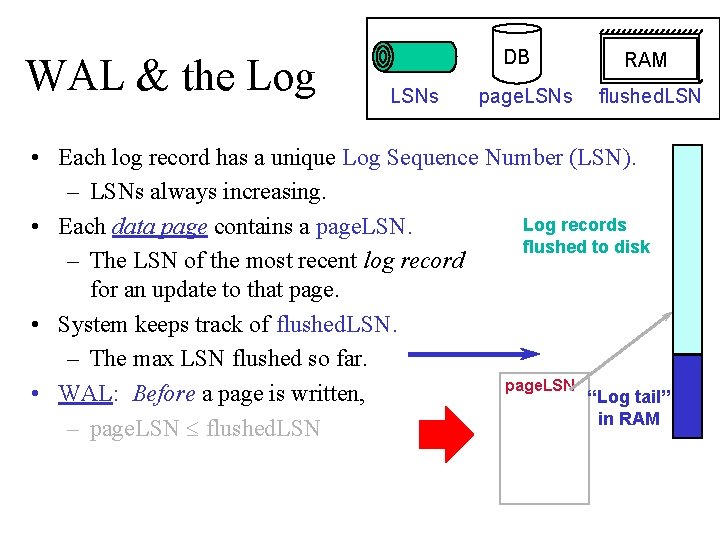
WAL & the Log DB LSNs page. LSNs RAM flushed. LSN • Each log record has a unique Log Sequence Number (LSN). – LSNs always increasing. Log records • Each data page contains a page. LSN. flushed to disk – The LSN of the most recent log record for an update to that page. • System keeps track of flushed. LSN. – The max LSN flushed so far. page. LSN • WAL: Before a page is written, “Log tail” in RAM – page. LSN £ flushed. LSN
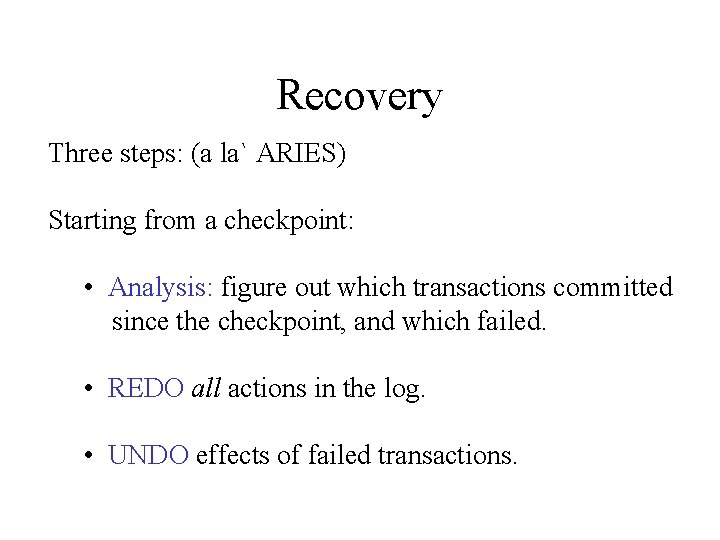
Recovery Three steps: (a la` ARIES) Starting from a checkpoint: • Analysis: figure out which transactions committed since the checkpoint, and which failed. • REDO all actions in the log. • UNDO effects of failed transactions.
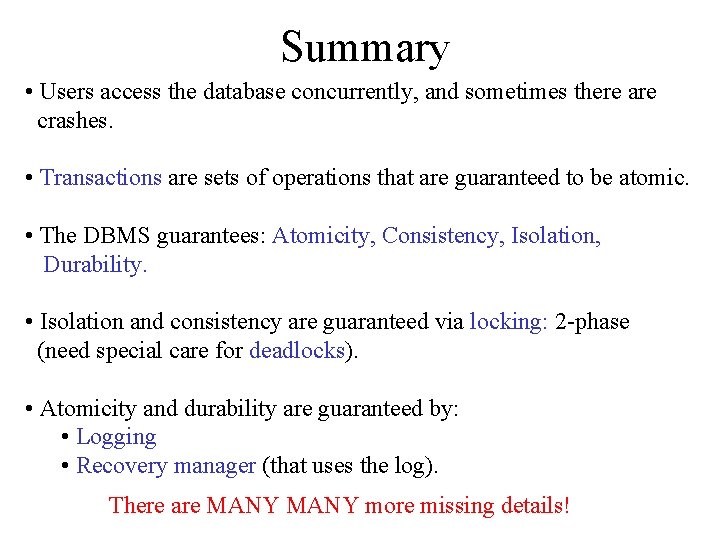
Summary • Users access the database concurrently, and sometimes there are crashes. • Transactions are sets of operations that are guaranteed to be atomic. • The DBMS guarantees: Atomicity, Consistency, Isolation, Durability. • Isolation and consistency are guaranteed via locking: 2 -phase (need special care for deadlocks). • Atomicity and durability are guaranteed by: • Logging • Recovery manager (that uses the log). There are MANY more missing details!