
Concurrency control abstractions PDCS 9 CPE 5 Carlos
Concurrency control abstractions (PDCS 9, CPE 5*) Carlos Varela Rennselaer Polytechnic Institute October 15, 2019 * Concurrent Programming in Erlang, by J. Armstrong, R. Virding, C. Wikström, M. Williams C. Varela 1
Actor Languages Summary • Actors are concurrent entities that react to messages. – State is completely encapsulated. There is no shared memory! – Message passing is asynchronous. – Actors can create new actors. Run-time has to ensure fairness. • AMST extends the call by value lambda calculus with actor primitives. State is modeled as function arguments. Actors use ready to receive new messages. • Erlang extends a functional programming language core with processes that run arbitrary functions. State is implicit in the function’s arguments. Control loop is explicit: actors use receive to get a message, and tailform recursive call to continue. Ending a function denotes process (actor) termination. • SALSA extends an object-oriented programming language (Java) with universal actors. State is explicit, encapsulated in instance variables. Control loop is implicit: ending a message handler, signals readiness to receive a new message. Actors are garbage-collected. C. Varela 2

Causal order • In a sequential program all execution states are totally ordered • In a concurrent program all execution states of a given actor are totally ordered • The execution state of the concurrent program as a whole is partially ordered C. Varela 3

Total order • In a sequential program all execution states are totally ordered sequential execution computation step C. Varela 4
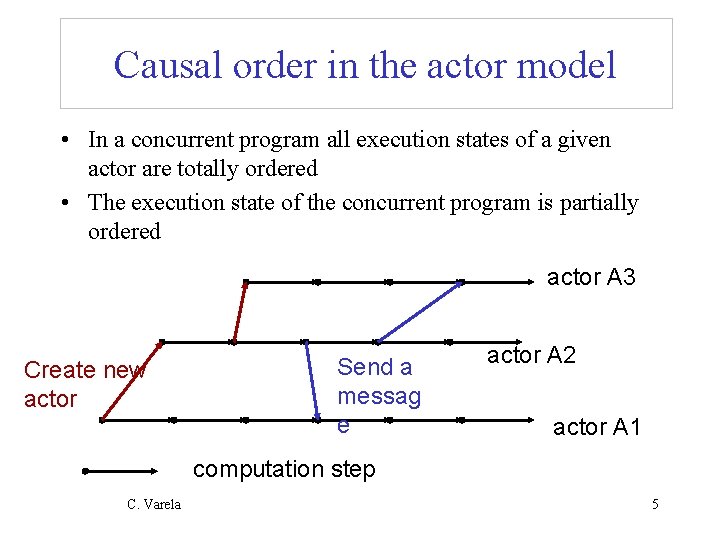
Causal order in the actor model • In a concurrent program all execution states of a given actor are totally ordered • The execution state of the concurrent program is partially ordered actor A 3 Create new actor Send a messag e actor A 2 actor A 1 computation step C. Varela 5
Nondeterminism • An execution is nondeterministic if there is a computation step in which there is a choice what to do next • Nondeterminism appears naturally when there is asynchronous message passing – Messages can arrive or be processed in an order different from the sending order. C. Varela 6
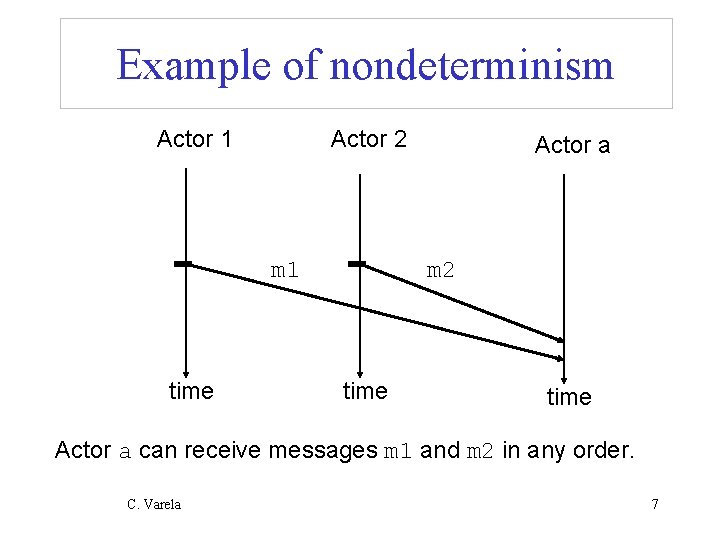
Example of nondeterminism Actor 1 Actor 2 m 1 time Actor a m 2 time Actor a can receive messages m 1 and m 2 in any order. C. Varela 7
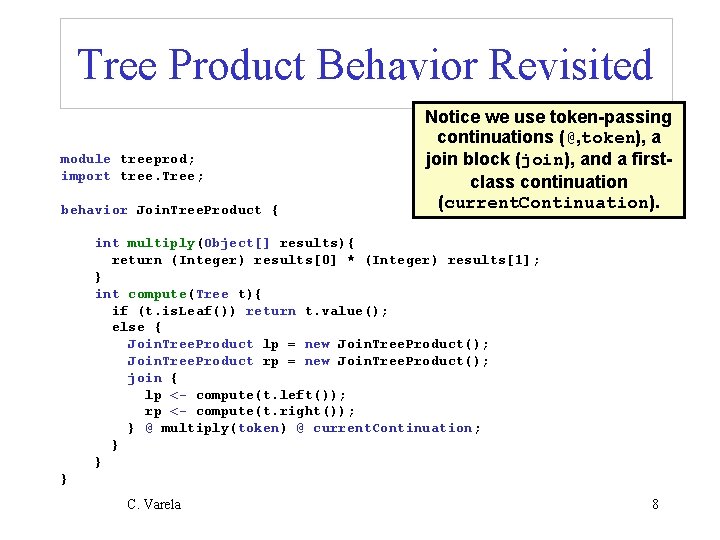
Tree Product Behavior Revisited module treeprod; import tree. Tree; behavior Join. Tree. Product { Notice we use token-passing continuations (@, token), a join block (join), and a firstclass continuation (current. Continuation). int multiply(Object[] results){ return (Integer) results[0] * (Integer) results[1]; } int compute(Tree t){ if (t. is. Leaf()) return t. value(); else { Join. Tree. Product lp = new Join. Tree. Product(); Join. Tree. Product rp = new Join. Tree. Product(); join { lp <- compute(t. left()); rp <- compute(t. right()); } @ multiply(token) @ current. Continuation; } } } C. Varela 8
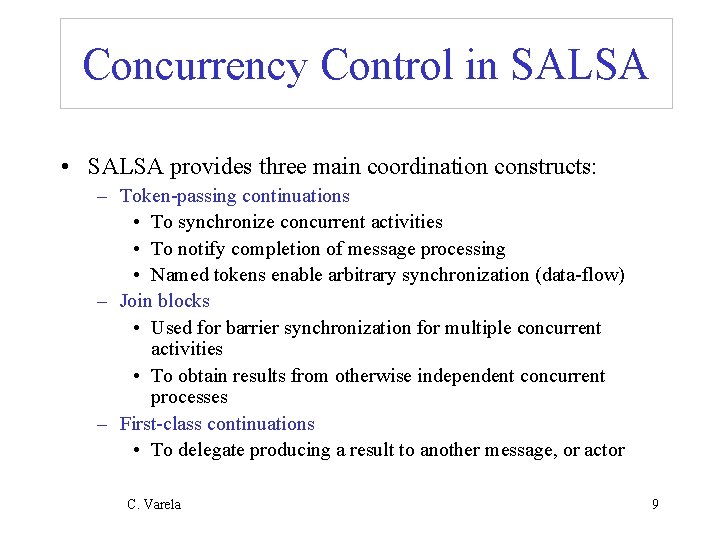
Concurrency Control in SALSA • SALSA provides three main coordination constructs: – Token-passing continuations • To synchronize concurrent activities • To notify completion of message processing • Named tokens enable arbitrary synchronization (data-flow) – Join blocks • Used for barrier synchronization for multiple concurrent activities • To obtain results from otherwise independent concurrent processes – First-class continuations • To delegate producing a result to another message, or actor C. Varela 9
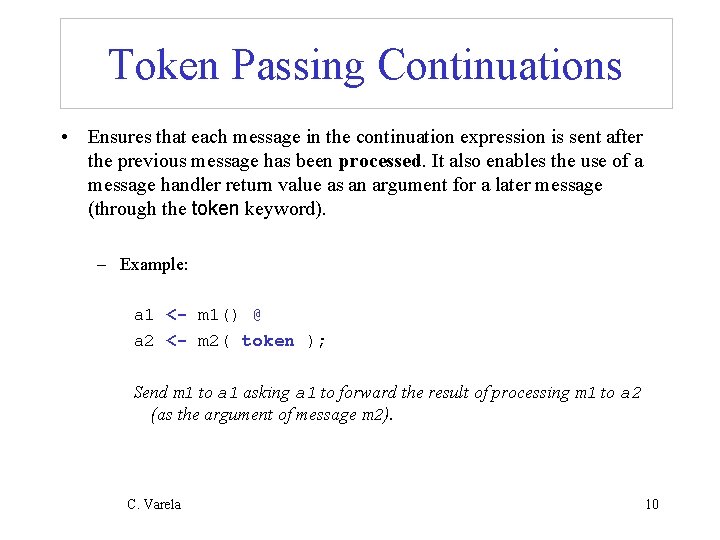
Token Passing Continuations • Ensures that each message in the continuation expression is sent after the previous message has been processed. It also enables the use of a message handler return value as an argument for a later message (through the token keyword). – Example: a 1 <- m 1() @ a 2 <- m 2( token ); Send m 1 to a 1 asking a 1 to forward the result of processing m 1 to a 2 (as the argument of message m 2). C. Varela 10
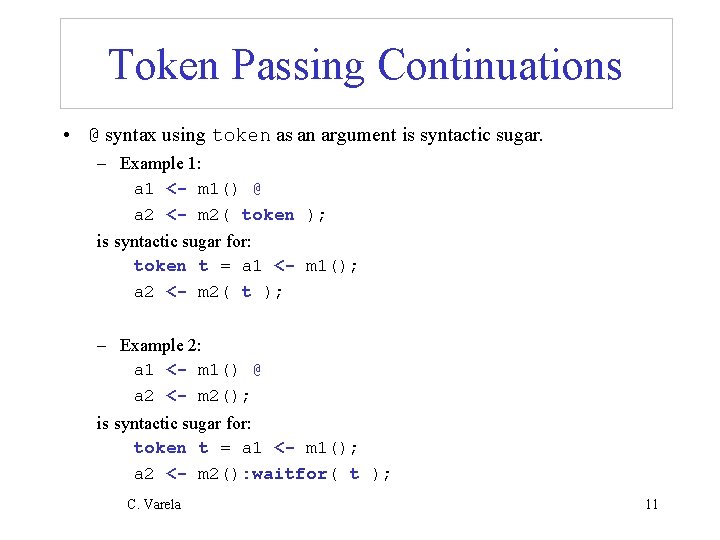
Token Passing Continuations • @ syntax using token as an argument is syntactic sugar. – Example 1: a 1 <- m 1() @ a 2 <- m 2( token ); is syntactic sugar for: token t = a 1 <- m 1(); a 2 <- m 2( t ); – Example 2: a 1 <- m 1() @ a 2 <- m 2(); is syntactic sugar for: token t = a 1 <- m 1(); a 2 <- m 2(): waitfor( t ); C. Varela 11
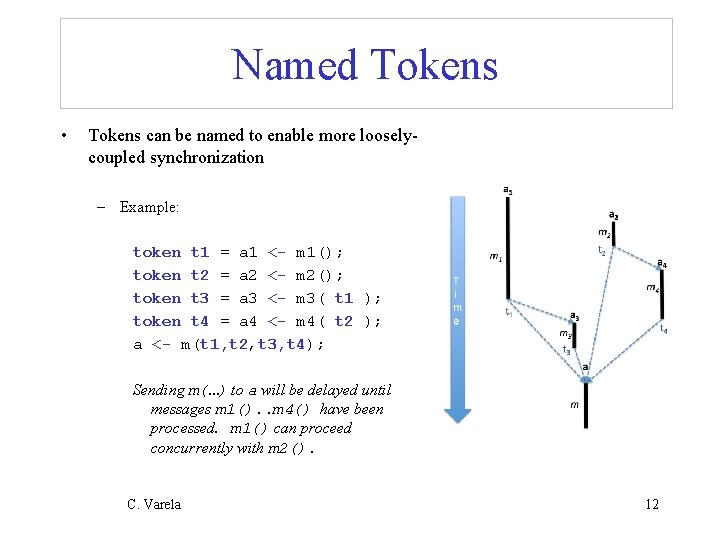
Named Tokens • Tokens can be named to enable more looselycoupled synchronization – Example: token t 1 = a 1 <- m 1(); token t 2 = a 2 <- m 2(); token t 3 = a 3 <- m 3( t 1 ); token t 4 = a 4 <- m 4( t 2 ); a <- m(t 1, t 2, t 3, t 4); Sending m(…) to a will be delayed until messages m 1(). . m 4() have been processed. m 1() can proceed concurrently with m 2(). C. Varela 12
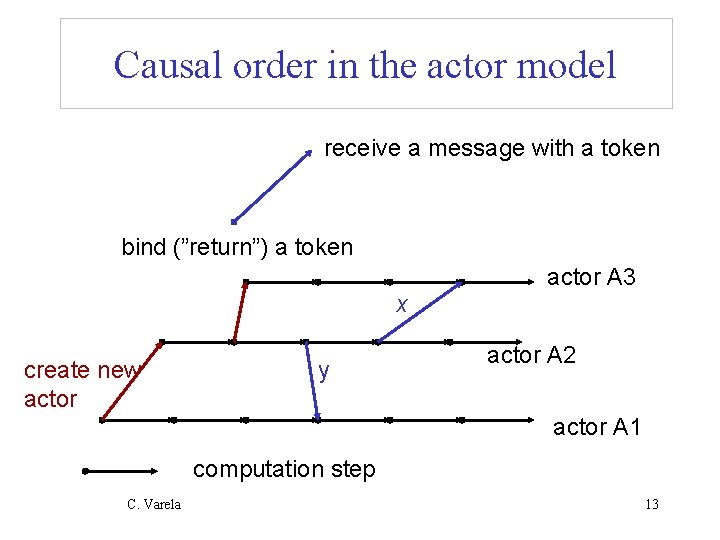
Causal order in the actor model receive a message with a token bind (”return”) a token actor A 3 x create new actor y actor A 2 actor A 1 computation step C. Varela 13
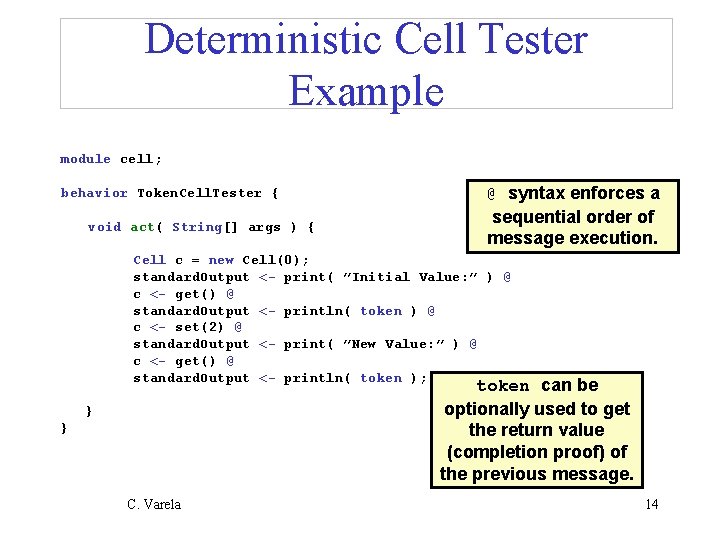
Deterministic Cell Tester Example module cell; behavior Token. Cell. Tester { void act( String[] args ) { @ syntax enforces a sequential order of message execution. Cell c = new Cell(0); standard. Output <- print( ”Initial Value: ” ) @ c <- get() @ standard. Output <- println( token ) @ c <- set(2) @ standard. Output <- print( ”New Value: ” ) @ c <- get() @ standard. Output <- println( token ); token can be optionally used to get the return value (completion proof) of the previous message. } } C. Varela 14
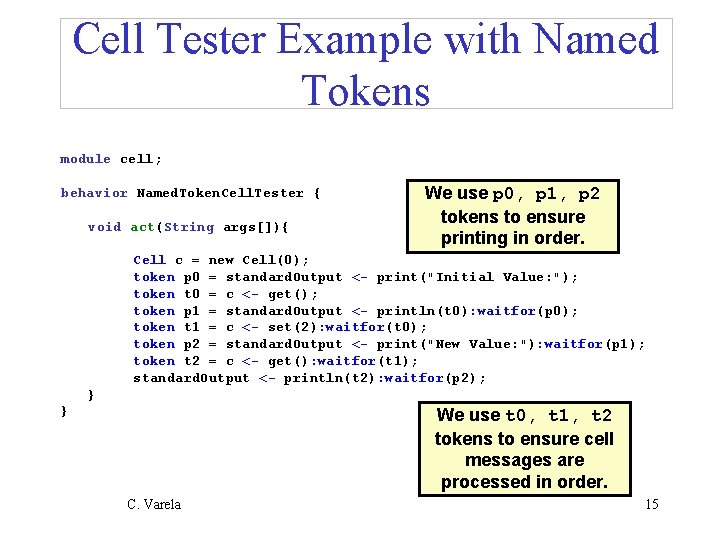
Cell Tester Example with Named Tokens module cell; behavior Named. Token. Cell. Tester { void act(String args[]){ We use p 0, p 1, p 2 tokens to ensure printing in order. Cell c = new Cell(0); token p 0 = standard. Output <- print("Initial Value: "); token t 0 = c <- get(); token p 1 = standard. Output <- println(t 0): waitfor(p 0); token t 1 = c <- set(2): waitfor(t 0); token p 2 = standard. Output <- print("New Value: "): waitfor(p 1); token t 2 = c <- get(): waitfor(t 1); standard. Output <- println(t 2): waitfor(p 2); } } We use t 0, t 1, t 2 tokens to ensure cell messages are processed in order. C. Varela 15
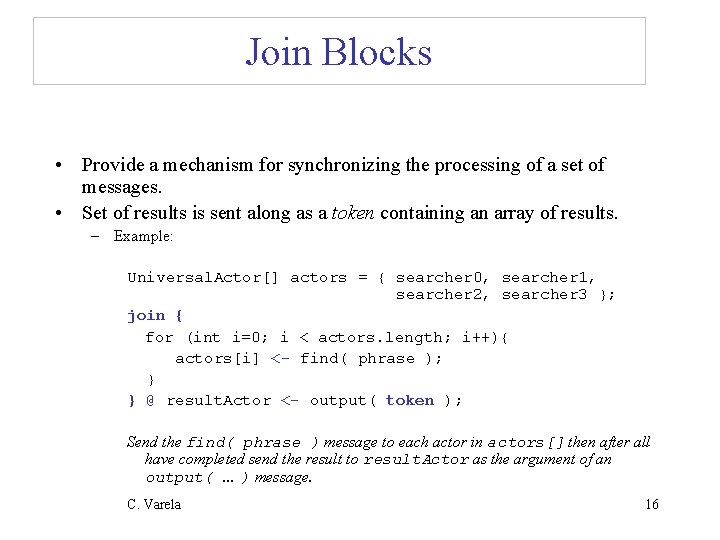
Join Blocks • Provide a mechanism for synchronizing the processing of a set of messages. • Set of results is sent along as a token containing an array of results. – Example: Universal. Actor[] actors = { searcher 0, searcher 1, searcher 2, searcher 3 }; join { for (int i=0; i < actors. length; i++){ actors[i] <- find( phrase ); } } @ result. Actor <- output( token ); Send the find( phrase ) message to each actor in actors[] then after all have completed send the result to result. Actor as the argument of an output( … ) message. C. Varela 16
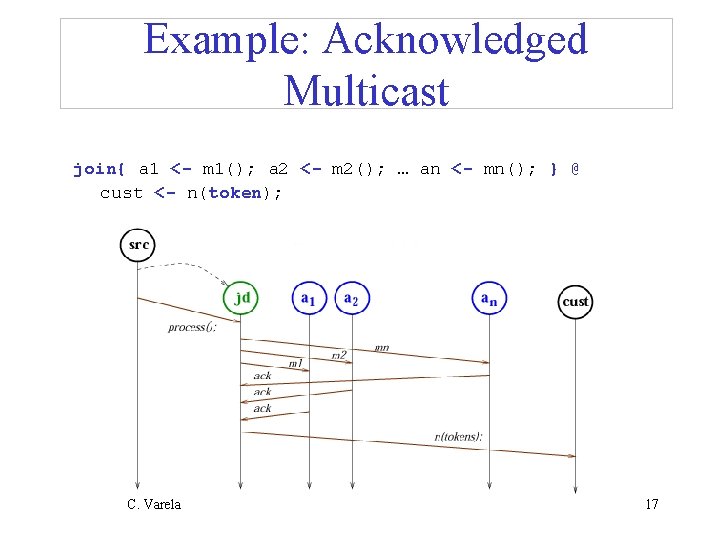
Example: Acknowledged Multicast join{ a 1 <- m 1(); a 2 <- m 2(); … an <- mn(); } @ cust <- n(token); C. Varela 17
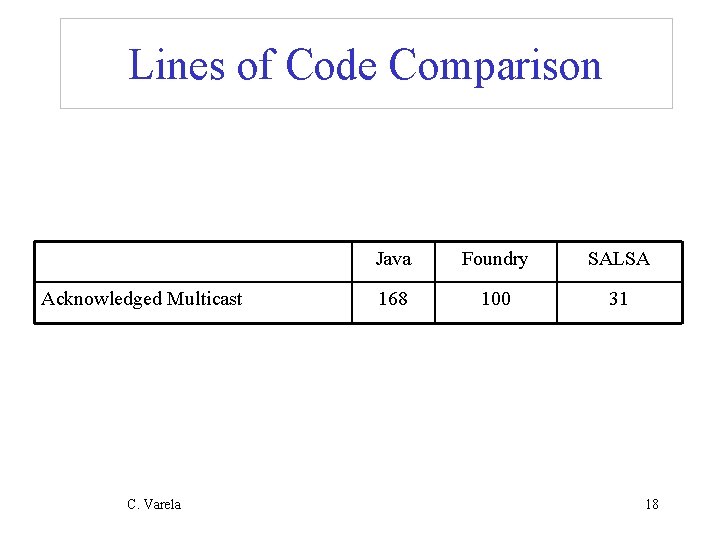
Lines of Code Comparison Acknowledged Multicast C. Varela Java Foundry SALSA 168 100 31 18
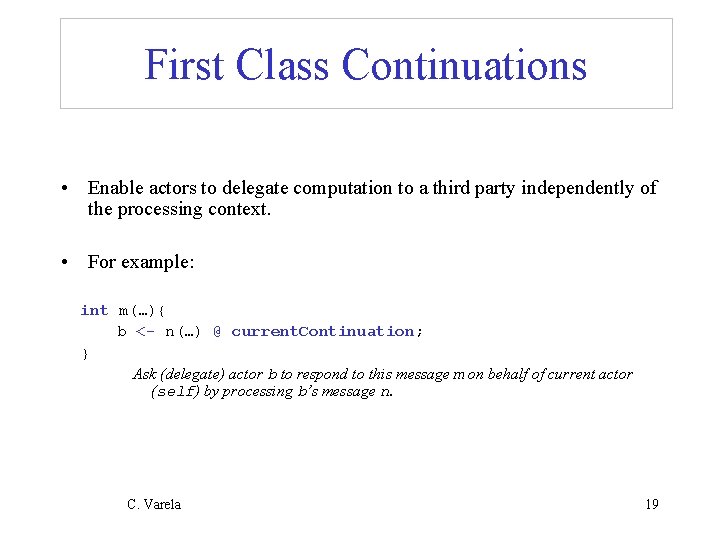
First Class Continuations • Enable actors to delegate computation to a third party independently of the processing context. • For example: int m(…){ b <- n(…) @ current. Continuation; } Ask (delegate) actor b to respond to this message m on behalf of current actor (self) by processing b’s message n. C. Varela 19
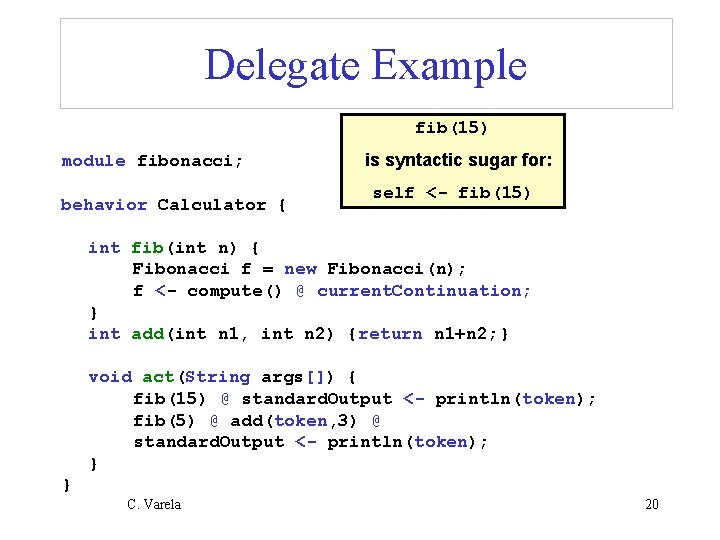
Delegate Example fib(15) module fibonacci; behavior Calculator { is syntactic sugar for: self <- fib(15) int fib(int n) { Fibonacci f = new Fibonacci(n); f <- compute() @ current. Continuation; } int add(int n 1, int n 2) {return n 1+n 2; } void act(String args[]) { fib(15) @ standard. Output <- println(token); fib(5) @ add(token, 3) @ standard. Output <- println(token); } } C. Varela 20
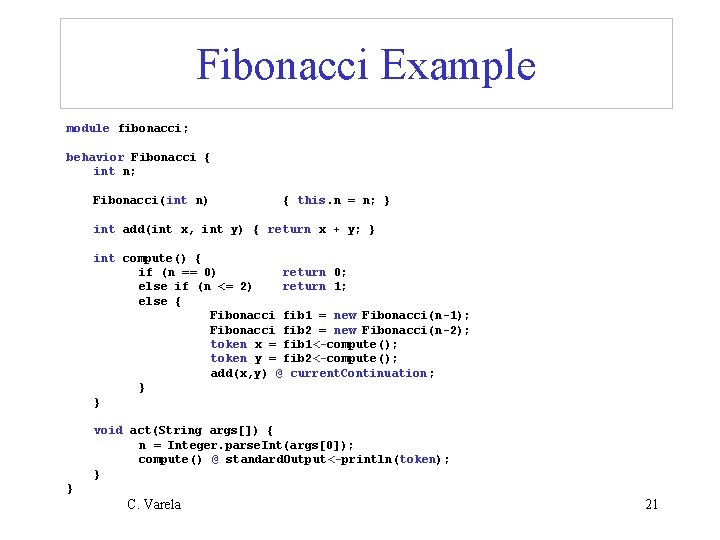
Fibonacci Example module fibonacci; behavior Fibonacci { int n; Fibonacci(int n) { this. n = n; } int add(int x, int y) { return x + y; } int compute() { if (n == 0) return 0; else if (n <= 2) return 1; else { Fibonacci fib 1 = new Fibonacci(n-1); Fibonacci fib 2 = new Fibonacci(n-2); token x = fib 1<-compute(); token y = fib 2<-compute(); add(x, y) @ current. Continuation; } } void act(String args[]) { n = Integer. parse. Int(args[0]); compute() @ standard. Output<-println(token); } } C. Varela 21
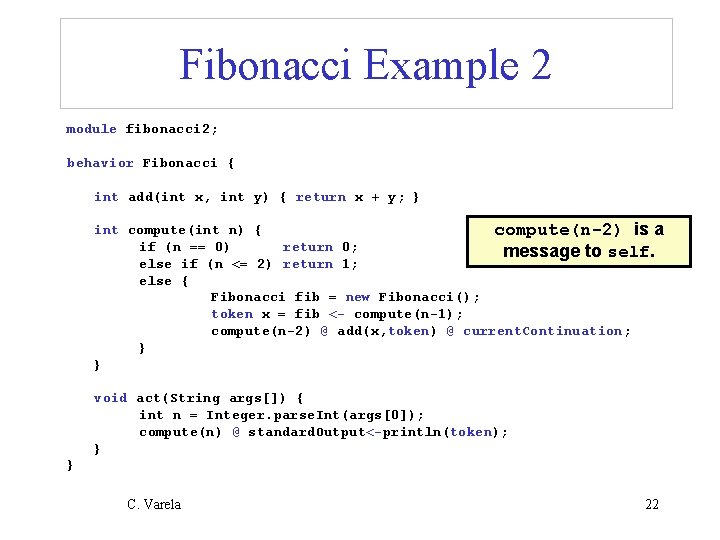
Fibonacci Example 2 module fibonacci 2; behavior Fibonacci { int add(int x, int y) { return x + y; } int compute(int n) { compute(n-2) is a if (n == 0) return 0; message to self. else if (n <= 2) return 1; else { Fibonacci fib = new Fibonacci(); token x = fib <- compute(n-1); compute(n-2) @ add(x, token) @ current. Continuation; } } void act(String args[]) { int n = Integer. parse. Int(args[0]); compute(n) @ standard. Output<-println(token); } } C. Varela 22
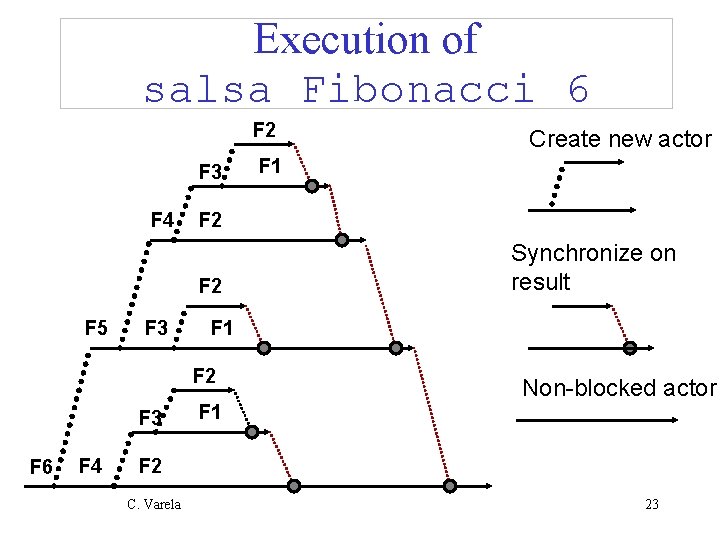
Execution of salsa Fibonacci 6 F 2 F 3 F 4 F 3 F 6 F 4 Synchronize on result F 1 F 2 F 3 F 1 F 2 F 5 Create new actor Non-blocked actor F 1 F 2 C. Varela 23
Concurrency control in Erlang • Erlang uses a selective receive mechanism to help coordinate concurrent activities: – Message patterns and guards • To select the next message (from possibly many) to execute. • To receive messages from a specific process (actor). • To receive messages of a specific kind (pattern). – Timeouts • To enable default activities to fire in the absence of messages (following certain patterns). • To create timers. – Zero timeouts (after 0) • To implement priority messages, to flush a mailbox. C. Varela 24
Selective Receive receive Message. Pattern 1 [when Guard 1] -> Actions 1 ; Message. Pattern 2 [when Guard 2] -> Actions 2 ; … end receive suspends until a message in the actor’s mailbox matches any of the patterns including optional guards. • Patterns are tried in order. On a match, the message is removed from the mailbox and the corresponding pattern’s actions are executed. • When a message does not match any of the patterns, it is left in the mailbox for future receive actions. C. Varela 25
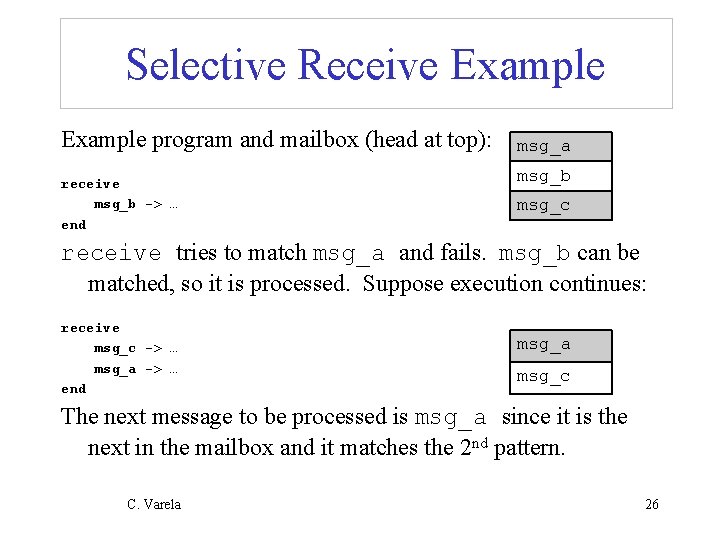
Selective Receive Example program and mailbox (head at top): receive msg_b -> … end msg_a msg_b msg_c receive tries to match msg_a and fails. msg_b can be matched, so it is processed. Suppose execution continues: receive msg_c -> … msg_a -> … end msg_a msg_c The next message to be processed is msg_a since it is the next in the mailbox and it matches the 2 nd pattern. C. Varela 26
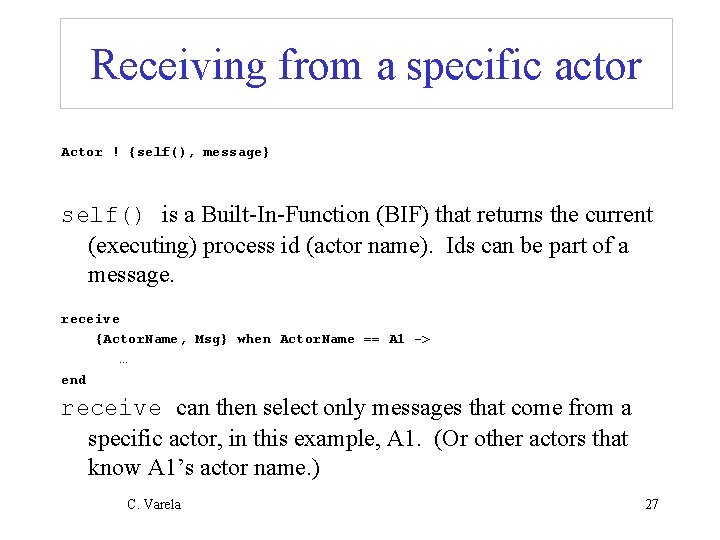
Receiving from a specific actor Actor ! {self(), message} self() is a Built-In-Function (BIF) that returns the current (executing) process id (actor name). Ids can be part of a message. receive {Actor. Name, Msg} when Actor. Name == A 1 -> … end receive can then select only messages that come from a specific actor, in this example, A 1. (Or other actors that know A 1’s actor name. ) C. Varela 27
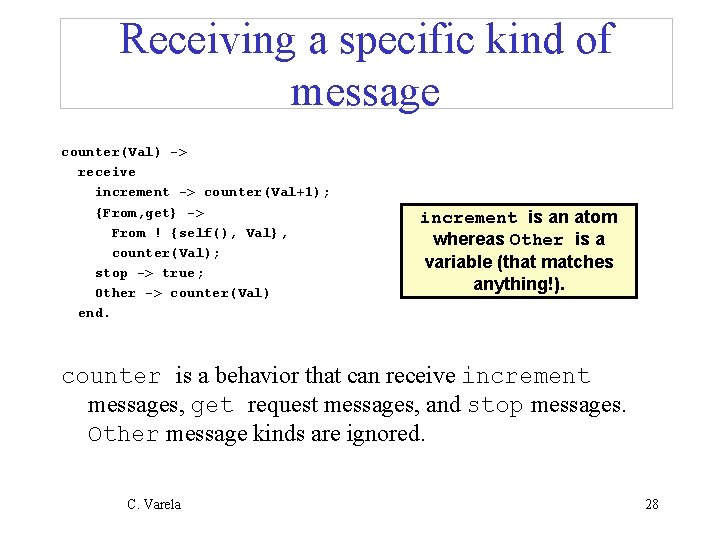
Receiving a specific kind of message counter(Val) -> receive increment -> counter(Val+1); {From, get} -> From ! {self(), Val}, counter(Val); stop -> true; Other -> counter(Val) end. increment is an atom whereas Other is a variable (that matches anything!). counter is a behavior that can receive increment messages, get request messages, and stop messages. Other message kinds are ignored. C. Varela 28
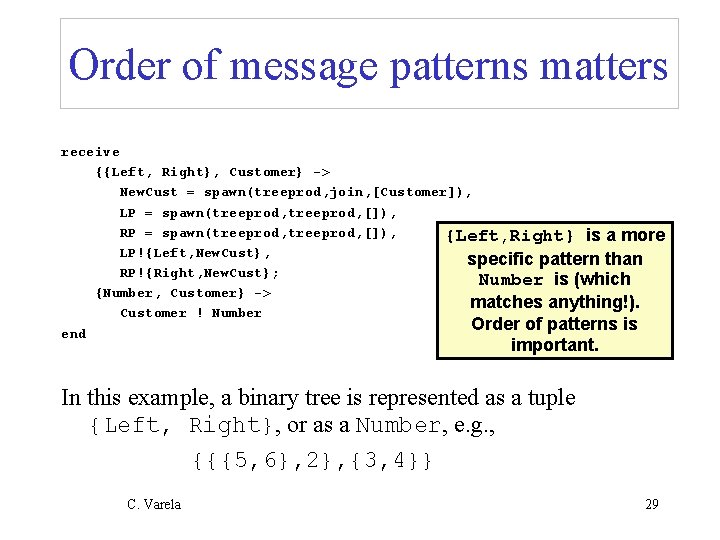
Order of message patterns matters receive {{Left, Right}, Customer} -> New. Cust = spawn(treeprod, join, [Customer]), LP = spawn(treeprod, []), RP = spawn(treeprod, []), {Left, Right} is a more LP!{Left, New. Cust}, specific pattern than RP!{Right, New. Cust}; Number is (which {Number, Customer} -> matches anything!). Customer ! Number Order of patterns is end important. In this example, a binary tree is represented as a tuple {Left, Right}, or as a Number, e. g. , {{{5, 6}, 2}, {3, 4}} C. Varela 29
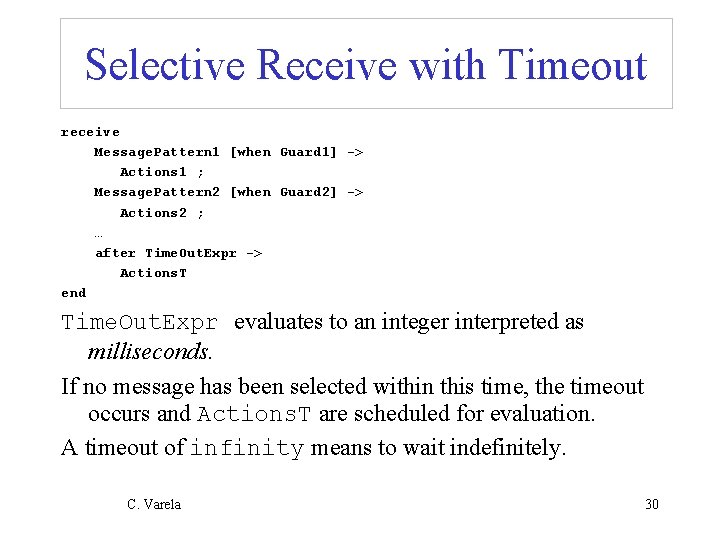
Selective Receive with Timeout receive Message. Pattern 1 [when Guard 1] -> Actions 1 ; Message. Pattern 2 [when Guard 2] -> Actions 2 ; … after Time. Out. Expr -> Actions. T end Time. Out. Expr evaluates to an integer interpreted as milliseconds. If no message has been selected within this time, the timeout occurs and Actions. T are scheduled for evaluation. A timeout of infinity means to wait indefinitely. C. Varela 30
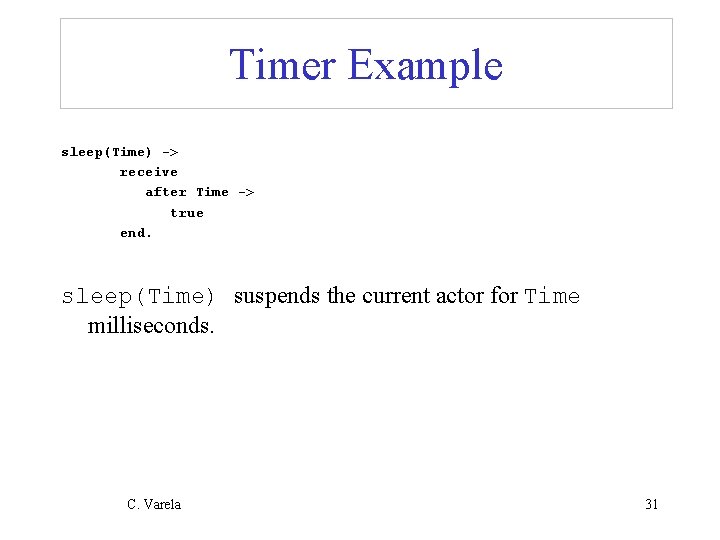
Timer Example sleep(Time) -> receive after Time -> true end. sleep(Time) suspends the current actor for Time milliseconds. C. Varela 31
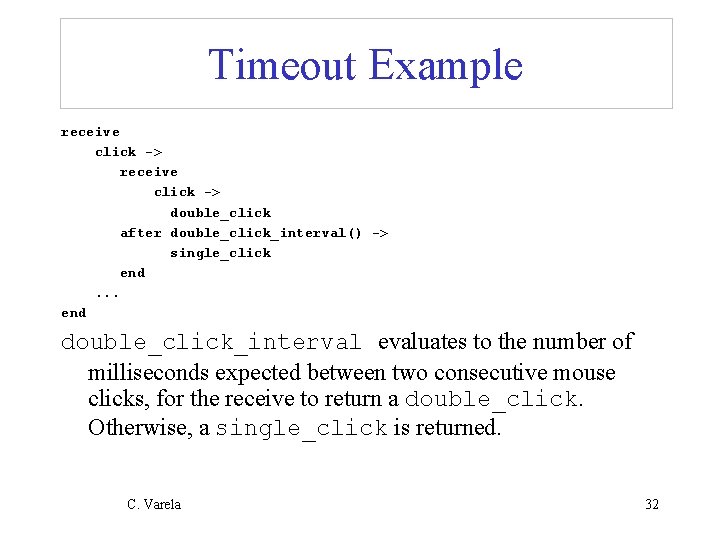
Timeout Example receive click -> double_click after double_click_interval() -> single_click end. . . end double_click_interval evaluates to the number of milliseconds expected between two consecutive mouse clicks, for the receive to return a double_click. Otherwise, a single_click is returned. C. Varela 32
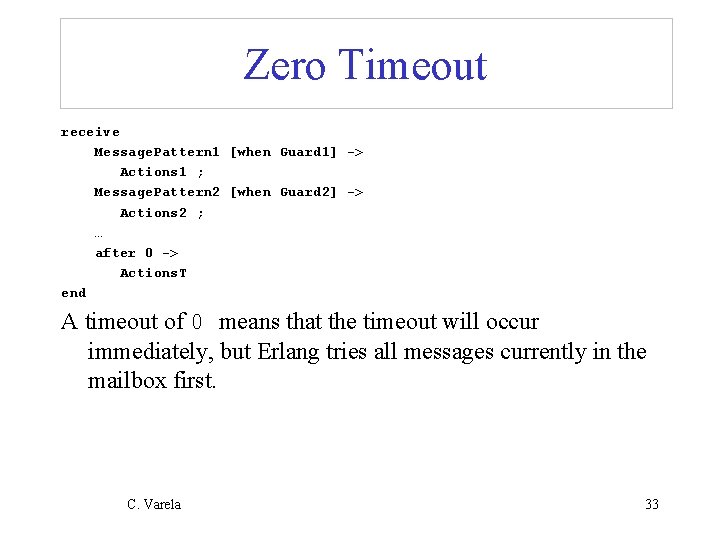
Zero Timeout receive Message. Pattern 1 [when Guard 1] -> Actions 1 ; Message. Pattern 2 [when Guard 2] -> Actions 2 ; … after 0 -> Actions. T end A timeout of 0 means that the timeout will occur immediately, but Erlang tries all messages currently in the mailbox first. C. Varela 33
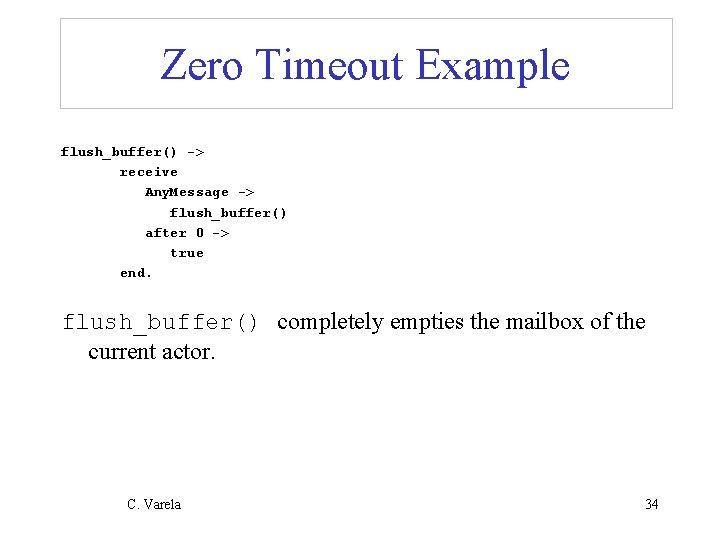
Zero Timeout Example flush_buffer() -> receive Any. Message -> flush_buffer() after 0 -> true end. flush_buffer() completely empties the mailbox of the current actor. C. Varela 34
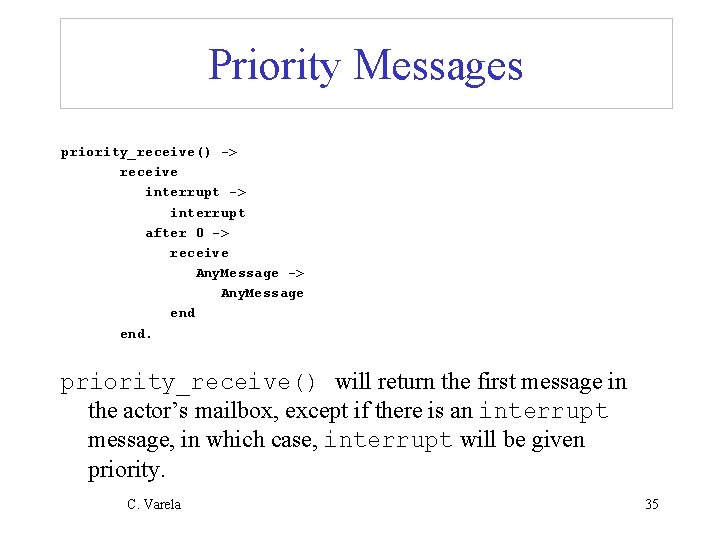
Priority Messages priority_receive() -> receive interrupt -> interrupt after 0 -> receive Any. Message -> Any. Message end. priority_receive() will return the first message in the actor’s mailbox, except if there is an interrupt message, in which case, interrupt will be given priority. C. Varela 35
Exercises 46. Download and execute the reference cell and tree product examples in SALSA and Erlang. 47. Write a solution to the Flavius Josephus problem in SALSA and Erlang. A description of the problem is at CTM Section 7. 8. 3 (page 558). 48. PDCS Exercise 9. 6. 6 (page 204). 49. How would you implement token-passing continuations, join blocks, and first-class continuations in Erlang? 50. How would you implement selective receive in SALSA? C. Varela 36
- Slides: 36