
Concurrency control 112219 Problems caused by concurrency Lost
Concurrency control 11/22/19
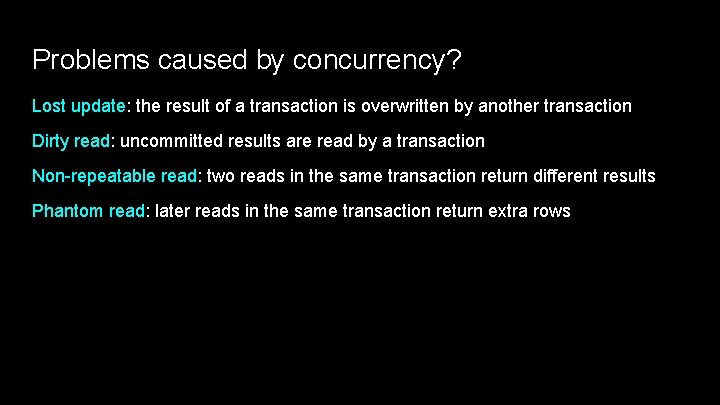
Problems caused by concurrency? Lost update: the result of a transaction is overwritten by another transaction Dirty read: uncommitted results are read by a transaction Non-repeatable read: two reads in the same transaction return different results Phantom read: later reads in the same transaction return extra rows
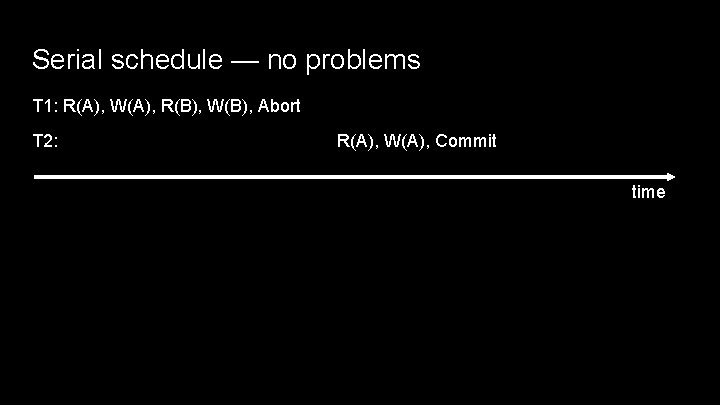
Serial schedule — no problems T 1: R(A), W(A), R(B), W(B), Abort T 2: R(A), W(A), Commit time
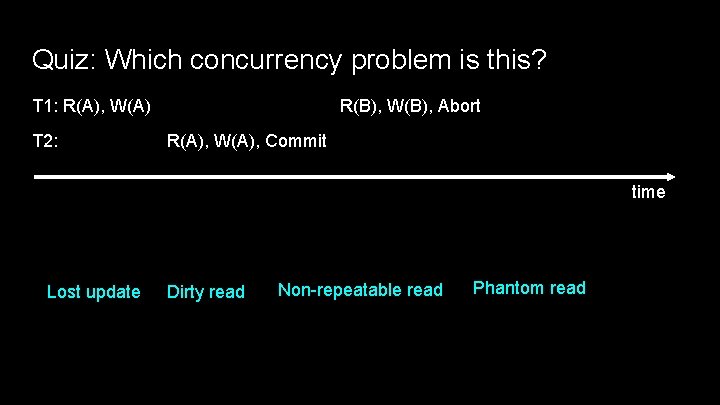
Quiz: Which concurrency problem is this? T 1: R(A), W(A) T 2: R(B), W(B), Abort R(A), W(A), Commit time Lost update Dirty read Non-repeatable read Phantom read
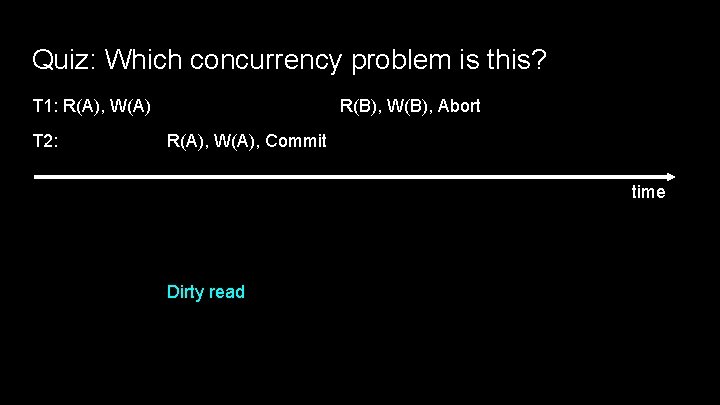
Quiz: Which concurrency problem is this? T 1: R(A), W(A) T 2: R(B), W(B), Abort R(A), W(A), Commit time Dirty read
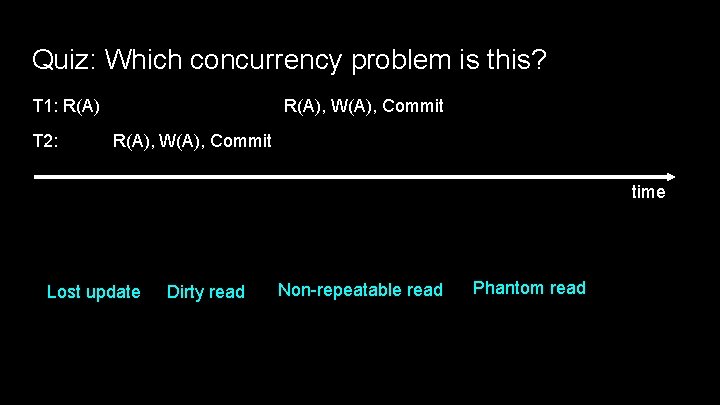
Quiz: Which concurrency problem is this? T 1: R(A) T 2: R(A), W(A), Commit time Lost update Dirty read Non-repeatable read Phantom read
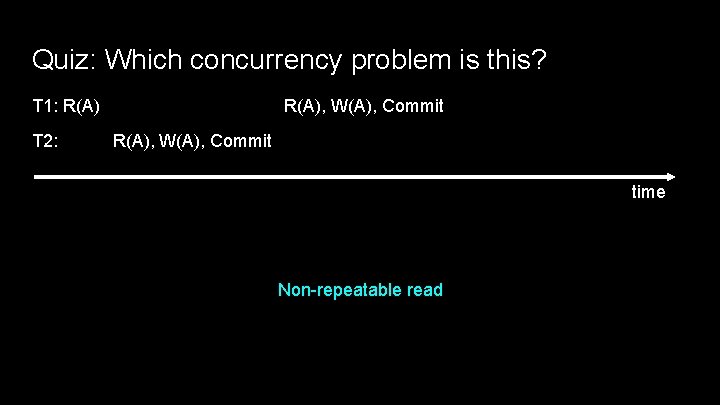
Quiz: Which concurrency problem is this? T 1: R(A) T 2: R(A), W(A), Commit time Non-repeatable read
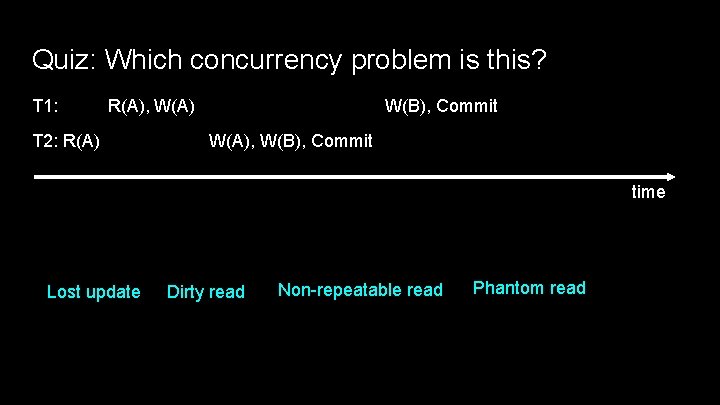
Quiz: Which concurrency problem is this? T 1: R(A), W(A) T 2: R(A) W(B), Commit W(A), W(B), Commit time Lost update Dirty read Non-repeatable read Phantom read
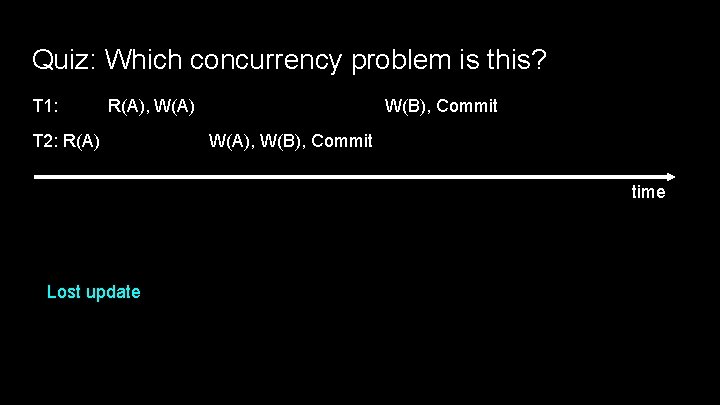
Quiz: Which concurrency problem is this? T 1: R(A), W(A) T 2: R(A) W(B), Commit W(A), W(B), Commit time Lost update
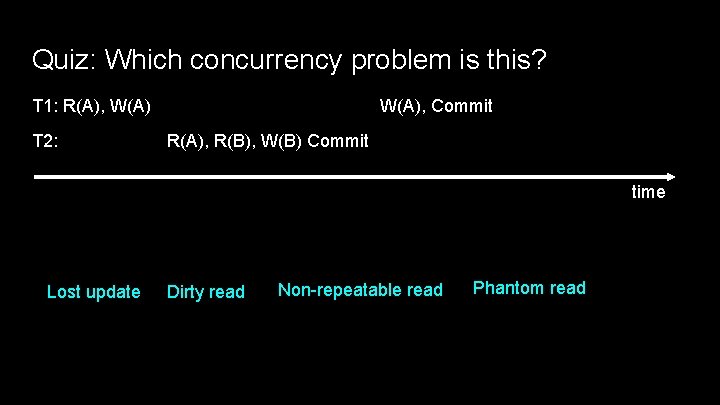
Quiz: Which concurrency problem is this? T 1: R(A), W(A) T 2: W(A), Commit R(A), R(B), W(B) Commit time Lost update Dirty read Non-repeatable read Phantom read
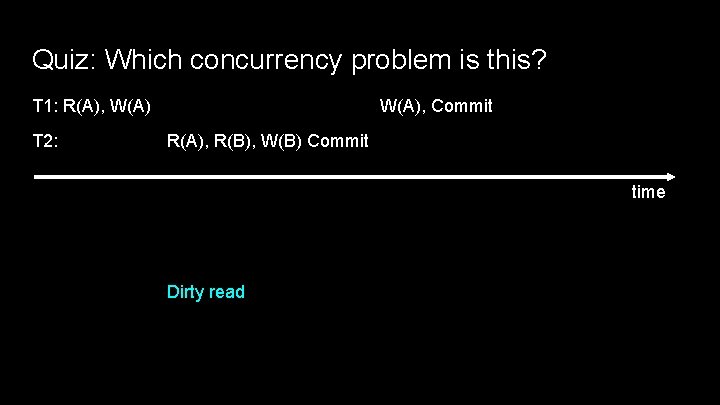
Quiz: Which concurrency problem is this? T 1: R(A), W(A) T 2: W(A), Commit R(A), R(B), W(B) Commit time Dirty read
How to ensure correctness when running concurrent transactions?
What does correctness mean? Transactions should have property of isolation, i. e. , where all operations in a transaction appear to happen together at the same time Today, we’ll review serializability Weaker isolation levels exist in the literature but we’ll ignore them in this class
Fixing concurrency problems Strawman: Just run transactions serially — prohibitively bad performance Observation: Problems only arise when 1. Two transactions touch the same data 2. At least one of these transactions involves a write to the data Key idea: Only permit schedules whose effects are guaranteed to be equivalent to serial schedules
Serializability of schedules Two operations conflict if 1. They belong to different transactions 2. They operate on the same data 3. One of them is a write Two schedules are equivalent if 1. They involve the same transactions and operations 2. All conflicting operations are ordered the same way A schedule is serializable if it is equivalent to a serial schedule
Testing for serializability Intuition: Swap non-conflicting operations until you reach a serial schedule
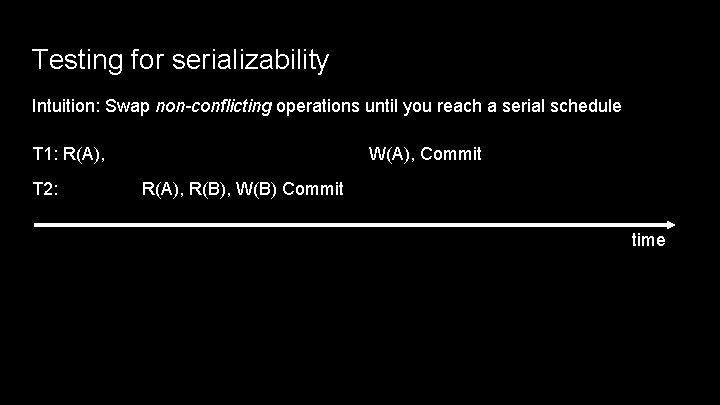
Testing for serializability Intuition: Swap non-conflicting operations until you reach a serial schedule T 1: R(A), T 2: W(A), Commit R(A), R(B), W(B) Commit time
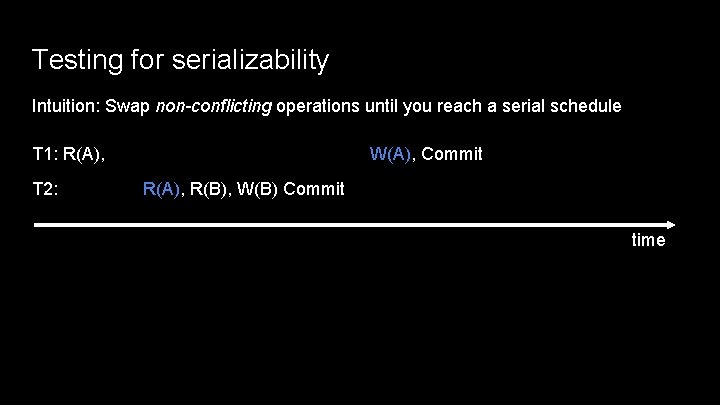
Testing for serializability Intuition: Swap non-conflicting operations until you reach a serial schedule T 1: R(A), T 2: W(A), Commit R(A), R(B), W(B) Commit time
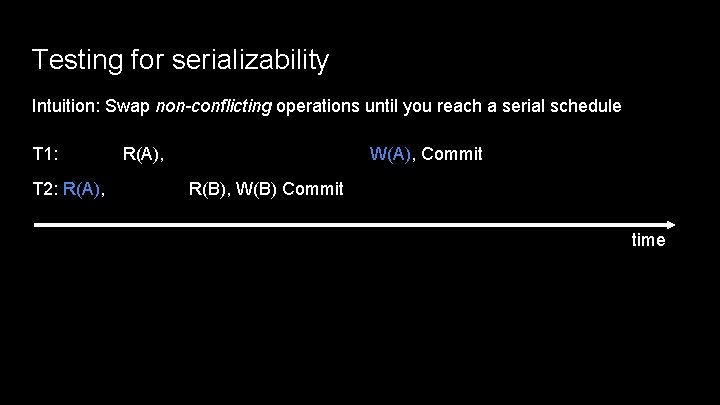
Testing for serializability Intuition: Swap non-conflicting operations until you reach a serial schedule T 1: T 2: R(A), W(A), Commit R(B), W(B) Commit time
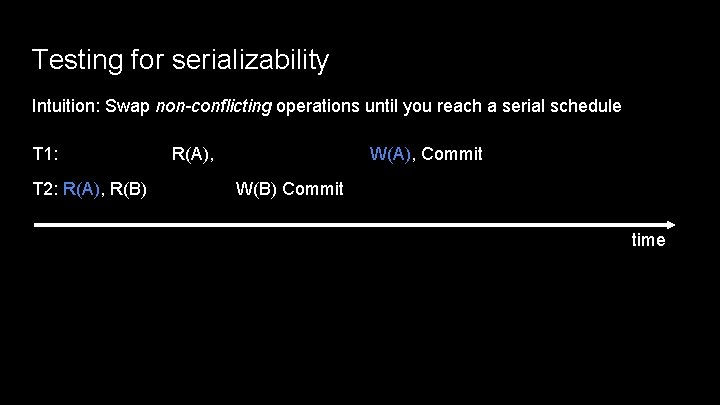
Testing for serializability Intuition: Swap non-conflicting operations until you reach a serial schedule T 1: T 2: R(A), R(B) R(A), W(A), Commit W(B) Commit time
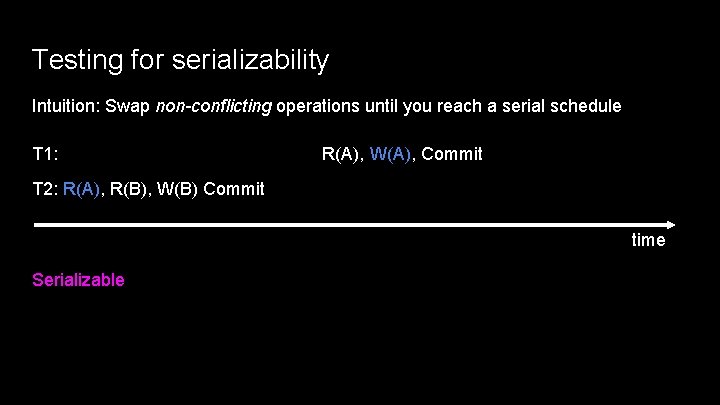
Testing for serializability Intuition: Swap non-conflicting operations until you reach a serial schedule T 1: R(A), W(A), Commit T 2: R(A), R(B), W(B) Commit time Serializable
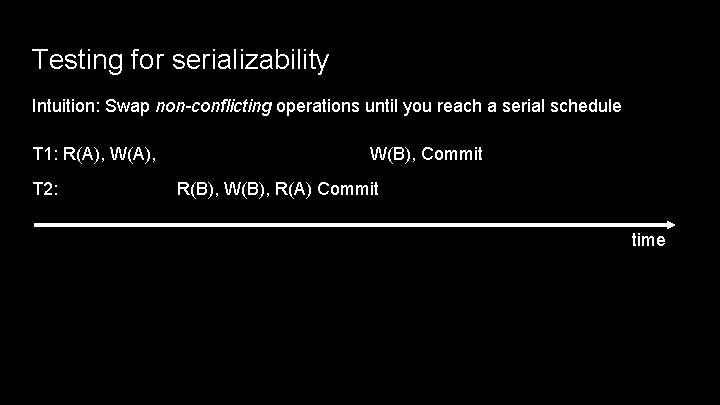
Testing for serializability Intuition: Swap non-conflicting operations until you reach a serial schedule T 1: R(A), W(A), T 2: W(B), Commit R(B), W(B), R(A) Commit time
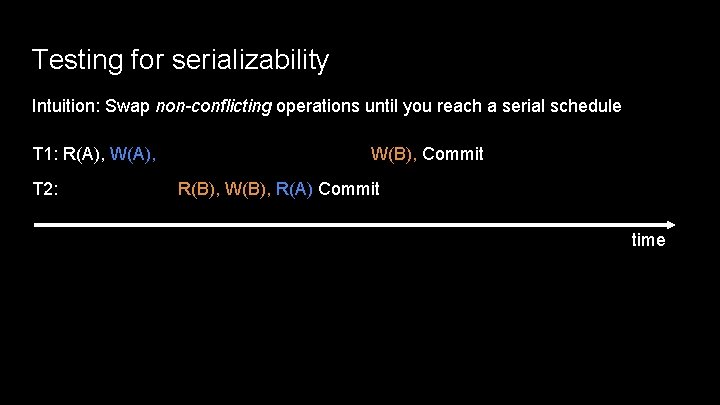
Testing for serializability Intuition: Swap non-conflicting operations until you reach a serial schedule T 1: R(A), W(A), T 2: W(B), Commit R(B), W(B), R(A) Commit time
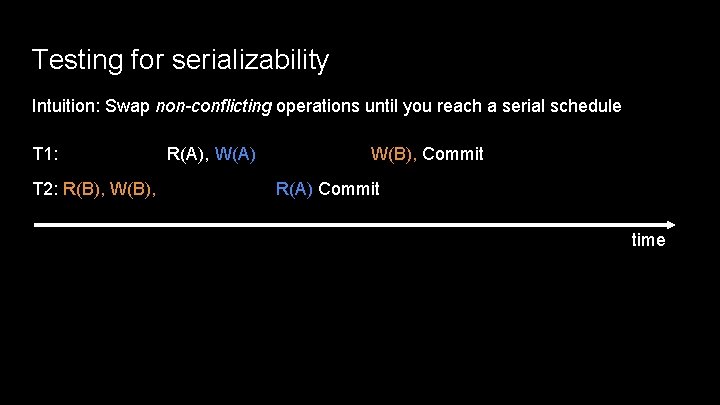
Testing for serializability Intuition: Swap non-conflicting operations until you reach a serial schedule T 1: T 2: R(B), W(B), R(A), W(A) W(B), Commit R(A) Commit time
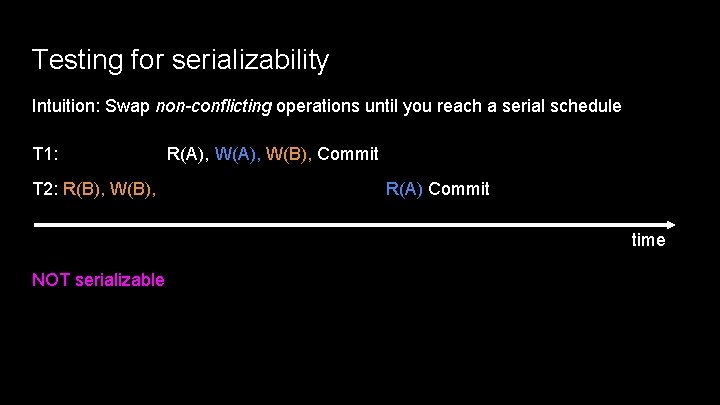
Testing for serializability Intuition: Swap non-conflicting operations until you reach a serial schedule T 1: T 2: R(B), W(B), R(A), W(B), Commit R(A) Commit time NOT serializable
Testing for serializability Another way to test serializability: Draw arrows between conflicting operations Arrow points in the direction of time If no cycles between transactions, the schedule is serializable
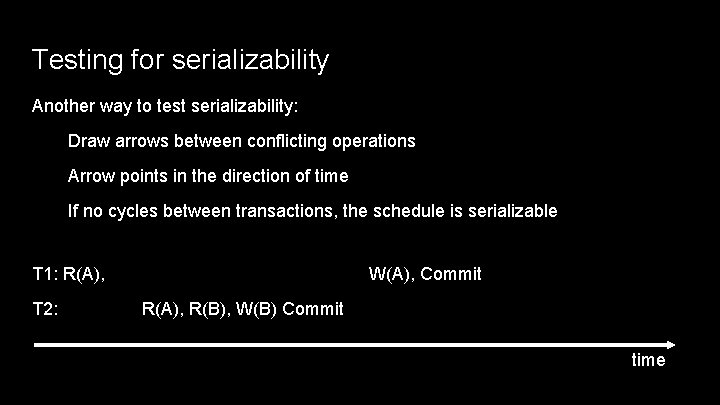
Testing for serializability Another way to test serializability: Draw arrows between conflicting operations Arrow points in the direction of time If no cycles between transactions, the schedule is serializable T 1: R(A), T 2: W(A), Commit R(A), R(B), W(B) Commit time
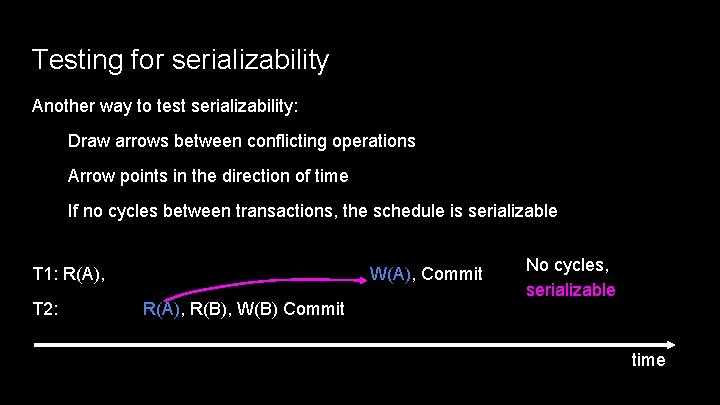
Testing for serializability Another way to test serializability: Draw arrows between conflicting operations Arrow points in the direction of time If no cycles between transactions, the schedule is serializable T 1: R(A), T 2: W(A), Commit R(A), R(B), W(B) Commit No cycles, serializable time
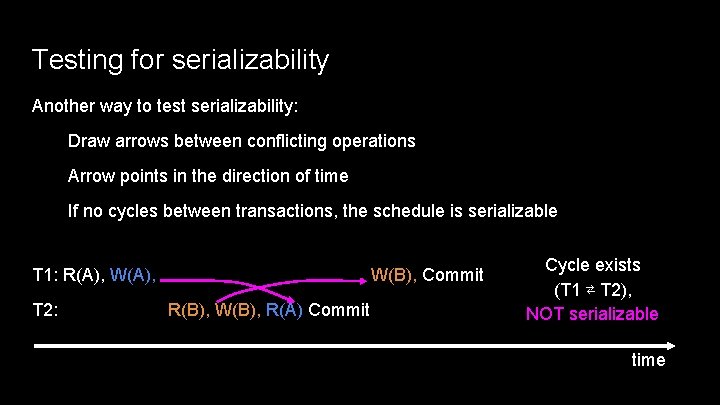
Testing for serializability Another way to test serializability: Draw arrows between conflicting operations Arrow points in the direction of time If no cycles between transactions, the schedule is serializable T 1: R(A), W(A), T 2: W(B), Commit R(B), W(B), R(A) Commit Cycle exists (T 1 ⇄ T 2), NOT serializable time
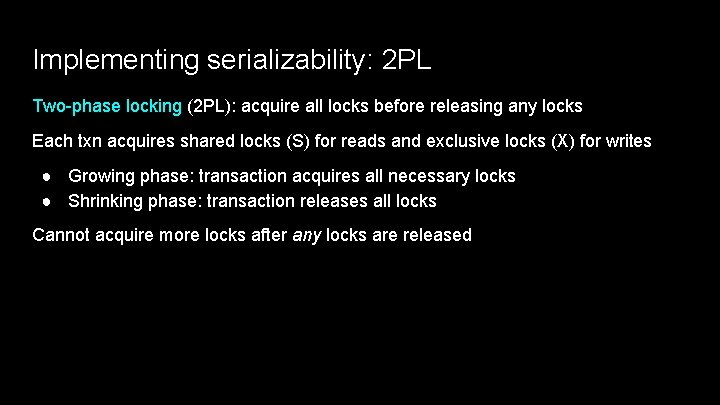
Implementing serializability: 2 PL Two-phase locking (2 PL): acquire all locks before releasing any locks Each txn acquires shared locks (S) for reads and exclusive locks (X) for writes ● Growing phase: transaction acquires all necessary locks ● Shrinking phase: transaction releases all locks Cannot acquire more locks after any locks are released
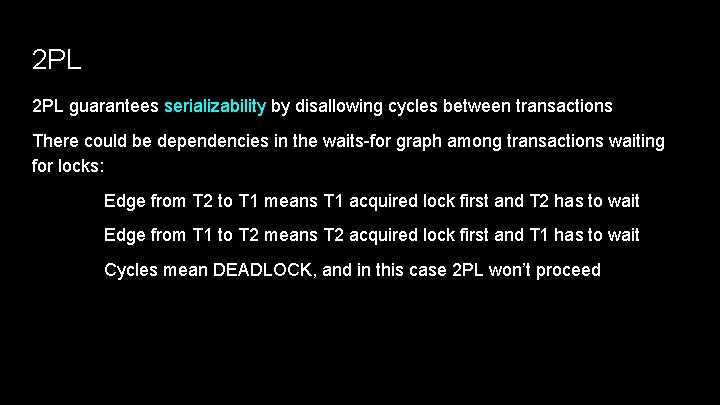
2 PL guarantees serializability by disallowing cycles between transactions There could be dependencies in the waits-for graph among transactions waiting for locks: Edge from T 2 to T 1 means T 1 acquired lock first and T 2 has to wait Edge from T 1 to T 2 means T 2 acquired lock first and T 1 has to wait Cycles mean DEADLOCK, and in this case 2 PL won’t proceed
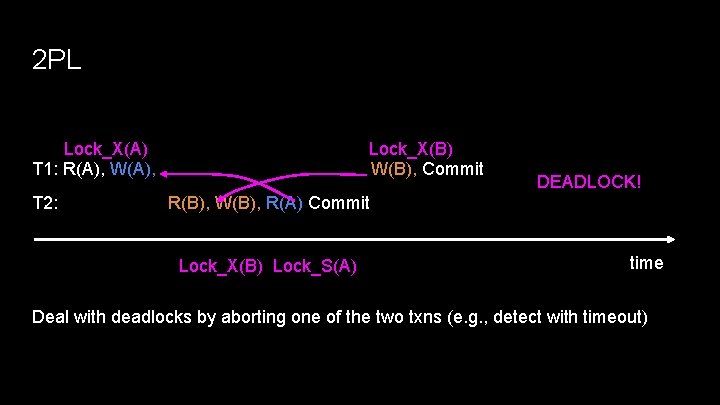
2 PL Lock_X(A) T 1: R(A), W(A), T 2: Lock_X(B) W(B), Commit DEADLOCK! R(B), W(B), R(A) Commit Lock_X(B) Lock_S(A) time Deal with deadlocks by aborting one of the two txns (e. g. , detect with timeout)
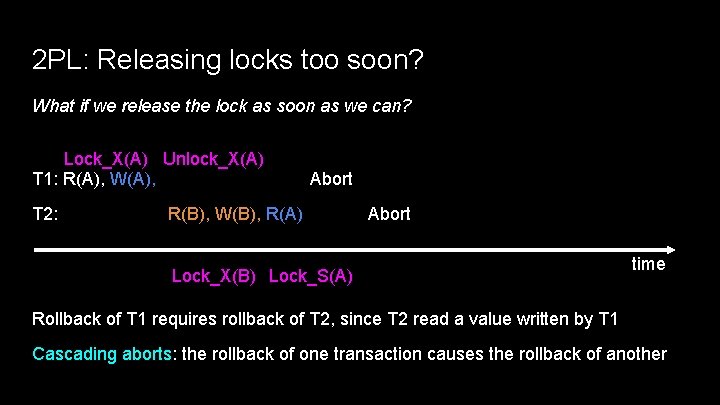
2 PL: Releasing locks too soon? What if we release the lock as soon as we can? Lock_X(A) Unlock_X(A) T 1: R(A), W(A), T 2: Abort R(B), W(B), R(A) Abort Lock_X(B) Lock_S(A) time Rollback of T 1 requires rollback of T 2, since T 2 read a value written by T 1 Cascading aborts: the rollback of one transaction causes the rollback of another
Strict 2 PL Release locks at the end of the transaction Variant of 2 PL implemented by most databases in practice
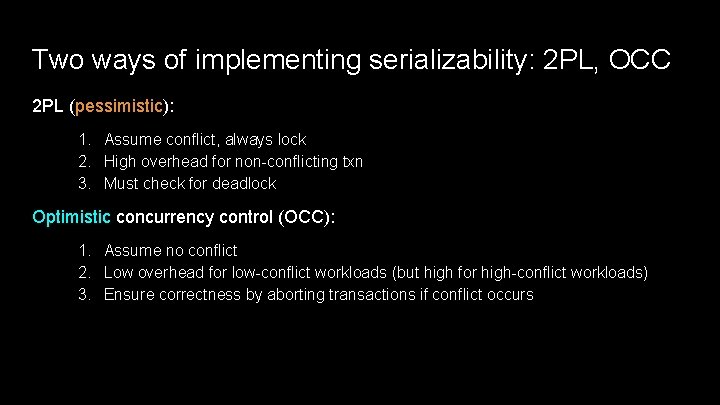
Two ways of implementing serializability: 2 PL, OCC 2 PL (pessimistic): 1. Assume conflict, always lock 2. High overhead for non-conflicting txn 3. Must check for deadlock Optimistic concurrency control (OCC): 1. Assume no conflict 2. Low overhead for low-conflict workloads (but high for high-conflict workloads) 3. Ensure correctness by aborting transactions if conflict occurs
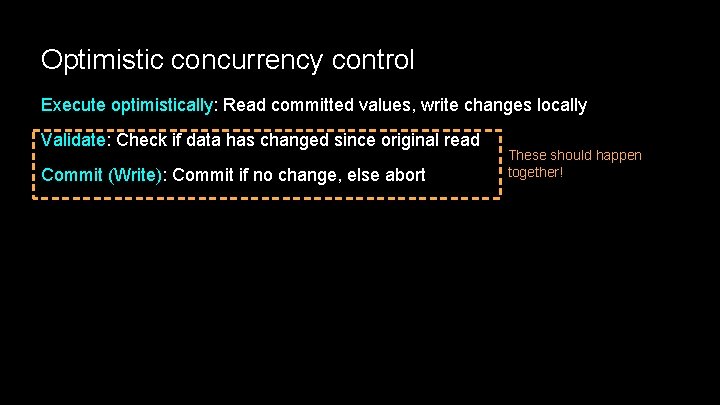
Optimistic concurrency control Execute optimistically: Read committed values, write changes locally Validate: Check if data has changed since original read Commit (Write): Commit if no change, else abort These should happen together!
- Slides: 36