
Concurrency Control 1 Interference Even if all transactions
- Slides: 29
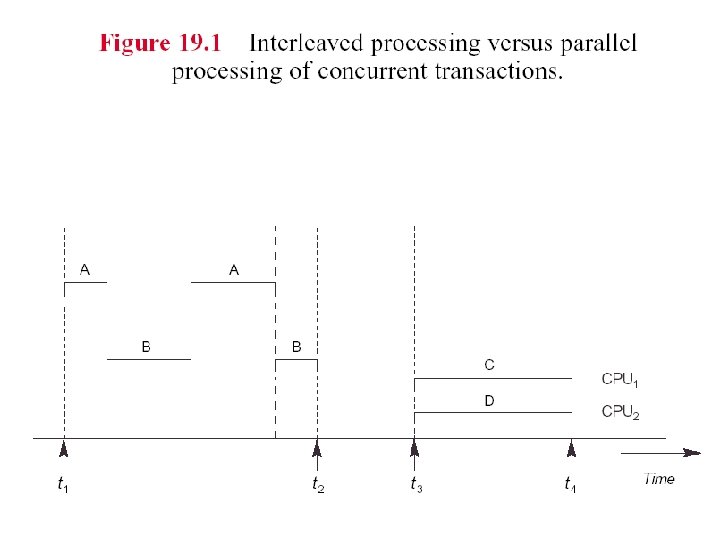
Concurrency Control 1. Interference Even if all transactions are individually correct, it is still possible in a shared (multiuser) system that interference on the concurrently executed transactions can cause an overall incorrect result. Types of Concurrency: Interleaved concurrency: in a uni-CPU environment (we focus on this) Simultaneous concurrency: in a multi-CPU environment (can in general be extended from interleaved concurrency))
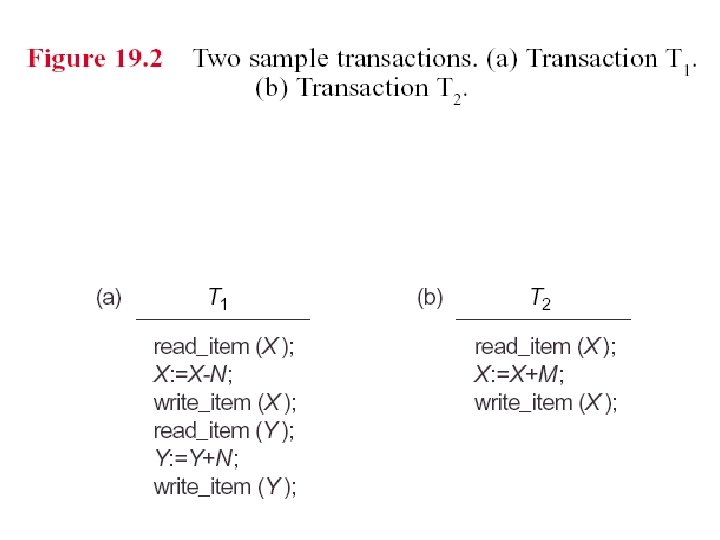
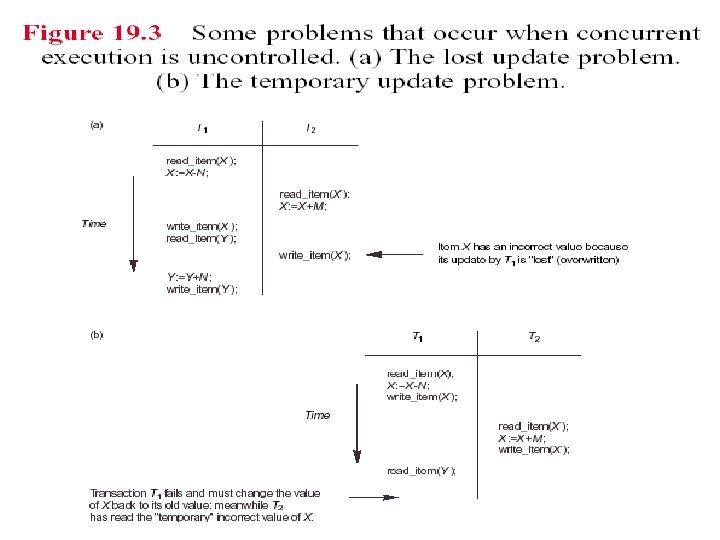
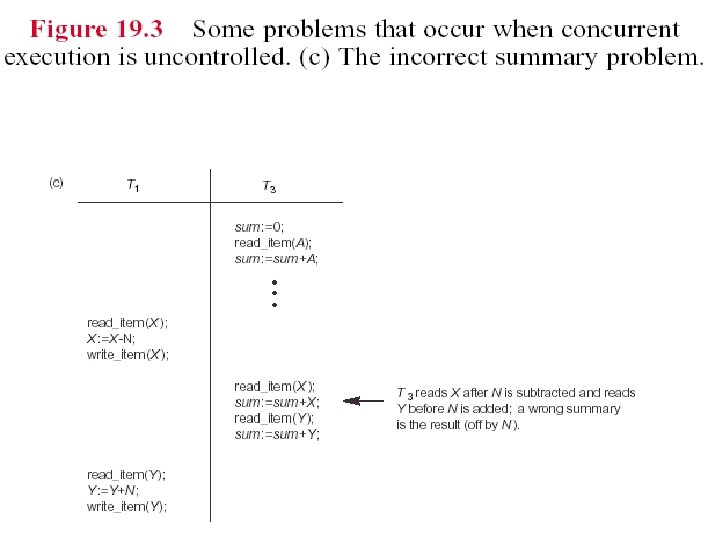
Why Concurrency Control Is Needed • The Lost Update Problem • The Temporary Update Problem • The Incorrect Summary Problem
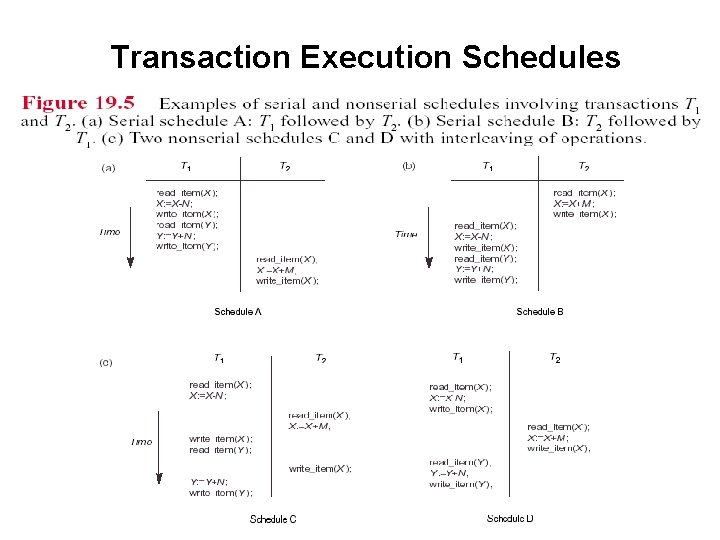
Transaction Execution Schedules
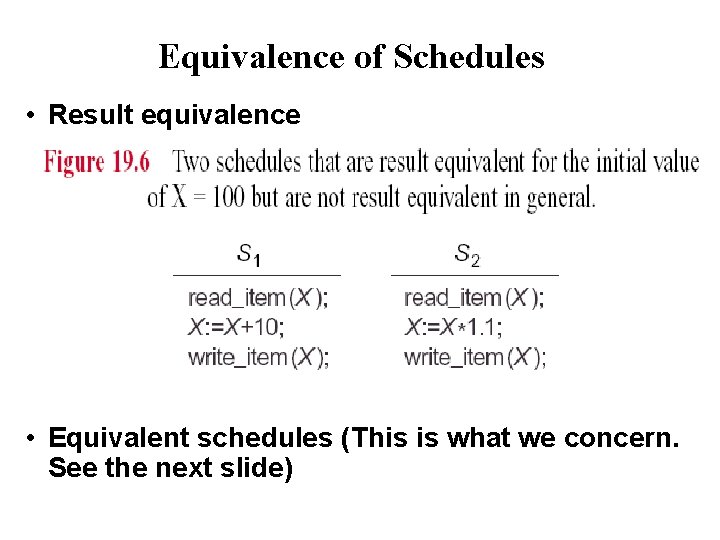
Equivalence of Schedules • Result equivalence • Equivalent schedules (This is what we concern. See the next slide)
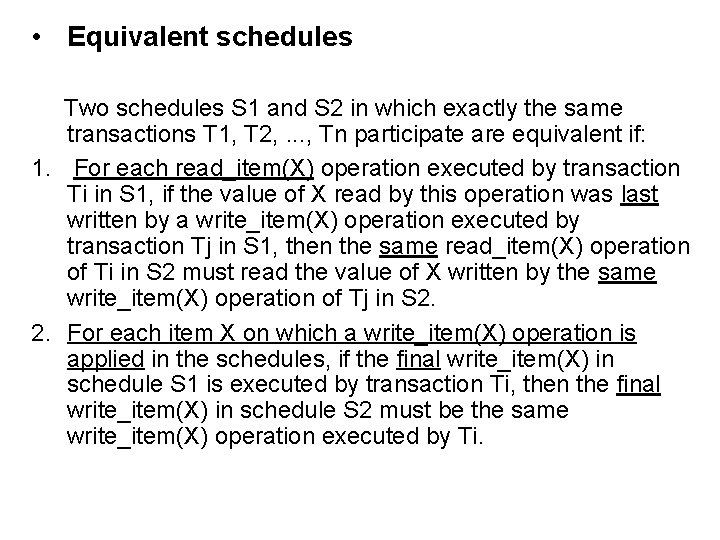
• Equivalent schedules Two schedules S 1 and S 2 in which exactly the same transactions T 1, T 2, . . . , Tn participate are equivalent if: 1. For each read_item(X) operation executed by transaction Ti in S 1, if the value of X read by this operation was last written by a write_item(X) operation executed by transaction Tj in S 1, then the same read_item(X) operation of Ti in S 2 must read the value of X written by the same write_item(X) operation of Tj in S 2. 2. For each item X on which a write_item(X) operation is applied in the schedules, if the final write_item(X) in schedule S 1 is executed by transaction Ti, then the final write_item(X) in schedule S 2 must be the same write_item(X) operation executed by Ti.
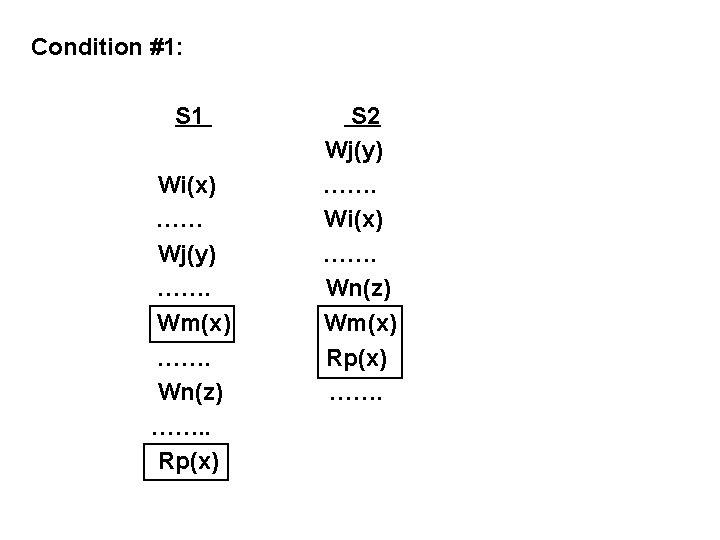
Condition #1: S 1 Wi(x) …… Wj(y) ……. Wm(x) ……. Wn(z) ……. . Rp(x) S 2 Wj(y) ……. Wi(x) ……. Wn(z) Wm(x) Rp(x) …….
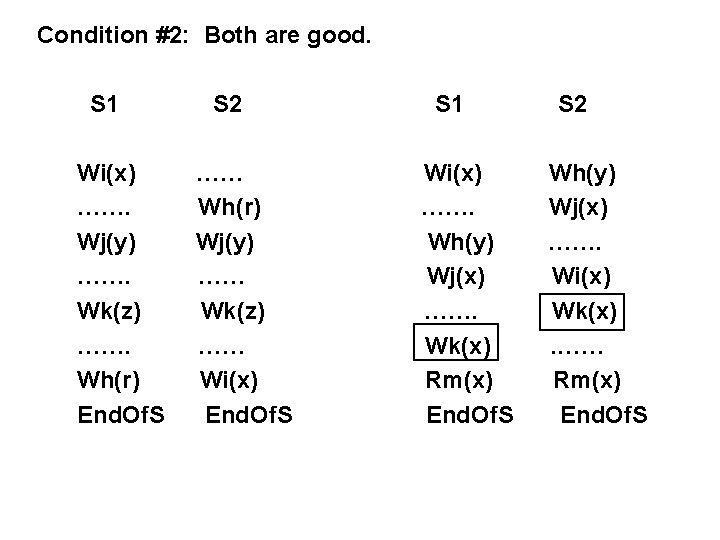
Condition #2: Both are good. S 1 Wi(x) ……. Wj(y) ……. Wk(z) ……. Wh(r) End. Of. S S 2 …… Wh(r) Wj(y) …… Wk(z) …… Wi(x) End. Of. S S 1 Wi(x) ……. Wh(y) Wj(x) ……. Wk(x) Rm(x) End. Of. S S 2 Wh(y) Wj(x) ……. Wi(x) Wk(x). …… Rm(x) End. Of. S
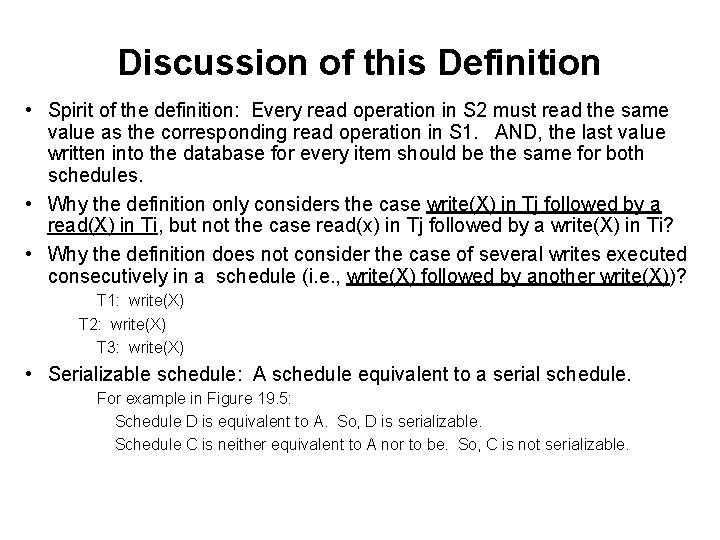
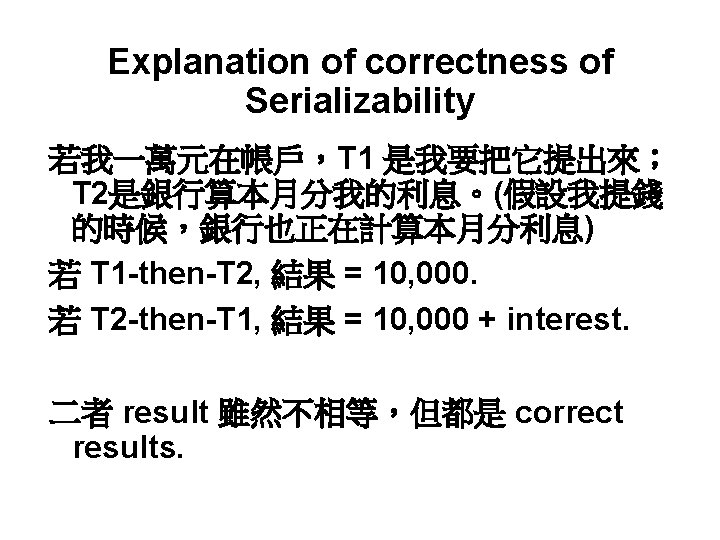
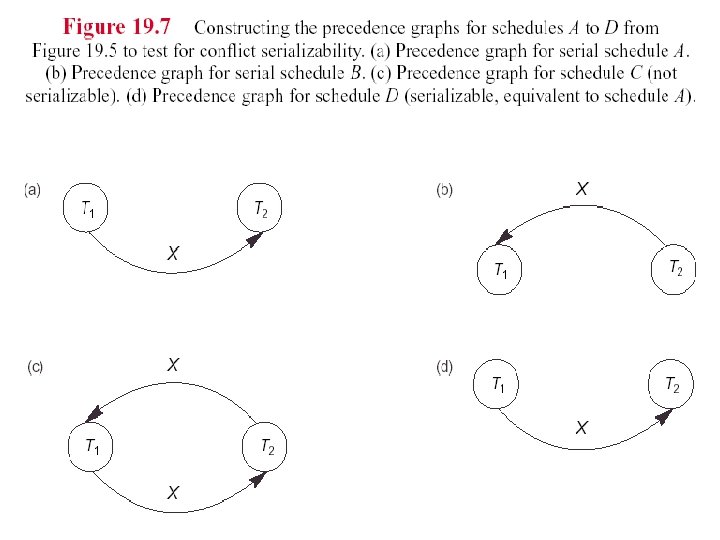
Discussion of this Definition • Spirit of the definition: Every read operation in S 2 must read the same value as the corresponding read operation in S 1. AND, the last value written into the database for every item should be the same for both schedules. • Why the definition only considers the case write(X) in Tj followed by a read(X) in Ti, but not the case read(x) in Tj followed by a write(X) in Ti? • Why the definition does not consider the case of several writes executed consecutively in a schedule (i. e. , write(X) followed by another write(X))? T 1: write(X) T 2: write(X) T 3: write(X) • Serializable schedule: A schedule equivalent to a serial schedule. For example in Figure 19. 5: Schedule D is equivalent to A. So, D is serializable. Schedule C is neither equivalent to A nor to be. So, C is not serializable.
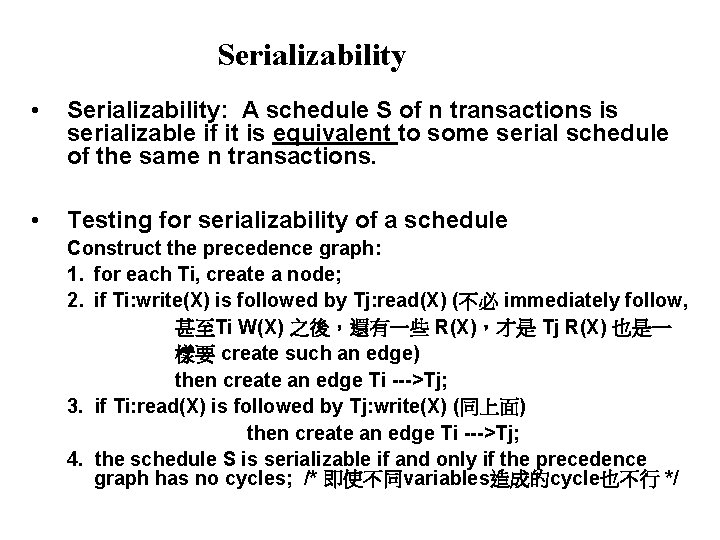
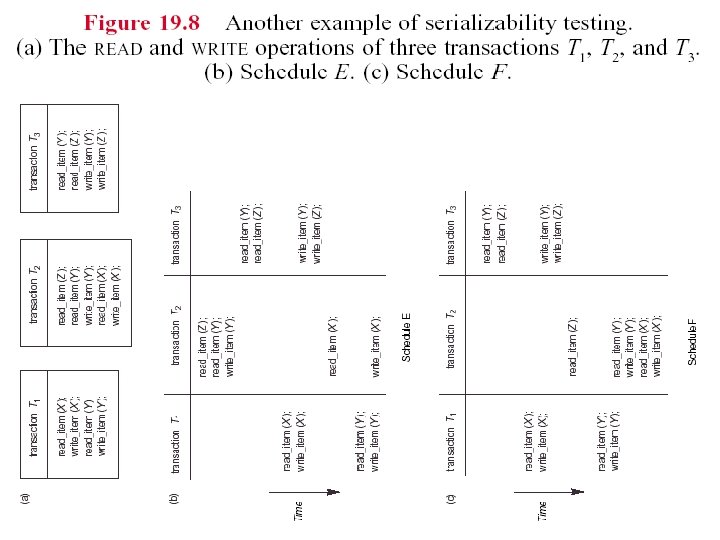
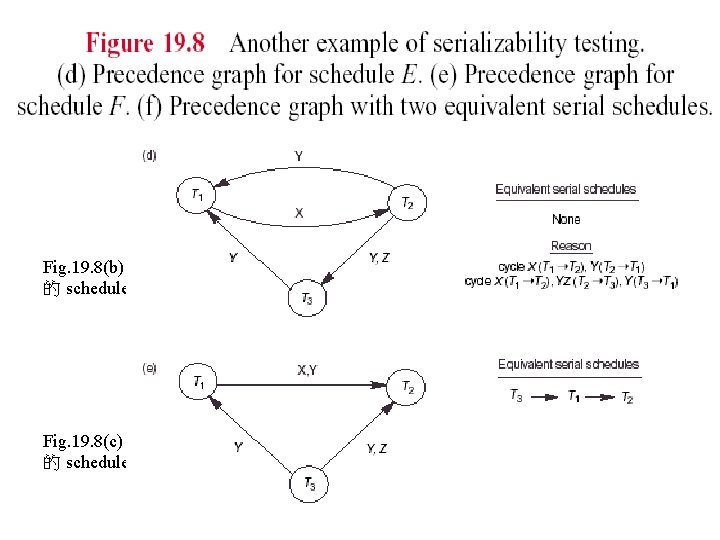
Serializability • Serializability: A schedule S of n transactions is serializable if it is equivalent to some serial schedule of the same n transactions. • Testing for serializability of a schedule Construct the precedence graph: 1. for each Ti, create a node; 2. if Ti: write(X) is followed by Tj: read(X) (不必 immediately follow, 甚至Ti W(X) 之後,還有一些 R(X),才是 Tj R(X) 也是一 樣要 create such an edge) then create an edge Ti --->Tj; 3. if Ti: read(X) is followed by Tj: write(X) (同上面) then create an edge Ti --->Tj; 4. the schedule S is serializable if and only if the precedence graph has no cycles; /* 即使不同variables造成的cycle也不行 */
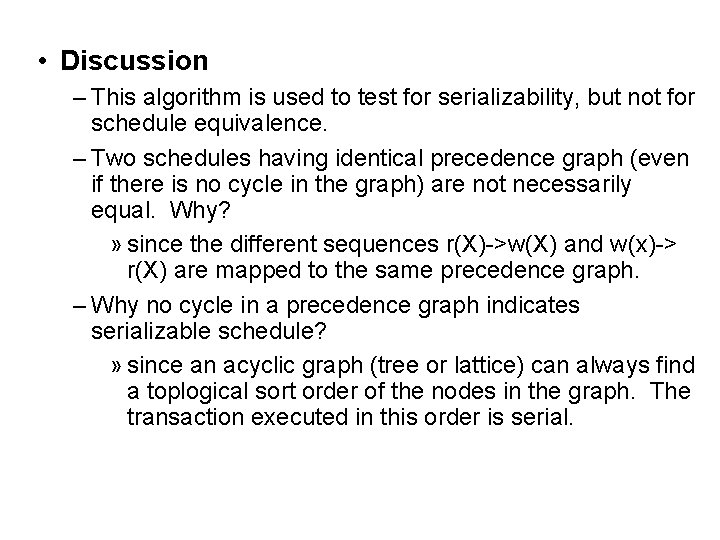
• Discussion – This algorithm is used to test for serializability, but not for schedule equivalence. – Two schedules having identical precedence graph (even if there is no cycle in the graph) are not necessarily equal. Why? » since the different sequences r(X)->w(X) and w(x)-> r(X) are mapped to the same precedence graph. – Why no cycle in a precedence graph indicates serializable schedule? » since an acyclic graph (tree or lattice) can always find a toplogical sort order of the nodes in the graph. The transaction executed in this order is serial.
Fig. 19. 8(b) 的 schedule Fig. 19. 8(c) 的 schedule
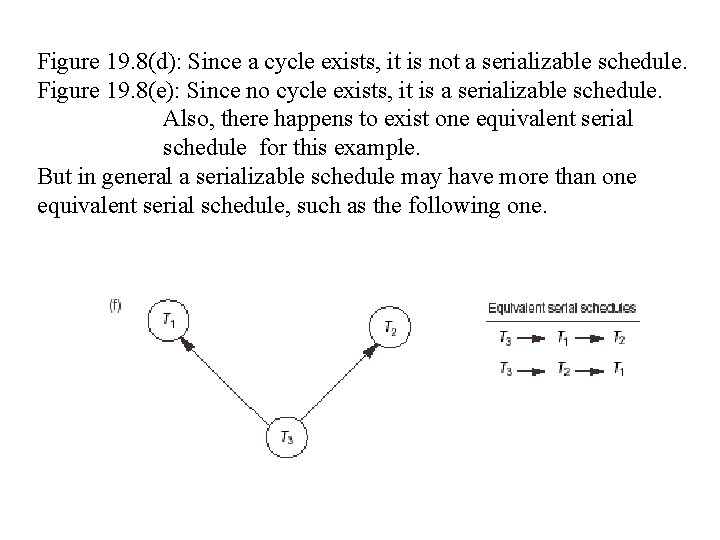
Figure 19. 8(d): Since a cycle exists, it is not a serializable schedule. Figure 19. 8(e): Since no cycle exists, it is a serializable schedule. Also, there happens to exist one equivalent serial schedule for this example. But in general a serializable schedule may have more than one equivalent serial schedule, such as the following one.
Problem of Seriralizability – In practice, we cannot test a schedule in advance, since the execution is determined by the OS timesharing scheme, the time instants that transactions are issued to the system, and so on. Neither can we let the transactions executed first and then test for serializability, since we must cancel the effect of the schedule if it turns out not to be serializable. – Concurrency control protocols are designed to resolve this problem.
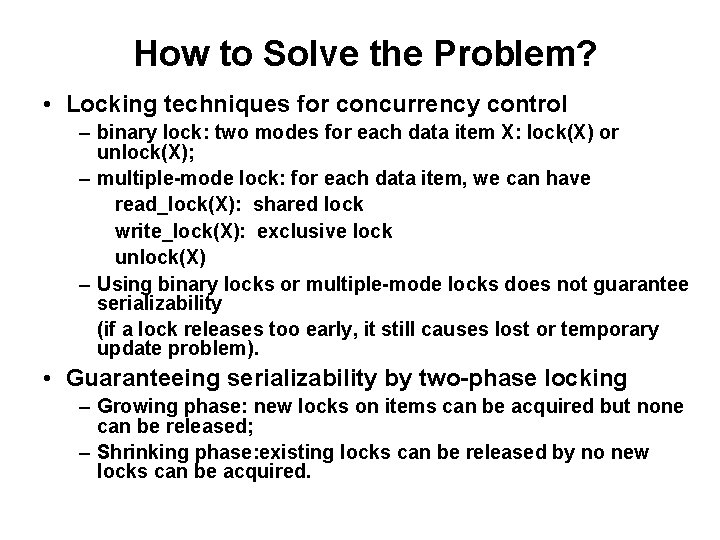
How to Solve the Problem? • Locking techniques for concurrency control – binary lock: two modes for each data item X: lock(X) or unlock(X); – multiple-mode lock: for each data item, we can have read_lock(X): shared lock write_lock(X): exclusive lock unlock(X) – Using binary locks or multiple-mode locks does not guarantee serializability (if a lock releases too early, it still causes lost or temporary update problem). • Guaranteeing serializability by two-phase locking – Growing phase: new locks on items can be acquired but none can be released; – Shrinking phase: existing locks can be released by no new locks can be acquired.
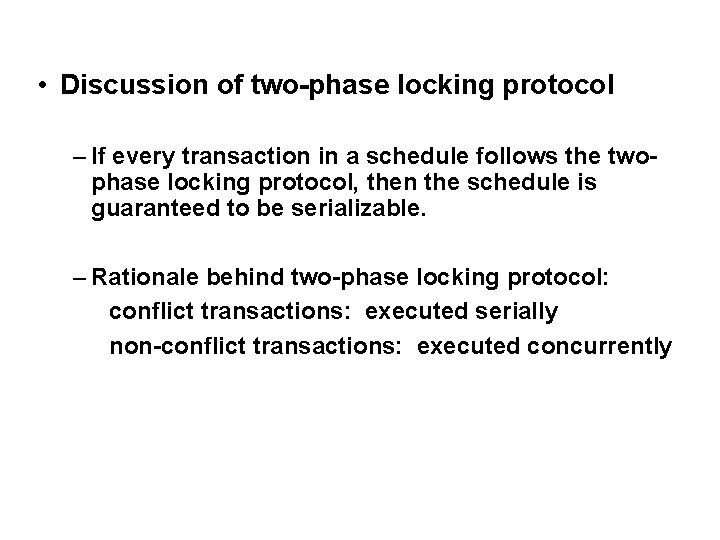
• Discussion of two-phase locking protocol – If every transaction in a schedule follows the twophase locking protocol, then the schedule is guaranteed to be serializable. – Rationale behind two-phase locking protocol: conflict transactions: executed serially non-conflict transactions: executed concurrently
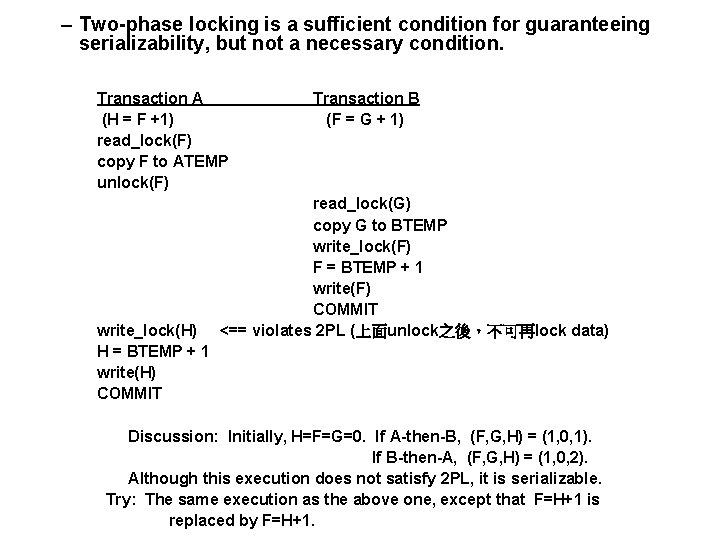
– Two-phase locking is a sufficient condition for guaranteeing serializability, but not a necessary condition. Transaction A (H = F +1) read_lock(F) copy F to ATEMP unlock(F) write_lock(H) H = BTEMP + 1 write(H) COMMIT Transaction B (F = G + 1) read_lock(G) copy G to BTEMP write_lock(F) F = BTEMP + 1 write(F) COMMIT <== violates 2 PL (上面unlock之後,不可再lock data) Discussion: Initially, H=F=G=0. If A-then-B, (F, G, H) = (1, 0, 1). If B-then-A, (F, G, H) = (1, 0, 2). Although this execution does not satisfy 2 PL, it is serializable. Try: The same execution as the above one, except that F=H+1 is replaced by F=H+1.
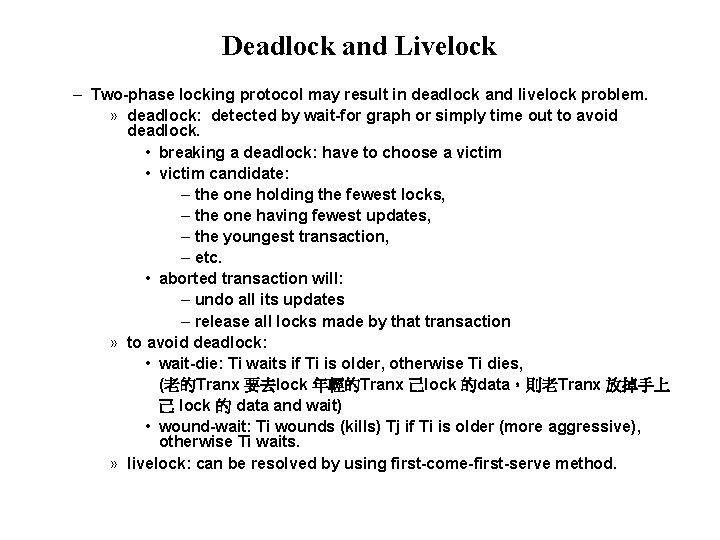
Deadlock and Livelock – Two-phase locking protocol may result in deadlock and livelock problem. » deadlock: detected by wait-for graph or simply time out to avoid deadlock. • breaking a deadlock: have to choose a victim • victim candidate: – the one holding the fewest locks, – the one having fewest updates, – the youngest transaction, – etc. • aborted transaction will: – undo all its updates – release all locks made by that transaction » to avoid deadlock: • wait-die: Ti waits if Ti is older, otherwise Ti dies, (老的Tranx 要去lock 年輕的Tranx 己lock 的data,則老Tranx 放掉手上 己 lock 的 data and wait) • wound-wait: Ti wounds (kills) Tj if Ti is older (more aggressive), otherwise Ti waits. » livelock: can be resolved by using first-come-first-serve method.
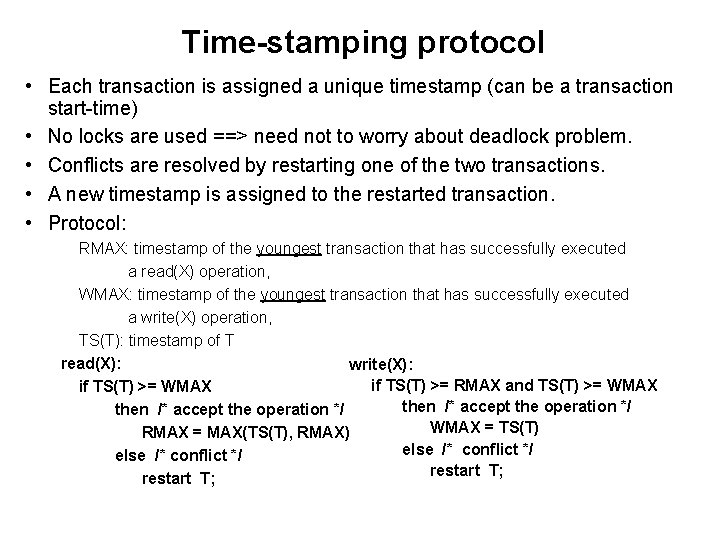
Time-stamping protocol • Each transaction is assigned a unique timestamp (can be a transaction start-time) • No locks are used ==> need not to worry about deadlock problem. • Conflicts are resolved by restarting one of the two transactions. • A new timestamp is assigned to the restarted transaction. • Protocol: RMAX: timestamp of the youngest transaction that has successfully executed a read(X) operation, WMAX: timestamp of the youngest transaction that has successfully executed a write(X) operation, TS(T): timestamp of T read(X): write(X): if TS(T) >= RMAX and TS(T) >= WMAX if TS(T) >= WMAX then /* accept the operation */ WMAX = TS(T) RMAX = MAX(TS(T), RMAX) else /* conflict */ restart T;
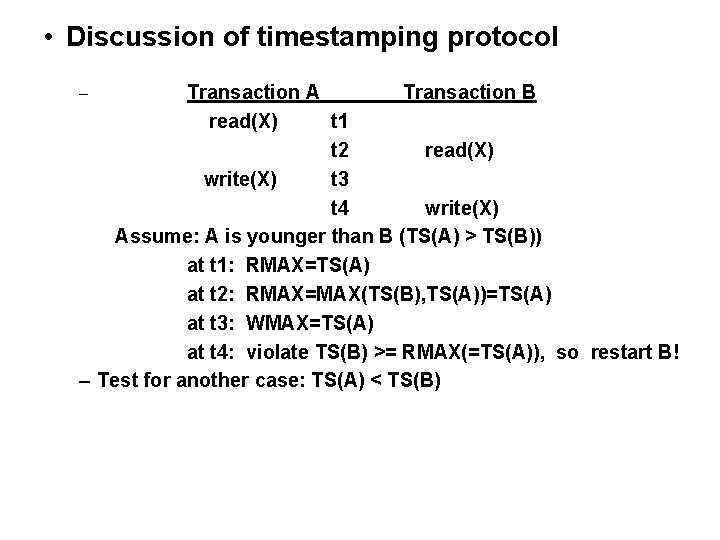
• Discussion of timestamping protocol Transaction A Transaction B read(X) t 1 t 2 read(X) write(X) t 3 t 4 write(X) Assume: A is younger than B (TS(A) > TS(B)) at t 1: RMAX=TS(A) at t 2: RMAX=MAX(TS(B), TS(A))=TS(A) at t 3: WMAX=TS(A) at t 4: violate TS(B) >= RMAX(=TS(A)), so restart B! – Test for another case: TS(A) < TS(B) –
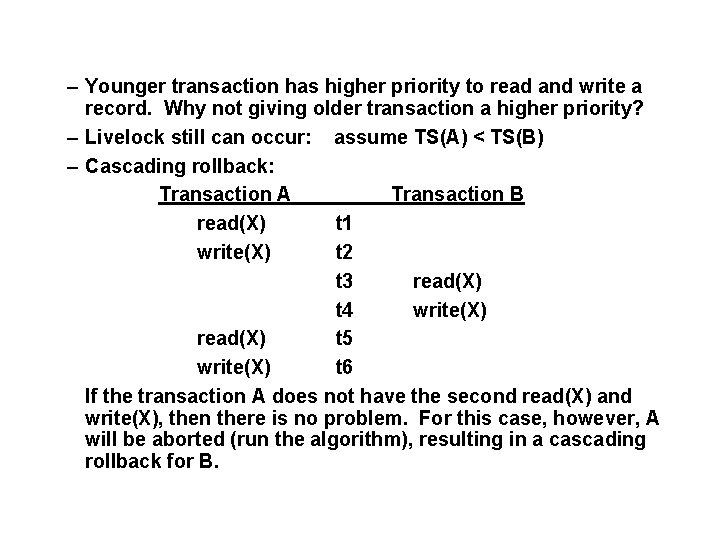
– Younger transaction has higher priority to read and write a record. Why not giving older transaction a higher priority? – Livelock still can occur: assume TS(A) < TS(B) – Cascading rollback: Transaction A Transaction B read(X) t 1 write(X) t 2 t 3 read(X) t 4 write(X) read(X) t 5 write(X) t 6 If the transaction A does not have the second read(X) and write(X), then there is no problem. For this case, however, A will be aborted (run the algorithm), resulting in a cascading rollback for B.
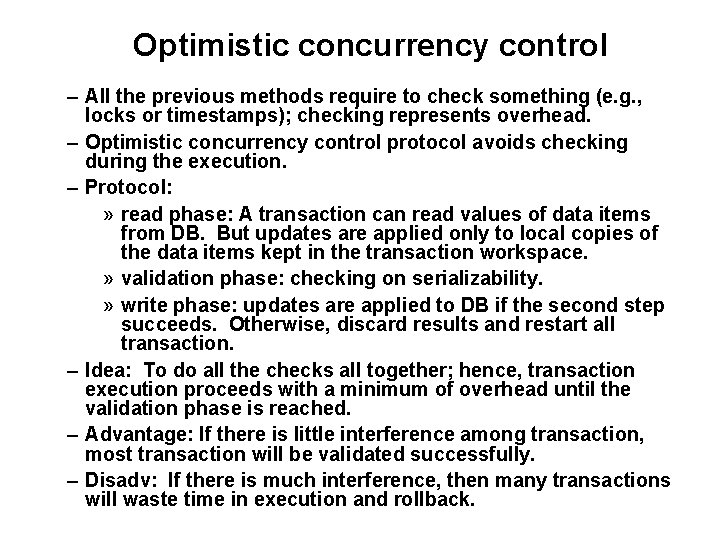
Optimistic concurrency control – All the previous methods require to check something (e. g. , locks or timestamps); checking represents overhead. – Optimistic concurrency control protocol avoids checking during the execution. – Protocol: » read phase: A transaction can read values of data items from DB. But updates are applied only to local copies of the data items kept in the transaction workspace. » validation phase: checking on serializability. » write phase: updates are applied to DB if the second step succeeds. Otherwise, discard results and restart all transaction. – Idea: To do all the checks all together; hence, transaction execution proceeds with a minimum of overhead until the validation phase is reached. – Advantage: If there is little interference among transaction, most transaction will be validated successfully. – Disadv: If there is much interference, then many transactions will waste time in execution and rollback.
Locking granularity • • File Page, cylinder, track, segment, . . . Record attribute