
CONCRETE TECHNOLOGY Testing of concrete materials Er Tushar
![CONCRETE TECHNOLOGY [Testing of concrete materials] Er. Tushar Harihar Sonawane ( Member : IEI](https://slidetodoc.com/presentation_image_h/b3e98eee5566adf65cffe11d88a18788/image-1.jpg "CONCRETE TECHNOLOGY [Testing of concrete materials] Er. Tushar Harihar Sonawane ( Member : IEI")

![Sieving [Dry Method] 1. 2. 3. 4. 5. Take correctly 100 grams of cement](https://slidetodoc.com/presentation_image_h/b3e98eee5566adf65cffe11d88a18788/image-10.jpg "Sieving [Dry Method] 1. 2. 3. 4. 5. Take correctly 100 grams of cement")




- Slides: 41
CONCRETE TECHNOLOGY [Testing of concrete materials] Er. Tushar Harihar Sonawane ( Member : IEI , IAENG ) Civil Engineering Department, SNJB’s KBJ COE Chandwad +91 9657688220 tusharsonawane. wordpress. com sonawane. thcoe@snjb. org Prepared for tusharhsonawane. wordpress. com 1
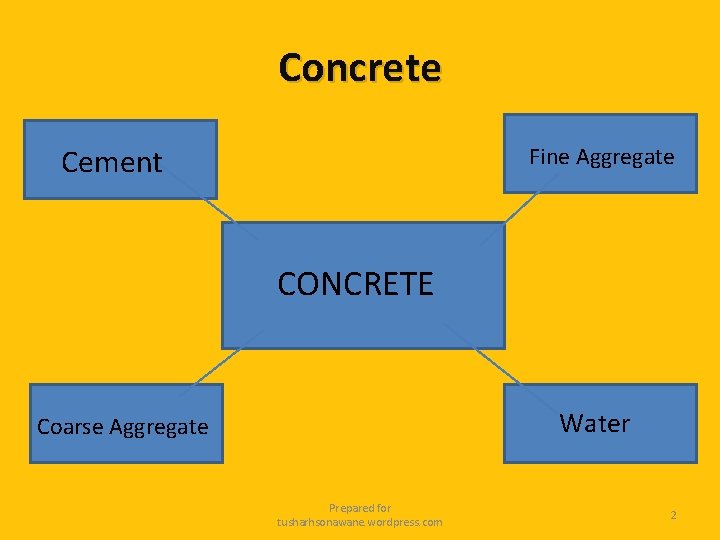
Concrete Fine Aggregate Cement CONCRETE Water Coarse Aggregate Prepared for tusharhsonawane. wordpress. com 2
Concrete is a homogenous mixture of Cement, Fine aggregate, Coarse aggregate and Water. Cement is a binding material manufactured by grinding calcareous and argillaceous materials, mixing them intimately in certain proportions depending upon their purity and composition and burning them in kiln at temp. about 13001500˚c, at which material sinters and forms clinker. The clinker is cooled and ground to fine powder with addition of about 3 -5% of gypsum. The product is a Portland Cement Prepared for tusharhsonawane. wordpress. com 3
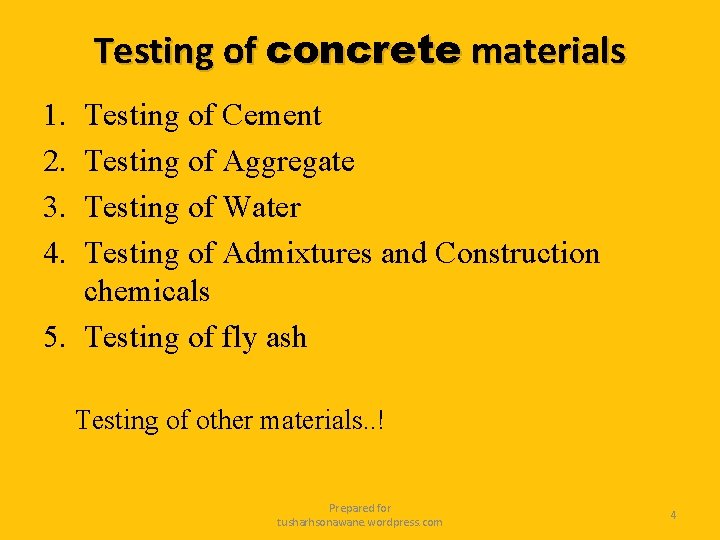
Testing of concrete materials 1. 2. 3. 4. Testing of Cement Testing of Aggregate Testing of Water Testing of Admixtures and Construction chemicals 5. Testing of fly ash Testing of other materials. . ! Prepared for tusharhsonawane. wordpress. com 4
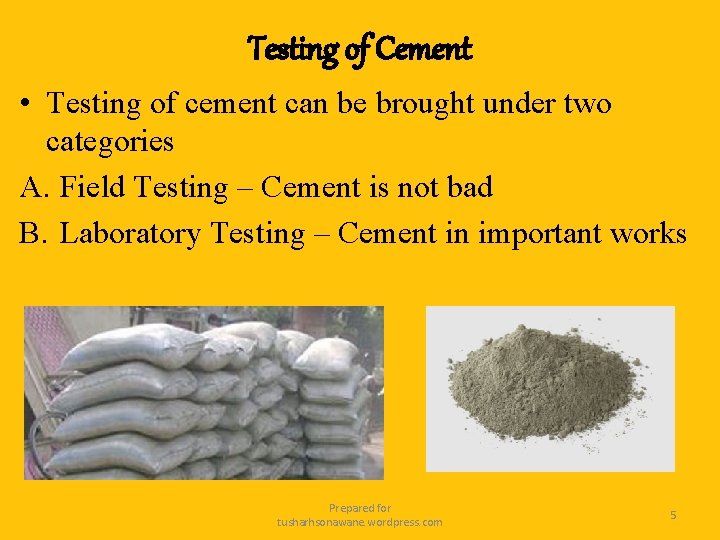
Testing of Cement • Testing of cement can be brought under two categories A. Field Testing – Cement is not bad B. Laboratory Testing – Cement in important works Prepared for tusharhsonawane. wordpress. com 5
Field Testing 1. Observe all the details on the cement bags like Type, grade, ISI mark, Date of manufacturing etc. 2. Open the bag and take good look at cement, the colour of cement should be greenish grey. 3. There should not be visible lumps 4. Thrust your hand inside the cement bag it should feel cool. There should not be any lump inside. 5. Take a pinch of cement and rinse it between fingers, it should give a smooth feeling. 6. Take a hand full of cement and throw it on a bucket full of water, the particles should float for some time before they sink. 7. Take a 100 gm of cement and prepare a cake using paste with sharp edges. Put it on glass plate and sink it in the water bucket. It should not have disturbed edges. Prepared for tusharhsonawane. wordpress. com 6
Laboratory Testing 1. 2. 3. 4. 5. 6. Fineness test Setting time test Strength test Soundness test Heat of hydration test Chemical composition test Prepared for tusharhsonawane. wordpress. com 7
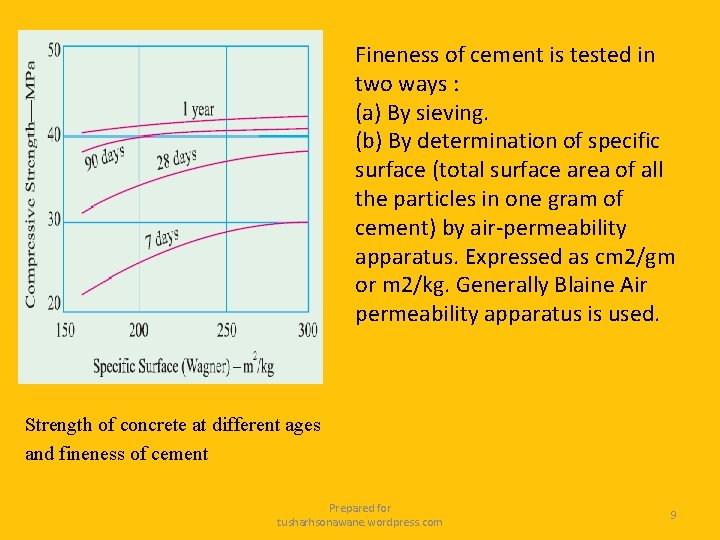
Fineness Test 1. The fineness of cement has an important bearing on the rate of hydration and hence on the rate of gain of strength and also on the rate of evolution of heat. 2. Finer cement offers a greater surface area for hydration and hence faster the development of strength 3. Different cements are ground to different fineness. The particle size fraction below 3 microns has been found to have the predominant effect on the strength at one day while 3 -25 micron fraction has a major influence on the 28 days strength. 4. Increase in fineness of cement is also found to increase the drying shrinkage of concrete. Prepared for tusharhsonawane. wordpress. com 8
Fineness of cement is tested in two ways : (a) By sieving. (b) By determination of specific surface (total surface area of all the particles in one gram of cement) by air-permeability apparatus. Expressed as cm 2/gm or m 2/kg. Generally Blaine Air permeability apparatus is used. Strength of concrete at different ages and fineness of cement Prepared for tusharhsonawane. wordpress. com 9
Sieving [Dry Method] 1. 2. 3. 4. 5. Take correctly 100 grams of cement on a standard IS sieve No. 9 Break down the air-set lumps & sieve it &weigh it. This weight shall not exceed 10% for ordinary cement. Sieve test is rarely used. The weight of the residue should not exceed 10% for ordinary cement. 90 u sieve Prepared for tusharhsonawane. wordpress. com 10
Air Permeability Method Principle of air permeability method is in observing the time taken for a fixed quantity of air to flow through compacted cement bed of specified dimension and porosity. PROCEDURE: 1. Cement required to make a cement bed of porosity 0. 475 is calculated. 2. Pass on the air slowly at constant velocity. 3. Adjust the rate of air flow until the flow meter shows a difference in level of 30 -50 cm. 4. Repeat these observation for constant h 1/h 2. specified air flow Prepared for tusharhsonawane. wordpress. com 11
Lea and Nurse Air Permeability apparatus Prepared for tusharhsonawane. wordpress. com 12
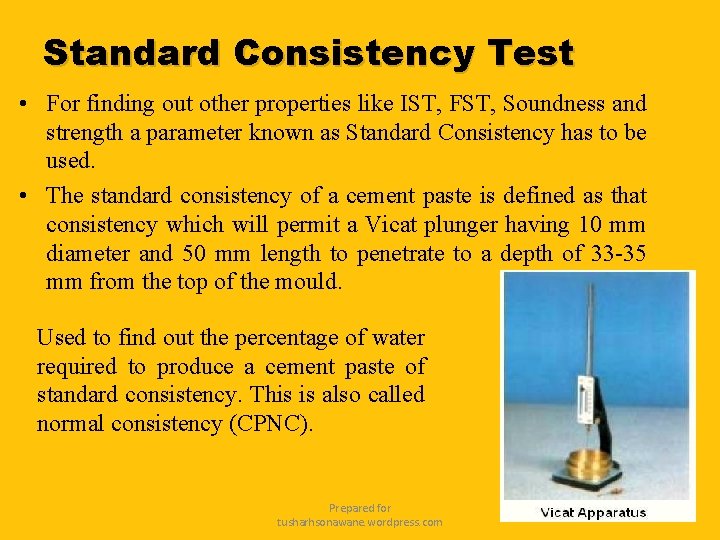
Standard Consistency Test • For finding out other properties like IST, FST, Soundness and strength a parameter known as Standard Consistency has to be used. • The standard consistency of a cement paste is defined as that consistency which will permit a Vicat plunger having 10 mm diameter and 50 mm length to penetrate to a depth of 33 -35 mm from the top of the mould. Used to find out the percentage of water required to produce a cement paste of standard consistency. This is also called normal consistency (CPNC). Prepared for tusharhsonawane. wordpress. com 13
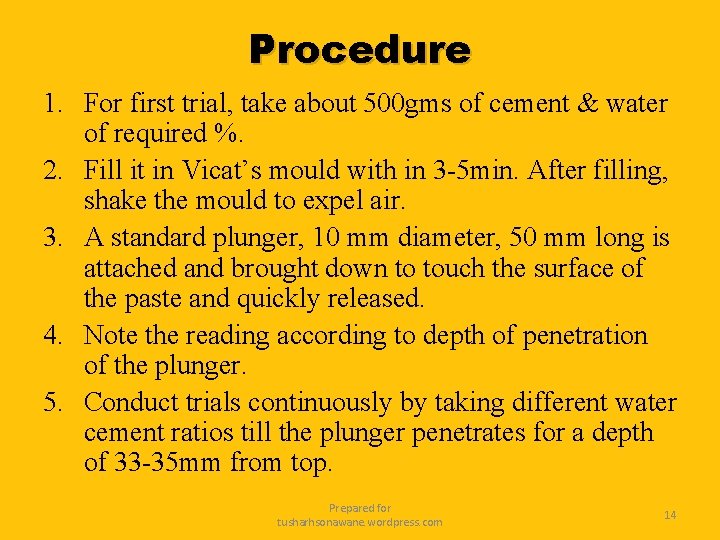
Procedure 1. For first trial, take about 500 gms of cement & water of required %. 2. Fill it in Vicat’s mould with in 3 -5 min. After filling, shake the mould to expel air. 3. A standard plunger, 10 mm diameter, 50 mm long is attached and brought down to touch the surface of the paste and quickly released. 4. Note the reading according to depth of penetration of the plunger. 5. Conduct trials continuously by taking different water cement ratios till the plunger penetrates for a depth of 33 -35 mm from top. Prepared for tusharhsonawane. wordpress. com 14
6. This particular percentage is known as percentage of water required to produce cement paste of standard consistency. 7. This is usually denoted as ‘P’. SUITABLE CONDITIONS: 1. Conducted in a constant temperature of 27˚± 2˚C with Constant Humidity 90%. 2. Procedure APCE Prepared for tusharhsonawane. wordpress. com 15
Setting Time Test • An arbitrary division has been made for the setting time of cement as Initial setting time and Final setting time. Initial Setting Time • The time elapsed between the moment that the water is added to the cement, to the time that the paste starts losing its plasticity. • Normally a minimum of 30 min has maintained for mixing & handling operations. • It should not be less than 30 min. Final Setting Time • The time elapsed between the moment the water is added to the cement, and the time when the paste has completely lost its plasticity and has attained sufficient firmness to resist certain definite pressure. • It should not exceed 10 hours. • So that it is avoided from least vulnerable to damages from external activities. Prepared for tusharhsonawane. wordpress. com 16
Procedure 1. 2. 3. 4. 5. Vicat apparatus is used for finding the setting time Take 500 gms of cement and add about 0. 85 p The paste should be filled within 3 -5 minutes. Initial and final setting time is noted. Video IST FST. mp 4 Prepared for tusharhsonawane. wordpress. com 17
Strength Test • This is the most important of all properties of hardened cement. • Due to excessive shrinkage and cracking the strength tests are not made on neat cement paste. • Standard sand is used for finding the strength of cement. • Video Comp. Strength of Cement Prepared for tusharhsonawane. wordpress. com 18
Procedure 1. Take sand cement (i. e. , 1: 3 ratio of cement and sand) Mix them for 1 min, then add water of quantity (P/4) + 3. 0%. 2. Mix three ingredients thoroughly until the mixture is of uniform colour. 3. The time of mixing should not be < 3 min and > 4 min. Then the mortar is filled into a cube mould of 7. 06 cm. 4. Compact the mortar. 5. Keep the compacted cube in the mould at a temperature of 27°C ± 2°C and at least 90 per cent relative humidity for 24 hours. 6. After 24 hours the cubes are removed & immersed in clean fresh water until taken for testing. Prepared for tusharhsonawane. wordpress. com 19
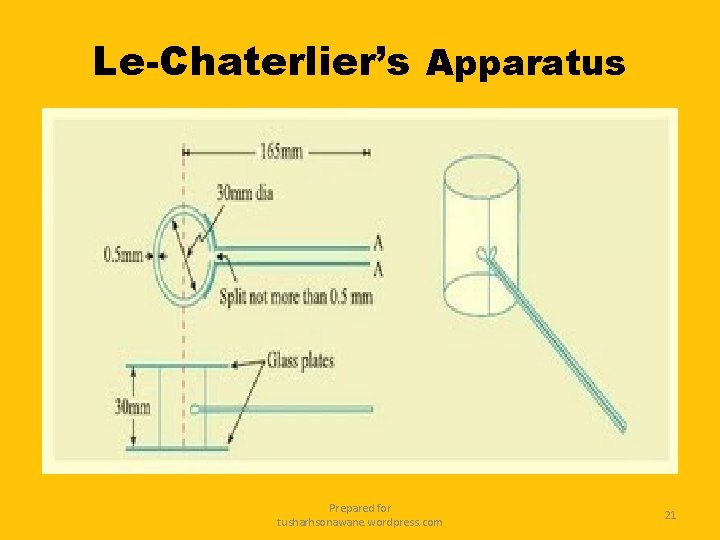
Soundness Test • It is very important that the cement after setting shall not undergo any appreciable change of volume. • This test is to ensure that the cement does not show any subsequent expansions. • The unsoundness in cement is due to the presence of excess of lime combined with acidic oxide at the kiln. • This is due to high proportion of magnesia & calcium sulphate. • Therefore magnesia content in cement is limited to 6%. • Video Soundness Test Prepared for tusharhsonawane. wordpress. com 20
Le-Chaterlier’s Apparatus Prepared for tusharhsonawane. wordpress. com 21
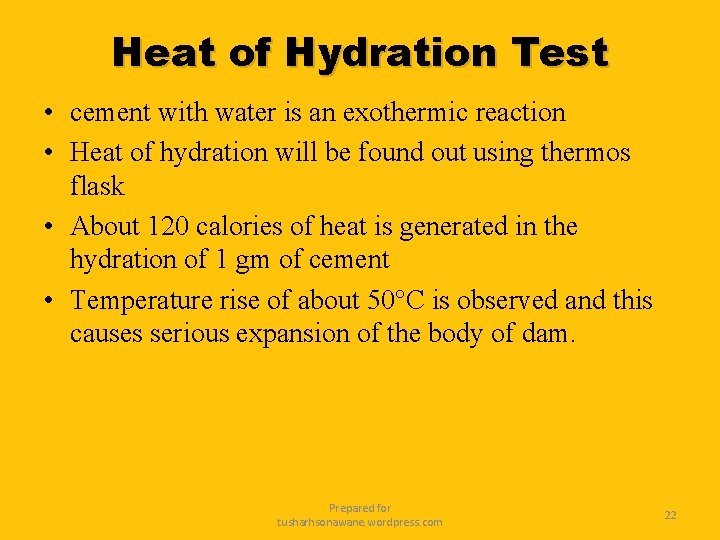
Heat of Hydration Test • cement with water is an exothermic reaction • Heat of hydration will be found out using thermos flask • About 120 calories of heat is generated in the hydration of 1 gm of cement • Temperature rise of about 50°C is observed and this causes serious expansion of the body of dam. Prepared for tusharhsonawane. wordpress. com 22
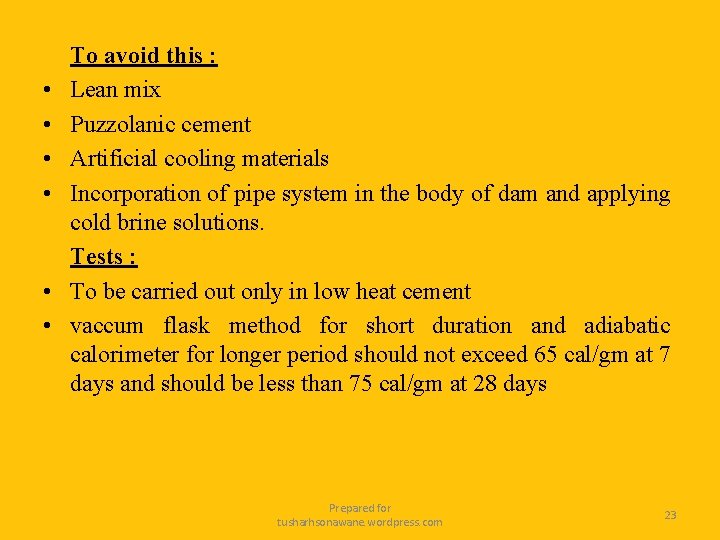
• • • To avoid this : Lean mix Puzzolanic cement Artificial cooling materials Incorporation of pipe system in the body of dam and applying cold brine solutions. Tests : To be carried out only in low heat cement vaccum flask method for short duration and adiabatic calorimeter for longer period should not exceed 65 cal/gm at 7 days and should be less than 75 cal/gm at 28 days Prepared for tusharhsonawane. wordpress. com 23
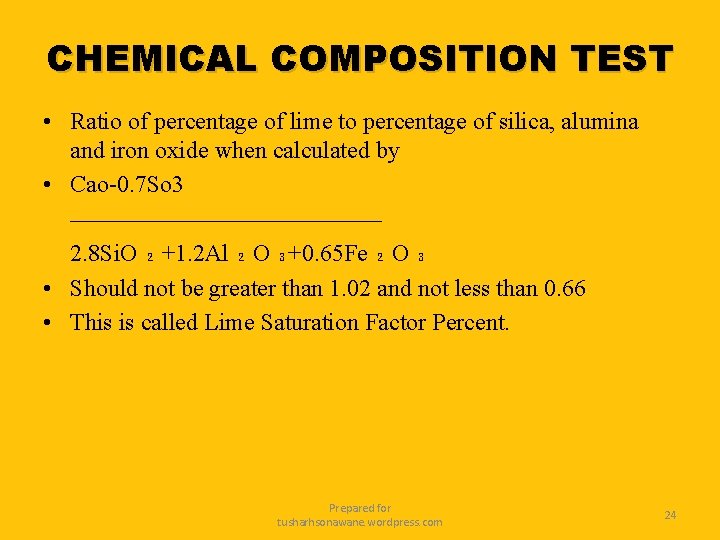
CHEMICAL COMPOSITION TEST • Ratio of percentage of lime to percentage of silica, alumina and iron oxide when calculated by • Cao-0. 7 So 3 ——————— 2. 8 Si. O ₂ +1. 2 Al ₂ O ₃+0. 65 Fe ₂ O ₃ • Should not be greater than 1. 02 and not less than 0. 66 • This is called Lime Saturation Factor Percent. Prepared for tusharhsonawane. wordpress. com 24
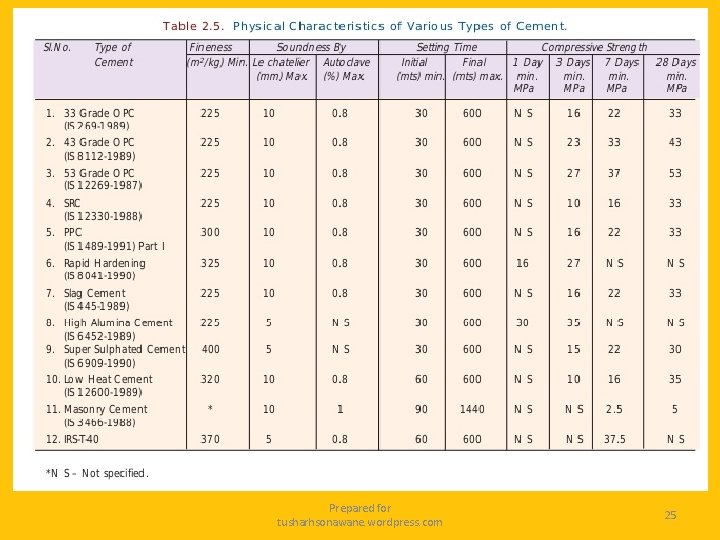
Prepared for tusharhsonawane. wordpress. com 25
Testing of Aggregates Prepared for tusharhsonawane. wordpress. com 26
Aggregates • Aggregate is the said inert material which gives body to concrete. It is available in the form of sand, gravels, boulders, crushed stones viz. , used for manufacturing of concrete. • Requirement of good or Ideal aggregate The aggregate used for construction must satisfy the requirement as per IS 383 : 1989 (1963) 1. Chemically Inert 2. Sufficient Hard 3. Free from Dust 4. Durability Prepared for tusharhsonawane. wordpress. com 27
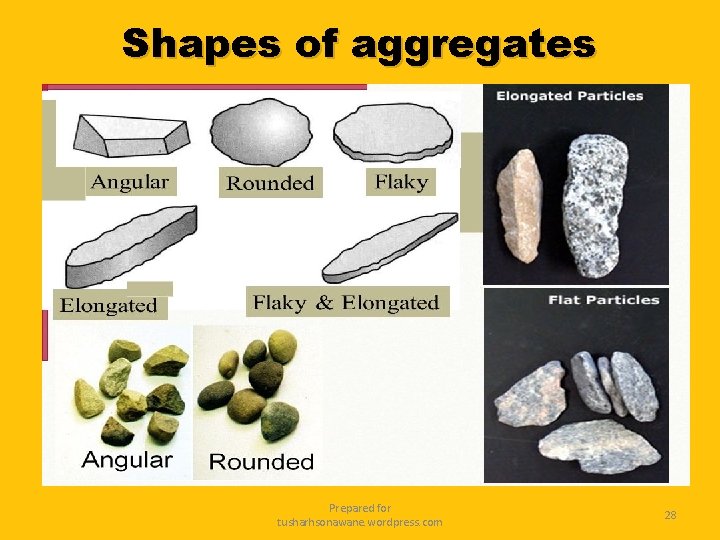
Shapes of aggregates Prepared for tusharhsonawane. wordpress. com 28
Mechanical Properties of Aggregate 1. Bond of Aggregate • Bond is the interlocking of the aggregate and the paste owing to the roughness of the surface of the former. • A rough surface, such as that of crushed particles, results in a better bond; better bond is also usually obtained with softer, porous and mineralogically heterogeneous particles. • No accepted test exists. Prepared for tusharhsonawane. wordpress. com 29
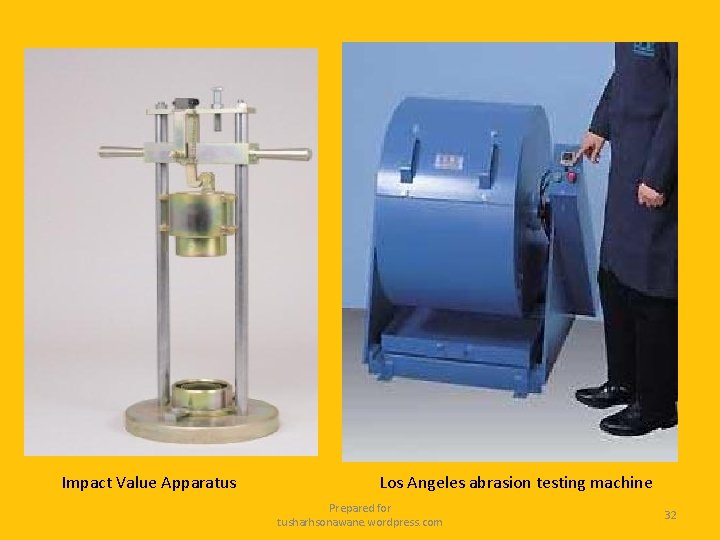
2. Strength of Aggregate NOTE: • Comp. strength (concrete) < Comp. strength (aggregate) • The crushing strength of aggregate cannot be tested with any direct test. There are some indirect tests to inform us about the crushing strength of aggregate. Test method: Crushing value test • Other Mechanical Properties of Aggregates: a) Impact value: Impact value of aggregates measures the toughness of particles by impact b) Abrasion Value : a) Abrasion value of aggregates measures the resistance of aggregates against wearing. b) It is an important property of concrete in roads and in floor surfaces subjected to heavy traffic. c) The most frequently used test method is the Los Angeles Abrasion Test Prepared for tusharhsonawane. wordpress. com 30
2. Strength of Aggregate • Los Angeles Abrasion Test: • The aggregates of specified grading are placed in a cylindrical drum, mounted horizontally. • A charge of steel balls is added and the drum is rotated a specified number of revolutions. • The tumbling and dropping of the aggregate and the balls result in abrasion and attrition of the aggregate. • The resulting grading should be compared with the standard limitations Prepared for tusharhsonawane. wordpress. com 31
Impact Value Apparatus Los Angeles abrasion testing machine Prepared for tusharhsonawane. wordpress. com 32
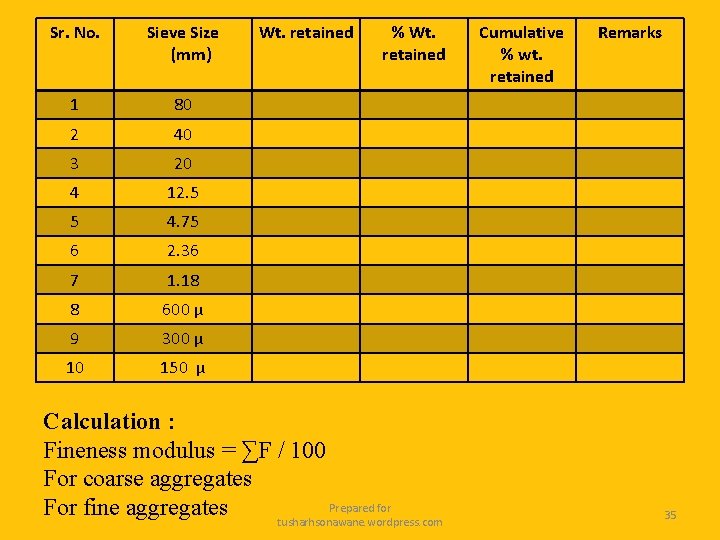
Sieve Analysis • Video Sieve Analysis by sieving method • Fineness Modulus of Aggregate A) Coarse Aggregates 1. 5 kg of coarse aggregate was taken from a sample of about 50 kg by quartering or through riffle box. 2. The relevant sieves were arranged one above the other with the sieve size increasing from the top. The pan was put at the bottom. The sample was placed in the top sieve and covered. 3. The set of sieves were shaken for 2 to 3 minutes in a sieve shaker. 4. The amount of aggregate retained on each sieve was weighed along with the pan. Prepared for tusharhsonawane. wordpress. com 33
B) Fine Aggregates 1. 2 kg of coarse aggregate was taken from a sample of about 50 kg by quartering or through riffle box. 2. The relevant sieves were arranged one above the other with the sieve size increasing from the top. The pan was put at the bottom. The sample was placed in the top sieve and covered. 3. The set of sieves were shaken for 2 to 3 minutes in a sieve shaker. 4. The amount of aggregate retained on each sieve was weighed along with the pan. Prepared for tusharhsonawane. wordpress. com 34
Sr. No. Sieve Size (mm) 1 80 2 40 3 20 4 12. 5 5 4. 75 6 2. 36 7 1. 18 8 600 μ 9 300 μ 10 150 μ Wt. retained % Wt. retained Calculation : Fineness modulus = ∑F / 100 For coarse aggregates Prepared for For fine aggregates tusharhsonawane. wordpress. com Cumulative % wt. retained Remarks 35
Crushing value of coarse aggregate • The aggregate sample consisted of particles passing a 12. 5 mm sieve and retained on a 10 mm sieve. When aggregate of required size was not available, test may be conducted on the available sample, the specification for cylinder and sieve separating the fines was taken from Table 1 of code. • The quantity of aggregate was such that the depth of the material in the cylinder after tamping shall be about 10 cm of the cylindrical measure. The appropriate quantity may be found conveniently by filling in three layers of approximately equal depth; the layers are tamped 25 times with the round end of the tamping rod and finally leveled off. The weight of the tamping comprising the test sample should be determined (weight A) and same weight of the sample was taken for repeat Prepared for 36 test. tusharhsonawane. wordpress. com
• The cylinder of the test apparatus was put in position on the base plate and the test sample was added in thirds, each part being subjected to 25 strokes from the tamping rod. The surface of the plunger should be carefully leveled and the plunger inserted so that it rests horizontally on this surface; care was taken to ensure that cylinder does not jam in the cylinder. • The apparatus with the test sample and plunger in position was than placed between the plates of the test machine and loaded at a fairly uniform rate so that the total load of 40 t is reached in 10 minutes. • The load was released and the whole of the material removed from the cylinder and sieved on a 2. 36 mm IS-sieve or the appropriate sieve if the sample size is not a standard one. The fraction passing the sieve was weighed (weight B). • Two tests were made Aggregate Crushing Value Test Video Prepared for tusharhsonawane. wordpress. com 37
Aggregate Impact Value Test 1. 2. 3. 4. The test sample shall consist of aggregate the whole of which passes a 12. 5 mm IS Sieve and is retained on a 10 mm IS Sieve. The aggregate comprising the test sample shall be dried in an oven for a period of four hours at a temperature of 100 to 110°C and cooled. The measure shall be filled about one-third full with the aggregate and tamped with 25 strokes of the rounded end of the tamping rod. The net weight of aggregate in the measure shall be determined to the nearest gram (Weight A) The impact machine shall rest without wedging or packing upon the level plate, block or floor, so that it is rigid and the hammer guide columns are vertical. The cup shall be fixed firmly in position on the base of the machine and the whole of the test sample placed in it and compacted by a single tamping of 25 strokes of the tamping rod. Prepared for tusharhsonawane. wordpress. com 38
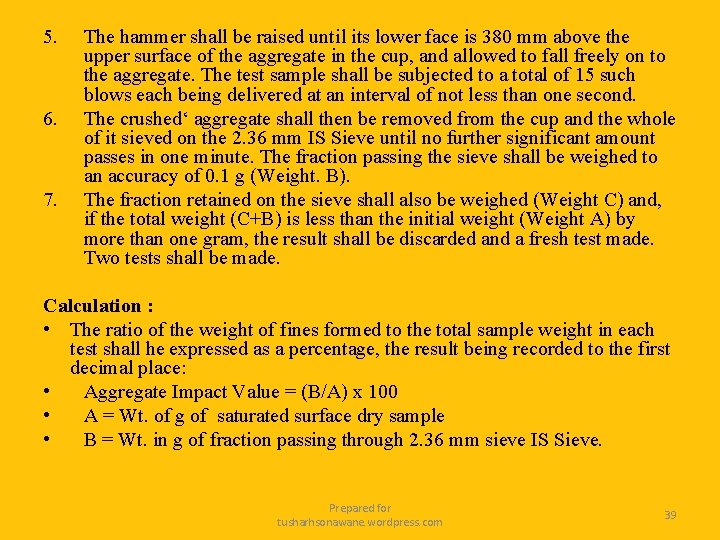
5. 6. 7. The hammer shall be raised until its lower face is 380 mm above the upper surface of the aggregate in the cup, and allowed to fall freely on to the aggregate. The test sample shall be subjected to a total of 15 such blows each being delivered at an interval of not less than one second. The crushed‘ aggregate shall then be removed from the cup and the whole of it sieved on the 2. 36 mm IS Sieve until no further significant amount passes in one minute. The fraction passing the sieve shall be weighed to an accuracy of 0. 1 g (Weight. B). The fraction retained on the sieve shall also be weighed (Weight C) and, if the total weight (C+B) is less than the initial weight (Weight A) by more than one gram, the result shall be discarded and a fresh test made. Two tests shall be made. Calculation : • The ratio of the weight of fines formed to the total sample weight in each test shall he expressed as a percentage, the result being recorded to the first decimal place: • Aggregate Impact Value = (B/A) x 100 • A = Wt. of g of saturated surface dry sample • B = Wt. in g of fraction passing through 2. 36 mm sieve IS Sieve. Prepared for tusharhsonawane. wordpress. com 39
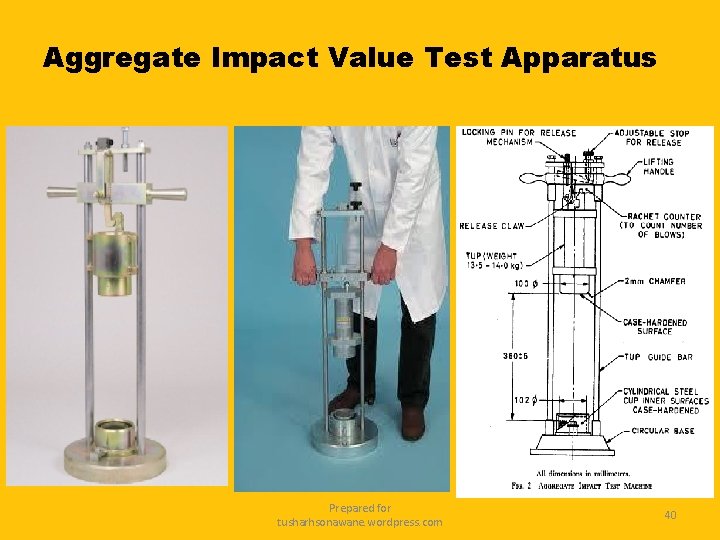
Aggregate Impact Value Test Apparatus Prepared for tusharhsonawane. wordpress. com 40
Thank You Er. Tushar Harihar Sonawane ( Member : IEI , IAENG ) Civil Engineering Department, SNJB’s KBJ COE Chandwad +91 9657688220 tusharsonawane. wordpress. com sonawane. thcoe@snjb. org Prepared for tusharhsonawane. wordpress. com 41