
Concrete Technology 2 What is Hydraulic Cement Concrete



- Slides: 51
Concrete Technology
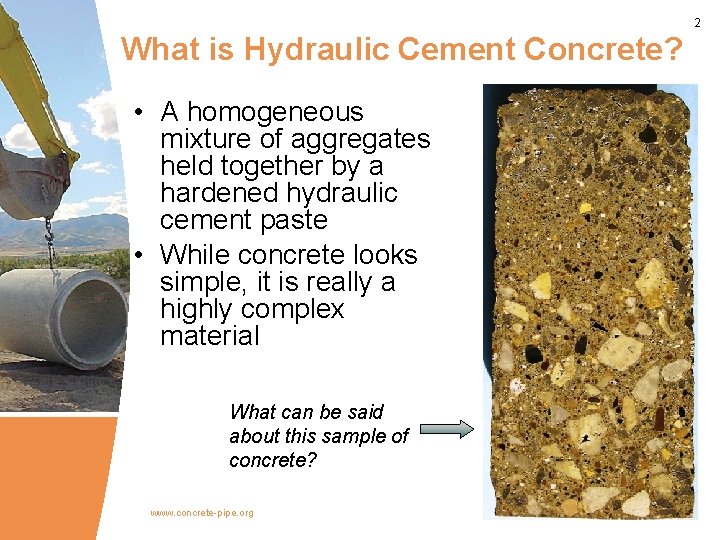
2 What is Hydraulic Cement Concrete? • A homogeneous mixture of aggregates held together by a hardened hydraulic cement paste • While concrete looks simple, it is really a highly complex material What can be said about this sample of concrete? www. concrete-pipe. org
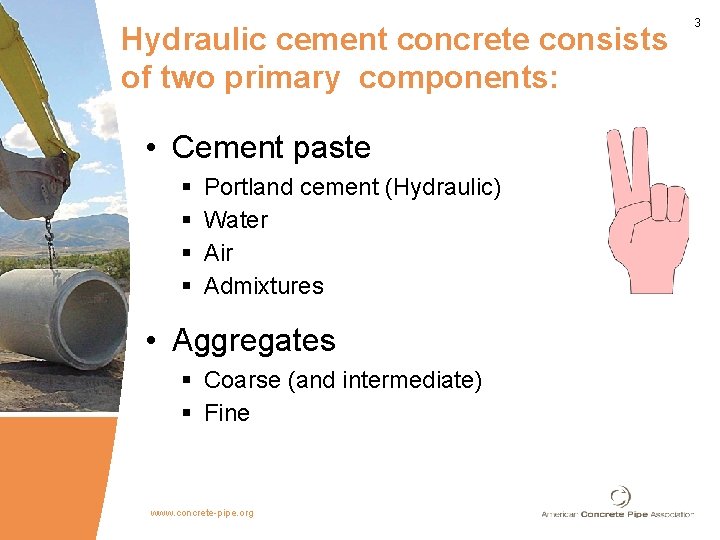
Hydraulic cement concrete consists of two primary components: • Cement paste § § Portland cement (Hydraulic) Water Air Admixtures • Aggregates § Coarse (and intermediate) § Fine www. concrete-pipe. org 3
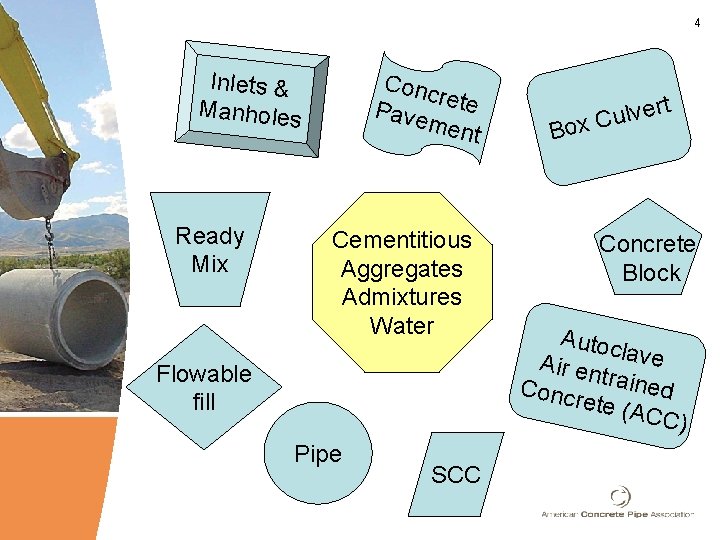
4 Inlets & Manholes Ready Mix Conc rete Pave ment Cementitious Aggregates Admixtures Water Flowable fill Pipe SCC rt e v l u ox C B Concrete Block Autoc Air en lave Conc trained rete ( ACC)
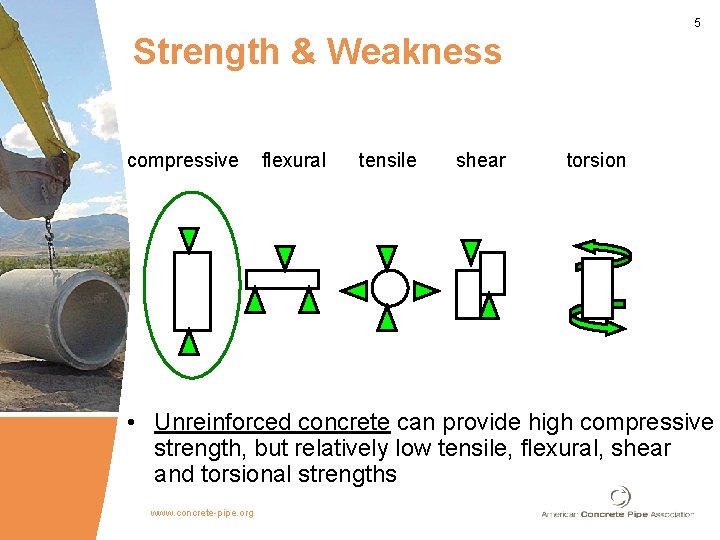
5 Strength & Weakness compressive flexural tensile shear torsion • Unreinforced concrete can provide high compressive strength, but relatively low tensile, flexural, shear and torsional strengths www. concrete-pipe. org
Cement Hydration
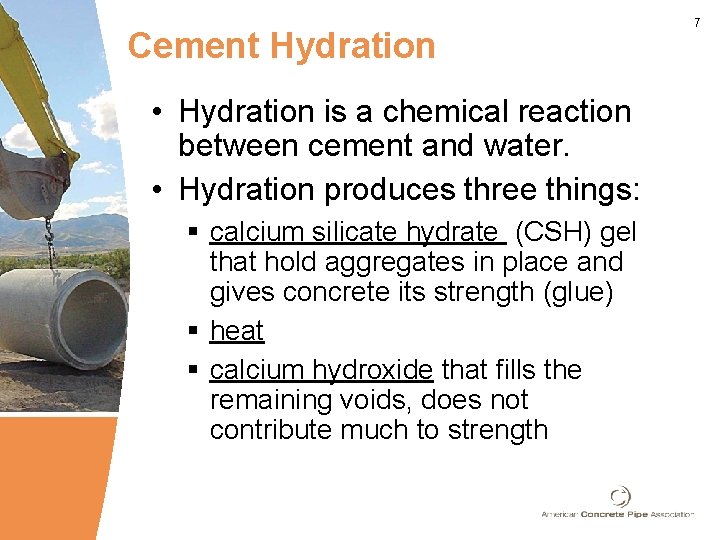
Cement Hydration • Hydration is a chemical reaction between cement and water. • Hydration produces three things: § calcium silicate hydrate (CSH) gel that hold aggregates in place and gives concrete its strength (glue) § heat § calcium hydroxide that fills the remaining voids, does not contribute much to strength 7
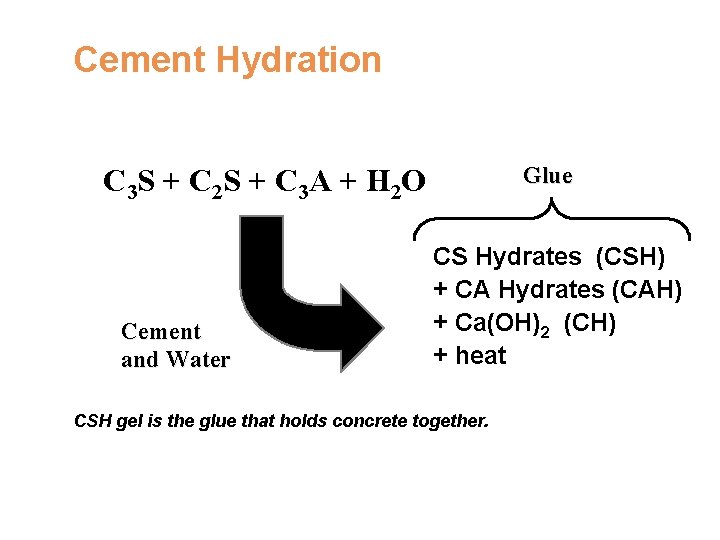
Cement Hydration Glue C 3 S + C 2 S + C 3 A + H 2 O Cement and Water CS Hydrates (CSH) + CA Hydrates (CAH) + Ca(OH)2 (CH) + heat CSH gel is the glue that holds concrete together.
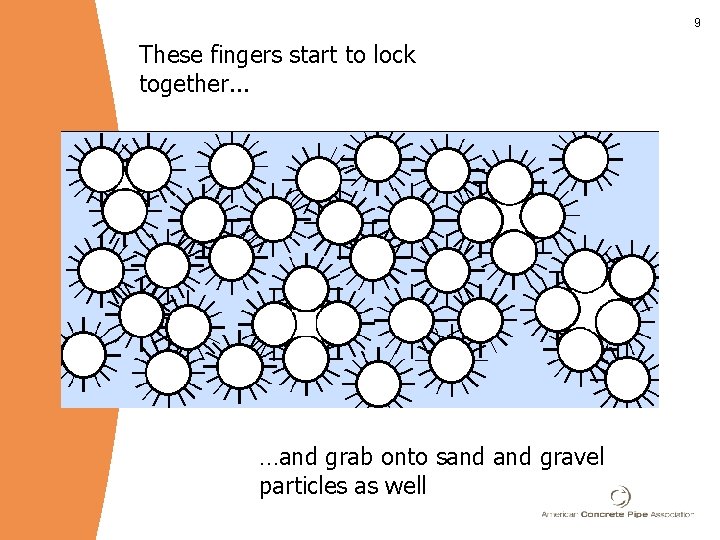
9 These fingers start to lock together. . . …and grab onto sand gravel particles as well
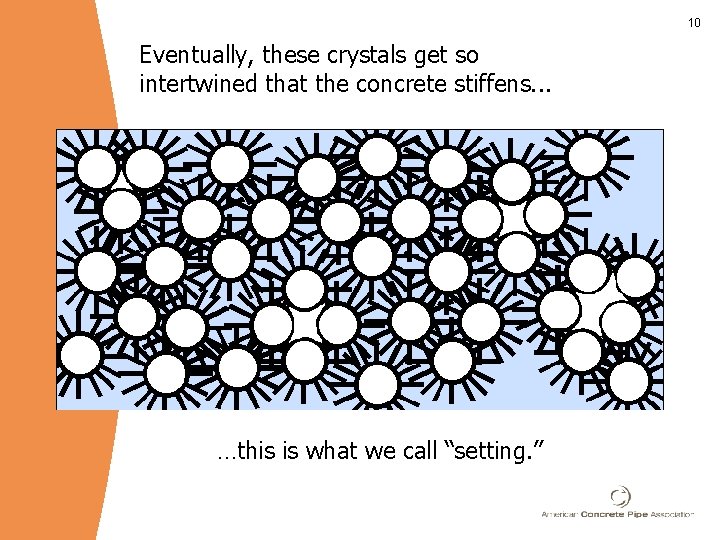
10 Eventually, these crystals get so intertwined that the concrete stiffens. . . …this is what we call “setting. ”
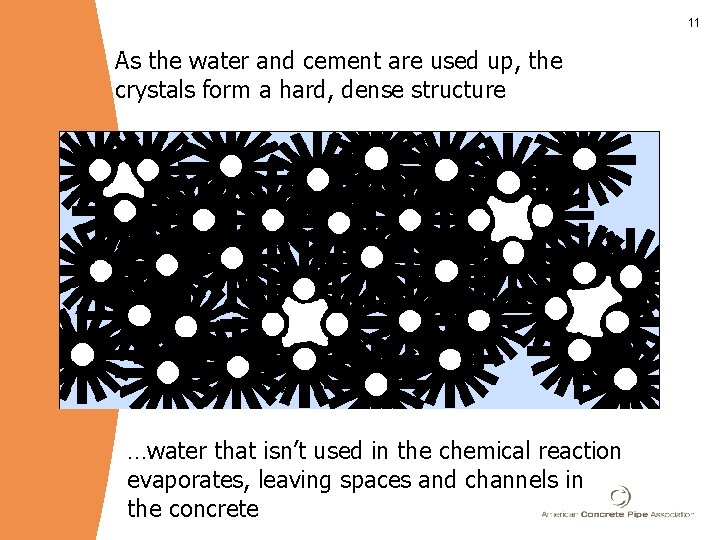
11 As the water and cement are used up, the crystals form a hard, dense structure …water that isn’t used in the chemical reaction evaporates, leaving spaces and channels in the concrete
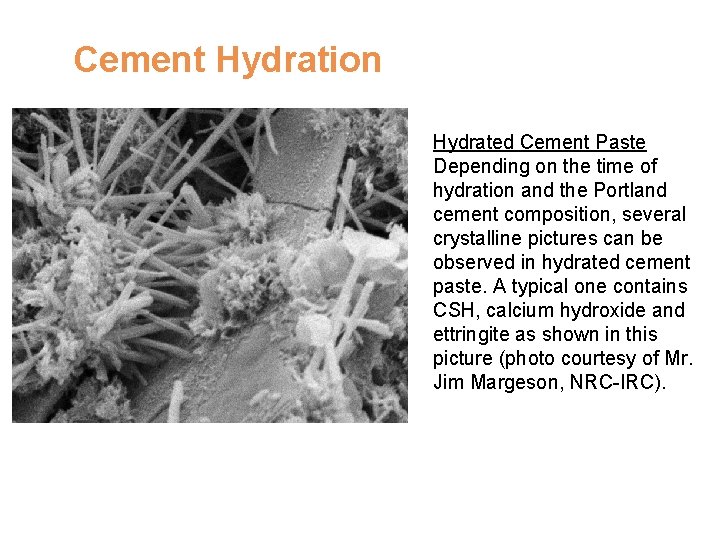
Cement Hydration Hydrated Cement Paste Depending on the time of hydration and the Portland cement composition, several crystalline pictures can be observed in hydrated cement paste. A typical one contains CSH, calcium hydroxide and ettringite as shown in this picture (photo courtesy of Mr. Jim Margeson, NRC-IRC).
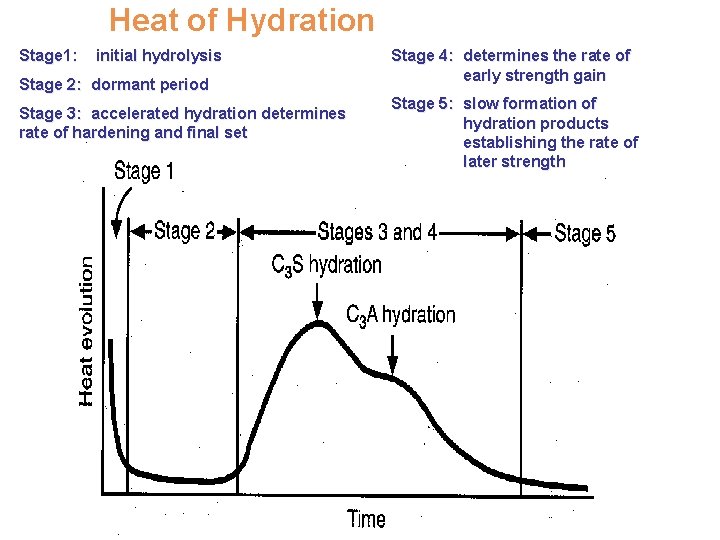
Heat of Hydration Stage 1: initial hydrolysis Stage 2: dormant period Stage 3: accelerated hydration determines rate of hardening and final set Stage 4: determines the rate of early strength gain Stage 5: slow formation of hydration products establishing the rate of later strength
Water and W/C Ratio
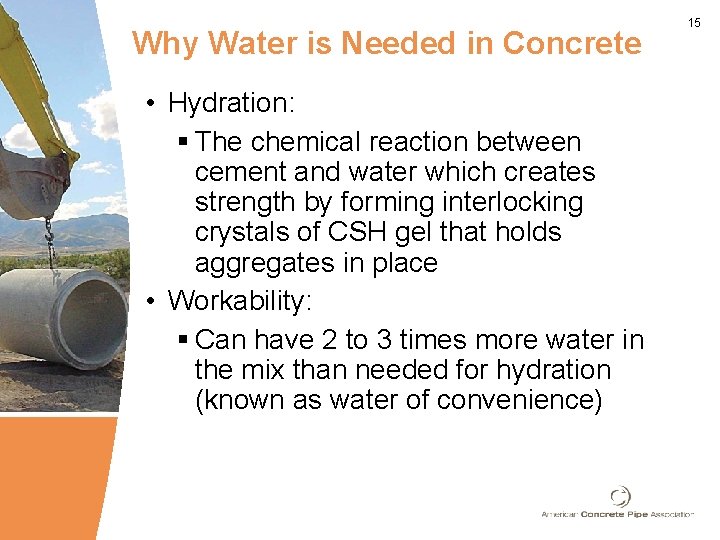
Why Water is Needed in Concrete • Hydration: § The chemical reaction between cement and water which creates strength by forming interlocking crystals of CSH gel that holds aggregates in place • Workability: § Can have 2 to 3 times more water in the mix than needed for hydration (known as water of convenience) 15
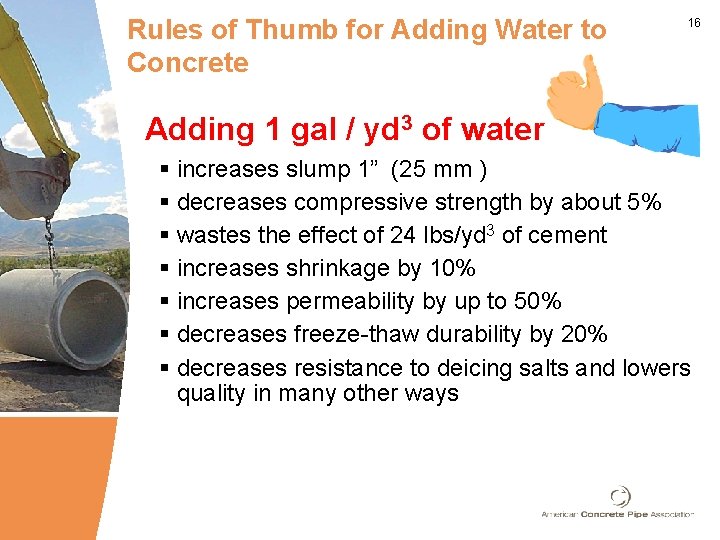
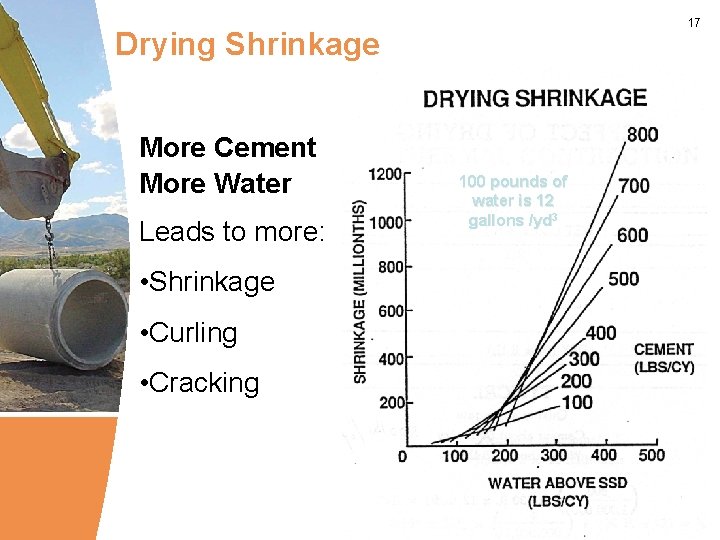
Rules of Thumb for Adding Water to Concrete 16 Adding 1 gal / yd 3 of water § increases slump 1” (25 mm ) § decreases compressive strength by about 5% § wastes the effect of 24 lbs/yd 3 of cement § increases shrinkage by 10% § increases permeability by up to 50% § decreases freeze-thaw durability by 20% § decreases resistance to deicing salts and lowers quality in many other ways
17 Drying Shrinkage More Cement More Water Leads to more: • Shrinkage • Curling • Cracking 100 pounds of water is 12 gallons /yd 3
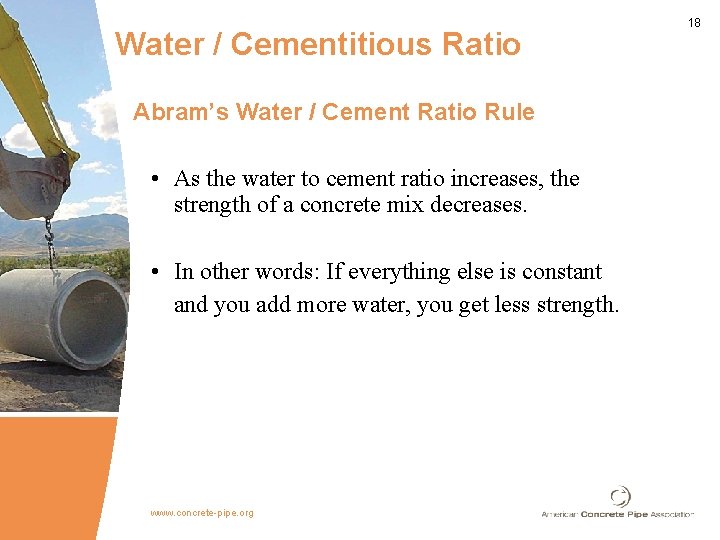
Water / Cementitious Ratio Abram’s Water / Cement Ratio Rule • As the water to cement ratio increases, the strength of a concrete mix decreases. • In other words: If everything else is constant and you add more water, you get less strength. www. concrete-pipe. org 18
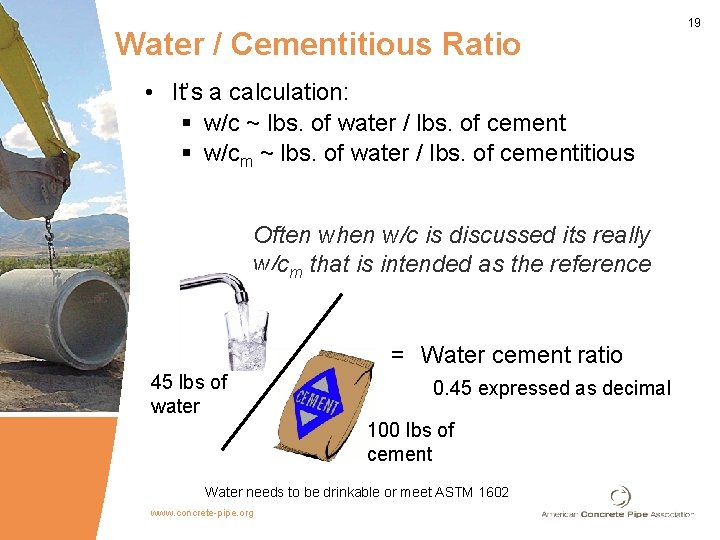
Water / Cementitious Ratio • It’s a calculation: § w/c ~ lbs. of water / lbs. of cement § w/cm ~ lbs. of water / lbs. of cementitious Often when w/c is discussed its really w/cm that is intended as the reference = Water cement ratio 45 lbs of water 0. 45 expressed as decimal 100 lbs of cement Water needs to be drinkable or meet ASTM 1602 www. concrete-pipe. org 19
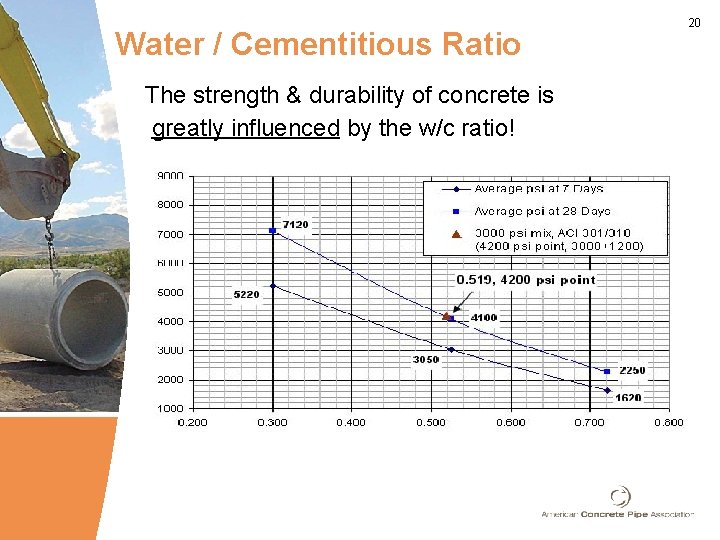
Water / Cementitious Ratio The strength & durability of concrete is greatly influenced by the w/c ratio! 20
Proportioning
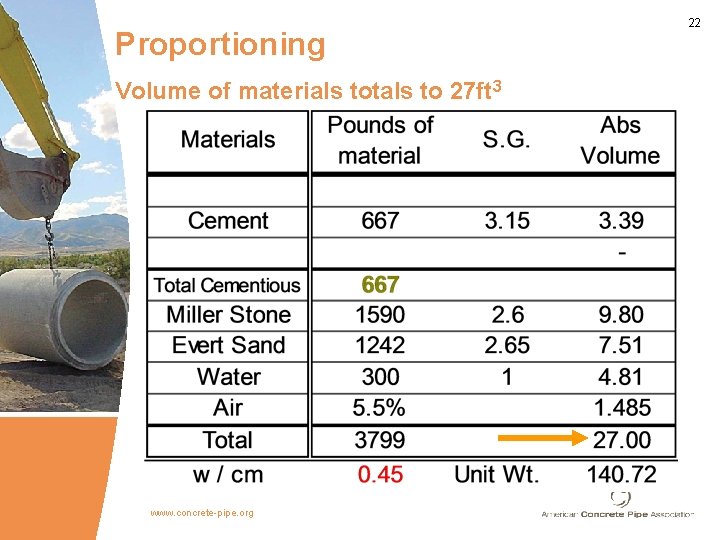
Proportioning Volume of materials totals to 27 ft 3 www. concrete-pipe. org 22
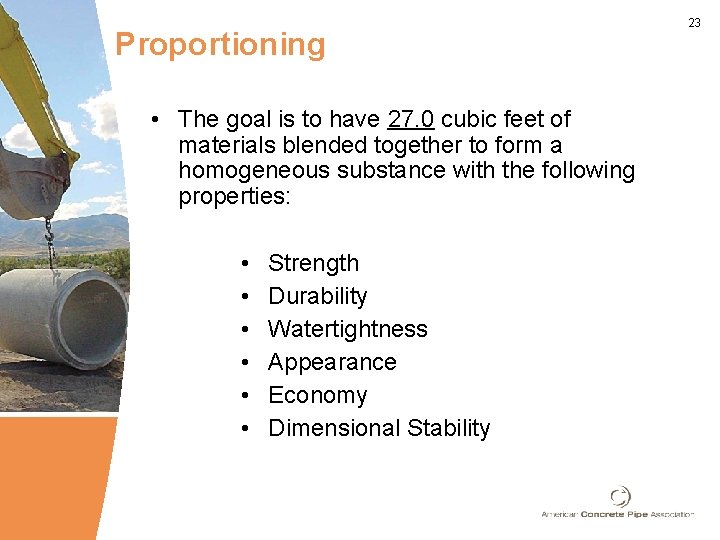
Proportioning • The goal is to have 27. 0 cubic feet of materials blended together to form a homogeneous substance with the following properties: • • • Strength Durability Watertightness Appearance Economy Dimensional Stability 23
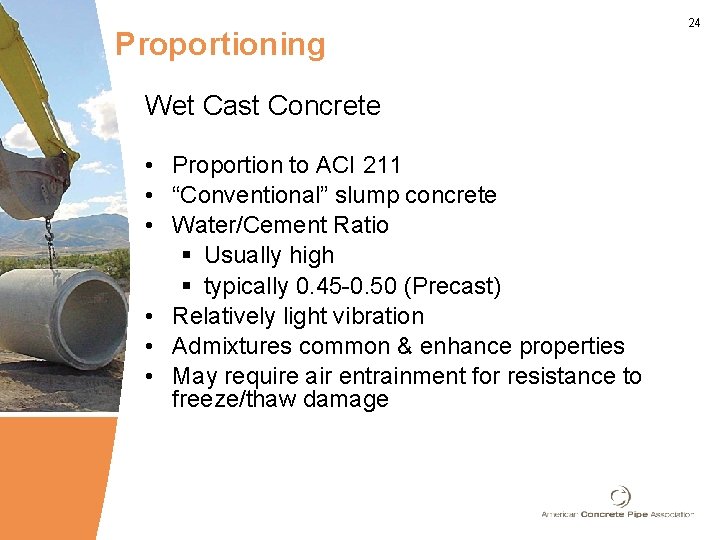
Proportioning Wet Cast Concrete • Proportion to ACI 211 • “Conventional” slump concrete • Water/Cement Ratio § Usually high § typically 0. 45 -0. 50 (Precast) • Relatively light vibration • Admixtures common & enhance properties • May require air entrainment for resistance to freeze/thaw damage 24
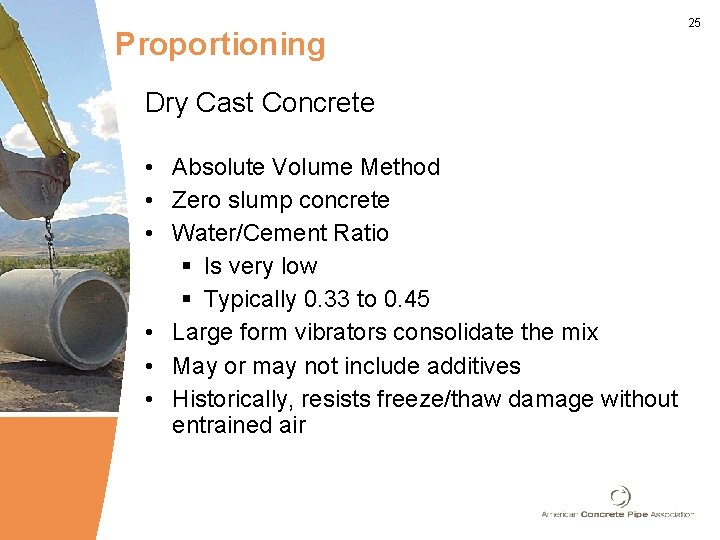
Proportioning Dry Cast Concrete • Absolute Volume Method • Zero slump concrete • Water/Cement Ratio § Is very low § Typically 0. 33 to 0. 45 • Large form vibrators consolidate the mix • May or may not include additives • Historically, resists freeze/thaw damage without entrained air 25
Durability of Concrete
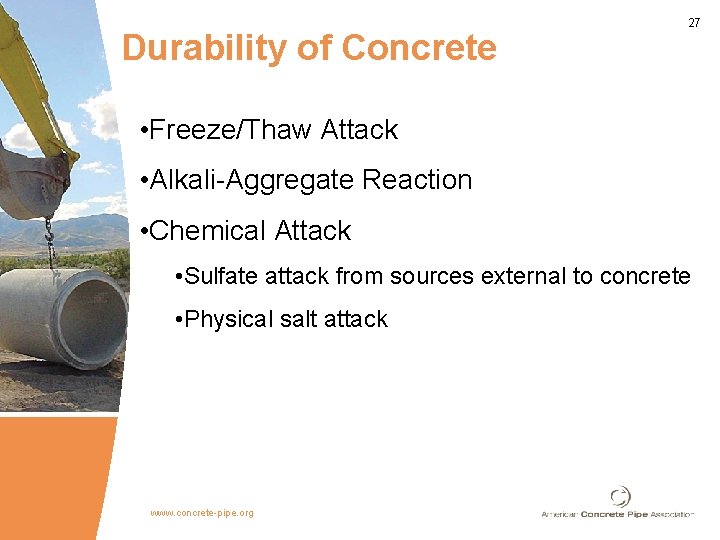
Durability of Concrete 27 • Freeze/Thaw Attack • Alkali-Aggregate Reaction • Chemical Attack • Sulfate attack from sources external to concrete • Physical salt attack www. concrete-pipe. org
Freeze/Thaw Attack
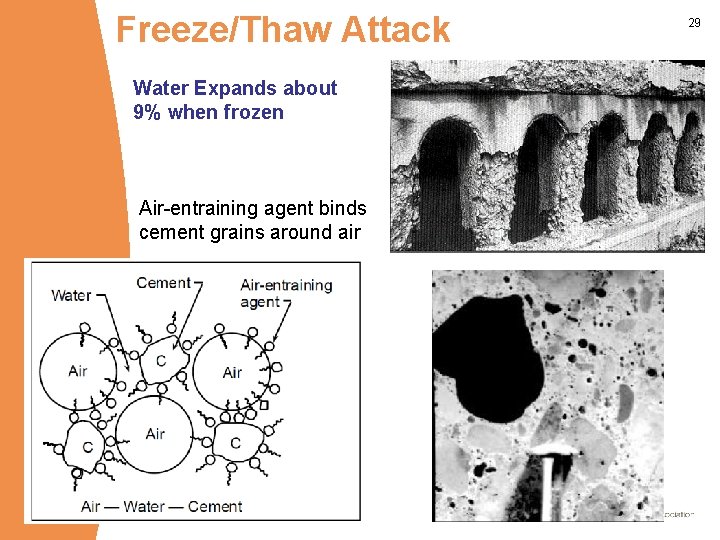
Freeze/Thaw Attack Water Expands about 9% when frozen Air-entraining agent binds cement grains around air 29
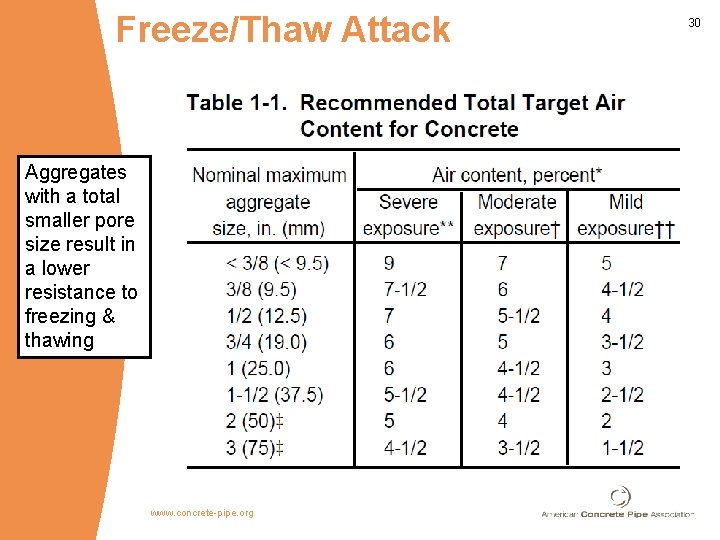
Freeze/Thaw Attack Aggregates with a total smaller pore size result in a lower resistance to freezing & thawing www. concrete-pipe. org 30
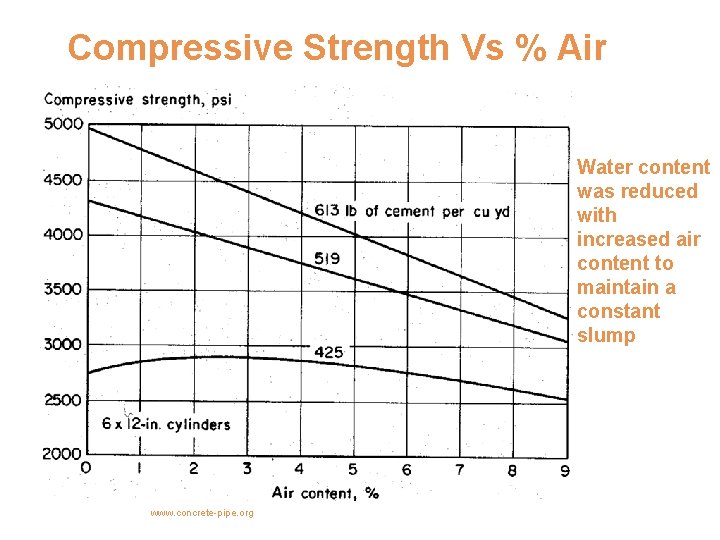
Compressive Strength Vs % Air Water content was reduced with increased air content to maintain a constant slump www. concrete-pipe. org
Freeze/Thaw Attack Air Content § Entrapped air § Entrained air www. concrete-pipe. org 32
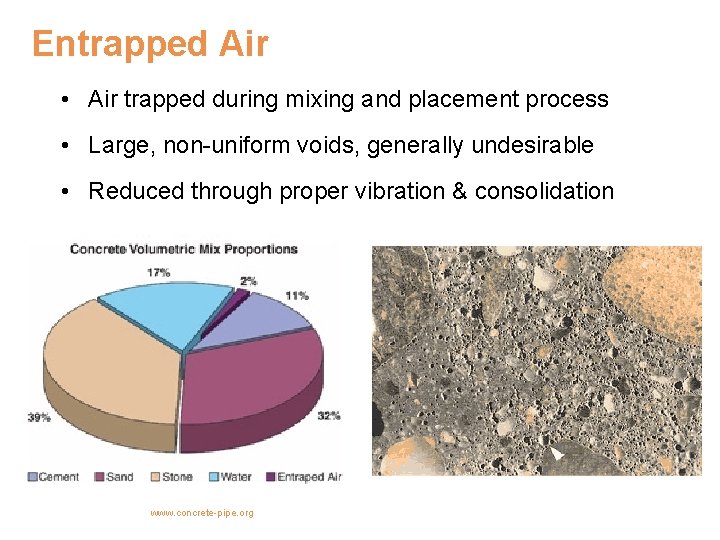
Entrapped Air • Air trapped during mixing and placement process • Large, non-uniform voids, generally undesirable • Reduced through proper vibration & consolidation www. concrete-pipe. org
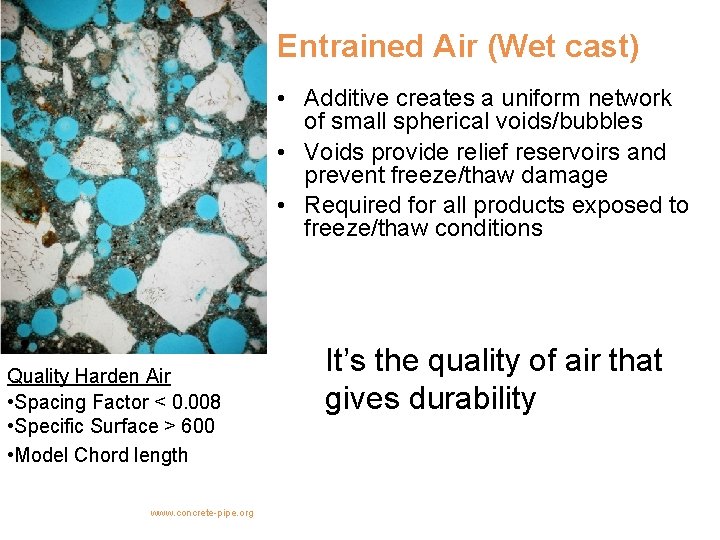
Entrained Air (Wet cast) • Additive creates a uniform network of small spherical voids/bubbles • Voids provide relief reservoirs and prevent freeze/thaw damage • Required for all products exposed to freeze/thaw conditions Quality Harden Air • Spacing Factor < 0. 008 • Specific Surface > 600 • Model Chord length www. concrete-pipe. org It’s the quality of air that gives durability
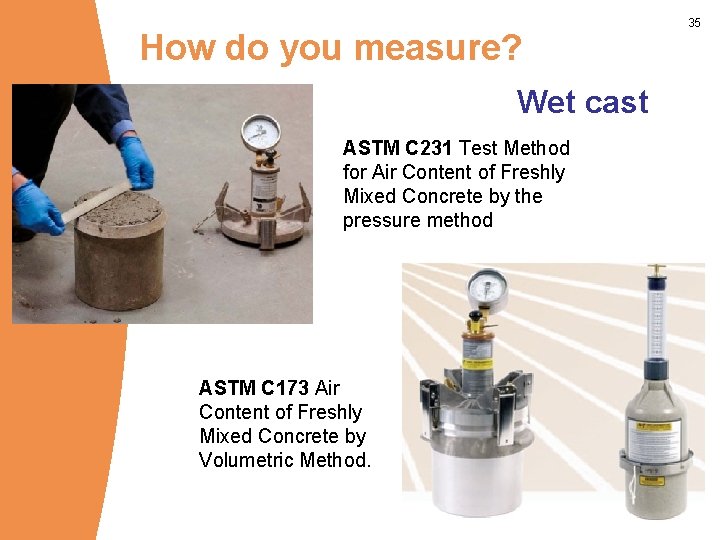
How do you measure? Wet cast ASTM C 231 Test Method for Air Content of Freshly Mixed Concrete by the pressure method ASTM C 173 Air Content of Freshly Mixed Concrete by Volumetric Method. 35
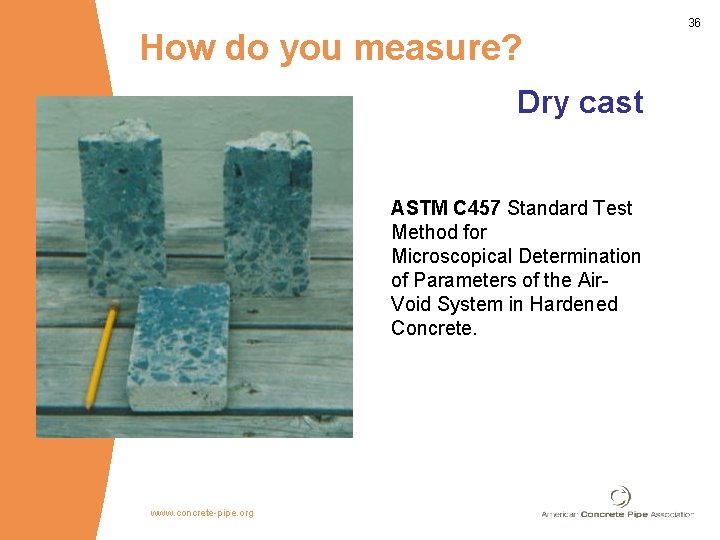
How do you measure? Dry cast ASTM C 457 Standard Test Method for Microscopical Determination of Parameters of the Air. Void System in Hardened Concrete. www. concrete-pipe. org 36
Alkali–Aggregate Reaction
Alkali-Aggregate Reaction • ACR (Alkali-Carbonate Reaction) A reaction between an alkali source and certain calcium magnesium carbonate rocks (dolomites) • ASR (Alkali-Silica Reaction) Reaction between an alkali and certain forms of reactive silica that can originate from some types of siliceous aggregate – far more widespread than ACR www. concrete-pipe. org 38
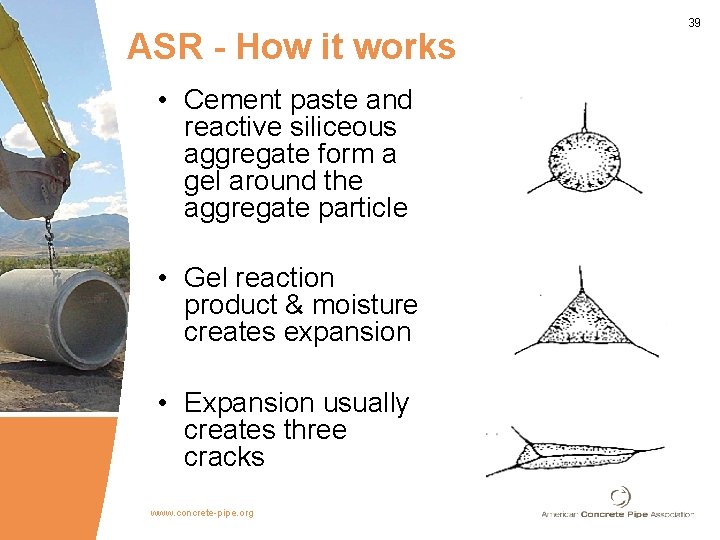
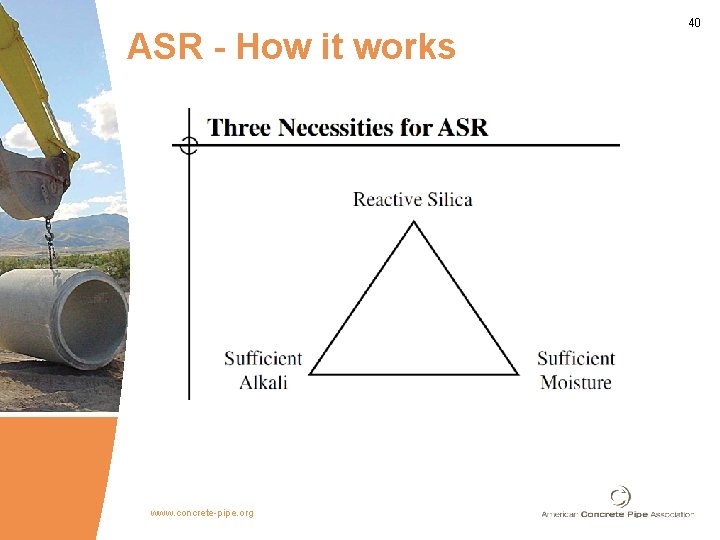
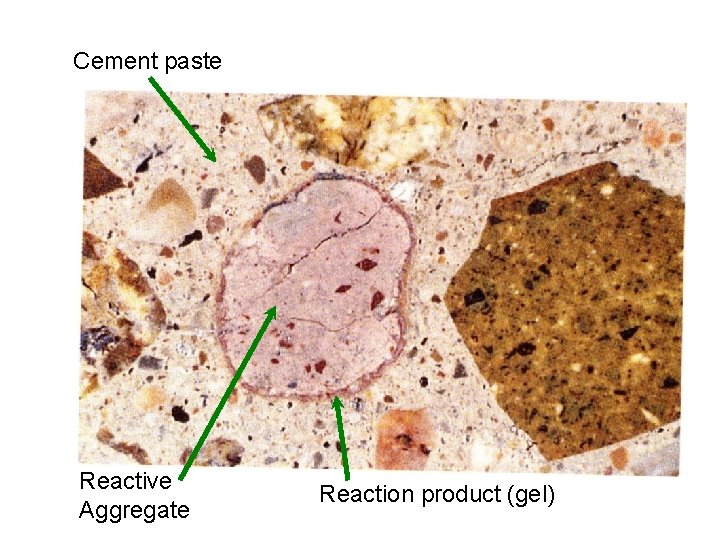
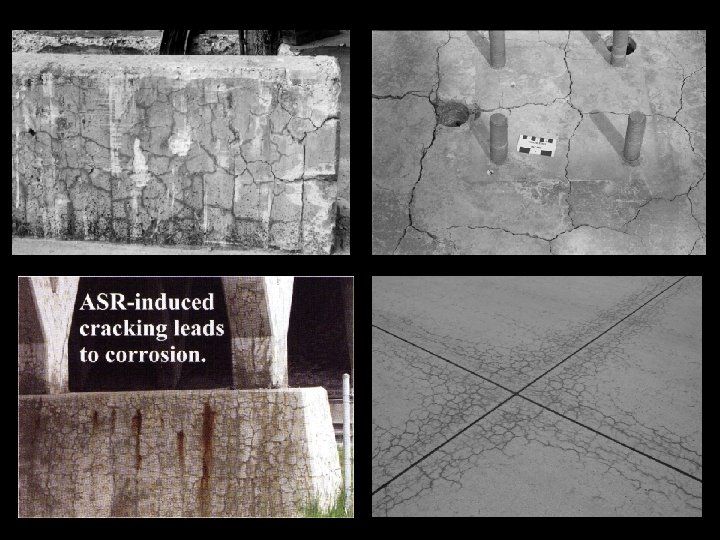
ASR - How it works • Cement paste and reactive siliceous aggregate form a gel around the aggregate particle • Gel reaction product & moisture creates expansion • Expansion usually creates three cracks www. concrete-pipe. org 39
ASR - How it works www. concrete-pipe. org 40
Cement paste Reactive Aggregate Reaction product (gel)
www. concrete-pipe. org
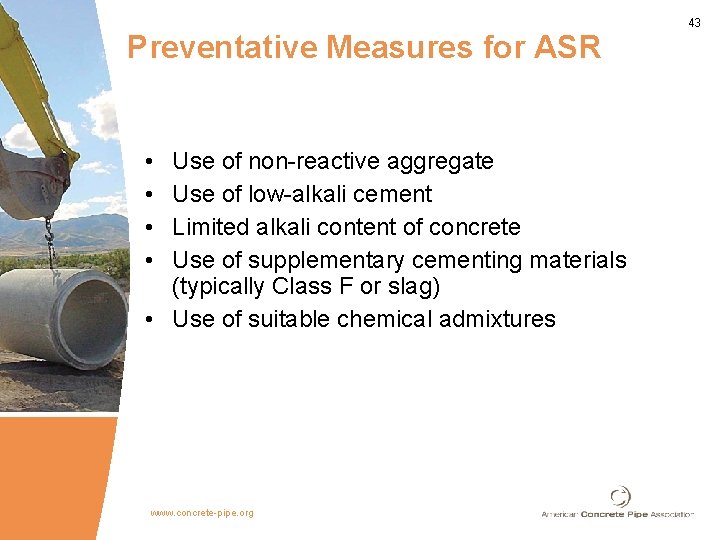
Preventative Measures for ASR • • Use of non-reactive aggregate Use of low-alkali cement Limited alkali content of concrete Use of supplementary cementing materials (typically Class F or slag) • Use of suitable chemical admixtures www. concrete-pipe. org 43
Chemical Attack
Chemical Attack 45 • Sulfate attack from sources external to concrete (Not to be confused with hydrogen sulfide from sanitary sewers) • Physical salt attack www. concrete-pipe. org
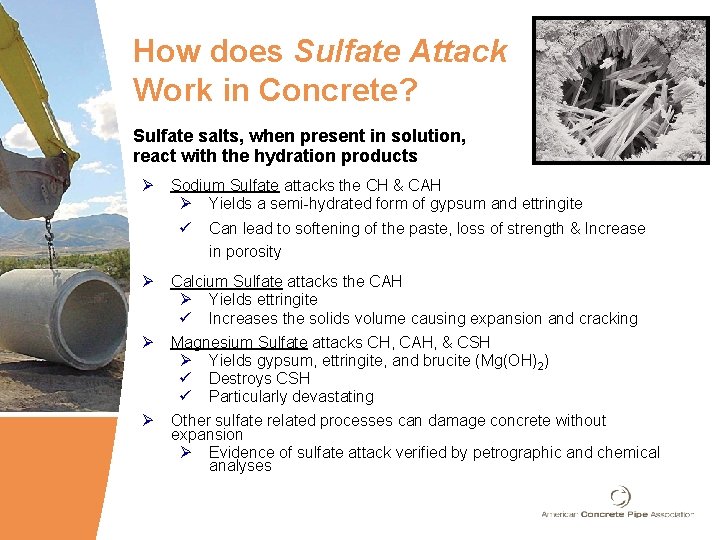
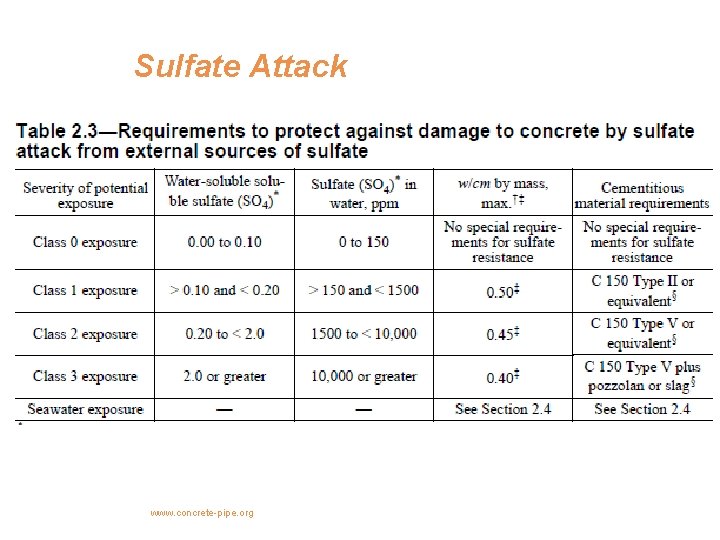
46 How does Sulfate Attack Work in Concrete? Sulfate salts, when present in solution, react with the hydration products Ø Sodium Sulfate attacks the CH & CAH Ø Yields a semi-hydrated form of gypsum and ettringite ü Ø Ø Ø Can lead to softening of the paste, loss of strength & Increase in porosity Calcium Sulfate attacks the CAH Ø Yields ettringite ü Increases the solids volume causing expansion and cracking Magnesium Sulfate attacks CH, CAH, & CSH Ø Yields gypsum, ettringite, and brucite (Mg(OH)2) ü Destroys CSH ü Particularly devastating Other sulfate related processes can damage concrete without expansion Ø Evidence of sulfate attack verified by petrographic and chemical analyses
47 Sulfate Attack Recommendations for protection • Use concrete that retards the ingress of the external sulfate • Low w/c ratio • Low permeability • Sulfate resistant cement (low C 3 A<5% Type V; <8% Type II) • Slag cement and or Class F Fly ash www. concrete-pipe. org
Sulfate Attack www. concrete-pipe. org
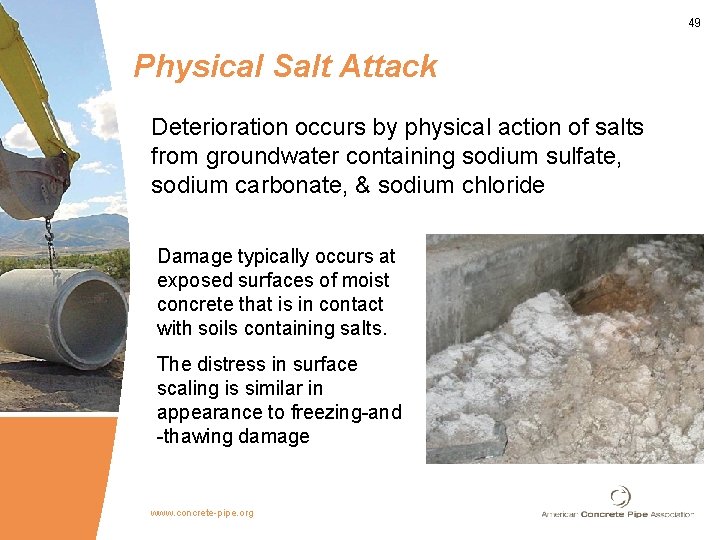
49 Physical Salt Attack Deterioration occurs by physical action of salts from groundwater containing sodium sulfate, sodium carbonate, & sodium chloride Damage typically occurs at exposed surfaces of moist concrete that is in contact with soils containing salts. The distress in surface scaling is similar in appearance to freezing-and -thawing damage www. concrete-pipe. org
50 How to make Durable Concrete? • Low w/cm ratio • Ample amount of cementitious • Quality Aggregates • Correct admixtures • Proper mixing & placing • Adequate Curing www. concrete-pipe. org
51 QUESTIONS?