
Concrete Representational Abstract The CRA Learning Progression Why
Concrete, Representational, Abstract
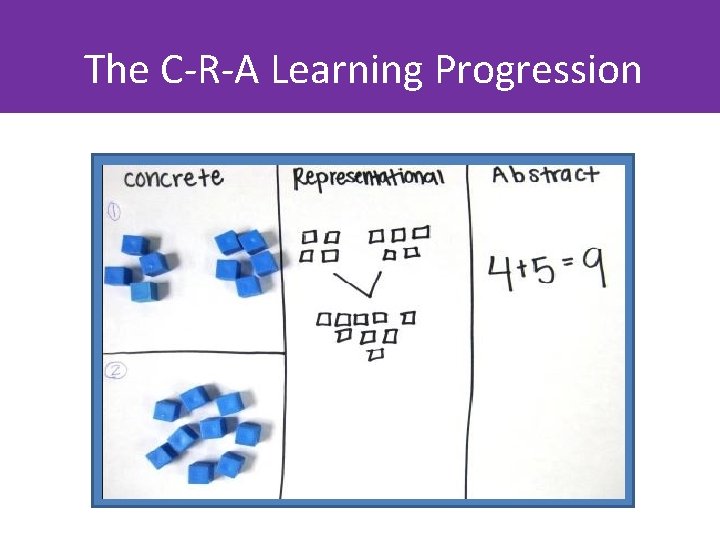
The C-R-A Learning Progression
Why is this beneficial to our students? Research-based studies show that students who use concrete materials • develop more precise and more comprehensive mental representations, • often show more motivation and on-task behavior, • understand mathematical ideas, and • better apply these ideas to life situations Harrison & Harrison, 1986; Suydam & Higgins, 1977 • •
C→ R → A Concrete → Representational → Abstract • Concrete: The “doing” stage using concrete objects to model problems • Representational: The “seeing” stage using representations of the objects to model problems • Abstract: The “symbolic” stage using abstract symbols to model problems
C→ R → A Based on work of Jerome Bruner in the 1960 s “To instruct someone… is not a matter of getting him to commit results to mind. Rather, it is to teach him to participate in the process that makes possible the establishment of knowledge. We teach a subject not to produce little living libraries on that subject, but rather to get a student to think mathematically for himself, to consider matters as an historian does, to take part in the process of knowledge-getting. Knowing is a process not a product. ” (1966: 72)
C→ R → A • Sequencing matters A gradual and systematic approach which builds on a child’s existing understanding • Concrete • – Show students that math can be used to solve real life problems – Use of manipulatives or hands-on activities
C→ R → A • Concrete and pictorial representations should be used at all grade levels. • By using cognitive strategies such as CRA, teachers provide students a technique for tackling mathematics problems rather than just searching for an answer.
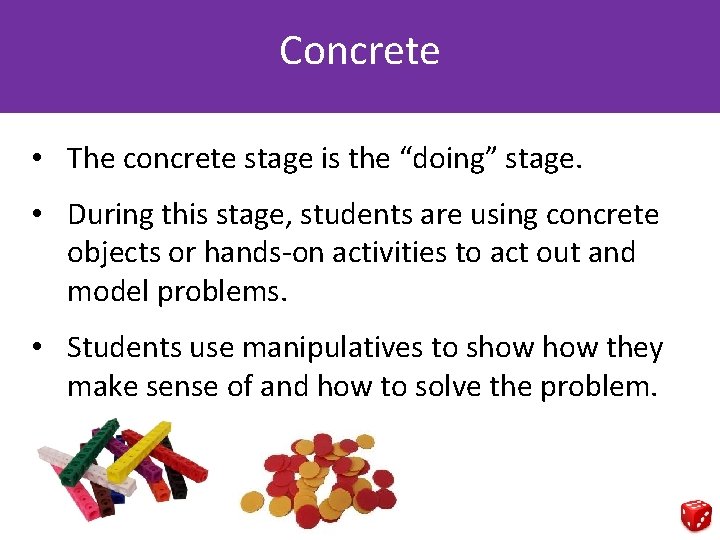
Concrete • The concrete stage is the “doing” stage. • During this stage, students are using concrete objects or hands-on activities to act out and model problems. • Students use manipulatives to show they make sense of and how to solve the problem.
Concrete • How do you use concrete experiences to introduce new concepts in your grade level? • What manipulatives will students choose to use to show their thinking?
C→ R → A • The representational stage is the “seeing” stage. ₋ Students need to understand how the representational or pictorial examples relate to the concrete examples • Representational. – Show the visual representation of the concrete – Help students visualize the mathematics operation
Representational When should we plan for students to use the representational stage? – As students begin to master concrete work – As a way of recording concrete work – When students have learned the concept at an earlier point and you are looking to reactivate that concrete knowledge – When students are struggling with the abstract
Representational • What are some examples of representations that are used at your grade level? • How do you connect these representations to students’ concrete experiences?
Abstract • Abstract. – The abstract stage is the “symbolic” stage. – Show symbols provide a shorter, efficient way to represent numerical operations • During this stage, students move to using abstract symbols to model problems. • Students need to understand how the abstract symbols relate to both the concrete and representational examples.
Abstract • What are some examples of abstract concepts that are used at your grade level? • How do you connect these abstract concepts to students’ concrete or representational experiences?
C→ R → A • Concrete and pictorial representations should be used at all grade levels. • By using cognitive strategies such as CRA, teachers provide students a technique for tackling mathematics problems rather than just searching for an answer.
- Slides: 15