
Concrete Representational Abstract Instructional Model Shelly Miedona Elementary
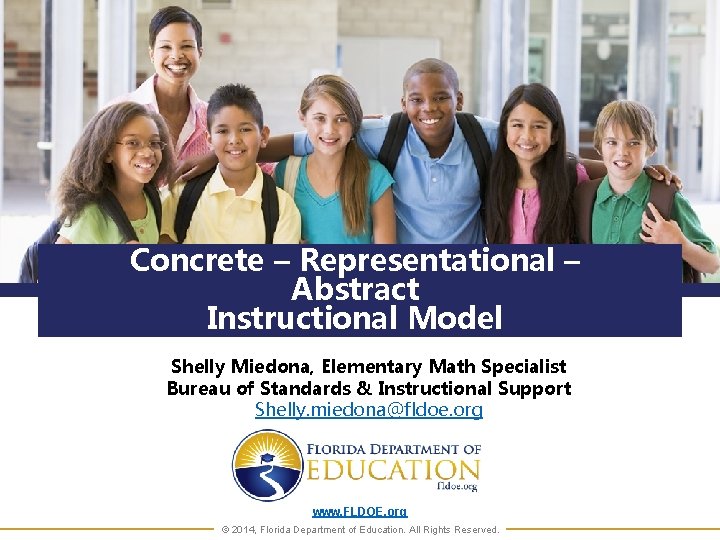
Concrete – Representational – Abstract Instructional Model Shelly Miedona, Elementary Math Specialist Bureau of Standards & Instructional Support Shelly. miedona@fldoe. org www. FLDOE. org © 2014, Florida Department of Education. All Rights Reserved.
Research Behind the Theory http: //padlet. com/shellytimesthree /CRAInstructional. Model www. FLDOE. org © 2014, Florida Department of Education. All Rights Reserved.
Jerome Bruner 3 Stages of Intellectual Development 1. Enactive üLearning through actions on physical objects 2. Iconic üUsing models and pictures 3. Symbolic üThink abstractly “Leads to more effective learning. ” (Bruner 1976) http: //www. lifecirclesinc. com/Learningtheories/constructivism/bruner. html www. FLDOE. org © 2014, Florida Department of Education. All Rights Reserved.
Jerome Bruner The Culture of Education (1996) Bruner reminds us that, “Education cannot be reduced to mere information processing, sorting knowledge into categories. It’s objective is to help learners construct meanings, not simply to manage information. ” www. FLDOE. org © 2014, Florida Department of Education. All Rights Reserved.
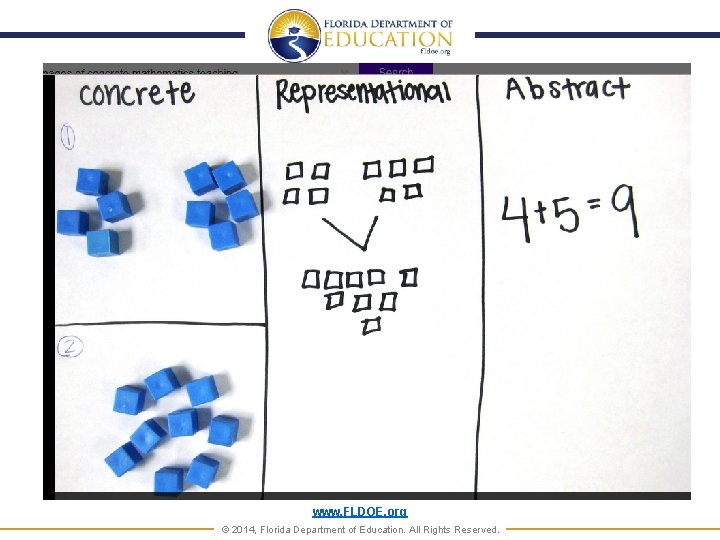
What is CRA? • Research based math intervention – 3 Levels: 1. Concrete üConcrete materials 2. Representational/Pictorial ü 2 dimensional written/pictorial representation 3. Abstract üsymbols ünumbers üAlgorithms http: //www. lifecircles-inc. com/Learningtheories/constructivism/bruner. html http: //www. ldworldwide. org/educators/strategies-for-successful-learning/1096 -deepeningmathematics-teaching-and-learning-through-the-concrete-pictorial-abstract-approach www. FLDOE. org © 2014, Florida Department of Education. All Rights Reserved.
Significance of the 3 -level progression: • Graduated, conceptually supported framework • Creates meaningful connections • Ensures thorough understanding of math concepts/skills www. FLDOE. org © 2014, Florida Department of Education. All Rights Reserved.
Level 1: CONCRETE Tangible, Hands–On Tools • Connecting cubes • Square tiles • Two colored circles • Base 10 blocks • Measuring tools • Coins • Buttons • Pattern blocks • Anything a student can touch and manipulate www. FLDOE. org © 2014, Florida Department of Education. All Rights Reserved.
CONCRETE EXAMPLES www. FLDOE. org © 2014, Florida Department of Education. All Rights Reserved.
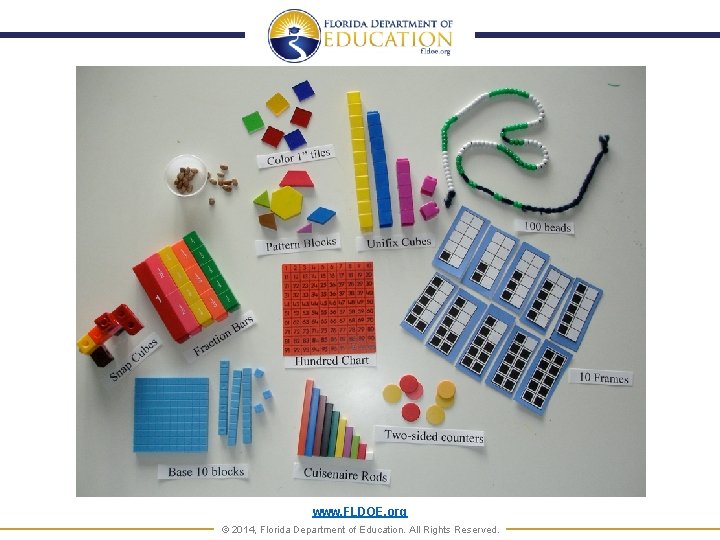
www. FLDOE. org © 2014, Florida Department of Education. All Rights Reserved.
Level 2: REPRESENTATIONAL/PICTORIAL • Drawings • Dots • Circles • Tally marks • Pictures to represent objects used www. FLDOE. org © 2014, Florida Department of Education. All Rights Reserved.
REPRESENTATIONAL EXAMPLES www. FLDOE. org © 2014, Florida Department of Education. All Rights Reserved.
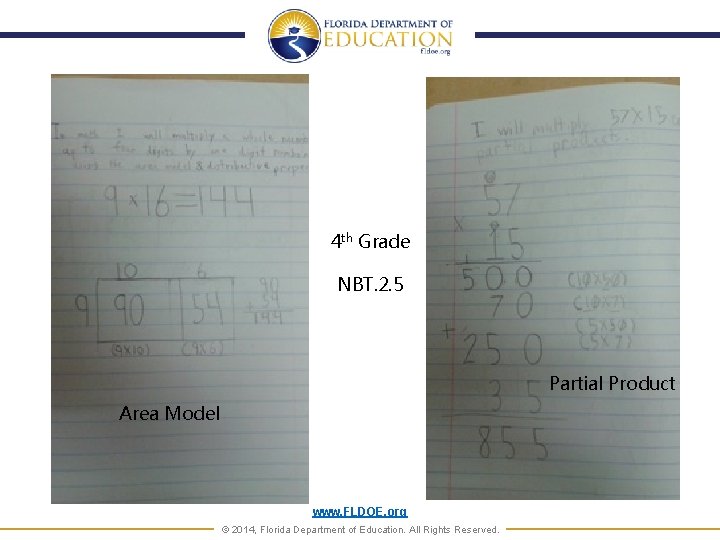
4 th Grade NBT. 2. 5 Partial Product Area Model www. FLDOE. org © 2014, Florida Department of Education. All Rights Reserved.
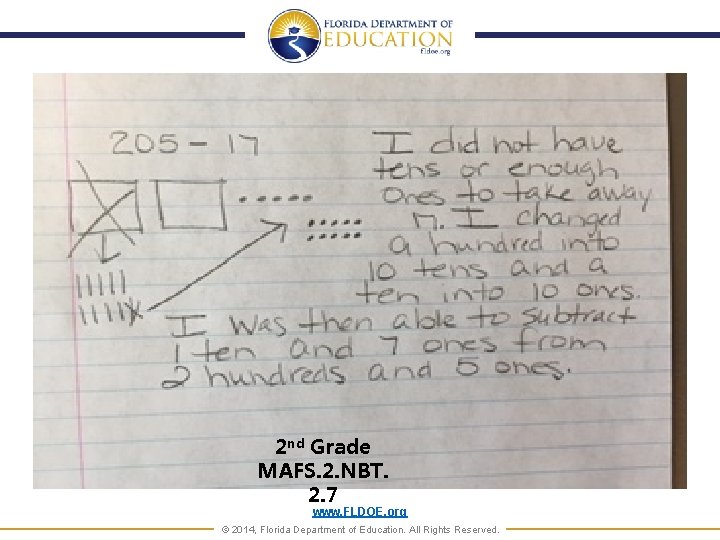
2 nd Grade MAFS. 2. NBT. 2. 7 www. FLDOE. org © 2014, Florida Department of Education. All Rights Reserved.
Level 3: ABSTRACT • Numbers • Letters • Symbols • Equations • Algorithms www. FLDOE. org © 2014, Florida Department of Education. All Rights Reserved.
ABSTRACT EXAMPLES www. FLDOE. org © 2014, Florida Department of Education. All Rights Reserved.
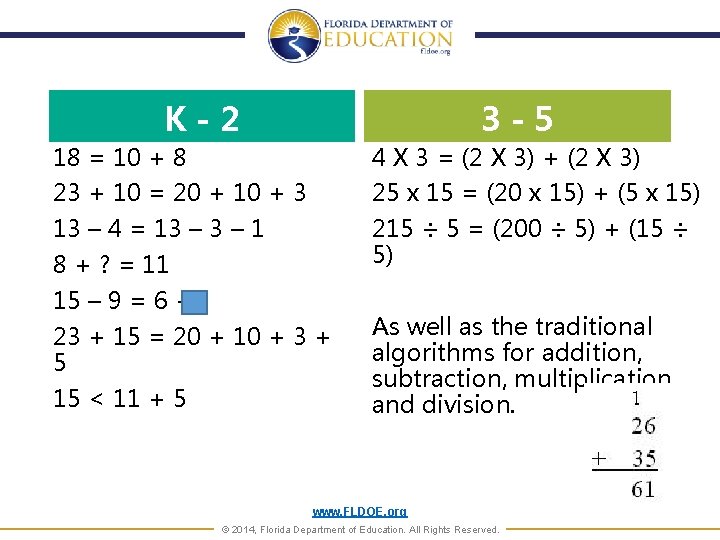
K-2 3 -5 18 = 10 + 8 23 + 10 = 20 + 10 + 3 13 – 4 = 13 – 1 8 + ? = 11 15 – 9 = 6 + 23 + 15 = 20 + 10 + 3 + 5 15 < 11 + 5 4 X 3 = (2 X 3) + (2 X 3) 25 x 15 = (20 x 15) + (5 x 15) 215 ÷ 5 = (200 ÷ 5) + (15 ÷ 5) As well as the traditional algorithms for addition, subtraction, multiplication and division. www. FLDOE. org © 2014, Florida Department of Education. All Rights Reserved.
Sequencing • It is important to follow the CRA sequence and not skip from concrete to abstract. Students need to proceed through all three levels to demonstrate understanding and mastery(University of Kansas). • It is important to spend sufficient time in each as well as side by side when students are ready to move on. üHave the concrete place value blocks on the desk as the students draw a picture of the concrete. üHave the students draw the representational problem of 25 + 49 then teach the “short cut” of the algorithm with regrouping. http: //www. specialconnections. ku. edu/? q=instruction/mathematics/teacher_tools/co www. FLDOE. org ncrete_to_representational_to_abstract_instruction © 2014, Florida Department of Education. All Rights Reserved.
www. FLDOE. org © 2014, Florida Department of Education. All Rights Reserved.
What does that mean for students? • Students learn a focused set of major math concepts and skills that progressively build to more challenging concepts • Students participate in real world, hands on, problem solving activities • Students develop a greater conceptual understanding of mathematical principles www. FLDOE. org © 2014, Florida Department of Education. All Rights Reserved.
Additional Reading Acker, J. V. (2014). Concrete/Representational(Pictorial)Abstract. Retrieved from Prezi: https: //prezi. com/1 rfj 4 g 22 dqua/concreterepresentationalpictorial-abstract/ American Institutes for Research. (2004). Doing What Works. Retrieved from Math Specialist: http: //www. mathspecialists. org/dww/Response_to_Intervention/Practice_ Intentional_Teaching/See/1923_it_mat_cra. pdf Bruner, J. (1996). The Culture of Education. MA: Harvard University Press. Joan Gujarati, E. (2013). Deepening Mathematics Teaching and Learning through the Concrete-Pictorial-Abstract Approach. Retrieved from Learning Disabilities Worldwide: http: //www. ldworldwide. org/educators/strategies-for- successfullearning/1096 -deepening-mathematics-teaching-and-learning-through-theconcrete-pictorial-abstract-approach Kansas, T. U. (n. d. ). Concrete-to-Representational-to-Abstract (C-R-A) Instruction. Retrieved from The University of Kansas: http: //www. specialconnections. ku. edu/? q=instruction/mathematics/teach er_tools/concrete_to_representational_to_abstract_instruction Sousa, D. A. (2008). How the brain learns mathematics. Thousand Oaks, CA: Corwin Press. www. FLDOE. org © 2014, Florida Department of Education. All Rights Reserved.
References Acker, J. V. (2014). Concrete/Representational(Pictorial)Abstract. Retrieved from Prezi: https: //prezi. com/1 rfj 4 g 22 dqua/concreterepresentationalpictorial-abstract/ American Institutes for Research. (2004). Doing What Works. Retrieved from Math Specialist: http: //www. mathspecialists. org/dww/Response_to_Intervention/Practice_ Intentional_Teaching/See/1923_it_mat_cra. pdf Balka, H. a. (n. d. ). What is Conceptual Understanding? Retrieved from Math Leadership: http: //www. mathleadership. com/sitebuildercontent/sitebuilderfiles/conceptual. Understandin g. pdf Ben-Hur, M. (2006). Concept-Rich Mathematics Instruction. Retrieved from ASCD: http: //www. ascd. org/publications/books/106008/chapters/Conceptual-Understanding. aspx Brickwedde, J. (2012). Developing Base Ten Understanding: Working with Tens, The Difference Between Numbers, Doubling, Tripling. . . , Splitting, Sharing and Scaling Up. Retrieved from Project for Elementary Mathematics: http: //www. uwosh. edu/coehs/cmagproject/concepts/documents/Developing_Base_Ten_Un d erstanding. pdf Bruner, J. (1996). The Culture of Education. Cambridge: Harvard University Press. CPALMS Where Educators Go For Bright Ideas. (2015). Retrieved from CPALMS: http: //www. cpalms. org/Public/ www. FLDOE. org © 2014, Florida Department of Education. All Rights Reserved.
References (continued) Florida Standards. (2015). Retrieved from Florida Department of Education: http: //fldoe. org/academics/standards/florida-standards Hanner, B. (n. d. ). Education. Retrieved from Pinterest: https: //www. pinterest. com/barbara_hanner/education/ Joan Gujarati, E. (2013). Deepening Mathematics Teaching and Learning through the Concrete-Pictorial. Abstract Approach. Retrieved from Learning Disabilities Worldwide: http: //www. ldworldwide. org/educators/strategies-for-successful-learning/1096 -deepeningmathematics-teaching-and-learning-through-the-concrete-pictorial-abstract-approach Press, H. U. (1995). Theories of Learning in Educational Psychology. Retrieved from Life Circles, Inc: http: //www. lifecircles-inc. com/Learningtheories/constructivism/bruner. html www. FLDOE. org © 2014, Florida Department of Education. All Rights Reserved.
Department of Education Updates www. FLDOE. org © 2014, Florida Department of Education. All Rights Reserved.
PAEMST Presidential Awards for Excellence in Mathematics & Science Teaching • Applications are due May 1 st • Reviewers will be assigned by May 9 th • Two rounds of reviews • Paid stipend to reviewers • Contact – Heidi. brennan@fldoe. org www. FLDOE. org © 2014, Florida Department of Education. All Rights Reserved.
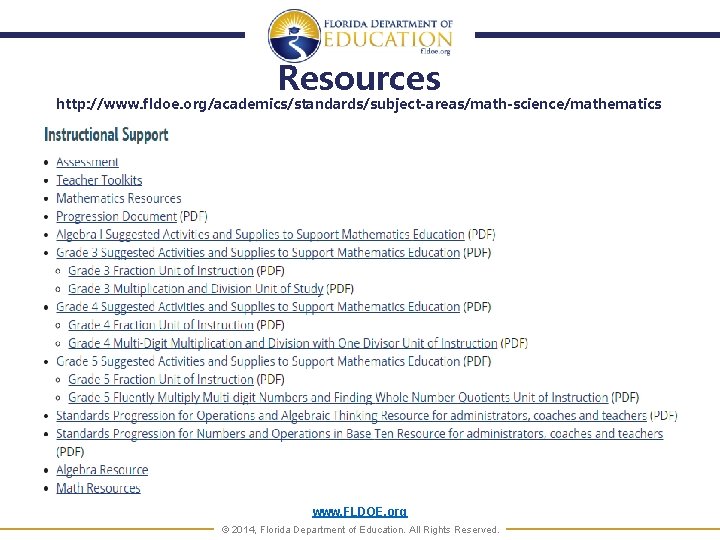
Resources http: //www. fldoe. org/academics/standards/subject-areas/math-science/mathematics www. FLDOE. org © 2014, Florida Department of Education. All Rights Reserved.
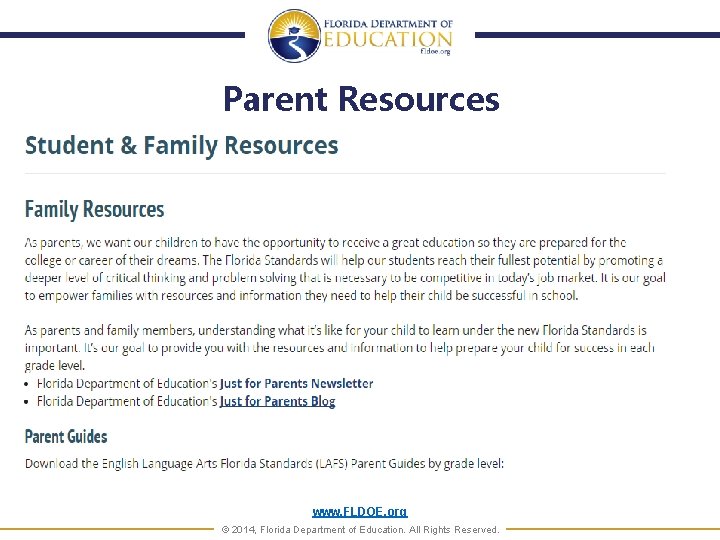
Parent Resources www. FLDOE. org © 2014, Florida Department of Education. All Rights Reserved.
Computer Science Standards • New Computer Science Standards for 16/17 school year • Public Review February 16 th • Districts may use these standards to submit K-12 courses • Certification to teach courses not yet finalized • Possibly a Math, Science and Computer Science Certification www. FLDOE. org © 2014, Florida Department of Education. All Rights Reserved.
Contact Information: Rashad Bennett 850 -245 -0830 Shelly Miedona 850 -245 -0660 Rashad. Bennett@fldoe. org Shelly. Miedona@fldoe. org Jonathan Keener 850 -245 -0808 Heidi Brennan 850 -245 -7805 Jonathan. Keener@fldoe. or g Heidi. Brennan@fldoe. org www. FLDOE. org © 2014, Florida Department of Education. All Rights Reserved.

www. FLDOE. org © 2014, Florida Department of Education. All Rights Reserved.
- Slides: 29