
CONCRETE MIX DESIGN As per IS Code method


- Slides: 26
CONCRETE MIX DESIGN (As per IS Code method) IS 10262: 2019 G. M. AGATKAR Sr. Instructor/Works-4 (Only For Ordinary concrete mix) 1
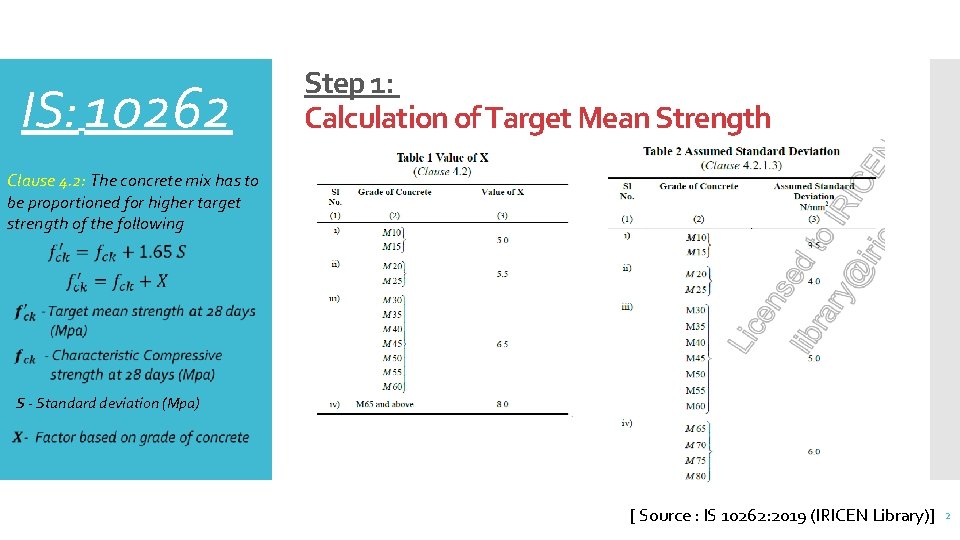
IS: 10262 Step 1: Calculation of Target Mean Strength Clause 4. 2: The concrete mix has to be proportioned for higher target strength of the following S - Standard deviation (Mpa) [ Source : IS 10262: 2019 (IRICEN Library)] 2
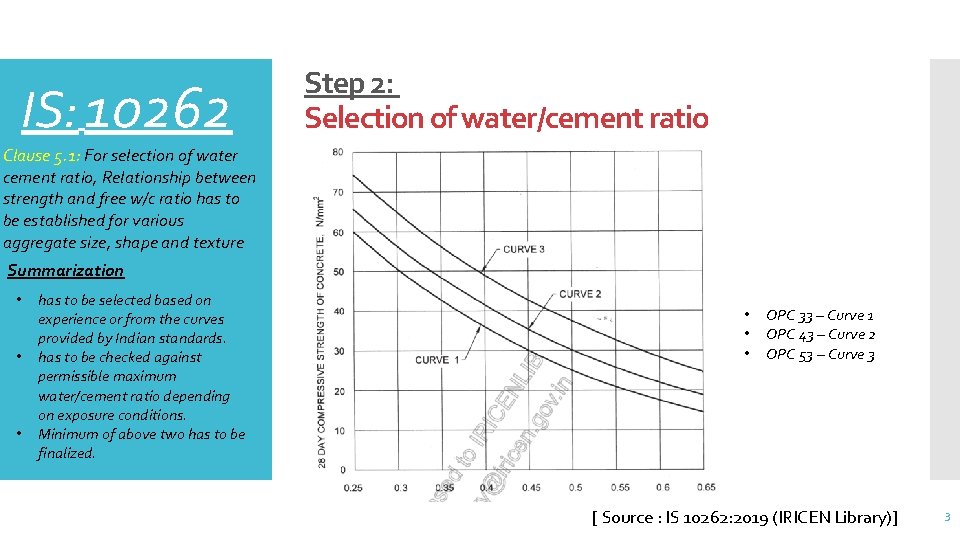
IS: 10262 Step 2: Selection of water/cement ratio Clause 5. 1: For selection of water cement ratio, Relationship between strength and free w/c ratio has to be established for various aggregate size, shape and texture Summarization • • • has to be selected based on experience or from the curves provided by Indian standards. has to be checked against permissible maximum water/cement ratio depending on exposure conditions. Minimum of above two has to be finalized. • • • OPC 33 – Curve 1 OPC 43 – Curve 2 OPC 53 – Curve 3 [ Source : IS 10262: 2019 (IRICEN Library)] 3
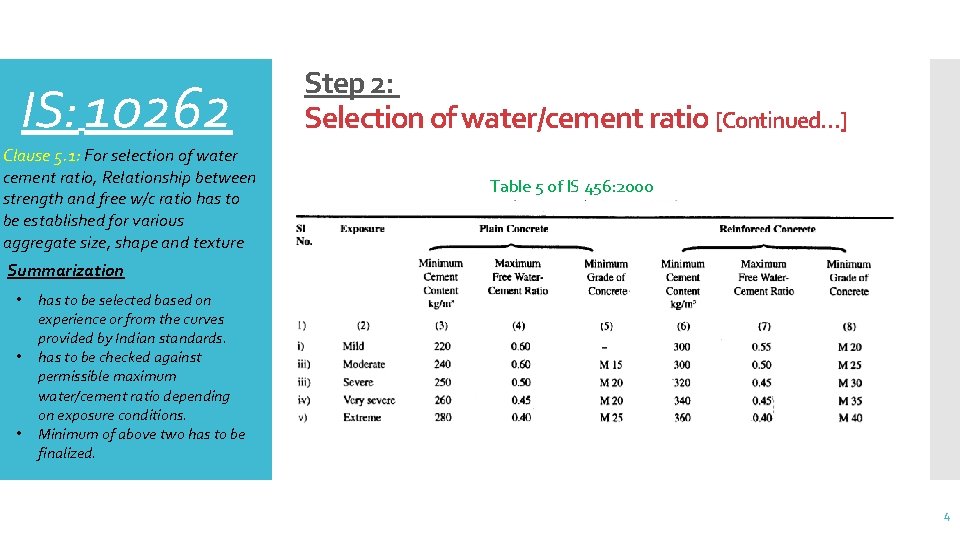
IS: 10262 Clause 5. 1: For selection of water cement ratio, Relationship between strength and free w/c ratio has to be established for various aggregate size, shape and texture Step 2: Selection of water/cement ratio [Continued…] Table 5 of IS 456: 2000 Summarization • • • has to be selected based on experience or from the curves provided by Indian standards. has to be checked against permissible maximum water/cement ratio depending on exposure conditions. Minimum of above two has to be finalized. 4
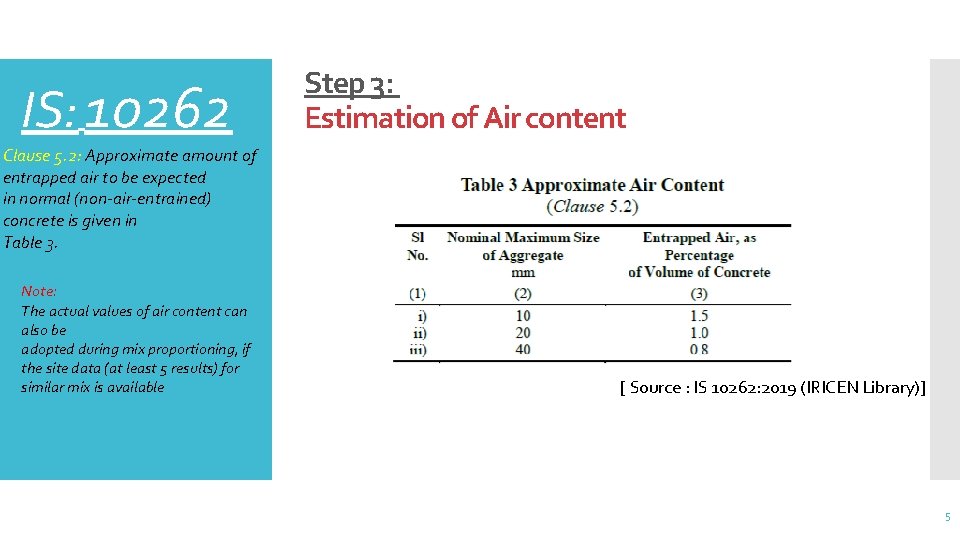
IS: 10262 Step 3: Estimation of Air content Clause 5. 2: Approximate amount of entrapped air to be expected in normal (non-air-entrained) concrete is given in Table 3. Note: The actual values of air content can also be adopted during mix proportioning, if the site data (at least 5 results) for similar mix is available [ Source : IS 10262: 2019 (IRICEN Library)] 5
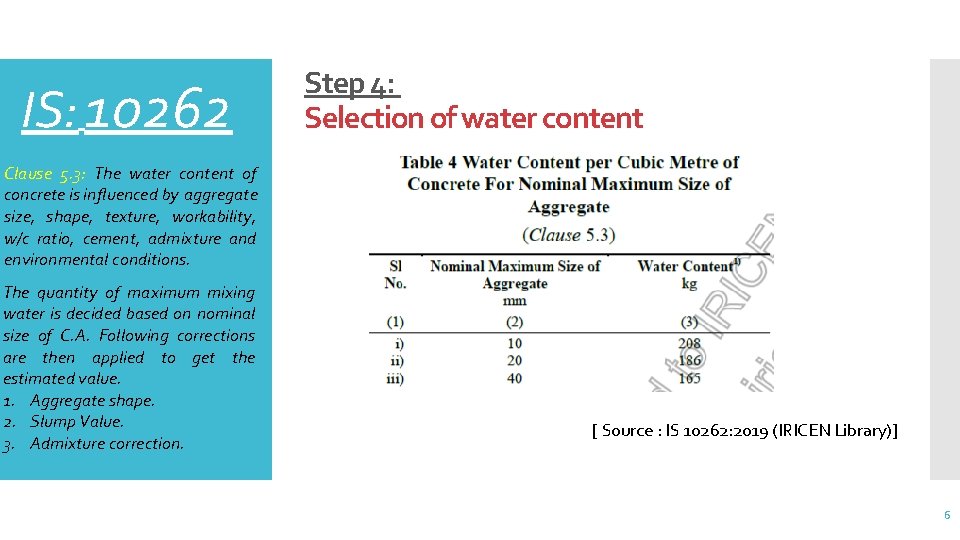
IS: 10262 Step 4: Selection of water content Clause 5. 3: The water content of concrete is influenced by aggregate size, shape, texture, workability, w/c ratio, cement, admixture and environmental conditions. The quantity of maximum mixing water is decided based on nominal size of C. A. Following corrections are then applied to get the estimated value. 1. Aggregate shape. 2. Slump Value. 3. Admixture correction. [ Source : IS 10262: 2019 (IRICEN Library)] 6
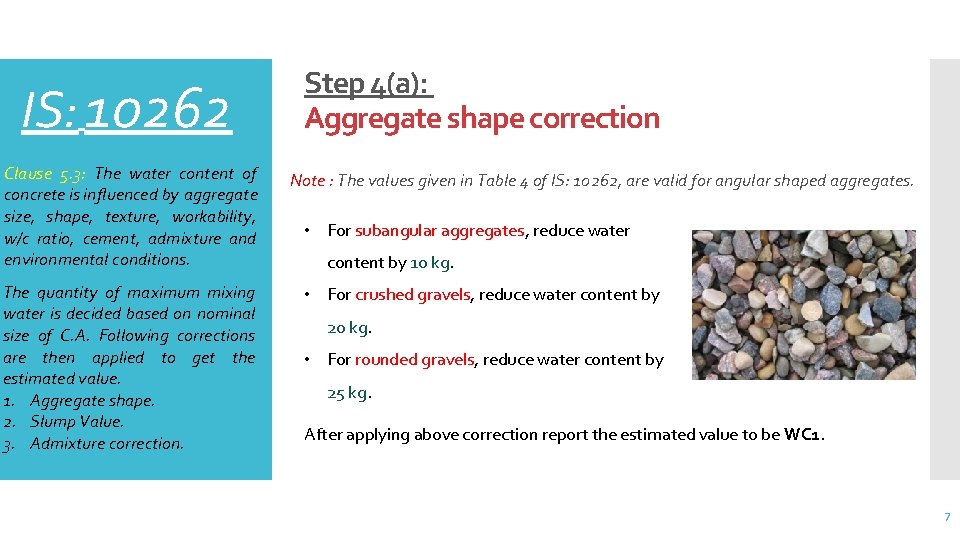
IS: 10262 Clause 5. 3: The water content of concrete is influenced by aggregate size, shape, texture, workability, w/c ratio, cement, admixture and environmental conditions. The quantity of maximum mixing water is decided based on nominal size of C. A. Following corrections are then applied to get the estimated value. 1. Aggregate shape. 2. Slump Value. 3. Admixture correction. Step 4(a): Aggregate shape correction Note : The values given in Table 4 of IS: 10262, are valid for angular shaped aggregates. • For subangular aggregates, reduce water content by 10 kg. • For crushed gravels, reduce water content by 20 kg. • For rounded gravels, reduce water content by 25 kg. After applying above correction report the estimated value to be WC 1. 7
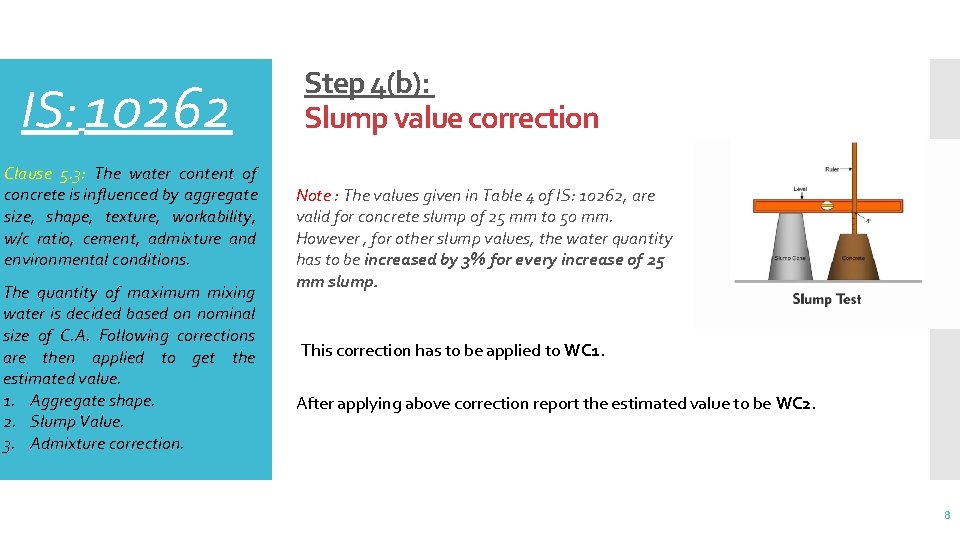
IS: 10262 Clause 5. 3: The water content of concrete is influenced by aggregate size, shape, texture, workability, w/c ratio, cement, admixture and environmental conditions. The quantity of maximum mixing water is decided based on nominal size of C. A. Following corrections are then applied to get the estimated value. 1. Aggregate shape. 2. Slump Value. 3. Admixture correction. Step 4(b): Slump value correction Note : The values given in Table 4 of IS: 10262, are valid for concrete slump of 25 mm to 50 mm. However , for other slump values, the water quantity has to be increased by 3% for every increase of 25 mm slump. This correction has to be applied to WC 1. After applying above correction report the estimated value to be WC 2. 8
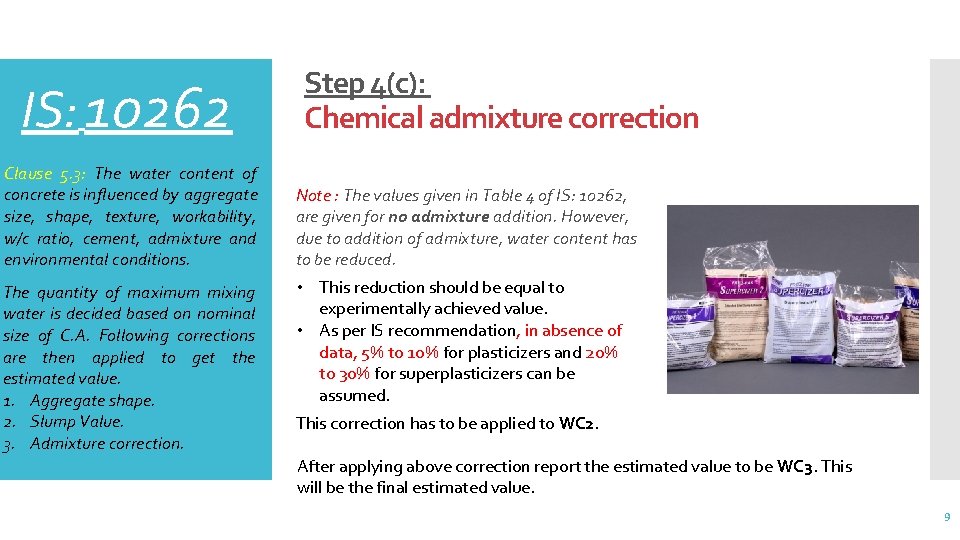
IS: 10262 Clause 5. 3: The water content of concrete is influenced by aggregate size, shape, texture, workability, w/c ratio, cement, admixture and environmental conditions. The quantity of maximum mixing water is decided based on nominal size of C. A. Following corrections are then applied to get the estimated value. 1. Aggregate shape. 2. Slump Value. 3. Admixture correction. Step 4(c): Chemical admixture correction Note : The values given in Table 4 of IS: 10262, are given for no admixture addition. However, due to addition of admixture, water content has to be reduced. • This reduction should be equal to experimentally achieved value. • As per IS recommendation, in absence of data, 5% to 10% for plasticizers and 20% to 30% for superplasticizers can be assumed. This correction has to be applied to WC 2. After applying above correction report the estimated value to be WC 3. This will be the final estimated value. 9
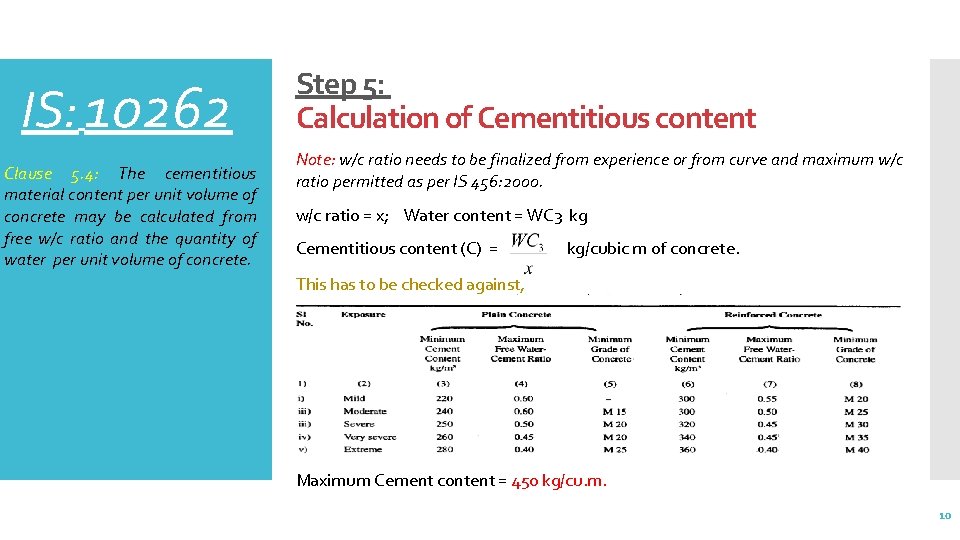
IS: 10262 Clause 5. 4: The cementitious material content per unit volume of concrete may be calculated from free w/c ratio and the quantity of water per unit volume of concrete. Step 5: Calculation of Cementitious content Note: w/c ratio needs to be finalized from experience or from curve and maximum w/c ratio permitted as per IS 456: 2000. w/c ratio = x; Water content = WC 3 kg Cementitious content (C) = kg/cubic m of concrete. This has to be checked against, Maximum Cement content = 450 kg/cu. m. 10
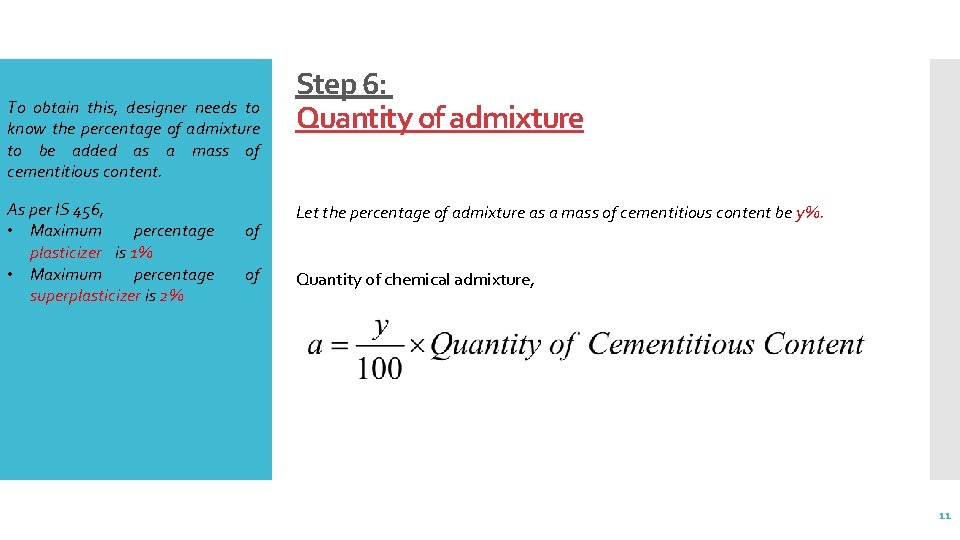
To obtain this, designer needs to know the percentage of admixture to be added as a mass of cementitious content. As per IS 456, • Maximum percentage plasticizer is 1% • Maximum percentage superplasticizer is 2% of of Step 6: Quantity of admixture Let the percentage of admixture as a mass of cementitious content be y%. Quantity of chemical admixture, 11
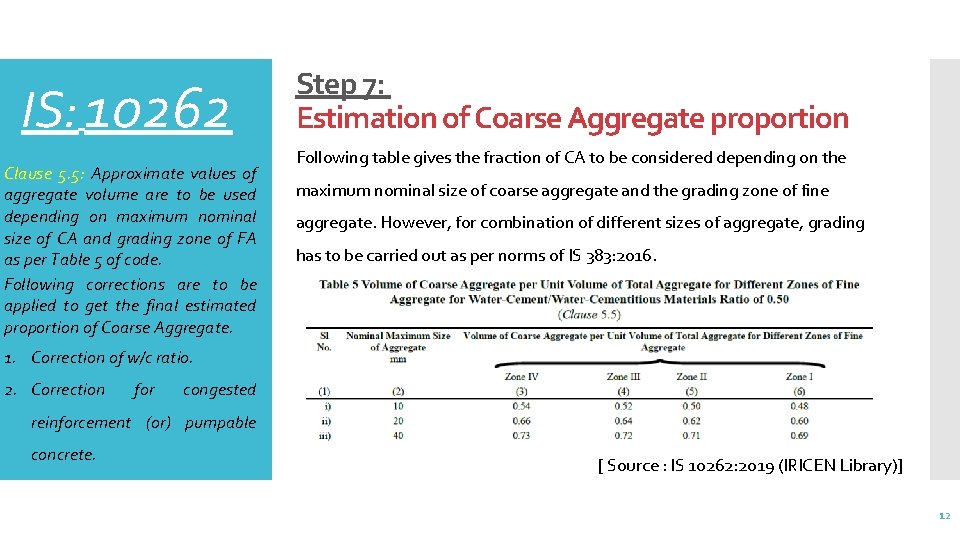
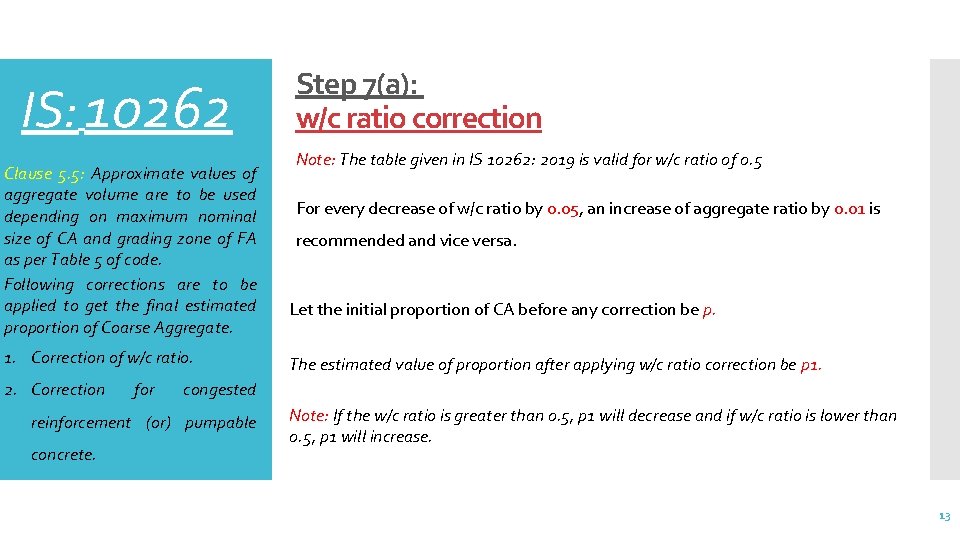
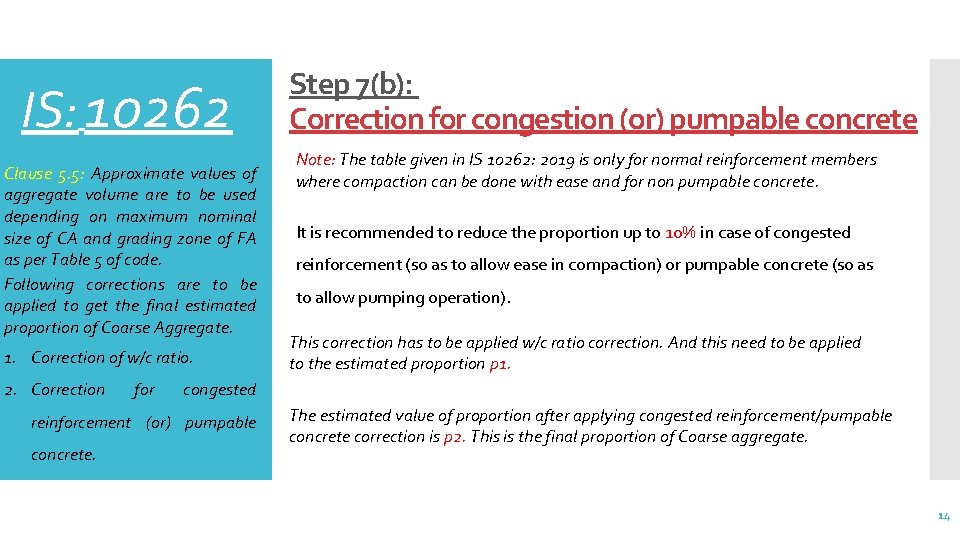
IS: 10262 Clause 5. 5: Approximate values of aggregate volume are to be used depending on maximum nominal size of CA and grading zone of FA as per Table 5 of code. Following corrections are to be applied to get the final estimated proportion of Coarse Aggregate. Step 7: Estimation of Coarse Aggregate proportion Following table gives the fraction of CA to be considered depending on the maximum nominal size of coarse aggregate and the grading zone of fine aggregate. However, for combination of different sizes of aggregate, grading has to be carried out as per norms of IS 383: 2016. 1. Correction of w/c ratio. 2. Correction for congested reinforcement (or) pumpable concrete. [ Source : IS 10262: 2019 (IRICEN Library)] 12
IS: 10262 Clause 5. 5: Approximate values of aggregate volume are to be used depending on maximum nominal size of CA and grading zone of FA as per Table 5 of code. Following corrections are to be applied to get the final estimated proportion of Coarse Aggregate. 1. Correction of w/c ratio. 2. Correction for Note: The table given in IS 10262: 2019 is valid for w/c ratio 0 f 0. 5 For every decrease of w/c ratio by 0. 05, an increase of aggregate ratio by 0. 01 is recommended and vice versa. Let the initial proportion of CA before any correction be p. The estimated value of proportion after applying w/c ratio correction be p 1. congested reinforcement (or) pumpable concrete. Step 7(a): w/c ratio correction Note: If the w/c ratio is greater than 0. 5, p 1 will decrease and if w/c ratio is lower than 0. 5, p 1 will increase. 13
IS: 10262 Clause 5. 5: Approximate values of aggregate volume are to be used depending on maximum nominal size of CA and grading zone of FA as per Table 5 of code. Following corrections are to be applied to get the final estimated proportion of Coarse Aggregate. 1. Correction of w/c ratio. 2. Correction for Note: The table given in IS 10262: 2019 is only for normal reinforcement members where compaction can be done with ease and for non pumpable concrete. It is recommended to reduce the proportion up to 10% in case of congested reinforcement (so as to allow ease in compaction) or pumpable concrete (so as to allow pumping operation). This correction has to be applied w/c ratio correction. And this need to be applied to the estimated proportion p 1. congested reinforcement (or) pumpable concrete. Step 7(b): Correction for congestion (or) pumpable concrete The estimated value of proportion after applying congested reinforcement/pumpable concrete correction is p 2. This is the final proportion of Coarse aggregate. 14
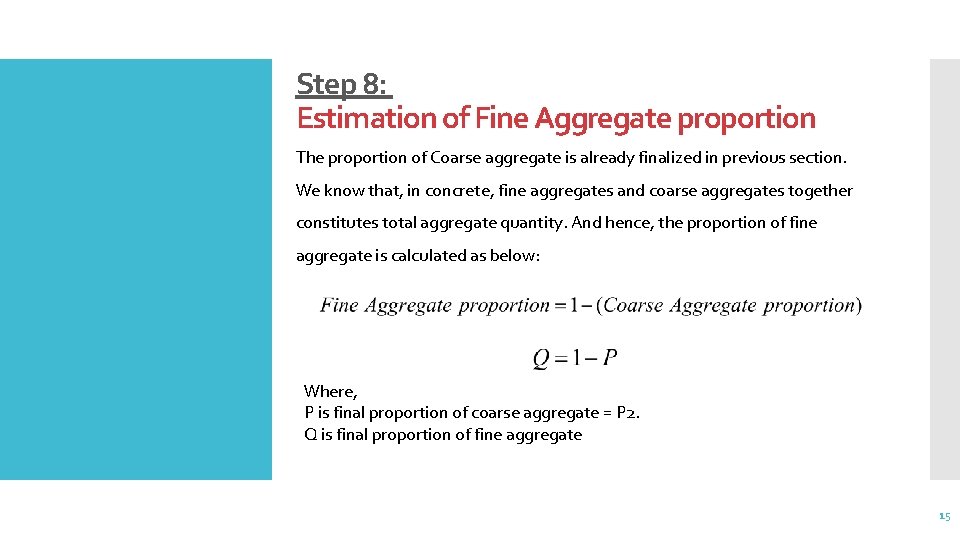
Step 8: Estimation of Fine Aggregate proportion The proportion of Coarse aggregate is already finalized in previous section. We know that, in concrete, fine aggregates and coarse aggregates together constitutes total aggregate quantity. And hence, the proportion of fine aggregate is calculated as below: Where, P is final proportion of coarse aggregate = P 2. Q is final proportion of fine aggregate 15
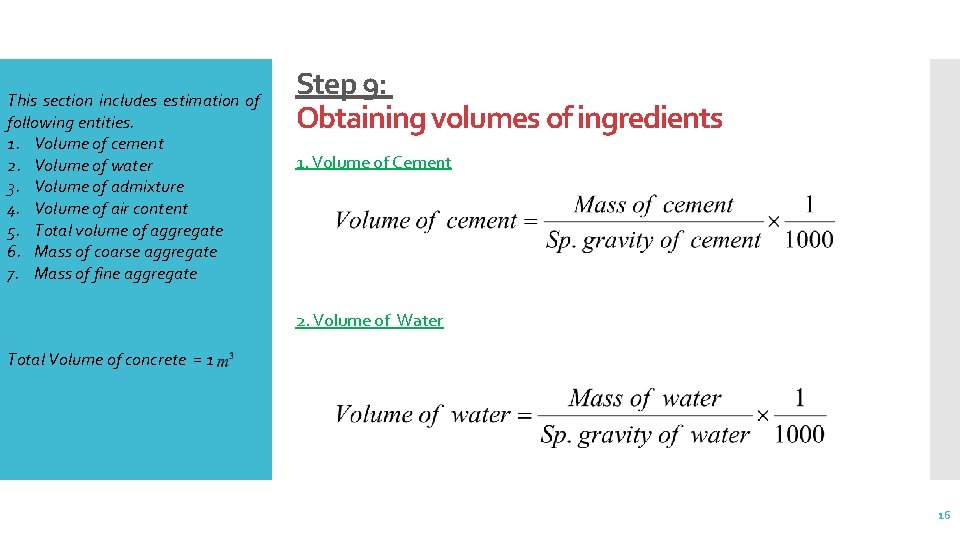
This section includes estimation of following entities. 1. Volume of cement 2. Volume of water 3. Volume of admixture 4. Volume of air content 5. Total volume of aggregate 6. Mass of coarse aggregate 7. Mass of fine aggregate Step 9: Obtaining volumes of ingredients 1. Volume of Cement 2. Volume of Water Total Volume of concrete = 1 16
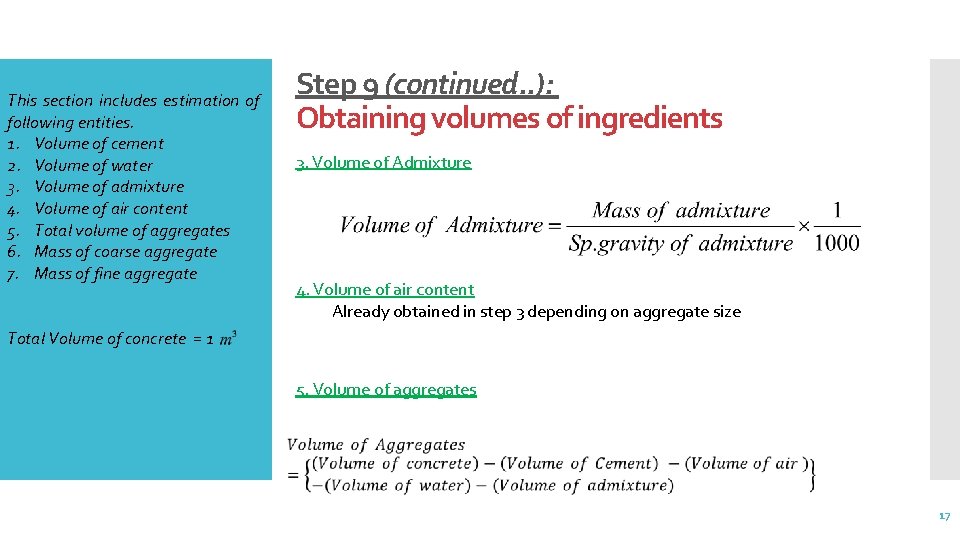
This section includes estimation of following entities. 1. Volume of cement 2. Volume of water 3. Volume of admixture 4. Volume of air content 5. Total volume of aggregates 6. Mass of coarse aggregate 7. Mass of fine aggregate Step 9 (continued. . ): Obtaining volumes of ingredients 3. Volume of Admixture 4. Volume of air content Already obtained in step 3 depending on aggregate size Total Volume of concrete = 1 5. Volume of aggregates 17
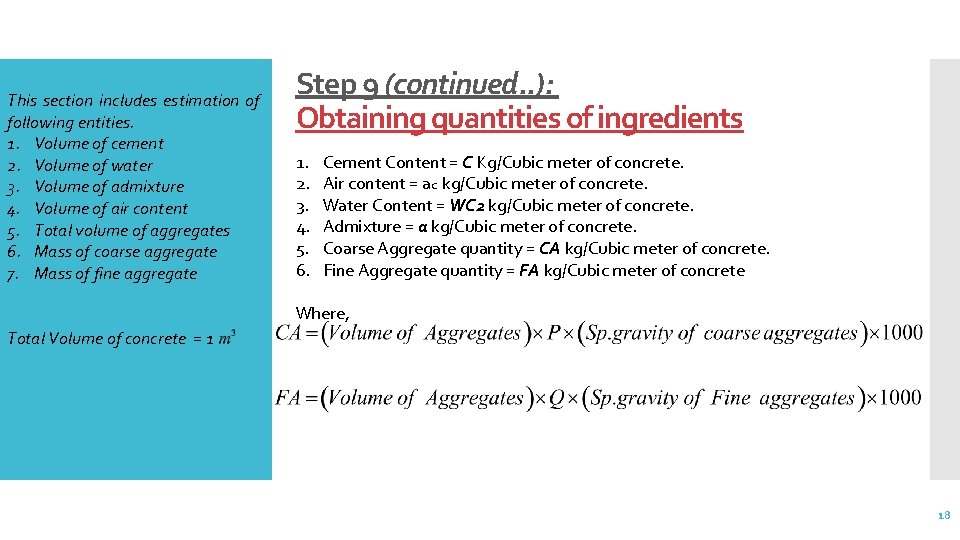
This section includes estimation of following entities. 1. Volume of cement 2. Volume of water 3. Volume of admixture 4. Volume of air content 5. Total volume of aggregates 6. Mass of coarse aggregate 7. Mass of fine aggregate Step 9 (continued. . ): Obtaining quantities of ingredients 1. 2. 3. 4. 5. 6. Cement Content = C Kg/Cubic meter of concrete. Air content = ac kg/Cubic meter of concrete. Water Content = WC 2 kg/Cubic meter of concrete. Admixture = a kg/Cubic meter of concrete. Coarse Aggregate quantity = CA kg/Cubic meter of concrete. Fine Aggregate quantity = FA kg/Cubic meter of concrete Where, Total Volume of concrete = 1 18
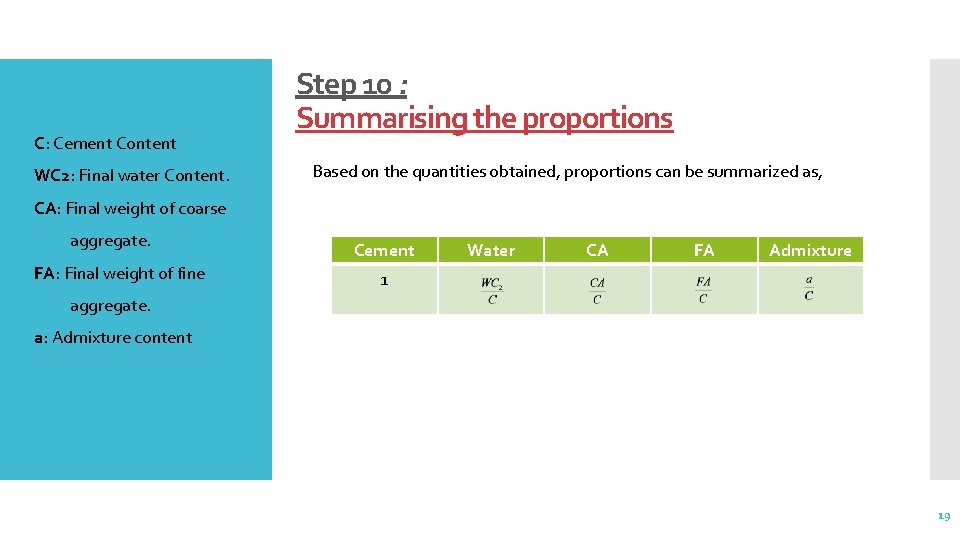
C: Cement Content WC 2: Final water Content. Step 10 : Summarising the proportions Based on the quantities obtained, proportions can be summarized as, CA: Final weight of coarse aggregate. FA: Final weight of fine Cement Water CA FA Admixture 1 aggregate. a: Admixture content 19
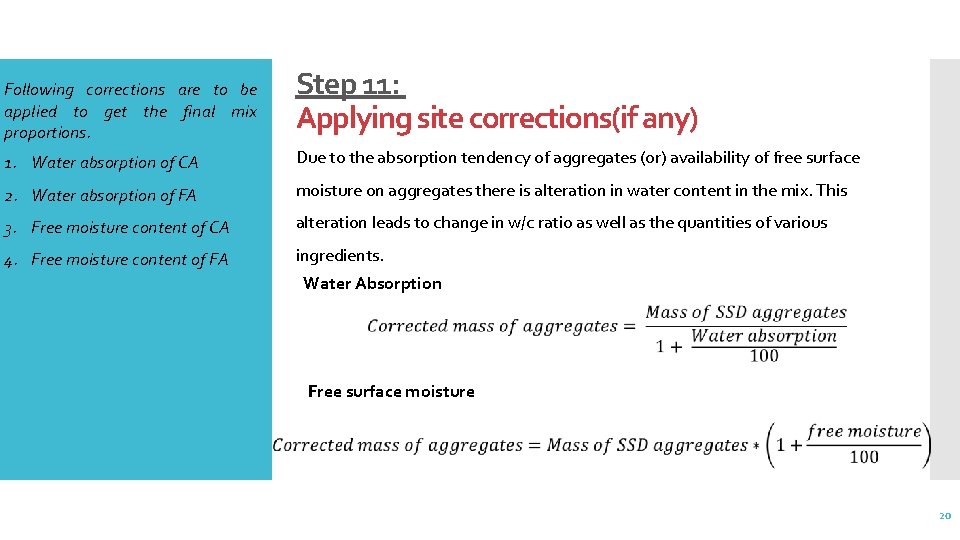
Following corrections are to be applied to get the final mix proportions. Step 11: Applying site corrections(if any) 1. Water absorption of CA Due to the absorption tendency of aggregates (or) availability of free surface 2. Water absorption of FA moisture on aggregates there is alteration in water content in the mix. This 3. Free moisture content of CA alteration leads to change in w/c ratio as well as the quantities of various 4. Free moisture content of FA ingredients. Water Absorption Free surface moisture 20
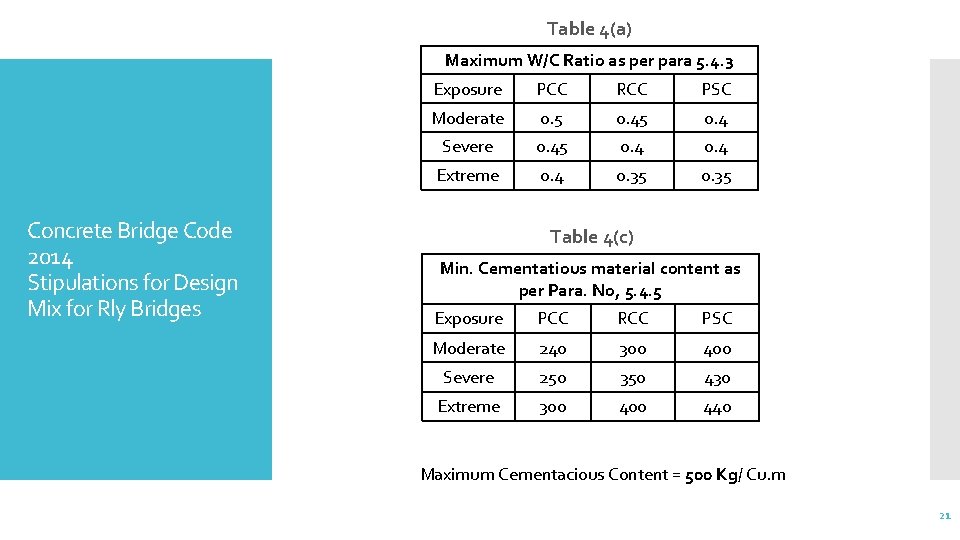
Table 4(a) Maximum W/C Ratio as per para 5. 4. 3 Concrete Bridge Code 2014 Stipulations for Design Mix for Rly Bridges Exposure PCC RCC PSC Moderate 0. 5 0. 4 Severe 0. 45 0. 4 Extreme 0. 4 0. 35 Table 4(c) Min. Cementatious material content as per Para. No, 5. 4. 5 Exposure PCC RCC PSC Moderate 240 300 400 Severe 250 350 430 Extreme 300 440 Maximum Cementacious Content = 500 Kg/ Cu. m 21
ILLUSTRATIVE EXAPMPLE ON CONCRETE MIX PROPORTIONING (Annex A: IS 10262: 2019) 22
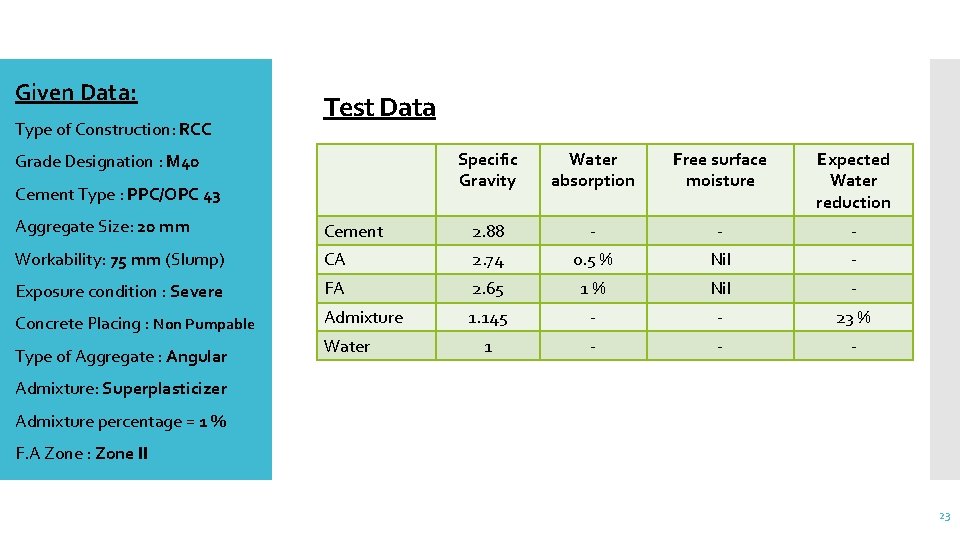
Given Data: Type of Construction: RCC Test Data Grade Designation : M 40 Cement Type : PPC/OPC 43 Specific Gravity Water absorption Free surface moisture Expected Water reduction Aggregate Size: 20 mm Cement 2. 88 - - - Workability: 75 mm (Slump) CA 2. 74 0. 5 % Nil - Exposure condition : Severe FA 2. 65 1% Nil - Concrete Placing : Non Pumpable Admixture 1. 145 - - 23 % 1 - - - Type of Aggregate : Angular Water Admixture: Superplasticizer Admixture percentage = 1 % F. A Zone : Zone II 23
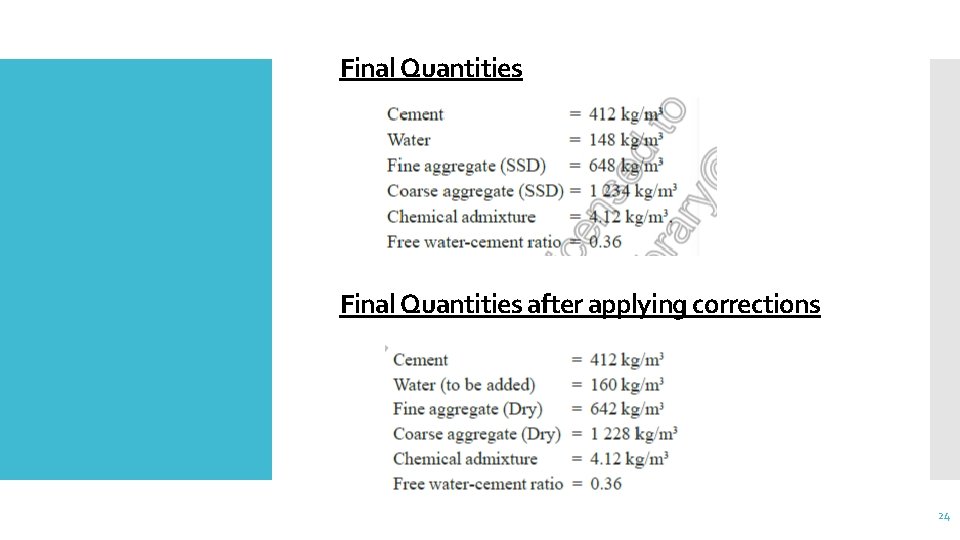
Final Quantities after applying corrections 24
To have more clear idea you can find similar presentation on https: //youtu. be/Gf 7 gt 2 A 5 PAE 25
Thank You!!! 26