
Concrete 25 40 cement absolute volume of cement

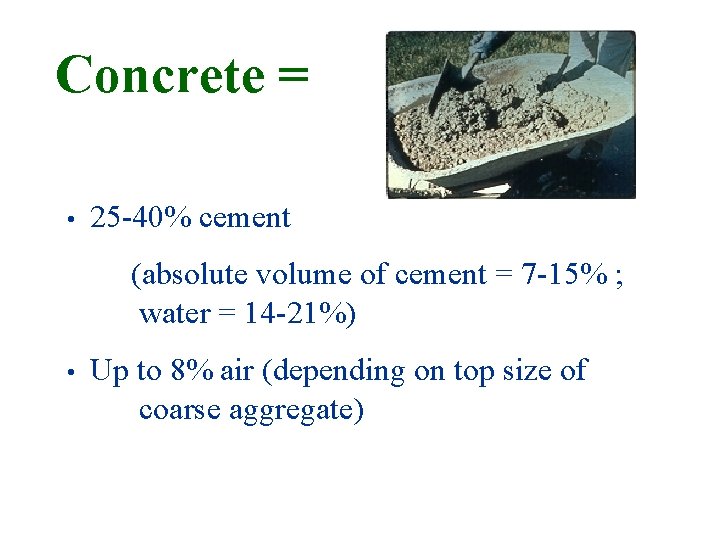
Concrete = • 25 -40% cement (absolute volume of cement = 7 -15% ; water = 14 -21%) • Up to 8% air (depending on top size of coarse aggregate)

Therefore: Aggregates make up 60 -75% of total volume of concrete.
What is an AGGREGATE?
ASTM defines agg • American Society for Testing Material • Inert material which when bound together into a conglomerated mass by a matrix forms concrete, mortar, plaster etc • In reality agg are not inert, but are chemically and physically active • Coarse agg : pass throgh 37 mm and retaied on 4. 8 mm • Fine agg : pass through 4. 8 mm and retaied in 100 mesh
Aggregate: the inert filler materials, such as sand or stone, used in making concrete
Physical Properties of Aggregates: 1. Unit Weight and Voids 2. Specific Gravity 3. Particle Shape and Surface Texture 4. Shrinkage of Aggregates 5. Absorption and Surface Moisture 6. Resistance to Freezing and Thawing
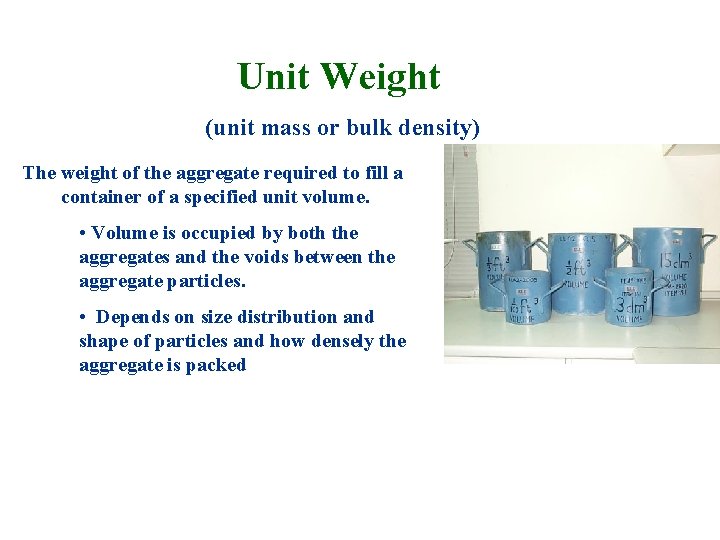
Unit Weight (unit mass or bulk density) The weight of the aggregate required to fill a container of a specified unit volume. • Volume is occupied by both the aggregates and the voids between the aggregate particles. • Depends on size distribution and shape of particles and how densely the aggregate is packed
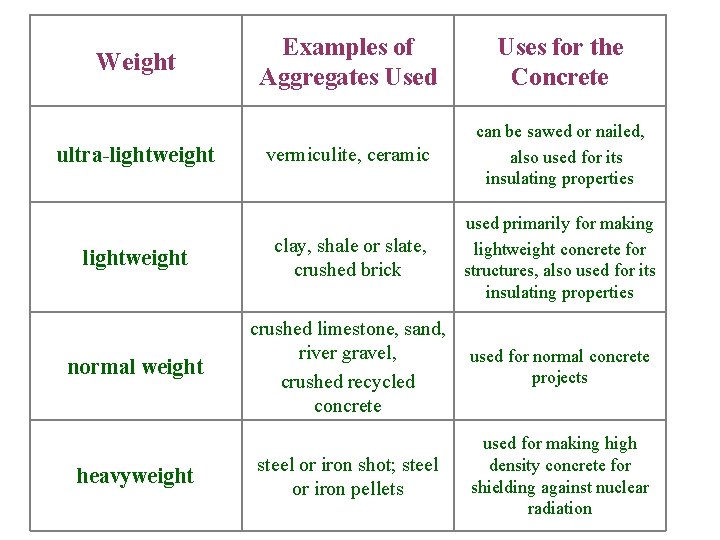
Examples of Aggregates Used Uses for the Concrete vermiculite, ceramic can be sawed or nailed, also used for its insulating properties lightweight clay, shale or slate, crushed brick used primarily for making lightweight concrete for structures, also used for its insulating properties normal weight crushed limestone, sand, river gravel, crushed recycled concrete used for normal concrete projects steel or iron shot; steel or iron pellets used for making high density concrete for shielding against nuclear radiation Weight ultra-lightweight heavyweight
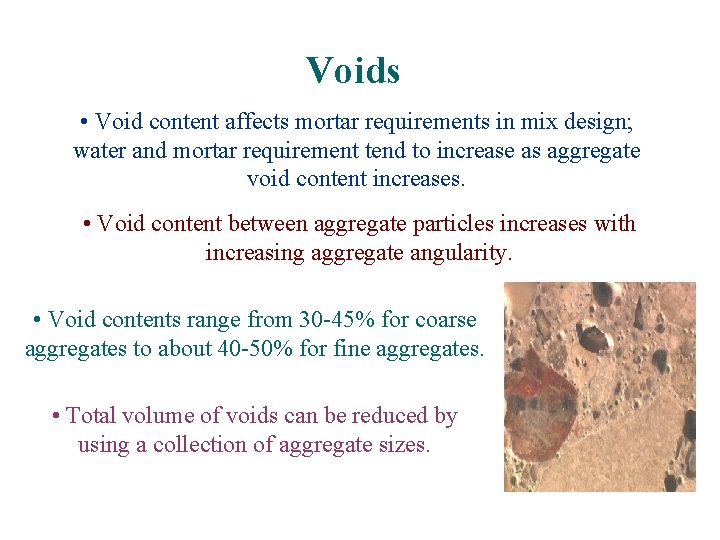
Voids • Void content affects mortar requirements in mix design; water and mortar requirement tend to increase as aggregate void content increases. • Void content between aggregate particles increases with increasing aggregate angularity. • Void contents range from 30 -45% for coarse aggregates to about 40 -50% for fine aggregates. • Total volume of voids can be reduced by using a collection of aggregate sizes.
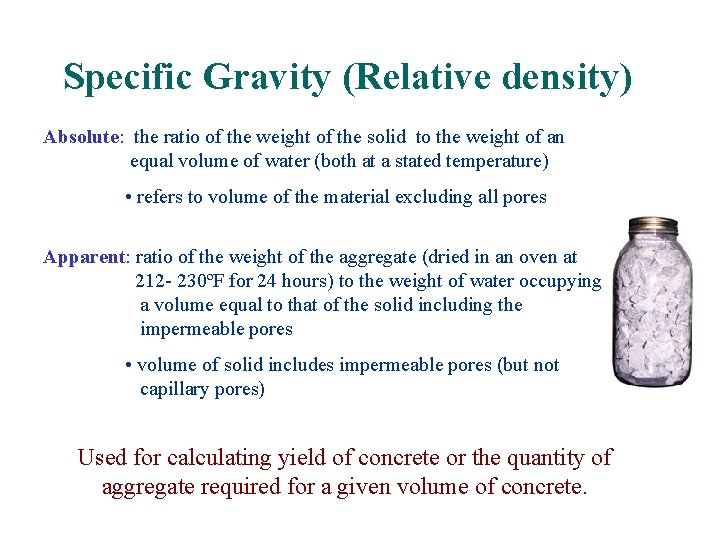
Specific Gravity (Relative density) Absolute: the ratio of the weight of the solid to the weight of an equal volume of water (both at a stated temperature) • refers to volume of the material excluding all pores Apparent: ratio of the weight of the aggregate (dried in an oven at 212 - 230ºF for 24 hours) to the weight of water occupying a volume equal to that of the solid including the impermeable pores • volume of solid includes impermeable pores (but not capillary pores) Used for calculating yield of concrete or the quantity of aggregate required for a given volume of concrete.
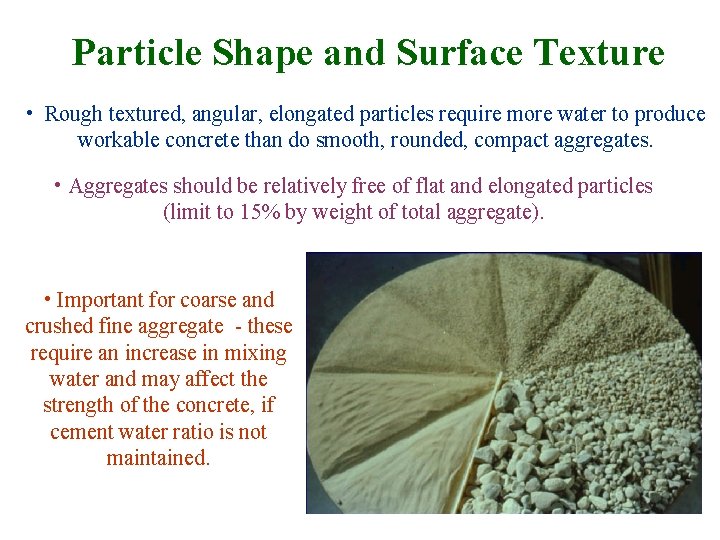
Particle Shape and Surface Texture • Rough textured, angular, elongated particles require more water to produce workable concrete than do smooth, rounded, compact aggregates. • Aggregates should be relatively free of flat and elongated particles (limit to 15% by weight of total aggregate). • Important for coarse and crushed fine aggregate - these require an increase in mixing water and may affect the strength of the concrete, if cement water ratio is not maintained.
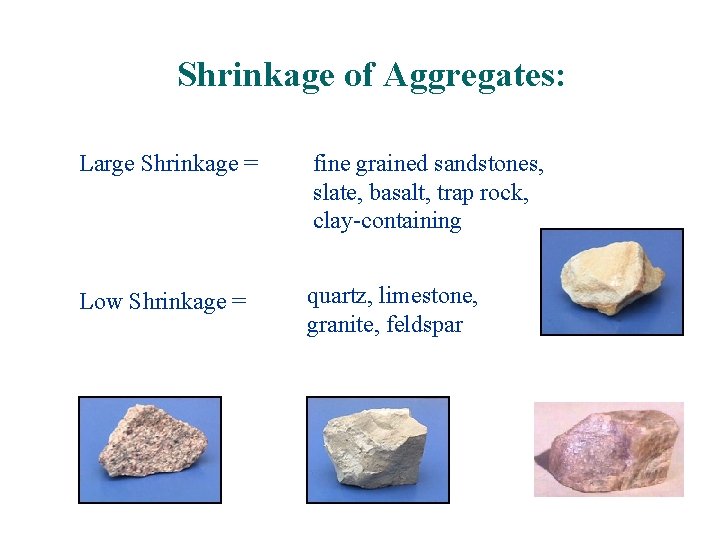
Shrinkage of Aggregates: Large Shrinkage = fine grained sandstones, slate, basalt, trap rock, clay-containing Low Shrinkage = quartz, limestone, granite, feldspar
What happens if abnormal aggregate shrinkage occurs?
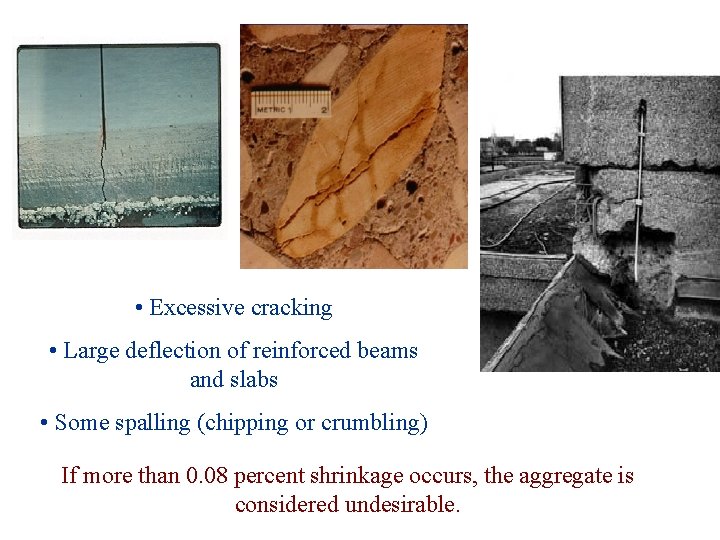
• Excessive cracking • Large deflection of reinforced beams and slabs • Some spalling (chipping or crumbling) If more than 0. 08 percent shrinkage occurs, the aggregate is considered undesirable.
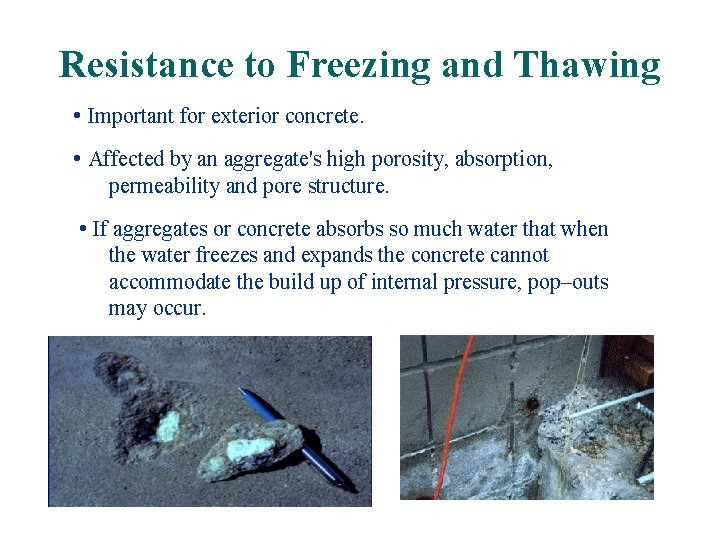
Resistance to Freezing and Thawing • Important for exterior concrete. • Affected by an aggregate's high porosity, absorption, permeability and pore structure. • If aggregates or concrete absorbs so much water that when the water freezes and expands the concrete cannot accommodate the build up of internal pressure, pop–outs may occur.
Size and gradation of agg • Natural material, if poorly graded, has to be processed (washed and screened) and all over-size and under-size particles rejected • If certain sizes are lacking, but necessary, the agg should be blended • Blending = the process of improving the poor grading of a sand material by adding to it the missing grade size
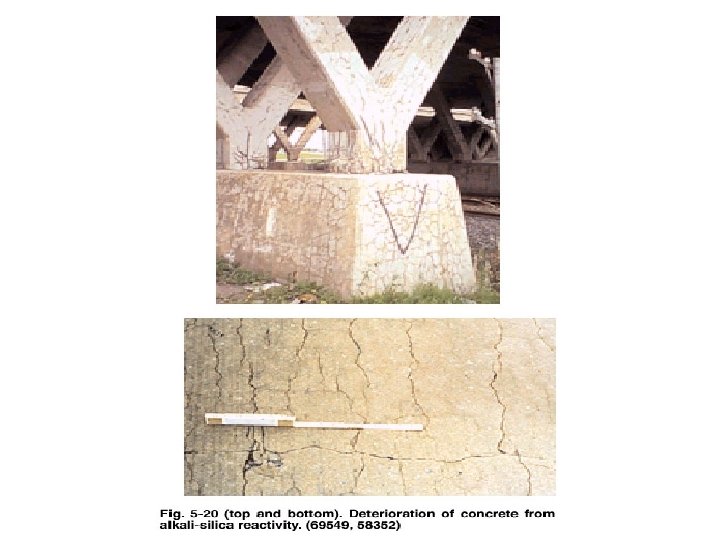
Alkali-Aggregate Reactivity Certain constituents in aggregates can react harmfully with alkali hydroxides in concrete and cause significant expansion. There are two forms of this reaction: – Alkali silica reaction (ASR) – Alkali-carbonate reaction (ACR) Alkali silica reaction (ASR) – Develops by aggregates containing reactive silica minerals. This form is more serious and common than ACR.
ASR • ASR has been recognized as a potential source of distress in concrete since the late 1930 s
![Alkali carbonate reaction (ACR) – The aggregates [dolomitic (calcium-magnesium carbonate)] have specific composition that](http://slidetodoc.com/presentation_image_h2/08b697d5f5d6824bfff54caec7a21616/image-20.jpg "Alkali carbonate reaction (ACR) – The aggregates [dolomitic (calcium-magnesium carbonate)] have specific composition that")
Alkali carbonate reaction (ACR) – The aggregates [dolomitic (calcium-magnesium carbonate)] have specific composition that is not very common.
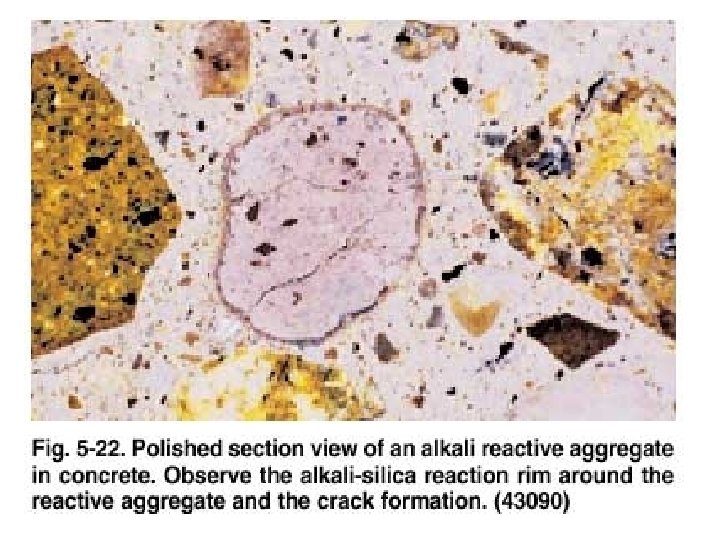
Alkali silica reaction (ASR) Mechanism • The reaction can be visualized as a two-step process: – Alkali hydroxide + reactive silica gel → alkalisilica gel – Alkali-silica gel + moisture → expansion
Alkali silica reaction (ASR) The amount of gel formed in the concrete depends on – Amount of and type of silica in aggregate. – Alkali hydroxide concentration. – Sufficient moisture.
Alkali silica reaction (ASR) • The ASR forms a gel that swells as it draws water from the surrounding cement paste (has great affinity to moisture). In absorbing water, these gels can induce pressure, expansion, and cracking of the aggregate and the surrounding paste. • The alkali silica gels will fill the microcracked regions both within the aggregate and concrete. Continued availability of moisture to the concrete causes enlargement and extension of the microcracks which eventually reach the outer surface of the concrete.
Alkali silica reaction (ASR) • List of most reactive substances: – Opal (Si. O 2 n. H 2 O) – Chalcedony (Si. O 2) – Certain forms of quartz (Si. O 2) – Cristobalite (Si. O 2)
Alkali silica reaction (ASR) • The most important harmful alkali reactive aggregates: – Opaline cherts – Chalcedonic cherts – Siliceous limestones – Siliceous dolomite
Reactive components • Siliceous rocks = opal, Si. O 2, H 2 O, chalcedony • Volcanic rocks = glass, devitrified glass, tridymite, Si. O 2 • Metamorphic rocks = Illite • Sulfides = it oxidize when hydrated – increase in volume • Organic matter = organic acid inhibit the hydration of cement with consequent decrease in strength and durability • Sulfate = may cause expansion
Artificial agg • May be produced by fusing silty and clayey loess in a high T kiln • Pozzolanic material : very fine graied natural and sometimes artificial material used in combination with cement to make concrete. • Natural pozzolan : volcanic ash, tuff • Pozzolan may retard or prevent alkali aggregate reaction
Terazzo agg • 01 part of cement + 02 crushed rock by volume. The hardened concrete is terazzo. • Terazzo used for decorative interior and exterior floors • Rocks used for terazzo : marble, dolomite, serpentine
Rocks as construction material • Dimension stone = roofing, facing = fissility, split into layers, slabs, durable, impermeable • Facing stone = thin salb, polished, asesthetic sense • Rip rap = broken stones or boulders as protective layer on the upstream face of a earth embankment to protect it from wave action
Exploration and Exploitation • River bed, alluvial fan, river terrace, flood plain, glacial outwash, glacial till, Moraines, sand dunes = sand gravel • Quarrying, blasting • Blasting explosives = • 1. Black blasting powder = tends to push the rock, act gently to break along weak plane = dimension stones • 2. High explosive = sharp jar, shatter, crushed stones
Detection of rock bursts, cavities • Mining- rock mass loose equilibrium, which generate high stress in some parts of the rocks and cause minute changes in density distribution. • Highly precise and accurate microgravity survey over a small area through time – rock bursts can be detected • Voids and cavities = gravity survey
- Slides: 33