
Concolic execution Formal Methods Foundation Baojian Hua bjhuaustc
Concolic execution Formal Methods Foundation Baojian Hua bjhua@ustc. edu. cn
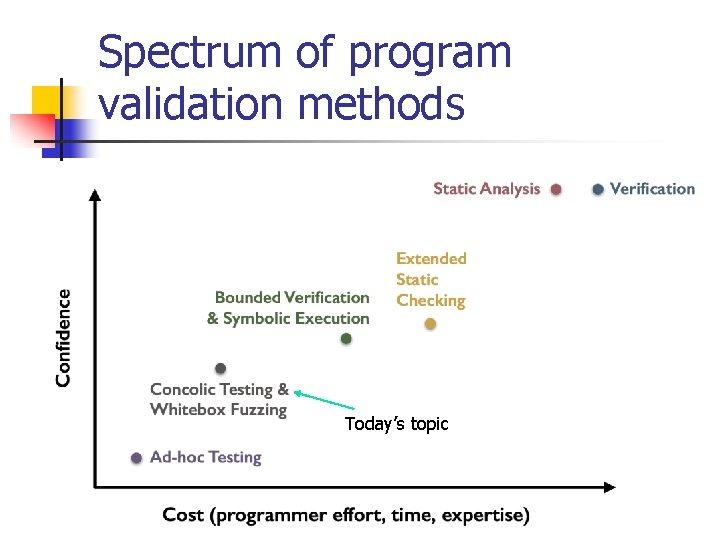
Spectrum of program validation methods Today’s topic
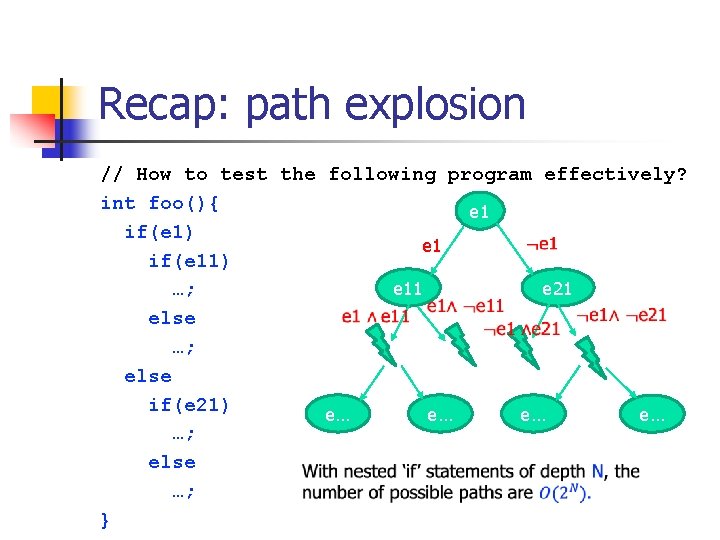
Recap: path explosion // How to test the following program effectively? int foo(){ e 1 if(e 1) e 1 if(e 11) e 11 e 21 …; else if(e 21) e… e… …; else …; }
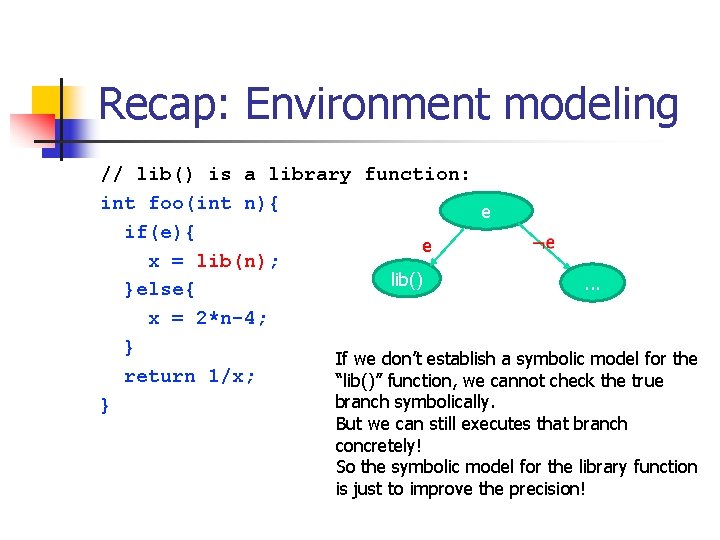
Recap: Environment modeling // lib() is a library function: int foo(int n){ e if(e){ e x = lib(n); lib(). . . }else{ x = 2*n-4; } If we don’t establish a symbolic model for the return 1/x; “lib()” function, we cannot check the true branch symbolically. } But we can still executes that branch concretely! So the symbolic model for the library function is just to improve the precision!
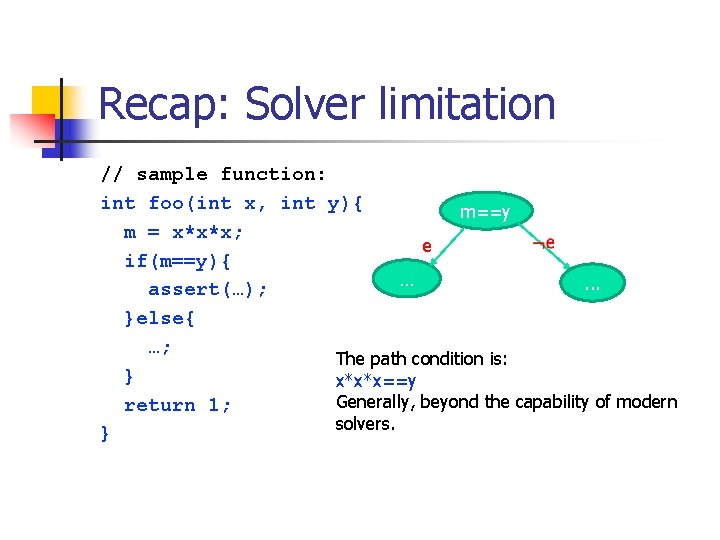
Recap: Solver limitation // sample function: int foo(int x, int y){ m==y m = x*x*x; e if(m==y){ …. . . assert(…); }else{ …; The path condition is: } x*x*x==y Generally, beyond the capability of modern return 1; solvers. }
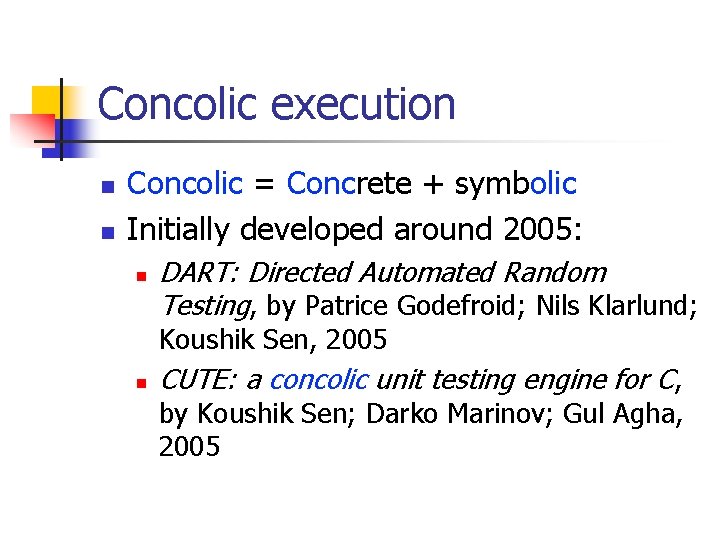
Concolic execution n n Concolic = Concrete + symbolic Initially developed around 2005: n DART: Directed Automated Random Testing, by Patrice Godefroid; Nils Klarlund; Koushik Sen, 2005 n CUTE: a concolic unit testing engine for C, by Koushik Sen; Darko Marinov; Gul Agha, 2005
Concolic Execution
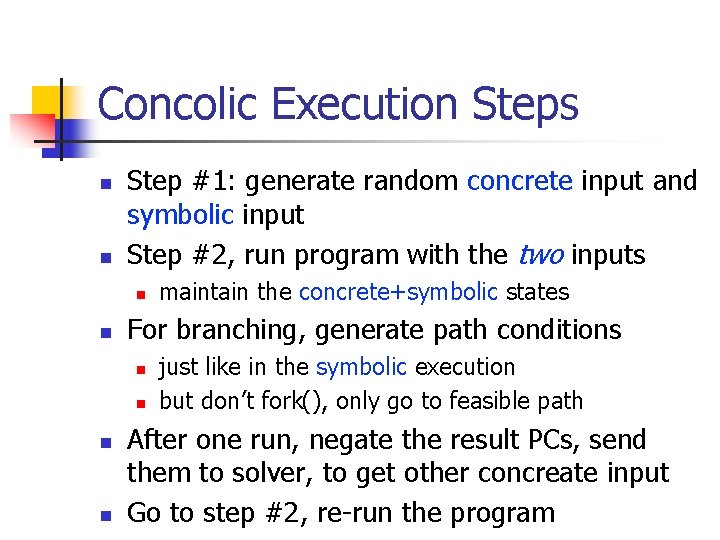
Concolic Execution Steps n n Step #1: generate random concrete input and symbolic input Step #2, run program with the two inputs n n For branching, generate path conditions n n maintain the concrete+symbolic states just like in the symbolic execution but don’t fork(), only go to feasible path After one run, negate the result PCs, send them to solver, to get other concreate input Go to step #2, re-run the program
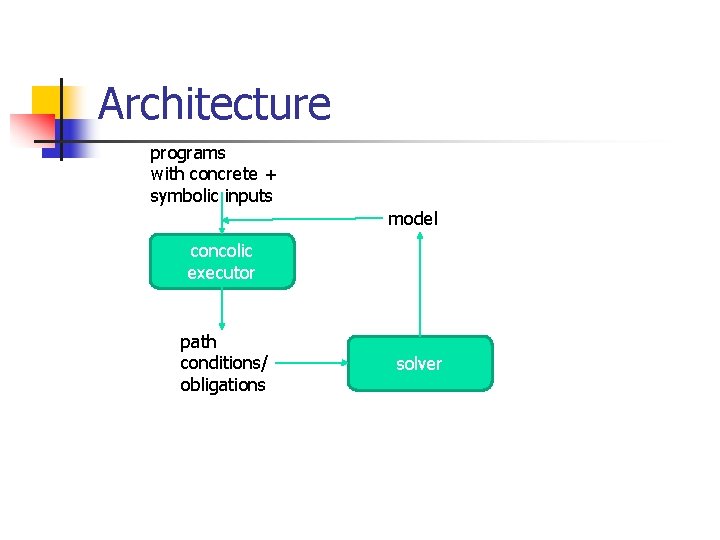
Architecture programs with concrete + symbolic inputs model concolic executor path conditions/ obligations solver
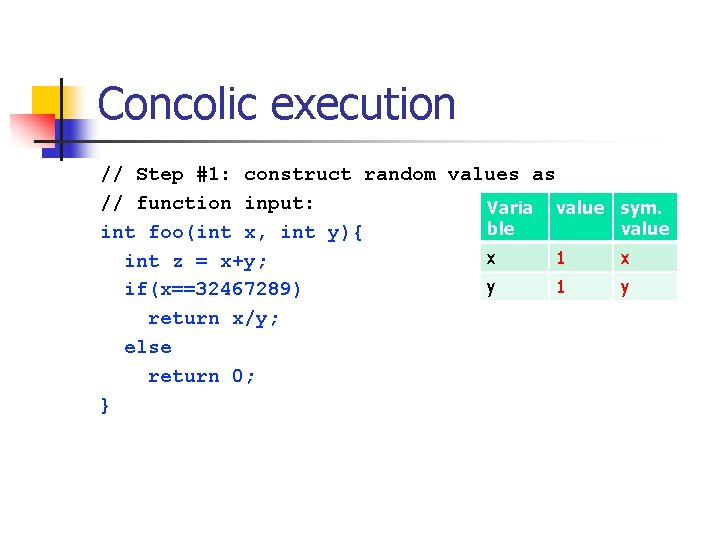
Concolic execution // Step #1: construct random values as // function input: Varia value ble int foo(int x, int y){ x 1 int z = x+y; y 1 if(x==32467289) return x/y; else return 0; } sym. value x y
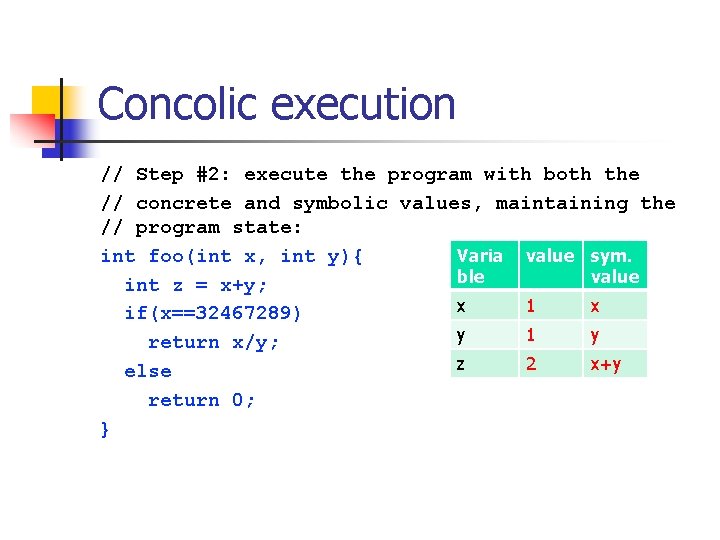
Concolic execution // Step #2: execute the program with both the // concrete and symbolic values, maintaining the // program state: Varia value sym. int foo(int x, int y){ ble value int z = x+y; x 1 x if(x==32467289) y 1 y return x/y; z 2 x+y else return 0; }
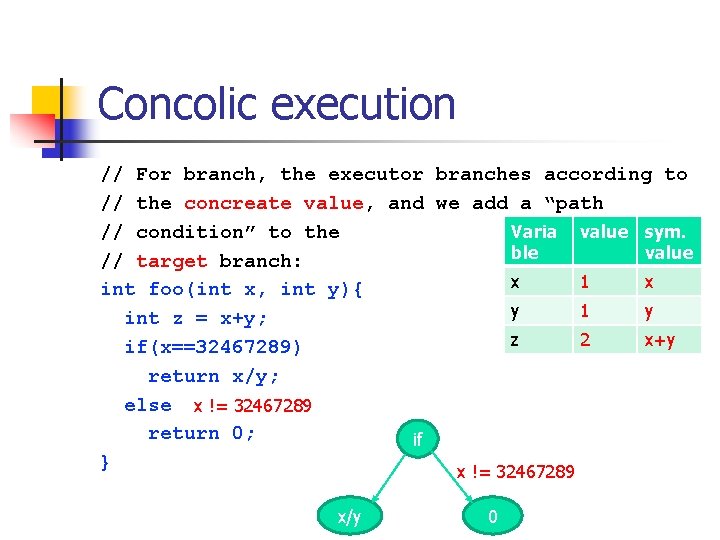
Concolic execution // For branch, the executor branches according to // the concreate value, and we add a “path Varia value sym. // condition” to the ble value // target branch: x 1 x int foo(int x, int y){ y 1 y int z = x+y; z 2 x+y if(x==32467289) return x/y; else x != 32467289 return 0; if } x != 32467289 x/y 0
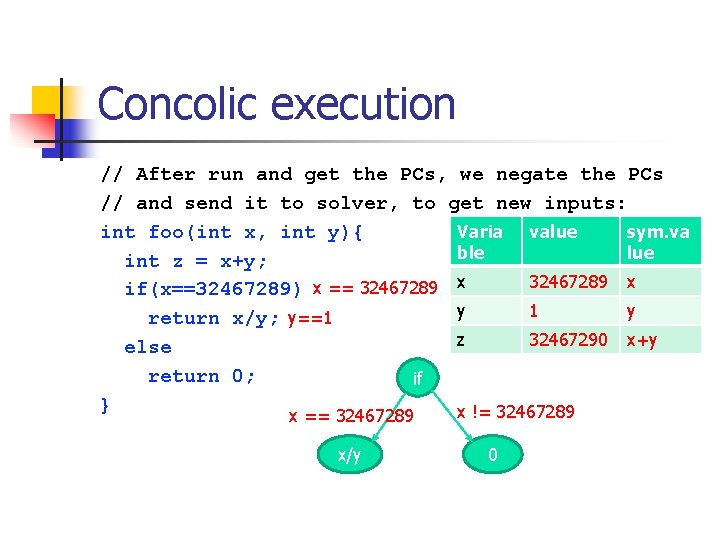
Concolic execution // After run and get the PCs, we negate the PCs // and send it to solver, to get new inputs: Varia value sym. va int foo(int x, int y){ ble lue int z = x+y; 32467289 x if(x==32467289) x == 32467289 x y 1 y return x/y; y==1 z 32467290 x+y else return 0; if } x != 32467289 x == 32467289 x/y 0
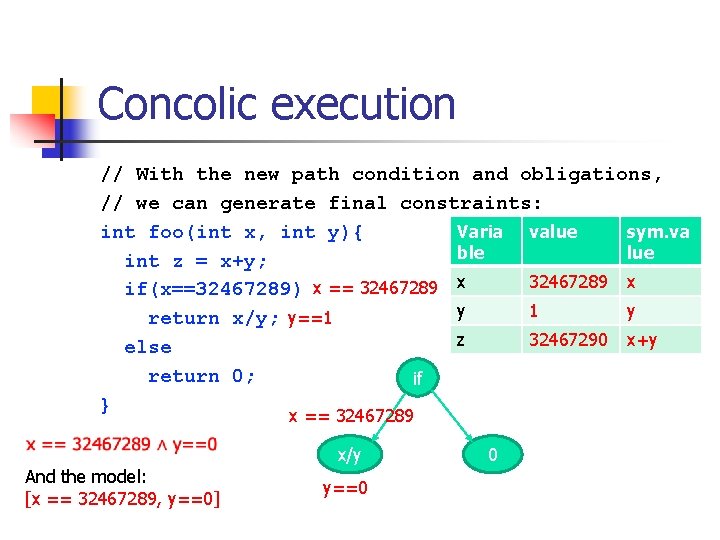
Concolic execution // With the new path condition and obligations, // we can generate final constraints: Varia value sym. va int foo(int x, int y){ ble lue int z = x+y; 32467289 x if(x==32467289) x == 32467289 x y 1 y return x/y; y==1 z 32467290 x+y else return 0; if } x == 32467289 x/y And the model: [x == 32467289, y==0] y==0 0
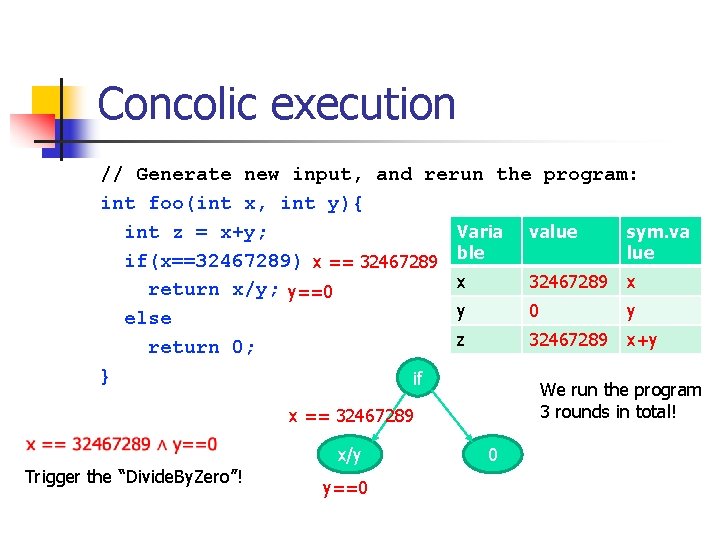
Concolic execution // Generate new input, and rerun the program: int foo(int x, int y){ Varia value sym. va int z = x+y; lue if(x==32467289) x == 32467289 ble x 32467289 x return x/y; y==0 y else z 32467289 x+y return 0; } if We run the program 3 rounds in total! x == 32467289 x/y Trigger the “Divide. By. Zero”! y==0 0
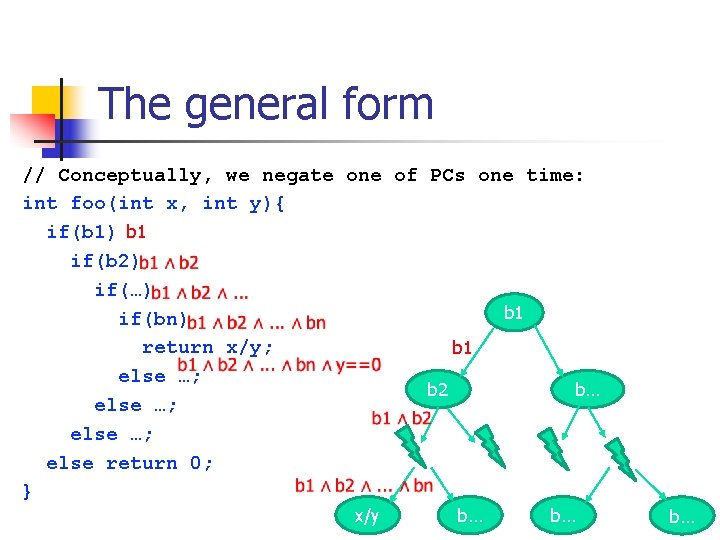
The general form // Conceptually, we negate one of PCs one time: int foo(int x, int y){ if(b 1) b 1 if(b 2) if(…) b 1 if(bn) return x/y; b 1 else …; b 2 b… else …; else return 0; } x/y b… b… b…
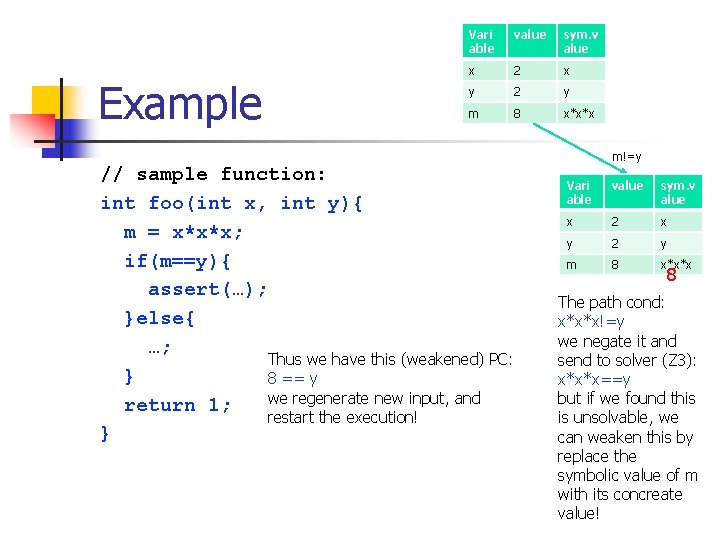
Example Vari able value sym. v alue x 2 x y 2 y m 8 x*x*x m!=y // sample function: int foo(int x, int y){ m = x*x*x; if(m==y){ assert(…); }else{ …; Thus we have this (weakened) PC: } 8 == y we regenerate new input, and return 1; restart the execution! } Vari able value sym. v alue x 2 x y 2 y m 8 x*x*x 8 The path cond: x*x*x!=y we negate it and send to solver (Z 3): x*x*x==y but if we found this is unsolvable, we can weaken this by replace the symbolic value of m with its concreate value!
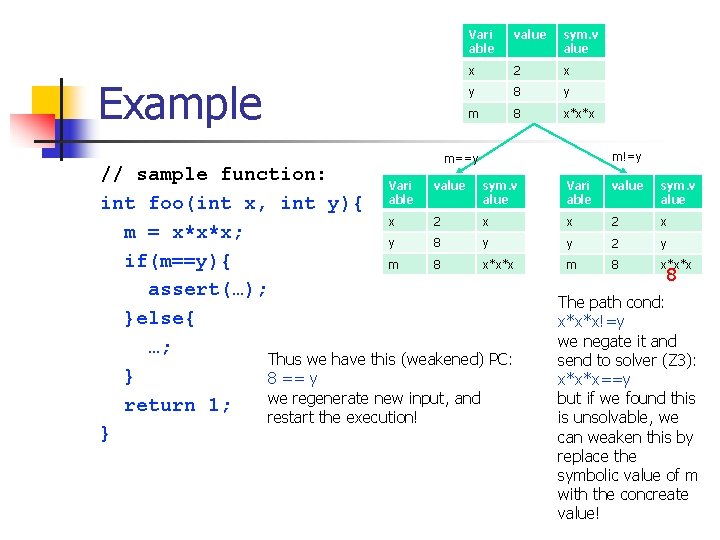
Example Vari able value sym. v alue x 2 x y 8 y m 8 x*x*x m!=y m==y // sample function: Vari value sym. v able alue int foo(int x, int y){ x 2 x m = x*x*x; y 8 y if(m==y){ m 8 x*x*x assert(…); }else{ …; Thus we have this (weakened) PC: } 8 == y we regenerate new input, and return 1; restart the execution! } Vari able value sym. v alue x 2 x y 2 y m 8 x*x*x 8 The path cond: x*x*x!=y we negate it and send to solver (Z 3): x*x*x==y but if we found this is unsolvable, we can weaken this by replace the symbolic value of m with the concreate value!
Advantages of Concolic Execution
Practical issues n n n Path explosion Loops and recursions Environment modeling
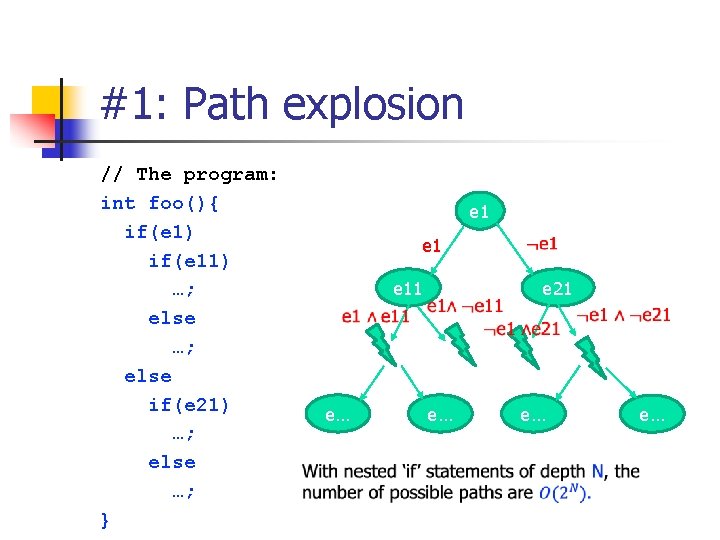
#1: Path explosion // The program: int foo(){ if(e 1) if(e 11) …; else if(e 21) …; else …; } e 1 e 11 e… e 21 e… e… e…
#1: Path explosion n In concolic execution, the number of paths explored can be controlled, according to: n n the total number the coverage the timeout etc. .
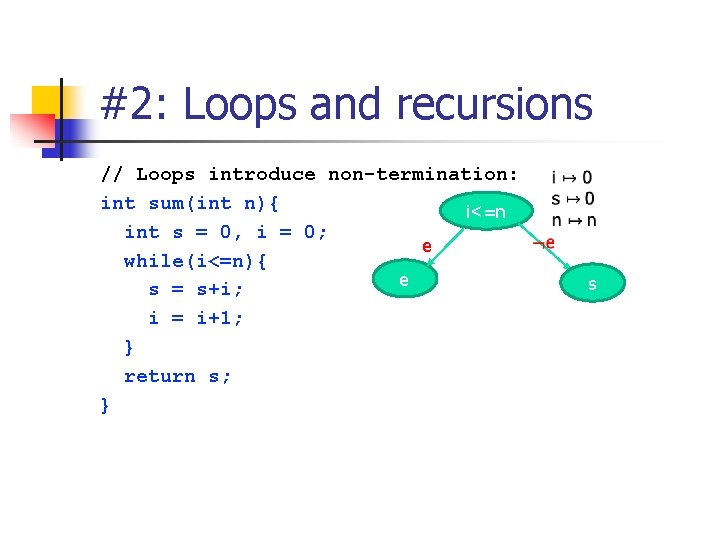
#2: Loops and recursions // Loops introduce non-termination: int sum(int n){ i<=n int s = 0, i = 0; e while(i<=n){ e s = s+i; i = i+1; } return s; } s
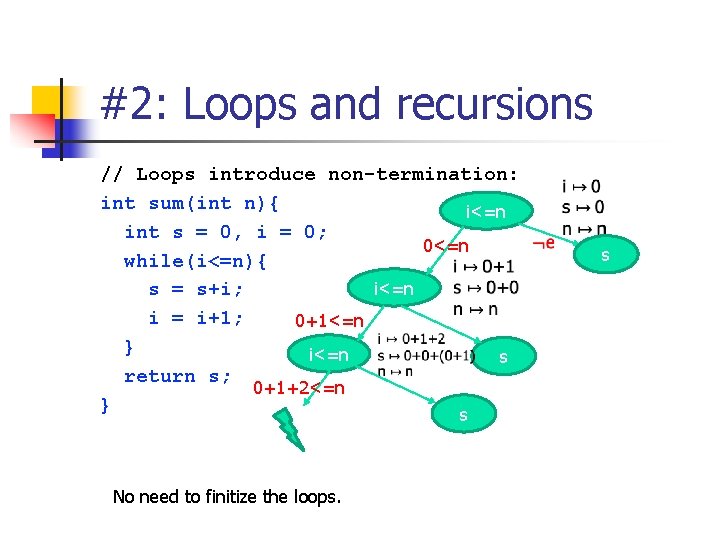
#2: Loops and recursions // Loops introduce non-termination: int sum(int n){ i<=n int s = 0, i = 0; 0<=n while(i<=n){ i<=n s = s+i; i = i+1; 0+1<=n } i<=n s return s; 0+1+2<=n } s No need to finitize the loops. s
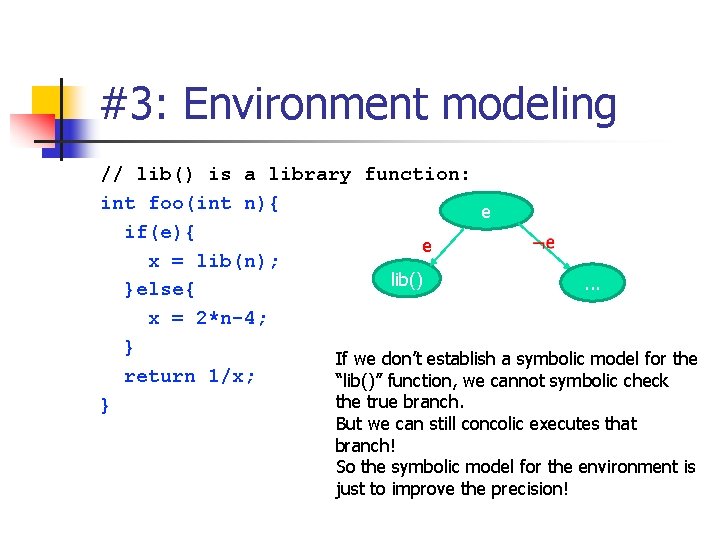
#3: Environment modeling // lib() is a library function: int foo(int n){ e if(e){ e x = lib(n); lib(). . . }else{ x = 2*n-4; } If we don’t establish a symbolic model for the return 1/x; “lib()” function, we cannot symbolic check the true branch. } But we can still concolic executes that branch! So the symbolic model for the environment is just to improve the precision!
Summary n n Concolic execution is a more practical (flexible) infrastructure for program testing Many practical tools with many applications
- Slides: 26