
Conclusion Writing the executive summary section of your

![What are the main points of the conclusion section? [student answer] • It should](https://slidetodoc.com/presentation_image_h2/f721b9da4f02b3836651358afe7e4d71/image-14.jpg "What are the main points of the conclusion section? [student answer] • It should")
![What is sampling error? [student answer] • Sampling error happens when taking different samples](https://slidetodoc.com/presentation_image_h2/f721b9da4f02b3836651358afe7e4d71/image-15.jpg "What is sampling error? [student answer] • Sampling error happens when taking different samples")
![What is a re-sample? [student answer] • A resample is a sample taken with](https://slidetodoc.com/presentation_image_h2/f721b9da4f02b3836651358afe7e4d71/image-16.jpg "What is a re-sample? [student answer] • A resample is a sample taken with")
![What is a confidence interval? [student answer] • A confidence interval is a range](https://slidetodoc.com/presentation_image_h2/f721b9da4f02b3836651358afe7e4d71/image-18.jpg "What is a confidence interval? [student answer] • A confidence interval is a range")

- Slides: 31
Conclusion Writing the executive summary section of your report
“Executive Summary is writing in a language that everybody understands. ”
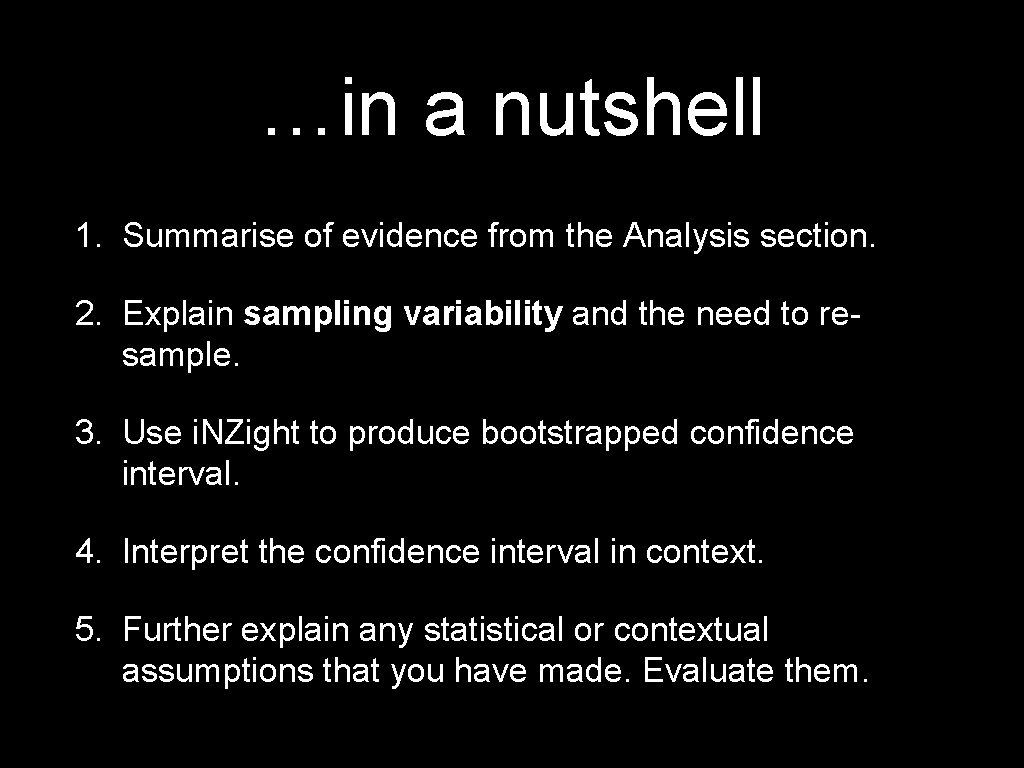
…in a nutshell 1. Summarise of evidence from the Analysis section. 2. Explain sampling variability and the need to resample. 3. Use i. NZight to produce bootstrapped confidence interval. 4. Interpret the confidence interval in context. 5. Further explain any statistical or contextual assumptions that you have made. Evaluate them.
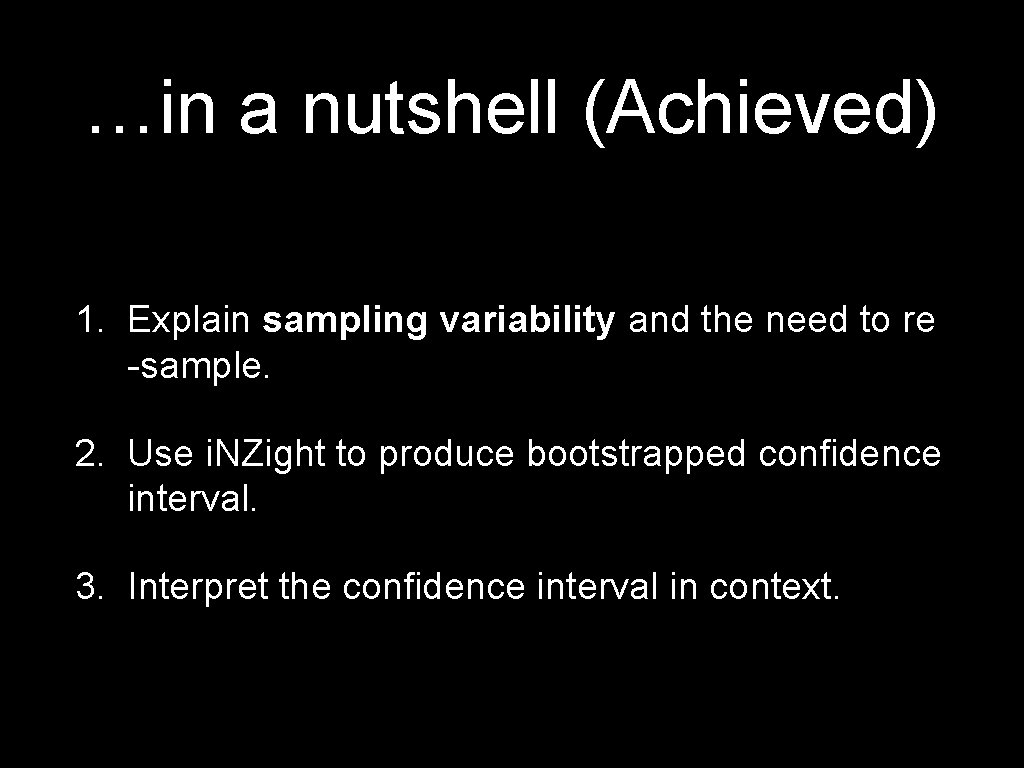
…in a nutshell (Achieved) 1. Explain sampling variability and the need to re -sample. 2. Use i. NZight to produce bootstrapped confidence interval. 3. Interpret the confidence interval in context.
Random sampling • A sample of any population is generally selected using a random sampling method. • This will (hopefully) ensure a good mix of the units of interest (e. g. height, weight, gender). • For example, one method is using random numbers (RAN# on the calculator!) • Always try and find out if your sample data consists of random selected units.
Sampling variability • “Sampling error arises due to the variability that occurs by chance because a random sample, rather than an entire population, is surveyed. Consider a sample of units selected randomly from the population and then used to make an estimate for a variable of interest. If we repeated the process (random selection) we would almost certainly select different units into the sample, and hence get a slightly different estimate for the variable this is the concept of sampling error. The level of sampling error can be estimated numerically and used directly when analysing the results for a variable in the survey. ”
Sampling variability • “Sampling error arises due to the variability that occurs by chance because a random sample, rather than an entire population, is surveyed. Consider a sample of units selected randomly from the population and then used to make an estimate for a variable of interest. If we repeated the process (random selection) we would almost certainly select different units into the sample, and hence get a slightly different estimate for the variable - this is the concept of sampling error. The level of sampling error can be estimated numerically and used directly when analysing the results for a variable in the survey. ”
Back to Example 1 • SURF dataset from Statistics New Zealand. • Random sample survey of male and female households with permanent dwellings in New Zealand. • Sample size is 200; assume random selection has taken of the sample was done.
3 parts to analyse • Centre …. median, shape • Spread …. interquartile range, shift, overlap • Unusual features …. outliers, clusters
Example 1 • SURF dataset from Statistics New Zealand. • Random sample survey of male and female households with permanent dwellings in New Zealand. • Sample size is 200.
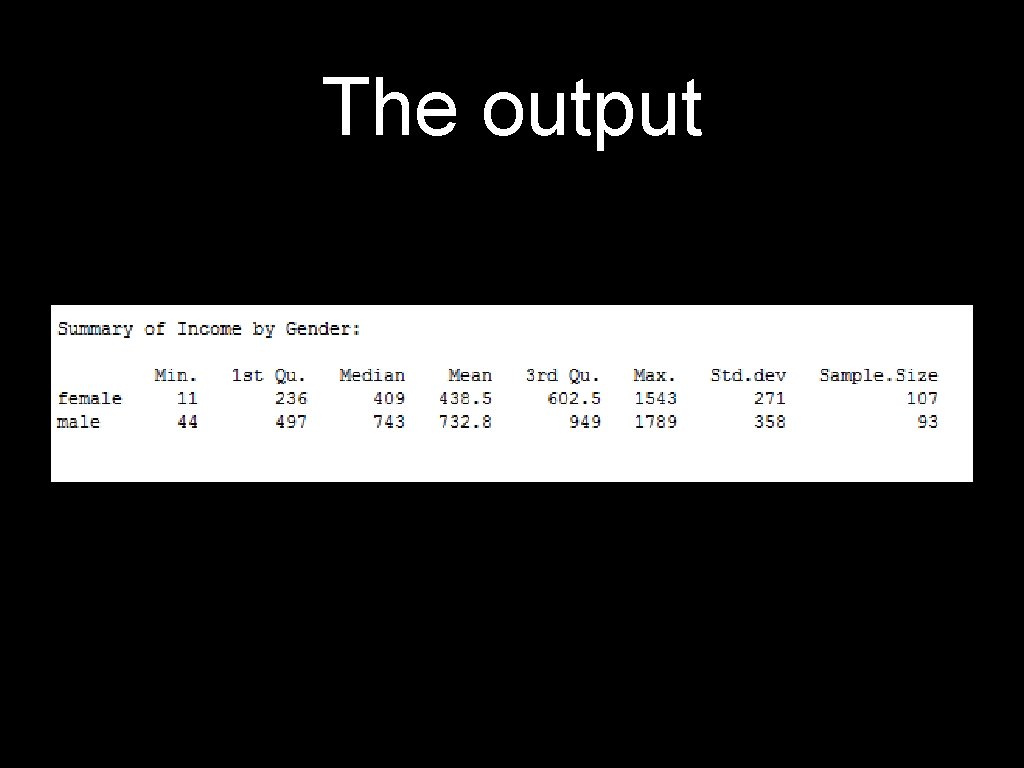
The output.
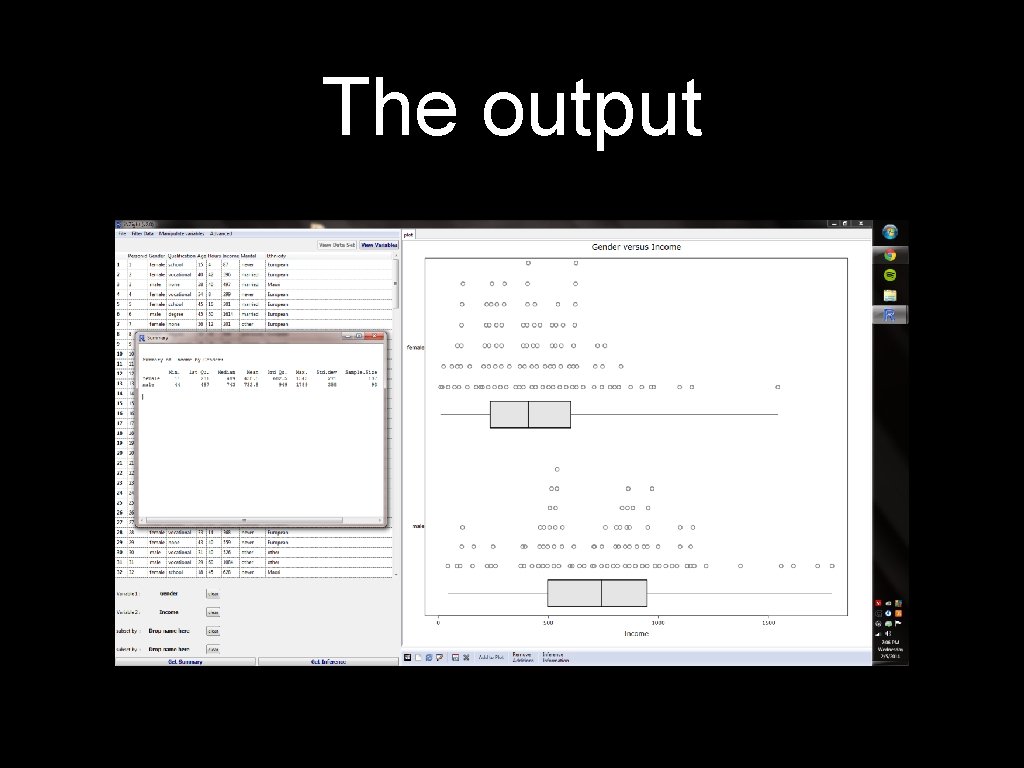
The output
The output
What are the main points of the conclusion section? [student answer] • It should be in a language that everybody understands • Summery from Analysis section • Explain sampling variability • Explain statistical / contextual assumptions • Interpret the Confidence Interval
What is sampling error? [student answer] • Sampling error happens when taking different samples of the same size from the sample population.
What is a re-sample? [student answer] • A resample is a sample taken with replacement taken from an original sample, which was formed from a population. By taking a resample from our original sample, this allows us to see more clearly the values the population might hold.
Why take a re-sample from the sample, and not another sample from the same population? [student answer] • Because it is often impractical or expensive to take another sample from the population and a resample often produces a distribution similar to repeated sampling from the population.
What is a confidence interval? [student answer] • A confidence interval is a range that estimates the closest representation of a value, we have of a whole population through a selected random sample.
WHAT do you SEE? S Statement: I notice that… N Numbers c Context
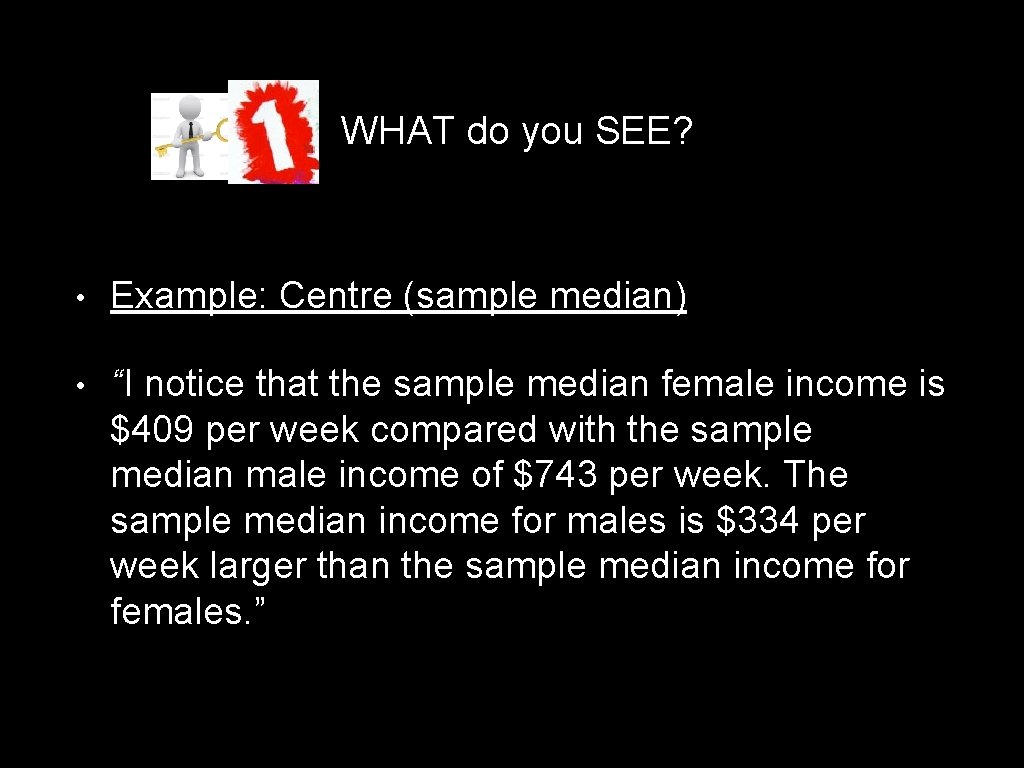
WHAT do you SEE? • Example: Centre (sample median) • “I notice that the sample median female income is $409 per week compared with the sample median male income of $743 per week. The sample median income for males is $334 per week larger than the sample median income for females. ”
WHAT does it mean? • Firstly, for the difference between the sample medians. • Secondly, for the difference between the population medians.
WHAT does it mean? • Example: Centre (sample median) • “The difference in the sample median weekly income, suggests that there could be a difference between weekly income of males and females in New Zealand. ”
WHAT do you SEE? • Example: Centre (sample distribution) • “I notice that the sample distribution of female weekly income appears to be right skewed compared with the sample distribution of male weekly income which appears to be normally distributed. ” • ”
WHAT does it mean? • Example: Centre (sample distribution) • “This suggests that in New Zealand, the majority of males earn more per week than females earn per week, which means that there could be a difference between median weekly income of males and females in New Zealand. ”
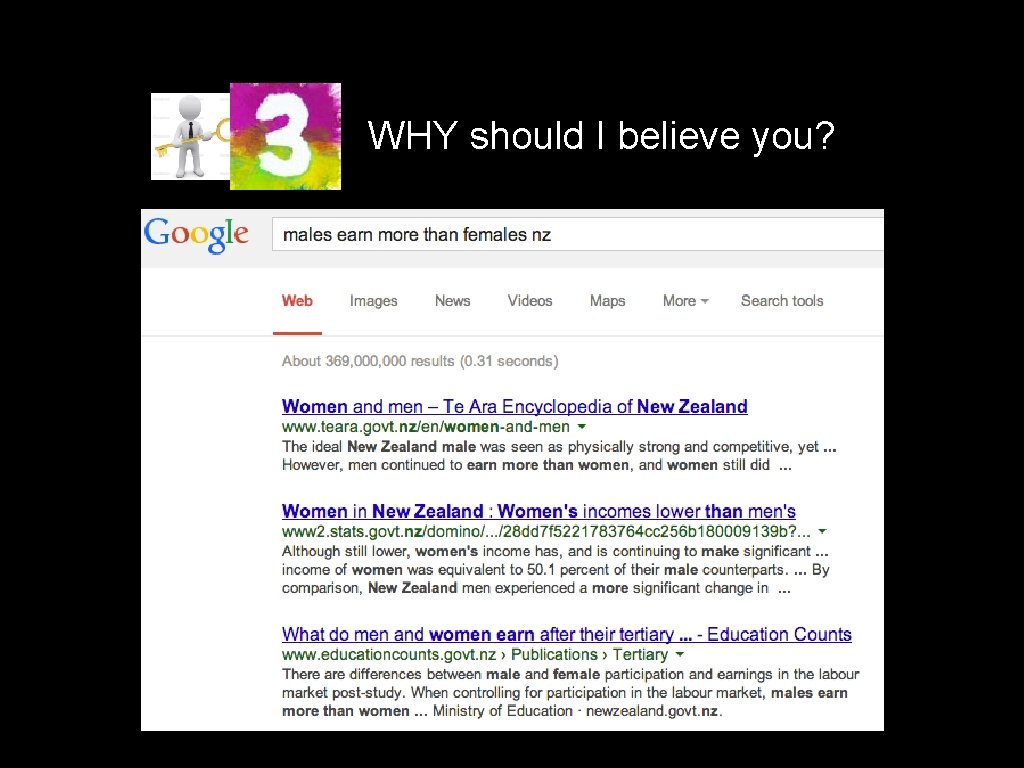
WHY should I believe you? • You need evidence from research to back up what you have found. • …Male median income higher than females… • …Males higher up the scale… • …Males earn more than females?
WHY should I believe you?
WHY should I believe you? • A possible reason for these differences is the continued trend of women (in general) being less valued in society than men. Evidence from The Encyclopedia of New Zealand (2013) details that in 1840 most settlers into New Zealand were male, with only in the 1880 s women began to campaign for equal rights, but social change not happening until the 1960 s. The effect of this seems to be seen in recent times, as per the sample data.
Centre. Done.
Repeat process for spread. Interquartile range. Shift of interquartile range. Overlap of interquartile range.
Repeat process for unusual features. Outliers Clusters.
See Example 1 for the rest of the analysis… Practicing writing these statements and getting feedback is the only way to improve.