
CONCLUSION CS 2110 Spring 2018 History 2 Programming

- Slides: 37
CONCLUSION CS 2110 Spring 2018
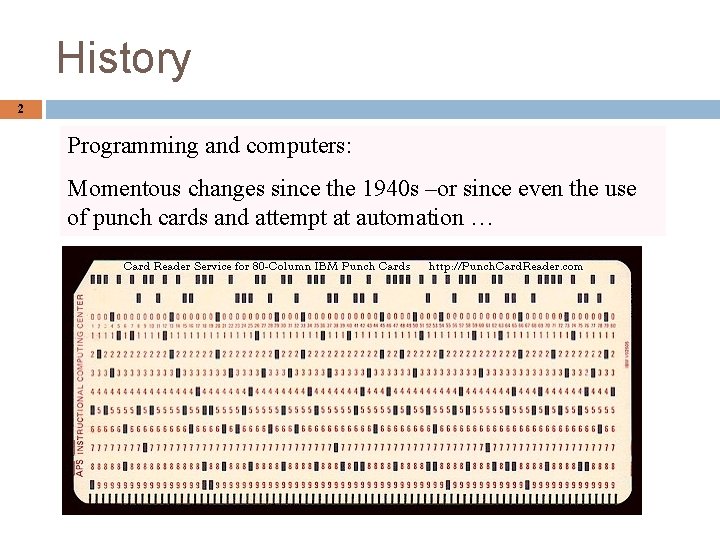
History 2 Programming and computers: Momentous changes since the 1940 s –or since even the use of punch cards and attempt at automation …
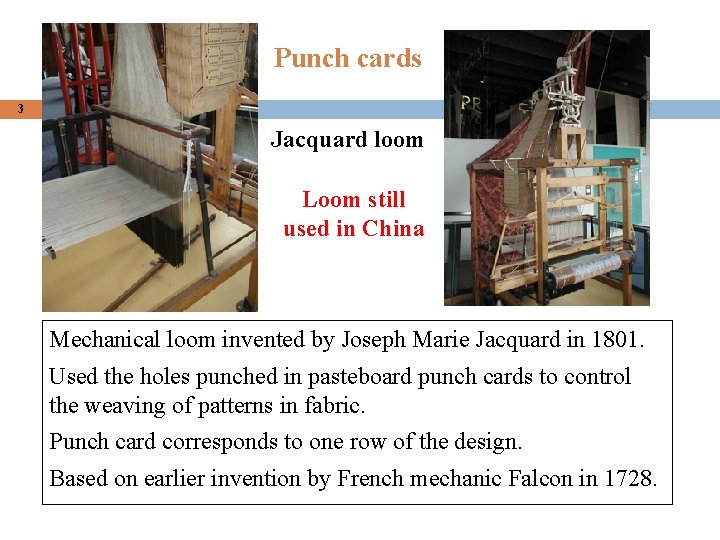
Punch cards 3 Jacquard loom Loom still used in China Mechanical loom invented by Joseph Marie Jacquard in 1801. Used the holes punched in pasteboard punch cards to control the weaving of patterns in fabric. Punch card corresponds to one row of the design. Based on earlier invention by French mechanic Falcon in 1728.
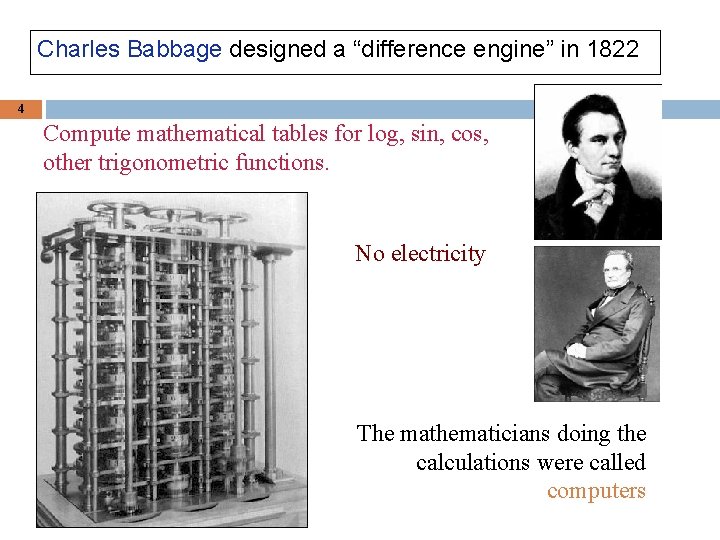
Charles Babbage designed a “difference engine” in 1822 4 Compute mathematical tables for log, sin, cos, other trigonometric functions. No electricity The mathematicians doing the calculations were called computers
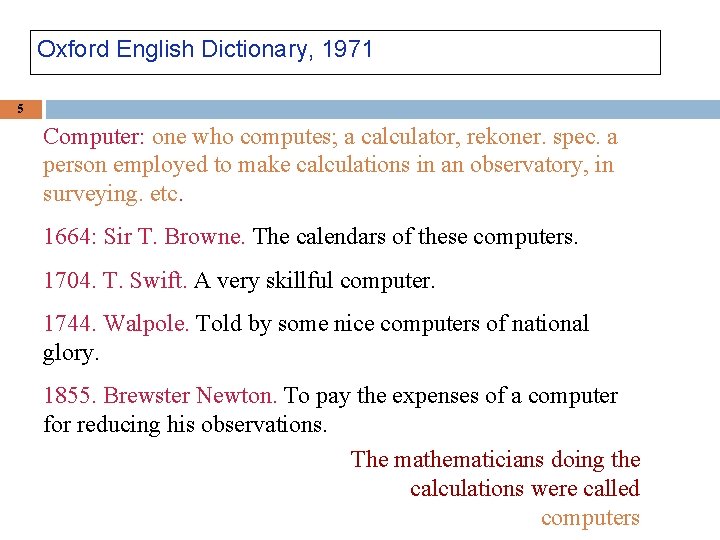
Oxford English Dictionary, 1971 5 Computer: one who computes; a calculator, rekoner. spec. a person employed to make calculations in an observatory, in surveying. etc. 1664: Sir T. Browne. The calendars of these computers. 1704. T. Swift. A very skillful computer. 1744. Walpole. Told by some nice computers of national glory. 1855. Brewster Newton. To pay the expenses of a computer for reducing his observations. The mathematicians doing the calculations were called computers
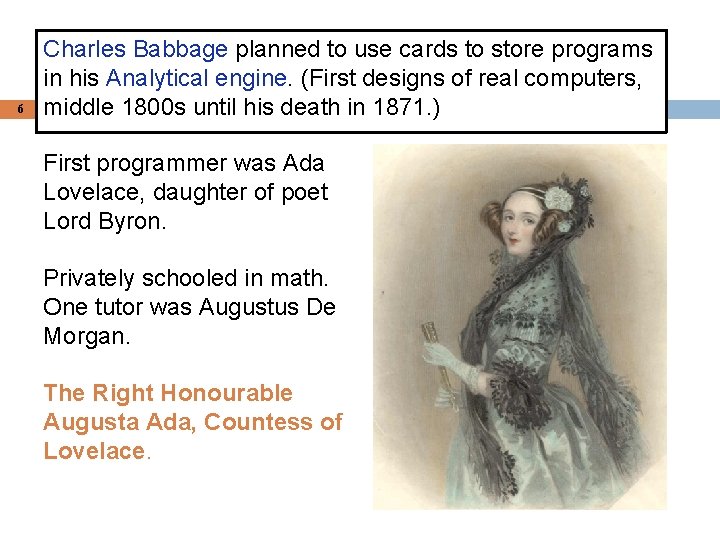
6 Charles Babbage planned to use cards to store programs in his Analytical engine. (First designs of real computers, middle 1800 s until his death in 1871. ) First programmer was Ada Lovelace, daughter of poet Lord Byron. Privately schooled in math. One tutor was Augustus De Morgan. The Right Honourable Augusta Ada, Countess of Lovelace.
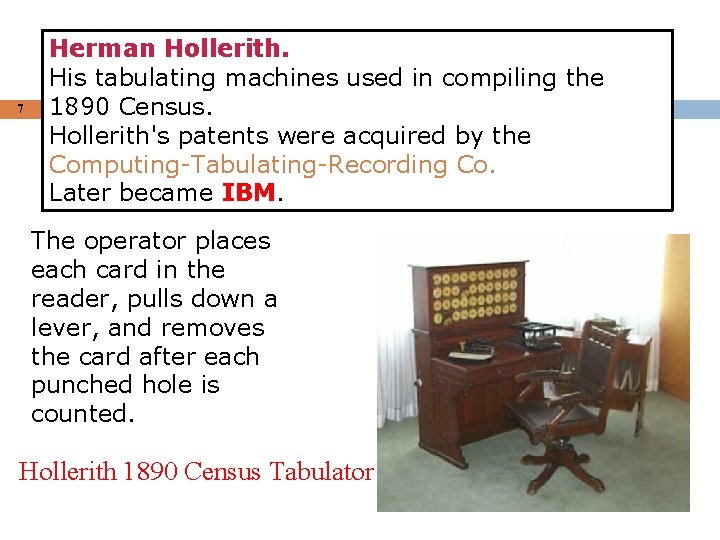
7 Herman Hollerith. His tabulating machines used in compiling the 1890 Census. Hollerith's patents were acquired by the Computing-Tabulating-Recording Co. Later became IBM. The operator places each card in the reader, pulls down a lever, and removes the card after each punched hole is counted. Hollerith 1890 Census Tabulator
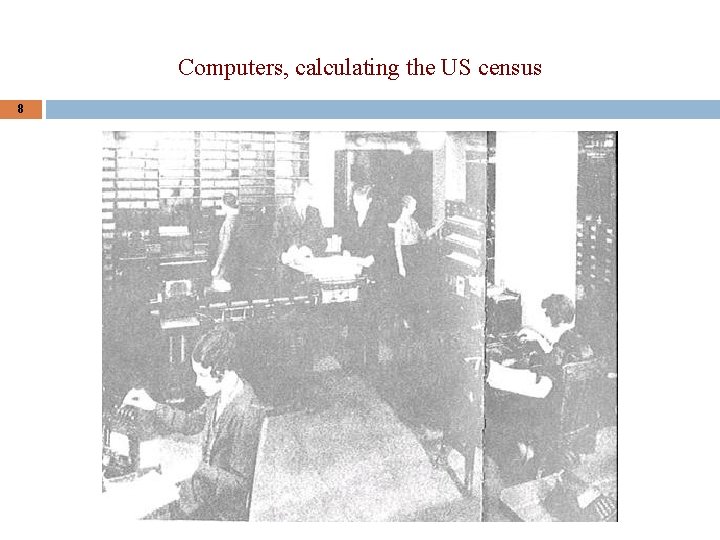
Computers, calculating the US census 8
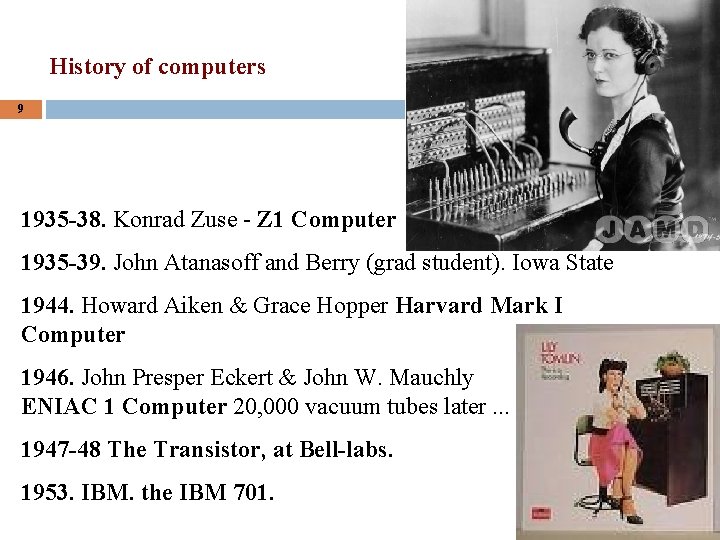
History of computers 9 1935 -38. Konrad Zuse - Z 1 Computer 1935 -39. John Atanasoff and Berry (grad student). Iowa State 1944. Howard Aiken & Grace Hopper Harvard Mark I Computer 1946. John Presper Eckert & John W. Mauchly ENIAC 1 Computer 20, 000 vacuum tubes later. . . 1947 -48 The Transistor, at Bell-labs. 1953. IBM. the IBM 701. 9
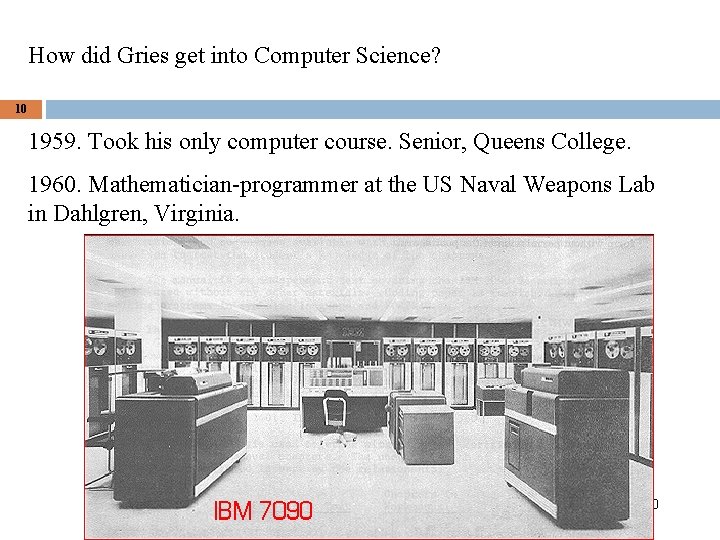
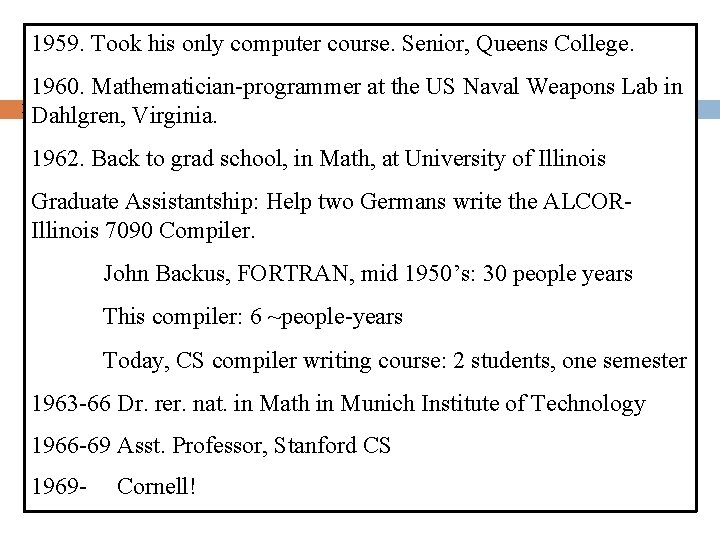
How did Gries get into Computer Science? 10 1959. Took his only computer course. Senior, Queens College. 1960. Mathematician-programmer at the US Naval Weapons Lab in Dahlgren, Virginia. 10
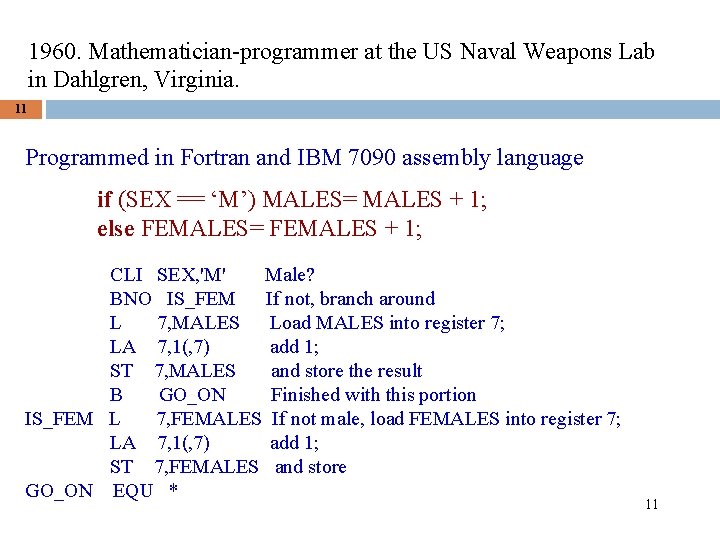
1960. Mathematician-programmer at the US Naval Weapons Lab in Dahlgren, Virginia. 11 Programmed in Fortran and IBM 7090 assembly language if (SEX == ‘M’) MALES= MALES + 1; else FEMALES= FEMALES + 1; CLI SEX, 'M' Male? BNO IS_FEM If not, branch around L 7, MALES Load MALES into register 7; LA 7, 1(, 7) add 1; ST 7, MALES and store the result B GO_ON Finished with this portion IS_FEM L 7, FEMALES If not male, load FEMALES into register 7; LA 7, 1(, 7) add 1; ST 7, FEMALES and store GO_ON EQU * 11
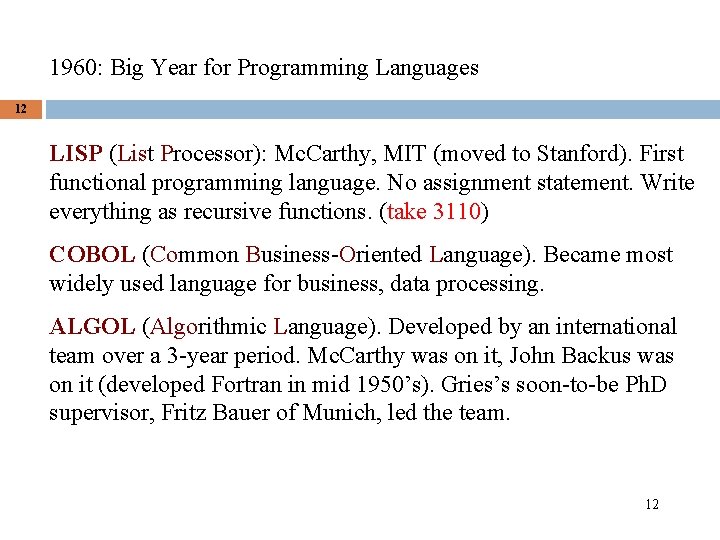
1960: Big Year for Programming Languages 12 LISP (List Processor): Mc. Carthy, MIT (moved to Stanford). First functional programming language. No assignment statement. Write everything as recursive functions. (take 3110) COBOL (Common Business-Oriented Language). Became most widely used language for business, data processing. ALGOL (Algorithmic Language). Developed by an international team over a 3 -year period. Mc. Carthy was on it, John Backus was on it (developed Fortran in mid 1950’s). Gries’s soon-to-be Ph. D supervisor, Fritz Bauer of Munich, led the team. 12
1959. Took his only computer course. Senior, Queens College. 1960. Mathematician-programmer at the US Naval Weapons Lab in 13 Dahlgren, Virginia. 1962. Back to grad school, in Math, at University of Illinois Graduate Assistantship: Help two Germans write the ALCORIllinois 7090 Compiler. John Backus, FORTRAN, mid 1950’s: 30 people years This compiler: 6 ~people-years Today, CS compiler writing course: 2 students, one semester 1963 -66 Dr. rer. nat. in Math in Munich Institute of Technology 1966 -69 Asst. Professor, Stanford CS 1969 - Cornell! 13
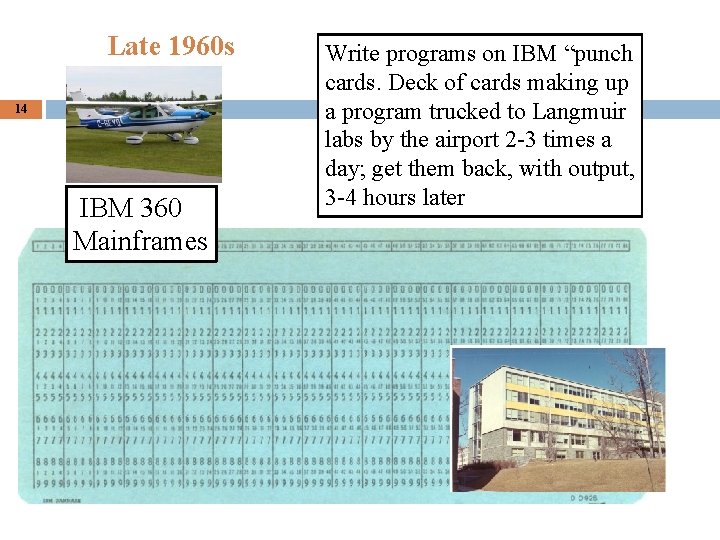
Late 1960 s 14 IBM 360 Mainframes Write programs on IBM “punch cards. Deck of cards making up a program trucked to Langmuir labs by the airport 2 -3 times a day; get them back, with output, 3 -4 hours later
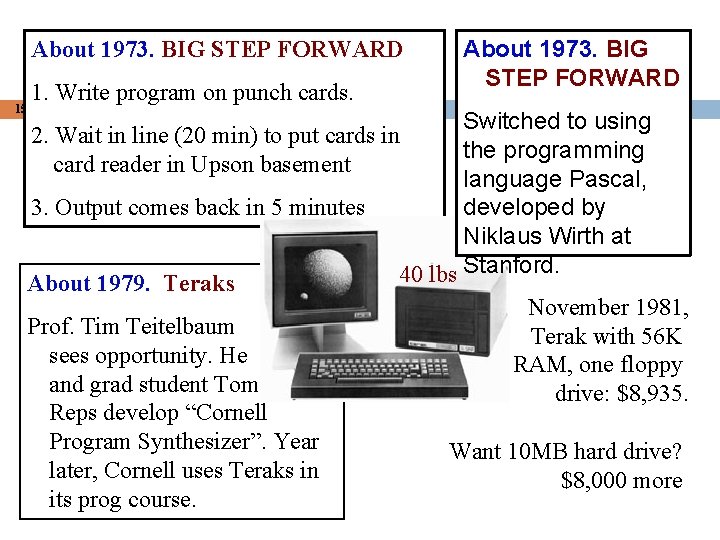
About 1973. BIG STEP FORWARD 15 1. Write program on punch cards. About 1973. BIG STEP FORWARD Switched to using the programming language Pascal, developed by Niklaus Wirth at 40 lbs Stanford. 2. Wait in line (20 min) to put cards in card reader in Upson basement 3. Output comes back in 5 minutes About 1979. Teraks Prof. Tim Teitelbaum sees opportunity. He and grad student Tom Reps develop “Cornell Program Synthesizer”. Year later, Cornell uses Teraks in its prog course. November 1981, Terak with 56 K RAM, one floppy drive: $8, 935. Want 10 MB hard drive? $8, 000 more
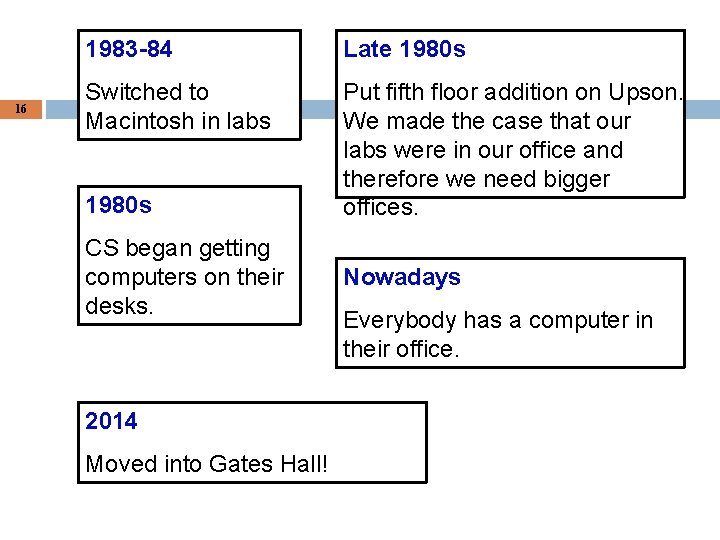
16 1983 -84 Late 1980 s Switched to Macintosh in labs Put fifth floor addition on Upson. We made the case that our labs were in our office and therefore we need bigger offices. 1980 s CS began getting computers on their desks. 2014 Moved into Gates Hall! Nowadays Everybody has a computer in their office.
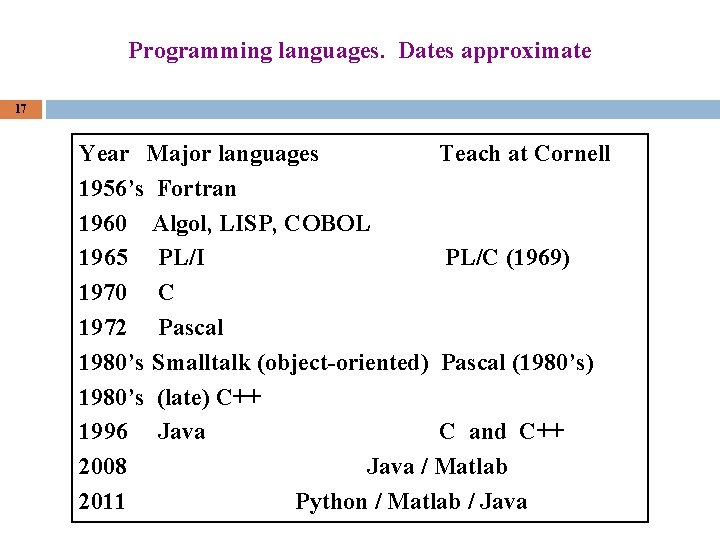
Programming languages. Dates approximate 17 Year Major languages Teach at Cornell 1956’s Fortran 1960 Algol, LISP, COBOL 1965 PL/I PL/C (1969) 1970 C 1972 Pascal 1980’s Smalltalk (object-oriented) Pascal (1980’s) 1980’s (late) C++ 1996 Java C and C++ 2008 Java / Matlab 2011 Python / Matlab / Java
18 Java is not the Only OO Language
19 Java is not the Only OO Language Usability Performance Security
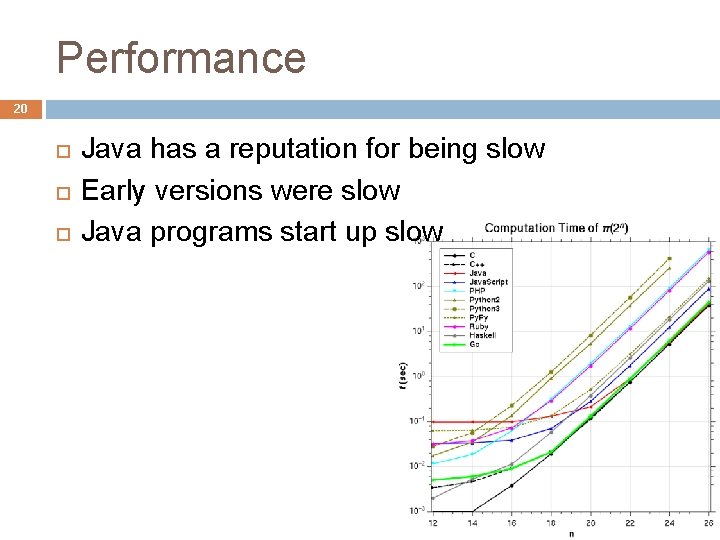
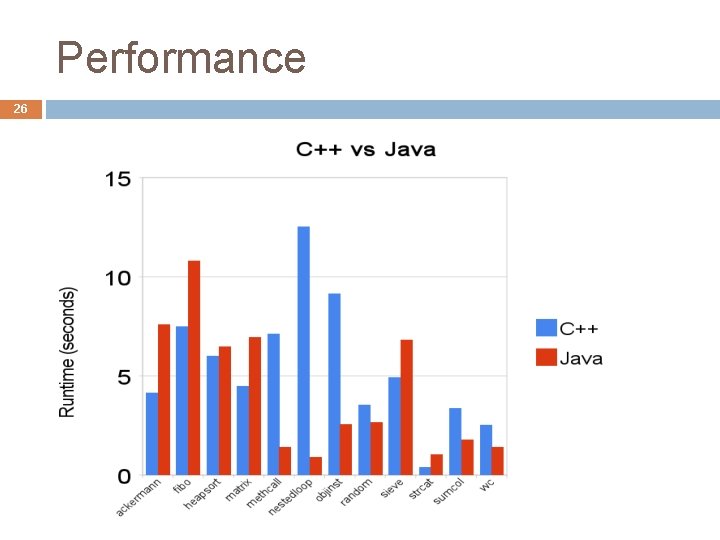
Performance 20 Java has a reputation for being slow Early versions were slow Java programs start up slow
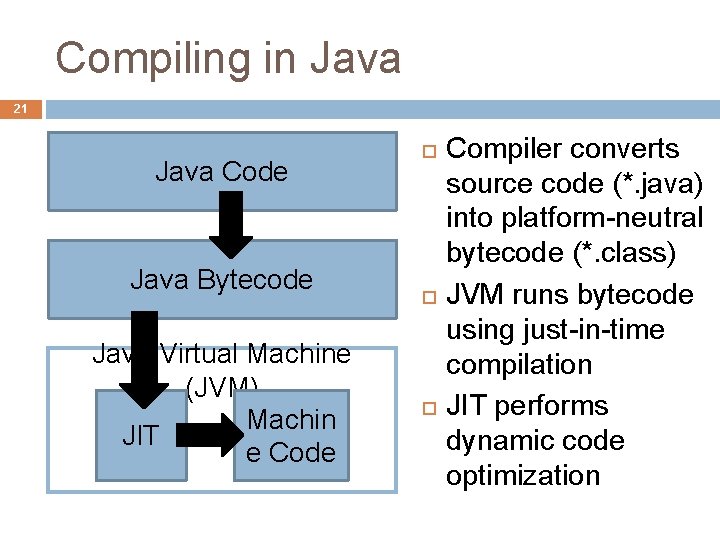
Compiling in Java 21 Java Code Java Bytecode Java Virtual Machine (JVM) Machin JIT e Code Compiler converts source code (*. java) into platform-neutral bytecode (*. class) JVM runs bytecode using just-in-time compilation JIT performs dynamic code optimization
Garbage Collection 22 What happens to objects after you are done with them? Why don't you run out of memory? JVM implements garbage collection. It detects and frees objects that are no longer needed
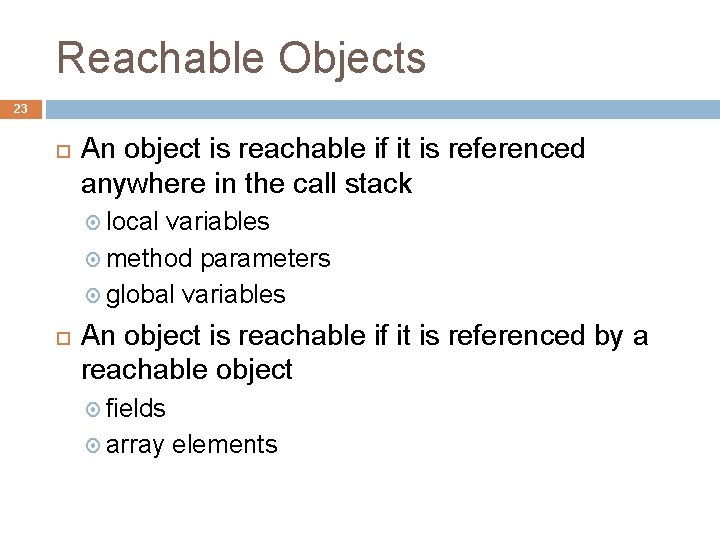
Reachable Objects 23 An object is reachable if it is referenced anywhere in the call stack local variables method parameters global variables An object is reachable if it is referenced by a reachable object fields array elements
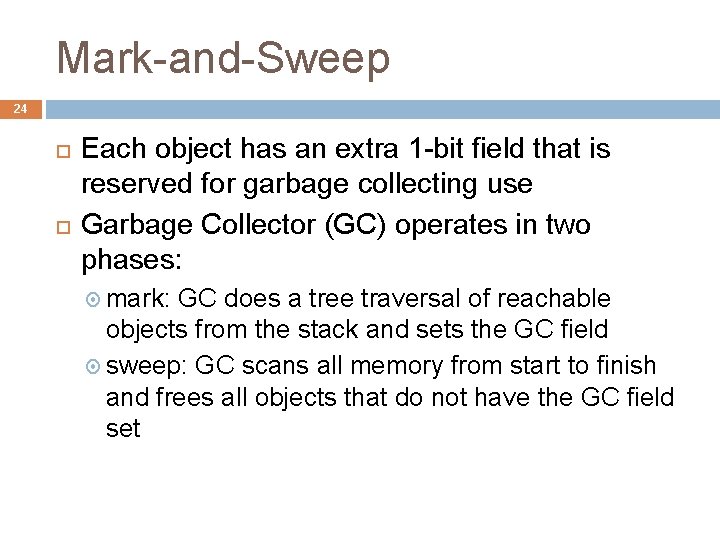
Mark-and-Sweep 24 Each object has an extra 1 -bit field that is reserved for garbage collecting use Garbage Collector (GC) operates in two phases: mark: GC does a tree traversal of reachable objects from the stack and sets the GC field sweep: GC scans all memory from start to finish and frees all objects that do not have the GC field set
Optimized Garbage Collection 25 Concurrent mark-and-sweep Generational management Garbage-First garbage collector
Performance 26
Shortcomings of Java 27 Java has no separation between specification and implementation Writing correct concurrent programs in Java is hard and/or inefficient People continue to develop new languages (e. g. , Rust) that address some of these shortcomings steeper learning curve longer compile times
tl; dr; 28 Modern compiled, OO languages have similar performance Different companies use different languages for historical, philosophical, or legal reasons The concepts you learned in this class apply to any language abstraction isolation inheritance incremental development & testing
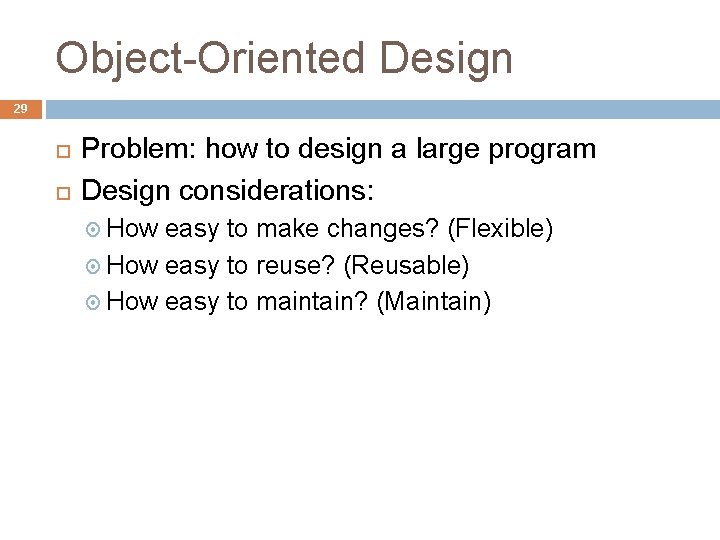
Object-Oriented Design 29 Problem: how to design a large program Design considerations: How easy to make changes? (Flexible) How easy to reuse? (Reusable) How easy to maintain? (Maintain)
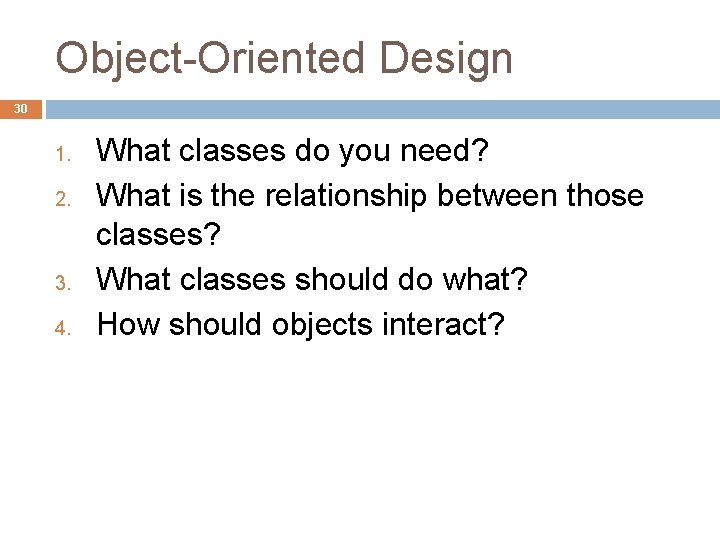
Object-Oriented Design 30 1. 2. 3. 4. What classes do you need? What is the relationship between those classes? What classes should do what? How should objects interact?
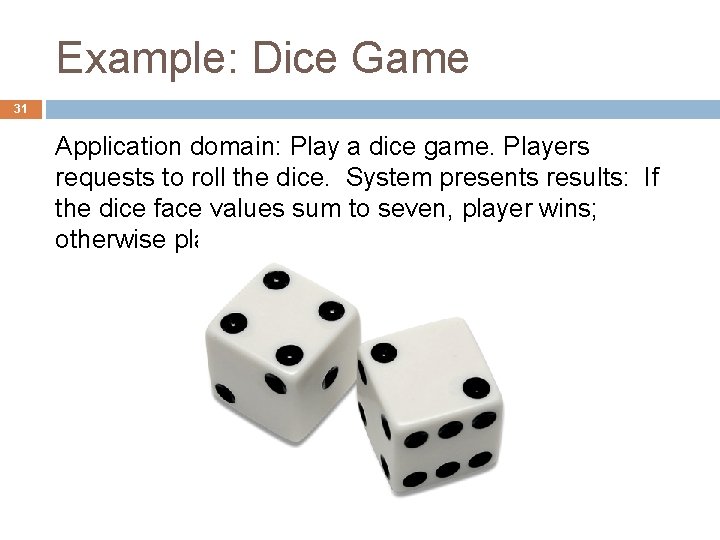
Example: Dice Game 31 Application domain: Play a dice game. Players requests to roll the dice. System presents results: If the dice face values sum to seven, player wins; otherwise player loses.
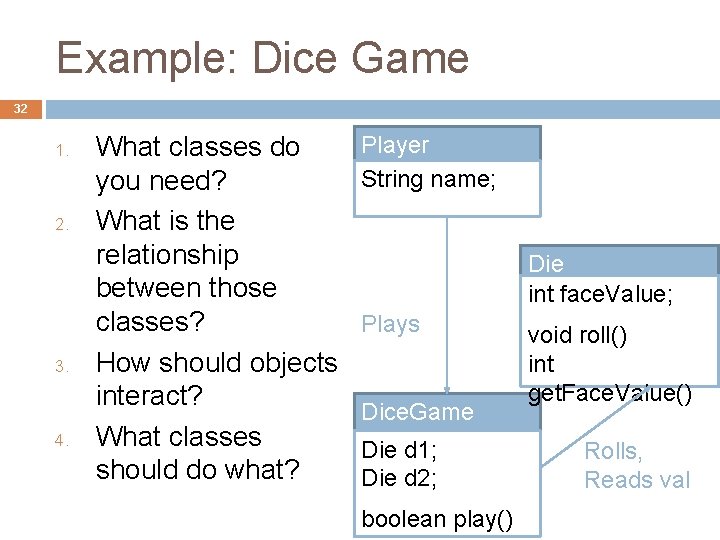
Example: Dice Game 32 1. 2. 3. 4. What classes do you need? What is the relationship between those classes? How should objects interact? What classes should do what? Player String name; Die int face. Value; Plays Dice. Game Die d 1; Die d 2; boolean play() void roll() int get. Face. Value() Rolls, Reads val
Design Patterns 33 Design patterns are general, re-usable solutions to commonly recurring problems OO design patterns typically show relationships and interactions between classes or objects Not a magic solution; blindly applying design patterns can overcomplicate your code
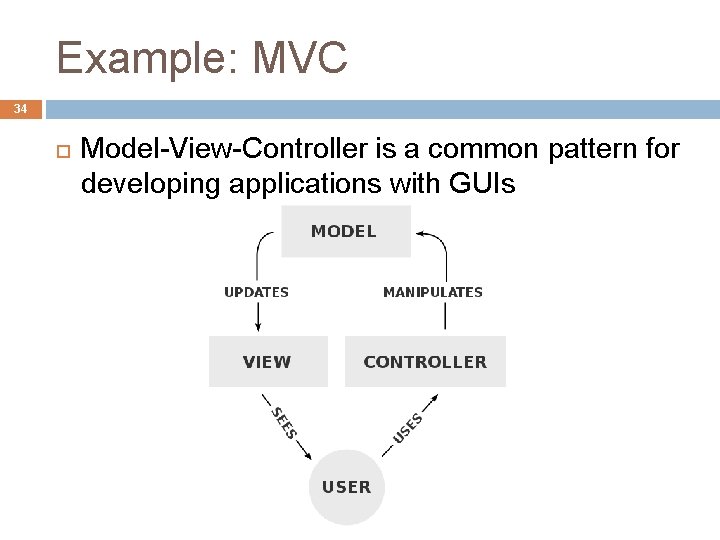
Example: MVC 34 Model-View-Controller is a common pattern for developing applications with GUIs
35
CS 2110 36 Object-oriented programming, reasoning about complex problems Testing; Reasoning about correctness Algorithmic complexity, analyzing algorithms, Data structures: linked lists, trees, hash tables, graphs, etc. Programming paradigms: recursion, parallel execution
37