
CONCLUSION AND EXAM PREPARATION Week 23 Module Overview

- Slides: 12
CONCLUSION AND EXAM PREPARATION Week 23
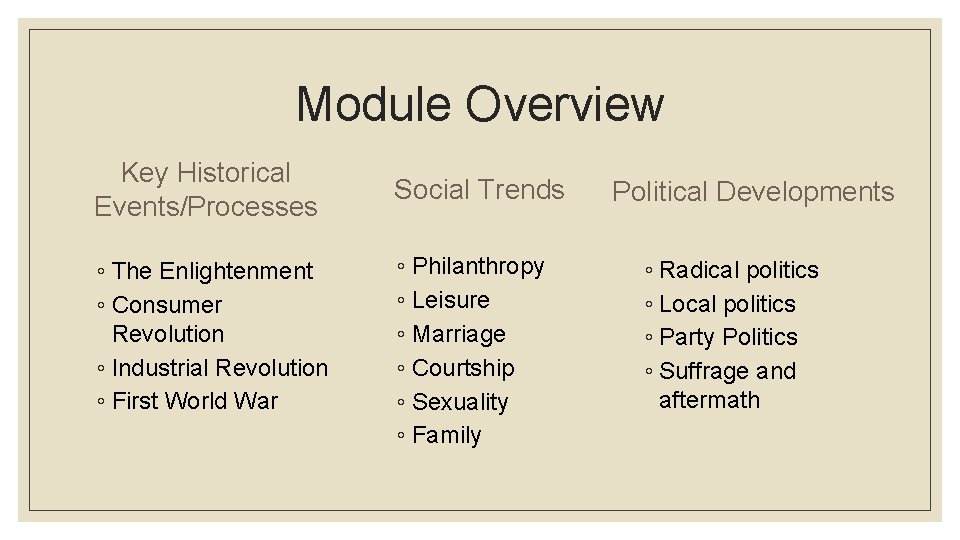
Module Overview Key Historical Events/Processes ◦ The Enlightenment ◦ Consumer Revolution ◦ Industrial Revolution ◦ First World War Social Trends ◦ Philanthropy ◦ Leisure ◦ Marriage ◦ Courtship ◦ Sexuality ◦ Family Political Developments ◦ Radical politics ◦ Local politics ◦ Party Politics ◦ Suffrage and aftermath
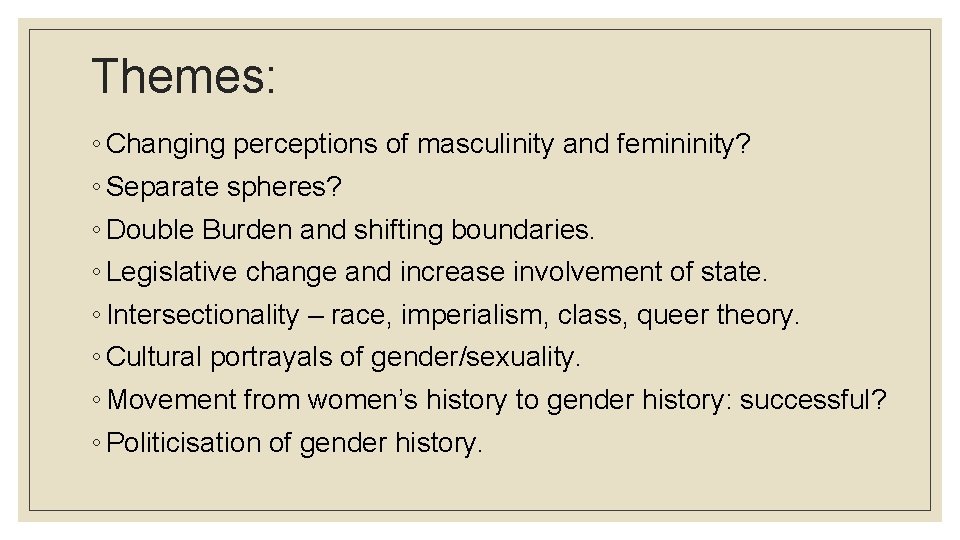
Themes: ◦ Changing perceptions of masculinity and femininity? ◦ Separate spheres? ◦ Double Burden and shifting boundaries. ◦ Legislative change and increase involvement of state. ◦ Intersectionality – race, imperialism, class, queer theory. ◦ Cultural portrayals of gender/sexuality. ◦ Movement from women’s history to gender history: successful? ◦ Politicisation of gender history.
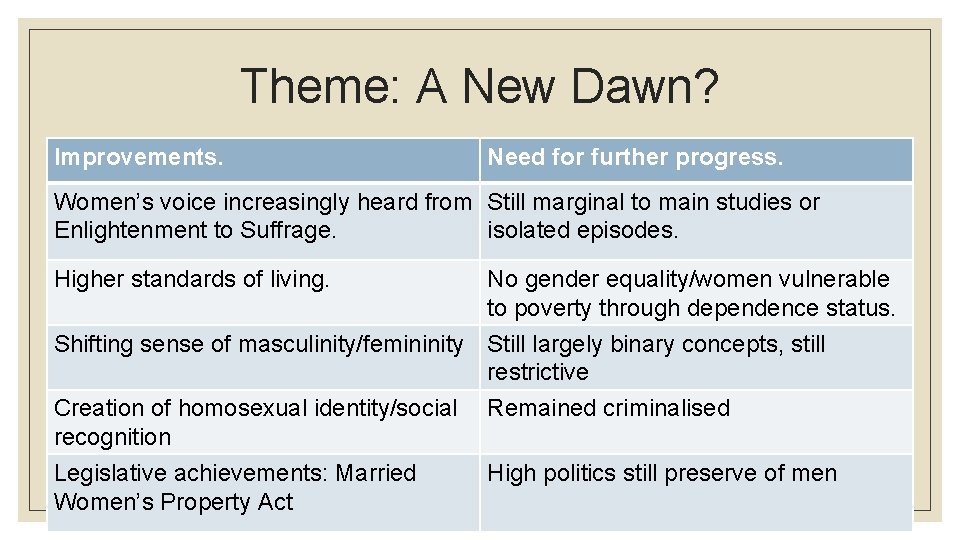
Theme: A New Dawn? Improvements. Need for further progress. Women’s voice increasingly heard from Still marginal to main studies or Enlightenment to Suffrage. isolated episodes. Higher standards of living. No gender equality/women vulnerable to poverty through dependence status. Shifting sense of masculinity/femininity Still largely binary concepts, still restrictive Creation of homosexual identity/social recognition Legislative achievements: Married Women’s Property Act Remained criminalised High politics still preserve of men
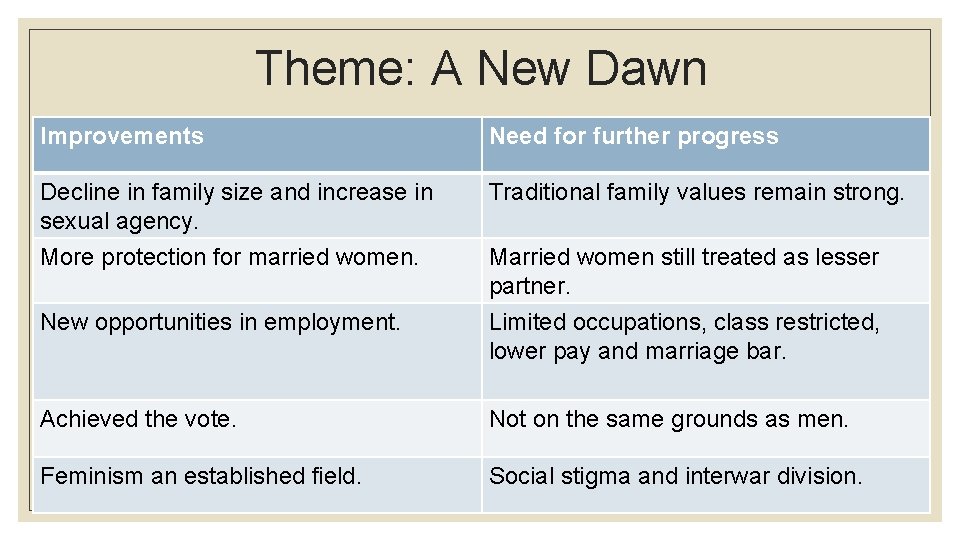
Theme: A New Dawn Improvements Need for further progress Decline in family size and increase in sexual agency. Traditional family values remain strong. More protection for married women. Married women still treated as lesser partner. Limited occupations, class restricted, lower pay and marriage bar. New opportunities in employment. Achieved the vote. Not on the same grounds as men. Feminism an established field. Social stigma and interwar division.
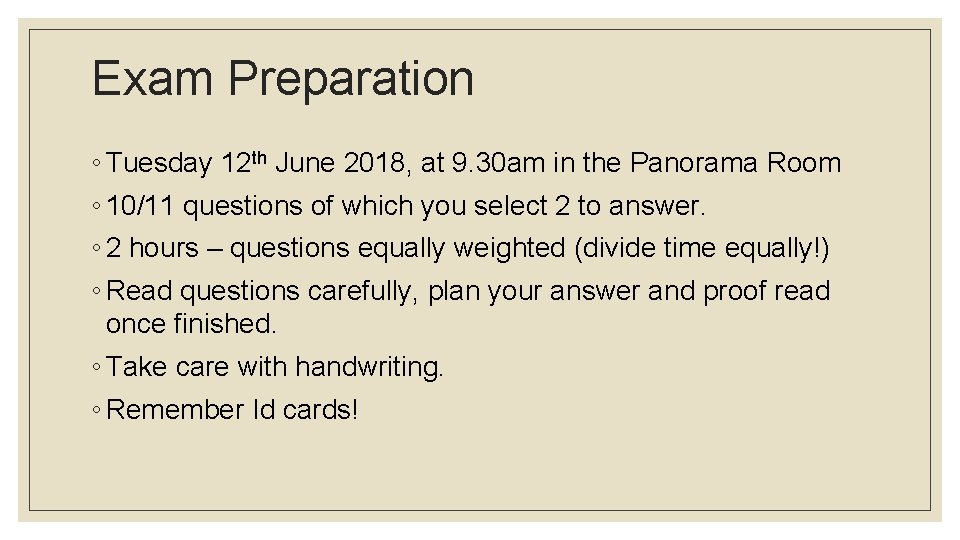
Exam Preparation ◦ Tuesday 12 th June 2018, at 9. 30 am in the Panorama Room ◦ 10/11 questions of which you select 2 to answer. ◦ 2 hours – questions equally weighted (divide time equally!) ◦ Read questions carefully, plan your answer and proof read once finished. ◦ Take care with handwriting. ◦ Remember Id cards!
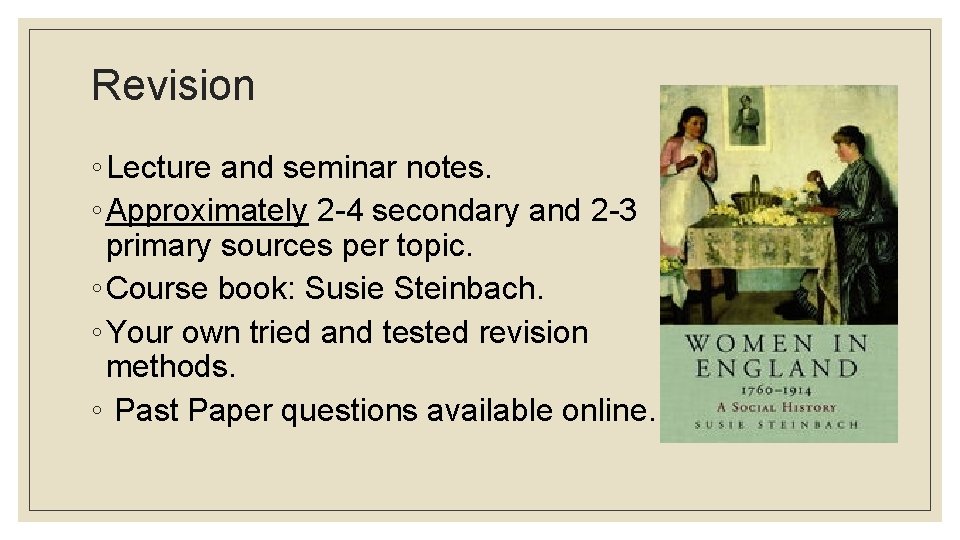
Revision ◦ Lecture and seminar notes. ◦ Approximately 2 -4 secondary and 2 -3 primary sources per topic. ◦ Course book: Susie Steinbach. ◦ Your own tried and tested revision methods. ◦ Past Paper questions available online.
Past paper questions ◦ Cover the whole module Term 1, 2 and 3. ◦ Some may be specific to a week/topic ◦ Some may be broader allowing you flexibility to engineer an answer which suits your specialisms (within reason!). ◦ However make sure it is RELEVANT and that you answer the question.
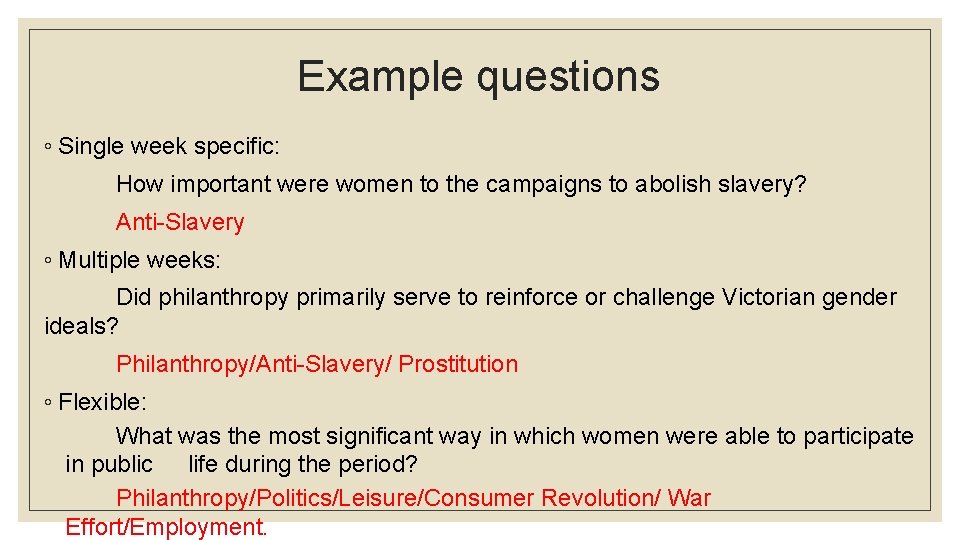
Example questions ◦ Single week specific: How important were women to the campaigns to abolish slavery? Anti-Slavery ◦ Multiple weeks: Did philanthropy primarily serve to reinforce or challenge Victorian gender ideals? Philanthropy/Anti-Slavery/ Prostitution ◦ Flexible: What was the most significant way in which women were able to participate in public life during the period? Philanthropy/Politics/Leisure/Consumer Revolution/ War Effort/Employment.
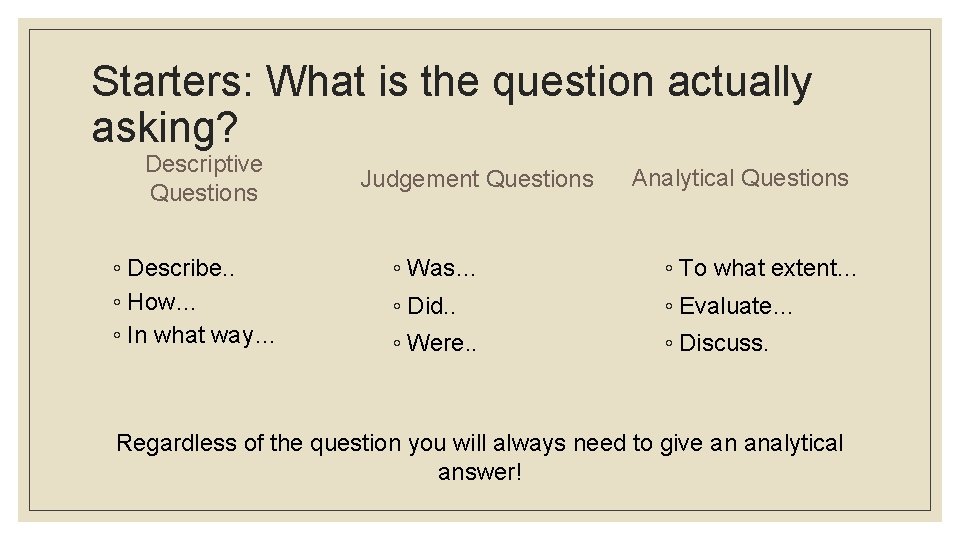
Starters: What is the question actually asking? Descriptive Questions ◦ Describe. . ◦ How… ◦ In what way… Judgement Questions Analytical Questions ◦ Was… ◦ To what extent… ◦ Did. . ◦ Evaluate… ◦ Were. . ◦ Discuss. Regardless of the question you will always need to give an analytical answer!
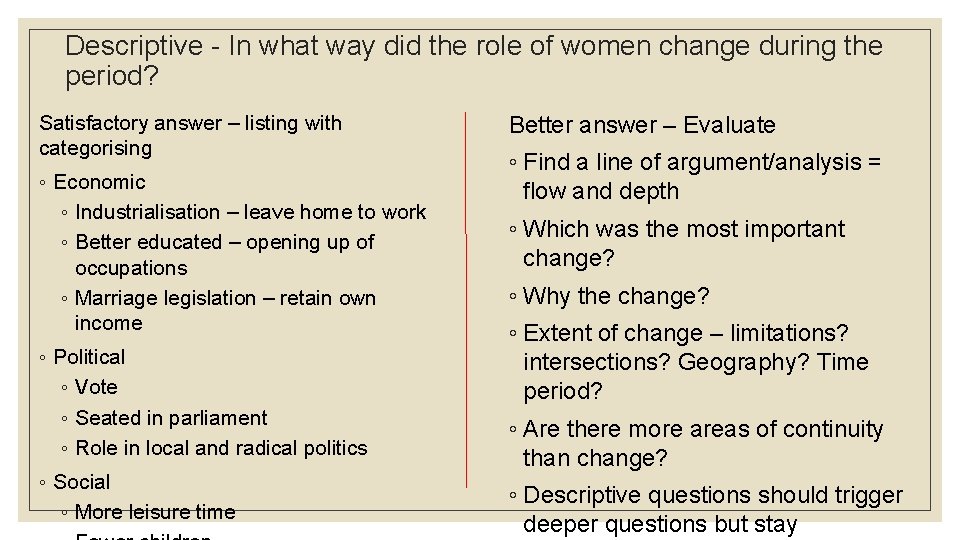
Descriptive - In what way did the role of women change during the period? Satisfactory answer – listing with categorising ◦ Economic ◦ Industrialisation – leave home to work ◦ Better educated – opening up of occupations ◦ Marriage legislation – retain own income ◦ Political ◦ Vote ◦ Seated in parliament ◦ Role in local and radical politics ◦ Social ◦ More leisure time Better answer – Evaluate ◦ Find a line of argument/analysis = flow and depth ◦ Which was the most important change? ◦ Why the change? ◦ Extent of change – limitations? intersections? Geography? Time period? ◦ Are there more areas of continuity than change? ◦ Descriptive questions should trigger deeper questions but stay
SEMINAR… ESSAY STRUCTURE PRACTICE