
Concern with definition goes back to ancient Greece
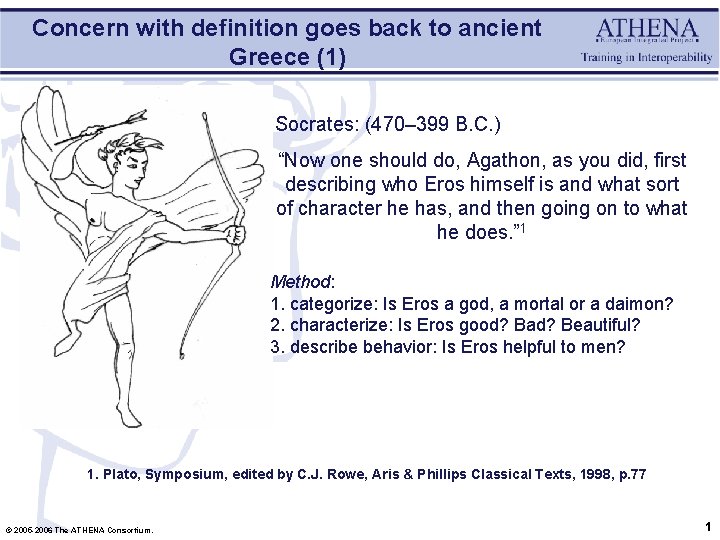
Concern with definition goes back to ancient Greece (1) Socrates: (470– 399 B. C. ) “Now one should do, Agathon, as you did, first describing who Eros himself is and what sort of character he has, and then going on to what he does. ” 1 Method: 1. categorize: Is Eros a god, a mortal or a daimon? 2. characterize: Is Eros good? Bad? Beautiful? 3. describe behavior: Is Eros helpful to men? 1. Plato, Symposium, edited by C. J. Rowe, Aris & Phillips Classical Texts, 1998, p. 77 © 2005 -2006 The ATHENA Consortium. 1
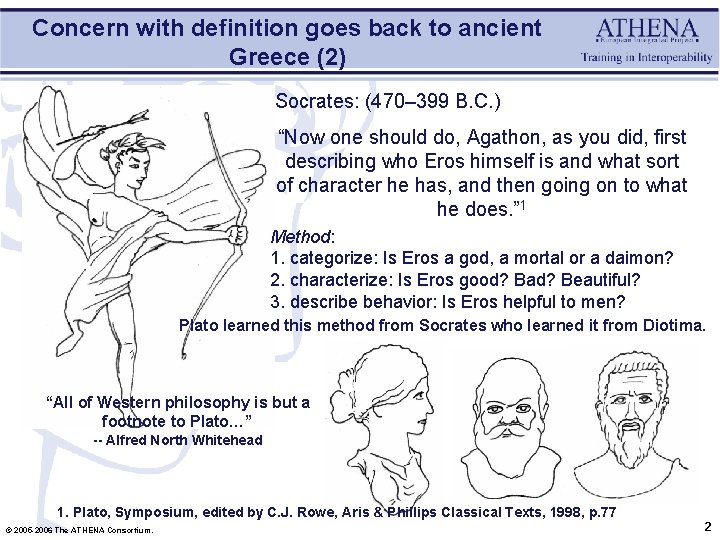
Concern with definition goes back to ancient Greece (2) Socrates: (470– 399 B. C. ) “Now one should do, Agathon, as you did, first describing who Eros himself is and what sort of character he has, and then going on to what he does. ” 1 Method: 1. categorize: Is Eros a god, a mortal or a daimon? 2. characterize: Is Eros good? Bad? Beautiful? 3. describe behavior: Is Eros helpful to men? Plato learned this method from Socrates who learned it from Diotima. “All of Western philosophy is but a footnote to Plato…” -- Alfred North Whitehead 1. Plato, Symposium, edited by C. J. Rowe, Aris & Phillips Classical Texts, 1998, p. 77 © 2005 -2006 The ATHENA Consortium. 2

How to write a definition (1) • If a good one exists refer to it. See dictionaries and ISO standards. Or try google define: © 2005 -2006 The ATHENA Consortium. 3
How to write a definition (2) • Otherwise choose a suitable method: – Intensional – Extensional – Ostensive – Ad-hoc – Theoretical – Operational – Genus (super class) and difference, the classic method • Key: Determine the intension of the concept and include examples of how the term is used. © 2005 -2006 The ATHENA Consortium. 4

Intension and Extension • The intension of a concept is its set of distinguishing characteristics • It is essentially a formula for testing if something is an instance of the concept. • The extension of a concept, on the other hand, is determined by its intension, and is the set of all those classes and objects that each have the distinguishing characteristics of the concept. © 2005 -2006 The ATHENA Consortium. 5
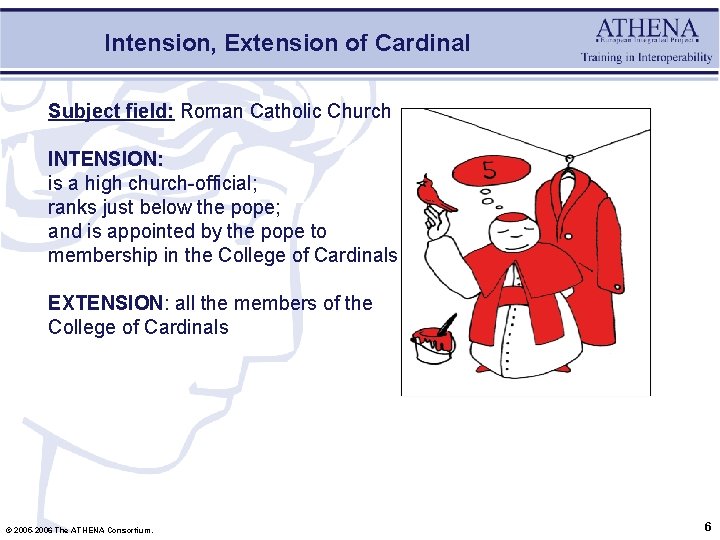
Intension, Extension of Cardinal Subject field: Roman Catholic Church INTENSION: is a high church-official; ranks just below the pope; and is appointed by the pope to membership in the College of Cardinals EXTENSION: all the members of the College of Cardinals © 2005 -2006 The ATHENA Consortium. 6
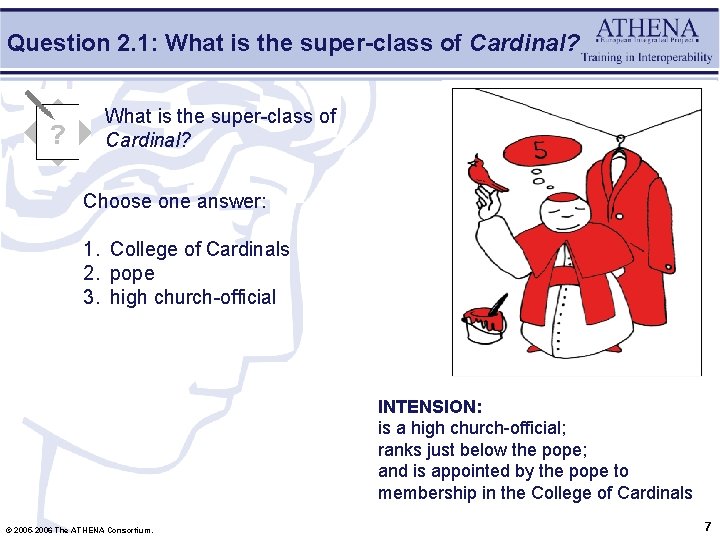
Question 2. 1: What is the super-class of Cardinal? Choose one answer: 1. College of Cardinals 2. pope 3. high church-official INTENSION: is a high church-official; ranks just below the pope; and is appointed by the pope to membership in the College of Cardinals © 2005 -2006 The ATHENA Consortium. 7
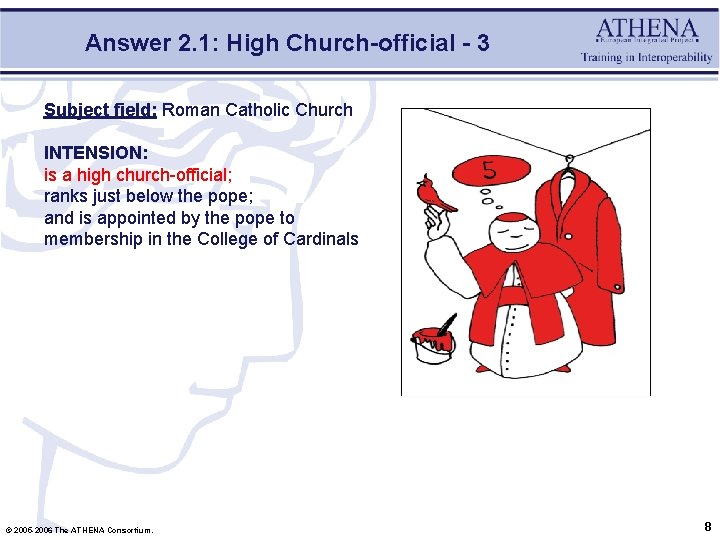
Answer 2. 1: High Church-official - 3 Subject field: Roman Catholic Church INTENSION: is a high church-official; ranks just below the pope; and is appointed by the pope to membership in the College of Cardinals © 2005 -2006 The ATHENA Consortium. 8
Exercise 2. 1 • 1. Pick out the intension of Purchase Order from the definition given below: • Purchase order (subject field: SAP MM-PUR) • A request or instruction from a purchasing organization to a vendor (external supplier) or a plant to deliver a quantity of material or to perform services at a certain point in time. • 2. What is the super-class (genus) of purchase order? © 2005 -2006 The ATHENA Consortium. 9
Answer to exercise 2. 1 and new question 2. 2 • Distinguishing characteristics: – A purchase order is a request or instruction – It is given by a purchasing organization – It is given to a vendor (external supplier) or a plant – It specifies either the delivery of a quantity of material at a certain point in time or the performance of services at a certain point in time • Super-class: – Request or instruction • How would you draw a subtype graph relating purchase order to its super-class? © 2005 -2006 The ATHENA Consortium. 10
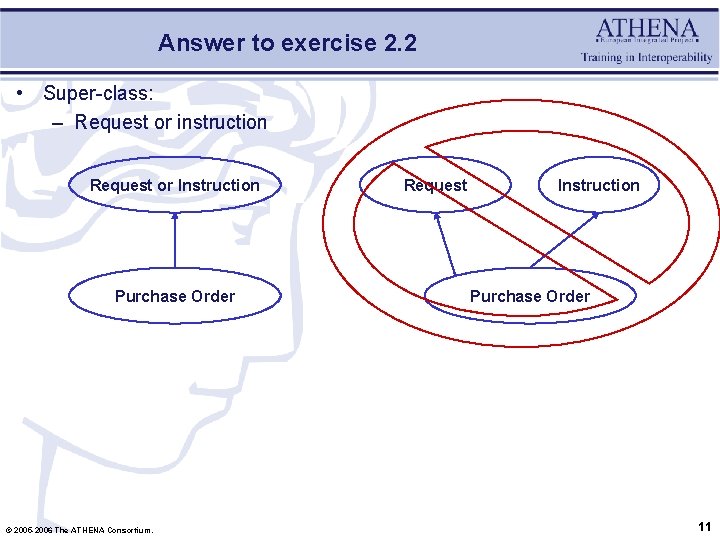
Answer to exercise 2. 2 • Super-class: – Request or instruction Request or Instruction Purchase Order © 2005 -2006 The ATHENA Consortium. Request Instruction Purchase Order 11
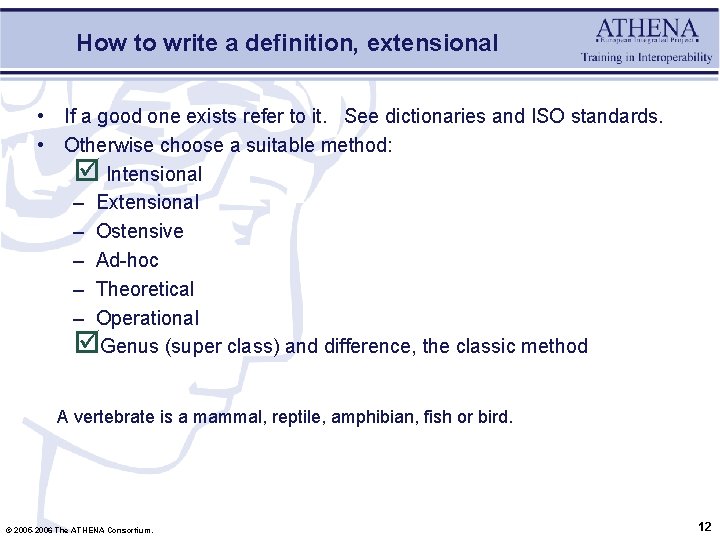
How to write a definition, extensional • If a good one exists refer to it. See dictionaries and ISO standards. • Otherwise choose a suitable method: þ Intensional – Extensional – Ostensive – Ad-hoc – Theoretical – Operational þGenus (super class) and difference, the classic method A vertebrate is a mammal, reptile, amphibian, fish or bird. © 2005 -2006 The ATHENA Consortium. 12
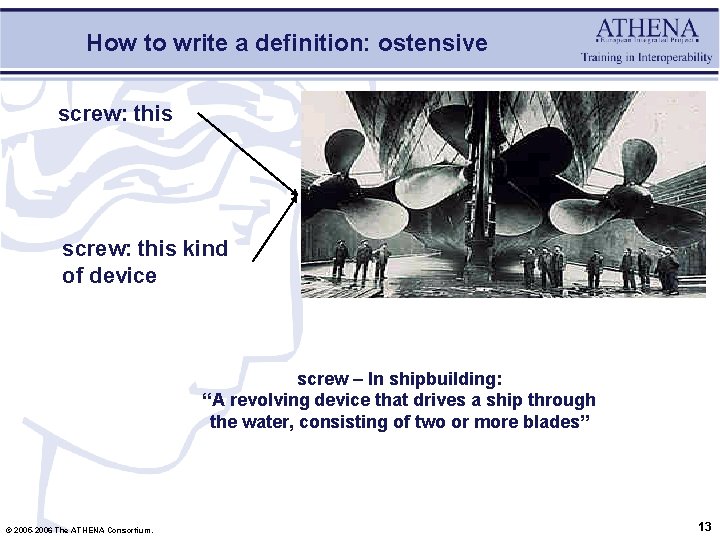
How to write a definition: ostensive screw: this kind of device screw – In shipbuilding: “A revolving device that drives a ship through the water, consisting of two or more blades” © 2005 -2006 The ATHENA Consortium. 13
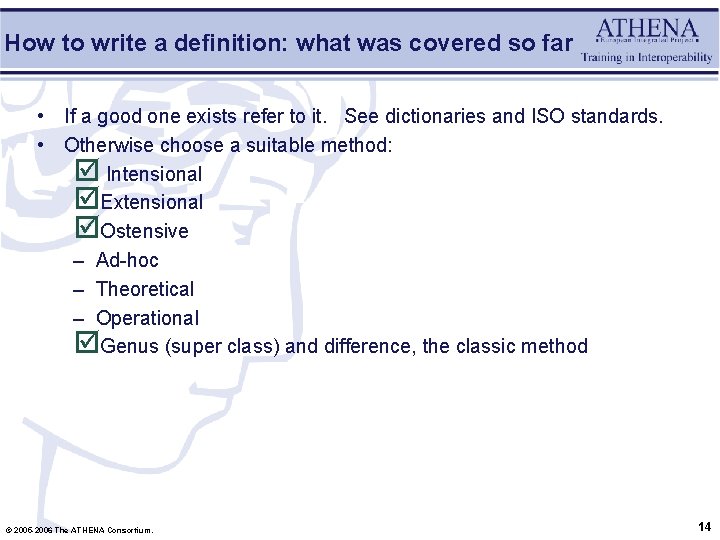
How to write a definition: what was covered so far • If a good one exists refer to it. See dictionaries and ISO standards. • Otherwise choose a suitable method: þ Intensional þExtensional þOstensive – Ad-hoc – Theoretical – Operational þGenus (super class) and difference, the classic method © 2005 -2006 The ATHENA Consortium. 14
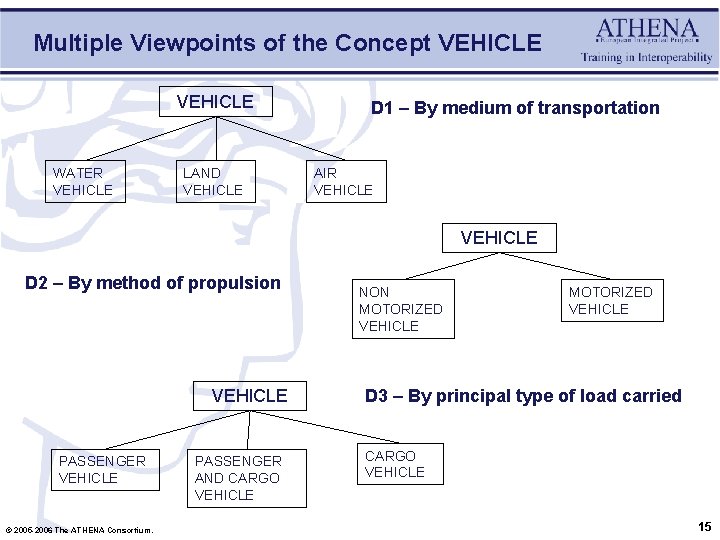
Multiple Viewpoints of the Concept VEHICLE WATER VEHICLE LAND VEHICLE D 1 – By medium of transportation AIR VEHICLE D 2 – By method of propulsion VEHICLE PASSENGER VEHICLE © 2005 -2006 The ATHENA Consortium. PASSENGER AND CARGO VEHICLE NON MOTORIZED VEHICLE D 3 – By principal type of load carried CARGO VEHICLE 15
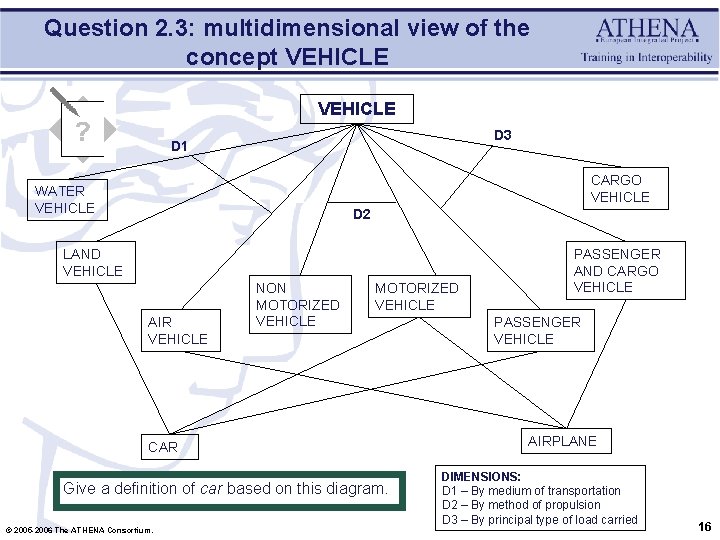
Question 2. 3: multidimensional view of the concept VEHICLE D 3 D 1 CARGO VEHICLE WATER VEHICLE D 2 LAND VEHICLE AIR VEHICLE NON MOTORIZED VEHICLE CAR Give a definition of car based on this diagram. © 2005 -2006 The ATHENA Consortium. PASSENGER AND CARGO VEHICLE PASSENGER VEHICLE AIRPLANE DIMENSIONS: D 1 – By medium of transportation D 2 – By method of propulsion D 3 – By principal type of load carried 16
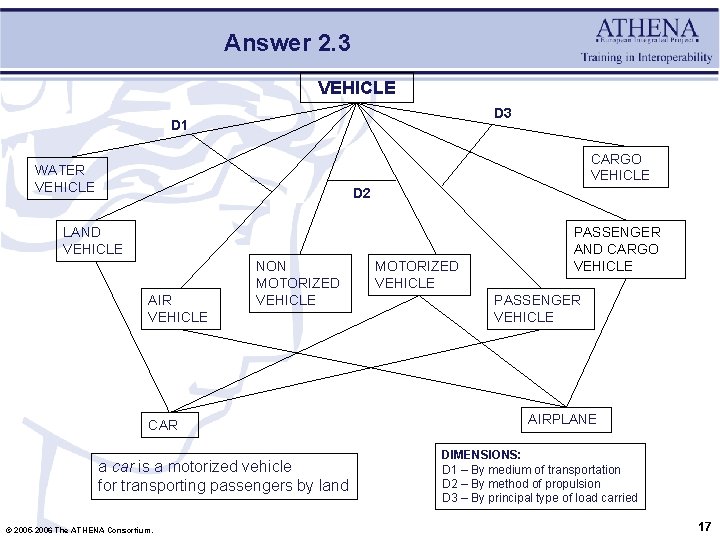
Answer 2. 3 VEHICLE D 3 D 1 CARGO VEHICLE WATER VEHICLE D 2 LAND VEHICLE AIR VEHICLE NON MOTORIZED VEHICLE CAR a car is a motorized vehicle for transporting passengers by land © 2005 -2006 The ATHENA Consortium. MOTORIZED VEHICLE PASSENGER AND CARGO VEHICLE PASSENGER VEHICLE AIRPLANE DIMENSIONS: D 1 – By medium of transportation D 2 – By method of propulsion D 3 – By principal type of load carried 17
- Slides: 17