
Conceptualization of Technology Engineering Entrepreneur and Innovation for
- Slides: 48
Conceptualization of Technology, Engineering, Entrepreneur and Innovation for Designing STEM Activities in Thailand Chokchai Yuenyong Science Education Program, Faculty of Education Khon Kaen University, Thailand Email: ychok@kku. ac. th
Increasing STEM Education • citizens of 21 st century live in a scientific and technological ‘culture’ • everyone needs to have some scientific literacy in order to make decisions and engage in debates about scientific issues • individuals who can understand the fundamentals of STEM ideas and think critically about these issues
Conception of STEM Education • what comprises STEM content and practices and what STEM conceptions look like range in the literature, especially conceptions of STEM education • Moore et al. (2015) defined STEM education for enhancing teachers. They define it as ‘‘the teaching and learning of the content and practices of disciplinary knowledge which include science and/or mathematics through the integration of the practices of engineering and engineering design of relevant technologies. ’’
Increasing STEM Education • The US promoted STEM education. Their STEM reform initiative could be understandable as: – Science, mathematics, engineering, and technology are fields in which the US needs to produce more highly competent workers in order to compete in the future global marketplace. – it would be advantageous for the learner to have real-life hands-on projects that explain and utilize the interconnectedness of S T E M – understanding of the fields of science, mathematics, technology, and engineering are essential knowledge sources for all citizens (particularly, minority group) - e. g. to fulfill job and to function as effective citizens
STEM education in overseas • Many countries (e. g. USA, UK, Australia, Finland, Japan etc. ) reform curriculum and pedagogy to make science and mathematics more engaging and practical, through problem-based and inquiry-based learning, and emphases on creativity and critical thinking in order to provide the STEM classrooms. • The main South Korean program for building participation and achievement in STEM has incorporated the arts, to strengthen the focuses on creativity and design. The program is titled STEAM. • Canada suggested the lessons for indigenous STEM education (Marginson et. al. , 2013). • Science coursework in Singapore stresses inventive thinking and activities for STEM education (Ministry of Education in Singapore, 2014).
Conception of STEM Education • what comprises STEM content and practices and what STEM conceptions look like range in the literature, especially conceptions of STEM education • Moore et al. (2015) defined STEM education for enhancing teachers. They define it as ‘‘the teaching and learning of the content and practices of disciplinary knowledge which include science and/or mathematics through the integration of the practices of engineering and engineering design of relevant technologies. ’’
Conception of STEM Education Moore et al. (2015) proposed five characteristics distinguish integrated STEM instruction from other teacher pedagogy: • (a) the content and practices of one or more anchor science and mathematics disciplines define some of the primary learning goals; • (b) the integrator is the engineering practices and engineering design of technologies as the context; • (c) the engineering design or engineering practices related to relevant technologies requires the use of scientific and mathematical concepts through design justification; • (d) the development of 21 st century skills is emphasized; and • (e) the context of instruction requires solving a real-world problem or task through teamwork.
STEM education in overseas • Many countries (e. g. USA, UK, Australia, Finland, Japan etc. ) reform curriculum and pedagogy to make science and mathematics more engaging and practical, through problem-based and inquiry-based learning, and emphases on creativity and critical thinking in order to provide the STEM classrooms. • The main South Korean program for building participation and achievement in STEM has incorporated the arts, to strengthen the focuses on creativity and design. The program is titled STEAM. • Canada suggested the lessons for indigenous STEM education (Marginson et. al. , 2013). • Science coursework in Singapore stresses inventive thinking and activities for STEM education (Ministry of Education in Singapore, 2014).
What did we learn from STEM learning those activities? • STEM learning could be provided through context of Problembased learning (PBL) • students would have the opportunity to design, solve problems, and then make decisions or put into research based on a challenging question. • Combines scientific study, technology design, engineering technology and mathematical analysis. • The activities was provided through engineering design process.
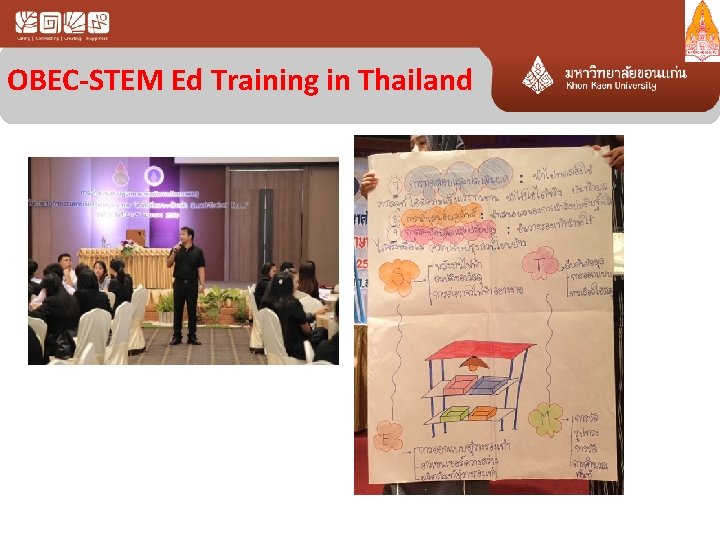
OBEC-STEM Ed Training in Thailand
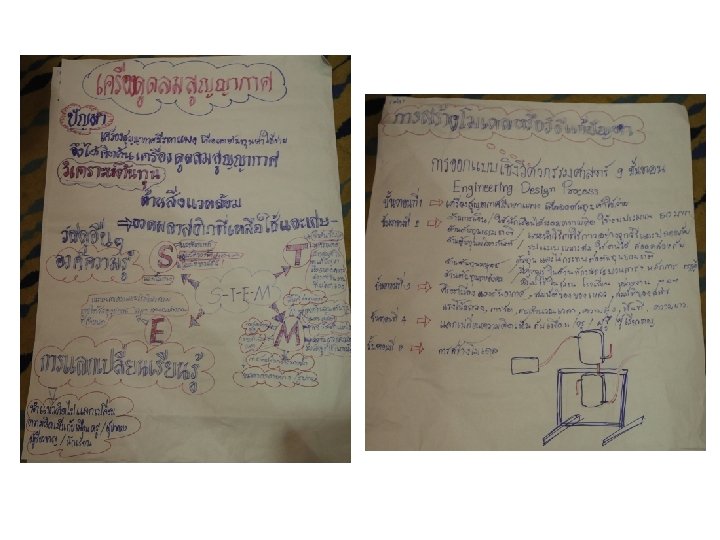
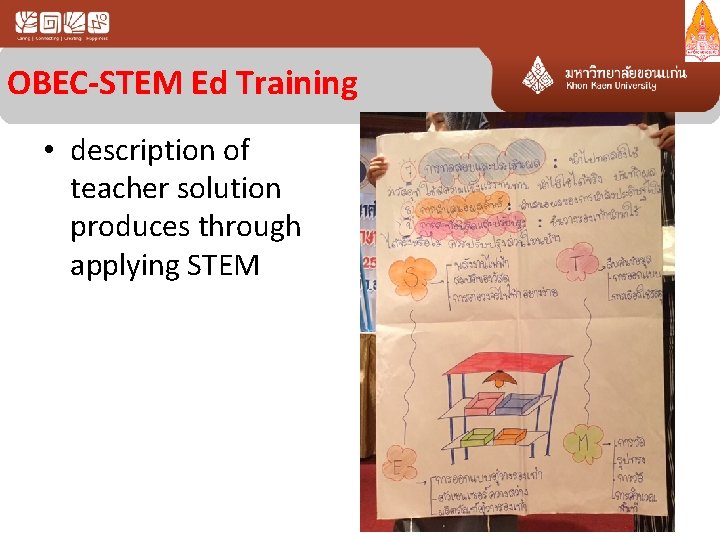
OBEC-STEM Ed Training • description of teacher solution produces through applying STEM
How can we develop the STEM activities? • Find some ways to integrate disciplines in activities – PBL • Clearly more understanding of technology and engineering • What the position of technology and engineering was perceived by Thai educators? It suggested some misconceptions about technology and engineering.
OBEC STEM Ed Training • Considering on element of technology from what teachers’ description of solution produces through applying STEM could be categorized as following: – Technology as instructional media – Technology as information technology – Technology as internet searching – Technology as designing – Technology as technological products
Technology and Engineering in curriculum • The technology appears Thailand curriculum as in the content standard of occupation and technology. The content focus on: – Living and family – Design and technology – Information technology and communication – (computer) – Currently- computing science – Occupation • No obvious Engineering appears in Thailand basic education
Technology and Engineering in curriculum • What aspects of technology and Engineers should be focused on STEM education?
Technology and Engineering in curriculum in Australia • technology subject – Designing technology – Learn to create things/products – Engineer as content of technology subject
Philosophy of technology - engineers • de Vries (1997) proposed the skeptical view of technology – “technology as beyond applied science”. He suggested that technology is not only applied science but also other knowledge (mathematics, art, culture, economics, and so on).
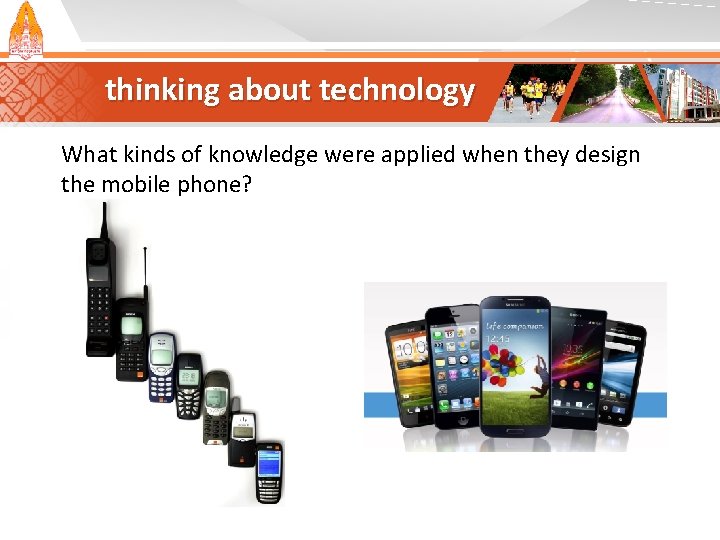
thinking about technology What kinds of knowledge were applied when they design the mobile phone?
Philosophy of technology - engineers • The philosophy of technology was initially dominated by metaphysical analyses of technology where the designing and making of modern artefacts were regarded as a ‘‘black box’’, and by critical analyses of the consequences of science and technology for the individual and society. • The so-called ‘‘cultural philosophy’’, ‘‘humanities approach’’ or ‘‘critical analyses’’ resulted in a philosophy about technology that could be called an external philosophy (De Vries 2003 c, p. 83; Kroes & Meijers 2000, p. xvii).
Philosophy of technology - engineers • by 1950 a movement towards an internal philosophy of technology occurred (Van Riessen 1949) insofar as this ‘‘black box’’ was unravelled by taking actual engineering practice as point of departure for the philosophy of technology (Kroes & Meijers 2000, p. xviii; Mitcham 1994, p. 157). • the term ‘‘technology’’ can have both a narrow and a wide meaning in its present discourse, which roughly coincides with the manner in which two professional groups, namely engineers and social scientists, respectively employ the term, and which lead to tension between the two uses (Mitcham 1994, p. 143). • The concept ‘‘technology’’ has mainly been reserved by engineers to refer to a direct involvement with material construction and the manipulation of artefacts (Mitcham 1994, p. 147).
Philosophy of technology - engineers • In the social sciences the concept ‘‘technology’’ also includes making material artefacts, the completed objects, their usages and to a limited extent also the intellectual and social contexts. Sometimes technology is defined in such a way that it includes making non-material things like laws and language (Mitcham 1994, p. 150). • The tension between the narrower engineering usage of the word ‘‘technology’’ and its broader use in the social sciences cannot be clearly resolved, and should at most be accommodated. • Mitcham (1994) ’s framework, which is now a-days regarded to be a ‘point of reference’ in the field of philosophy of technology, consists of the four modes of the manifestation of technology: technology as object, technology as knowledge, technology as activity, and technology as volition
Difficulties to designing the STEM activities • Thai teachers seem to unclear understand the concept of technology • They perceived technology as products • The technology was viewed as technicians • The curriculum related to technology emphasized on the product rather than process and concept of technology
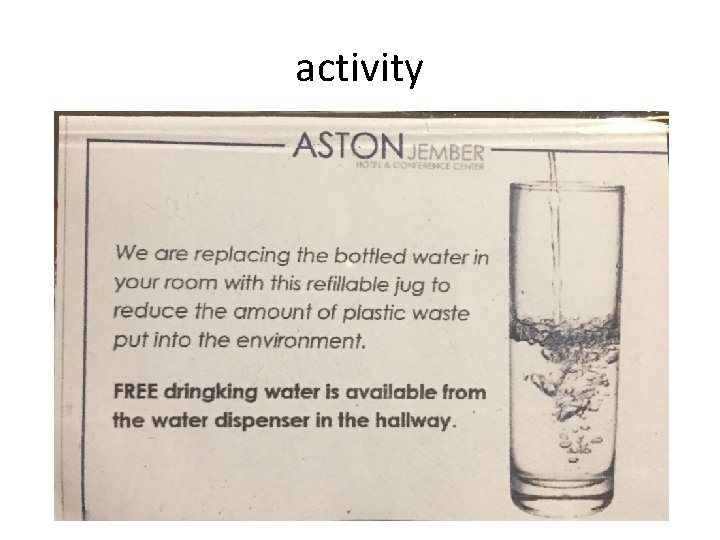
activity
Conceptualization of technology • To organize the STEM education, teachers need to consider conceptualization of technology regarding to the philosophy of technology • Because of STEM education organizing, Re-conceptualization of technology should be considered.
In real world of technology • For example, biotechnology • Biotechnology industry VS Governments, universities, start-up companies, and publicly • creates a need for STEM employees who have appropriate skills - one of which is entrepreneurship • entrepreneurship education has received attention for its importance in the areas of science, technology, engineering, and mathematics (STEM) (Spike Innovation 2015)
Entrepreneurship and Innovation • the concepts of entrepreneurship and innovation • Entrepreneurship refers to the process of developing new business ventures and acquiring existing businesses • creating and managing innovative organisations • Innovation is an important prerequisite for gaining a competitive advantage and for building a strong and sustainable business. • developing knowledge and competency in meeting the unique challenges of managing and marketing a growing organisation
Developing STEM Education Learning activity: Hot and Cool Container food delivery • Wacharaporn Khaokhajorn, Sakonnakorn Rajabhat University, Thailand • Ask students to discuss about the food delivery at home
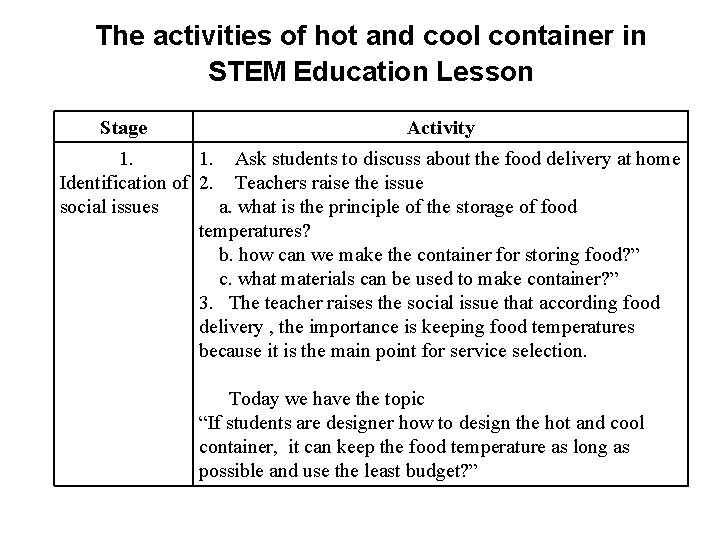
The activities of hot and cool container in STEM Education Lesson Stage Activity 1. 1. Ask students to discuss about the food delivery at home Identification of 2. Teachers raise the issue social issues a. what is the principle of the storage of food temperatures? b. how can we make the container for storing food? ” c. what materials can be used to make container? ” 3. The teacher raises the social issue that according food delivery , the importance is keeping food temperatures because it is the main point for service selection. Today we have the topic “If students are designer how to design the hot and cool container, it can keep the food temperature as long as possible and use the least budget? ”
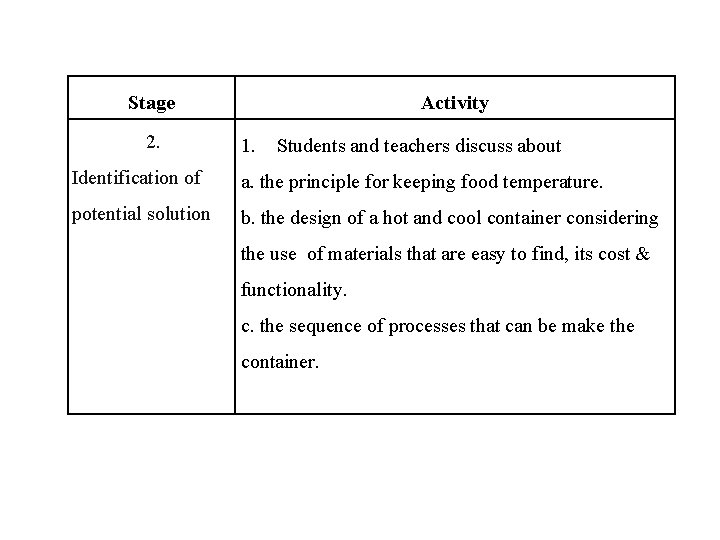
Stage 2. Activity 1. Students and teachers discuss about Identification of a. the principle for keeping food temperature. potential solution b. the design of a hot and cool container considering the use of materials that are easy to find, its cost & functionality. c. the sequence of processes that can be make the container.
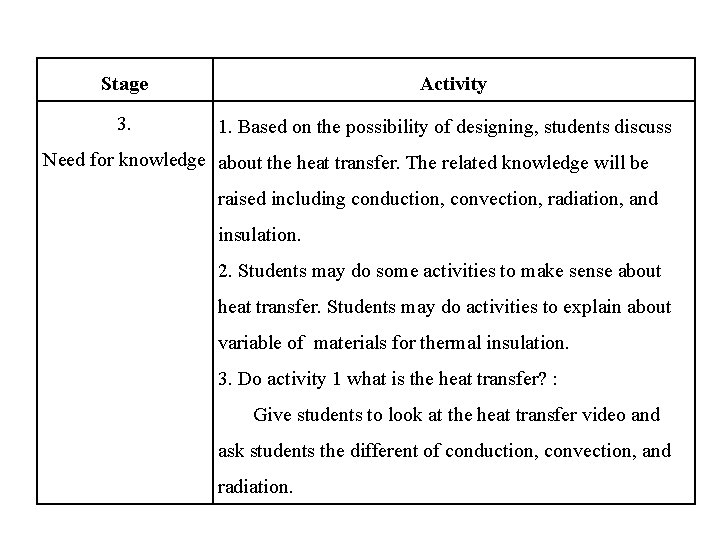
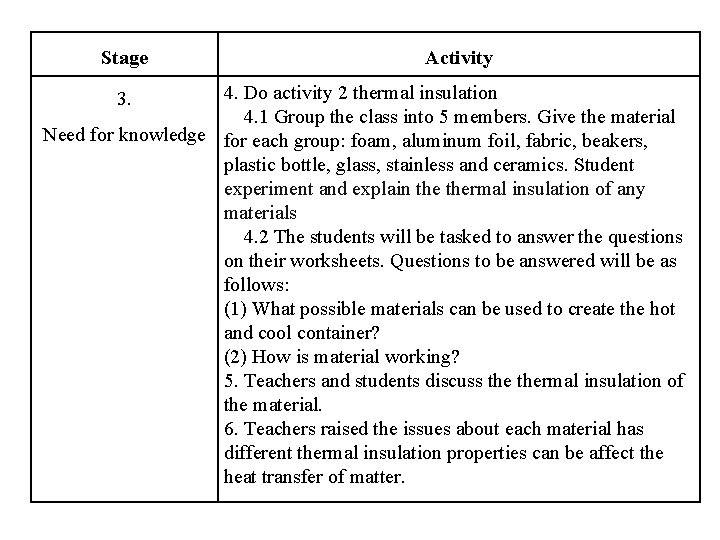
Stage 3. Activity 1. Based on the possibility of designing, students discuss Need for knowledge about the heat transfer. The related knowledge will be raised including conduction, convection, radiation, and insulation. 2. Students may do some activities to make sense about heat transfer. Students may do activities to explain about variable of materials for thermal insulation. 3. Do activity 1 what is the heat transfer? : Give students to look at the heat transfer video and ask students the different of conduction, convection, and radiation.
Stage Activity 4. Do activity 2 thermal insulation 4. 1 Group the class into 5 members. Give the material Need for knowledge for each group: foam, aluminum foil, fabric, beakers, plastic bottle, glass, stainless and ceramics. Student experiment and explain thermal insulation of any materials 4. 2 The students will be tasked to answer the questions on their worksheets. Questions to be answered will be as follows: (1) What possible materials can be used to create the hot and cool container? (2) How is material working? 5. Teachers and students discuss thermal insulation of the material. 6. Teachers raised the issues about each material has different thermal insulation properties can be affect the heat transfer of matter. 3.
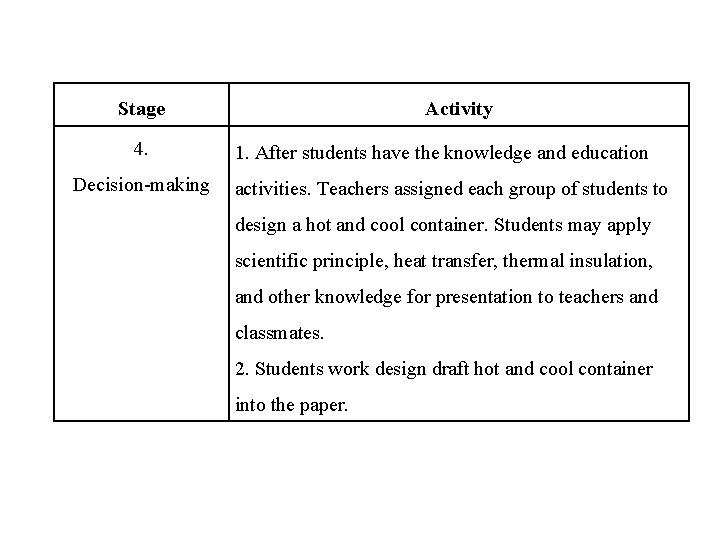
Stage 4. Decision-making Activity 1. After students have the knowledge and education activities. Teachers assigned each group of students to design a hot and cool container. Students may apply scientific principle, heat transfer, thermal insulation, and other knowledge for presentation to teachers and classmates. 2. Students work design draft hot and cool container into the paper.
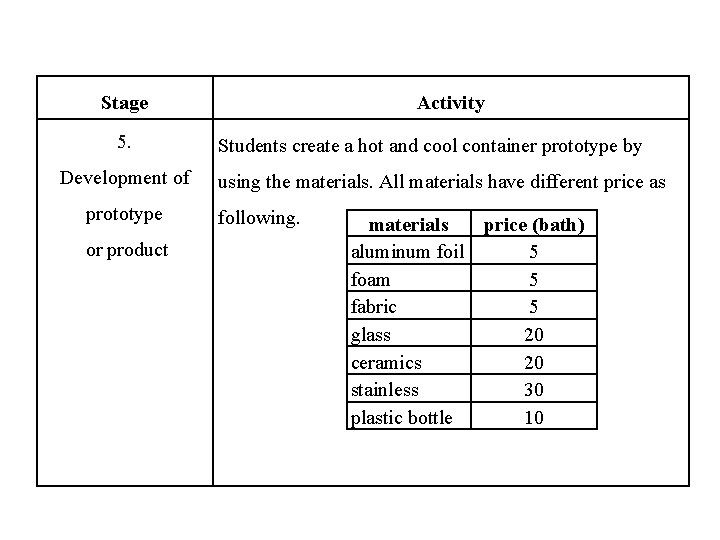
Stage 5. Development of prototype or product Activity Students create a hot and cool container prototype by using the materials. All materials have different price as following. materials price (bath) aluminum foil 5 foam 5 fabric 5 glass 20 ceramics 20 stainless 30 plastic bottle 10
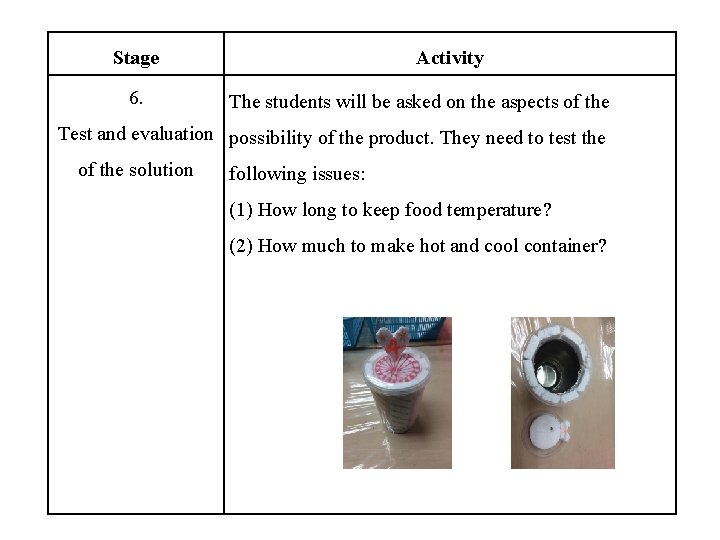
Stage 6. Activity The students will be asked on the aspects of the Test and evaluation possibility of the product. They need to test the of the solution following issues: (1) How long to keep food temperature? (2) How much to make hot and cool container?
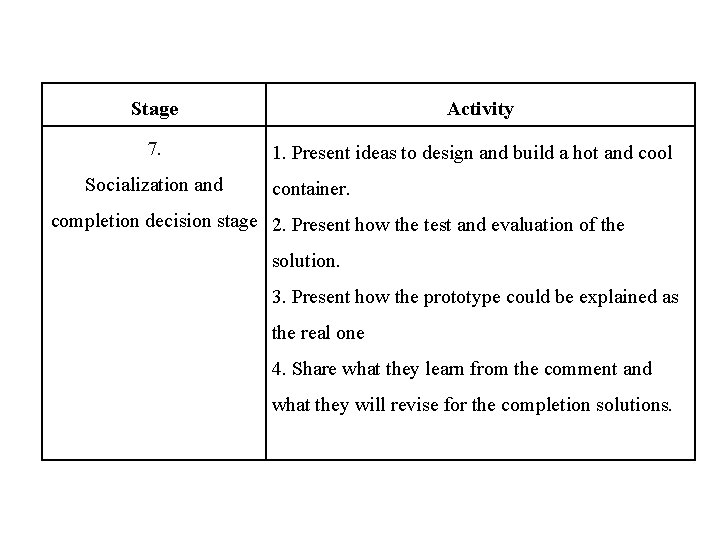
Stage 7. Socialization and Activity 1. Present ideas to design and build a hot and cool container. completion decision stage 2. Present how the test and evaluation of the solution. 3. Present how the prototype could be explained as the real one 4. Share what they learn from the comment and what they will revise for the completion solutions.
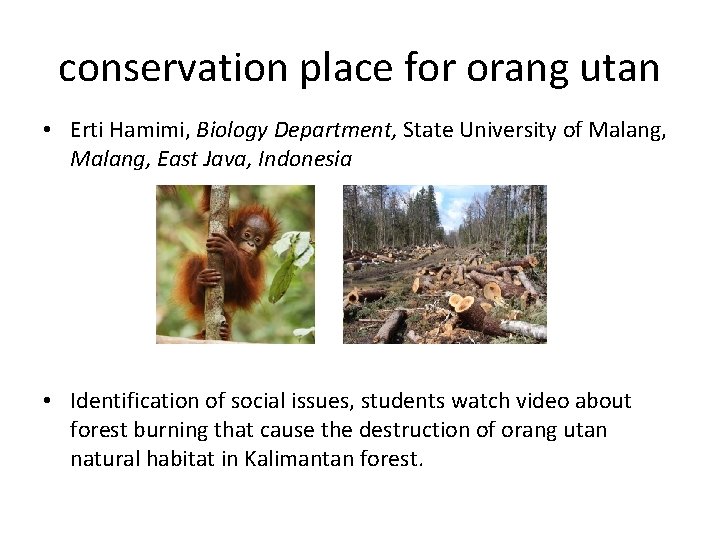
conservation place for orang utan • Erti Hamimi, Biology Department, State University of Malang, East Java, Indonesia • Identification of social issues, students watch video about forest burning that cause the destruction of orang utan natural habitat in Kalimantan forest.
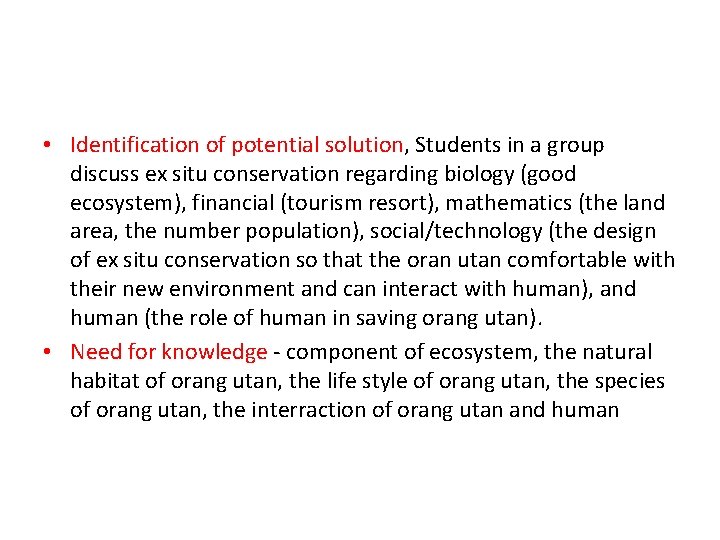
• Identification of potential solution, Students in a group discuss ex situ conservation regarding biology (good ecosystem), financial (tourism resort), mathematics (the land area, the number population), social/technology (the design of ex situ conservation so that the oran utan comfortable with their new environment and can interact with human), and human (the role of human in saving orang utan). • Need for knowledge - component of ecosystem, the natural habitat of orang utan, the life style of orang utan, the species of orang utan, the interraction of orang utan and human
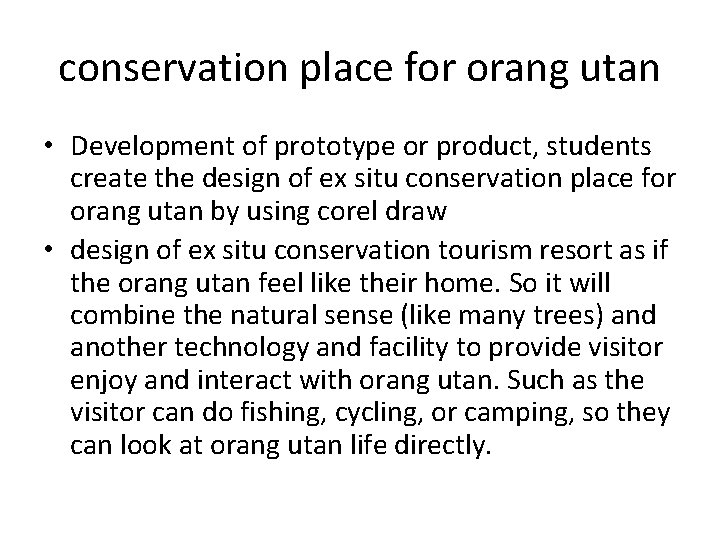
conservation place for orang utan • Development of prototype or product, students create the design of ex situ conservation place for orang utan by using corel draw • design of ex situ conservation tourism resort as if the orang utan feel like their home. So it will combine the natural sense (like many trees) and another technology and facility to provide visitor enjoy and interact with orang utan. Such as the visitor can do fishing, cycling, or camping, so they can look at orang utan life directly.
• Test and evaluation, students will be asked to develop some ideas how it could be the real ex situ conservation place for orang utan. – Is the ex situ conservation tourism resort suitable for orang utan to live (land area, number of population of orang utan, presence of arboreal environment)? – Is the ex situ conservation tourism resort capable to attract the visitors? – Can the ex situ conservation tourism resort make a good ecosystem for orang utan and enable their interaction with biotic and abiotic components? – Can the orang utan adapt with their new environment? – Is the facility good enough for human to be able interact with orang utan and can arise sense of belonging to the orang utan? – Can the tourism resort entertain the visitors (human)? – Can the tourism resort make profit and the money is used to take care the orang utan? – Can the tourism resort improve skill of orang utan so maybe someday if their natural habitat has been repaired, they will be able to be back in their natural habitat?
• Socialization and completion decision stage, Each group presents the design of their ex situ conservation place for tourism resort (orang utan paradise) in their social media: Instagram and linked with youtube to make the tutorial and make explanation about the design.
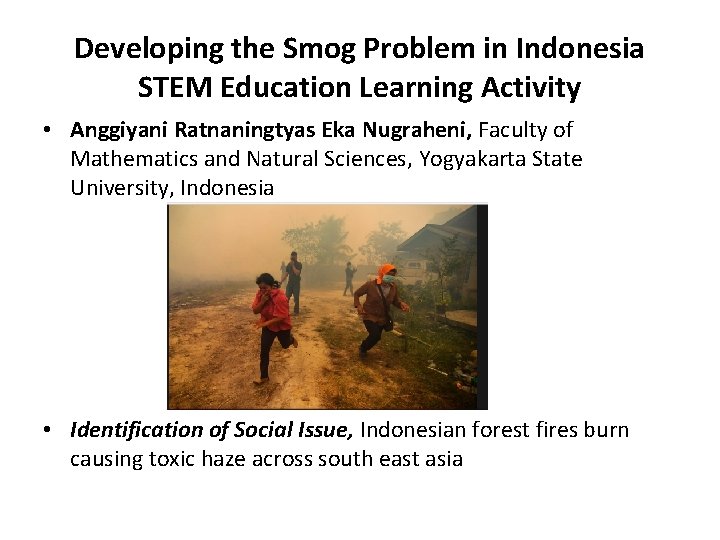
Developing the Smog Problem in Indonesia STEM Education Learning Activity • Anggiyani Ratnaningtyas Eka Nugraheni, Faculty of Mathematics and Natural Sciences, Yogyakarta State University, Indonesia • Identification of Social Issue, Indonesian forest fires burn causing toxic haze across south east asia
• Identification of potential solutions, Students work in group to design a specific form of air purifier that is different each other • Need for knowledge: – kind of gases which is existed in smog – colloid, mixture separation, and acid-base reaction – photosynthesis knowledge because some of air purifiers create by using plant as a air filter
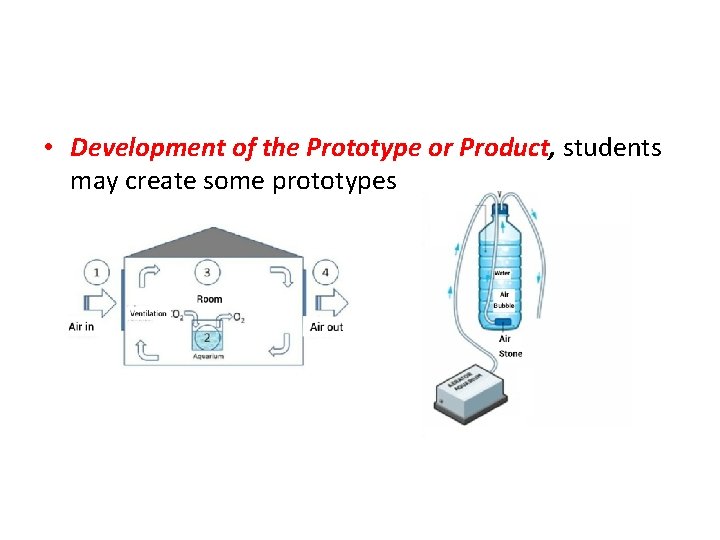
• Development of the Prototype or Product, students may create some prototypes
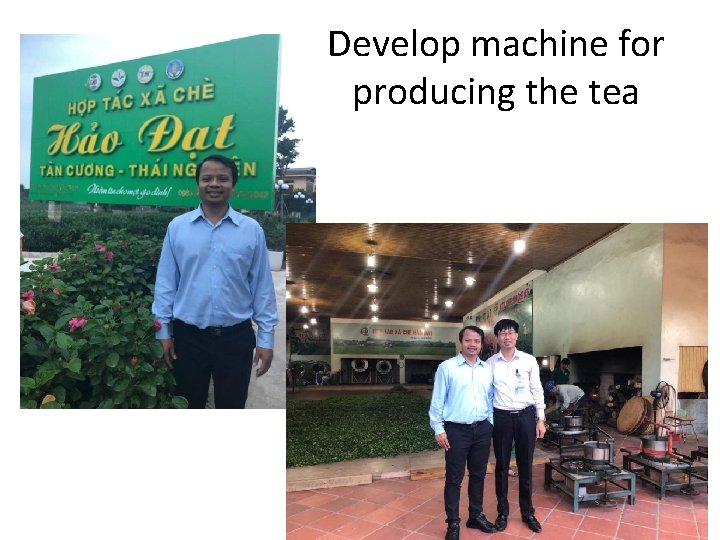
Develop machine for producing the tea
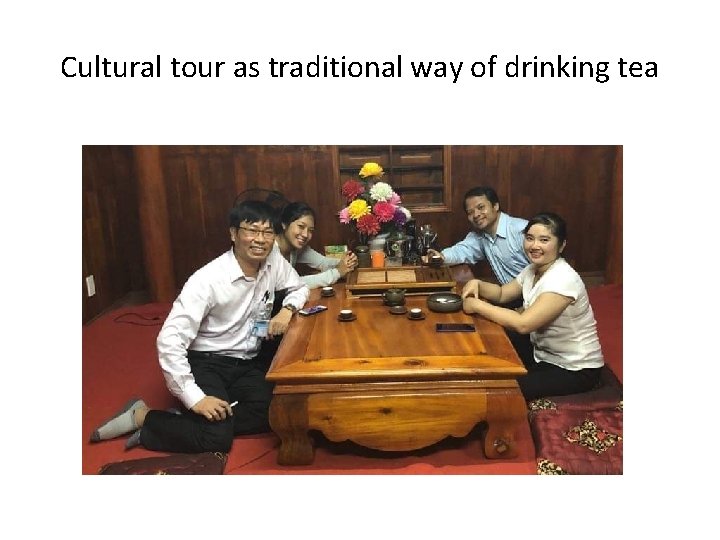
Cultural tour as traditional way of drinking tea
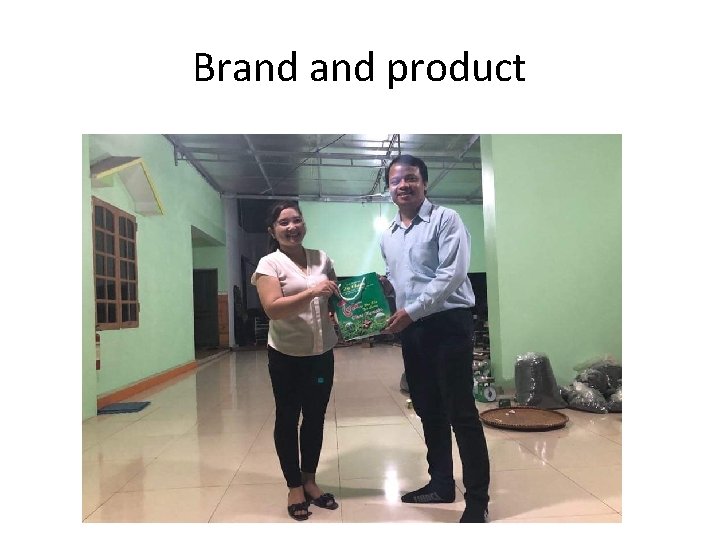
Brand product