
CONCEPTUALISING ICT USE IN A PRIMARY TEACHERS MATHEMATICS
- Slides: 27
CONCEPTUALISING ICT USE IN A PRIMARY TEACHER’S MATHEMATICS CLASSROOM Dr Esther Yook-Kin Loong Deakin University esther. loong@deakin. edu. au The Fourth South East Asia Design/Development Research International Conference 17 -18 April 2016 Deakin University CRICOS Provider Code: 00113 B
GUIDELINES FOR CARRYING OUT DESIGN RESEARCH • Implementing a design • Modifying a design • Multiple ways of analysing the design • Measuring dependent variables • Measuring independent variables • Reporting on design research (Collins, Joseph & Bielaczyc, 2004, p. 33) Deakin University CRICOS Provider Code: 00113 B
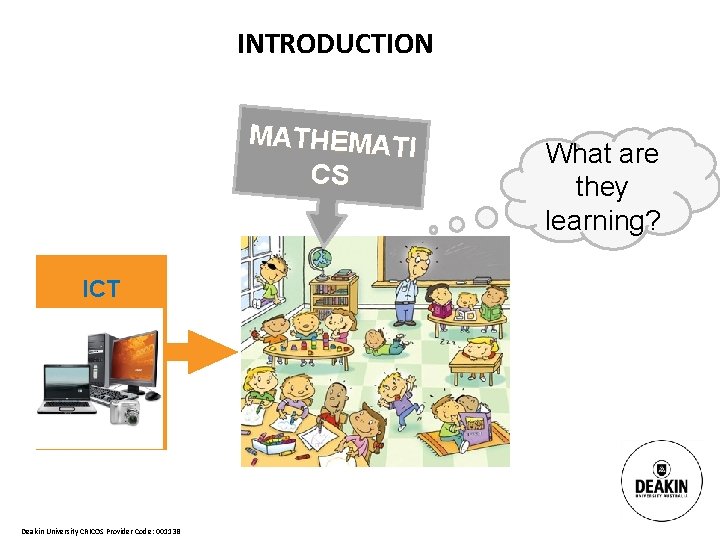
INTRODUCTION MATHEMATI CS ICT Deakin University CRICOS Provider Code: 00113 B What are they learning?
MEETING THIS CHALLENGE • ‘…it is a nontrivial task to capture the rich social and intellectual life of a classroom with a level of analysis that would permit one to look at real conceptual change taking place over time. ’ (Brown, 1992, p. 163) Deakin University CRICOS Provider Code: 00113 B
CAPTURING THE COMPLEXITIES OF ICT USE IN THE PRIMARY MATHEMATICS CLASSROOM The research questions were : § What active pedagogies do in-service teachers employ when using digital resources in mathematics teaching? § What are students’ perceptions about using digital resources in primary mathematics? Deakin University CRICOS Provider Code: 00113 B
GOALS AND ELEMENTS OF THE DESIGN • The goal- to explore one teacher’s TPACK and investigate students' perceptions of ICT use in the normal classroom • The elements –Classroom pedagogy when ICT is used – Teacher’s choice and decisions to use ICT –Measuring learning and perceptions of students Deakin University CRICOS Provider Code: 00113 B
CONTEXT OF STUDY • A mixed ability Grade 5 class of about 25 students • Teacher Carolyn (Psuedonym) is the class teacher and teaches all the subjects • The school is a suburban public school with an enrolment of about 1100 and slightly more than 20% students have Language background other than English • It has an index of community socio-educational advantage slightly higher than the average Australian school. • The classroom has an interactive whiteboard and internet access • Laptops were available but has to be shared amongst the classes. Carolyn managed to get 12 laptops from the other classes • The school has a website and teachers build their class blogs on the website. Deakin University CRICOS Provider Code: 00113 B
THE TEACHER • In her 7 th year of teaching at the time of participation in the study. • Not a strong user of technology and in her own words ‘’ been making use of ICT tools, but favoured such programs as Excel and Word (shapes) where I could specifically design and determine the task and monitor for a desired outcome. I also could see how ICT was used to introduce a topic, how it could enhance an explicit teaching session to a whole grade. • Not convinced that online games were able to engender mathematics learning and perceived that ‘online Maths resources …were used by teachers to keep early finishers busy, occupy students who needed extending or even remedial work and as rewards. ‘I wasn’t sure that children actually learnt anything whilst using online games and resources; I saw it as ‘playing’. Deakin University CRICOS Provider Code: 00113 B
PHASE 1 Due to the limited number of laptops, Carolyn used a TASK CENTRE Approach to teach Surface Area The class was divided into three groups to work with each of the following on a rotation basis: 1) Worksheet 1) Hands-on with concrete materials ( e. g. boxes) 1) Computer –Word and a website Deakin University CRICOS Provider Code: 00113 B
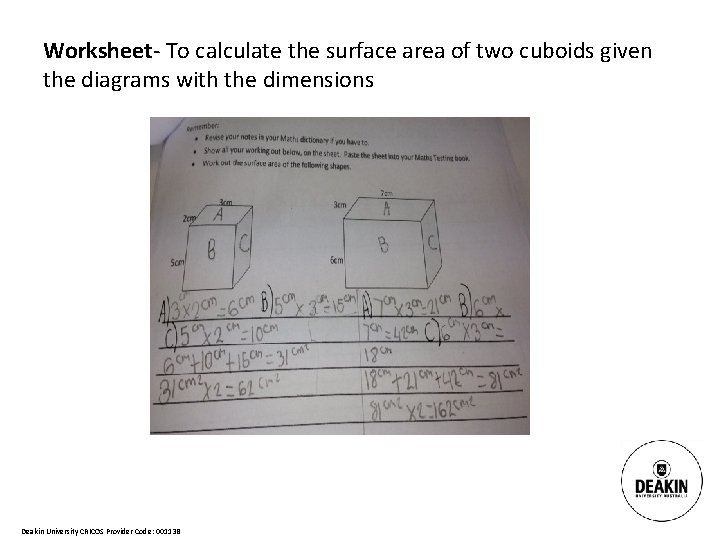
Worksheet- To calculate the surface area of two cuboids given the diagrams with the dimensions Deakin University CRICOS Provider Code: 00113 B
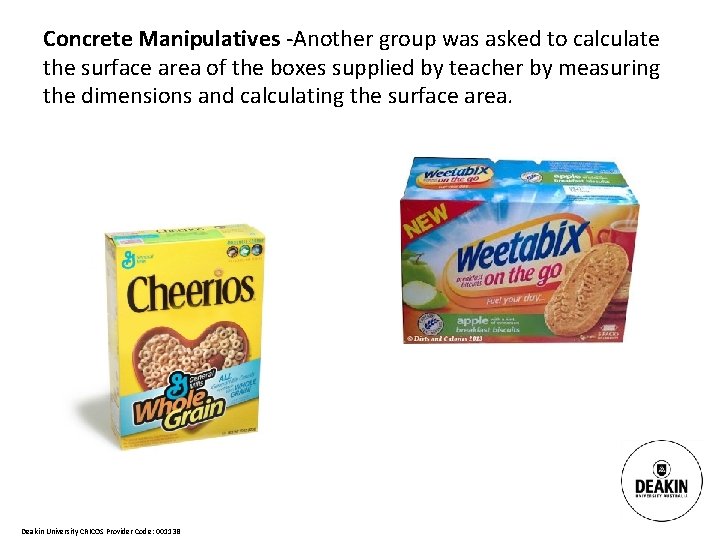
Concrete Manipulatives -Another group was asked to calculate the surface area of the boxes supplied by teacher by measuring the dimensions and calculating the surface area. Deakin University CRICOS Provider Code: 00113 B
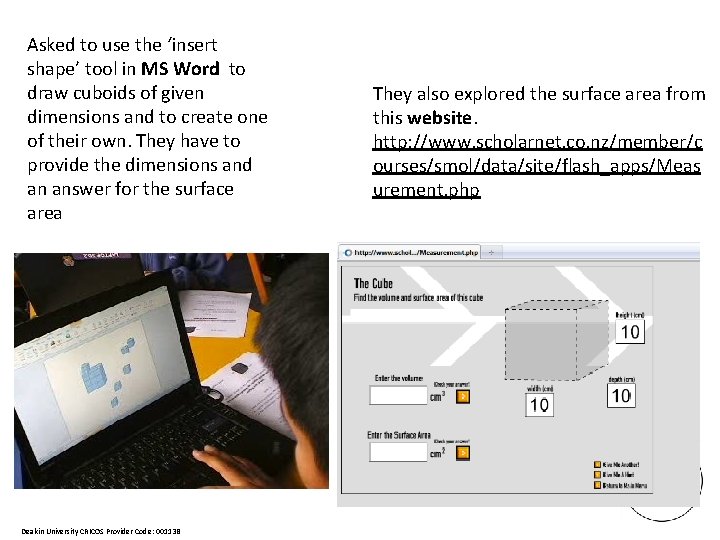
Asked to use the ‘insert shape’ tool in MS Word to draw cuboids of given dimensions and to create one of their own. They have to provide the dimensions and an answer for the surface area Deakin University CRICOS Provider Code: 00113 B They also explored the surface area from this website. http: //www. scholarnet. co. nz/member/c ourses/smol/data/site/flash_apps/Meas urement. php
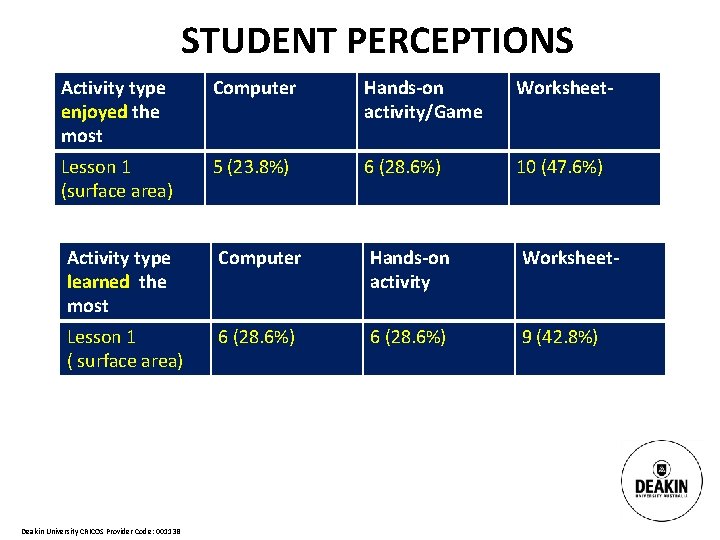
STUDENT PERCEPTIONS Activity type enjoyed the most Computer Hands-on activity/Game Worksheet- Lesson 1 (surface area) 5 (23. 8%) 6 (28. 6%) 10 (47. 6%) Activity type learned the most Computer Hands-on activity Worksheet- Lesson 1 ( surface area) 6 (28. 6%) 9 (42. 8%) Deakin University CRICOS Provider Code: 00113 B
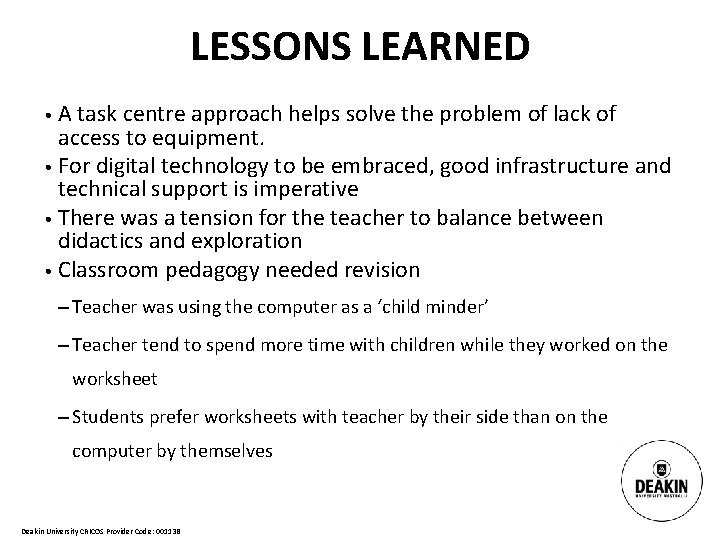
LESSONS LEARNED • A task centre approach helps solve the problem of lack of access to equipment. • For digital technology to be embraced, good infrastructure and technical support is imperative • There was a tension for the teacher to balance between didactics and exploration • Classroom pedagogy needed revision – Teacher was using the computer as a ‘child minder’ – Teacher tend to spend more time with children while they worked on the worksheet – Students prefer worksheets with teacher by their side than on the computer by themselves Deakin University CRICOS Provider Code: 00113 B
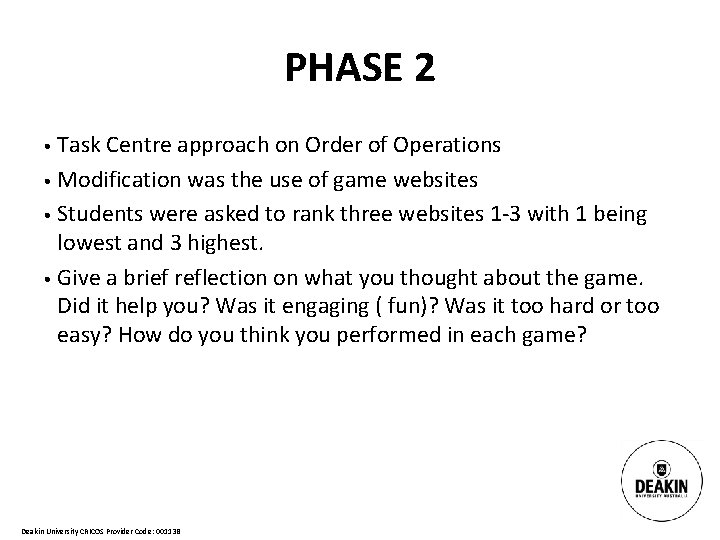
PHASE 2 • Task Centre approach on Order of Operations • Modification was the use of game websites • Students were asked to rank three websites 1 -3 with 1 being lowest and 3 highest. • Give a brief reflection on what you thought about the game. Did it help you? Was it engaging ( fun)? Was it too hard or too easy? How do you think you performed in each game? Deakin University CRICOS Provider Code: 00113 B
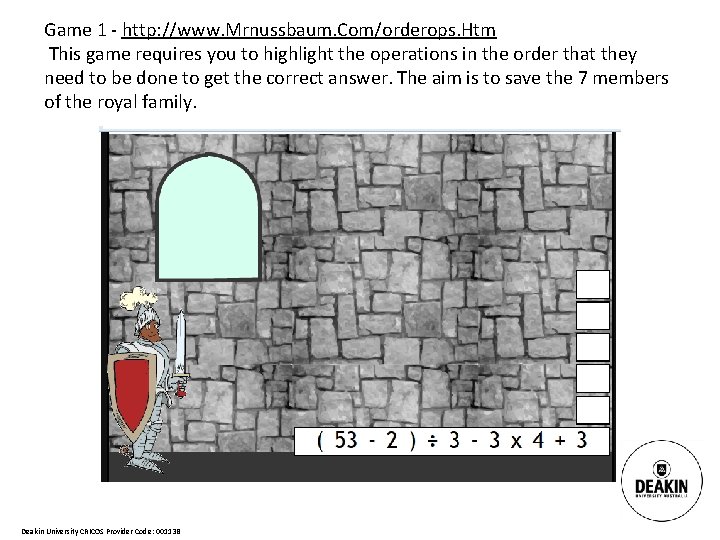
Game 1 - http: //www. Mrnussbaum. Com/orderops. Htm This game requires you to highlight the operations in the order that they need to be done to get the correct answer. The aim is to save the 7 members of the royal family. Deakin University CRICOS Provider Code: 00113 B
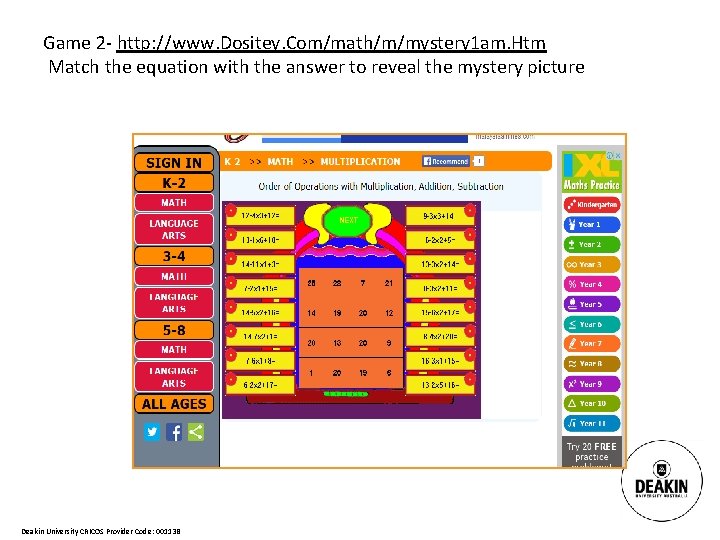
Game 2 - http: //www. Dositey. Com/math/m/mystery 1 am. Htm Match the equation with the answer to reveal the mystery picture Deakin University CRICOS Provider Code: 00113 B
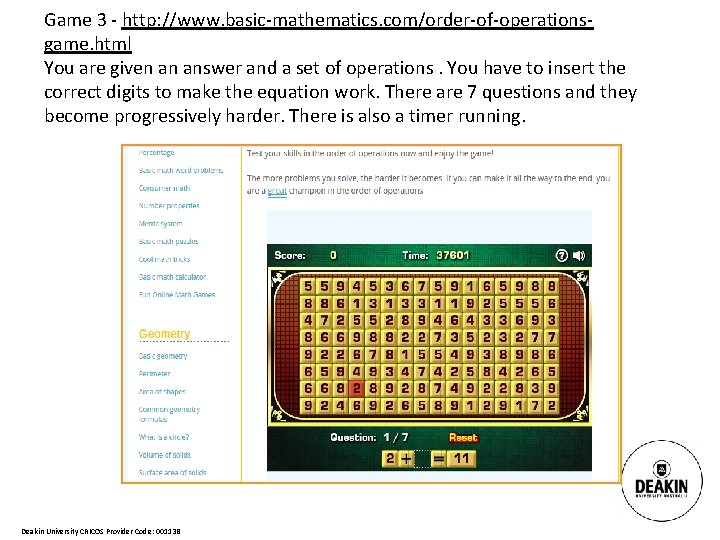
Game 3 - http: //www. basic-mathematics. com/order-of-operationsgame. html You are given an answer and a set of operations. You have to insert the correct digits to make the equation work. There are 7 questions and they become progressively harder. There is also a timer running. Deakin University CRICOS Provider Code: 00113 B
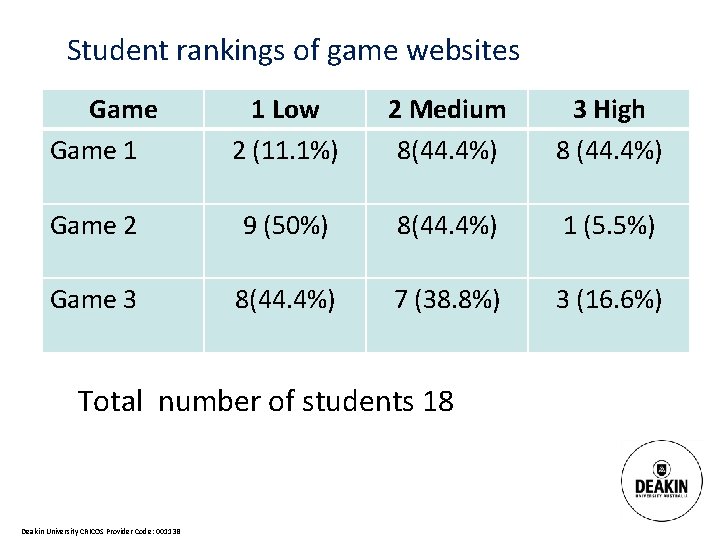
Student rankings of game websites Game 1 1 Low 2 (11. 1%) 2 Medium 8(44. 4%) 3 High 8 (44. 4%) Game 2 9 (50%) 8(44. 4%) 1 (5. 5%) Game 3 8(44. 4%) 7 (38. 8%) 3 (16. 6%) Total number of students 18 Deakin University CRICOS Provider Code: 00113 B
Deakin University CRICOS Provider Code: 00113 B
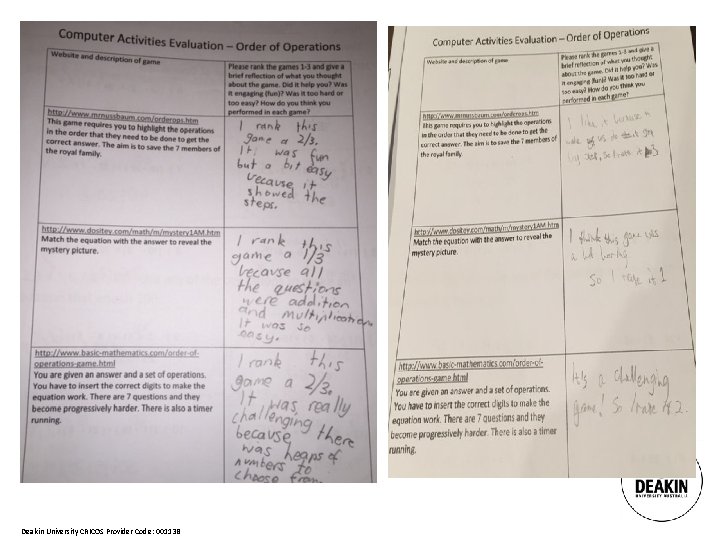
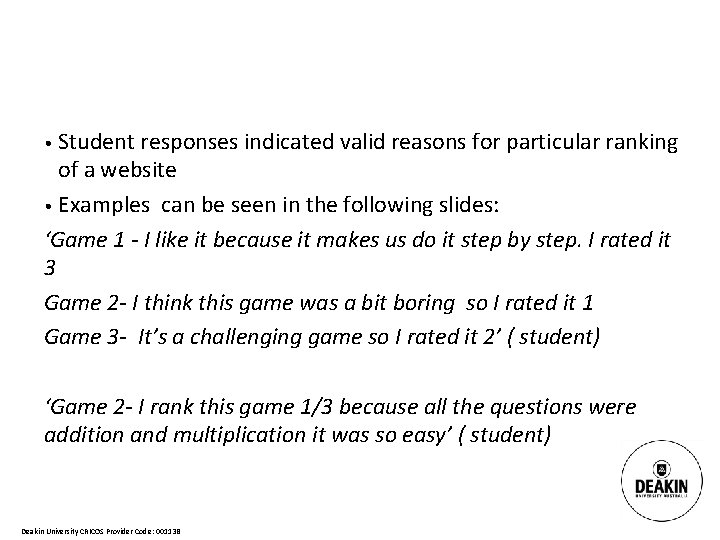
• Student responses indicated valid reasons for particular ranking of a website • Examples can be seen in the following slides: ‘Game 1 - I like it because it makes us do it step by step. I rated it 3 Game 2 - I think this game was a bit boring so I rated it 1 Game 3 - It’s a challenging game so I rated it 2’ ( student) ‘Game 2 - I rank this game 1/3 because all the questions were addition and multiplication it was so easy’ ( student) Deakin University CRICOS Provider Code: 00113 B
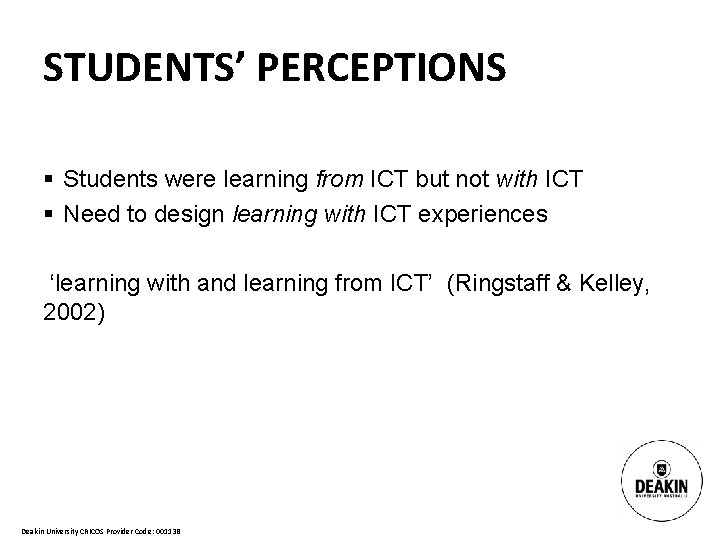
STUDENTS’ PERCEPTIONS § Students were learning from ICT but not with ICT § Need to design learning with ICT experiences ‘learning with and learning from ICT’ (Ringstaff & Kelley, 2002) Deakin University CRICOS Provider Code: 00113 B
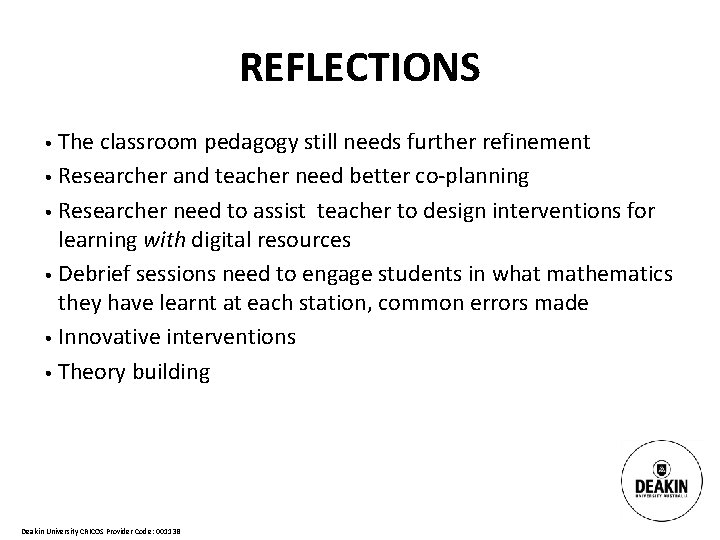
REFLECTIONS • The classroom pedagogy still needs further refinement • Researcher and teacher need better co-planning • Researcher need to assist teacher to design interventions for learning with digital resources • Debrief sessions need to engage students in what mathematics they have learnt at each station, common errors made • Innovative interventions • Theory building Deakin University CRICOS Provider Code: 00113 B
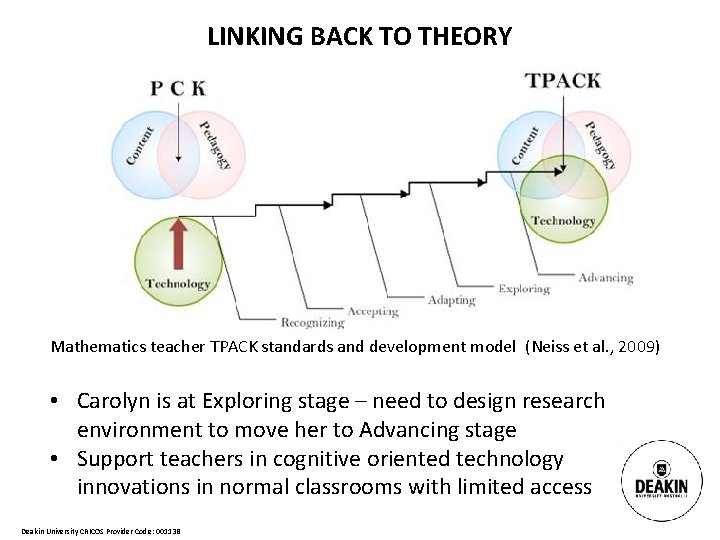
LINKING BACK TO THEORY Mathematics teacher TPACK standards and development model (Neiss et al. , 2009) • Carolyn is at Exploring stage – need to design research environment to move her to Advancing stage • Support teachers in cognitive oriented technology innovations in normal classrooms with limited access Deakin University CRICOS Provider Code: 00113 B
5 CHARACTERISTICS OF GOOD DESIGNBASED RESEARCH 1. 2. 3. 4. 5. the central goals of designing learning environments and developing theories or “prototheories” of learning are intertwined. development and research take place through continuous cycles of design, enactment, analysis, and redesign (Cobb, 2001; Collins, 1992). research on designs must lead to sharable theories that help communicate relevant implications to practitioners and other educational designers (cf. Brophy, 2002). Research must account for how designs function in authentic settings. It must not only document success or failure but also focus on interactions that refine our understanding of the learning issues involved. the development of such accounts relies on methods that can document and connect processes of enactment to outcomes of interest • Source: The design-based research collective (2003). Design-based research: an emerging paradigm for educational inquiry. Educational Researcher, 32 (1) pp. 5 -8 Deakin University CRICOS Provider Code: 00113 B
THE FUTURE OF DIGITAL TECHNOLOGY USE IN MATHEMATICS CLASSROOM • Much more needed to be learnt about how students learn with technology – more than mere enjoyment • More design innovations - ‘on tological innovations’ (di. Sessa & Cobb, 2003) • Be realistic about teacher constraints Deakin University CRICOS Provider Code: 00113 B
REFERENCES Brown, A. L. (1992). Design experiments: theoretical and methodological challenges in creating complex interventions in classroom settings. The Journal of The Learning Sciences, 2 (2) 141 -178. Collins, A. , Joseph, D. , & Bielaczyc, K. (2004). Design research: theoretical and methodological issues. The Journal of The Learning Sciences, 13 (1), 15 -42. di. Sessa, A. A. & Cobb, P. (2004). Ontological innovations and the role of theory in design experiments. The Journal of The Learning Sciences, 13 (1), 77 -103. Niess, M. L. , Ronau, R. N. , Shafer, K. G. , Driskell, S. O. , Harper, S. R. , Johnston, C. , . . . Kersaint, G. (2009). Mathematics Teacher TPACK Standards and Development Model. Contemporary Issues in Technology and Teacher Education, 9(1), 4 -24. Ringstaff, C & Kelley, L. (2002). The learning return on our educational technology investment. Retrieved from http: //www. wested. org/online_pubs/learning_return. pdf Deakin University CRICOS Provider Code: 00113 B