
Conceptualising Fourth Generation Strategic Culture ALEX BURNS ALEXANDER
Conceptualising Fourth Generation Strategic Culture ALEX BURNS (ALEXANDER. BURNS@MONASH. EDU) SPS SYMPOSIUM, 25 TH OCTOBER 2017 PHD CANDIDATE, SCHOOL OF POLITICS & SOCIAL INQUIRY, MONASH UNIVERSITY
2017 Thesis Milestones 51, 101 words of raw draft text written to-date for 2017 Completed two Griffith University units to understand government policy process Used research insights to co-facilitate POL 20008 Australian Foreign Policy unit in Teaching Period 2 with Swinburne Online – discussion of terrorism and policy formulation Attended the Australian Strategic Policy Institute’s Nuclear Strategy Masterclass on 27 th September 2017: gained a better understanding of how nuclear deterrence works Conceptualisation of on-going research program (including possible future Post-Doc and ARC DECRA applications)
Research Methodology Small-N case study using “heuristic” approach: existing literature versus strategic subculture explanations (George & Bennett 2005). Selection of deviant and extreme cases (Gerring 2012). Process tracing that identifies the causal mechanisms and processes that link X 1 (terrorist organisation exists and rapidly grows) and Y 1 outcome (survival over a significant time period and carries out successful terrorist campaigns) (George & Bennett 2005; Brun & Pedersen 2013; Bennett & Checkel 2015). Qualitative data coding (causation / narrative / thematic) of primary and secondary sources (Saldana 2013; Weller & Barnes 2014; Guest, Mac. Queen & Namey 2012). Beginning of database / codebook for Large-N future research.
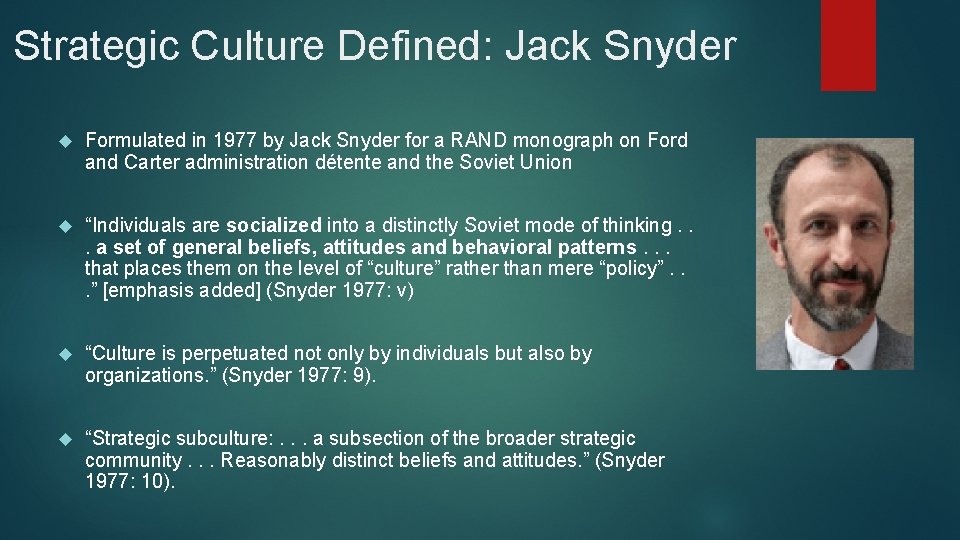
Strategic Culture Defined: Jack Snyder Formulated in 1977 by Jack Snyder for a RAND monograph on Ford and Carter administration détente and the Soviet Union “Individuals are socialized into a distinctly Soviet mode of thinking. . . a set of general beliefs, attitudes and behavioral patterns. . . that places them on the level of “culture” rather than mere “policy”. . . ” [emphasis added] (Snyder 1977: v) “Culture is perpetuated not only by individuals but also by organizations. ” (Snyder 1977: 9). “Strategic subculture: . . . a subsection of the broader strategic community. . . Reasonably distinct beliefs and attitudes. ” (Snyder 1977: 10).
Thinking About Strategic Culture (1995) by Alastair Iain Johnston Built on the book version of Johnston’s 1993 Ph. D thesis: Cultural Realism: Strategic Culture and Grand Strategy in Chinese History (Princeton University Press, 1995). Highly cited article in International Security journal (816 citations, Google Scholar 2017) Proposed an influential ‘generations’ model of theory-building development in strategic culture: Generation 1: early 1980 s emphasis on US-Soviet comparative nuclear strategy Generation 2: mid 1980 s emphasis on understanding political hegemony Generation 3: 1990 s emphasis on organisational culture as an intervening variable Addressed definitional issues and the need for empirical evidence Proposes cultural realism: idealpolitik and realpolitik strategic cultures
Responding to Alastair Iain Johnston Ph. D broadens and deepens Johnston’s generations model: Discussion of Jack Snyder, Colin S. Gray, Ken Booth, and Carnes Lord (first generation) Acknowledges role of United States think tank environment (RAND, Hudson Institute) Situates the development of strategic culture in United States nuclear policy (e. g. Schlesinger ‘flexible response’ doctrine and Carter Administration’s neutron bomb debate) Issues of construct validity for the generations model: Selection of theorists and timelines for each particular generation Parallel research (e. g. Herman and Chomsky’s work relevant to second generation) Development of mature research programs (e. g. Snyder’s later use of rational choice theory, Gray’s contribution to strategy, Booth’s development of world security theory) Johnston left the sub-field after the ‘Gray-Johnston’ debate in 1999 ‘Debate’ was really a series of rejoinders in journal articles by Gray and Johnston Puzzle of why major conceptual theorists leave the sub-field
Fourth Generation Strategic Culture: Jeffrey S. Lantis’ Contribution ‘Strategic Culture and National Security Policy’ by Jeffrey S. Lantis (2002): Sub-field links to national security policy and weapons of mass destruction Posits a new research agenda for strategic culture as a sub-field Asks: ‘Who are the keepers of strategic culture? ’ Posits a ‘continuity or change’ dynamic in the sub-field Defense Threat Reduction Agency funding in 2006 Paper by Lantis links strategic culture, Carl Clausewitz, and constructivist theory United States Government funding to explore potential security threats and responses Strategic Cultures and Security Policies in the Asia-Pacific (2015) Chapter by Lantis on theoretical foundations and methodological issues in sub-field Chapter by Alex Burns and Dr Ben Eltham on Australia’s strategic culture
Conceptualising Fourth Generation Strategic Culture Reflects a possible multipolar world in which there are shifts in great power hierarchies / ‘rising’ powers (T. V. Paul, Jonathon Renshon, David M. Edelstein) Sub-field basis in national security context: problem / threat emphasis Sub-field links to terrorism studies research on terrorist organisations (Martha Crenshaw, Jacob N. Shapiro, Jessica Stern, Mark Juergensmeyer, David C. Rapoport) Stronger links to understanding nuclear proliferation networks and regional nuclear powers (Vipin Narang, Alexandre Debs, Nuno P. Monteiro, Scott Sagan) Understanding ‘red team’ theories of victory in nuclear blackmail and possible ‘limited’ nuclear war: Russia, China, Pakistan, India, North Korea (Brad Roberts) Different policy instruments: economic statecraft (David Baldwin), coercive diplomacy (Todd S. Sechser, Matthew Fuhrmann), extended nuclear deterrence (Andrew O’Neil)

Discussion
- Slides: 9