
Conceptual model for designing learning and instruction for





- Slides: 20
Conceptual model for designing learning and instruction for the future Margus Pedaste Professor of Educational Technology Head of the Pedagogicum of the University of Tartu
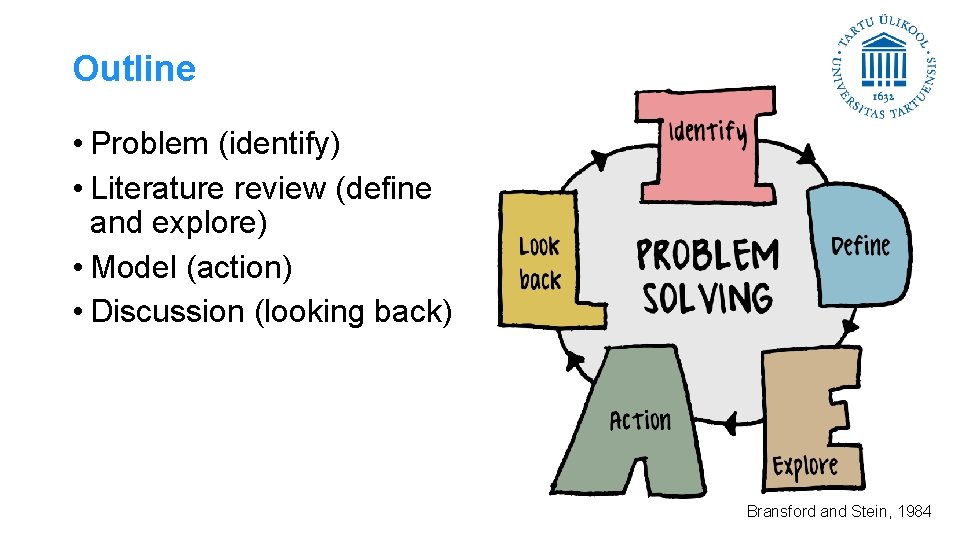
Outline • Problem (identify) • Literature review (define and explore) • Model (action) • Discussion (looking back) Bransford and Stein, 1984
Problem to be solved Needs, beliefs, and practices do not overlap enough
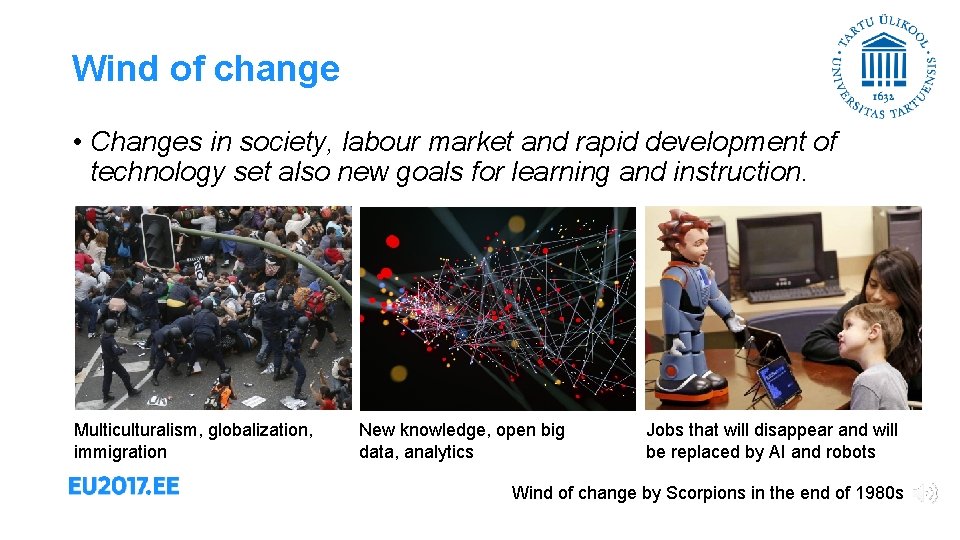
Wind of change • Changes in society, labour market and rapid development of technology set also new goals for learning and instruction. Multiculturalism, globalization, immigration New knowledge, open big data, analytics Jobs that will disappear and will be replaced by AI and robots Wind of change by Scorpions in the end of 1980 s
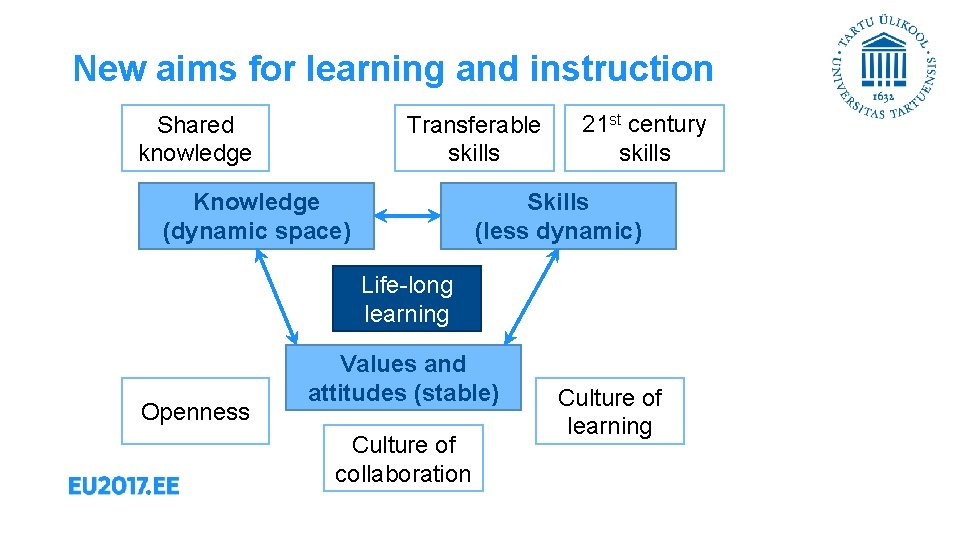
New aims for learning and instruction Shared knowledge Transferable skills Knowledge (dynamic space) 21 st century skills Skills (less dynamic) Life-long learning Openness Values and attitudes (stable) Culture of collaboration Culture of learning
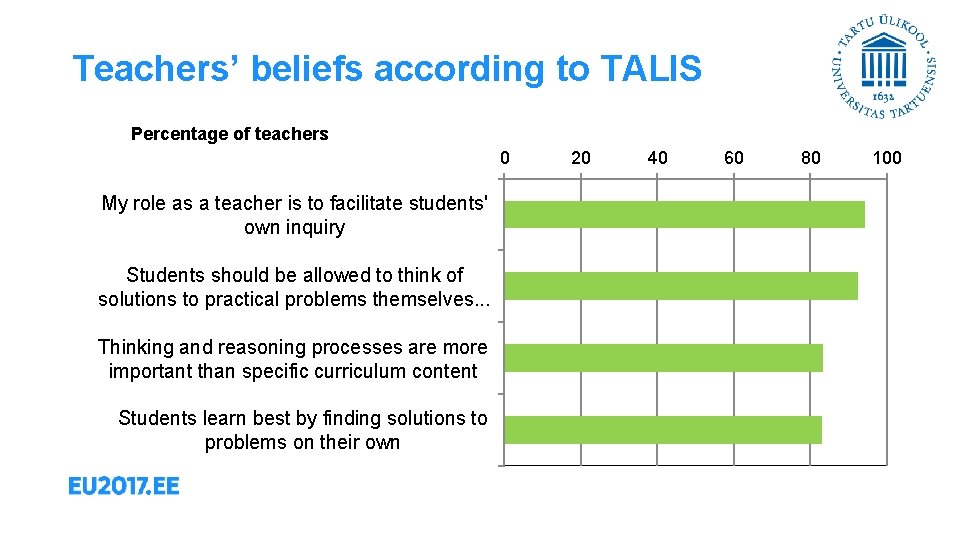
Teachers’ beliefs according to TALIS Percentage of teachers 0 My role as a teacher is to facilitate students' own inquiry Students should be allowed to think of solutions to practical problems themselves. . . Thinking and reasoning processes are more important than specific curriculum content Students learn best by finding solutions to problems on their own 20 40 60 80 100
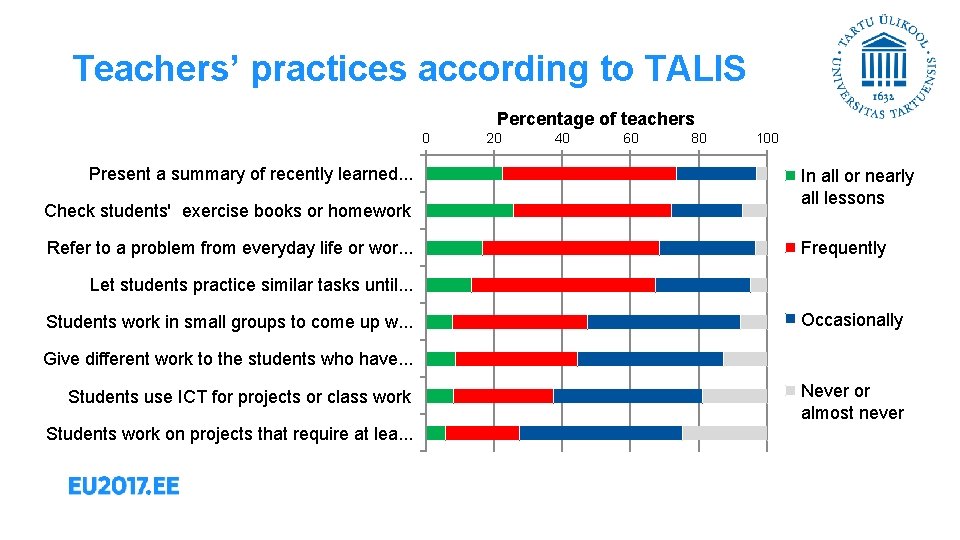
Teachers’ practices according to TALIS Percentage of teachers 0 Present a summary of recently learned. . . Check students' exercise books or homework Refer to a problem from everyday life or wor. . . 20 40 60 80 100 In all or nearly all lessons Frequently Let students practice similar tasks until. . . Students work in small groups to come up w. . . Occasionally Give different work to the students who have. . . Students use ICT for projects or class work Students work on projects that require at lea. . . Never or almost never
Literature review What is innovative?
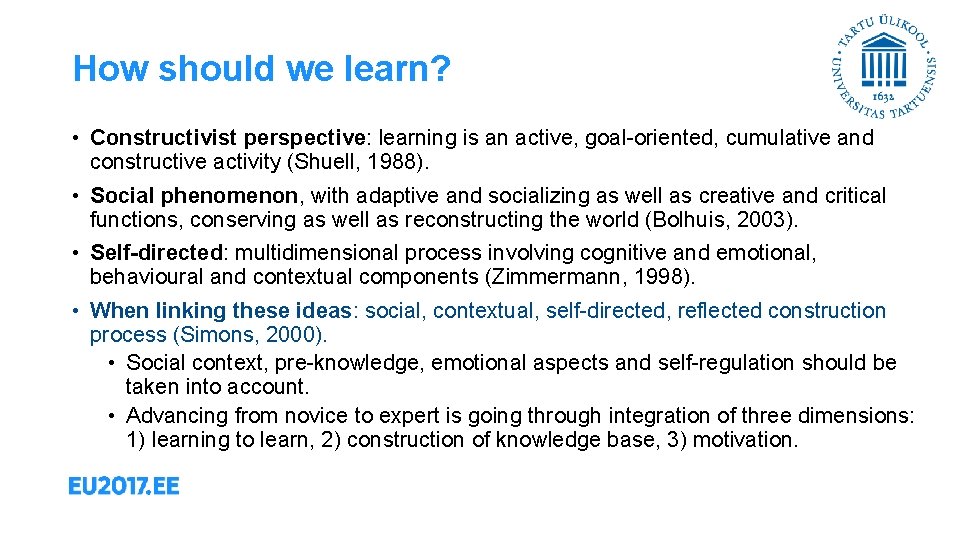
How should we learn? • Constructivist perspective: learning is an active, goal-oriented, cumulative and constructive activity (Shuell, 1988). • Social phenomenon, with adaptive and socializing as well as creative and critical functions, conserving as well as reconstructing the world (Bolhuis, 2003). • Self-directed: multidimensional process involving cognitive and emotional, behavioural and contextual components (Zimmermann, 1998). • When linking these ideas: social, contextual, self-directed, reflected construction process (Simons, 2000). • Social context, pre-knowledge, emotional aspects and self-regulation should be taken into account. • Advancing from novice to expert is going through integration of three dimensions: 1) learning to learn, 2) construction of knowledge base, 3) motivation.
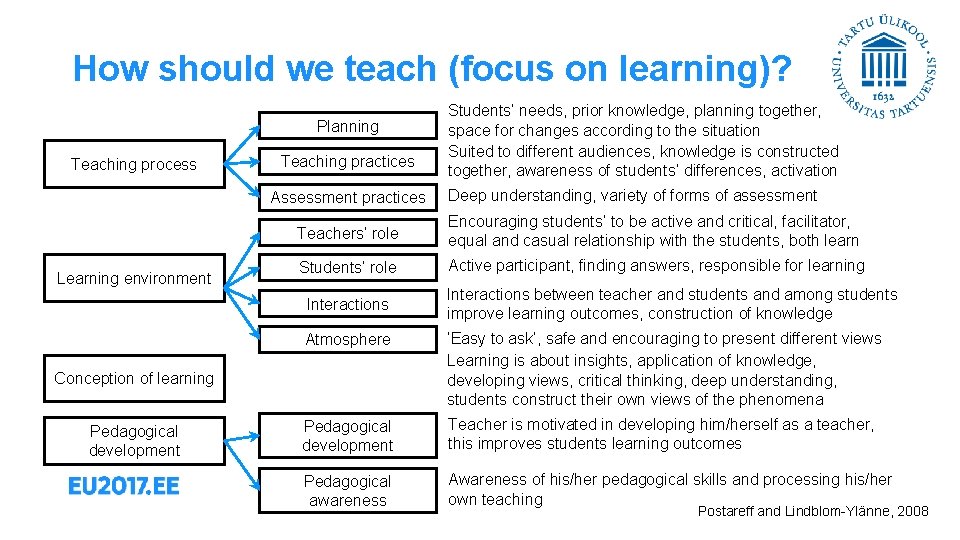
How should we teach (focus on learning)? Planning Teaching process Teaching practices Assessment practices Learning environment Deep understanding, variety of forms of assessment Teachers’ role Encouraging students’ to be active and critical, facilitator, equal and casual relationship with the students, both learn Students’ role Active participant, finding answers, responsible for learning Interactions between teacher and students and among students improve learning outcomes, construction of knowledge Atmosphere ‘Easy to ask’, safe and encouraging to present different views Learning is about insights, application of knowledge, developing views, critical thinking, deep understanding, students construct their own views of the phenomena Pedagogical development Teacher is motivated in developing him/herself as a teacher, this improves students learning outcomes Pedagogical awareness Awareness of his/her pedagogical skills and processing his/her own teaching Conception of learning Pedagogical development Students’ needs, prior knowledge, planning together, space for changes according to the situation Suited to different audiences, knowledge is constructed together, awareness of students’ differences, activation Postareff and Lindblom-Ylänne, 2008
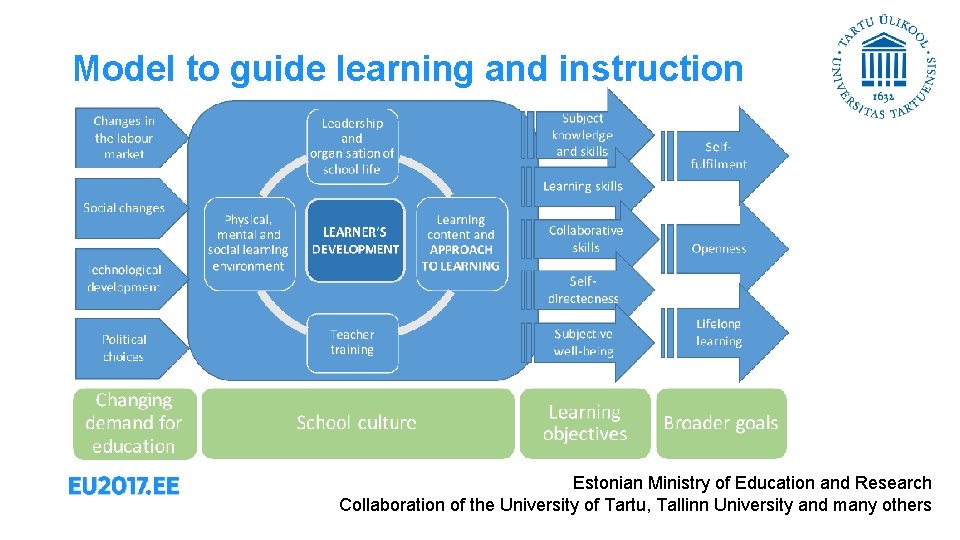
Model Link between goals, objectives and methods for learning and instruction
Model to guide learning and instruction Estonian Ministry of Education and Research Collaboration of the University of Tartu, Tallinn University and many others
Discussion How to proceed and who should take action?
What we know and where to go? • New approach to learning contributes to ensure self-fulfilment, openness and life-long learning • We know that the instructional approach in schools is too often not innovative • We know something about subject-specific learning outcomes but we need to evaluate learning skills, collaborative skills, selfregulation and subjective well-being as well • Empirical knowledge should force changes in learning and instruction
References Bolhuis, S. (2003). Towards process-oriented teaching for self-directed lifelong learning: a multidimensional perspective. Learning and Instruction, 13, 327– 347. Bransford, J. , & Stein, B. (1984). The IDEAL problem solver. New York: Freeman. Postareff, L. , & Lindblom-Ylänne, S. (2008). Variation in teachers’ description of teaching: Broadening the understanding of teaching in higher education. Learning and Instruction, 18, 109– 102. Shuell, T. J. (1988). The role of the student in learning from instruction. Contemporary Educational Psychology, 13, 276– 295. Simons, P. R. J. (2000). Towards a constructivistic theory of self-directed learning. In G. A. Straka (Ed. ), Conceptions of self-directed learning: Theoretical and conceptional considerations (pp. 155– 169). Mu nster, Germany: Waxmann. Zimmerman, B. J. (1998). Developing self-fulfilling cycles of academic regulation: An analysis of exemplary instructional models. In D. H. Schunk, & B. J. Zimmerman (Eds. ), Self-regulated learning: From teaching to self-reflective practice (pp. 225– 235). New York: Guilford Press.