
Conceptual Mathematics How does it all work together

- Slides: 11
Conceptual Mathematics How does it all work together? Lincoln County Schools Alycen Wilson Math Lead Teacher K-8
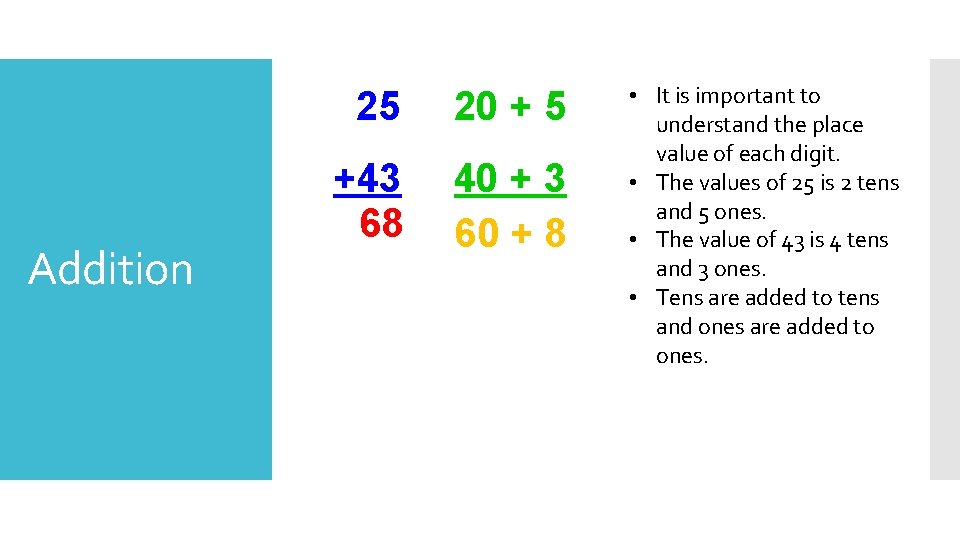
Addition 25 20 + 5 +43 68 40 + 3 60 + 8 • It is important to understand the place value of each digit. • The values of 25 is 2 tens and 5 ones. • The value of 43 is 4 tens and 3 ones. • Tens are added to tens and ones are added to ones.
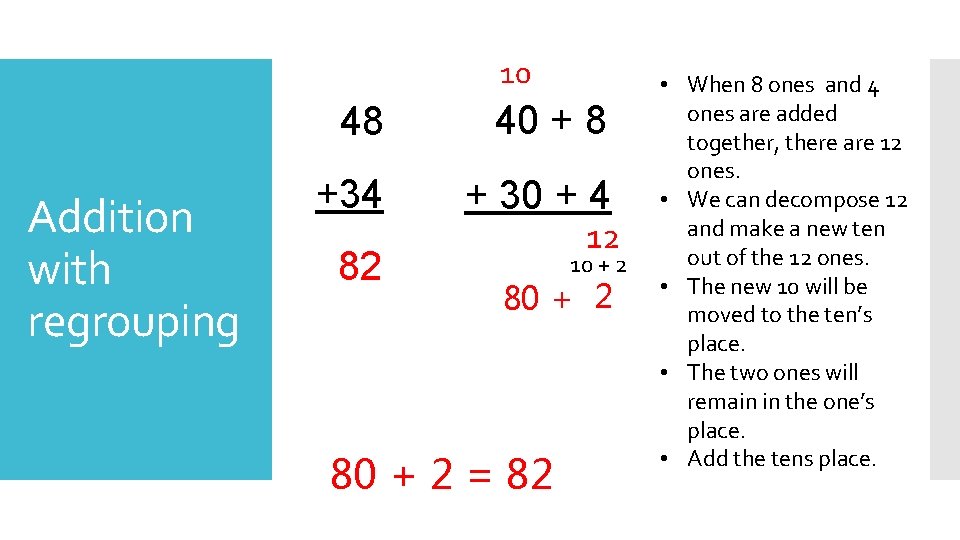
10 Addition with regrouping 48 40 + 8 +34 + 30 + 4 82 12 10 + 2 80 + 2 = 82 • When 8 ones and 4 ones are added together, there are 12 ones. • We can decompose 12 and make a new ten out of the 12 ones. • The new 10 will be moved to the ten’s place. • The two ones will remain in the one’s place. • Add the tens place.
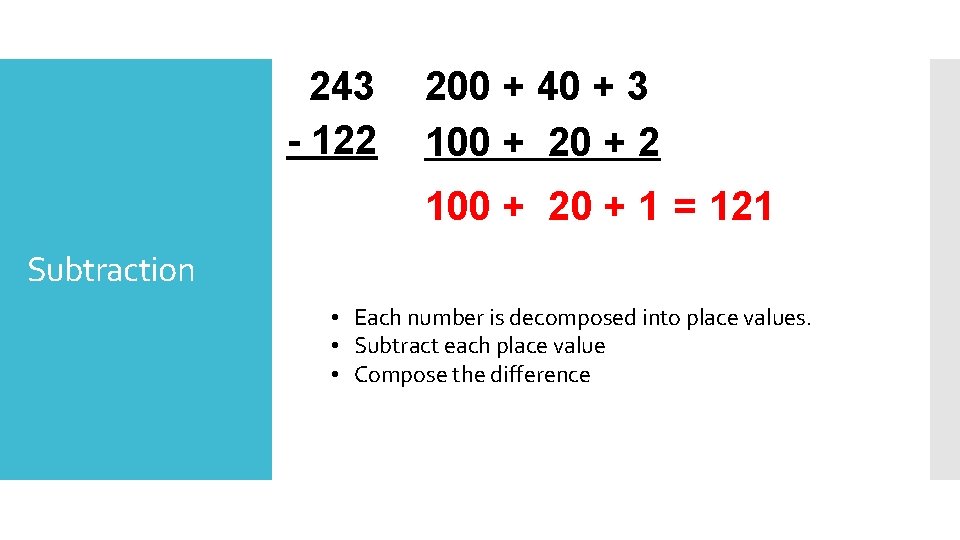
243 - 122 200 + 40 + 3 100 + 20 + 1 = 121 Subtraction • Each number is decomposed into place values. • Subtract each place value • Compose the difference
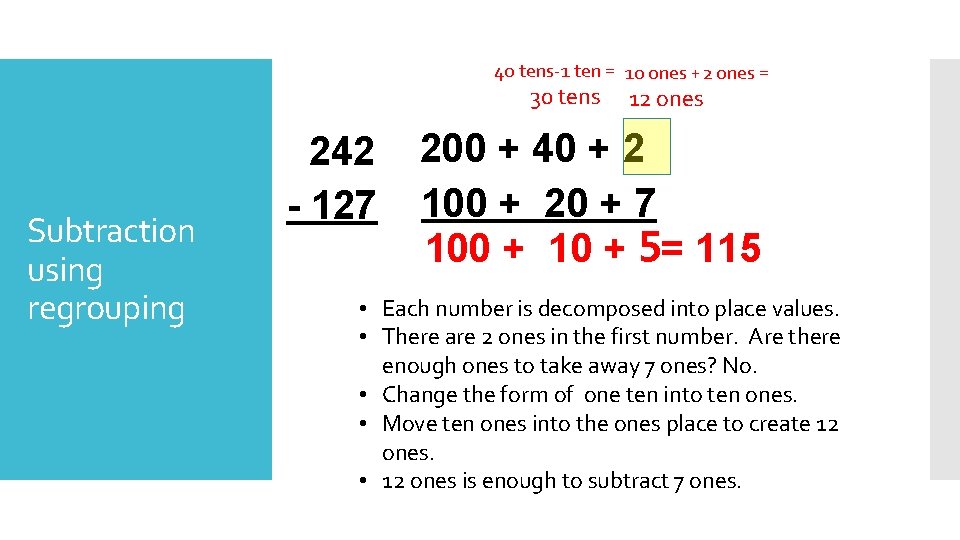
40 tens-1 ten = 10 ones +2 ones = 30 tens Subtraction using regrouping 242 - 127 12 ones 200 + 40 + 2 100 + 20 + 7 100 + 10 + 5= 115 • Each number is decomposed into place values. • There are 2 ones in the first number. Are there enough ones to take away 7 ones? No. • Change the form of one ten into ten ones. • Move ten ones into the ones place to create 12 ones. • 12 ones is enough to subtract 7 ones.
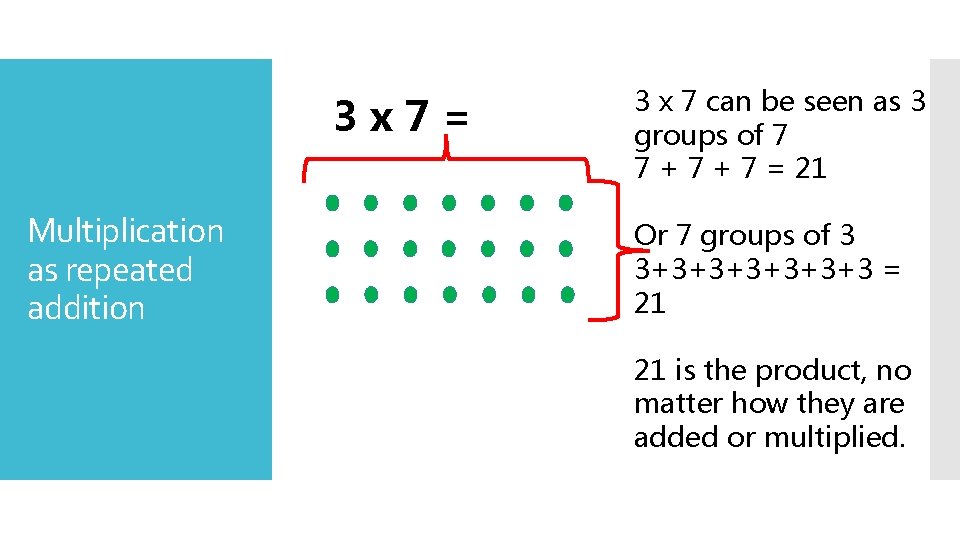
3 x 7= Multiplication as repeated addition 3 x 7 can be seen as 3 groups of 7 7 + 7 = 21 Or 7 groups of 3 3+3+3+3 = 21 21 is the product, no matter how they are added or multiplied.
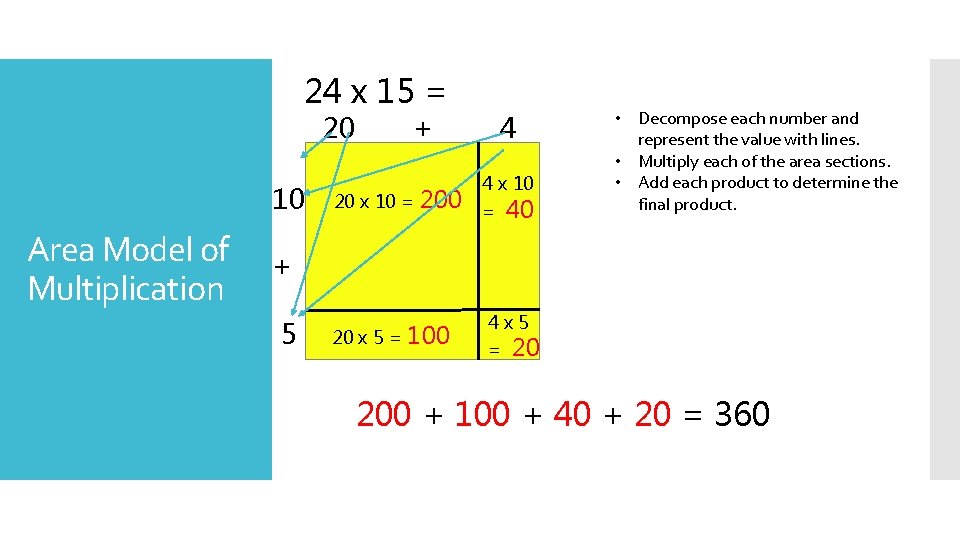
24 x 15 = 20 10 Area Model of Multiplication + 20 x 10 = 200 4 4 x 10 = 40 • Decompose each number and represent the value with lines. • Multiply each of the area sections. • Add each product to determine the final product. + 5 20 x 5 = 100 4 x 5 = 20 200 + 100 + 40 + 20 = 360
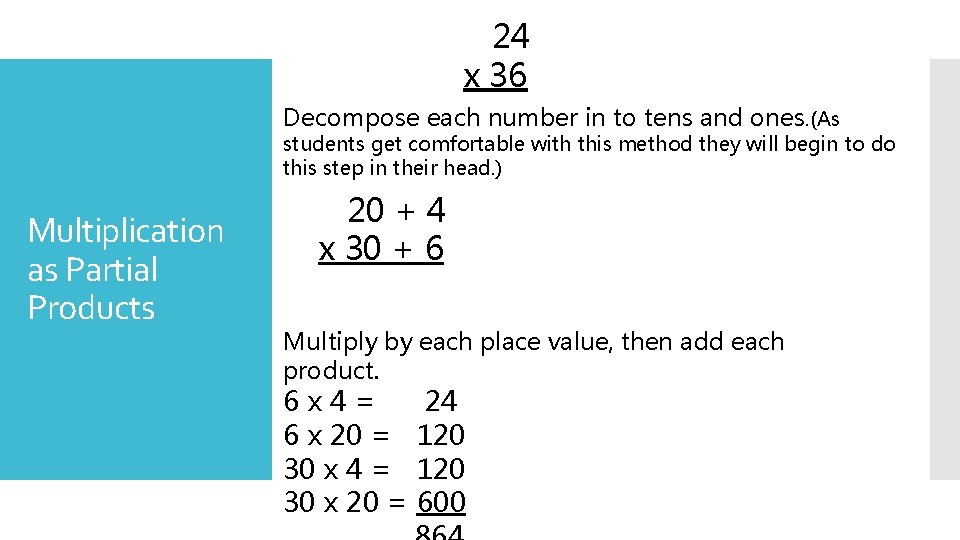
24 x 36 Decompose each number in to tens and ones. (As students get comfortable with this method they will begin to do this step in their head. ) Multiplication as Partial Products 20 + 4 x 30 + 6 Multiply by each place value, then add each product. 6 x 4= 24 6 x 20 = 120 30 x 4 = 120 30 x 20 = 600
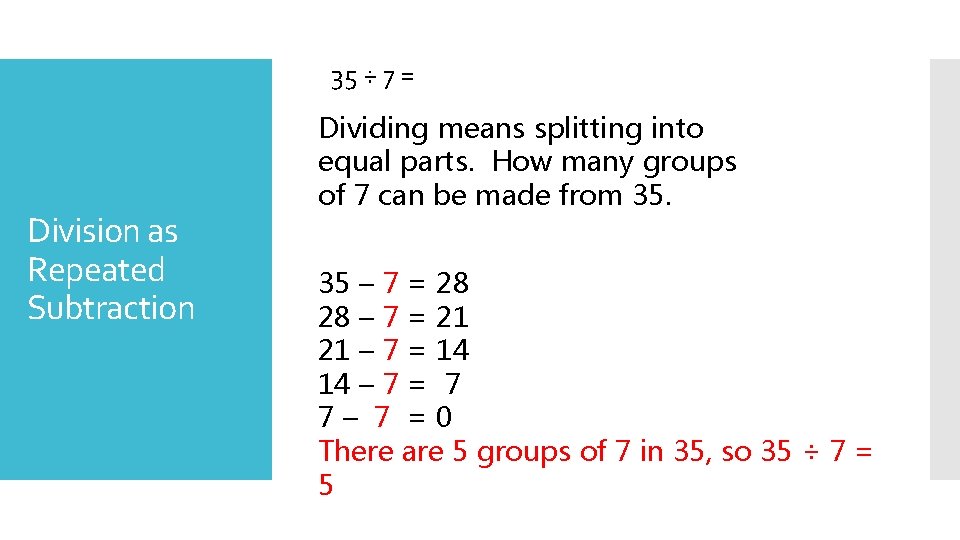
35 ÷ 7 = Division as Repeated Subtraction Dividing means splitting into equal parts. How many groups of 7 can be made from 35. 35 – 7 = 28 28 – 7 = 21 21 – 7 = 14 14 – 7 = 7 7– 7 =0 There are 5 groups of 7 in 35, so 35 ÷ 7 = 5
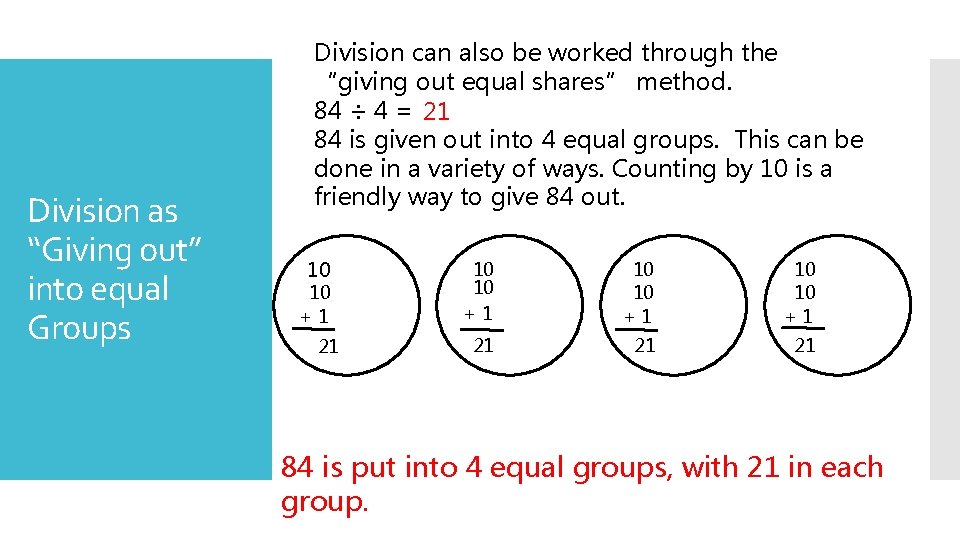
Division as “Giving out” into equal Groups Division can also be worked through the “giving out equal shares” method. 84 ÷ 4 = 21 84 is given out into 4 equal groups. This can be done in a variety of ways. Counting by 10 is a friendly way to give 84 out. 10 10 +1 21 10 10 +1 21 21 21 84 is put into 4 equal groups, with 21 in each group.
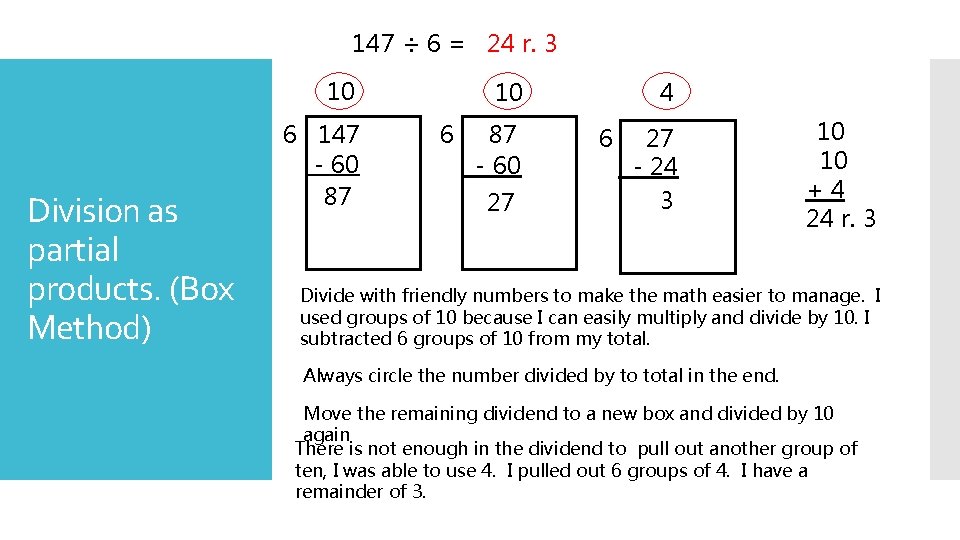
147 ÷ 6 = 24 r. 3 10 Division as partial products. (Box Method) 6 147 - 60 87 4 10 6 87 - 60 27 6 27 - 24 3 10 10 +4 24 r. 3 Divide with friendly numbers to make the math easier to manage. I used groups of 10 because I can easily multiply and divide by 10. I subtracted 6 groups of 10 from my total. Always circle the number divided by to total in the end. Move the remaining dividend to a new box and divided by 10 again There is not enough in the dividend to pull out another group of ten, I was able to use 4. I pulled out 6 groups of 4. I have a remainder of 3.