
Conceptual Graphs Combing logic and semantic net Motivations
Conceptual Graphs: Combing logic and semantic net
Motivations • Semantic networks & frame systems have trouble handling – negation, the fact that something is not true – disjunction – quantification, the fact that something is true for all objects • Conceptual graphs can handle them naturally.
Objectives 1. Examples of conceptual graphs 2. Conceptual graph syntax 3. Individual (article: the) and generic (article: a) concepts 4. Conceptual graph operations: how to produce new conceptual graphs from old ones 5. Conceptual graphs and logic
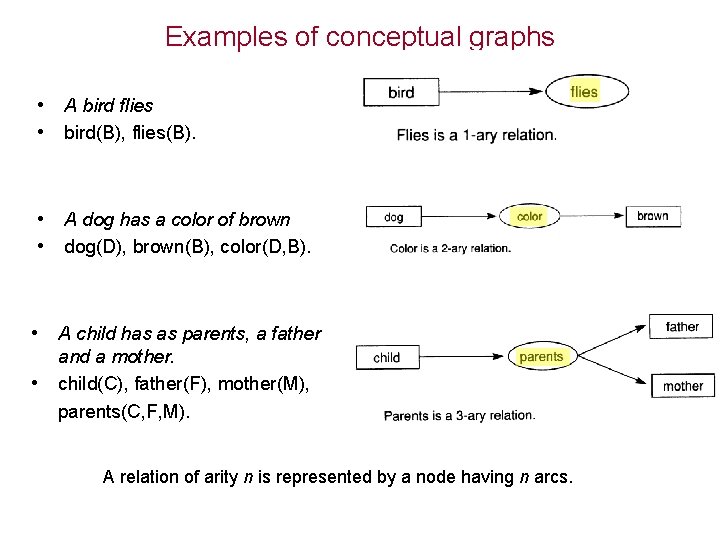
Examples of conceptual graphs • A bird flies • bird(B), flies(B). • A dog has a color of brown • dog(D), brown(B), color(D, B). • A child has as parents, a father and a mother. • child(C), father(F), mother(M), parents(C, F, M). A relation of arity n is represented by a node having n arcs.
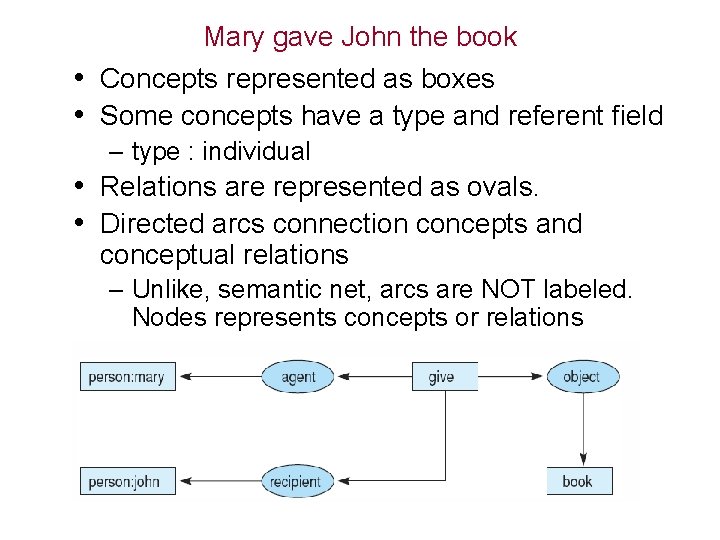
Mary gave John the book • Concepts represented as boxes • Some concepts have a type and referent field – type : individual • Relations are represented as ovals. • Directed arcs connection concepts and conceptual relations – Unlike, semantic net, arcs are NOT labeled. Nodes represents concepts or relations
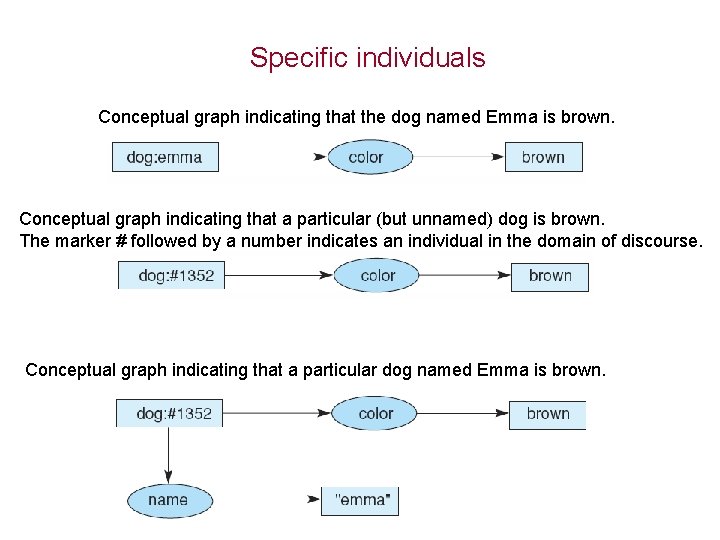
Specific individuals Conceptual graph indicating that the dog named Emma is brown. Conceptual graph indicating that a particular (but unnamed) dog is brown. The marker # followed by a number indicates an individual in the domain of discourse. Conceptual graph indicating that a particular dog named Emma is brown.
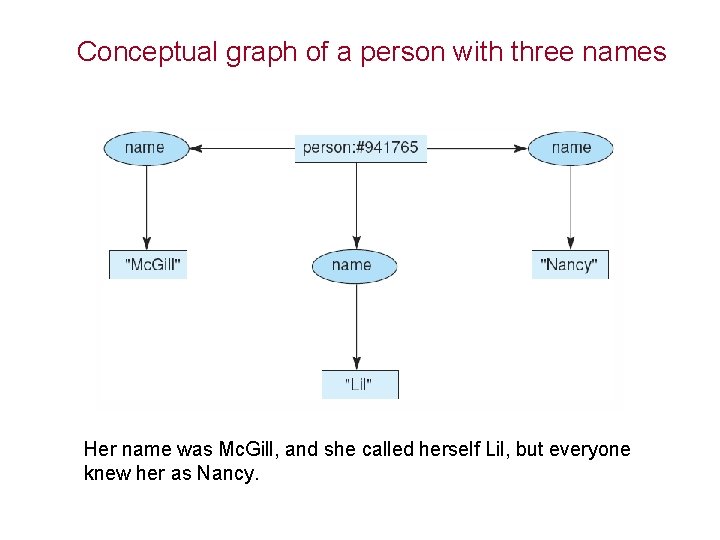
Conceptual graph of a person with three names Her name was Mc. Gill, and she called herself Lil, but everyone knew her as Nancy.
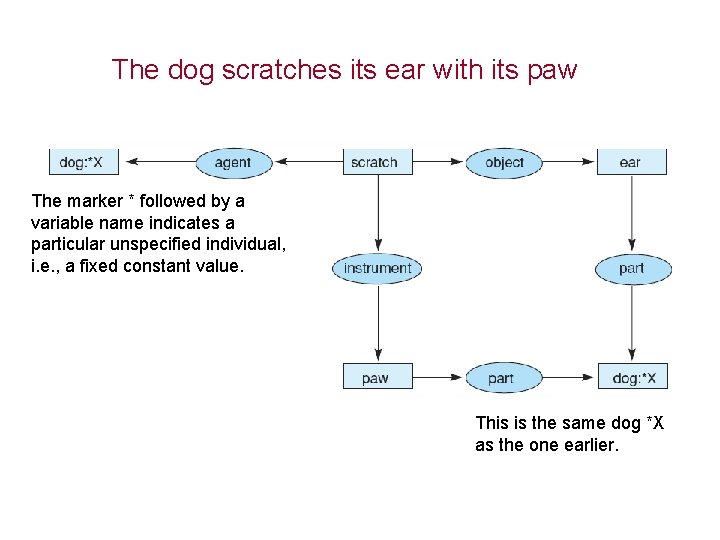
The dog scratches its ear with its paw The marker * followed by a variable name indicates a particular unspecified individual, i. e. , a fixed constant value. This is the same dog *X as the one earlier.
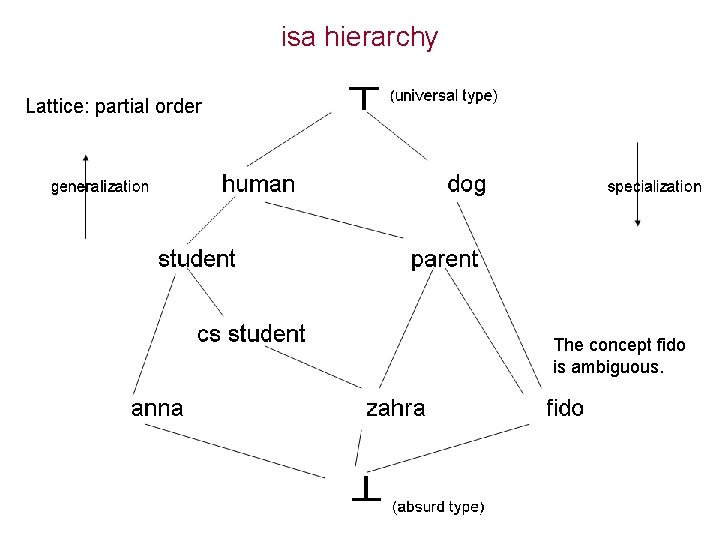
isa hierarchy Lattice: partial order The concept fido is ambiguous.
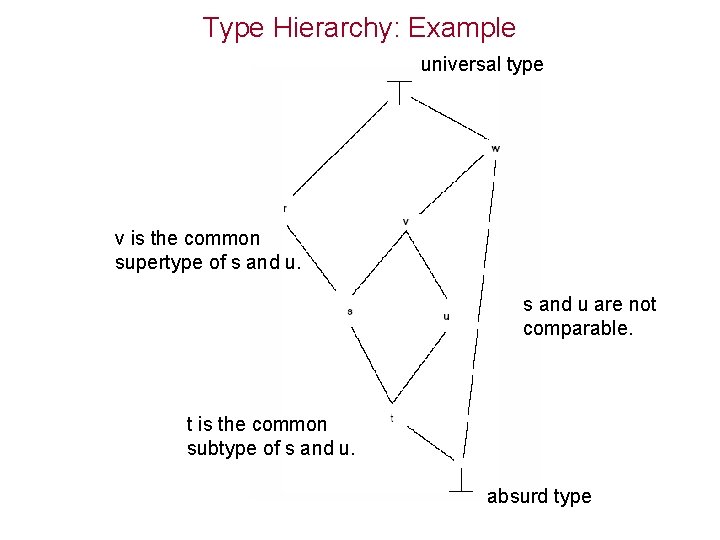
Type Hierarchy: Example universal type v is the common supertype of s and u are not comparable. t is the common subtype of s and u. absurd type
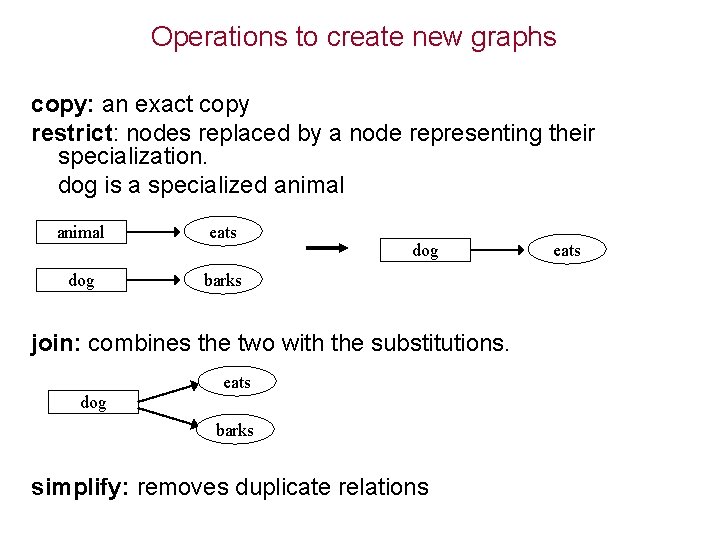
Operations to create new graphs copy: an exact copy restrict: nodes replaced by a node representing their specialization. dog is a specialized animal eats dog barks dog join: combines the two with the substitutions. eats dog barks simplify: removes duplicate relations eats
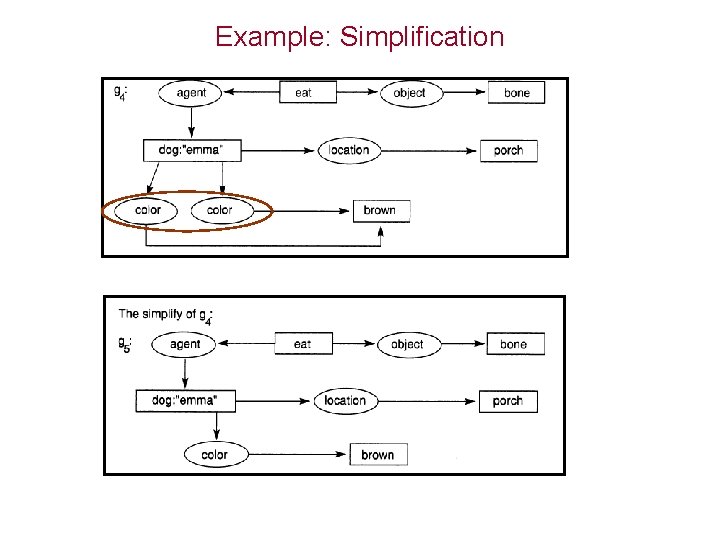
Example: Simplification

Example: Restriction
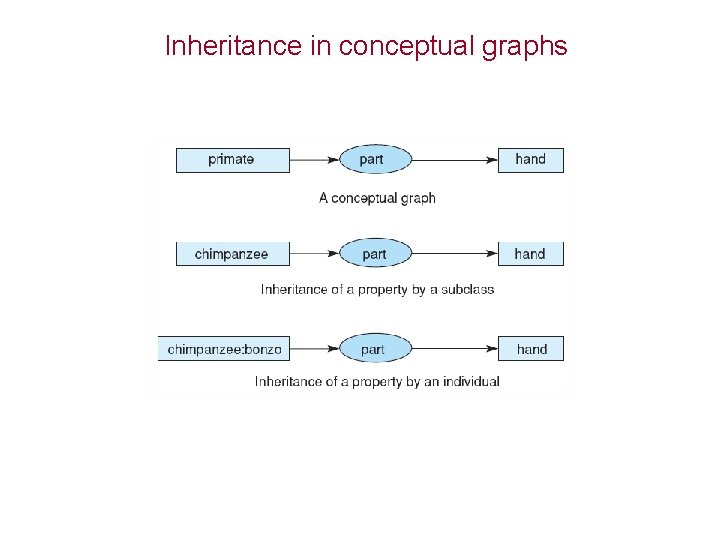
Inheritance in conceptual graphs
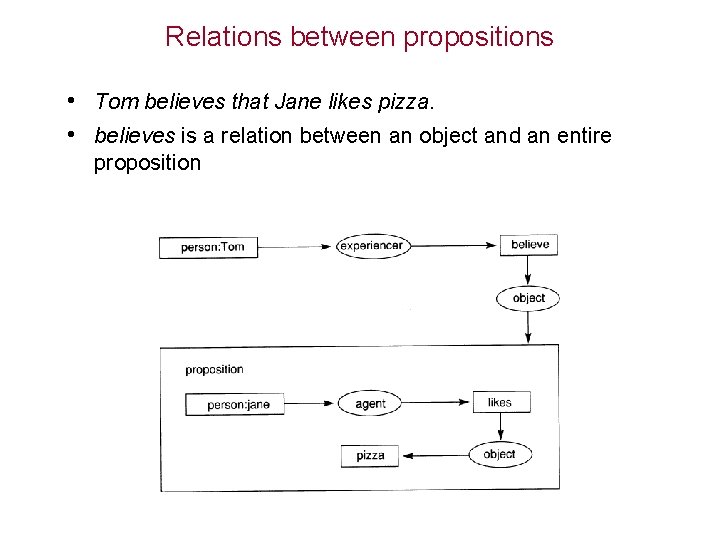
Relations between propositions • Tom believes that Jane likes pizza. • believes is a relation between an object and an entire proposition
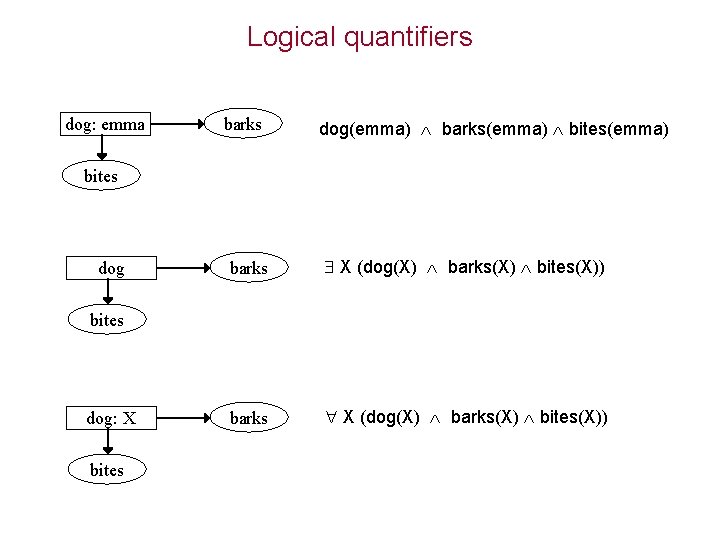
Logical quantifiers dog: emma barks dog(emma) barks(emma) bites(emma) bites dog barks X (dog(X) barks(X) bites(X)) bites dog: X bites
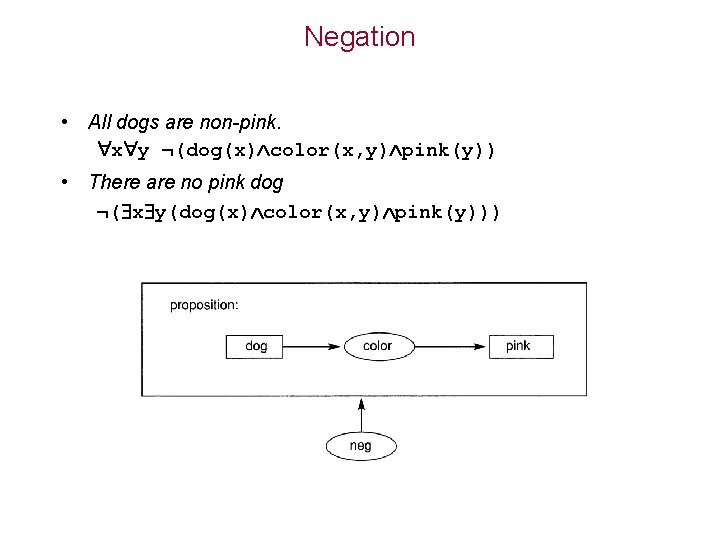
Negation • All dogs are non-pink. x y ¬(dog(x) color(x, y) pink(y)) • There are no pink dog ¬( x y(dog(x) color(x, y) pink(y)))
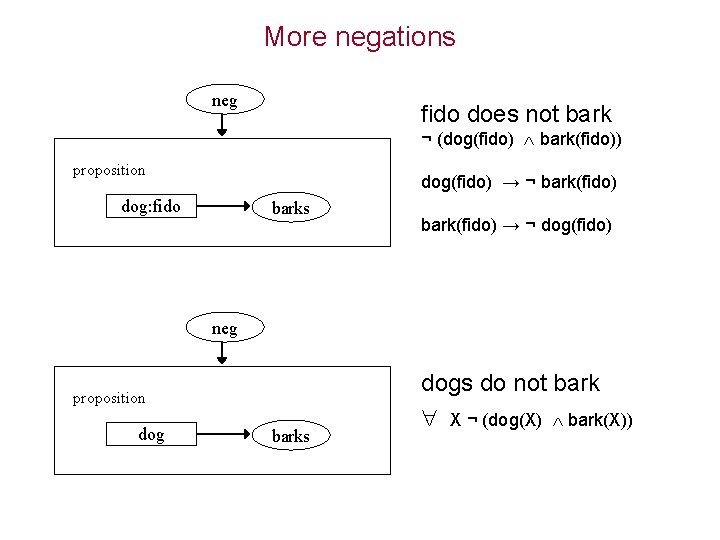
More negations neg fido does not bark ¬ (dog(fido) bark(fido)) proposition dog(fido) → ¬ bark(fido) dog: fido barks bark(fido) → ¬ dog(fido) neg proposition dog barks dogs do not bark X ¬ (dog(X) bark(X))
Conceptual graphs vs predicate logic • Any conceptual graph can be reformulated into predicate logic • But conceptual graphs support additional operations (ex. join, restrict…) • Restriction can be used to implement inheritance • Criticism – no sound inference rules – no formal semantics
Conclusion • Conceptual graph expresses meaning in a form that is logically precise, humanly readable, and computationally tractable. • Unlike semantic net, it can naturally express logical negation and existential and universal quantifications. • We have now added another tool in our arsenal of knowledge representation.
- Slides: 20