
Conceptual Foundations for Health Measurements Disability and Handicap
Conceptual Foundations for Health Measurements
Disability and Handicap Examples of Conceptual Foundations for Measurement Scales

Three Perspectives: Disease, Sickness & Illness Disease Illness (The person’s subjective experience of their symptoms. What the patient brings to the doctor) (Underlying pathology; biologically defined: the practitioner’s perspective. The illness seen in terms of a biological theory of disorder) Sickness (Social & cultural conceptions of the condition: cultural beliefs and reactions such as fear or stigma. These affect how the patient reacts, and also what is considered a disorder suitable for medical treatment)
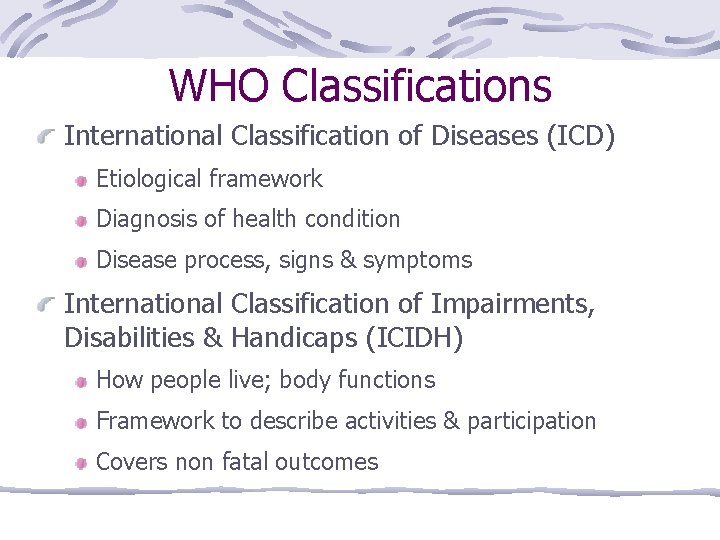
WHO Classifications International Classification of Diseases (ICD) Etiological framework Diagnosis of health condition Disease process, signs & symptoms International Classification of Impairments, Disabilities & Handicaps (ICIDH) How people live; body functions Framework to describe activities & participation Covers non fatal outcomes
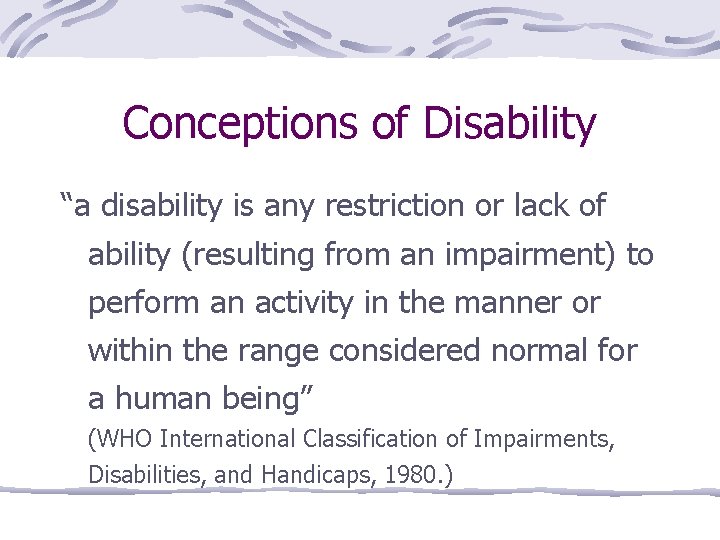
Conceptions of Disability “a disability is any restriction or lack of ability (resulting from an impairment) to perform an activity in the manner or within the range considered normal for a human being” (WHO International Classification of Impairments, Disabilities, and Handicaps, 1980. )
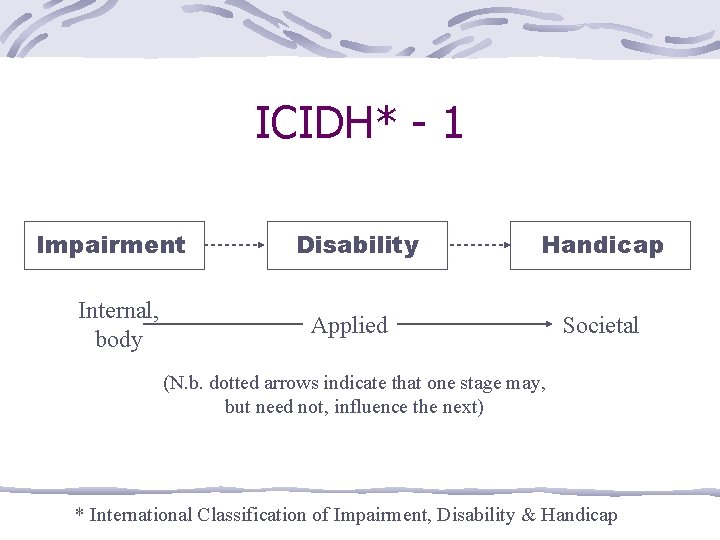
ICIDH* - 1 Impairment Internal, body Disability Handicap Applied Societal (N. b. dotted arrows indicate that one stage may, but need not, influence the next) * International Classification of Impairment, Disability & Handicap
Issues in the Definition Defining disability in terms of activity limitations is neat, but what activities? What level of limitation should be used? Same expectations for everyone, or relative to age, sex, etc. ? Threshold: does not perform an activity, versus cannot perform it? Maybe doesn’t, but could?
ICIDH - 2 Appeared March, 2001 Conceptual changes: From consequences of disease (1980) to components of health (2000) Uses more positive language (‘activity’ & ‘participation’ instead of ‘disability’ & ‘handicap’) Broadens concept of disability More on environmental factors in which the person lives
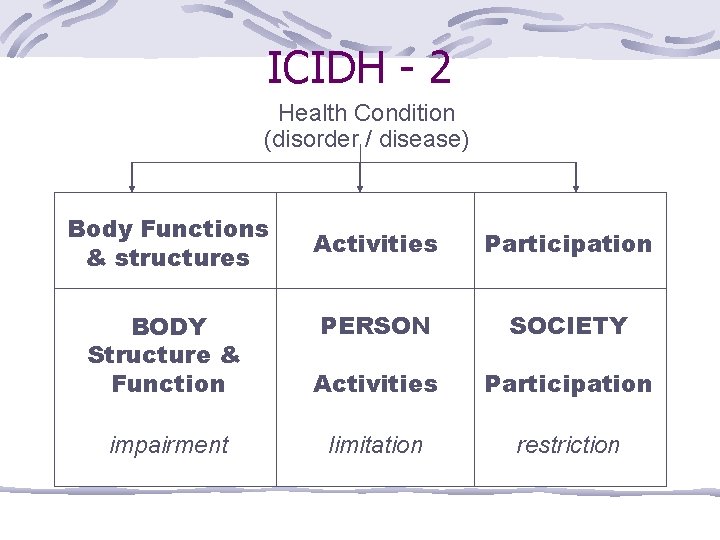
ICIDH - 2 Health Condition (disorder / disease) Body Functions & structures Activities Participation BODY Structure & Function PERSON SOCIETY Activities Participation impairment limitation restriction
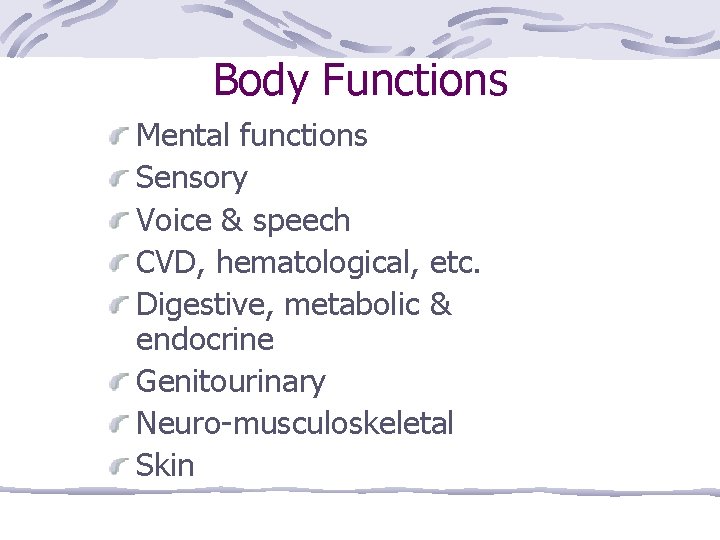
Body Functions Mental functions Sensory Voice & speech CVD, hematological, etc. Digestive, metabolic & endocrine Genitourinary Neuro-musculoskeletal Skin
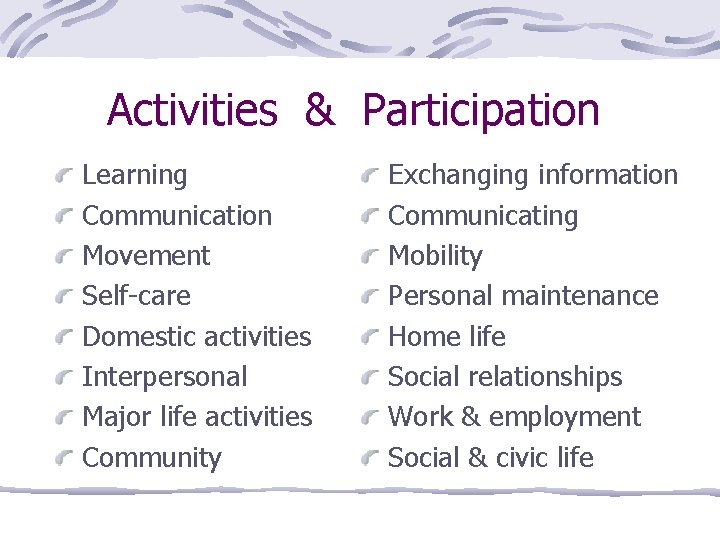
Activities & Participation Learning Communication Movement Self-care Domestic activities Interpersonal Major life activities Community Exchanging information Communicating Mobility Personal maintenance Home life Social relationships Work & employment Social & civic life
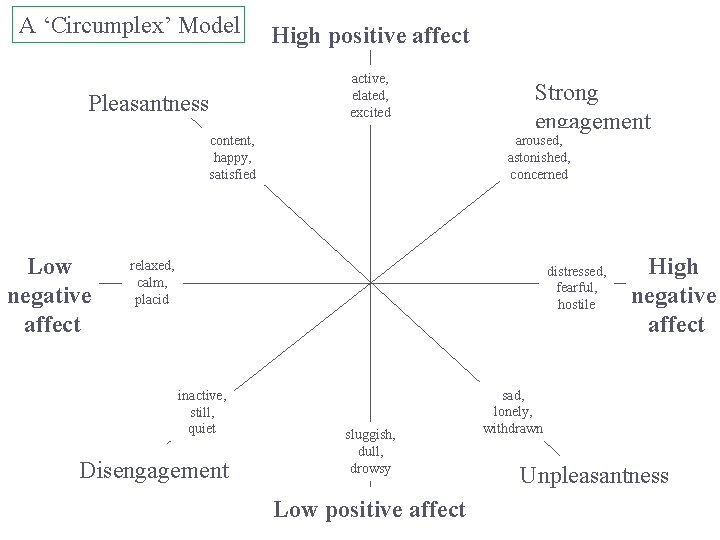
A ‘Circumplex’ Model Pleasantness High positive affect active, elated, excited content, happy, satisfied Low negative affect Strong engagement aroused, astonished, concerned relaxed, calm, placid distressed, fearful, hostile inactive, still, quiet Disengagement sluggish, dull, drowsy Low positive affect High negative affect sad, lonely, withdrawn Unpleasantness
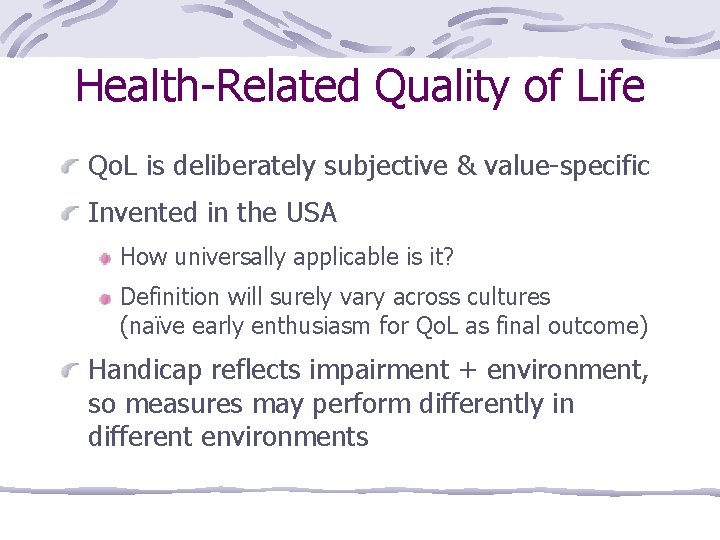
Health-Related Quality of Life Qo. L is deliberately subjective & value-specific Invented in the USA How universally applicable is it? Definition will surely vary across cultures (naïve early enthusiasm for Qo. L as final outcome) Handicap reflects impairment + environment, so measures may perform differently in different environments
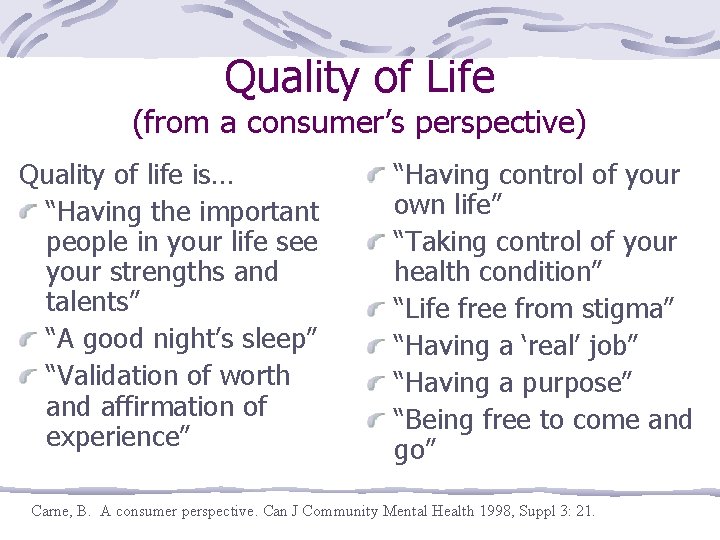
Quality of Life (from a consumer’s perspective) Quality of life is… “Having the important people in your life see your strengths and talents” “A good night’s sleep” “Validation of worth and affirmation of experience” “Having control of your own life” “Taking control of your health condition” “Life free from stigma” “Having a ‘real’ job” “Having a purpose” “Being free to come and go” Carne, B. A consumer perspective. Can J Community Mental Health 1998, Suppl 3: 21.
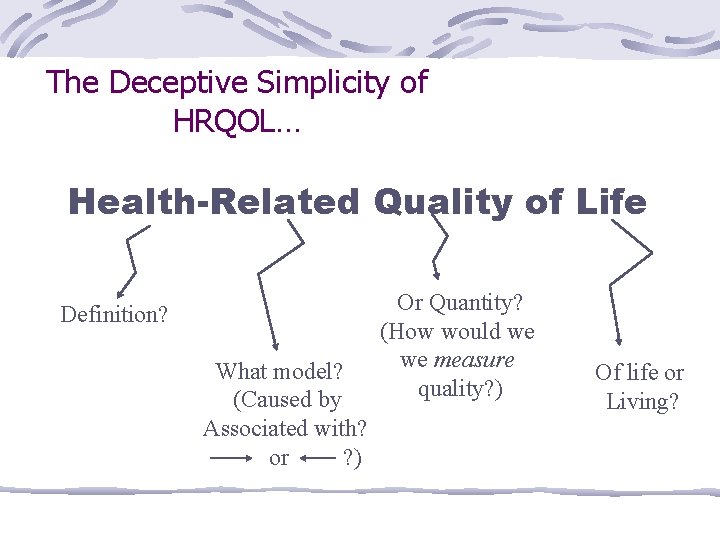
The Deceptive Simplicity of HRQOL… Health-Related Quality of Life Definition? What model? (Caused by Associated with? or ? ) Or Quantity? (How would we we measure quality? ) Of life or Living?
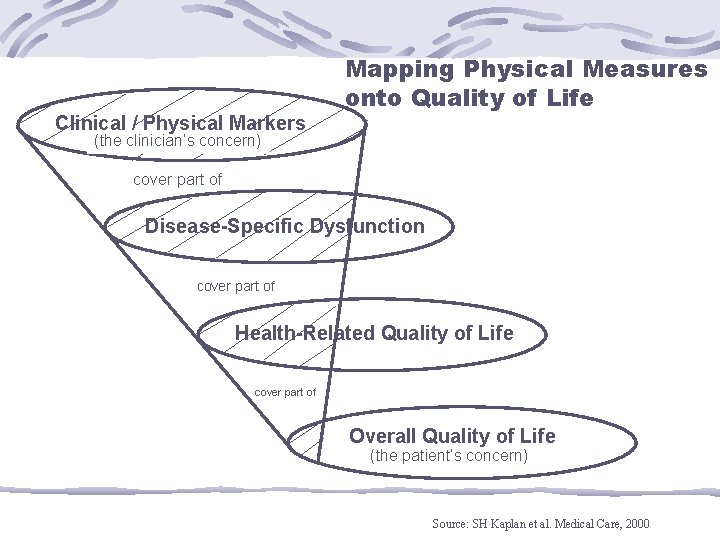
Clinical / Physical Markers Mapping Physical Measures onto Quality of Life (the clinician’s concern) cover part of Disease-Specific Dysfunction cover part of Health-Related Quality of Life cover part of Overall Quality of Life (the patient’s concern) Source: SH Kaplan et al. Medical Care, 2000
- Slides: 16