
Conceptual Design of a Combat Search and Rescue
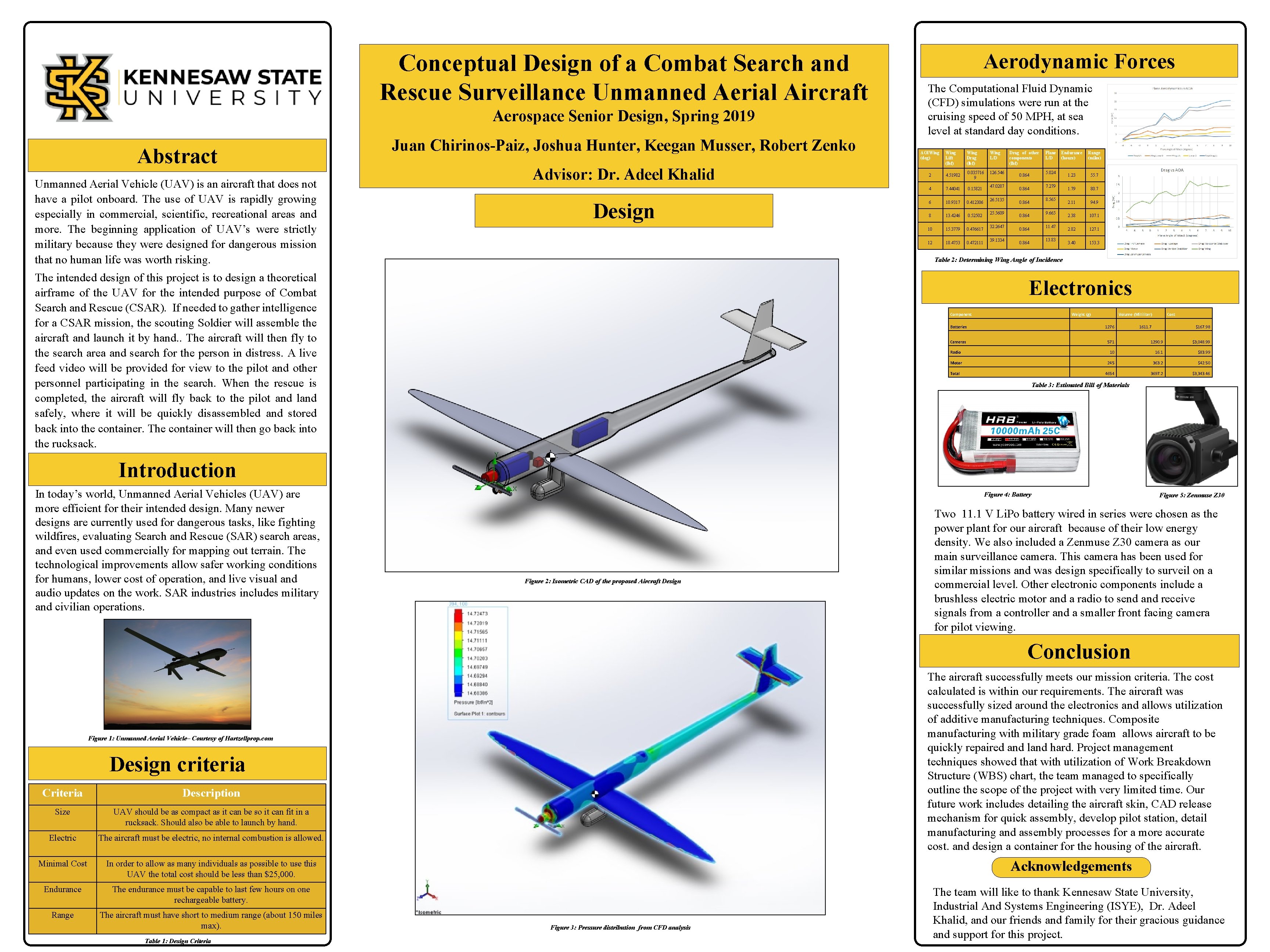
Conceptual Design of a Combat Search and Rescue Surveillance Unmanned Aerial Aircraft Aerospace Senior Design, Spring 2019 Abstract Unmanned Aerial Vehicle (UAV) is an aircraft that does not have a pilot onboard. The use of UAV is rapidly growing especially in commercial, scientific, recreational areas and more. The beginning application of UAV’s were strictly military because they were designed for dangerous mission that no human life was worth risking. Juan Chirinos-Paiz, Joshua Hunter, Keegan Musser, Robert Zenko Advisor: Dr. Adeel Khalid Design Aerodynamic Forces The Computational Fluid Dynamic (CFD) simulations were run at the cruising speed of 50 MPH, at sea level at standard day conditions. AOIWing (deg) Wing Lift (lbf) Wing Drag (lbf) Wing L/D 2 4. 51982 0. 035716 9 126. 546 4 7. 44041 0. 15821 6 10. 9317 0. 412306 8 13. 4246 0. 52502 10 15. 3779 0. 476617 12 18. 4753 0. 472111 47. 0287 26. 5135 25. 5609 32. 2647 39. 1334 Drag of other components (lbf) 0. 864 Plane L/D Endurance (hours) Range (miles) 1. 23 55. 7 1. 79 80. 7 2. 11 94. 9 2. 38 107. 1 2. 82 127. 1 3. 40 153. 3 5. 024 7. 279 8. 565 9. 665 11. 47 13. 83 Table 2: Determining Wing Angle of Incidence The intended design of this project is to design a theoretical airframe of the UAV for the intended purpose of Combat Search and Rescue (CSAR). If needed to gather intelligence for a CSAR mission, the scouting Soldier will assemble the aircraft and launch it by hand. . The aircraft will then fly to the search area and search for the person in distress. A live feed video will be provided for view to the pilot and other personnel participating in the search. When the rescue is completed, the aircraft will fly back to the pilot and land safely, where it will be quickly disassembled and stored back into the container. The container will then go back into the rucksack. Electronics Component Weight (g) Volume (Milliliter) Cost Batteries 1276 1611. 7 $167. 98 Cameras 571 1290. 9 $3, 048. 99 Radio 10 16. 1 $83. 99 Motor 245 363. 2 $42. 50 Total 4654 3697. 2 $3, 343. 46 Table 3: Estimated Bill of Materials Introduction In today’s world, Unmanned Aerial Vehicles (UAV) are more efficient for their intended design. Many newer designs are currently used for dangerous tasks, like fighting wildfires, evaluating Search and Rescue (SAR) search areas, and even used commercially for mapping out terrain. The technological improvements allow safer working conditions for humans, lower cost of operation, and live visual and audio updates on the work. SAR industries includes military and civilian operations. Figure 4: Battery Figure 2: Isometric CAD of the proposed Aircraft Design Figure 5: Zenmuse Z 30 Two 11. 1 V Li. Po battery wired in series were chosen as the power plant for our aircraft because of their low energy density. We also included a Zenmuse Z 30 camera as our main surveillance camera. This camera has been used for similar missions and was design specifically to surveil on a commercial level. Other electronic components include a brushless electric motor and a radio to send and receive signals from a controller and a smaller front facing camera for pilot viewing. Conclusion The aircraft successfully meets our mission criteria. The cost calculated is within our requirements. The aircraft was successfully sized around the electronics and allows utilization of additive manufacturing techniques. Composite manufacturing with military grade foam allows aircraft to be quickly repaired and land hard. Project management techniques showed that with utilization of Work Breakdown Structure (WBS) chart, the team managed to specifically outline the scope of the project with very limited time. Our future work includes detailing the aircraft skin, CAD release mechanism for quick assembly, develop pilot station, detail manufacturing and assembly processes for a more accurate cost. and design a container for the housing of the aircraft. Figure 1: Unmanned Aerial Vehicle– Courtesy of Hartzellprop. com Design criteria Criteria Description Size UAV should be as compact as it can be so it can fit in a rucksack. Should also be able to launch by hand. Electric The aircraft must be electric, no internal combustion is allowed. Minimal Cost In order to allow as many individuals as possible to use this UAV the total cost should be less than $25, 000. Endurance The endurance must be capable to last few hours on one rechargeable battery. Range The aircraft must have short to medium range (about 150 miles max). Table 1: Design Criteria Acknowledgements Figure 3: Pressure distribution from CFD analysis The team will like to thank Kennesaw State University, Industrial And Systems Engineering (ISYE), Dr. Adeel Khalid, and our friends and family for their gracious guidance and support for this project.
- Slides: 1