
Conceptual Art and Software Art Notations Algorithms and
- Slides: 36
Conceptual Art and Software Art: Notations, Algorithms and Codes Literature and Current: Code Interface Concept Literaturhaus Stuttgart, 11/11/2005 Thomas Dreher http: //dreher. netzliteratur. net
Concepts: • verbal instructions • Instructions with algorithmic disposition • machine-readable notations (with algorithms in programming languages) 2
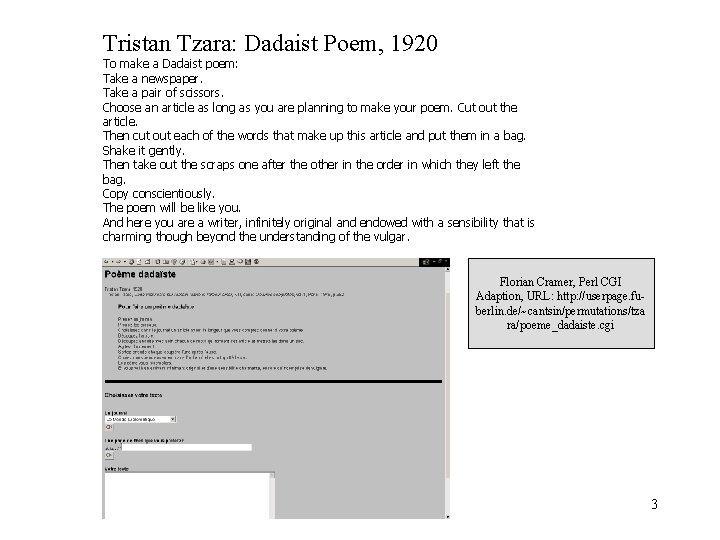
Tristan Tzara: Dadaist Poem, 1920 To make a Dadaist poem: Take a newspaper. Take a pair of scissors. Choose an article as long as you are planning to make your poem. Cut out the article. Then cut out each of the words that make up this article and put them in a bag. Shake it gently. Then take out the scraps one after the other in the order in which they left the bag. Copy conscientiously. The poem will be like you. And here you are a writer, infinitely original and endowed with a sensibility that is charming though beyond the understanding of the vulgar. Florian Cramer, Perl CGI Adaption, URL: http: //userpage. fuberlin. de/~cantsin/permutations/tza ra/poeme_dadaiste. cgi 3
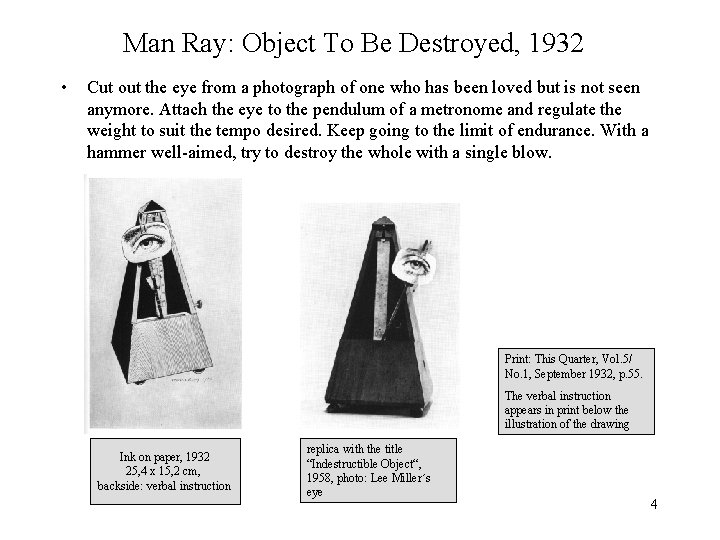
Man Ray: Object To Be Destroyed, 1932 • Cut out the eye from a photograph of one who has been loved but is not seen anymore. Attach the eye to the pendulum of a metronome and regulate the weight to suit the tempo desired. Keep going to the limit of endurance. With a hammer well-aimed, try to destroy the whole with a single blow. Print: This Quarter, Vol. 5/ No. 1, September 1932, p. 55. The verbal instruction appears in print below the illustration of the drawing Ink on paper, 1932 25, 4 x 15, 2 cm, backside: verbal instruction replica with the title “Indestructible Object“, 1958, photo: Lee Miller´s eye 4
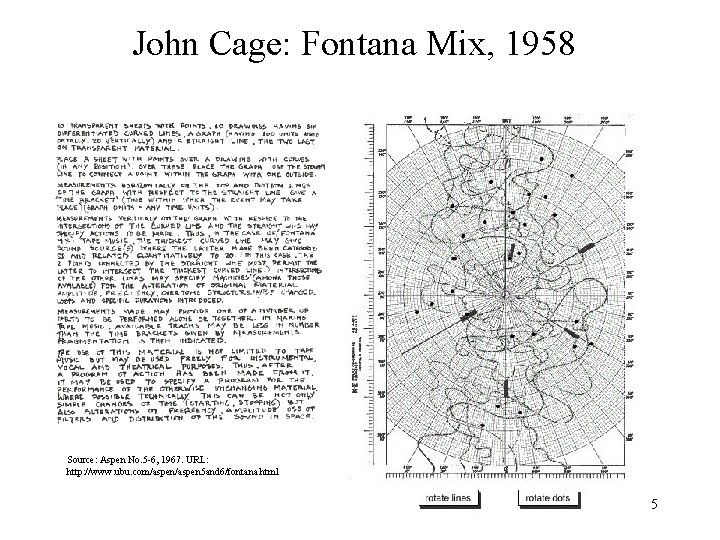
John Cage: Fontana Mix, 1958 Source: Aspen No. 5 -6, 1967. URL: http: //www. ubu. com/aspen 5 and 6/fontana. html 5
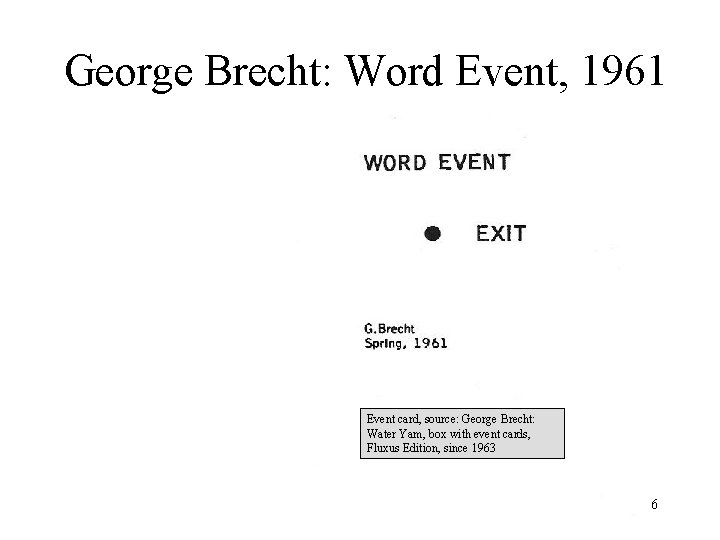
George Brecht: Word Event, 1961 Event card, source: George Brecht: Water Yam, box with event cards, Fluxus Edition, since 1963 6
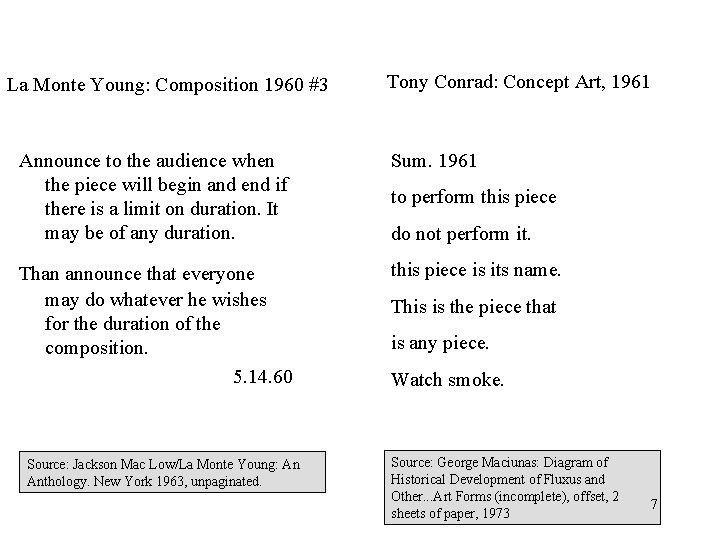
La Monte Young: Composition 1960 #3 Tony Conrad: Concept Art, 1961 Announce to the audience when the piece will begin and end if there is a limit on duration. It may be of any duration. Sum. 1961 Than announce that everyone may do whatever he wishes for the duration of the composition. 5. 14. 60 this piece is its name. Source: Jackson Mac Low/La Monte Young: An Anthology. New York 1963, unpaginated. to perform this piece do not perform it. This is the piece that is any piece. Watch smoke. Source: George Maciunas: Diagram of Historical Development of Fluxus and Other. . . Art Forms (incomplete), offset, 2 sheets of paper, 1973 7
Conceptual Performance 4 aspects: • The written planning liberated from conventions of art media and notations. • The highlighting of the relation planning - realization prompted problematization of the execution as a realization of actions or the objects. • The relation notation - operation of observing is demonstrated on the one hand parallel to possible realizations as actions or objects and on the other hand as a substitute of these realizations: Notations can be realizable in no other way than as operations of observing. • Texts of and as works instruct to operations of observing and describe with it procedures of thinking. 8
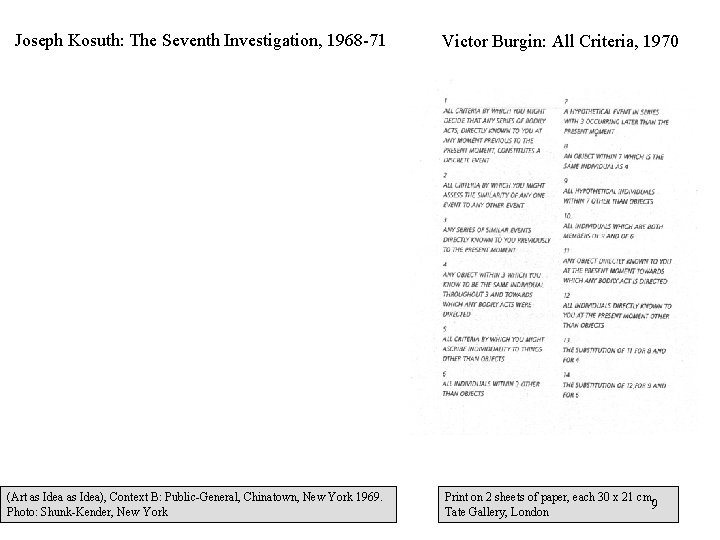
Joseph Kosuth: The Seventh Investigation, 1968 -71 (Art as Idea), Context B: Public-General, Chinatown, New York 1969. Photo: Shunk-Kender, New York Victor Burgin: All Criteria, 1970 Print on 2 sheets of paper, each 30 x 21 cm, 9 Tate Gallery, London
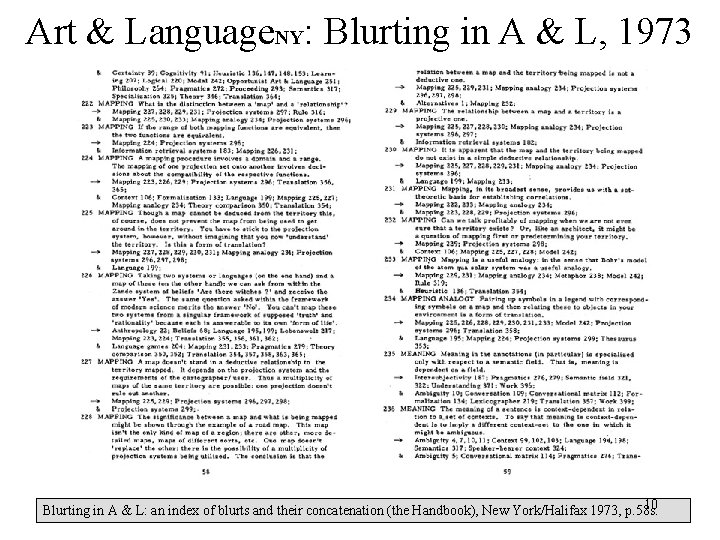
Art & Language. NY: Blurting in A & L, 1973 10 Blurting in A & L: an index of blurts and their concatenation (the Handbook), New York/Halifax 1973, p. 58 s.
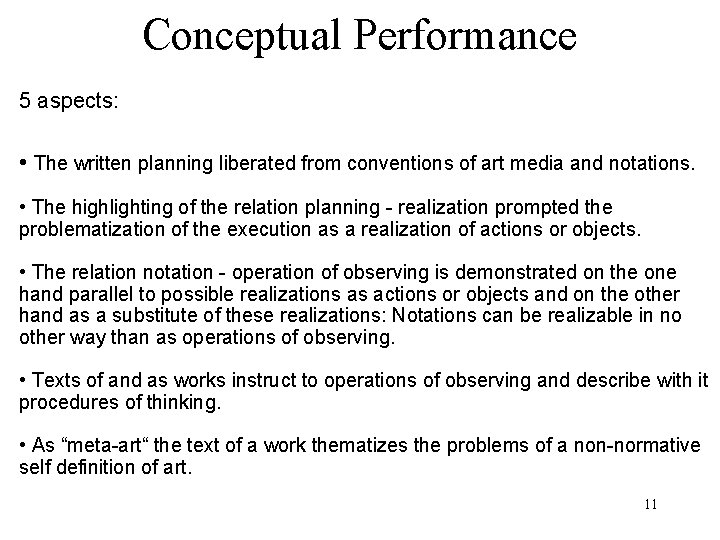
Conceptual Performance 5 aspects: • The written planning liberated from conventions of art media and notations. • The highlighting of the relation planning - realization prompted the problematization of the execution as a realization of actions or objects. • The relation notation - operation of observing is demonstrated on the one hand parallel to possible realizations as actions or objects and on the other hand as a substitute of these realizations: Notations can be realizable in no other way than as operations of observing. • Texts of and as works instruct to operations of observing and describe with it procedures of thinking. • As “meta-art“ the text of a work thematizes the problems of a non-normative self definition of art. 11
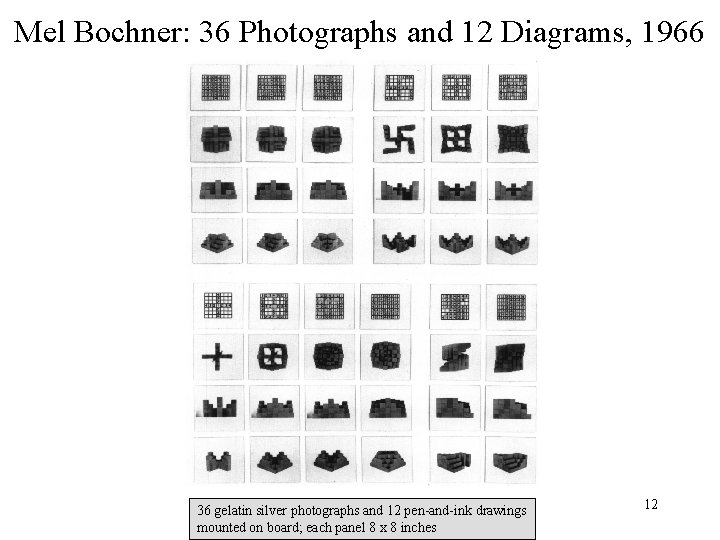
Mel Bochner: 36 Photographs and 12 Diagrams, 1966 36 gelatin silver photographs and 12 pen-and-ink drawings mounted on board; each panel 8 x 8 inches 12
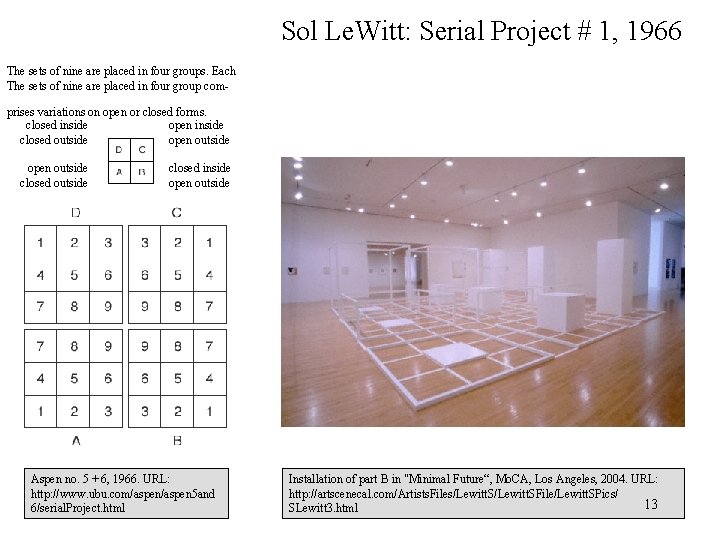
Sol Le. Witt: Serial Project # 1, 1966 The sets of nine are placed in four groups. Each The sets of nine are placed in four group comprises variations on open or closed forms. closed inside open inside closed outside open outside closed inside open outside Aspen no. 5 + 6, 1966. URL: http: //www. ubu. com/aspen 5 and 6/serial. Project. html Installation of part B in "Minimal Future“, Mo. CA, Los Angeles, 2004. URL: http: //artscenecal. com/Artists. Files/Lewitt. SFile/Lewitt. SPics/ 13 SLewitt 3. html
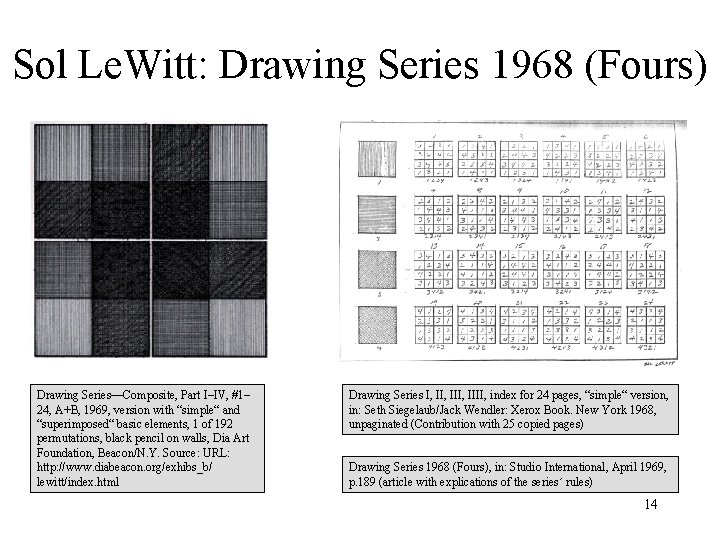
Sol Le. Witt: Drawing Series 1968 (Fours) Drawing Series—Composite, Part I–IV, #1– 24, A+B, 1969, version with “simple“ and “superimposed“ basic elements, 1 of 192 permutations, black pencil on walls, Dia Art Foundation, Beacon/N. Y. Source: URL: http: //www. diabeacon. org/exhibs_b/ lewitt/index. html Drawing Series I, III, IIII, index for 24 pages, “simple“ version, in: Seth Siegelaub/Jack Wendler: Xerox Book. New York 1968, unpaginated (Contribution with 25 copied pages) Drawing Series 1968 (Fours), in: Studio International, April 1969, p. 189 (article with explications of the series´ rules) 14
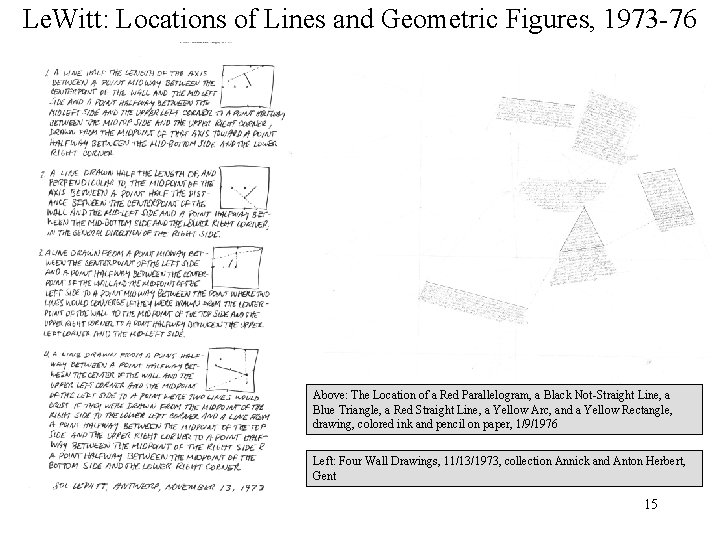
Le. Witt: Locations of Lines and Geometric Figures, 1973 -76 Above: The Location of a Red Parallelogram, a Black Not-Straight Line, a Blue Triangle, a Red Straight Line, a Yellow Arc, and a Yellow Rectangle, drawing, colored ink and pencil on paper, 1/9/1976 Left: Four Wall Drawings, 11/13/1973, collection Annick and Anton Herbert, Gent 15
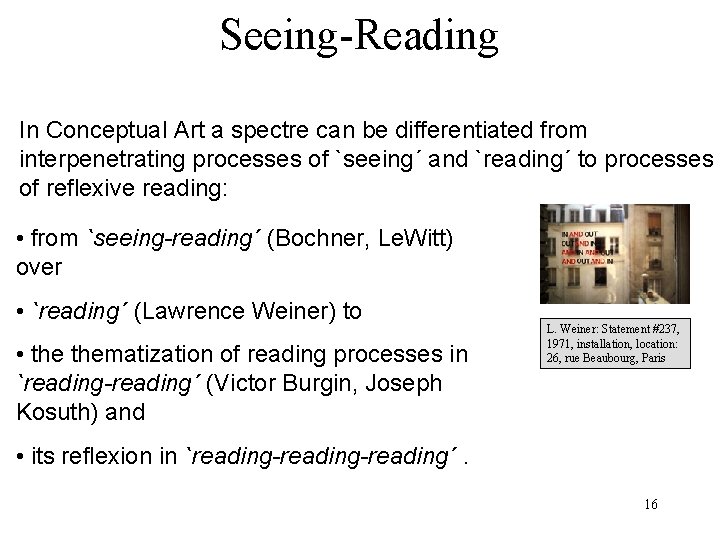
Seeing-Reading In Conceptual Art a spectre can be differentiated from interpenetrating processes of `seeing´ and `reading´ to processes of reflexive reading: • from `seeing-reading´ (Bochner, Le. Witt) over • `reading´ (Lawrence Weiner) to • thematization of reading processes in `reading-reading´ (Victor Burgin, Joseph Kosuth) and L. Weiner: Statement #237, 1971, installation, location: 26, rue Beaubourg, Paris • its reflexion in `reading-reading´. 16
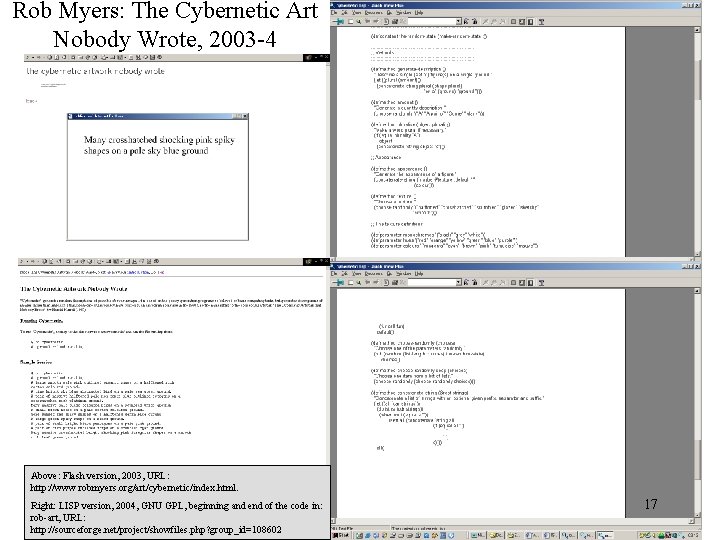
Rob Myers: The Cybernetic Art Nobody Wrote, 2003 -4 Above: Flash version, 2003, URL: http: //www. robmyers. org/art/cybernetic/index. html. Right: LISP version, 2004, GNU GPL, beginning and end of the code in: rob-art, URL: http: //sourceforge. net/project/showfiles. php? group_id=108602 17
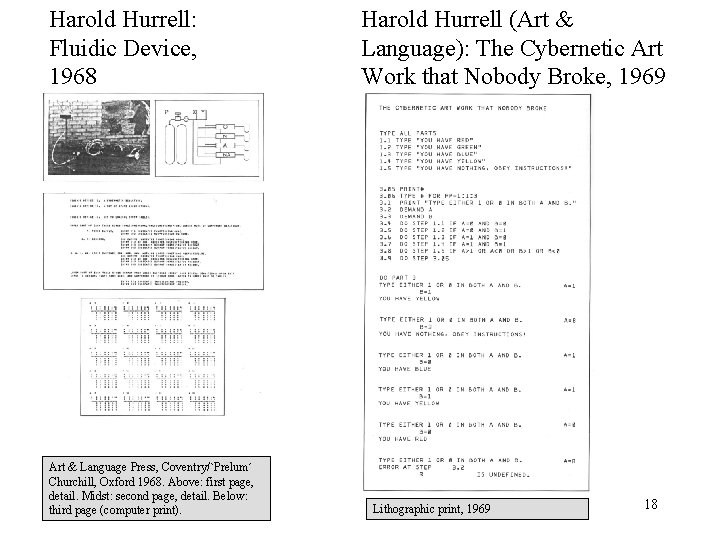
Harold Hurrell: Fluidic Device, 1968 Art & Language Press, Coventry/`Prelum´ Churchill, Oxford 1968. Above: first page, detail. Midst: second page, detail. Below: third page (computer print). Harold Hurrell (Art & Language): The Cybernetic Art Work that Nobody Broke, 1969 Lithographic print, 1969 18
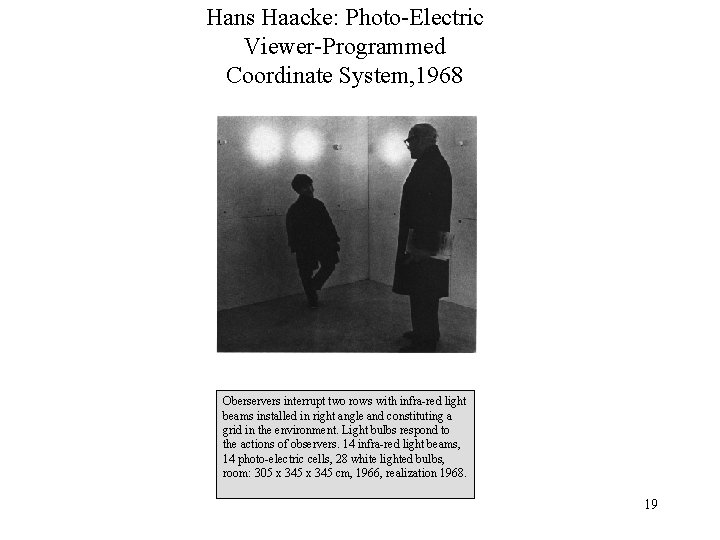
Hans Haacke: Photo-Electric Viewer-Programmed Coordinate System, 1968 Oberservers interrupt two rows with infra-red light beams installed in right angle and constituting a grid in the environment. Light bulbs respond to the actions of observers. 14 infra-red light beams, 14 photo-electric cells, 28 white lighted bulbs, room: 305 x 345 cm, 1966, realization 1968. 19
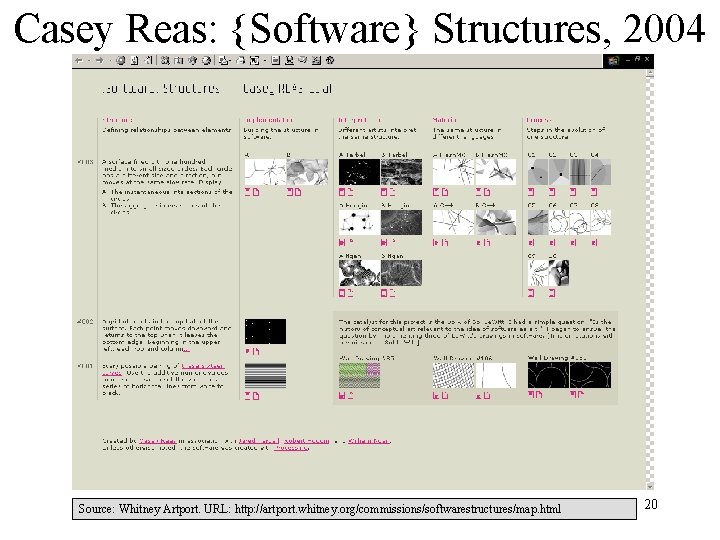
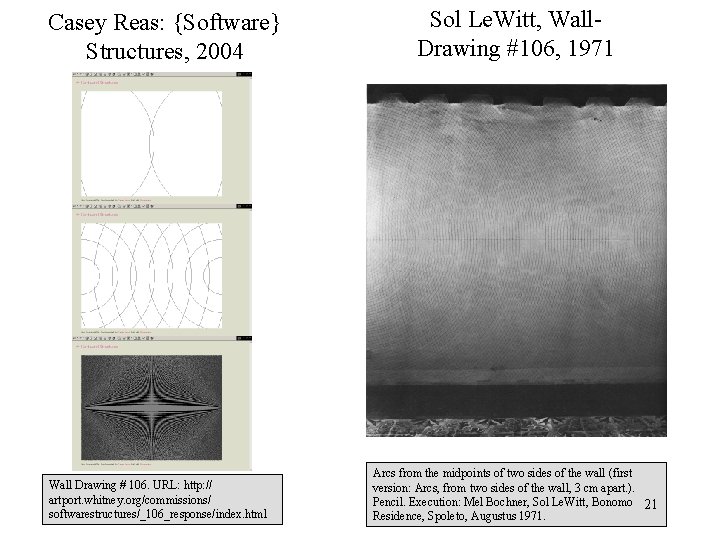
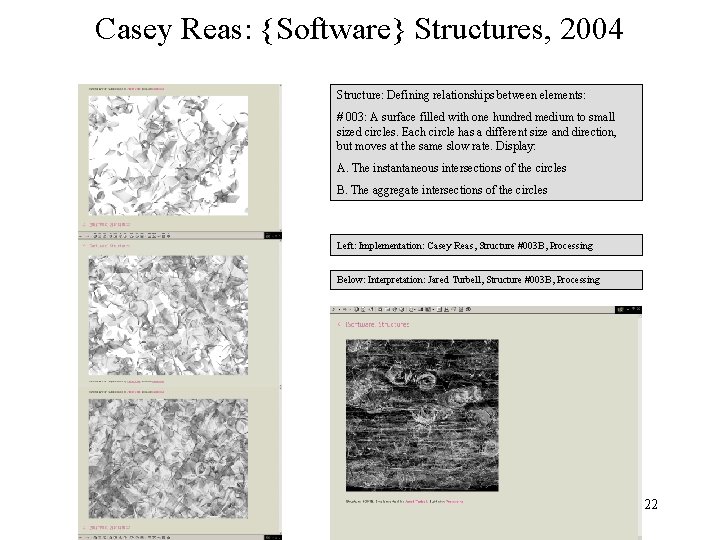
Casey Reas: {Software} Structures, 2004 Source: Whitney Artport. URL: http: //artport. whitney. org/commissions/softwarestructures/map. html 20
Casey Reas: {Software} Structures, 2004 Wall Drawing # 106. URL: http: // artport. whitney. org/commissions/ softwarestructures/_106_response/index. html Sol Le. Witt, Wall. Drawing #106, 1971 Arcs from the midpoints of two sides of the wall (first version: Arcs, from two sides of the wall, 3 cm apart. ). Pencil. Execution: Mel Bochner, Sol Le. Witt, Bonomo 21 Residence, Spoleto, Augustus 1971.
Casey Reas: {Software} Structures, 2004 Structure: Defining relationships between elements: # 003: A surface filled with one hundred medium to small sized circles. Each circle has a different size and direction, but moves at the same slow rate. Display: A. The instantaneous intersections of the circles B. The aggregate intersections of the circles Left: Implementation: Casey Reas, Structure #003 B, Processing Below: Interpretation: Jared Turbell, Structure #003 B, Processing 22
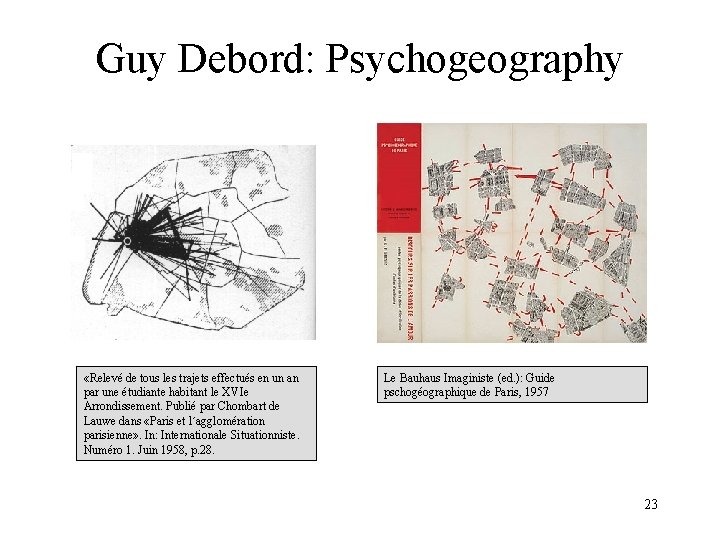
Guy Debord: Psychogeography «Relevé de tous les trajets effectués en un an par une étudiante habitant le XVIe Arrondissement. Publié par Chombart de Lauwe dans «Paris et l´agglomération parisienne» . In: Internationale Situationniste. Numéro 1. Juin 1958, p. 28. Le Bauhaus Imaginiste (ed. ): Guide pschogéographique de Paris, 1957 23
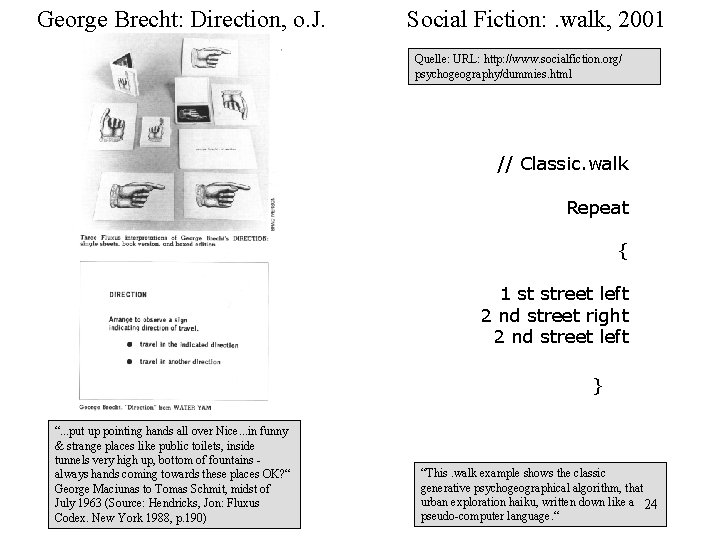
George Brecht: Direction, o. J. Social Fiction: . walk, 2001 Quelle: URL: http: //www. socialfiction. org/ psychogeography/dummies. html // Classic. walk Repeat { 1 st street left 2 nd street right 2 nd street left } “. . . put up pointing hands all over Nice. . . in funny & strange places like public toilets, inside tunnels very high up, bottom of fountains always hands coming towards these places OK? “ George Maciunas to Tomas Schmit, midst of July 1963 (Source: Hendricks, Jon: Fluxus Codex. New York 1988, p. 190) “This. walk example shows the classic generative psychogeographical algorithm, that urban exploration haiku, written down like a 24 pseudo-computer language. “
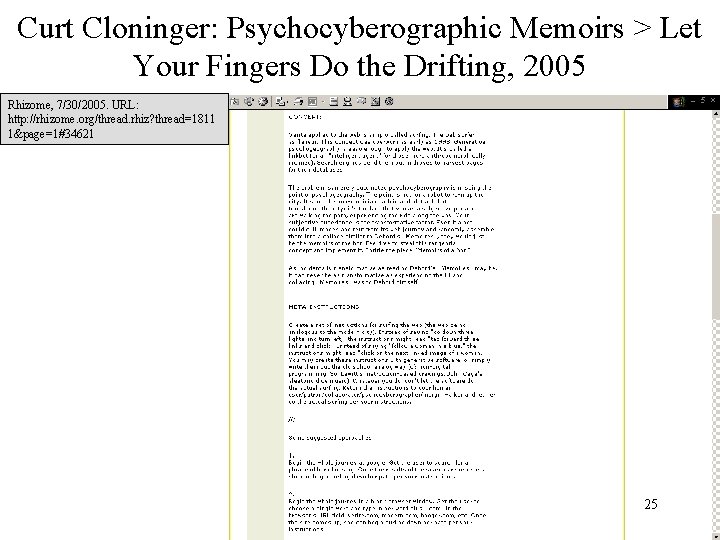
Curt Cloninger: Psychocyberographic Memoirs > Let Your Fingers Do the Drifting, 2005 Rhizome, 7/30/2005. URL: http: //rhizome. org/thread. rhiz? thread=1811 1&page=1#34621 25
Algorithm In mathematics and informatics, the term “algorithm” designates an instruction which describes a task precise and completely in several steps. The computer scientist Paul E. Black defines an algorithm as “a computable set of steps to achieve a desired result. ” Therefore an algorithm is a precise stepwise structure of a repeatable instruction but its result is not so definitely predeterminated as definitions in natural sciences prescribe it. 26
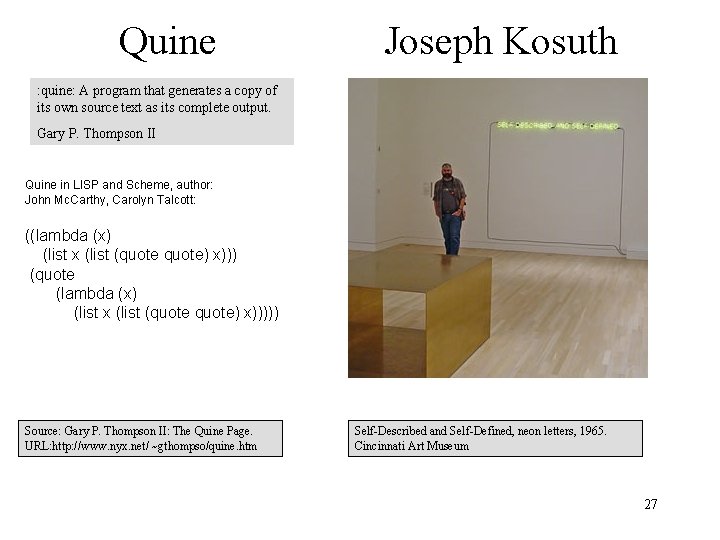
Quine Joseph Kosuth : quine: A program that generates a copy of its own source text as its complete output. Gary P. Thompson II Quine in LISP and Scheme, author: John Mc. Carthy, Carolyn Talcott: ((lambda (x) (list x (list (quote) x))) (quote (lambda (x) (list x (list (quote) x))))) Source: Gary P. Thompson II: The Quine Page. URL: http: //www. nyx. net/ ~gthompso/quine. htm Self-Described and Self-Defined, neon letters, 1965. Cincinnati Art Museum 27
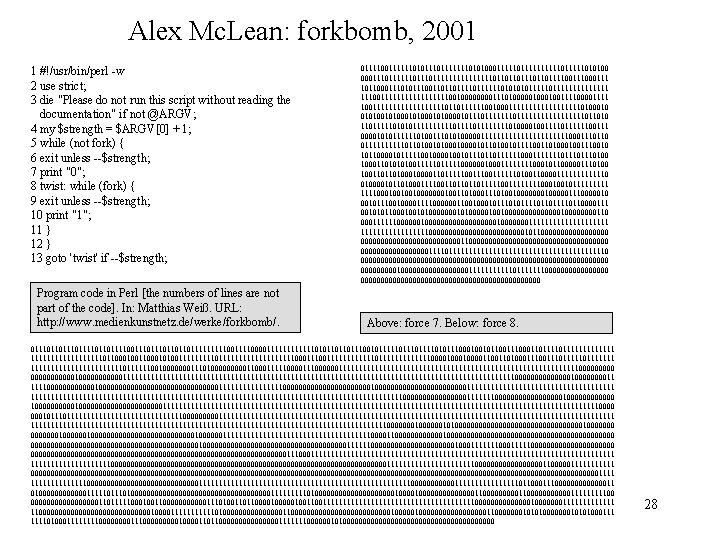
Alex Mc. Lean: forkbomb, 2001 1 #!/usr/bin/perl -w 2 use strict; 3 die "Please do not run this script without reading the documentation" if not @ARGV; 4 my $strength = $ARGV[0] + 1; 5 while (not fork) { 6 exit unless --$strength; 7 print "0"; 8 twist: while (fork) { 9 exit unless --$strength; 10 print "1"; 11 } 12 } 13 goto 'twist' if --$strength; Program code in Perl [the numbers of lines are not part of the code]. In: Matthias Weiß. URL: http: //www. medienkunstnetz. de/werke/forkbomb/. 0111100111111010111111101010001111111111010100 00011101111111111101101101111000111 1011000111010111001101101111110101111101111111 1110011111111100100001110100000100111100001111 10011111111101101111110010001111111110100010 010100010100001011111110111111111011010 11011111010101111101111111101000010011111100111 000010101111110100111010100000111111111110001110110 011111011010001000010110100101111001101001110010 1011000010111110010010110111111000111111101110100 100011010011111000000111111110001011000001110100 10011011010000110111110011111101001100001111110 010000101101000111100110111110011110001001011111000100100100000001001101000111010010000011100000101110010000111100000011001011101011110110000111 00101011000100101000001001000000010000110 000111111000000000000100000001111111111000000000000101100000000000001100000000000000000011111111111111111111110 000000000000000000000000000000010000000001111110111111100000000000000000000000 Above: force 7. Below: force 8. 011101111011011110011101101101111100111100001111110101101101110010111110111101011100010010110011100011011111111101100010100111111111111110001111111101111111000010000110100011101111111111110111111001000000011101000001100011111000000111111111111111111111111111111000000000001111111111111111111111111111111111111111111111111100000001000011 111100000000000000000000011111111000000000001000000000000111111111111111111111111111111111111111111111110000000011111110000000001000000000000000011111111111111111111111111111111111111111111111111111110000 000101111111111111111000001111111111111111111111111111111111111111111111111100000001010000000000000000100000000000001000000111111111111111111100001100000000000000000000000000010000000000000000001111110000000000010001111111000000000000000000000000000000001110001111111111111111111111111111111111111100000000000000000000000000000000000111111111110000000001100000111111 0000000000000000000000000000000000000000000000000000000000000000000000011111110000000000000011111111111111111111111111100000011111111011000111000000011 01000000111110100000000000000000011111010000000000100000000011000000000001111100 000000000110111110001001100000011101001101100000100111111111111111111110000000100000001111111 110000000000000010000111111010000000011000000000000010000000000011000000010101000111 111101000111100001110000010000110110000000011111110000001010000000000000000000 28
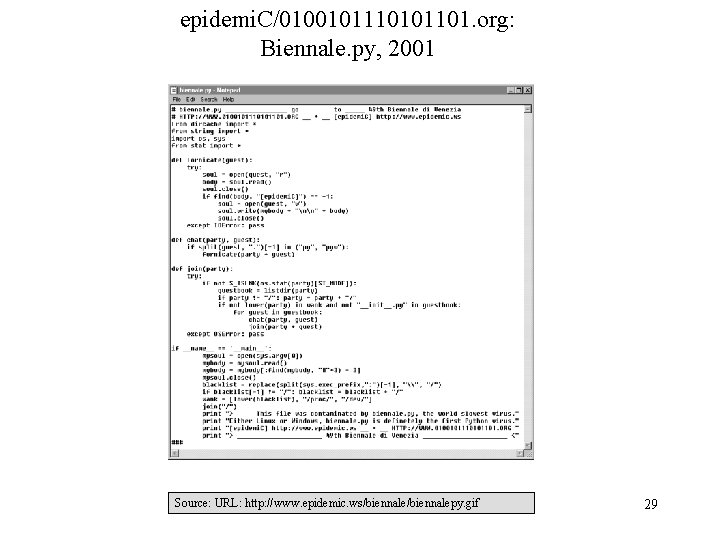
epidemi. C/0100101110101101. org: Biennale. py, 2001 Source: URL: http: //www. epidemic. ws/biennalepy. gif 29
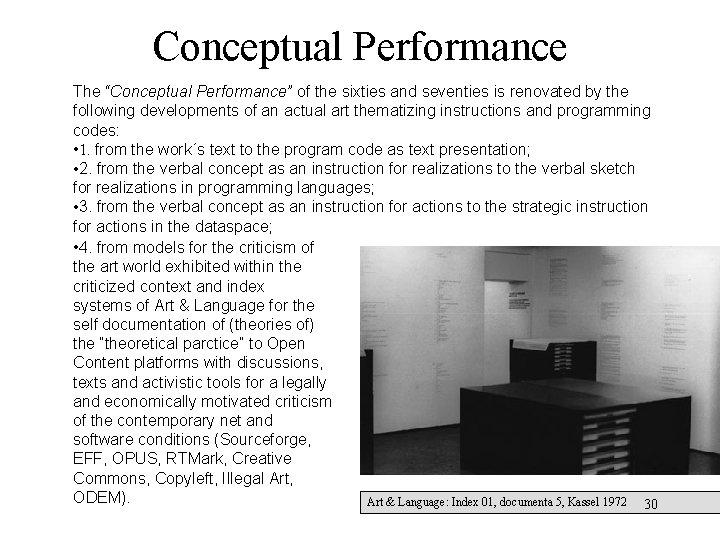
Conceptual Performance The “Conceptual Performance” of the sixties and seventies is renovated by the following developments of an actual art thematizing instructions and programming codes: • 1. from the work´s text to the program code as text presentation; • 2. from the verbal concept as an instruction for realizations to the verbal sketch for realizations in programming languages; • 3. from the verbal concept as an instruction for actions to the strategic instruction for actions in the dataspace; • 4. from models for the criticism of the art world exhibited within the criticized context and index systems of Art & Language for the self documentation of (theories of) the “theoretical parctice” to Open Content platforms with discussions, texts and activistic tools for a legally and economically motivated criticism of the contemporary net and software conditions (Sourceforge, EFF, OPUS, RTMark, Creative Commons, Copyleft, Illegal Art, ODEM). Art & Language: Index 01, documenta 5, Kassel 1972 30
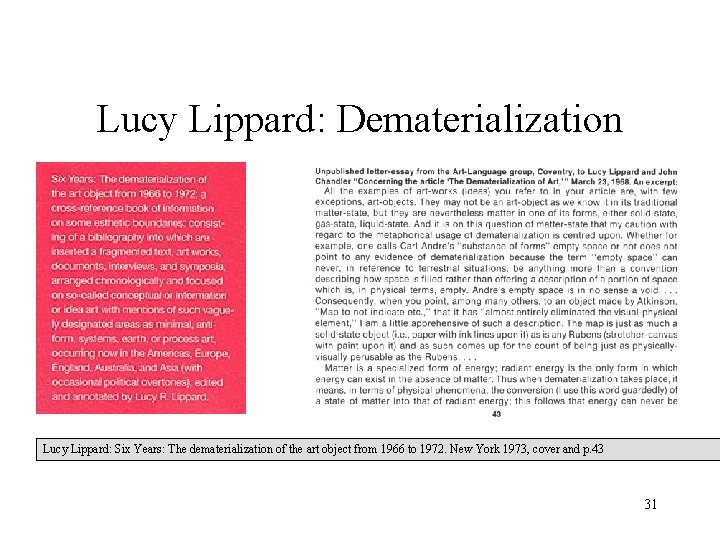
Lucy Lippard: Dematerialization Lucy Lippard: Six Years: The dematerialization of the art object from 1966 to 1972. New York 1973, cover and p. 43 31
Inke Arns: Program Code Program code is characterised by the fact that here `saying´ coincides with `doing´. Code as an effective speech act is not a description or a representation of something, but, on the contrary, it directly affects, and literally sets in motion - or it even `kills´ a process. Inke Arns: Read_me, Run_me, Execute_me. Software and its Discontents, or: It´s the Performativity of Code, Stupid. URL: http: //art. runme. org/1107863582 -4268 -0/arns. pdf 32
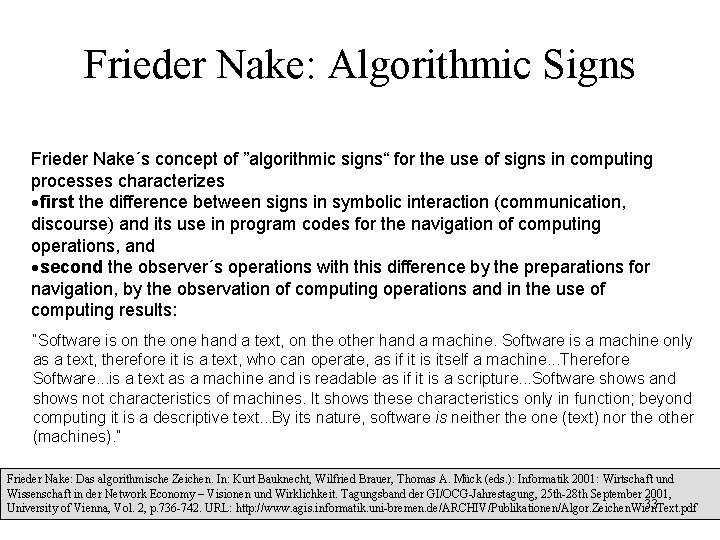
Frieder Nake: Algorithmic Signs Frieder Nake´s concept of ”algorithmic signs“ for the use of signs in computing processes characterizes first the difference between signs in symbolic interaction (communication, discourse) and its use in program codes for the navigation of computing operations, and second the observer´s operations with this difference by the preparations for navigation, by the observation of computing operations and in the use of computing results: “Software is on the one hand a text, on the other hand a machine. Software is a machine only as a text, therefore it is a text, who can operate, as if it is itself a machine. . . Therefore Software. . . is a text as a machine and is readable as if it is a scripture. . . Software shows and shows not characteristics of machines. It shows these characteristics only in function; beyond computing it is a descriptive text. . . By its nature, software is neither the one (text) nor the other (machines). ” Frieder Nake: Das algorithmische Zeichen. In: Kurt Bauknecht, Wilfried Brauer, Thomas A. Mück (eds. ): Informatik 2001: Wirtschaft und Wissenschaft in der Network Economy – Visionen und Wirklichkeit. Tagungsband der GI/OCG-Jahrestagung, 25 th-28 th September 2001, 33 University of Vienna, Vol. 2, p. 736 -742. URL: http: //www. agis. informatik. uni-bremen. de/ARCHIV/Publikationen/Algor. Zeichen. Wien. Text. pdf
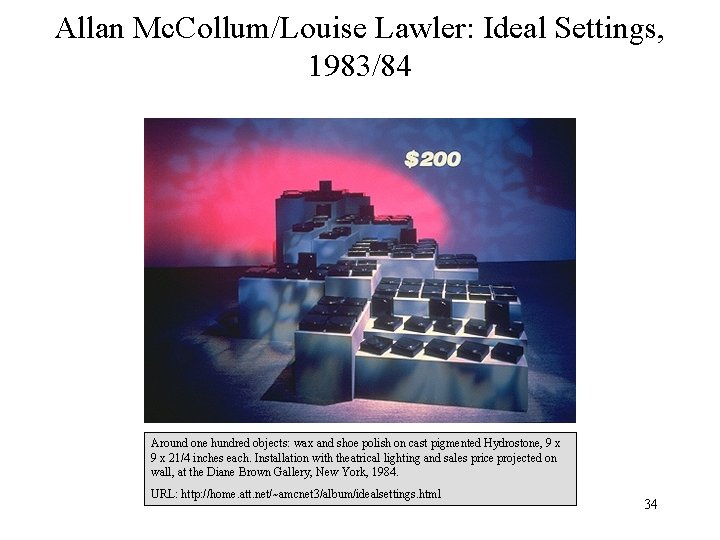
Allan Mc. Collum/Louise Lawler: Ideal Settings, 1983/84 Around one hundred objects: wax and shoe polish on cast pigmented Hydrostone, 9 x 21/4 inches each. Installation with theatrical lighting and sales price projected on wall, at the Diane Brown Gallery, New York, 1984. URL: http: //home. att. net/~amcnet 3/album/idealsettings. html 34
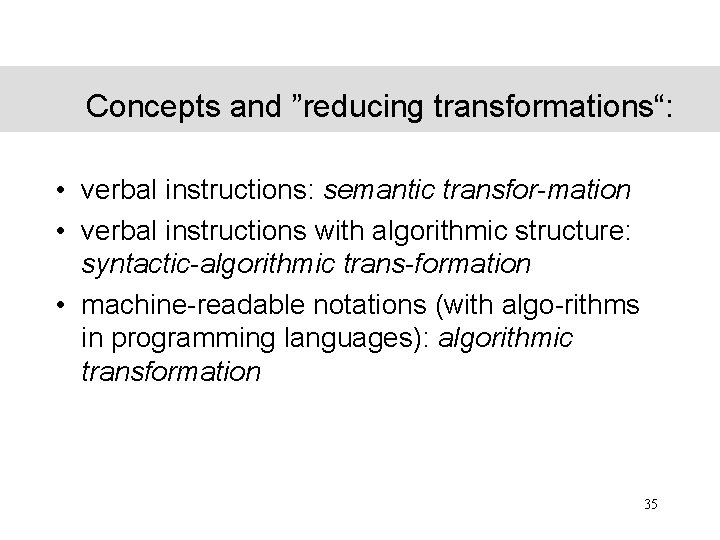
Concepts and ”reducing transformations“: • verbal instructions: semantic transfor-mation • verbal instructions with algorithmic structure: syntactic-algorithmic trans-formation • machine-readable notations (with algo-rithms in programming languages): algorithmic transformation 35
Origins of illustrations: The following notes on the origins of illustrations complete the notes in the captions: • Foil 4: Hultén, K. G. Pontus: The machine as seen at the end of the mechanical age. Mo. MA, New York 1968, p. 153. • Foil 9: Kosuth: Corris, Michael (ed. ): Conceptual Art. Theory, Myth and Practice. Cambridge/UK 2003, S. 241; Burgin: Osborne, Peter (ed. ): Conceptual Art. New York 2002, p. 126. • Foil 12: Bochner, Mel: Thought Made Visible 1966 -1973. Cat. exhib. Yale University Art Gallery, New Haven 1995, p. 14 (C 24). • Foil 15: left: Fuchs, R. H. /Debbaut, Jan: L´Architecte est absent. Works from the Collection of Annick and Anton Herbert. Cat. exhib. Stedelijk Van Abbemuseum. Eindhoven 1984, p. 36; right: Le. Witt, Sol: Drawings 1958 -1992. Cat. exhib. Haags Gemeentemuseum. Den Haag 1992, unpaginated, Nr. 181. • Foil 16: Website Ghislain Mollet-Viéville: Art Minimal & Conceptuel. URL: http: //www. conceptual-art. net/lweiner. html (11/14/2005). • Foil 18: left: Dreher, Thomas: Konzeptuelle Kunst in Amerika und England zwischen 1963 und 1976. Frankfurt am Main a. o. 1992, unpaginated, ill. 19; right: Harrison, Charles: Essays on Art & Language. Oxford 1991, p. 58, pl. 39. • Foil 19: Haacke, Hans: Werkmonographie. Köln 1972, unpaginated, ill. 31. • Foil 21: right: Legg, Alicia (ed. ): Sol Le. Witt. Cat. exhib. The Museum of Modern Art. New York 1978, p. 122. • Foil 27: right: Website Chris Glass. URL: http: //www. chrisglass. com/photos/artmuseum/art. html (11/14/2005). • Foil 30: Website Thomas Dreher: Intermedia Art. URL: http: //dreher. netzliteratur. net/ 3_Konzeptkunst_Art. Lang_B 2. html (11/14/2005). Photo: Charles Harrison. 36