
Concepts of Object Orientation lecture 1 b Objectives
Concepts of Object Orientation lecture 1 –b
Objectives: Concepts of Object Orientation Explain the basic principles of object orientation Define the basic concepts and terms of object orientation Demonstrate the strengths of object orientation OOAD 2
Best Practices Implementation Ø Object technology helps implement these Best Practices. Develop Iteratively: tolerates changing requirements, integrates elements progressively, facilitates reuse. Use Component-Based Architectures: architectural emphasis, componentbased development. Model Visually: easy understanding, easy modification. OOAD 3
What Is Object Technology? Ø Object technology A set of principles guiding software construction together with languages, databases, and other tools that support those principles. (Object Technology: A Manager’s Guide, Taylor, 1997) OOAD 4
Strengths of Object Technology Ø Provides a single paradigm A single language used by users, analysts, designers, and implementers Ø Facilitates architectural and code reuse Ø Models more closely reflect the real world More accurately describes corporate entities Decomposed based on natural partitioning Easier to understand maintain Ø Provides stability A small change in requirements does not mean massive changes in the system under development Ø Is adaptive to change OOAD 5
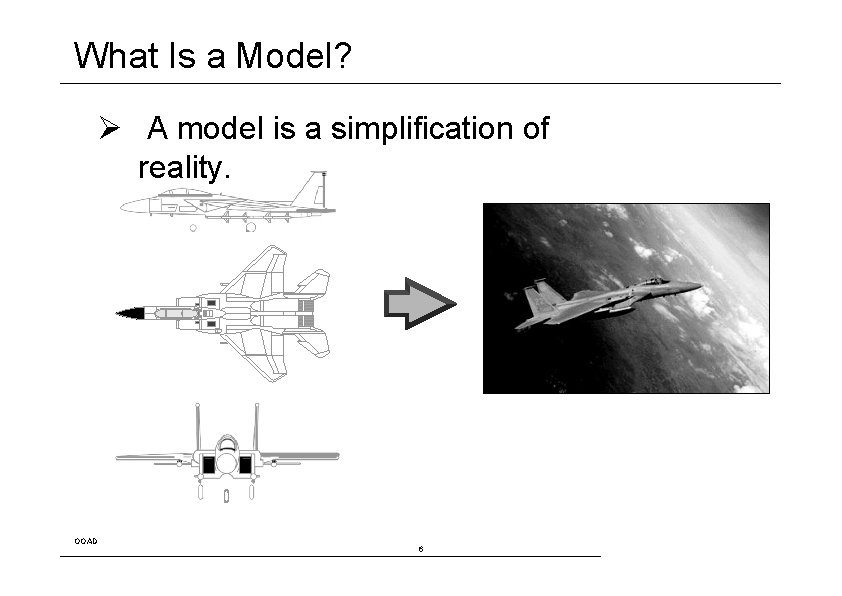
What Is a Model? Ø A model is a simplification of reality. OOAD 6
Why Do We Model? Ø We build models to better understand the system we are developing. Ø Modeling achieves four aims. It: Helps us to visualize a system as we want it to be. Permits us to specify the structure or behavior of a system. Gives us a template that guides us in constructing a system. Documents the decisions we have made. Ø We build models of complex systems because we cannot comprehend such a system in its entirety. OOAD 7
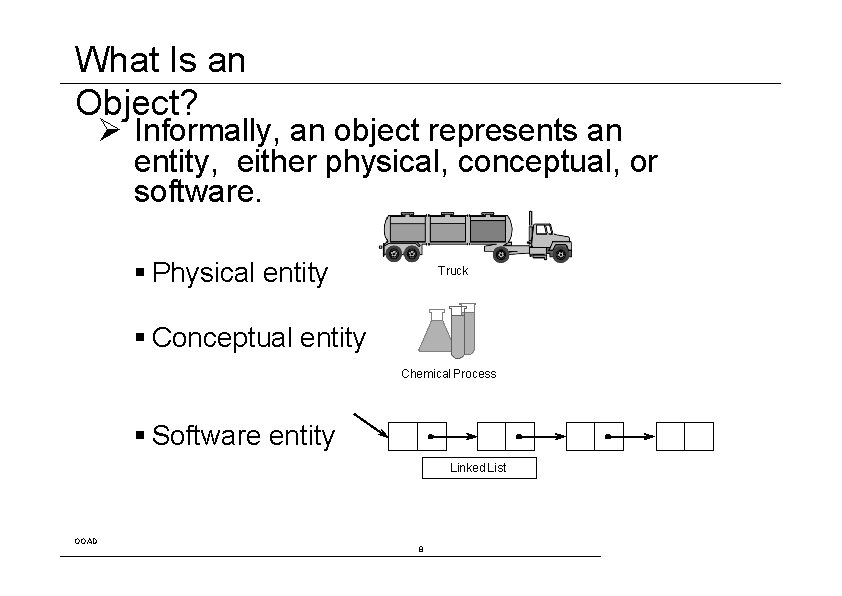
What Is an Object? Ø Informally, an object represents an entity, either physical, conceptual, or software. Physical entity Truck Conceptual entity Chemical Process Software entity Linked List OOAD 8
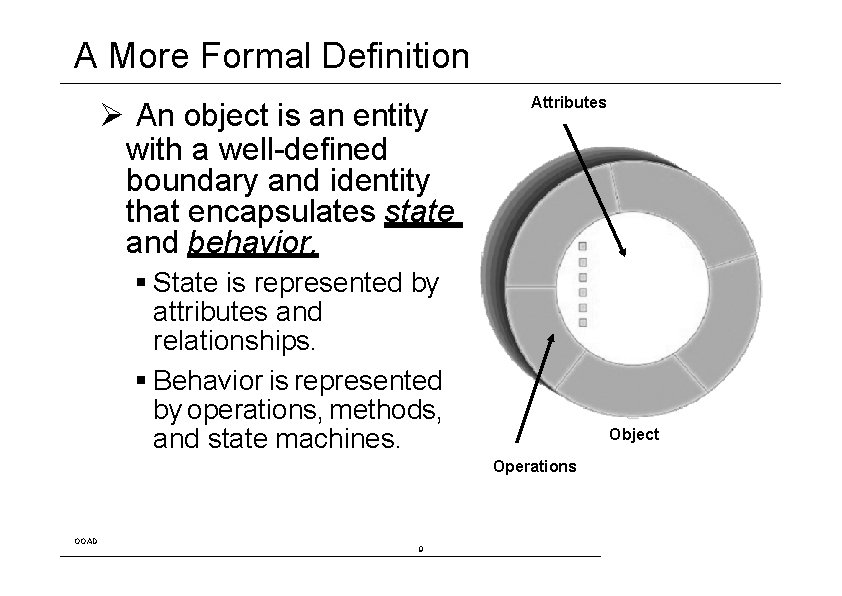
A More Formal Definition Ø An object is an entity with a well-defined boundary and identity that encapsulates state and behavior. Attributes State is represented by attributes and relationships. Behavior is represented by operations, methods, and state machines. Object Operations OOAD 9
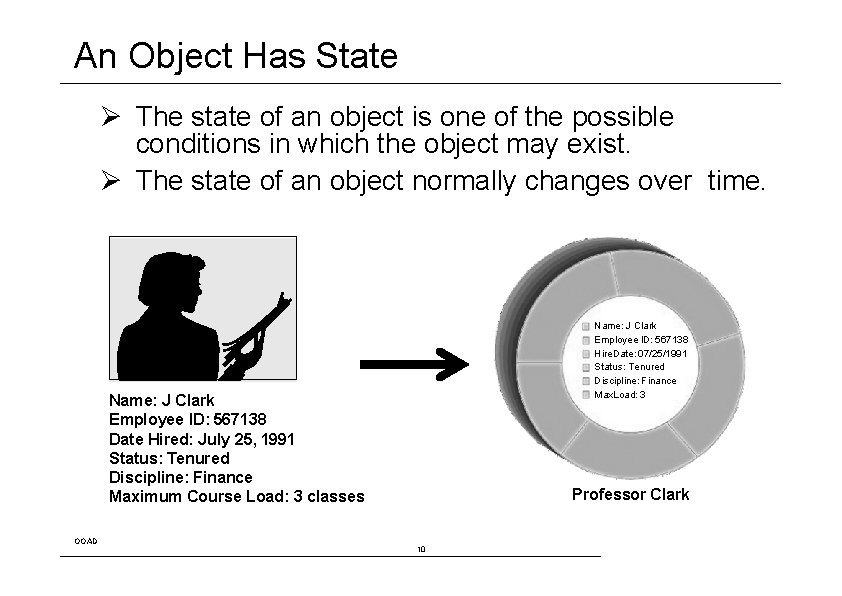
An Object Has State Ø The state of an object is one of the possible conditions in which the object may exist. Ø The state of an object normally changes over time. Name: J Clark Employee ID: 567138 Hire. Date: 07/25/1991 Status: Tenured Discipline: Finance Max. Load: 3 Name: J Clark Employee ID: 567138 Date Hired: July 25, 1991 Status: Tenured Discipline: Finance Maximum Course Load: 3 classes OOAD Professor Clark 10
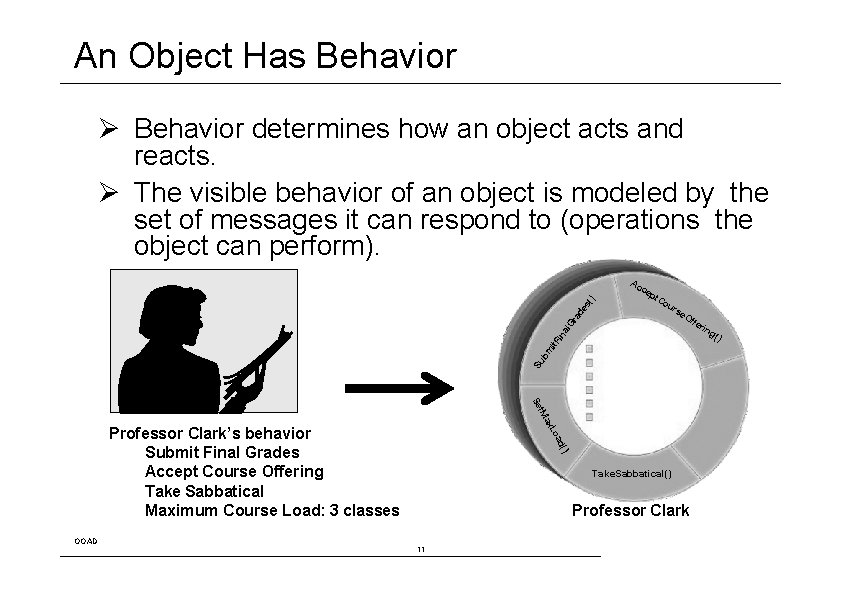
An Object Has Behavior Su bm it. F ina l. G ra de s( ) Ø Behavior determines how an object acts and reacts. Ø The visible behavior of an object is modeled by the set of messages it can respond to (operations the object can perform). () ad Lo ax t. M Se Professor Clark’s behavior Submit Final Grades Accept Course Offering Take Sabbatical Maximum Course Load: 3 classes OOAD Ac ce pt Co urs e. O ffe rin g() Take. Sabbatical() Professor Clark 11
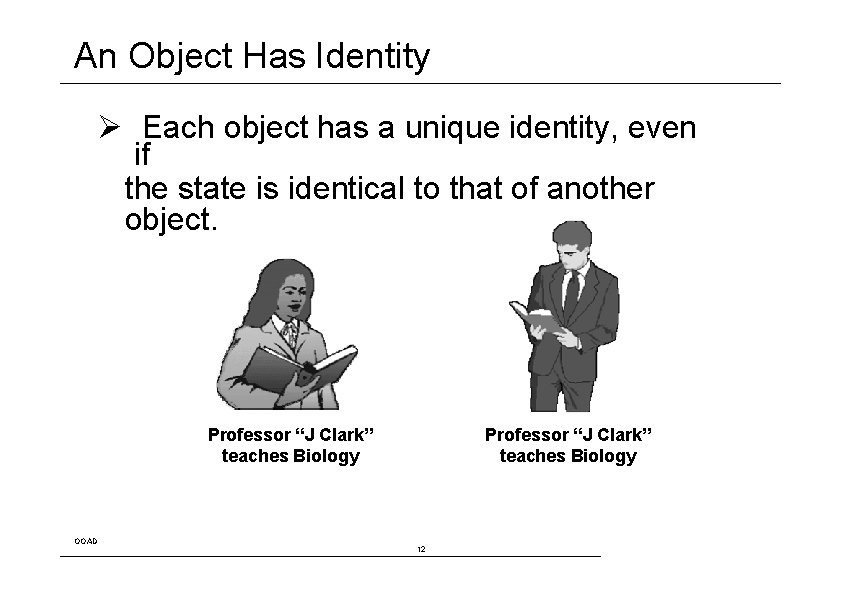
An Object Has Identity Ø Each object has a unique identity, even if the state is identical to that of another object. Professor “J Clark” teaches Biology OOAD Professor “J Clark” teaches Biology 12
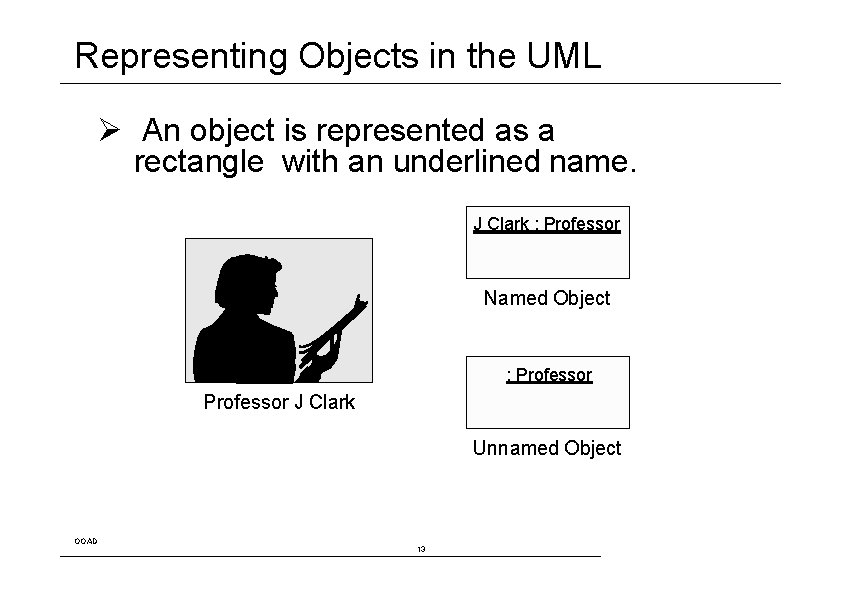
Representing Objects in the UML Ø An object is represented as a rectangle with an underlined name. J Clark : Professor Named Object : Professor J Clark Unnamed Object OOAD 13
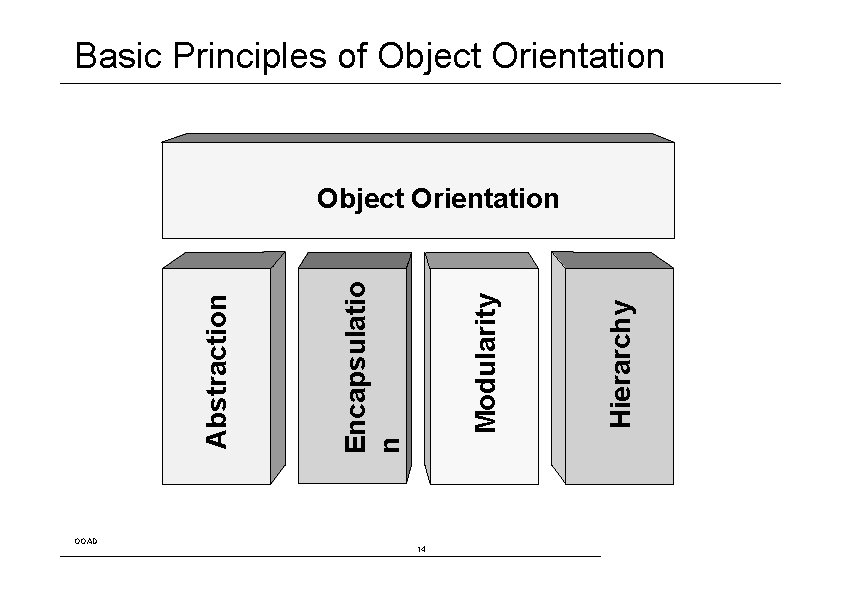
Basic Principles of Object Orientation OOAD 14 Hierarchy Modularity Encapsulatio n Abstraction Object Orientation
What Is Abstraction? The essential characteristics of an entity that distinguish it from all other kinds of entities Defines a boundary relative to the perspective of the viewer Is not a concrete manifestation, denotes the ideal essence of something OOAD 15
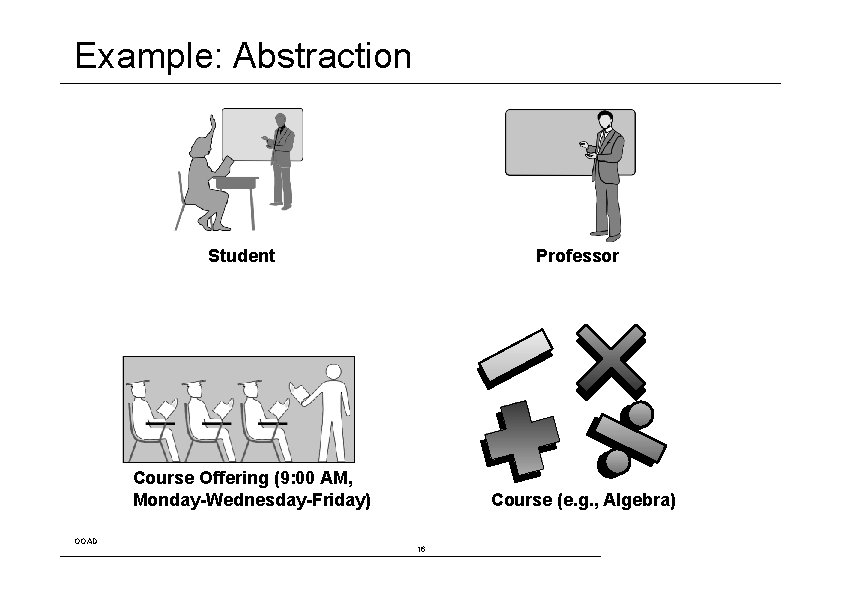
Example: Abstraction Student Professor Course Offering (9: 00 AM, Monday-Wednesday-Friday) OOAD Course (e. g. , Algebra) 16
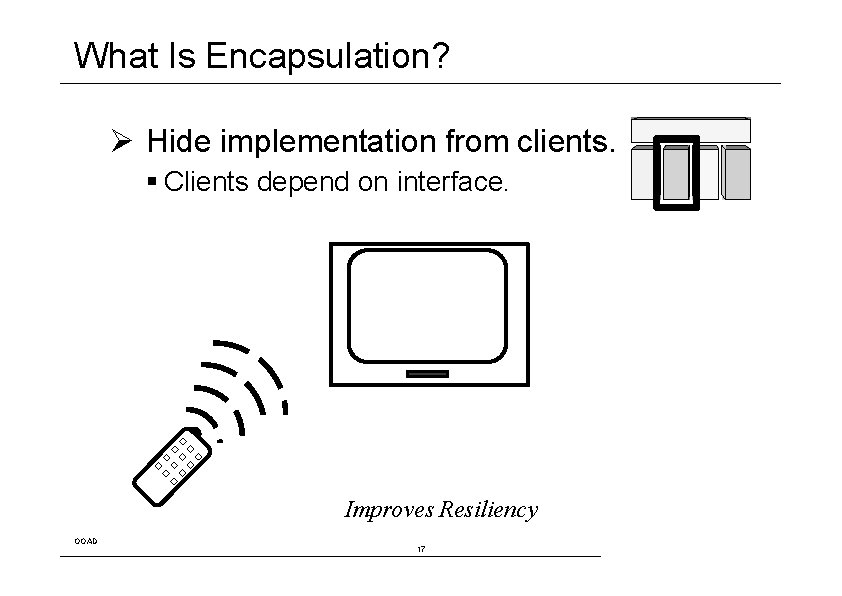
What Is Encapsulation? Ø Hide implementation from clients. Clients depend on interface. Improves Resiliency OOAD 17
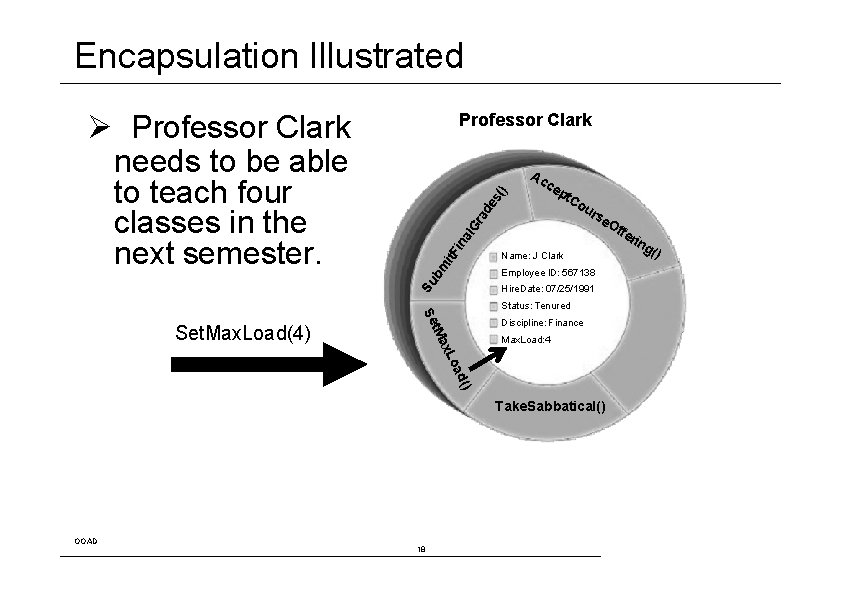
Encapsulation Illustrated Professor Clark Ac ce pt Co ur se Of fer ing () Name: J Clark Su bm it. F ina l. G ra de s( ) Ø Professor Clark needs to be able to teach four classes in the next semester. Employee ID: 567138 Hire. Date: 07/25/1991 d() oa x. L t. Ma Se Set. Max. Load(4) Status: Tenured Discipline: Finance Max. Load: 4 Take. Sabbatical() OOAD 18
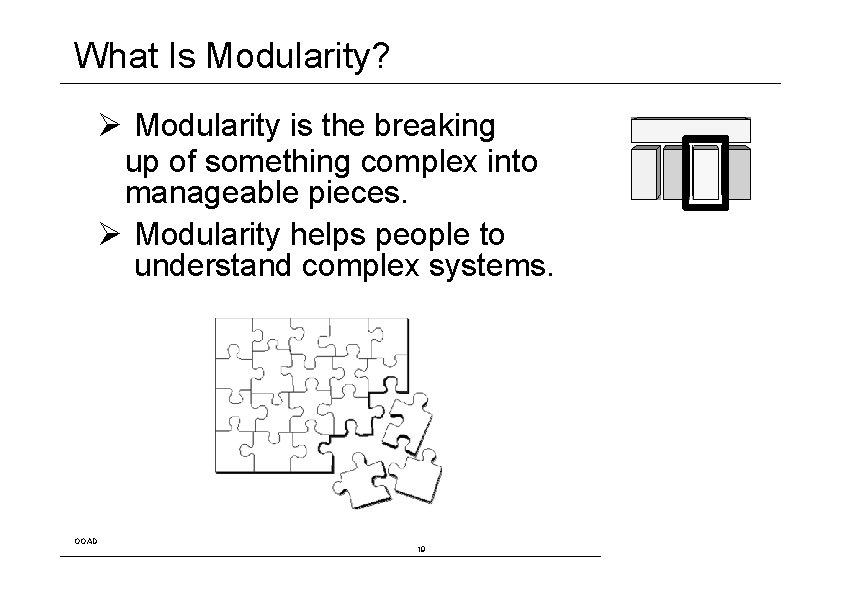
What Is Modularity? Ø Modularity is the breaking up of something complex into manageable pieces. Ø Modularity helps people to understand complex systems. OOAD 19
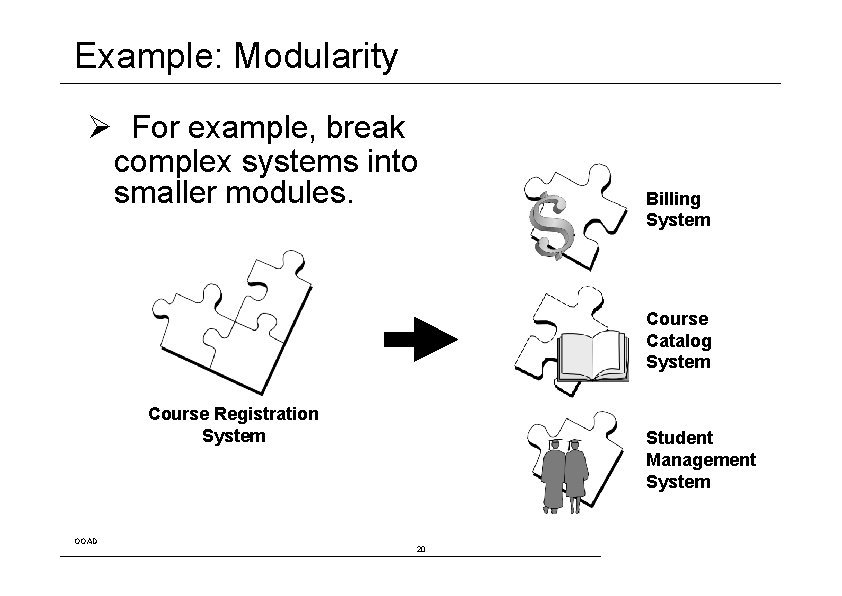
Example: Modularity Ø For example, break complex systems into smaller modules. Billing System Course Catalog System Course Registration System OOAD Student Management System 20
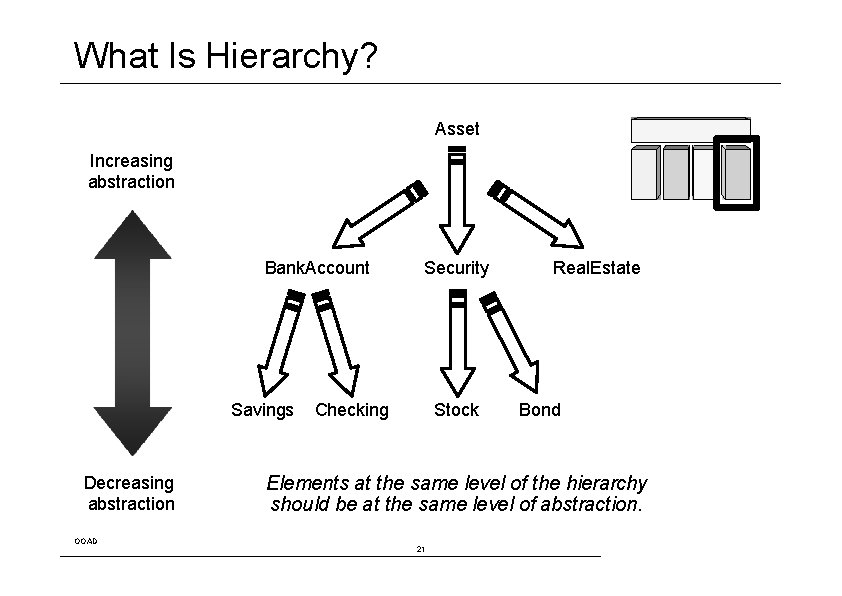
What Is Hierarchy? Asset Increasing abstraction Bank. Account Savings Decreasing abstraction OOAD Security Checking Stock Real. Estate Bond Elements at the same level of the hierarchy should be at the same level of abstraction. 21
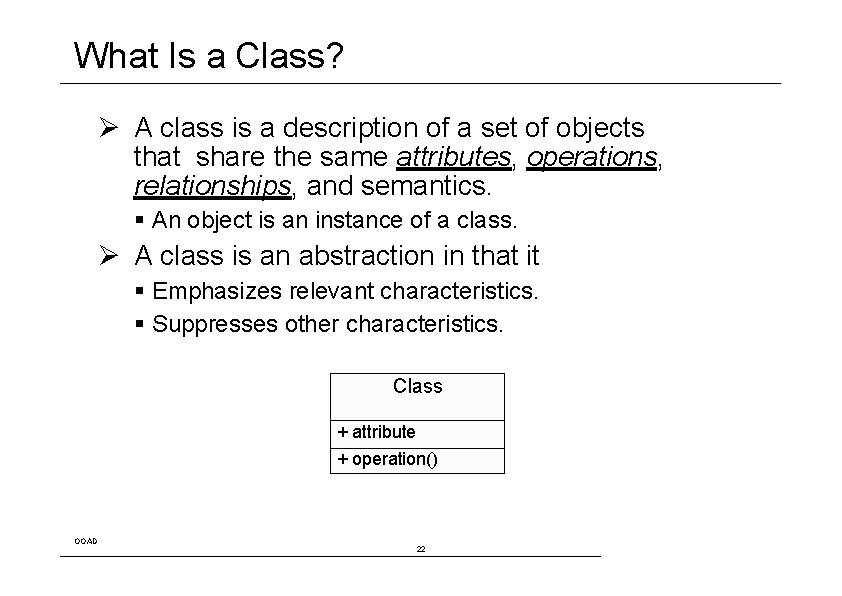
What Is a Class? Ø A class is a description of a set of objects that share the same attributes, operations, relationships, and semantics. An object is an instance of a class. Ø A class is an abstraction in that it Emphasizes relevant characteristics. Suppresses other characteristics. Class + attribute + operation() OOAD 22
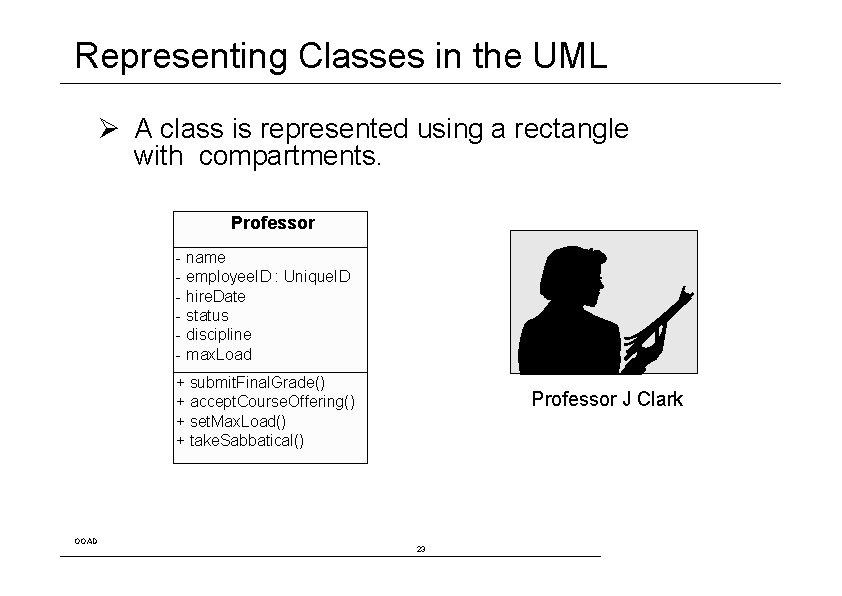
Representing Classes in the UML Ø A class is represented using a rectangle with compartments. Professor - name - employee. ID : Unique. ID - hire. Date - status - discipline - max. Load + submit. Final. Grade() + accept. Course. Offering() + set. Max. Load() + take. Sabbatical() OOAD Professor J Clark 23
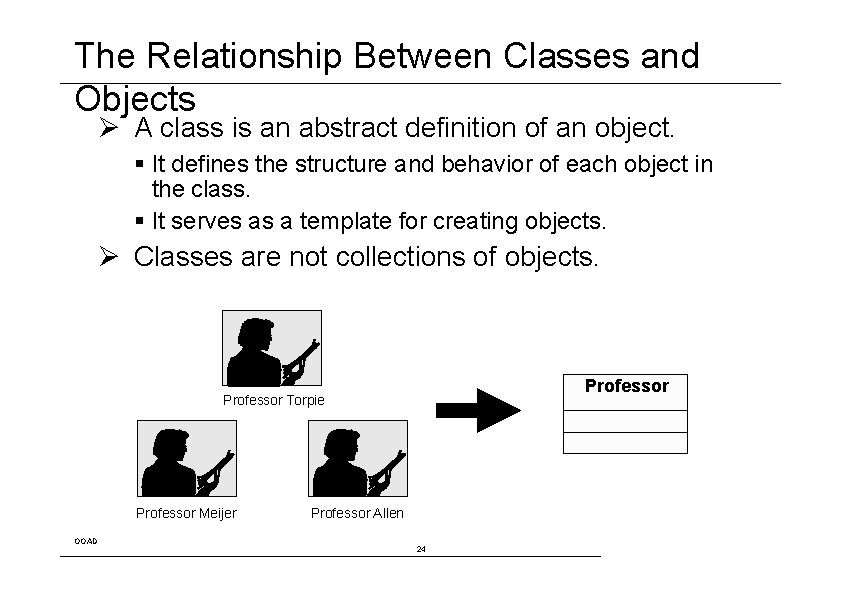
The Relationship Between Classes and Objects Ø A class is an abstract definition of an object. It defines the structure and behavior of each object in the class. It serves as a template for creating objects. Ø Classes are not collections of objects. Professor Torpie Professor Meijer OOAD Professor Allen 24
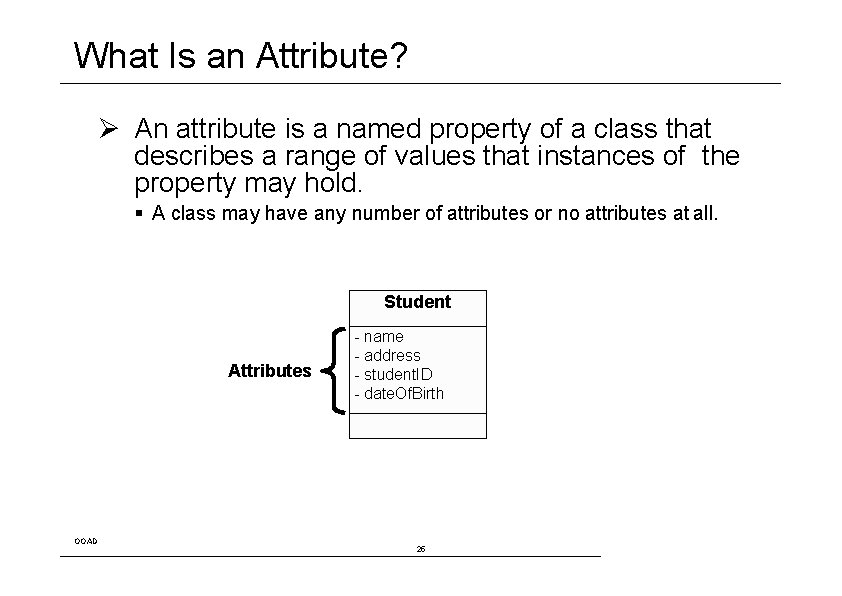
What Is an Attribute? Ø An attribute is a named property of a class that describes a range of values that instances of the property may hold. A class may have any number of attributes or no attributes at all. Student Attributes OOAD - name - address - student. ID - date. Of. Birth 25
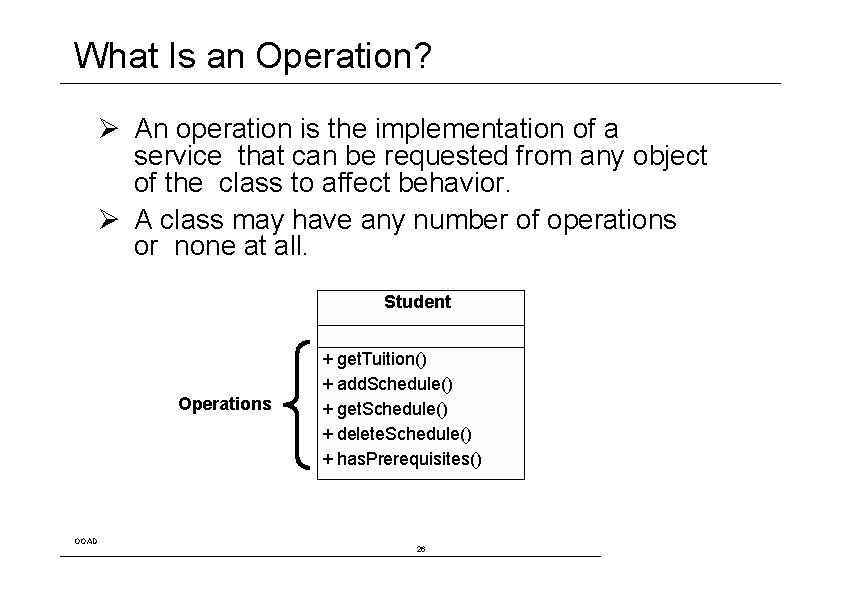
What Is an Operation? Ø An operation is the implementation of a service that can be requested from any object of the class to affect behavior. Ø A class may have any number of operations or none at all. Student Operations OOAD + get. Tuition() + add. Schedule() + get. Schedule() + delete. Schedule() + has. Prerequisites() 26
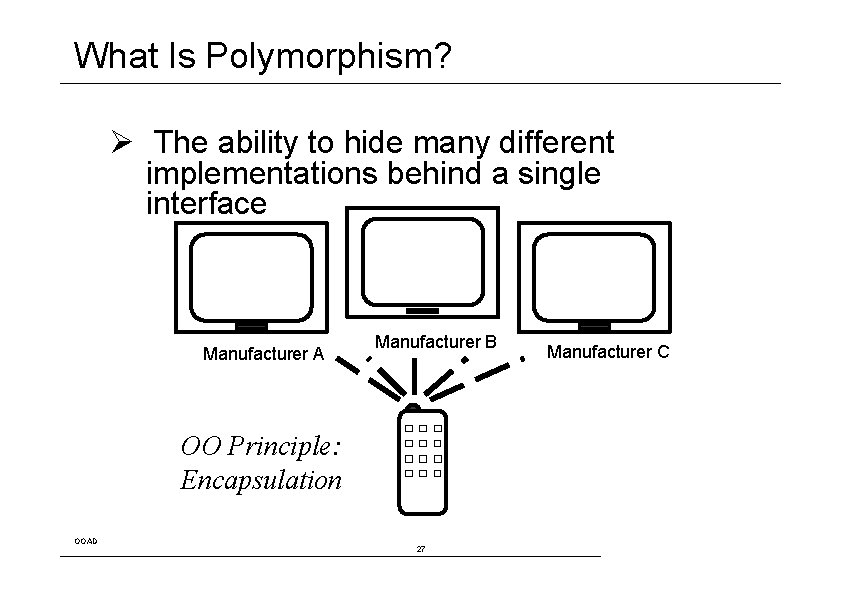
What Is Polymorphism? Ø The ability to hide many different implementations behind a single interface Manufacturer A Manufacturer B OO Principle: Encapsulation OOAD 27 Manufacturer C
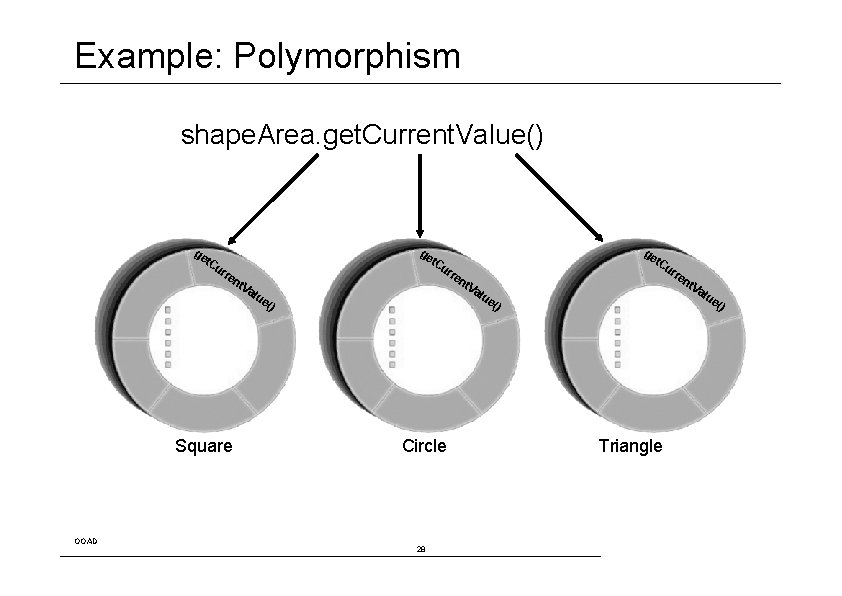
Example: Polymorphism shape. Area. get. Current. Value() ge t. C ur re nt Va lue () Square OOAD ge t. C ur re nt Va lue () Circle 28 ge t. C ur re nt Va lue () Triangle
- Slides: 28