
CONCEPTS OF BIOLOGY Chapter 16 THE BODYS SYSTEMS
CONCEPTS OF BIOLOGY Chapter 16 THE BODY’S SYSTEMS Power. Point Image Slideshow
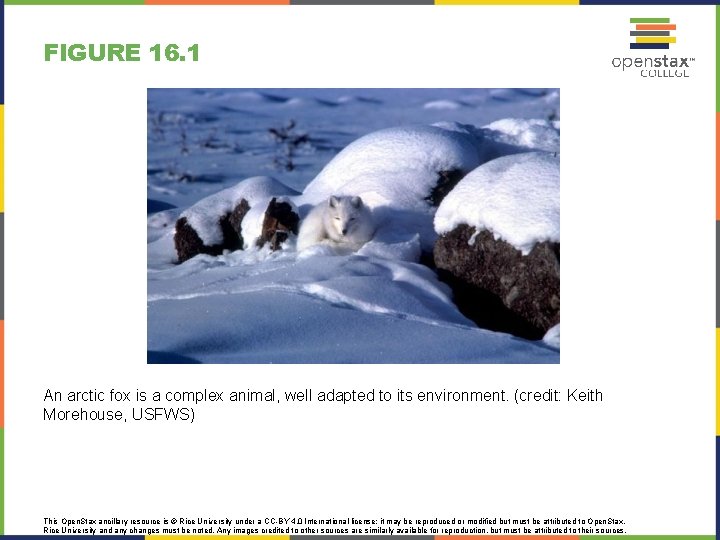
FIGURE 16. 1 An arctic fox is a complex animal, well adapted to its environment. (credit: Keith Morehouse, USFWS) This Open. Stax ancillary resource is © Rice University under a CC-BY 4. 0 International license; it may be reproduced or modified but must be attributed to Open. Stax, Rice University and any changes must be noted. Any images credited to other sources are similarly available for reproduction, but must be attributed to their sources.
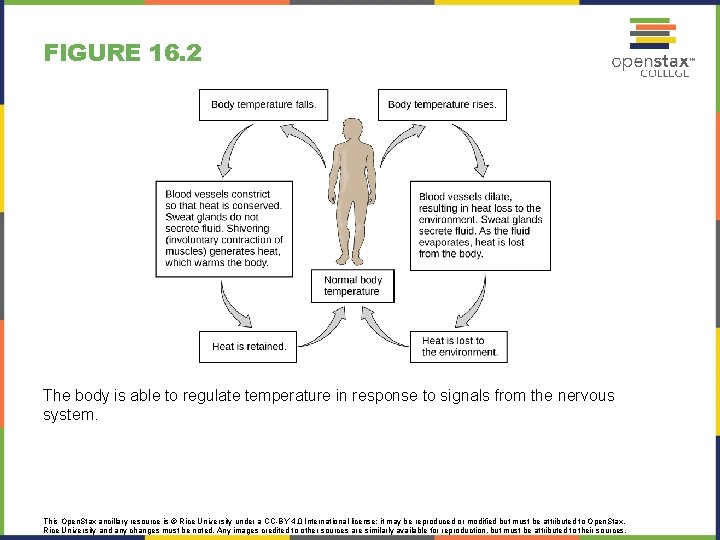
FIGURE 16. 2 The body is able to regulate temperature in response to signals from the nervous system. This Open. Stax ancillary resource is © Rice University under a CC-BY 4. 0 International license; it may be reproduced or modified but must be attributed to Open. Stax, Rice University and any changes must be noted. Any images credited to other sources are similarly available for reproduction, but must be attributed to their sources.
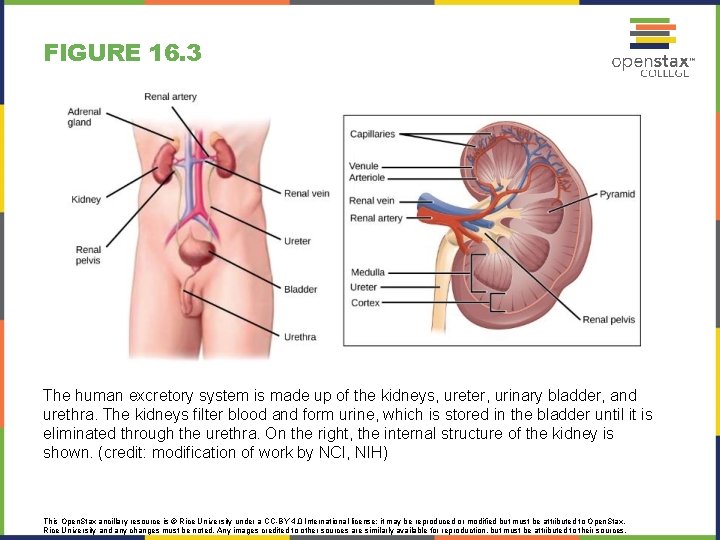
FIGURE 16. 3 The human excretory system is made up of the kidneys, ureter, urinary bladder, and urethra. The kidneys filter blood and form urine, which is stored in the bladder until it is eliminated through the urethra. On the right, the internal structure of the kidney is shown. (credit: modification of work by NCI, NIH) This Open. Stax ancillary resource is © Rice University under a CC-BY 4. 0 International license; it may be reproduced or modified but must be attributed to Open. Stax, Rice University and any changes must be noted. Any images credited to other sources are similarly available for reproduction, but must be attributed to their sources.
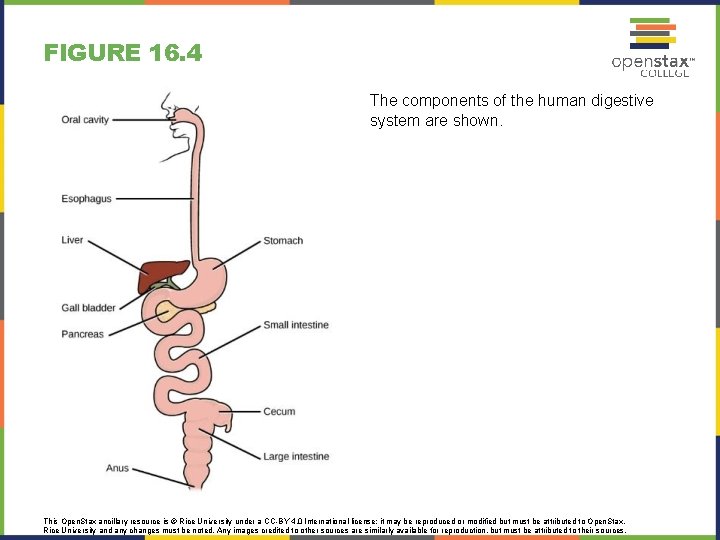
FIGURE 16. 4 The components of the human digestive system are shown. This Open. Stax ancillary resource is © Rice University under a CC-BY 4. 0 International license; it may be reproduced or modified but must be attributed to Open. Stax, Rice University and any changes must be noted. Any images credited to other sources are similarly available for reproduction, but must be attributed to their sources.
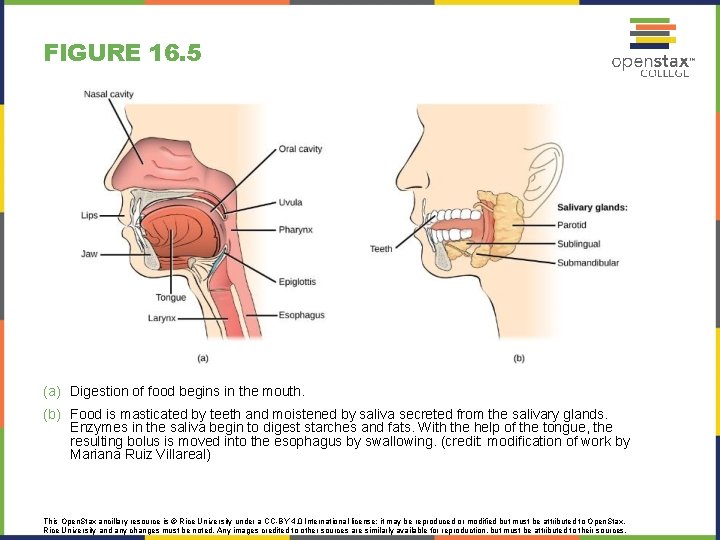
FIGURE 16. 5 (a) Digestion of food begins in the mouth. (b) Food is masticated by teeth and moistened by saliva secreted from the salivary glands. Enzymes in the saliva begin to digest starches and fats. With the help of the tongue, the resulting bolus is moved into the esophagus by swallowing. (credit: modification of work by Mariana Ruiz Villareal) This Open. Stax ancillary resource is © Rice University under a CC-BY 4. 0 International license; it may be reproduced or modified but must be attributed to Open. Stax, Rice University and any changes must be noted. Any images credited to other sources are similarly available for reproduction, but must be attributed to their sources.

FIGURE 16. 6 The large intestine reabsorbs water from undigested food and stores waste until it is eliminated. (credit: modification of work by Mariana Ruiz Villareal) This Open. Stax ancillary resource is © Rice University under a CC-BY 4. 0 International license; it may be reproduced or modified but must be attributed to Open. Stax, Rice University and any changes must be noted. Any images credited to other sources are similarly available for reproduction, but must be attributed to their sources.
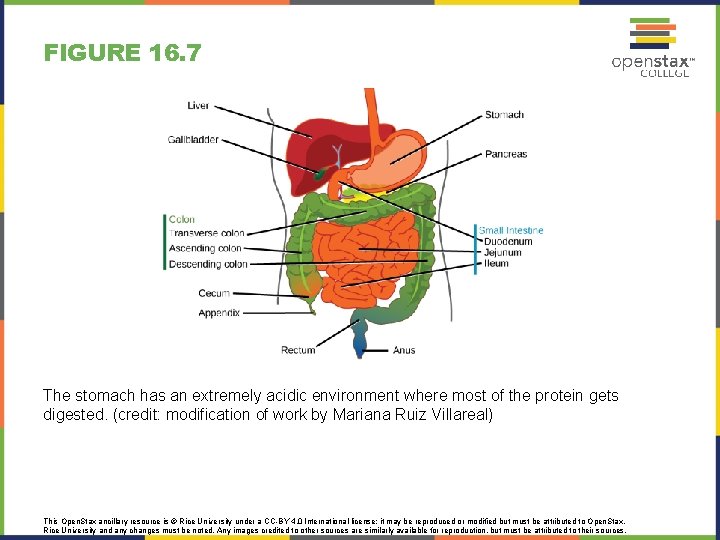
FIGURE 16. 7 The stomach has an extremely acidic environment where most of the protein gets digested. (credit: modification of work by Mariana Ruiz Villareal) This Open. Stax ancillary resource is © Rice University under a CC-BY 4. 0 International license; it may be reproduced or modified but must be attributed to Open. Stax, Rice University and any changes must be noted. Any images credited to other sources are similarly available for reproduction, but must be attributed to their sources.
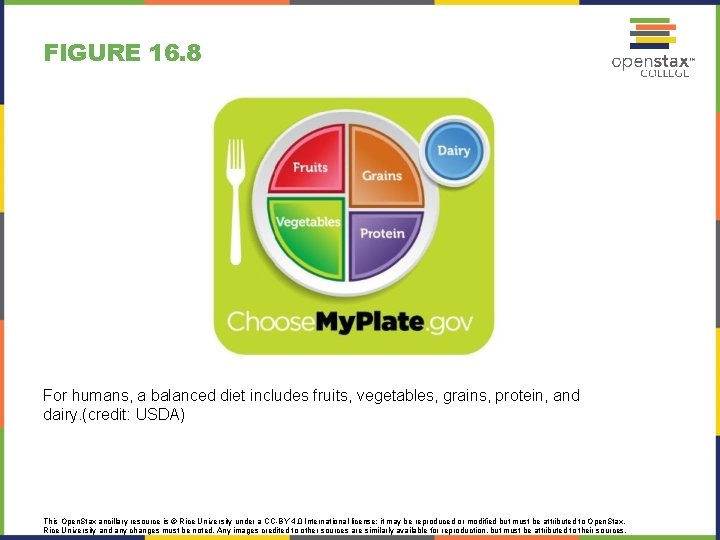
FIGURE 16. 8 For humans, a balanced diet includes fruits, vegetables, grains, protein, and dairy. (credit: USDA) This Open. Stax ancillary resource is © Rice University under a CC-BY 4. 0 International license; it may be reproduced or modified but must be attributed to Open. Stax, Rice University and any changes must be noted. Any images credited to other sources are similarly available for reproduction, but must be attributed to their sources.
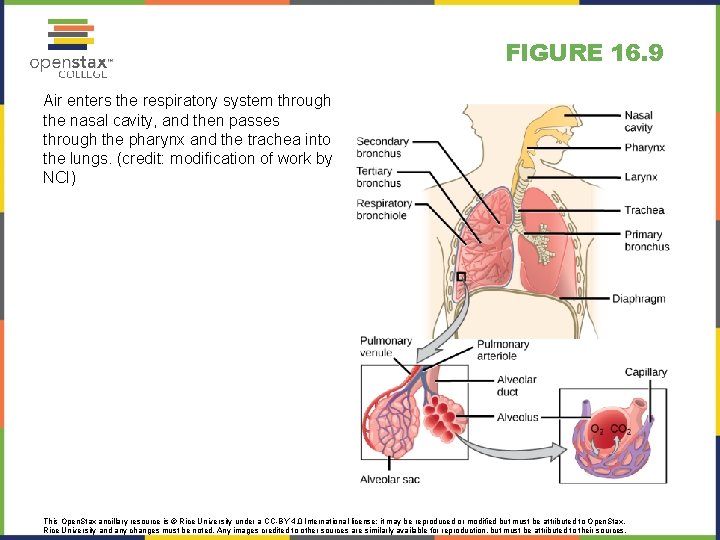
FIGURE 16. 9 Air enters the respiratory system through the nasal cavity, and then passes through the pharynx and the trachea into the lungs. (credit: modification of work by NCI) This Open. Stax ancillary resource is © Rice University under a CC-BY 4. 0 International license; it may be reproduced or modified but must be attributed to Open. Stax, Rice University and any changes must be noted. Any images credited to other sources are similarly available for reproduction, but must be attributed to their sources.
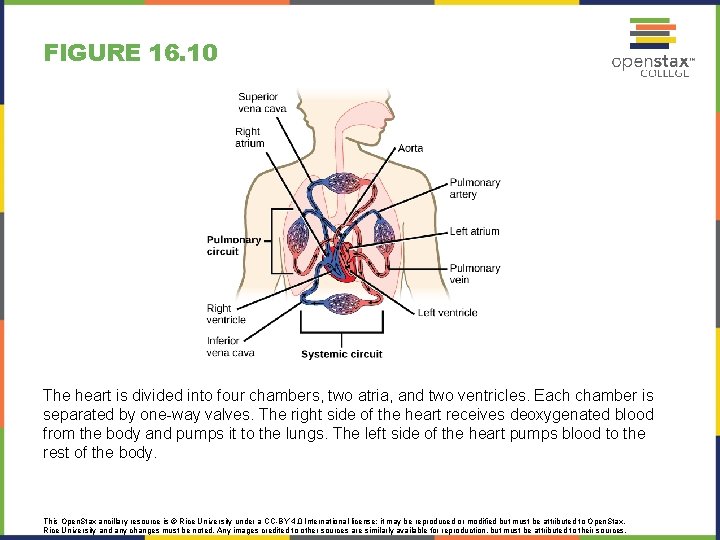
FIGURE 16. 10 The heart is divided into four chambers, two atria, and two ventricles. Each chamber is separated by one-way valves. The right side of the heart receives deoxygenated blood from the body and pumps it to the lungs. The left side of the heart pumps blood to the rest of the body. This Open. Stax ancillary resource is © Rice University under a CC-BY 4. 0 International license; it may be reproduced or modified but must be attributed to Open. Stax, Rice University and any changes must be noted. Any images credited to other sources are similarly available for reproduction, but must be attributed to their sources.

FIGURE 16. 11 In each cardiac cycle, a series of contractions (systoles) and relaxations (diastoles) pumps blood through the heart and through the body. (a) During cardiac diastole, blood flows into the heart while all chambers are relaxed. (b) Then the ventricles remain relaxed while atrial systole pushes blood into the ventricles. (c) Once the atria relax again, ventricle systole pushes blood out of the heart. This Open. Stax ancillary resource is © Rice University under a CC-BY 4. 0 International license; it may be reproduced or modified but must be attributed to Open. Stax, Rice University and any changes must be noted. Any images credited to other sources are similarly available for reproduction, but must be attributed to their sources.
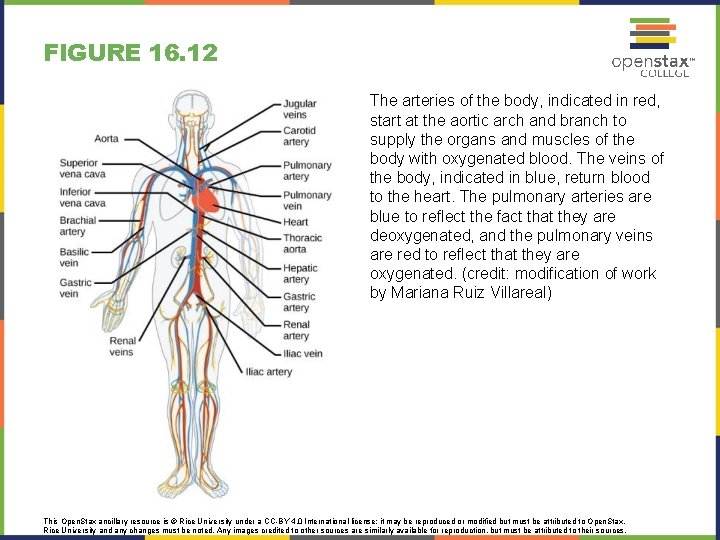
FIGURE 16. 12 The arteries of the body, indicated in red, start at the aortic arch and branch to supply the organs and muscles of the body with oxygenated blood. The veins of the body, indicated in blue, return blood to the heart. The pulmonary arteries are blue to reflect the fact that they are deoxygenated, and the pulmonary veins are red to reflect that they are oxygenated. (credit: modification of work by Mariana Ruiz Villareal) This Open. Stax ancillary resource is © Rice University under a CC-BY 4. 0 International license; it may be reproduced or modified but must be attributed to Open. Stax, Rice University and any changes must be noted. Any images credited to other sources are similarly available for reproduction, but must be attributed to their sources.
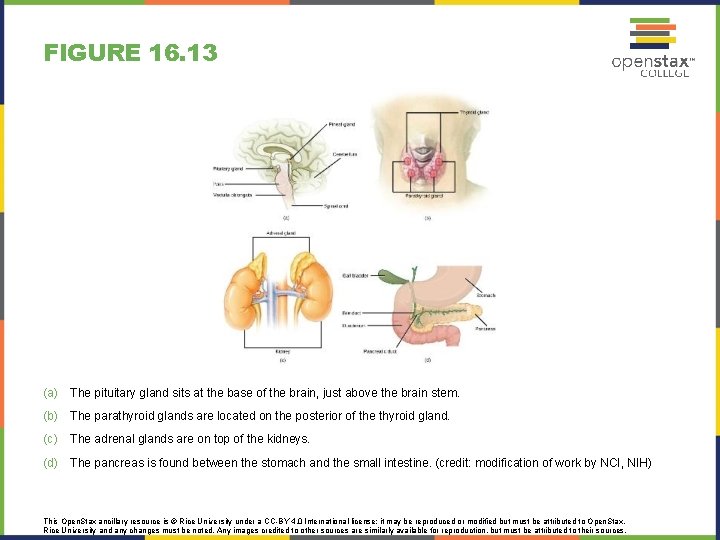
FIGURE 16. 13 (a) The pituitary gland sits at the base of the brain, just above the brain stem. (b) The parathyroid glands are located on the posterior of the thyroid gland. (c) The adrenal glands are on top of the kidneys. (d) The pancreas is found between the stomach and the small intestine. (credit: modification of work by NCI, NIH) This Open. Stax ancillary resource is © Rice University under a CC-BY 4. 0 International license; it may be reproduced or modified but must be attributed to Open. Stax, Rice University and any changes must be noted. Any images credited to other sources are similarly available for reproduction, but must be attributed to their sources.
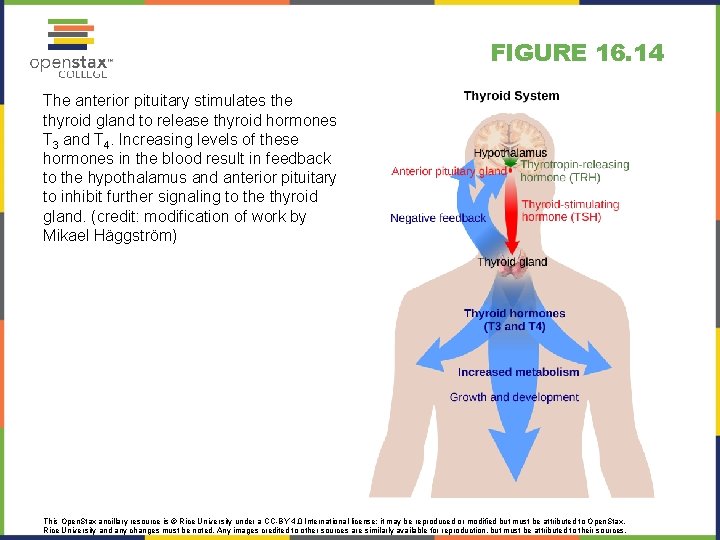
FIGURE 16. 14 The anterior pituitary stimulates the thyroid gland to release thyroid hormones T 3 and T 4. Increasing levels of these hormones in the blood result in feedback to the hypothalamus and anterior pituitary to inhibit further signaling to the thyroid gland. (credit: modification of work by Mikael Häggström) This Open. Stax ancillary resource is © Rice University under a CC-BY 4. 0 International license; it may be reproduced or modified but must be attributed to Open. Stax, Rice University and any changes must be noted. Any images credited to other sources are similarly available for reproduction, but must be attributed to their sources.
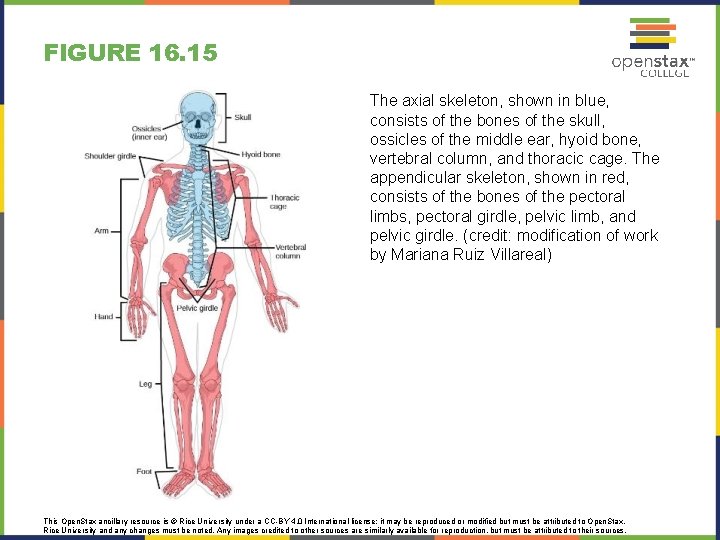
FIGURE 16. 15 The axial skeleton, shown in blue, consists of the bones of the skull, ossicles of the middle ear, hyoid bone, vertebral column, and thoracic cage. The appendicular skeleton, shown in red, consists of the bones of the pectoral limbs, pectoral girdle, pelvic limb, and pelvic girdle. (credit: modification of work by Mariana Ruiz Villareal) This Open. Stax ancillary resource is © Rice University under a CC-BY 4. 0 International license; it may be reproduced or modified but must be attributed to Open. Stax, Rice University and any changes must be noted. Any images credited to other sources are similarly available for reproduction, but must be attributed to their sources.
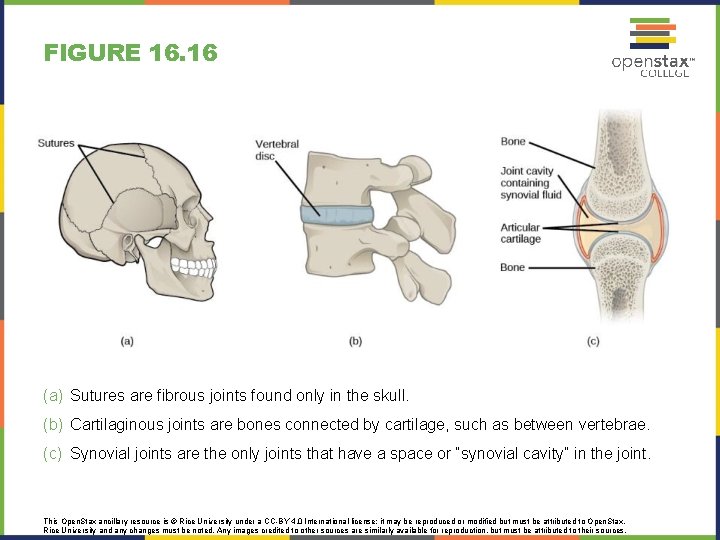
FIGURE 16. 16 (a) Sutures are fibrous joints found only in the skull. (b) Cartilaginous joints are bones connected by cartilage, such as between vertebrae. (c) Synovial joints are the only joints that have a space or “synovial cavity” in the joint. This Open. Stax ancillary resource is © Rice University under a CC-BY 4. 0 International license; it may be reproduced or modified but must be attributed to Open. Stax, Rice University and any changes must be noted. Any images credited to other sources are similarly available for reproduction, but must be attributed to their sources.
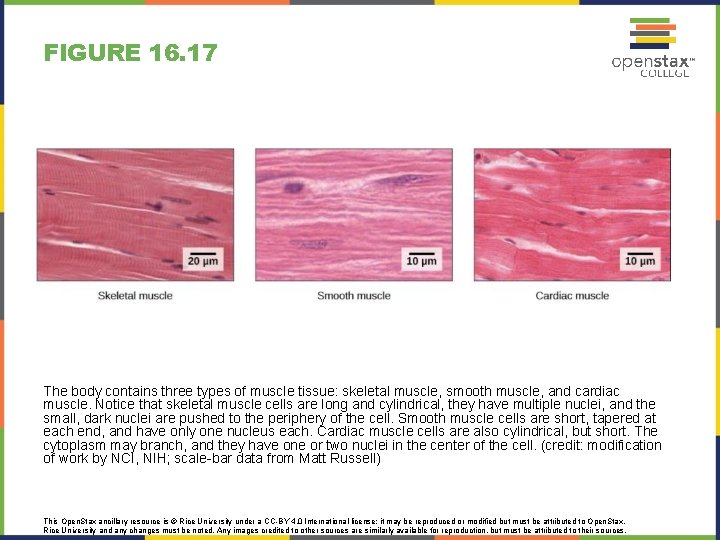
FIGURE 16. 17 The body contains three types of muscle tissue: skeletal muscle, smooth muscle, and cardiac muscle. Notice that skeletal muscle cells are long and cylindrical, they have multiple nuclei, and the small, dark nuclei are pushed to the periphery of the cell. Smooth muscle cells are short, tapered at each end, and have only one nucleus each. Cardiac muscle cells are also cylindrical, but short. The cytoplasm may branch, and they have one or two nuclei in the center of the cell. (credit: modification of work by NCI, NIH; scale-bar data from Matt Russell) This Open. Stax ancillary resource is © Rice University under a CC-BY 4. 0 International license; it may be reproduced or modified but must be attributed to Open. Stax, Rice University and any changes must be noted. Any images credited to other sources are similarly available for reproduction, but must be attributed to their sources.
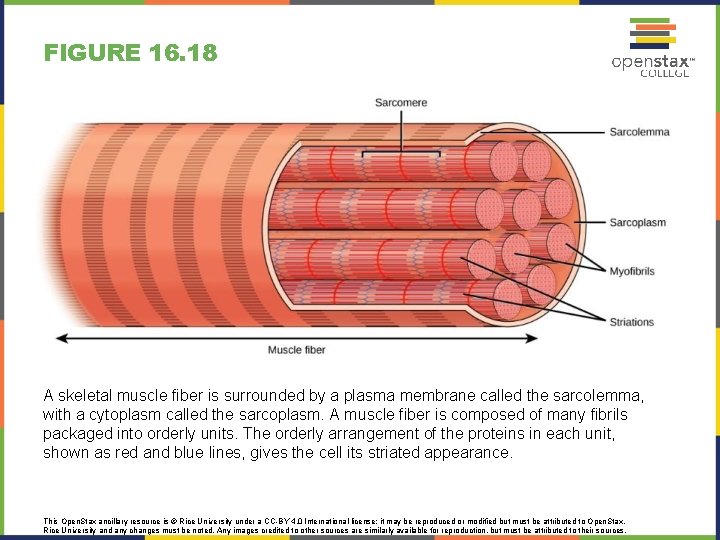
FIGURE 16. 18 A skeletal muscle fiber is surrounded by a plasma membrane called the sarcolemma, with a cytoplasm called the sarcoplasm. A muscle fiber is composed of many fibrils packaged into orderly units. The orderly arrangement of the proteins in each unit, shown as red and blue lines, gives the cell its striated appearance. This Open. Stax ancillary resource is © Rice University under a CC-BY 4. 0 International license; it may be reproduced or modified but must be attributed to Open. Stax, Rice University and any changes must be noted. Any images credited to other sources are similarly available for reproduction, but must be attributed to their sources.
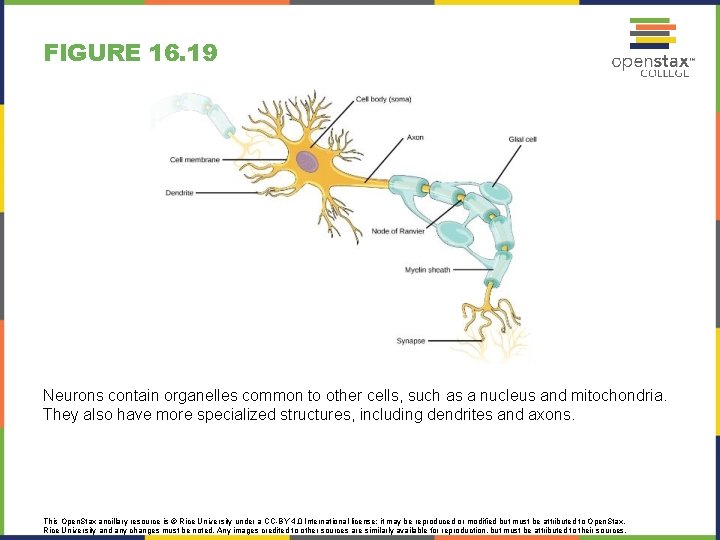
FIGURE 16. 19 Neurons contain organelles common to other cells, such as a nucleus and mitochondria. They also have more specialized structures, including dendrites and axons. This Open. Stax ancillary resource is © Rice University under a CC-BY 4. 0 International license; it may be reproduced or modified but must be attributed to Open. Stax, Rice University and any changes must be noted. Any images credited to other sources are similarly available for reproduction, but must be attributed to their sources.
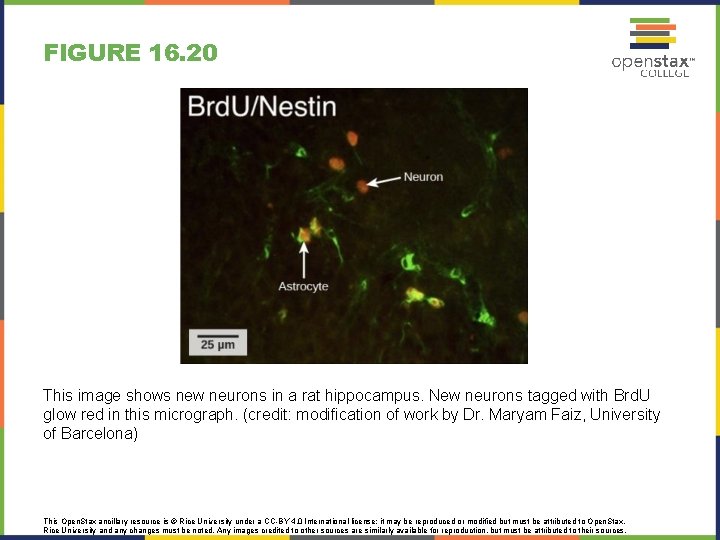
FIGURE 16. 20 This image shows new neurons in a rat hippocampus. New neurons tagged with Brd. U glow red in this micrograph. (credit: modification of work by Dr. Maryam Faiz, University of Barcelona) This Open. Stax ancillary resource is © Rice University under a CC-BY 4. 0 International license; it may be reproduced or modified but must be attributed to Open. Stax, Rice University and any changes must be noted. Any images credited to other sources are similarly available for reproduction, but must be attributed to their sources.
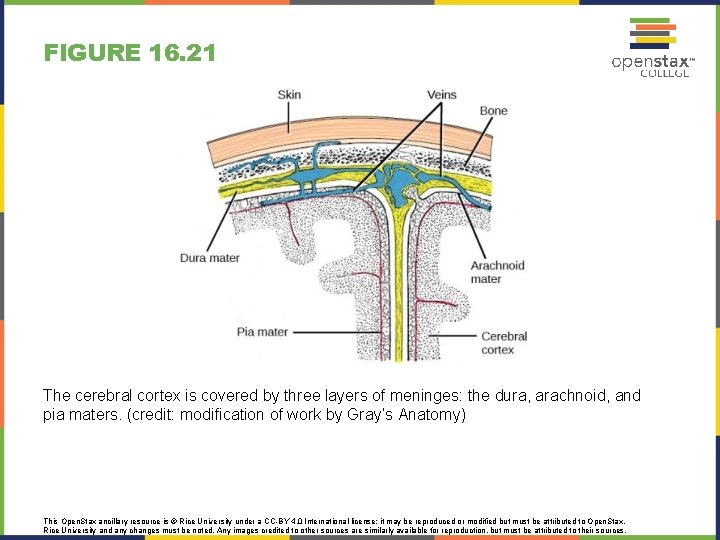
FIGURE 16. 21 The cerebral cortex is covered by three layers of meninges: the dura, arachnoid, and pia maters. (credit: modification of work by Gray’s Anatomy) This Open. Stax ancillary resource is © Rice University under a CC-BY 4. 0 International license; it may be reproduced or modified but must be attributed to Open. Stax, Rice University and any changes must be noted. Any images credited to other sources are similarly available for reproduction, but must be attributed to their sources.
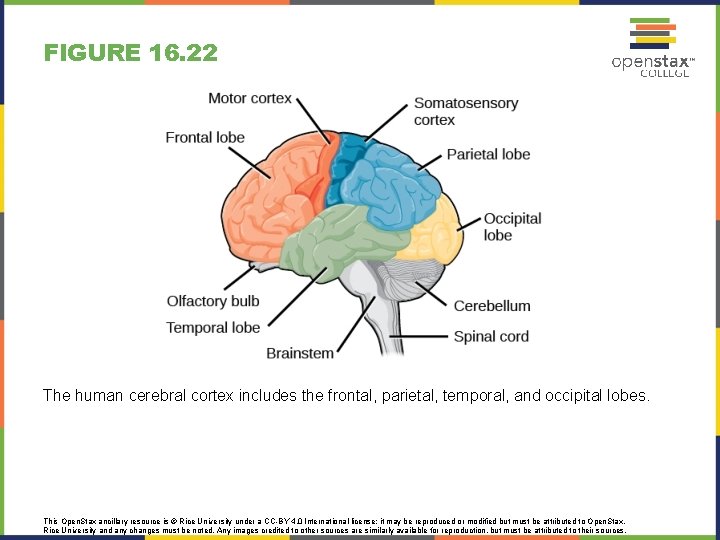
FIGURE 16. 22 The human cerebral cortex includes the frontal, parietal, temporal, and occipital lobes. This Open. Stax ancillary resource is © Rice University under a CC-BY 4. 0 International license; it may be reproduced or modified but must be attributed to Open. Stax, Rice University and any changes must be noted. Any images credited to other sources are similarly available for reproduction, but must be attributed to their sources.
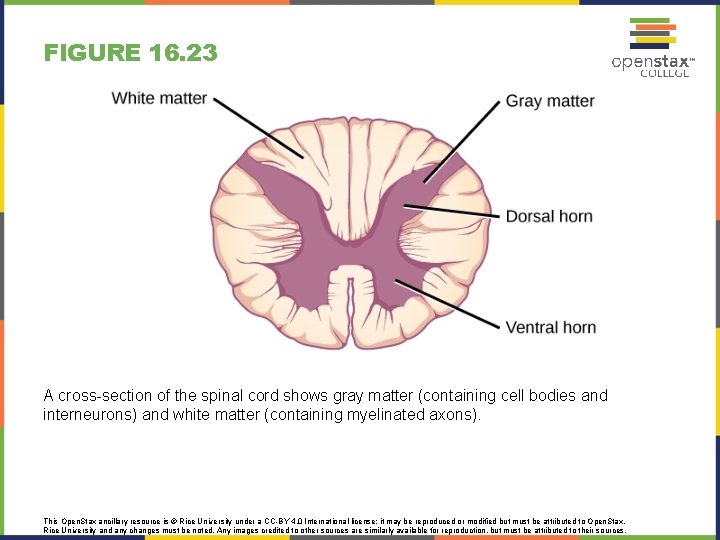
FIGURE 16. 23 A cross-section of the spinal cord shows gray matter (containing cell bodies and interneurons) and white matter (containing myelinated axons). This Open. Stax ancillary resource is © Rice University under a CC-BY 4. 0 International license; it may be reproduced or modified but must be attributed to Open. Stax, Rice University and any changes must be noted. Any images credited to other sources are similarly available for reproduction, but must be attributed to their sources.
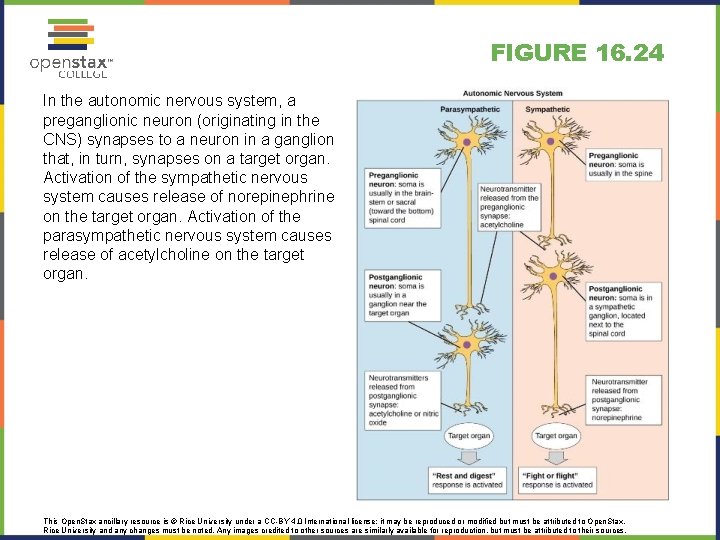
FIGURE 16. 24 In the autonomic nervous system, a preganglionic neuron (originating in the CNS) synapses to a neuron in a ganglion that, in turn, synapses on a target organ. Activation of the sympathetic nervous system causes release of norepinephrine on the target organ. Activation of the parasympathetic nervous system causes release of acetylcholine on the target organ. This Open. Stax ancillary resource is © Rice University under a CC-BY 4. 0 International license; it may be reproduced or modified but must be attributed to Open. Stax, Rice University and any changes must be noted. Any images credited to other sources are similarly available for reproduction, but must be attributed to their sources.
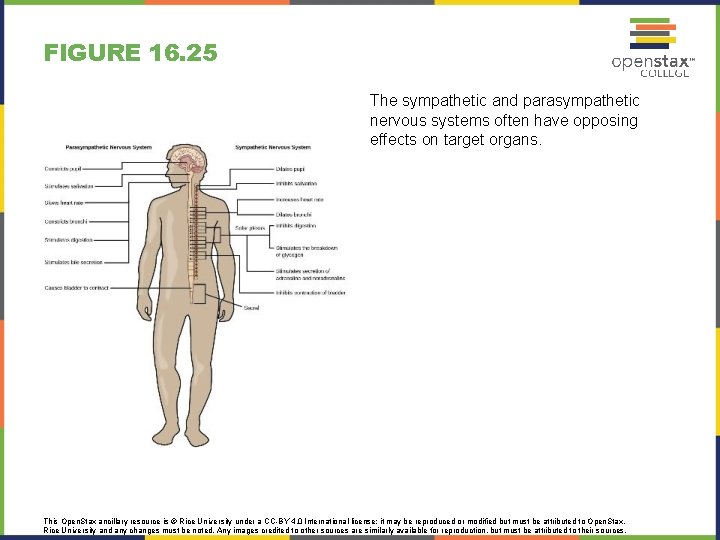
FIGURE 16. 25 The sympathetic and parasympathetic nervous systems often have opposing effects on target organs. This Open. Stax ancillary resource is © Rice University under a CC-BY 4. 0 International license; it may be reproduced or modified but must be attributed to Open. Stax, Rice University and any changes must be noted. Any images credited to other sources are similarly available for reproduction, but must be attributed to their sources.
- Slides: 26