
Concepts in Work Energy Notes and Virtual Lab
Concepts in Work & Energy Notes and Virtual Lab Activity – AP Mechanics
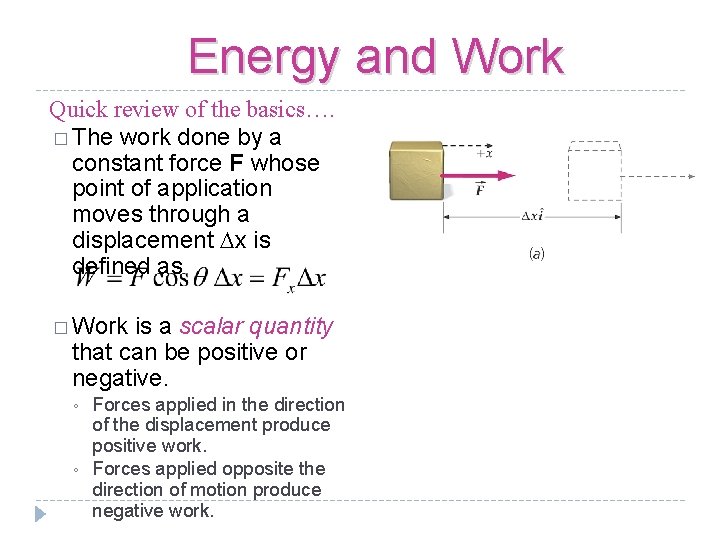
Energy and Work Quick review of the basics…. � The work done by a constant force F whose point of application moves through a displacement Dx is defined as � Work is a scalar quantity that can be positive or negative. ◦ ◦ Forces applied in the direction of the displacement produce positive work. Forces applied opposite the direction of motion produce negative work.
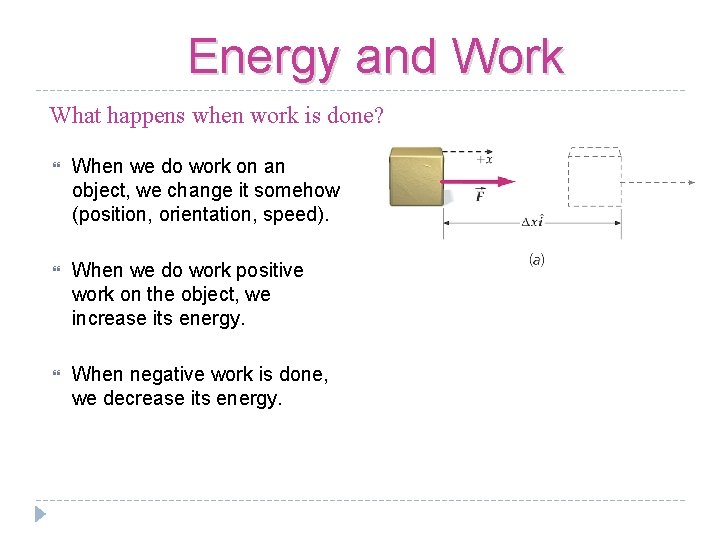
Energy and Work What happens when work is done? When we do work on an object, we change it somehow (position, orientation, speed). When we do work positive work on the object, we increase its energy. When negative work is done, we decrease its energy.
Energy and Work In keeping with the basics… A body is given energy when a force does work on it. � A force does work on a body (and changes its energy) when it causes a displacement. That force may not be solely responsible for the displacement (their could be other forces acting), but it plays a role in the displacement. � If a force causes no displacement, it does no work.
Energy and Work In keeping with the basics… § There is no work done by a force if it causes no displacement. § Forces perpendicular to displacement, such as the normal force, can do no work. § Likewise, centripetal forces never do work.
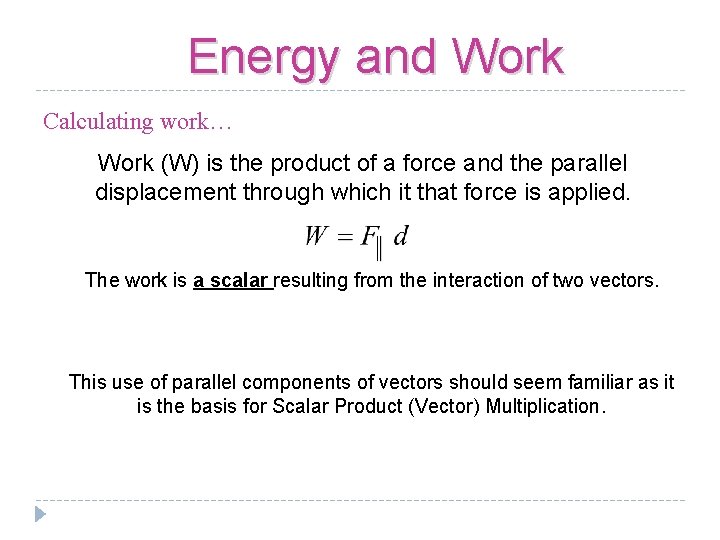
Energy and Work Calculating work… Work (W) is the product of a force and the parallel displacement through which it that force is applied. The work is a scalar resulting from the interaction of two vectors. This use of parallel components of vectors should seem familiar as it is the basis for Scalar Product (Vector) Multiplication.
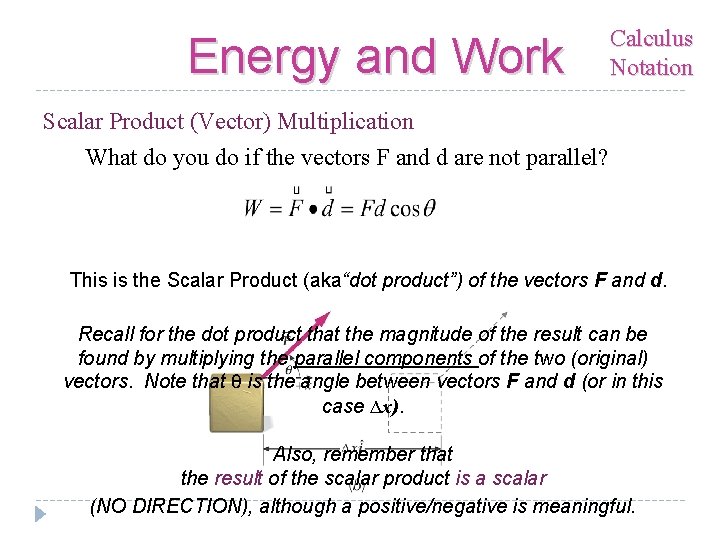
Energy and Work Calculus Notation Scalar Product (Vector) Multiplication What do you do if the vectors F and d are not parallel? This is the Scalar Product (aka“dot product”) of the vectors F and d. Recall for the dot product that the magnitude of the result can be found by multiplying the parallel components of the two (original) vectors. Note that θ is the angle between vectors F and d (or in this case ∆x). Also, remember that the result of the scalar product is a scalar (NO DIRECTION), although a positive/negative is meaningful.
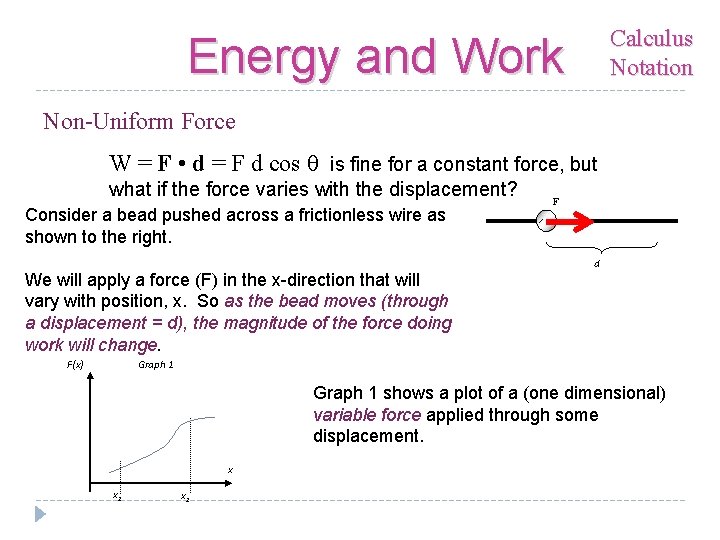
Calculus Notation Energy and Work Non-Uniform Force W = F • d = F d cos θ is fine for a constant force, but what if the force varies with the displacement? Consider a bead pushed across a frictionless wire as shown to the right. We will apply a force (F) in the x-direction that will vary with position, x. So as the bead moves (through a displacement = d), the magnitude of the force doing work will change. F(x) F d Graph 1 shows a plot of a (one dimensional) variable force applied through some displacement. x x 1 x 2
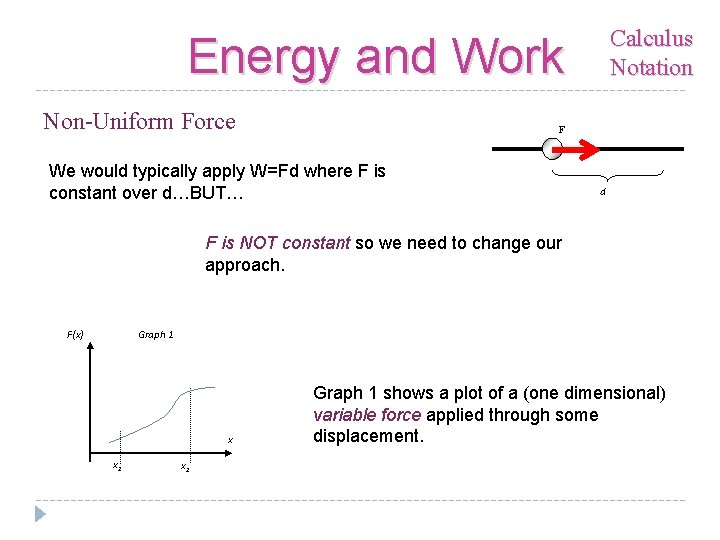
Calculus Notation Energy and Work Non-Uniform Force F We would typically apply W=Fd where F is constant over d…BUT… d F is NOT constant so we need to change our approach. F(x) Graph 1 x x 1 x 2 Graph 1 shows a plot of a (one dimensional) variable force applied through some displacement.
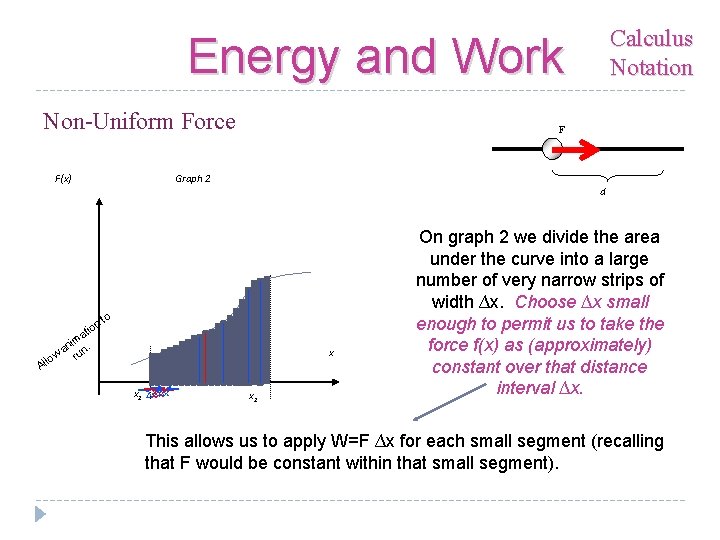
Calculus Notation Energy and Work Non-Uniform Force F(x) n tio a im an un. w r o F Graph 2 d to x l Al x 1 ∆x∆x∆x x 2 On graph 2 we divide the area under the curve into a large number of very narrow strips of width ∆x. Choose ∆x small enough to permit us to take the force f(x) as (approximately) constant over that distance interval ∆x. This allows us to apply W=F ∆x for each small segment (recalling that F would be constant within that small segment).
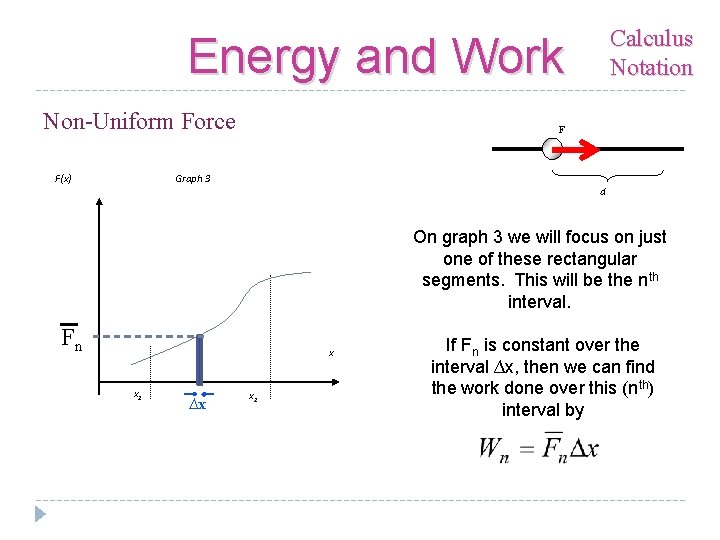
Calculus Notation Energy and Work Non-Uniform Force F(x) F Graph 3 d On graph 3 we will focus on just one of these rectangular segments. This will be the nth interval. Fn x x 1 ∆x x 2 If Fn is constant over the interval ∆x, then we can find the work done over this (nth) interval by
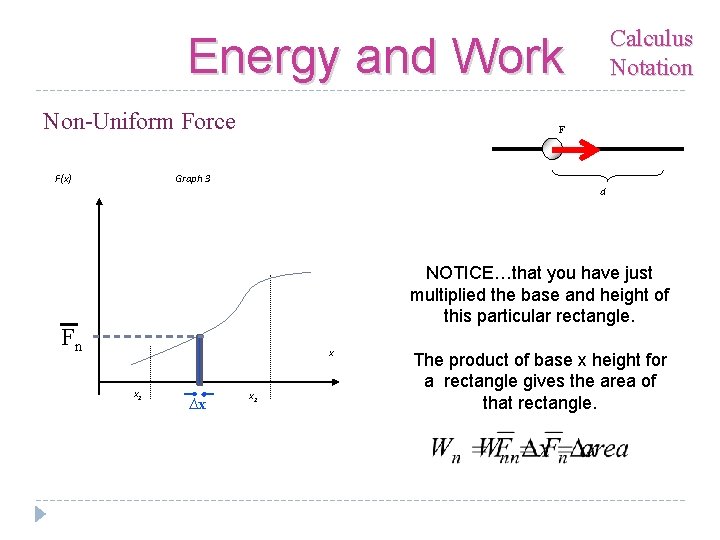
Calculus Notation Energy and Work Non-Uniform Force F(x) F Graph 3 d NOTICE…that you have just multiplied the base and height of this particular rectangle. Fn x x 1 ∆x x 2 The product of base x height for a rectangle gives the area of that rectangle.
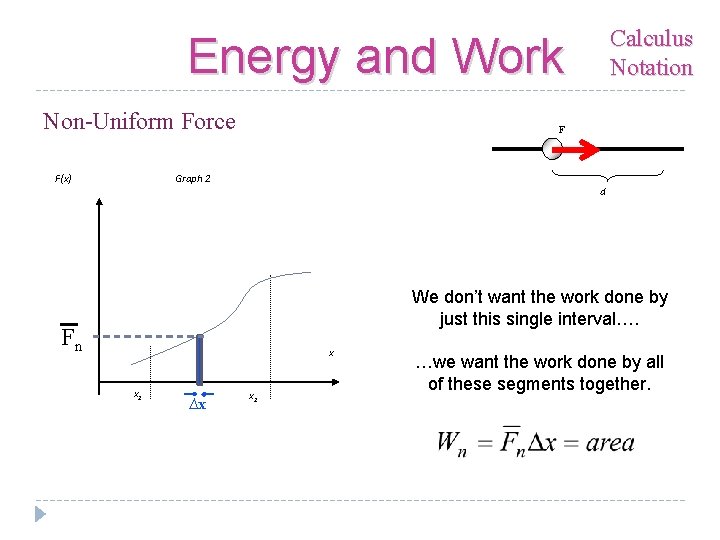
Calculus Notation Energy and Work Non-Uniform Force F(x) F Graph 2 d We don’t want the work done by just this single interval…. Fn x x 1 ∆x x 2 …we want the work done by all of these segments together.
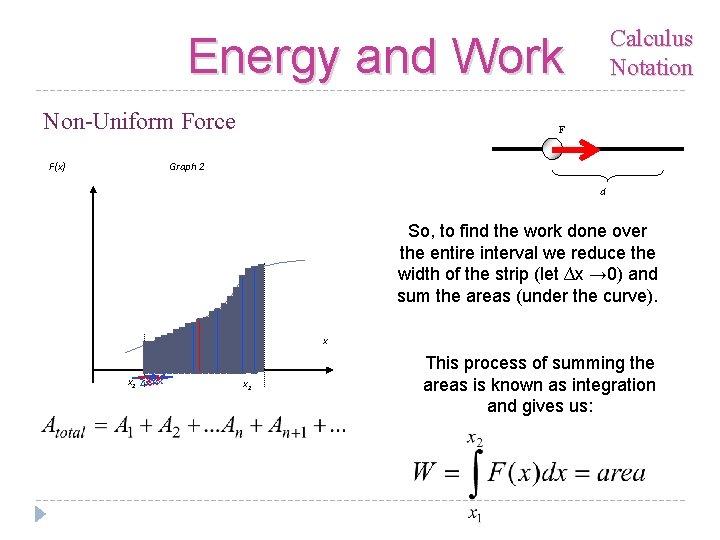
Calculus Notation Energy and Work Non-Uniform Force F(x) F Graph 2 d So, to find the work done over the entire interval we reduce the width of the strip (let ∆x → 0) and sum the areas (under the curve). x x 1 ∆x∆x∆x x 2 This process of summing the areas is known as integration and gives us:
Energy and Work Non-Uniform Force Oh my goodness! We have talked about integration (and differentiation) before. If you are feeling a little rusty on these concepts then revisit the derivative and integration Power. Points. Otherwise…let’s keep going Calculus Notation
Energy and Work Non-Uniform Force What if you have a non-uniform force that is not parallel to the displacement? Really? That’s just mean! It’s no big deal, just use the idea of integration with the concept of the scalar product of vector multiplication. W = F • dx We’ll do this together in class Calculus Notation
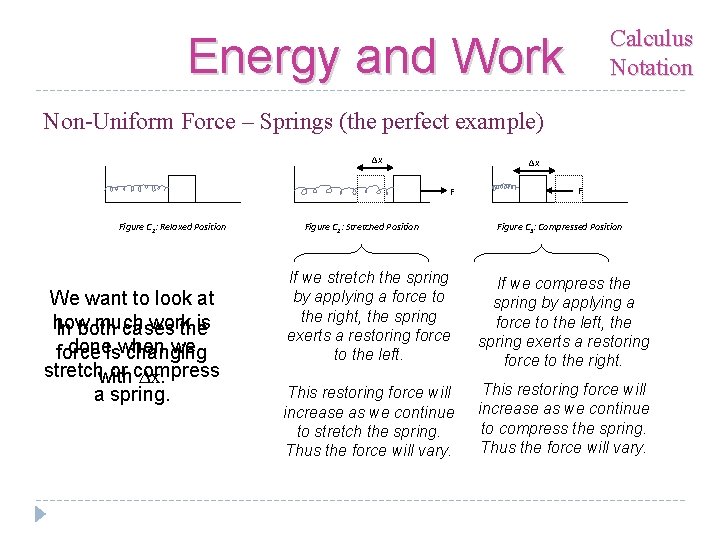
Calculus Notation Energy and Work Non-Uniform Force – Springs (the perfect example) Δx Δx F Figure C 1: Relaxed Position We want to look at how much work is In both cases the doneiswhen we force changing stretchwith or compress ∆x. a spring. Figure C 2: Stretched Position F Figure C 3: Compressed Position If we stretch the spring by applying a force to the right, the spring exerts a restoring force to the left. If we compress the spring by applying a force to the left, the spring exerts a restoring force to the right. This restoring force will increase as we continue to stretch the spring. Thus the force will vary. This restoring force will increase as we continue to compress the spring. Thus the force will vary.
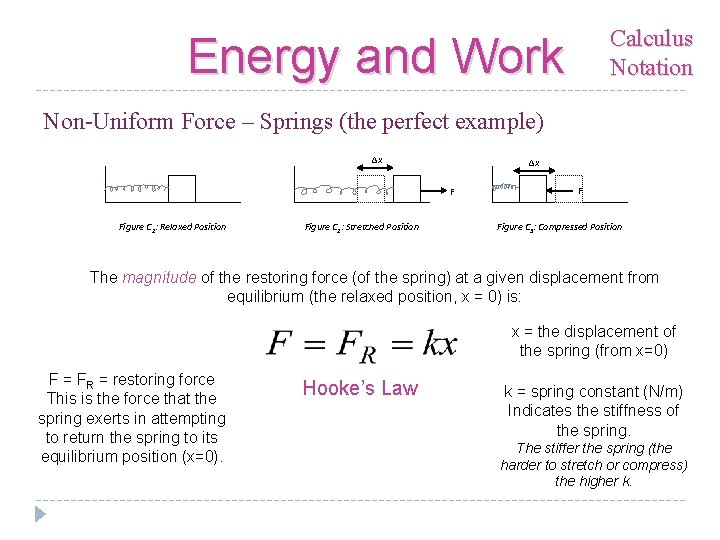
Calculus Notation Energy and Work Non-Uniform Force – Springs (the perfect example) Δx Δx F Figure C 1: Relaxed Position Figure C 2: Stretched Position F Figure C 3: Compressed Position The magnitude of the restoring force (of the spring) at a given displacement from equilibrium (the relaxed position, x = 0) is: x = the displacement of the spring (from x=0) F = FR = restoring force This is the force that the spring exerts in attempting to return the spring to its equilibrium position (x=0). Hooke’s Law k = spring constant (N/m) Indicates the stiffness of the spring. The stiffer the spring (the harder to stretch or compress) the higher k.
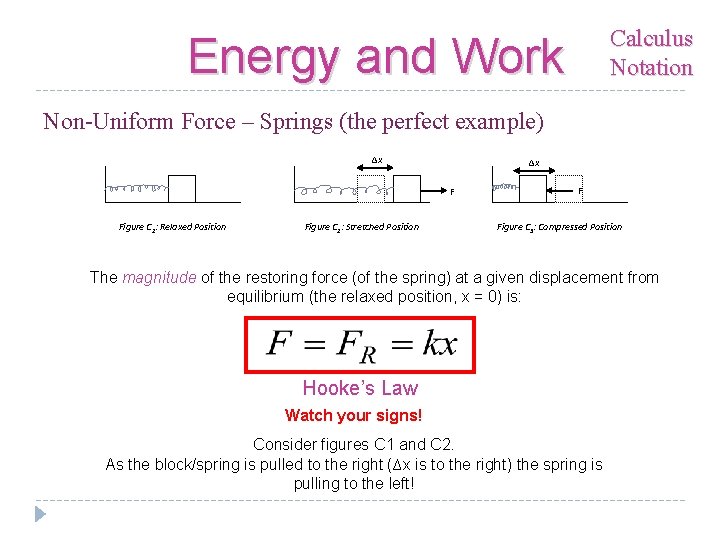
Calculus Notation Energy and Work Non-Uniform Force – Springs (the perfect example) Δx Δx F Figure C 1: Relaxed Position Figure C 2: Stretched Position F Figure C 3: Compressed Position The magnitude of the restoring force (of the spring) at a given displacement from equilibrium (the relaxed position, x = 0) is: Hooke’s Law Watch your signs! Consider figures C 1 and C 2. As the block/spring is pulled to the right (∆x is to the right) the spring is pulling to the left!
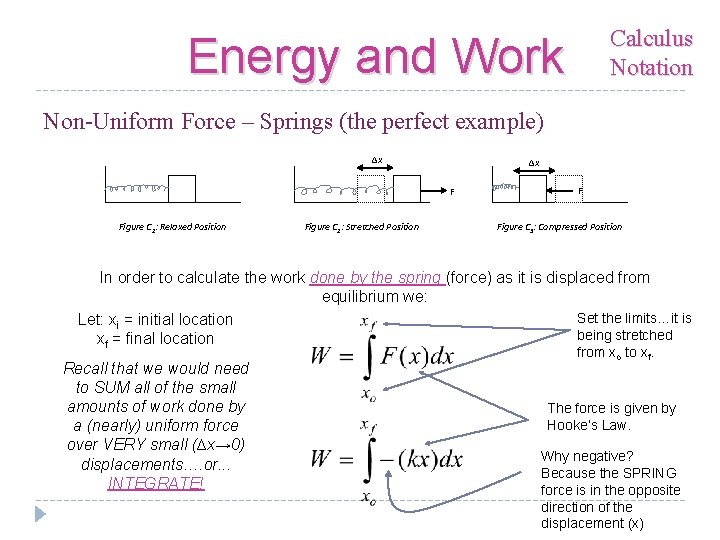
Calculus Notation Energy and Work Non-Uniform Force – Springs (the perfect example) Δx Δx F Figure C 1: Relaxed Position Figure C 2: Stretched Position F Figure C 3: Compressed Position In order to calculate the work done by the spring (force) as it is displaced from equilibrium we: Set the limits…it is Let: xi = initial location being stretched xf = final location Recall that we would need to SUM all of the small amounts of work done by a (nearly) uniform force over VERY small (∆x→ 0) displacements…. or. . . INTEGRATE! from xo to xf. The force is given by Hooke’s Law. Why negative? Because the SPRING force is in the opposite direction of the displacement (x)
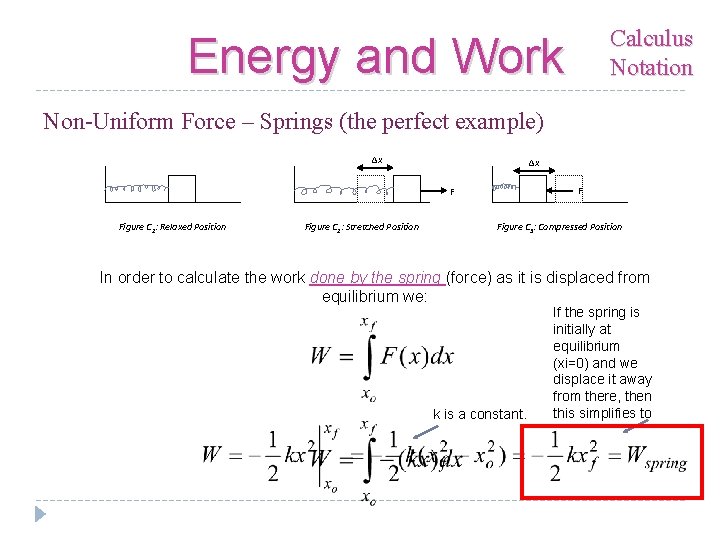
Calculus Notation Energy and Work Non-Uniform Force – Springs (the perfect example) Δx Δx F F Figure C 1: Relaxed Position Figure C 2: Stretched Position Figure C 3: Compressed Position In order to calculate the work done by the spring (force) as it is displaced from equilibrium we: k is a constant. If the spring is initially at equilibrium (xi=0) and we displace it away from there, then this simplifies to
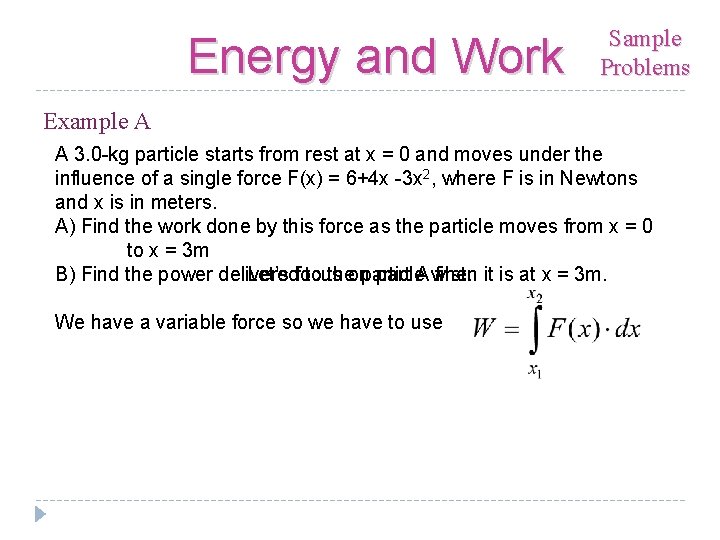
Energy and Work Sample Problems Example A A 3. 0 -kg particle starts from rest at x = 0 and moves under the influence of a single force F(x) = 6+4 x -3 x 2, where F is in Newtons and x is in meters. A) Find the work done by this force as the particle moves from x = 0 to x = 3 m Let’s focus part A when first. it is at x = 3 m. B) Find the power delivered to theonparticle We have a variable force so we have to use
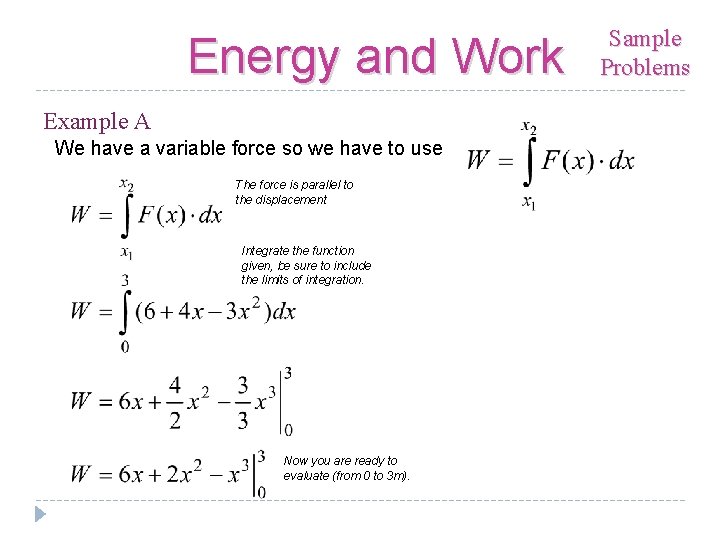
Energy and Work Example A We have a variable force so we have to use The force is parallel to the displacement Integrate the function given, be sure to include the limits of integration. Now you are ready to evaluate (from 0 to 3 m). Sample Problems
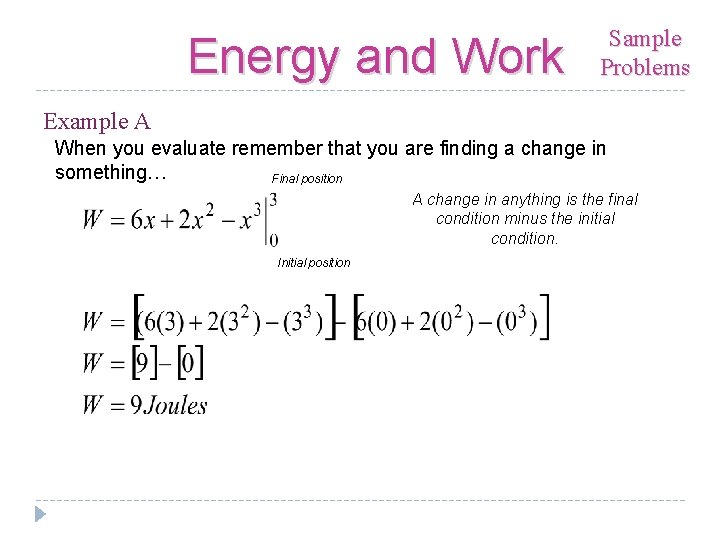
Energy and Work Sample Problems Example A When you evaluate remember that you are finding a change in something… Final position A change in anything is the final condition minus the initial condition. Initial position
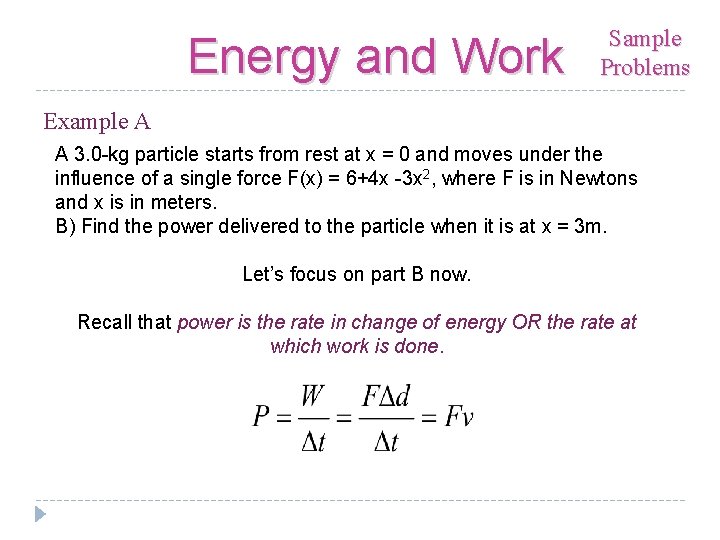
Energy and Work Sample Problems Example A A 3. 0 -kg particle starts from rest at x = 0 and moves under the influence of a single force F(x) = 6+4 x -3 x 2, where F is in Newtons and x is in meters. B) Find the power delivered to the particle when it is at x = 3 m. Let’s focus on part B now. Recall that power is the rate in change of energy OR the rate at which work is done.
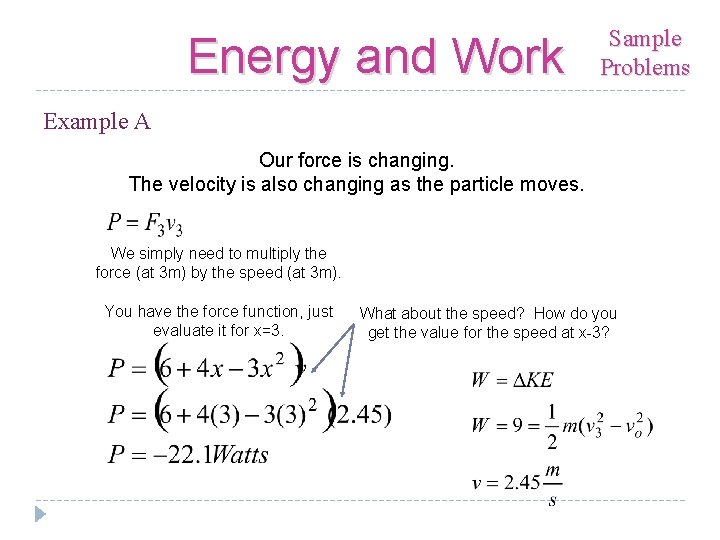
Energy and Work Sample Problems Example A Our force is changing. The velocity is also changing as the particle moves. We simply need to multiply the force (at 3 m) by the speed (at 3 m). You have the force function, just evaluate it for x=3. What about the speed? How do you get the value for the speed at x-3?
- Slides: 26