
Concepts in design Functionality and beyond work organization
Concepts in design • Functionality and beyond
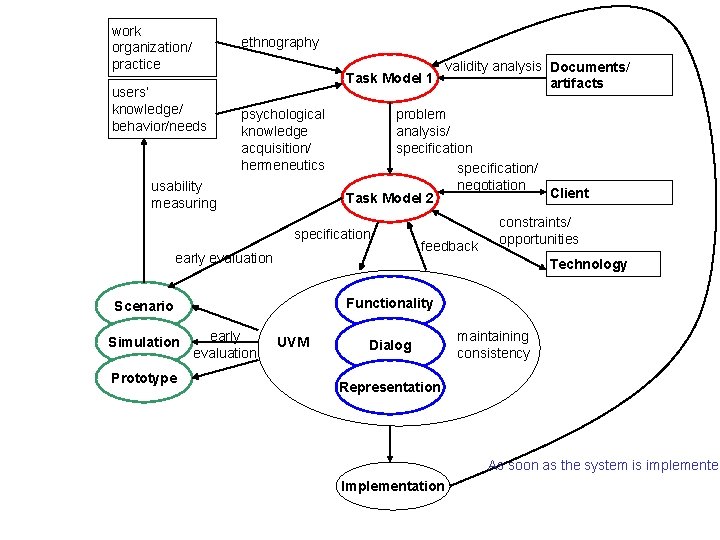
work organization/ practice ethnography users’ knowledge/ behavior/needs Task Model 1 psychological knowledge acquisition/ hermeneutics usability measuring problem analysis/ specification/ negotiation Client Task Model 2 specification early evaluation Prototype feedback constraints/ opportunities Technology Functionality Scenario Simulation validity analysis Documents/ artifacts early evaluation UVM Dialog maintaining consistency Representation As soon as the system is implemented Implementation
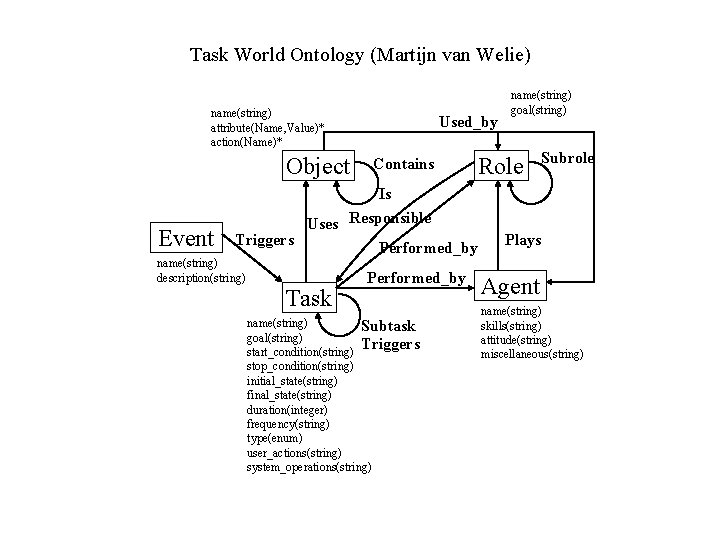
Task World Ontology (Martijn van Welie) name(string) attribute(Name, Value)* action(Name)* Object Event Triggers Used_by Contains Is Uses Responsible name(string) description(string) Task Performed_by name(string) Subtask goal(string) Triggers start_condition(string) stop_condition(string) initial_state(string) final_state(string) duration(integer) frequency(string) type(enum) user_actions(string) system_operations(string) name(string) goal(string) Role Subrole Plays Agent name(string) skills(string) attitude(string) miscellaneous(string)
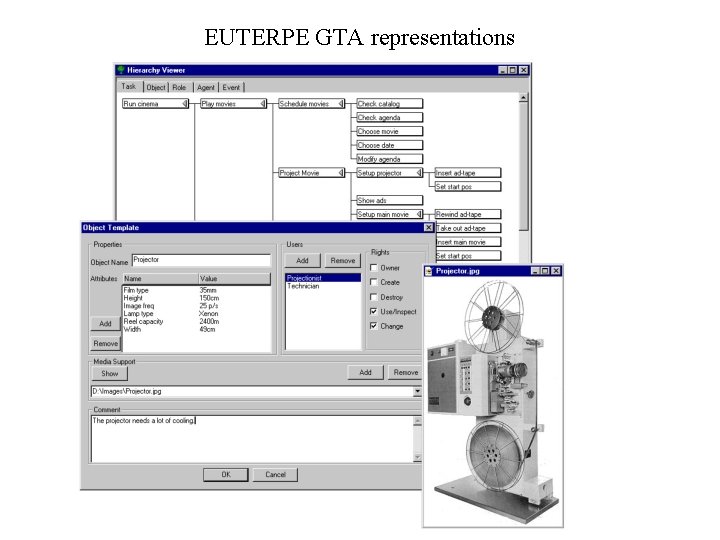
EUTERPE GTA representations

Task models Pretend to describe the whole domain of design: All … • Tasks • Roles • actors • Objects • Events
The UVM • One for each role, • But include relations to other roles (as a note to relate)
functionality From task model 2: For each relevant role (i. e. when new technology is envisioned) As far as relevant for the design (i. e. , what is new in our envisioning) • Unit (or basic) tasks • Related objects • Object attributes • Object – role relations • Events
Unit tasks From task model 2: For each relevant role (i. e. when new technology is envisioned) Tasks that are different from task model 1 and not trivial
Objects “things” that feature in any new unit task: • • As conditions As triggers Being created, changed, transferred That help to manage new technology Competences of all involved roles to the object: • Allowance to create, change, transfer, inspect
Events Trigger start or end of tasks Conditions for start or end As far as not effect of modeled tasks
- Slides: 10