
Concepts Complement activation pathways COMMON TERMINAL PATHWAY ACTIVATION
- Slides: 3
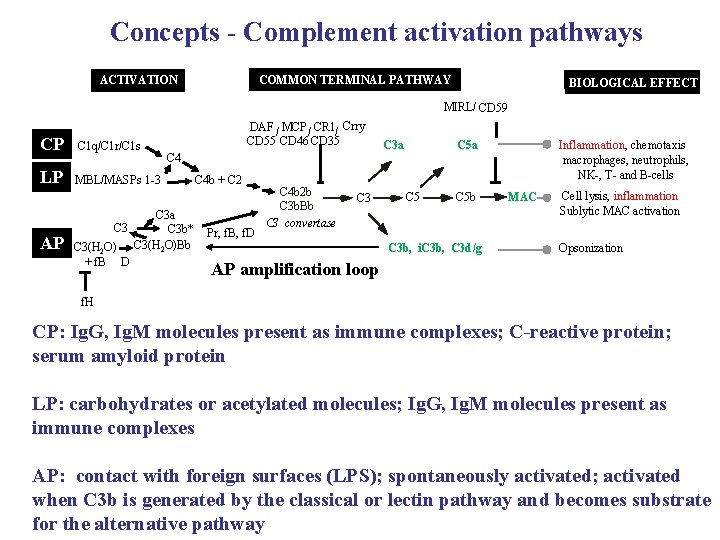
Concepts - Complement activation pathways COMMON TERMINAL PATHWAY ACTIVATION BIOLOGICAL EFFECT MIRL/ CD 59 CP C 1 q/C 1 r/C 1 s LP MBL/MASPs 1 -3 AP C 3(H 2 O) + f. B D DAF / MCP / CR 1/ Crry CD 55 CD 46 CD 35 C 4 C 3 a C 3 b* C 3(H 2 O)Bb C 4 b + C 2 Pr, f. B, f. D C 4 b 2 b C 3 b. Bb C 3 convertase C 3 a C 5 C 5 b C 3 b, i. C 3 b, C 3 d/g Inflammation, chemotaxis macrophages, neutrophils, NK-, T- and B-cells MAC Cell lysis, inflammation Sublytic MAC activation Opsonization AP amplification loop f. H CP: Ig. G, Ig. M molecules present as immune complexes; C-reactive protein; serum amyloid protein LP: carbohydrates or acetylated molecules; Ig. G, Ig. M molecules present as immune complexes AP: contact with foreign surfaces (LPS); spontaneously activated; activated when C 3 b is generated by the classical or lectin pathway and becomes substrate for the alternative pathway
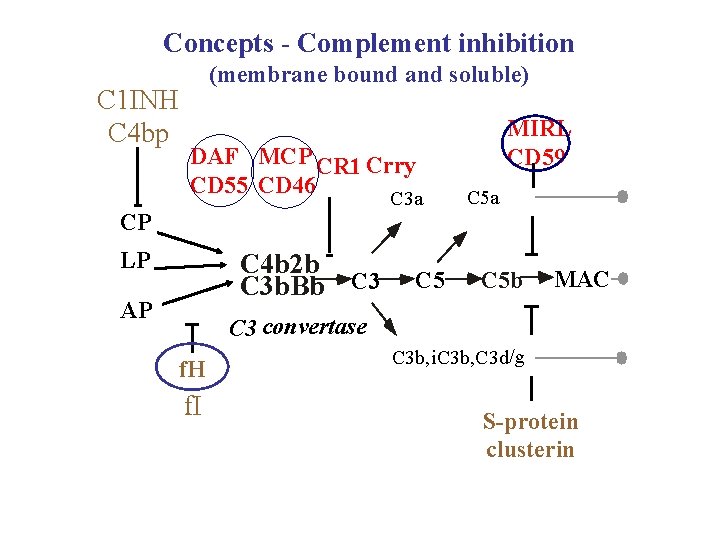
Concepts - Complement inhibition C 1 INH C 4 bp (membrane bound and soluble) DAF MCP CR 1 Crry CD 55 CD 46 C 3 a CP LP C 4 b 2 b C 3 b. Bb C 3 AP C 5 MIRL CD 59 C 5 a C 5 b MAC C 3 convertase f. H f. I C 3 b, i. C 3 b, C 3 d/g S-protein clusterin
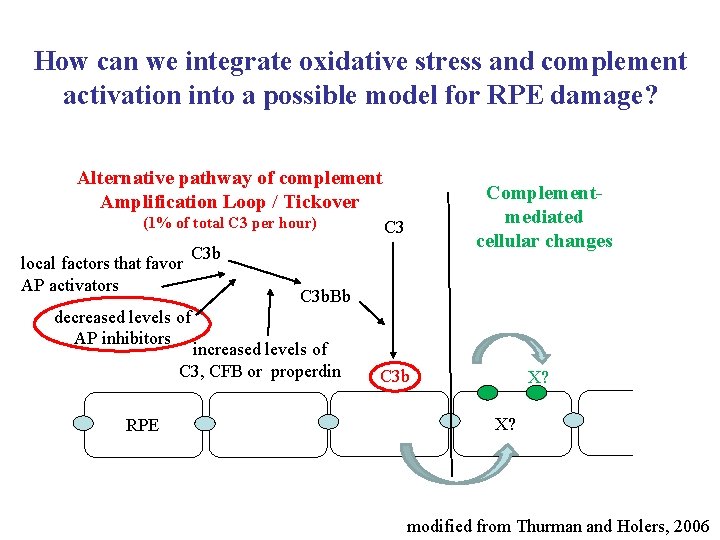
How can we integrate oxidative stress and complement activation into a possible model for RPE damage? Alternative pathway of complement Amplification Loop / Tickover (1% of total C 3 per hour) local factors that favor AP activators Complementmediated cellular changes C 3 b. Bb decreased levels of AP inhibitors increased levels of C 3, CFB or properdin RPE C 3 b X? X? modified from Thurman and Holers, 2006