
Concepts and Measures Empirical Evidence on the interpretation
- Slides: 29
Concepts and Measures: Empirical Evidence on the interpretation of ESe. C and other occupation-based social classifications Paul Lambert University of Stirling Erik Bihagen University of Stockholm Paper presented to Social Stratification Research Seminar, Stirling 5 -7 September 2007 Stratification - Stirling 2007 1
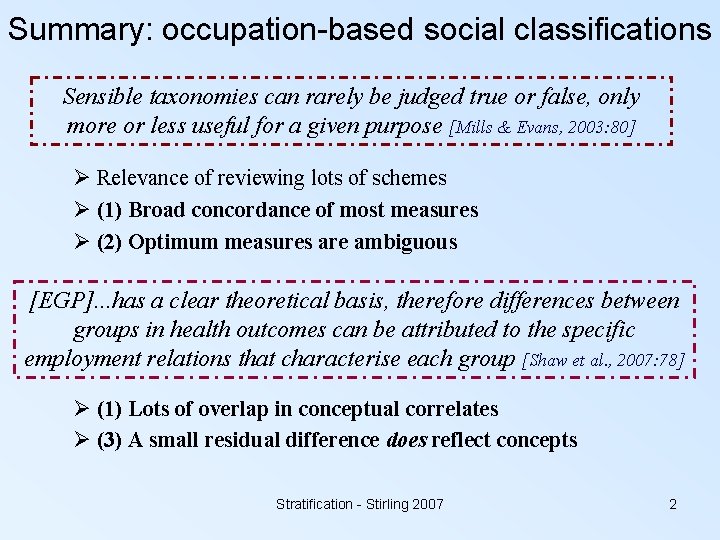
Summary: occupation-based social classifications Sensible taxonomies can rarely be judged true or false, only more or less useful for a given purpose [Mills & Evans, 2003: 80] Ø Relevance of reviewing lots of schemes Ø (1) Broad concordance of most measures Ø (2) Optimum measures are ambiguous [EGP]. . . has a clear theoretical basis, therefore differences between groups in health outcomes can be attributed to the specific employment relations that characterise each group [Shaw et al. , 2007: 78] Ø (1) Lots of overlap in conceptual correlates Ø (3) A small residual difference does reflect concepts Stratification - Stirling 2007 2
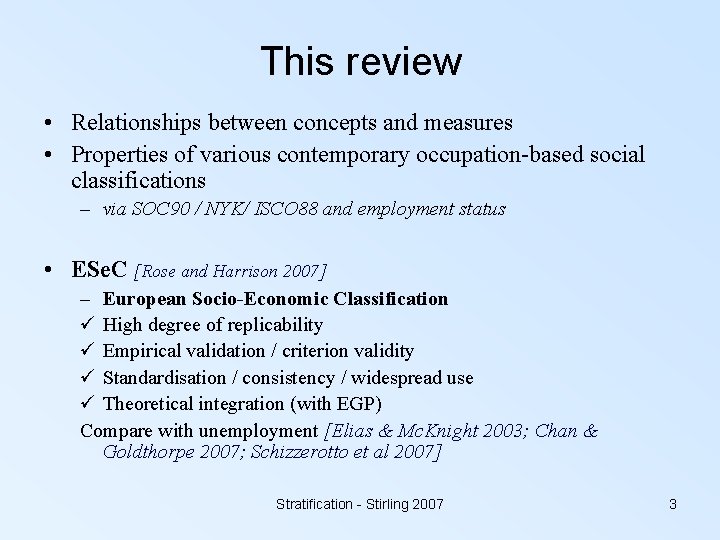
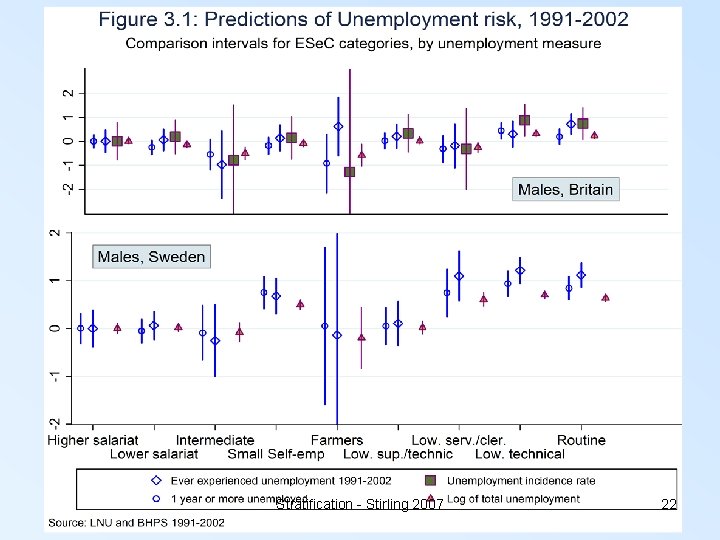
This review • Relationships between concepts and measures • Properties of various contemporary occupation-based social classifications – via SOC 90 / NYK/ ISCO 88 and employment status • ESe. C [Rose and Harrison 2007] – European Socio-Economic Classification ü High degree of replicability ü Empirical validation / criterion validity ü Standardisation / consistency / widespread use ü Theoretical integration (with EGP) Compare with unemployment [Elias & Mc. Knight 2003; Chan & Goldthorpe 2007; Schizzerotto et al 2007] Stratification - Stirling 2007 3
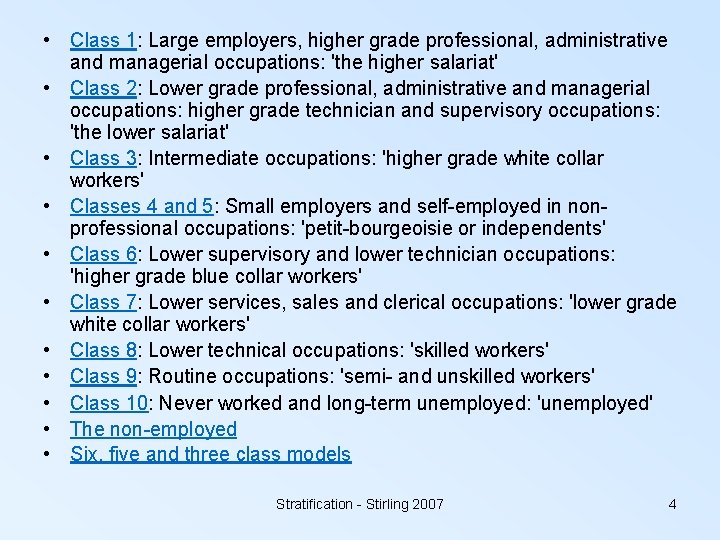
• Class 1: Large employers, higher grade professional, administrative and managerial occupations: 'the higher salariat' • Class 2: Lower grade professional, administrative and managerial occupations: higher grade technician and supervisory occupations: 'the lower salariat' • Class 3: Intermediate occupations: 'higher grade white collar workers' • Classes 4 and 5: Small employers and self-employed in nonprofessional occupations: 'petit-bourgeoisie or independents' • Class 6: Lower supervisory and lower technician occupations: 'higher grade blue collar workers' • Class 7: Lower services, sales and clerical occupations: 'lower grade white collar workers' • Class 8: Lower technical occupations: 'skilled workers' • Class 9: Routine occupations: 'semi- and unskilled workers' • Class 10: Never worked and long-term unemployed: 'unemployed' • The non-employed • Six, five and three class models Stratification - Stirling 2007 4
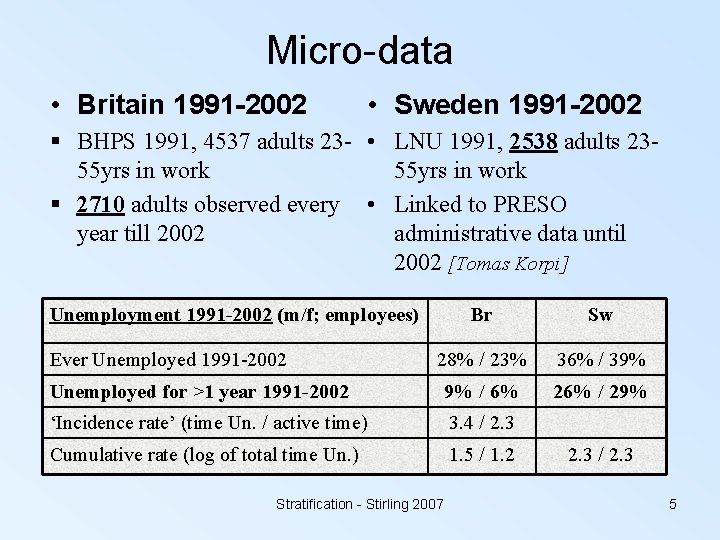
Micro-data • Britain 1991 -2002 • Sweden 1991 -2002 § BHPS 1991, 4537 adults 23 - • LNU 1991, 2538 adults 2355 yrs in work § 2710 adults observed every • Linked to PRESO year till 2002 administrative data until 2002 [Tomas Korpi] Unemployment 1991 -2002 (m/f; employees) Br Sw 28% / 23% 36% / 39% Unemployed for >1 year 1991 -2002 9% / 6% 26% / 29% ‘Incidence rate’ (time Un. / active time) 3. 4 / 2. 3 Cumulative rate (log of total time Un. ) 1. 5 / 1. 2 Ever Unemployed 1991 -2002 Stratification - Stirling 2007 2. 3 / 2. 3 5
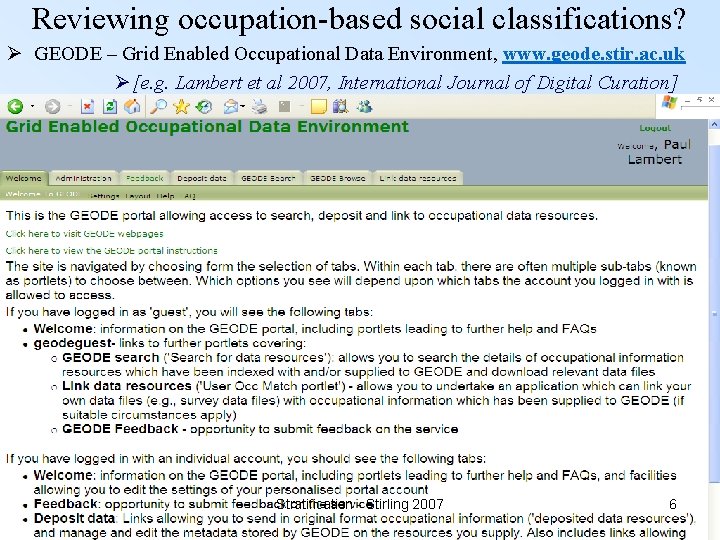
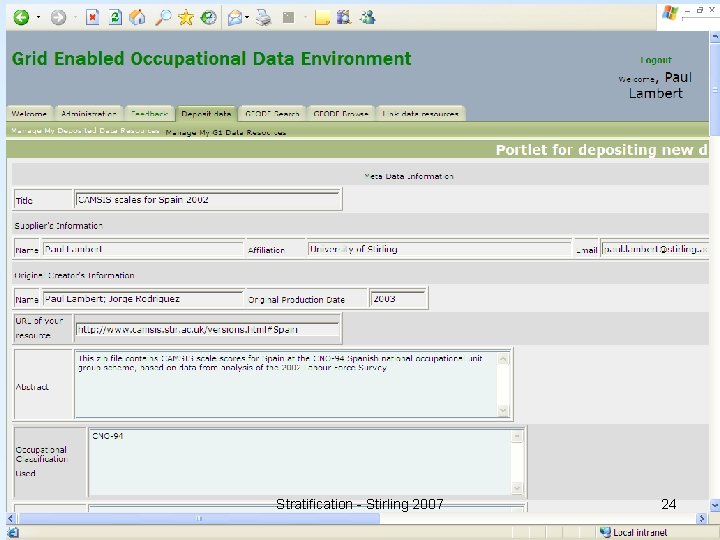
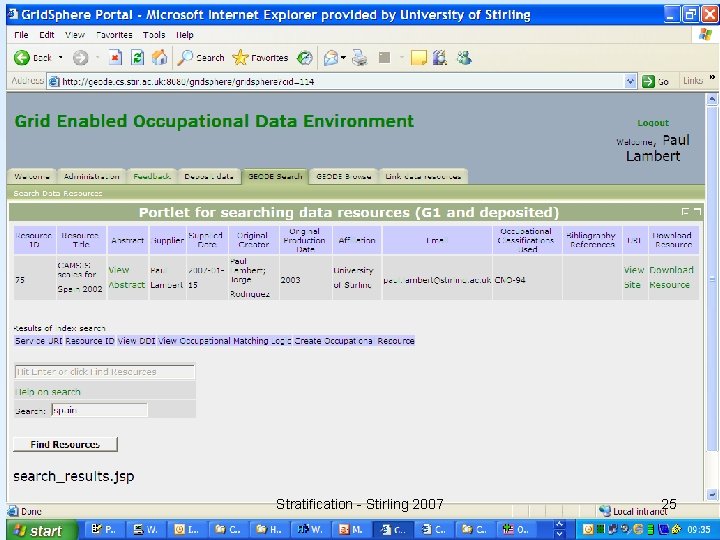
Reviewing occupation-based social classifications? Ø GEODE – Grid Enabled Occupational Data Environment, www. geode. stir. ac. uk Ø [e. g. Lambert et al 2007, International Journal of Digital Curation] Stratification - Stirling 2007 6
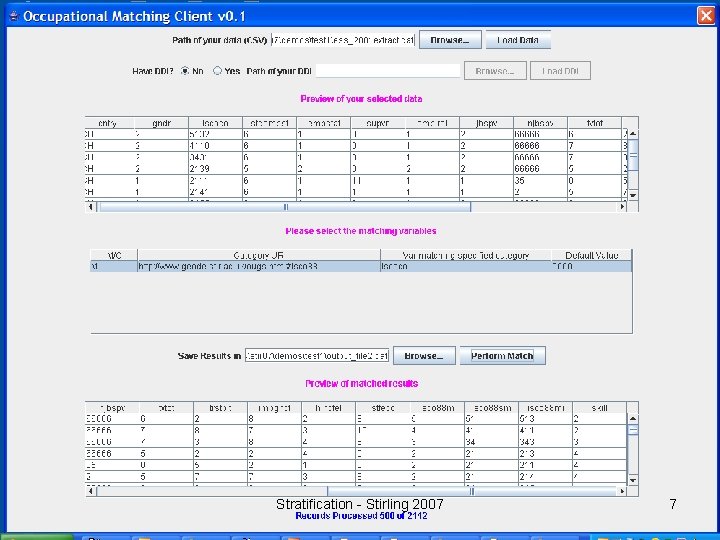
Stratification - Stirling 2007 7
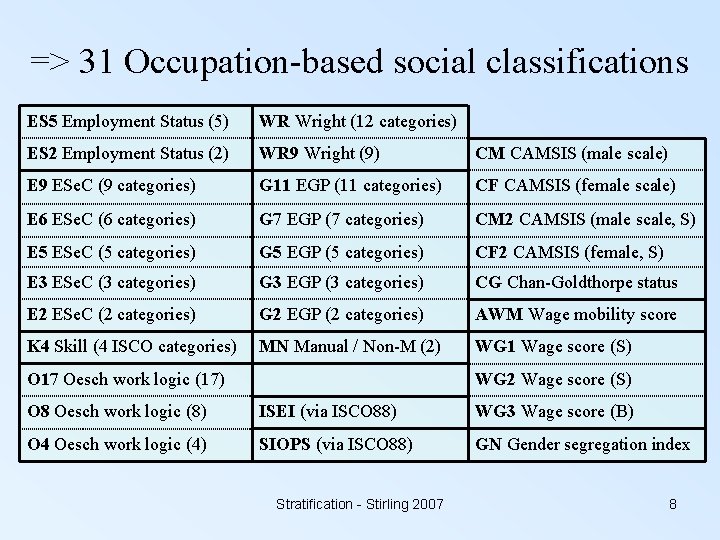
=> 31 Occupation-based social classifications ES 5 Employment Status (5) WR Wright (12 categories) ES 2 Employment Status (2) WR 9 Wright (9) CM CAMSIS (male scale) E 9 ESe. C (9 categories) G 11 EGP (11 categories) CF CAMSIS (female scale) E 6 ESe. C (6 categories) G 7 EGP (7 categories) CM 2 CAMSIS (male scale, S) E 5 ESe. C (5 categories) G 5 EGP (5 categories) CF 2 CAMSIS (female, S) E 3 ESe. C (3 categories) G 3 EGP (3 categories) CG Chan-Goldthorpe status E 2 ESe. C (2 categories) G 2 EGP (2 categories) AWM Wage mobility score K 4 Skill (4 ISCO categories) MN Manual / Non-M (2) WG 1 Wage score (S) O 17 Oesch work logic (17) WG 2 Wage score (S) O 8 Oesch work logic (8) ISEI (via ISCO 88) WG 3 Wage score (B) O 4 Oesch work logic (4) SIOPS (via ISCO 88) GN Gender segregation index Stratification - Stirling 2007 8
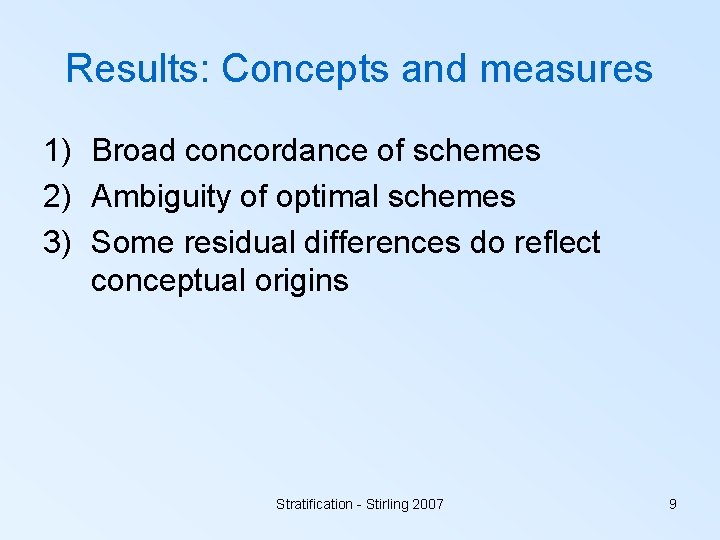
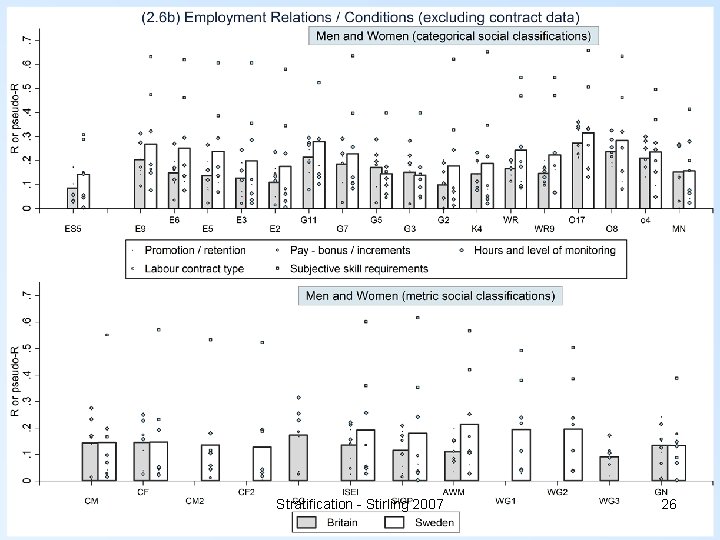
Results: Concepts and measures 1) Broad concordance of schemes 2) Ambiguity of optimal schemes 3) Some residual differences do reflect conceptual origins Stratification - Stirling 2007 9
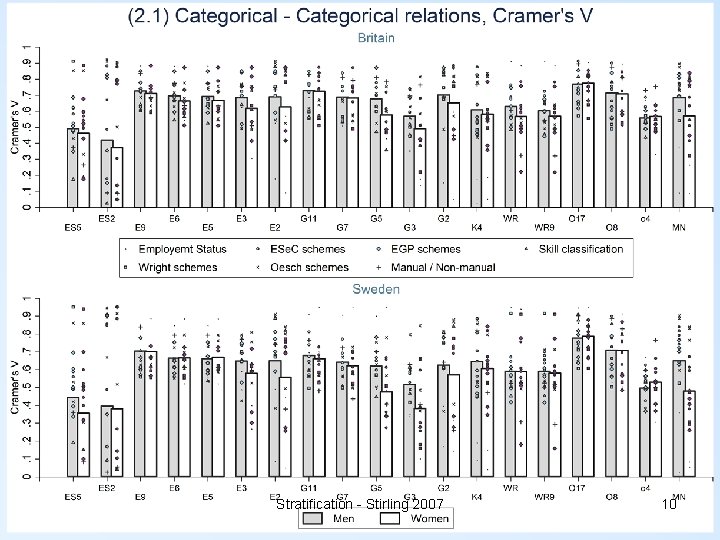
Stratification - Stirling 2007 10
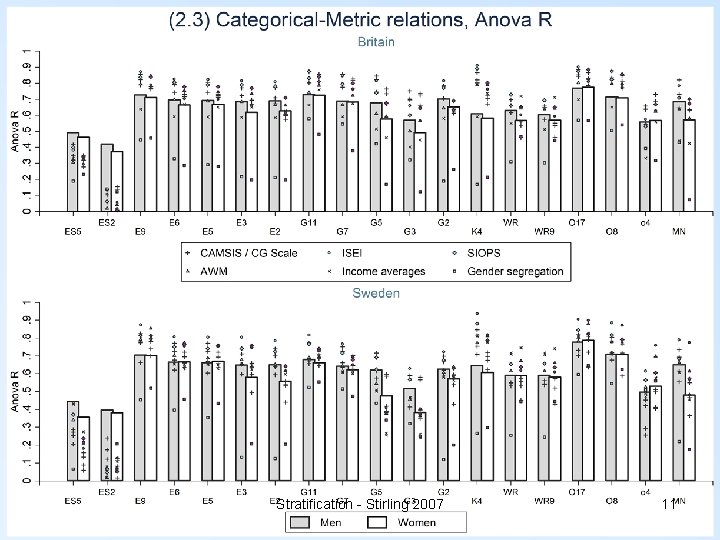
Stratification - Stirling 2007 11
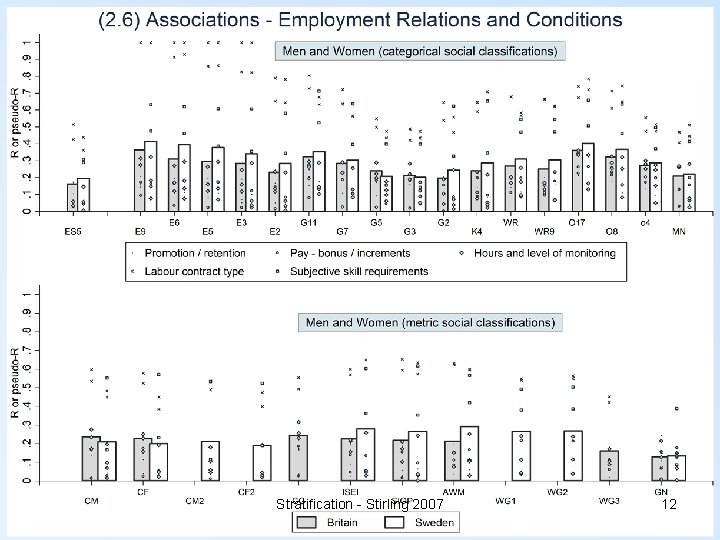
Stratification - Stirling 2007 12
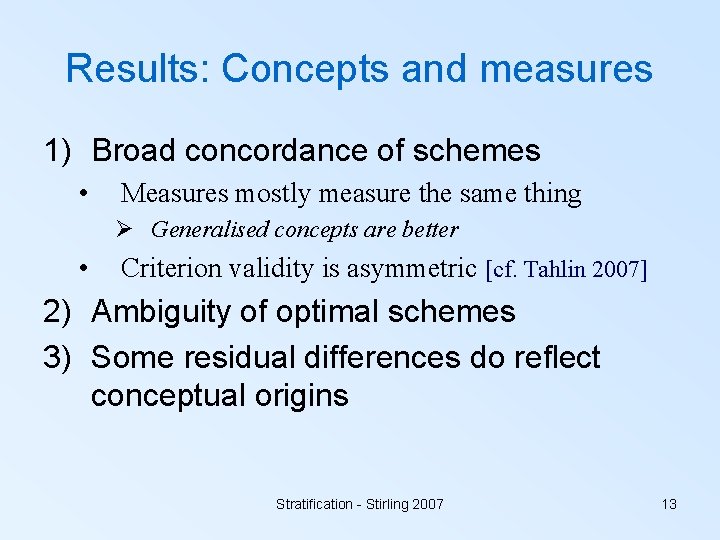
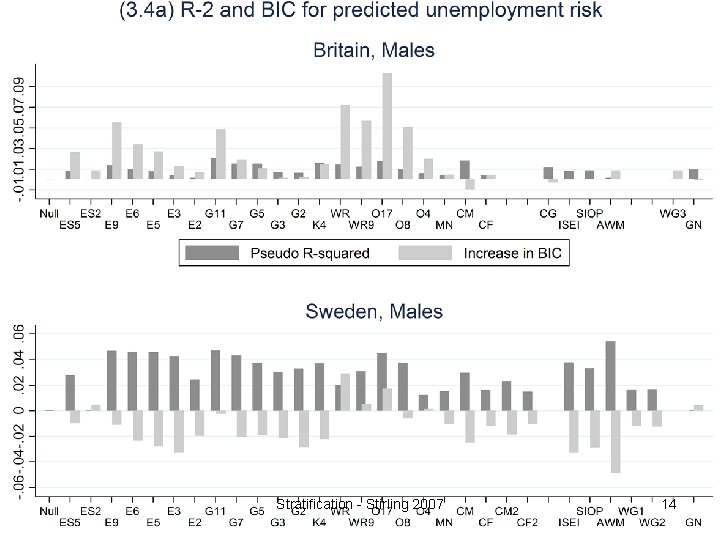
Results: Concepts and measures 1) Broad concordance of schemes • Measures mostly measure the same thing Ø Generalised concepts are better • Criterion validity is asymmetric [cf. Tahlin 2007] 2) Ambiguity of optimal schemes 3) Some residual differences do reflect conceptual origins Stratification - Stirling 2007 13
Stratification - Stirling 2007 14
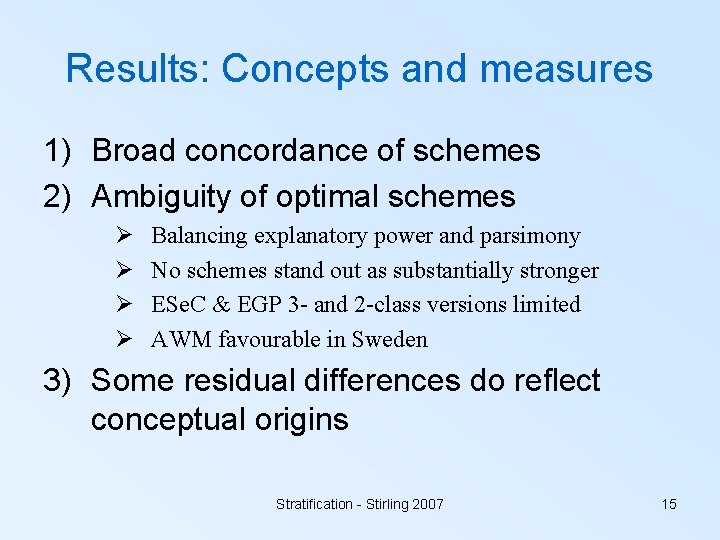
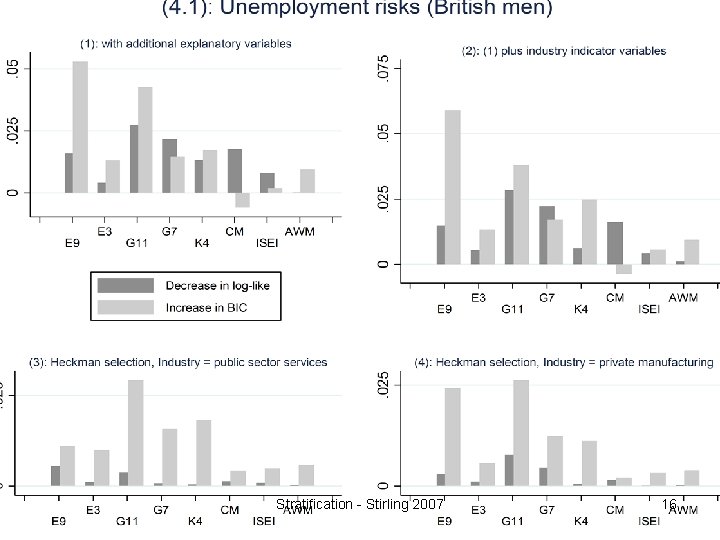
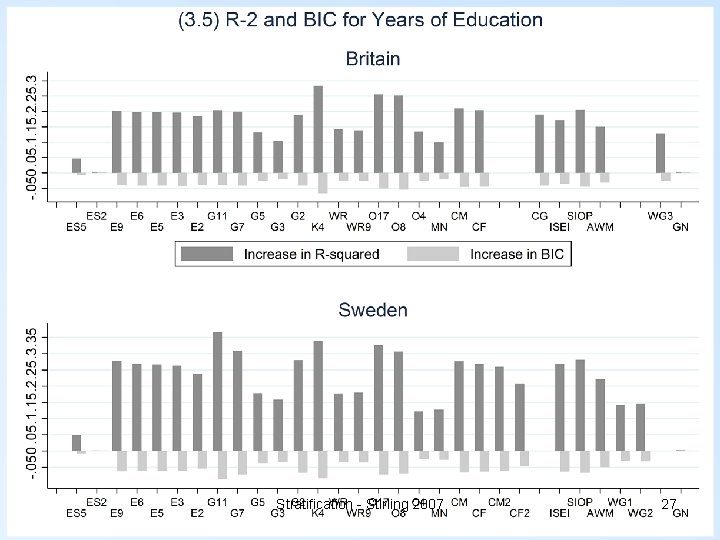
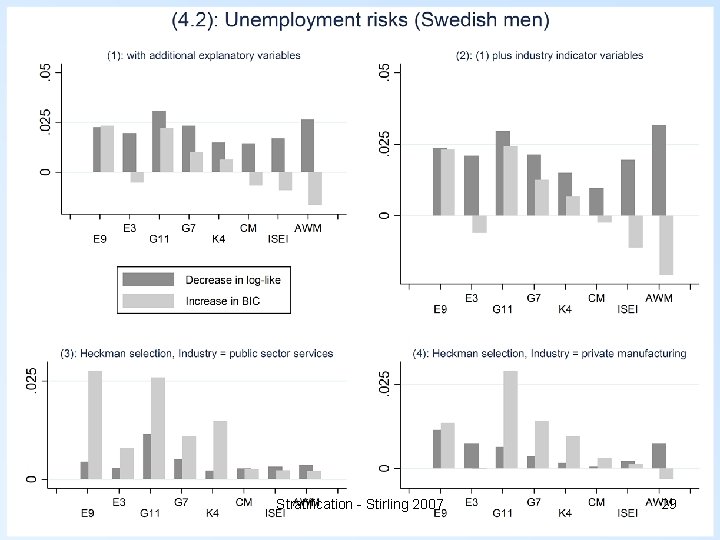
Results: Concepts and measures 1) Broad concordance of schemes 2) Ambiguity of optimal schemes Ø Ø Balancing explanatory power and parsimony No schemes stand out as substantially stronger ESe. C & EGP 3 - and 2 -class versions limited AWM favourable in Sweden 3) Some residual differences do reflect conceptual origins Stratification - Stirling 2007 15
Stratification - Stirling 2007 16
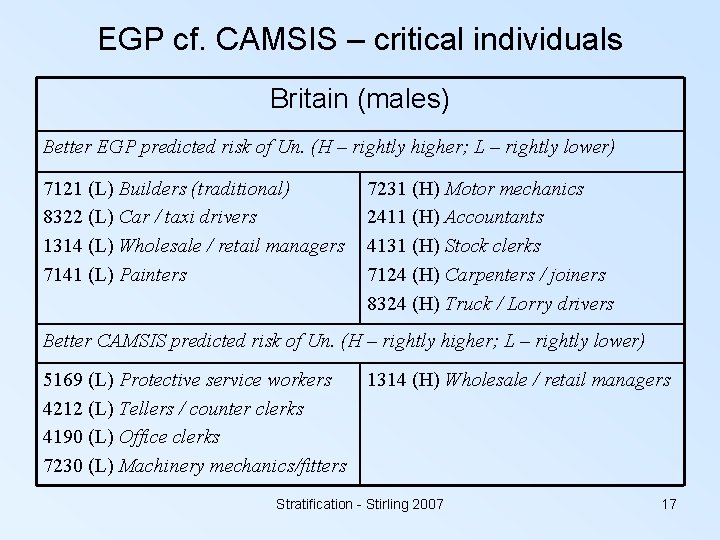
EGP cf. CAMSIS – critical individuals Britain (males) Better EGP predicted risk of Un. (H – rightly higher; L – rightly lower) 7121 (L) Builders (traditional) 8322 (L) Car / taxi drivers 1314 (L) Wholesale / retail managers 7141 (L) Painters 7231 (H) Motor mechanics 2411 (H) Accountants 4131 (H) Stock clerks 7124 (H) Carpenters / joiners 8324 (H) Truck / Lorry drivers Better CAMSIS predicted risk of Un. (H – rightly higher; L – rightly lower) 5169 (L) Protective service workers 4212 (L) Tellers / counter clerks 4190 (L) Office clerks 7230 (L) Machinery mechanics/fitters 1314 (H) Wholesale / retail managers Stratification - Stirling 2007 17
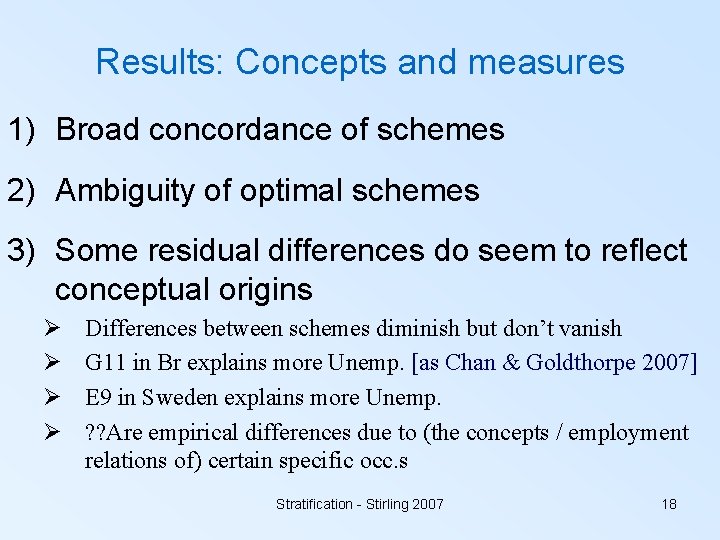
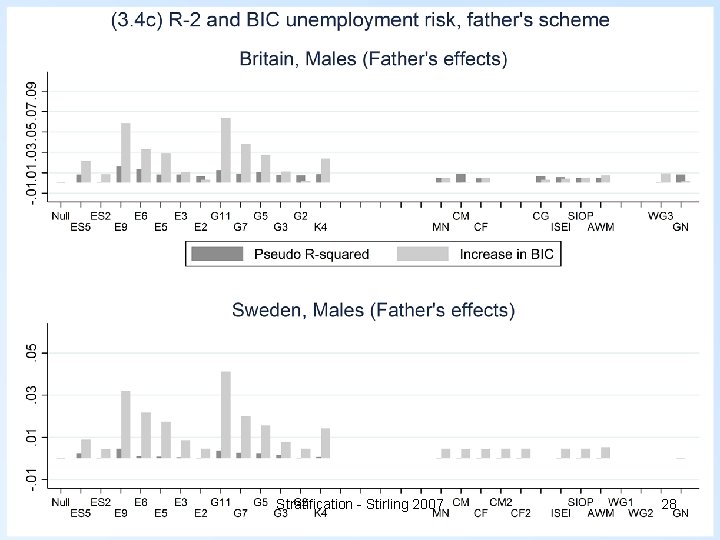
Results: Concepts and measures 1) Broad concordance of schemes 2) Ambiguity of optimal schemes 3) Some residual differences do seem to reflect conceptual origins Ø Ø Differences between schemes diminish but don’t vanish G 11 in Br explains more Unemp. [as Chan & Goldthorpe 2007] E 9 in Sweden explains more Unemp. ? ? Are empirical differences due to (the concepts / employment relations of) certain specific occ. s Stratification - Stirling 2007 18
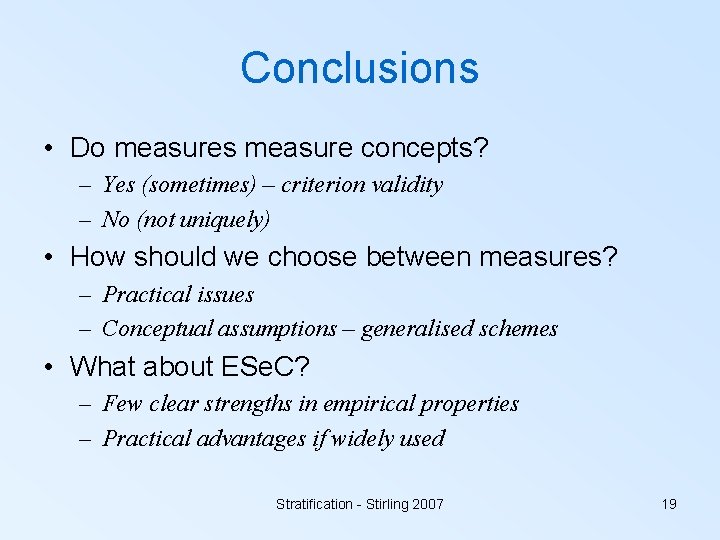
Conclusions • Do measures measure concepts? – Yes (sometimes) – criterion validity – No (not uniquely) • How should we choose between measures? – Practical issues – Conceptual assumptions – generalised schemes • What about ESe. C? – Few clear strengths in empirical properties – Practical advantages if widely used Stratification - Stirling 2007 19
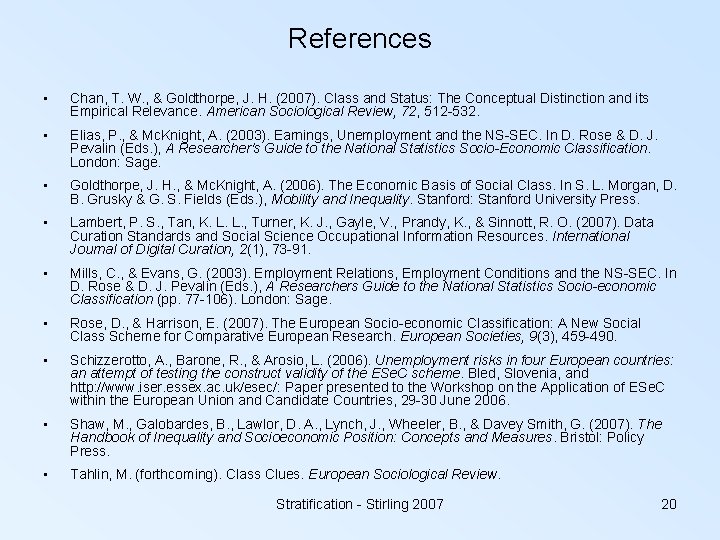
References • Chan, T. W. , & Goldthorpe, J. H. (2007). Class and Status: The Conceptual Distinction and its Empirical Relevance. American Sociological Review, 72, 512 -532. • Elias, P. , & Mc. Knight, A. (2003). Earnings, Unemployment and the NS-SEC. In D. Rose & D. J. Pevalin (Eds. ), A Researcher's Guide to the National Statistics Socio-Economic Classification. London: Sage. • Goldthorpe, J. H. , & Mc. Knight, A. (2006). The Economic Basis of Social Class. In S. L. Morgan, D. B. Grusky & G. S. Fields (Eds. ), Mobility and Inequality. Stanford: Stanford University Press. • Lambert, P. S. , Tan, K. L. L. , Turner, K. J. , Gayle, V. , Prandy, K. , & Sinnott, R. O. (2007). Data Curation Standards and Social Science Occupational Information Resources. International Journal of Digital Curation, 2(1), 73 -91. • Mills, C. , & Evans, G. (2003). Employment Relations, Employment Conditions and the NS-SEC. In D. Rose & D. J. Pevalin (Eds. ), A Researchers Guide to the National Statistics Socio-economic Classification (pp. 77 -106). London: Sage. • Rose, D. , & Harrison, E. (2007). The European Socio-economic Classification: A New Social Class Scheme for Comparative European Research. European Societies, 9(3), 459 -490. • Schizzerotto, A. , Barone, R. , & Arosio, L. (2006). Unemployment risks in four European countries: an attempt of testing the construct validity of the ESe. C scheme. Bled, Slovenia, and http: //www. iser. essex. ac. uk/esec/: Paper presented to the Workshop on the Application of ESe. C within the European Union and Candidate Countries, 29 -30 June 2006. • Shaw, M. , Galobardes, B. , Lawlor, D. A. , Lynch, J. , Wheeler, B. , & Davey Smith, G. (2007). The Handbook of Inequality and Socioeconomic Position: Concepts and Measures. Bristol: Policy Press. • Tahlin, M. (forthcoming). Class Clues. European Sociological Review. Stratification - Stirling 2007 20
Appendices Stratification - Stirling 2007 21
Stratification - Stirling 2007 22
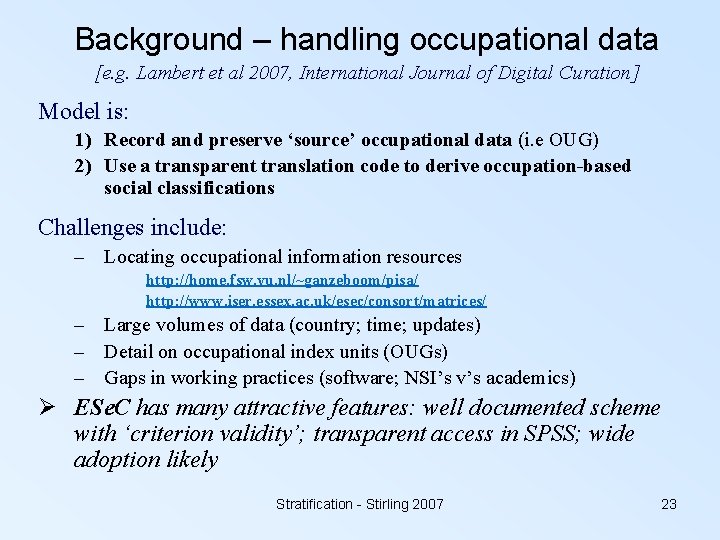
Background – handling occupational data [e. g. Lambert et al 2007, International Journal of Digital Curation] Model is: 1) Record and preserve ‘source’ occupational data (i. e OUG) 2) Use a transparent translation code to derive occupation-based social classifications Challenges include: – Locating occupational information resources http: //home. fsw. vu. nl/~ganzeboom/pisa/ http: //www. iser. essex. ac. uk/esec/consort/matrices/ – Large volumes of data (country; time; updates) – Detail on occupational index units (OUGs) – Gaps in working practices (software; NSI’s v’s academics) Ø ESe. C has many attractive features: well documented scheme with ‘criterion validity’; transparent access in SPSS; wide adoption likely Stratification - Stirling 2007 23
Stratification - Stirling 2007 24
Stratification - Stirling 2007 25
Stratification - Stirling 2007 26
Stratification - Stirling 2007 27
Stratification - Stirling 2007 28
Stratification - Stirling 2007 29