
Concept Summary Batesville High School Physics Circular Motion
Concept Summary Batesville High School Physics
Circular Motion Terms ® The point or line that is the center of the circle is the axis of rotation. ® If the axis of rotation is inside the object, the object is rotating (spinning). ® If the axis of rotation is outside the object, the object is revolving.

Linear/Tangential Velocity ® Objects moving in a circle still have a linear velocity = distance/time. ® This is often called tangential velocity, since the direction of the linear velocity is tangent to the circle. v
Rotational/Angular Velocity ® Objects moving in a circle also have a rotational or angular velocity, which is the rate angular position changes. ® Rotational velocity is measured in degrees/second, rotations/minute (rpm), etc. ® Common symbol, w (Greek letter omega)
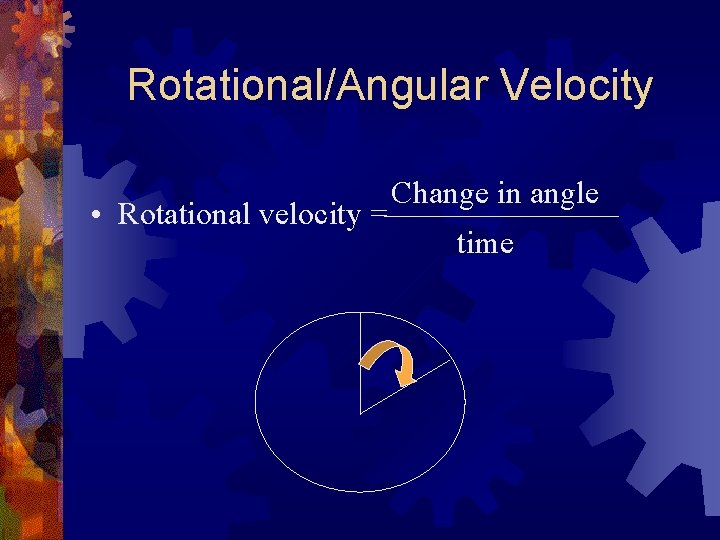
Rotational/Angular Velocity • Rotational velocity = Change in angle time
Rotational & Linear Velocity ® If an object is rotating: ® All points on the object have the same rotational (angular) velocity. points on the object do not have the same linear (tangential) velocity. ® All
Rotational & Linear Velocity ® Linear ® The ® velocity of a point depends on: rotational velocity of the point. More rotational velocity means more linear velocity. ® The distance from the point to the axis of rotation. ® More distance from the axis means more linear velocity.
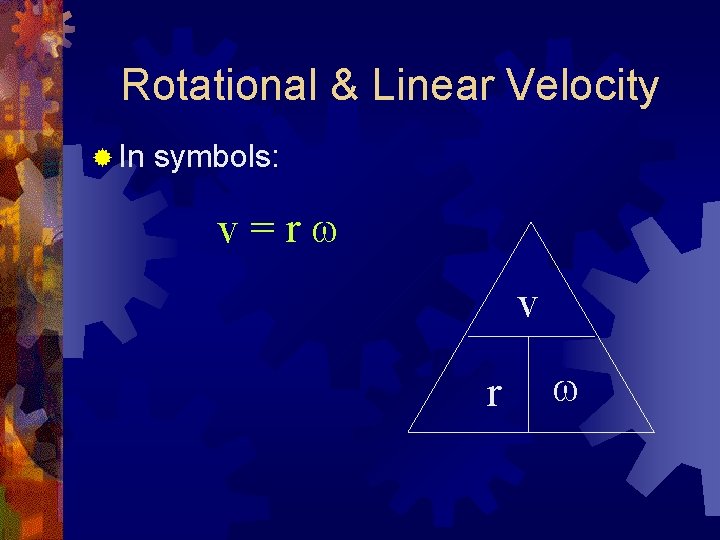
Rotational & Linear Velocity ® In symbols: v=rw v r w
Acceleration ® As an object moves around a circle, its direction of motion is constantly changing. ® Therefore its velocity is changing. ® Therefore an object moving in a circle is constantly accelerating.
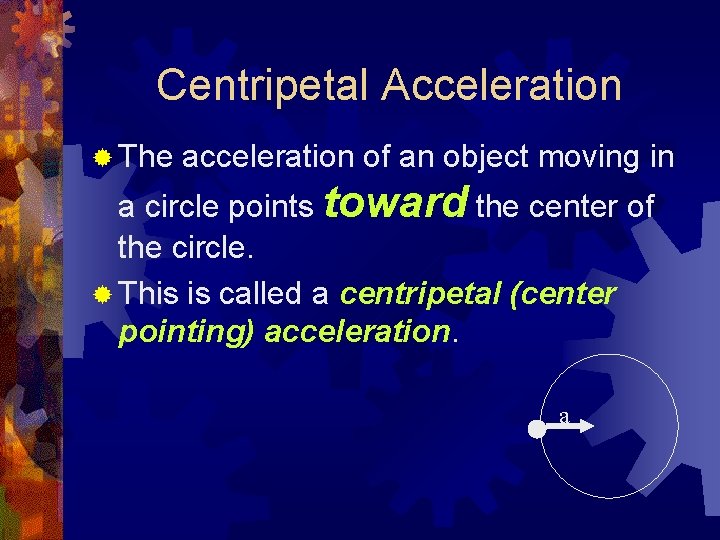
Centripetal Acceleration ® The acceleration of an object moving in a circle points toward the center of the circle. ® This is called a centripetal (center pointing) acceleration. a
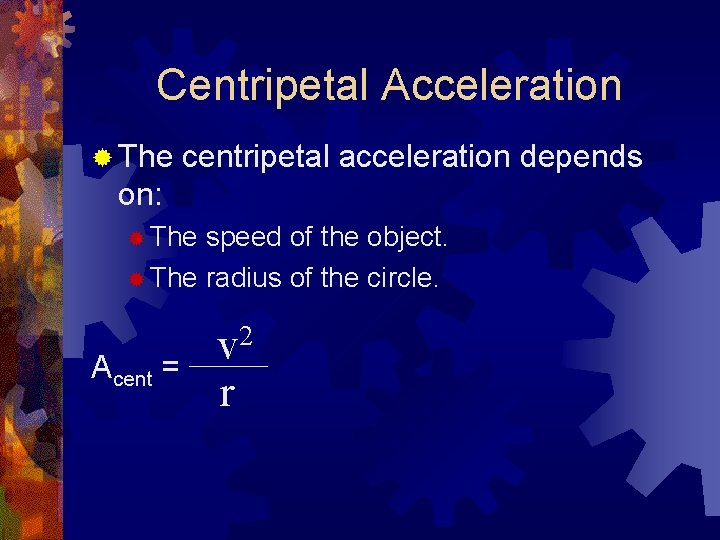
Centripetal Acceleration ® The centripetal acceleration depends on: ® The speed of the object. ® The radius of the circle. Acent = v 2 r
Centripetal Force ® Newton’s Second Law says that if an object is accelerating, there must be a net force on it. ® For an object moving in a circle, this is called the centripetal force points toward the center of the circle. ® The
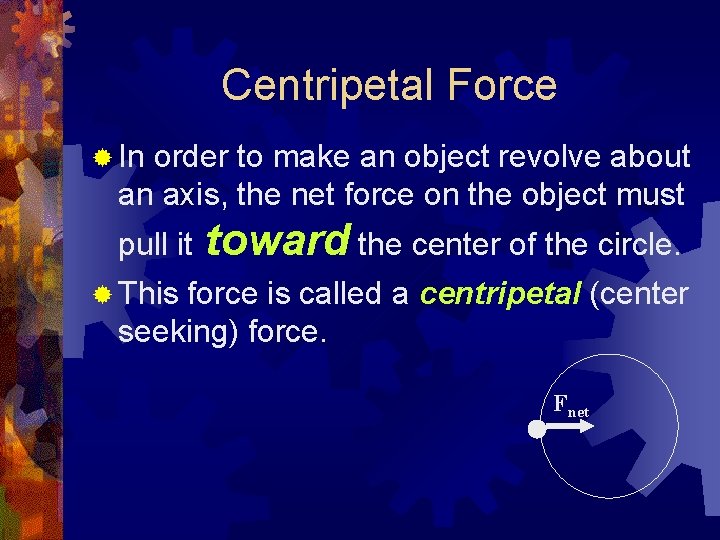
Centripetal Force ® In order to make an object revolve about an axis, the net force on the object must pull it toward the center of the circle. ® This force is called a centripetal (center seeking) force. Fnet
Centripetal Force ® Centripetal force on an object depends on: ® The object’s mass - more mass means more force. ® The object’s speed - more speed means more force. ® And…
Centripetal Force ® The centripetal force on an object also depends on: ® The object’s distance from the axis (radius). If linear velocity is held constant, more distance requires less force. ® If rotational velocity is held constant, more distance requires more force. ®
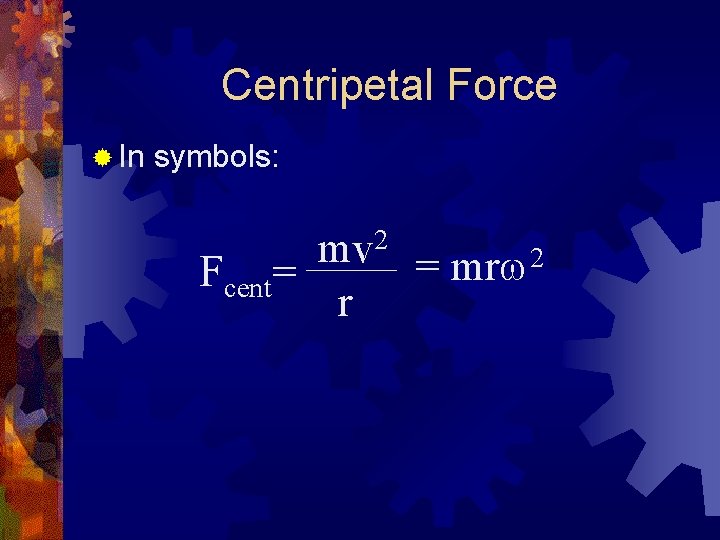
Centripetal Force ® In symbols: mv 2 = mrw 2 Fcent= r
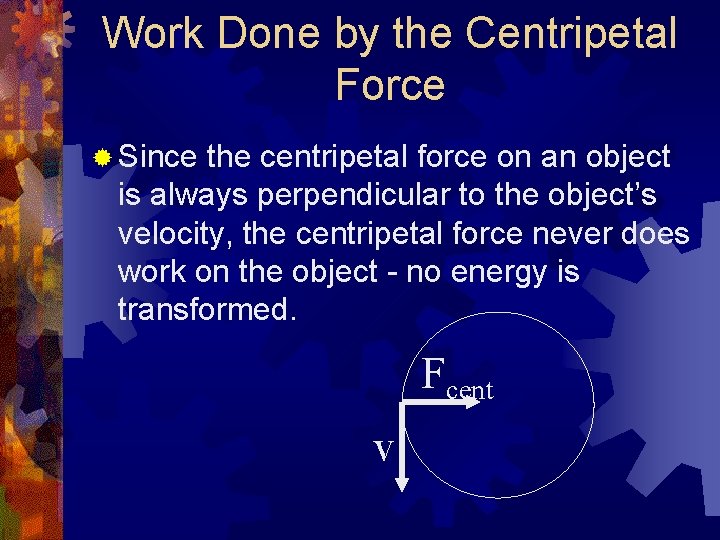
Work Done by the Centripetal Force ® Since the centripetal force on an object is always perpendicular to the object’s velocity, the centripetal force never does work on the object - no energy is transformed. Fcent v
“Centrifugal Force” ® “Centrifugal force” is a fictitious force it is not an interaction between 2 objects, and therefore not a real force. ®Nothing pulls an object away from the center of the circle.
“Centrifugal Force” ® What is erroneously attributed to “centrifugal force” is actually the action of the object’s inertia - whatever velocity it has (speed + direction) it wants to keep.

The End
- Slides: 20