
CONCEPT OF NURSING Promoting Healthy Physiologic Responses Oxygenation

- Slides: 20
CONCEPT OF NURSING Promoting Healthy Physiologic Responses Oxygenation
Physiology of Oxygenation 1. Ventilation 2. Alveolar Gas Exchange 3. Oxygen Transport and Delivery 4. Cellular Respiration
Physiology of Oxygenation 1. Ventilation • Movement of air into and out of the lungs - Inhalation - Exhalation • Delivery of fresh air into the lung’s alveoli • Regulated by respiratory control centers in the brain • Hypoxemia is a decrease in blood oxygen concentration.
Physiology of Oxygenation 2. Alveolar Gas Exchange Diffusion is the movement of gases from an area of greater pressure or concentration to an area of lower pressure or concentration. • Oxygen uptake (external respiration) is the exchange of oxygen from the alveolar space into the pulmonary capillary blood. • Carbon dioxide diffuses from the blood to the alveolar space.
Physiology of Oxygenation 3. Circulation/Perfusion • The heart pumps oxygenated blood into the arterial system, which carries it to the cells, and collects deoxygenated blood from the tissues through venous system back to the lungs.
Physiology of Oxygenation 4. Cellular Respiration (internal respiration) • Oxygen diffuses from the blood to the tissues • Carbon dioxide moves from the tissues to the blood. • The blood is then reoxygenated by the heart.
Process of Ventilation § The diaphragm contracts and descends, lengthening the thoracic cavity. § The external intercoastal muscles contract, lifting the ribs upward and outward. § The sternum is pushed forward, enlarging the chest from front to back. § Increased lung volume and decreased intrapulmonic pressure allows air to move from an area of greater pressure (outside lungs ) to lesser pressure (inside lungs). § The relaxation of these structures results in expiration.
Alterations in breathing patterns & Alterations in respiratory function § Tachypnea (hyperventilation) § Bradypnea (hypoventilation) § Dyspnea § Apnea § Orthopnea § Cyanosis § Hypoxia & hypoxemia
Factors Affecting Oxygenation § Environmental: altitude, heat and cold, air pollution § Lifestyle Factors: cigarette smoking, occupation, activity pattern § Health Status: e. g diseases of the respiratory system § Exercise § Stress & emotions § Medication: e. g narcotics
Diagnostic and Laboratory Data § Pulse Oximetry § Arterial Blood Gases (ABGs) § Sputum Collection § Pulmonary Function Tests § Hemoglobin level § Chest X-Ray, Computerized Tomography § Bronchoscopy § Thoracentesis § Echocardiography
Nursing Diagnosis § Primary Nursing Diagnoses • Ineffective Airway Clearance • Ineffective Breathing Patterns • Impaired Gas Exchange • Decreased Cardiac Output • Altered Tissue Perfusion
Secondary Nursing Diagnoses § Deficient Knowledge § Activity Intolerance § Disturbed Sleep Pattern § Imbalanced Nutrition § Acute Pain § Anxiety
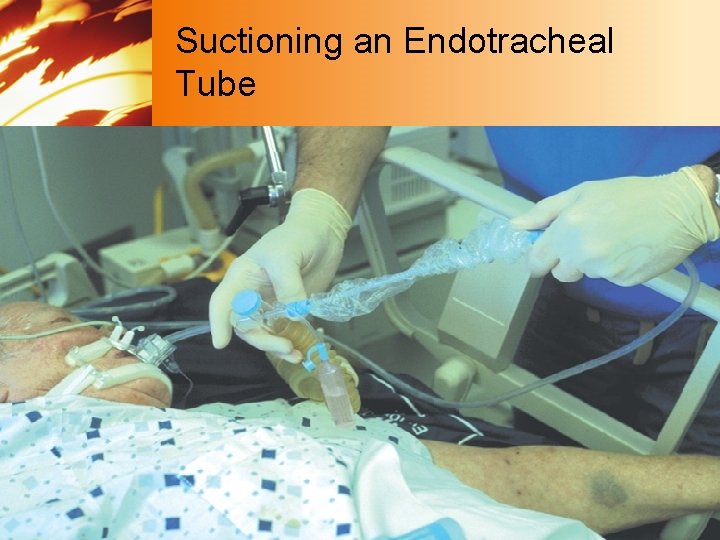
Implementation 1. Interventions to Promote Airway Clearance • • Teach the patient effective coughing. Initiate postural drainage and chest physiotherapy. Monitor hydration. Administer medications. Monitor environmental and lifestyle conditions. Manage artificial airways. Suction the airway.
Suctioning an Endotracheal Tube
Implementation 2. Interventions to Improve Breathing Patterns • Position client properly. • Teach controlled breathing exercises. • Manage chest drainage systems.
Implementation 3. Interventions to Improve Oxygen Uptake and Delivery • Administer oxygen. *simple mask *Nasal canula *Ventori mask *Rebreathing and Non-rebreathing mask • Administer blood components.
Implementation 4. Interventions to Increase Cardiac Output and Tissue Perfusion • Manage fluid balance. • Encourage activity restrictions and assistance with activities of daily living. • Position client properly. • Administer medications.
Implementation § Emergency Interventions • Remove airway obstruction. • Initiate cardiopulmonary resuscitation (CPR).
Implementations § Interventions to Address Associated Nursing Diagnoses • Explore lifestyle and activity adaptations. • Encourage dietary and nutritional modifications. • Promote comfort measures.
Precautions for Oxygen Administration § Avoid open flames in patient’s room § Place no smoking signs in conspicuous places § Check to see electrical equipment in room is in good working order