
CONCEPT OF NERST POTENTIAL AND SODIUM POTASSIUM PUMP


- Slides: 32
CONCEPT OF NERST POTENTIAL AND SODIUM POTASSIUM PUMP BY: DR. ANEEQA SHAHID
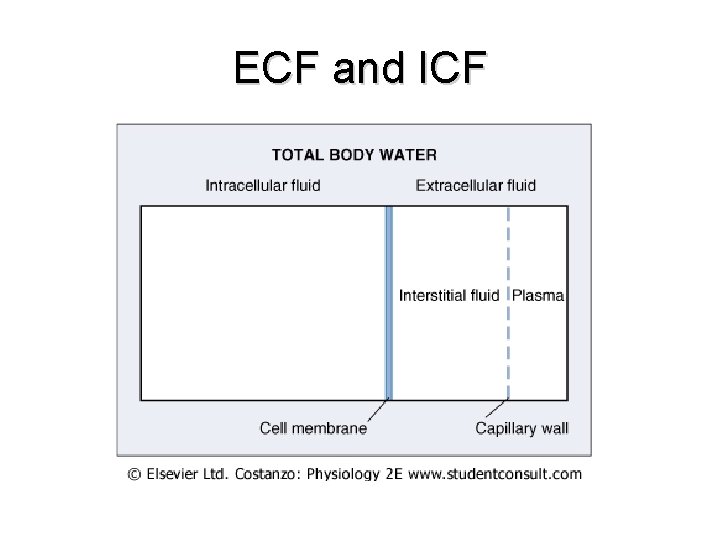
ECF and ICF
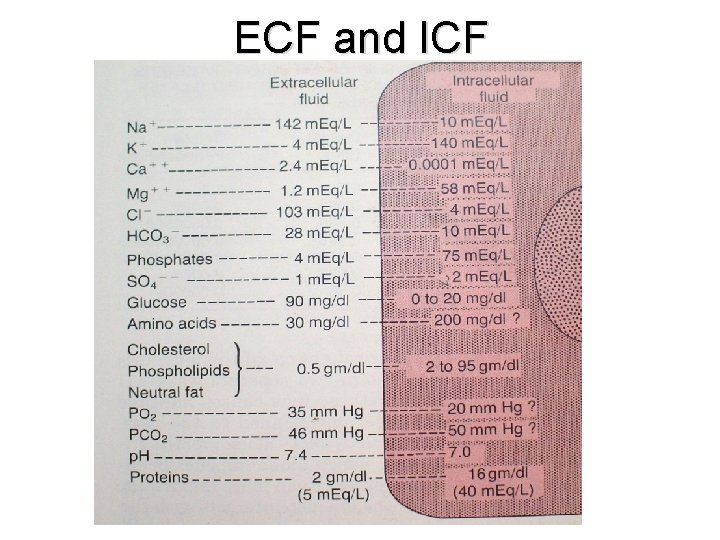
ECF and ICF
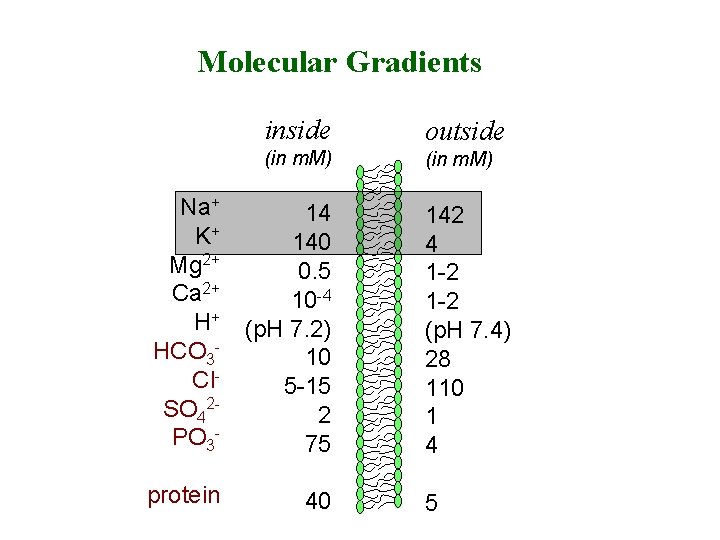
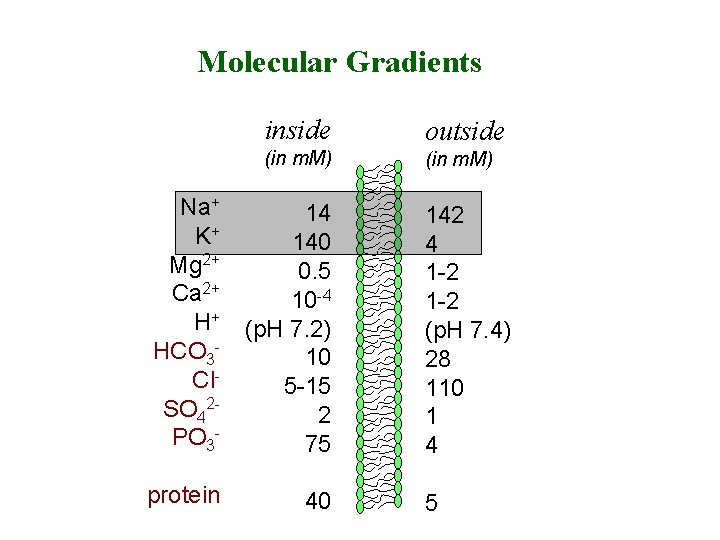
Molecular Gradients inside outside (in m. M) Na+ K+ Mg 2+ Ca 2+ H+ HCO 3 Cl. SO 42 PO 3 - 14 140 0. 5 10 -4 (p. H 7. 2) 10 5 -15 2 75 protein 40 142 4 1 -2 (p. H 7. 4) 28 110 1 4 5
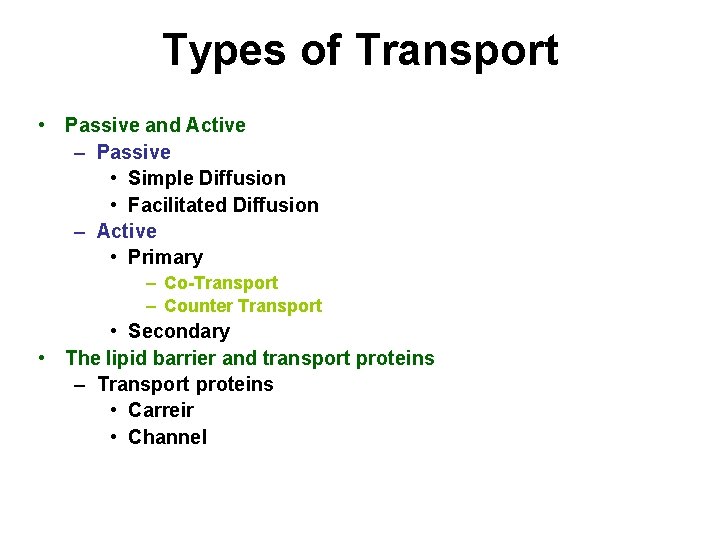
Types of Transport • Passive and Active – Passive • Simple Diffusion • Facilitated Diffusion – Active • Primary – Co-Transport – Counter Transport • Secondary • The lipid barrier and transport proteins – Transport proteins • Carreir • Channel
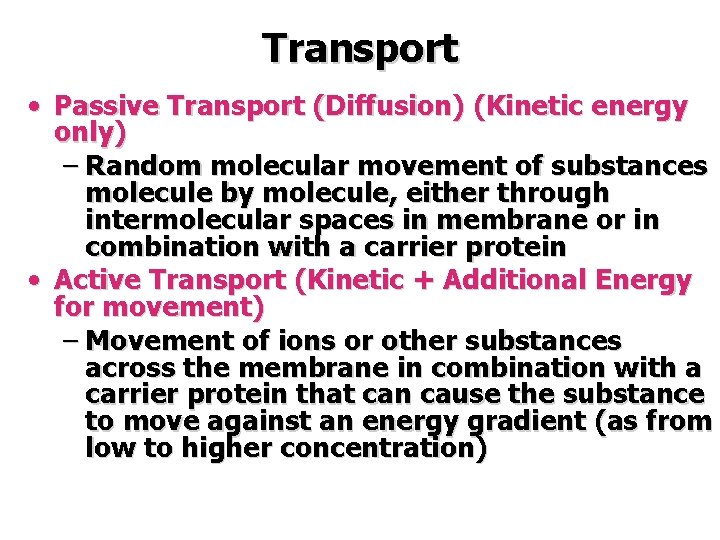
Transport • Passive Transport (Diffusion) (Kinetic energy only) – Random molecular movement of substances molecule by molecule, either through intermolecular spaces in membrane or in combination with a carrier protein • Active Transport (Kinetic + Additional Energy for movement) – Movement of ions or other substances across the membrane in combination with a carrier protein that can cause the substance to move against an energy gradient (as from low to higher concentration)
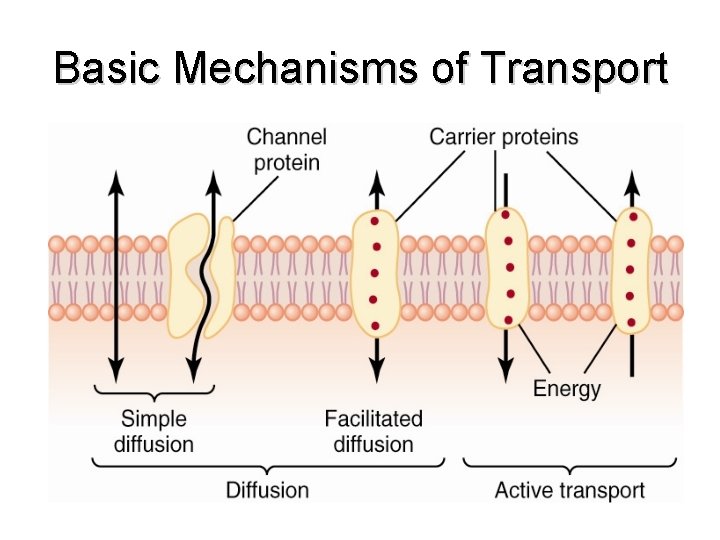
Basic Mechanisms of Transport
Molecular Gradients inside outside (in m. M) Na+ K+ Mg 2+ Ca 2+ H+ HCO 3 Cl. SO 42 PO 3 - 14 140 0. 5 10 -4 (p. H 7. 2) 10 5 -15 2 75 protein 40 142 4 1 -2 (p. H 7. 4) 28 110 1 4 5
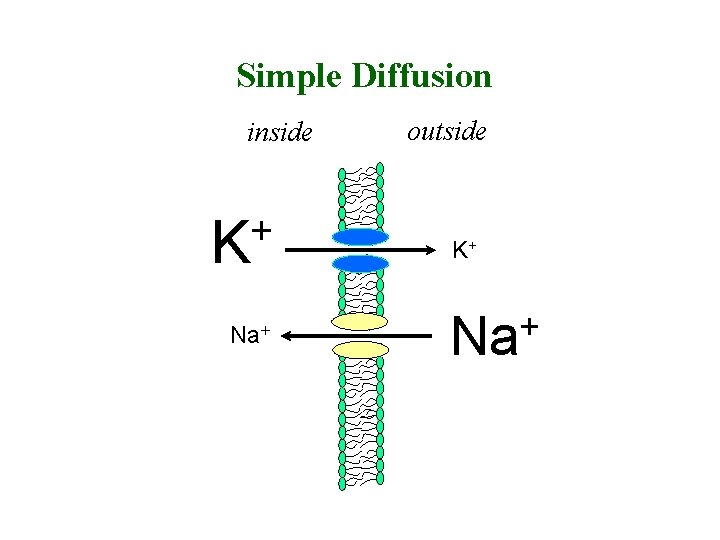
Simple Diffusion inside + K Na+ outside K+ + Na
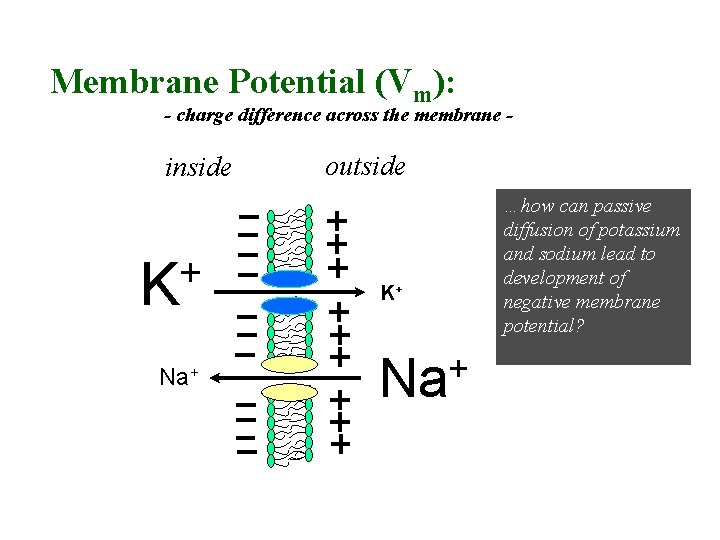
Membrane Potential (Vm): - charge difference across the membrane - inside + K Na+ outside K+ + Na …how can passive diffusion of potassium and sodium lead to development of negative membrane potential?
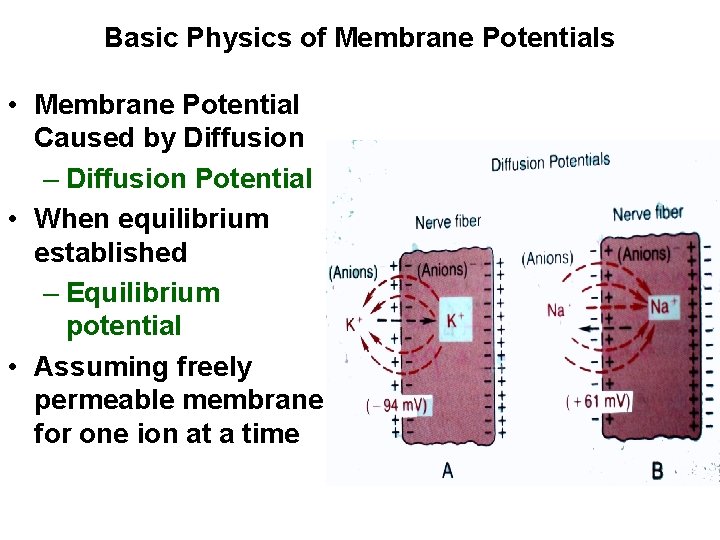
Basic Physics of Membrane Potentials • Membrane Potential Caused by Diffusion – Diffusion Potential • When equilibrium established – Equilibrium potential • Assuming freely permeable membrane for one ion at a time
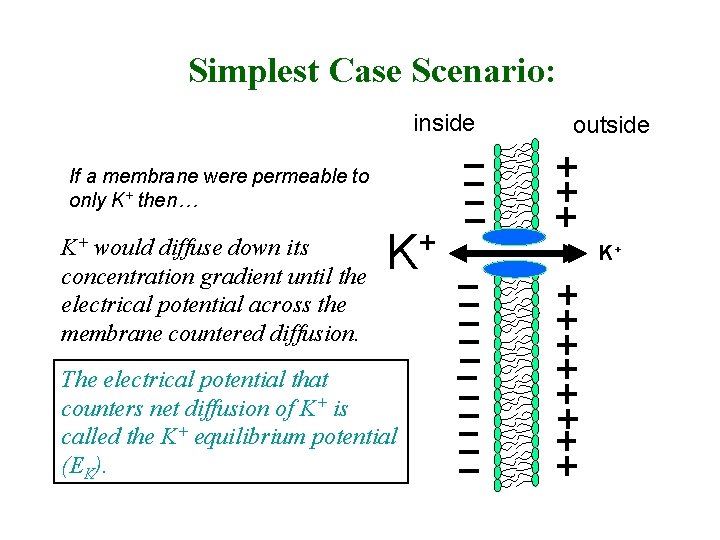
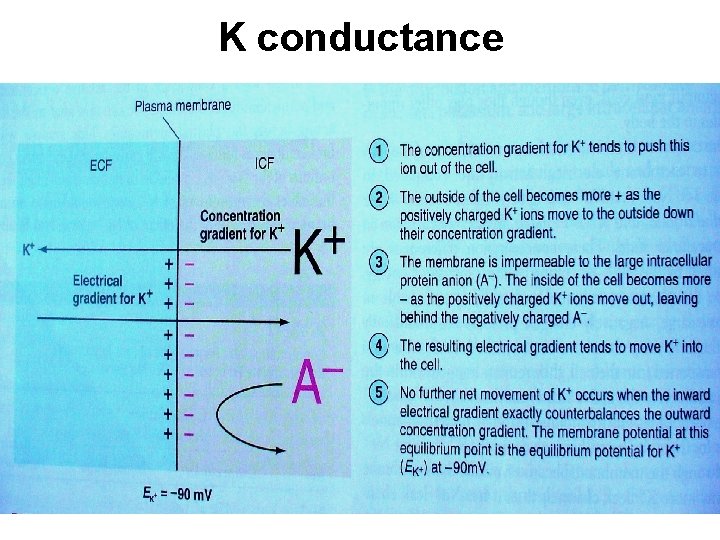
Simplest Case Scenario: inside outside If a membrane were permeable to only K+ then… K+ would diffuse down its concentration gradient until the electrical potential across the membrane countered diffusion. + K The electrical potential that counters net diffusion of K+ is called the K+ equilibrium potential (EK). K+
K conductance
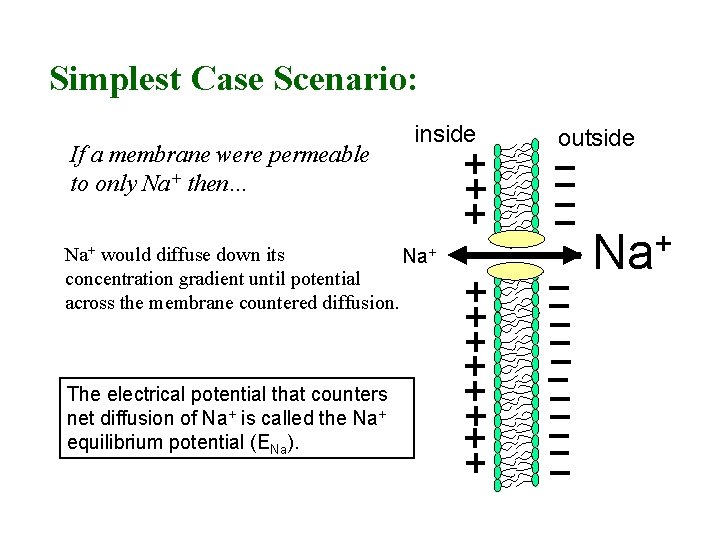
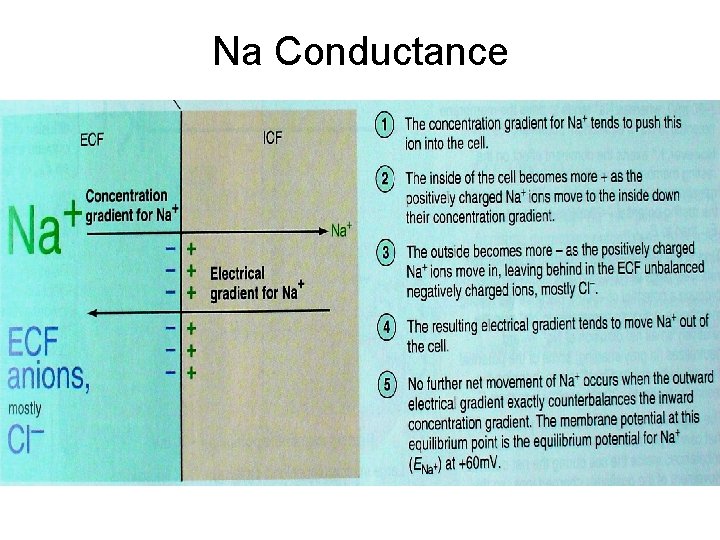
Simplest Case Scenario: If a membrane were permeable to only Na+ then… inside Na+ would diffuse down its Na+ concentration gradient until potential across the membrane countered diffusion. The electrical potential that counters net diffusion of Na+ is called the Na+ equilibrium potential (ENa). outside + Na
Na Conductance
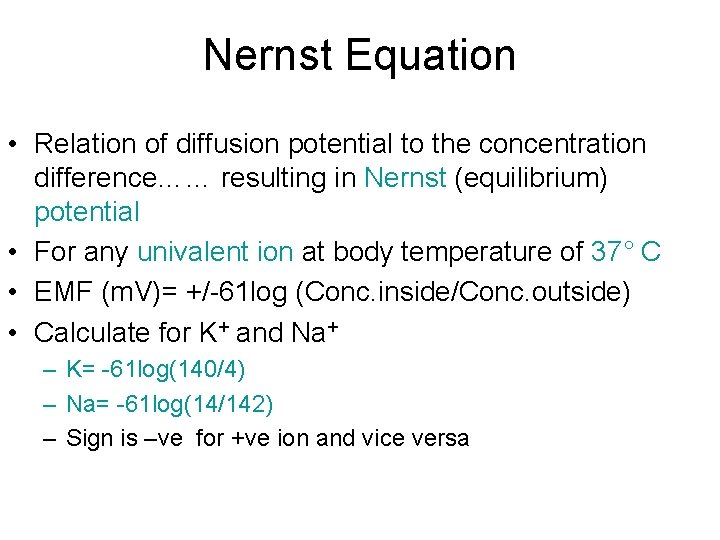
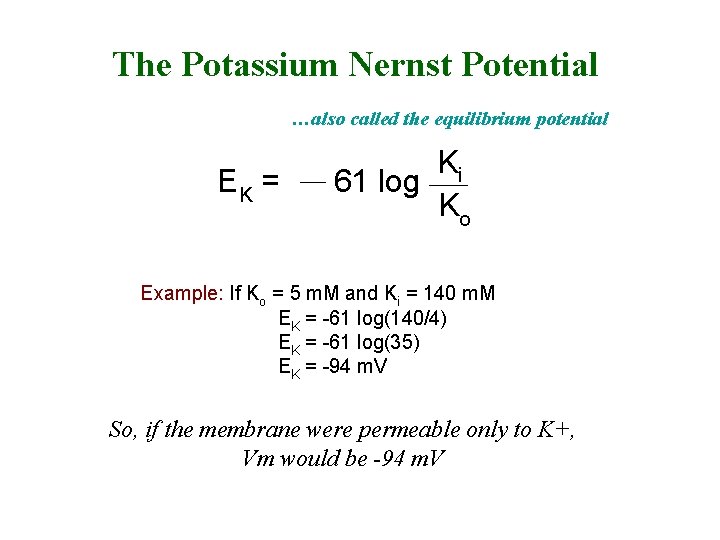
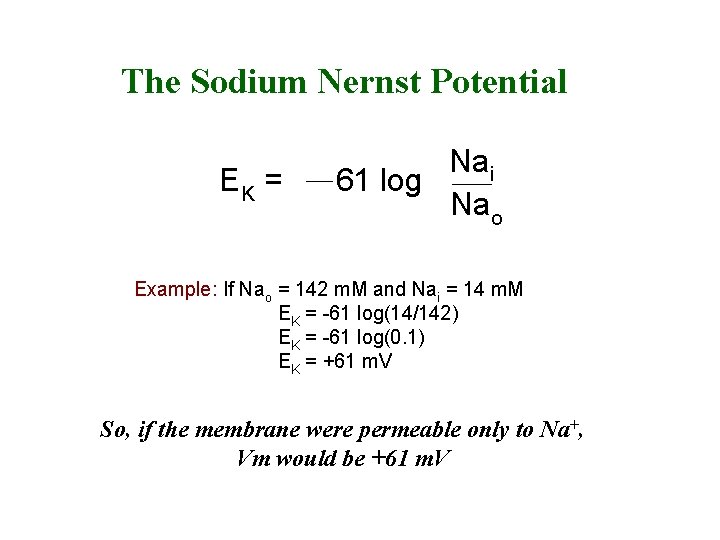
Nernst Equation • Relation of diffusion potential to the concentration difference…… resulting in Nernst (equilibrium) potential • For any univalent ion at body temperature of 37° C • EMF (m. V)= +/-61 log (Conc. inside/Conc. outside) • Calculate for K+ and Na+ – K= -61 log(140/4) – Na= -61 log(14/142) – Sign is –ve for +ve ion and vice versa
The Potassium Nernst Potential …also called the equilibrium potential EK = Ki 61 log Ko Example: If Ko = 5 m. M and Ki = 140 m. M EK = -61 log(140/4) EK = -61 log(35) EK = -94 m. V So, if the membrane were permeable only to K+, Vm would be -94 m. V
The Sodium Nernst Potential EK = Nai 61 log Nao Example: If Nao = 142 m. M and Nai = 14 m. M EK = -61 log(14/142) EK = -61 log(0. 1) EK = +61 m. V So, if the membrane were permeable only to Na+, Vm would be +61 m. V
NOW CONCENTRATE further
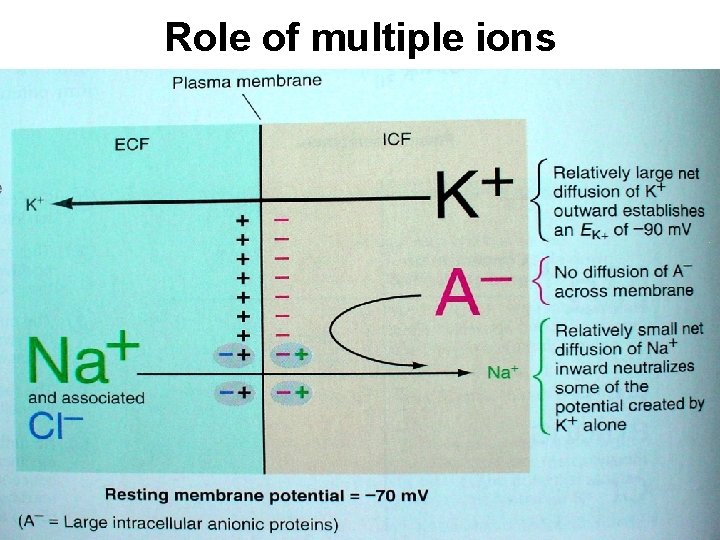
Role of multiple ions
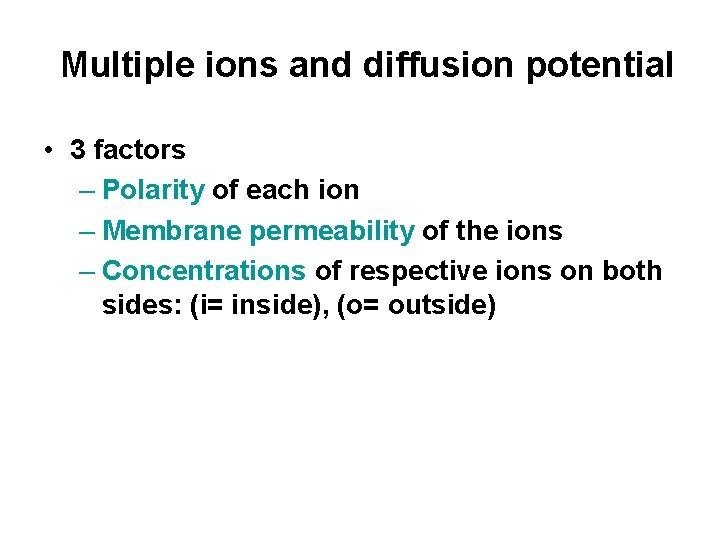
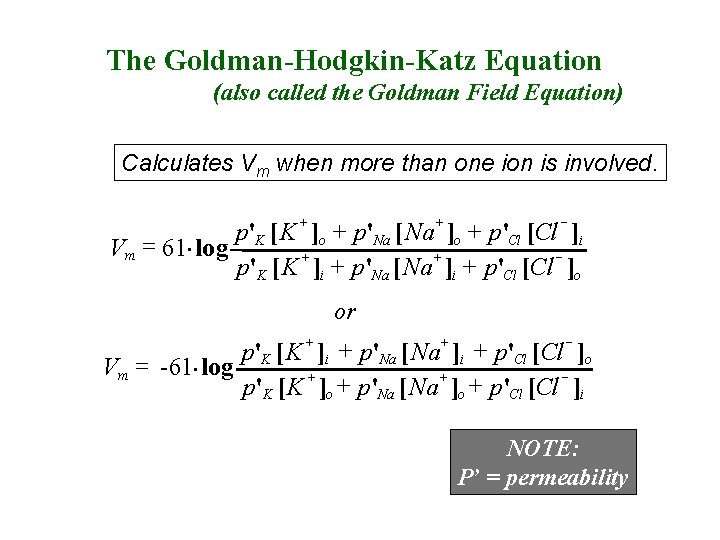
Multiple ions and diffusion potential • 3 factors – Polarity of each ion – Membrane permeability of the ions – Concentrations of respective ions on both sides: (i= inside), (o= outside)
The Goldman-Hodgkin-Katz Equation (also called the Goldman Field Equation) Calculates Vm when more than one ion is involved. + + p' [ K ] p' Na [ Na ]o p'Cl [Cl ]i Vm = 61. log K + o + p'K [ K ]i + p'Na [ Na ]i + p'Cl [Cl ]o or + + p ' [ K ] p ' [ Na ] p ' [ Cl ]o K i Na i Cl. Vm = -61 log + + p'K [ K ]o + p'Na [ Na ]o + p'Cl [Cl ]i NOTE: P’ = permeability
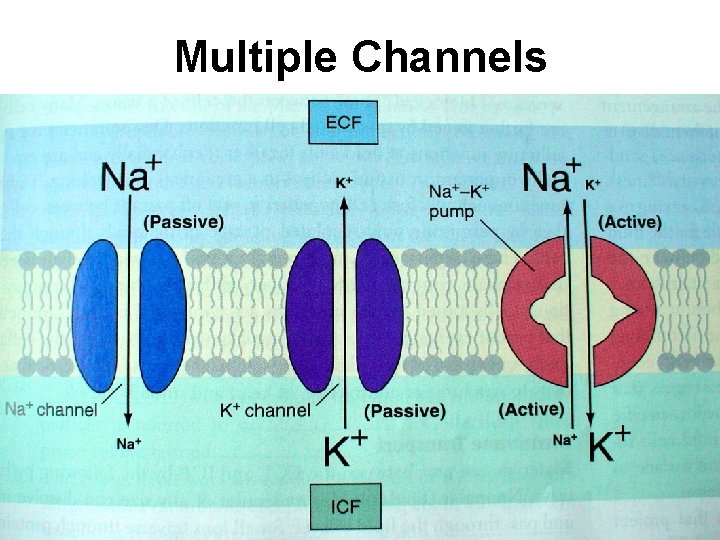
Multiple Channels
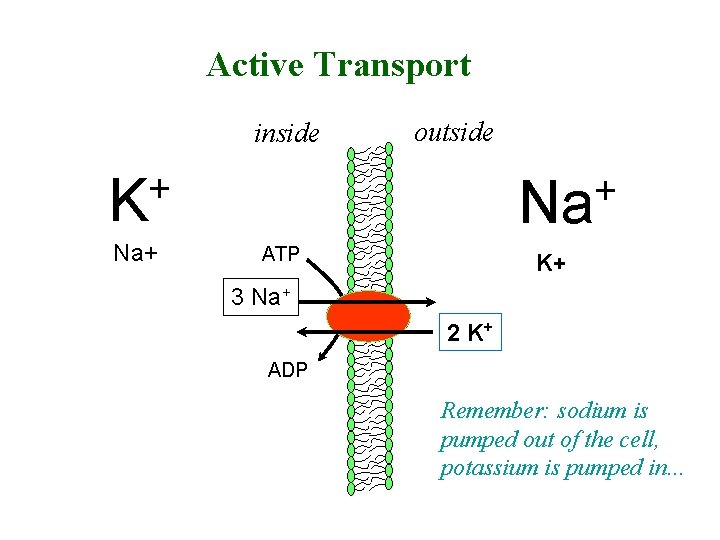
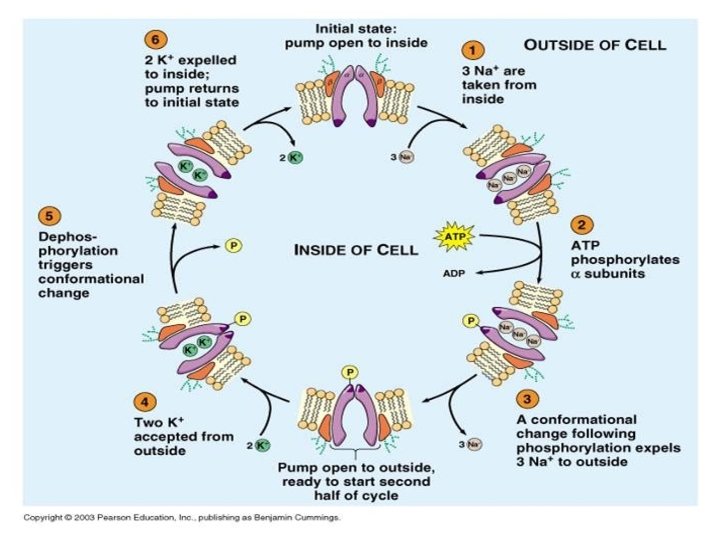
Active Transport inside outside + K Na+ + Na ATP K+ 3 Na+ 2 K+ ADP Remember: sodium is pumped out of the cell, potassium is pumped in. . .
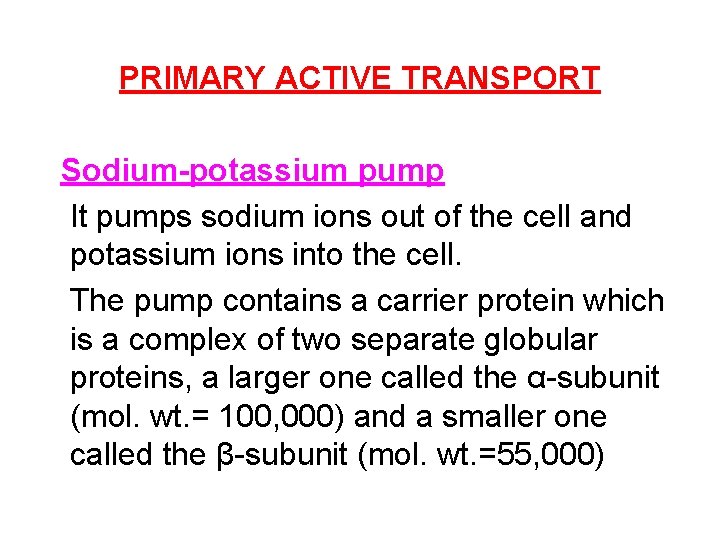
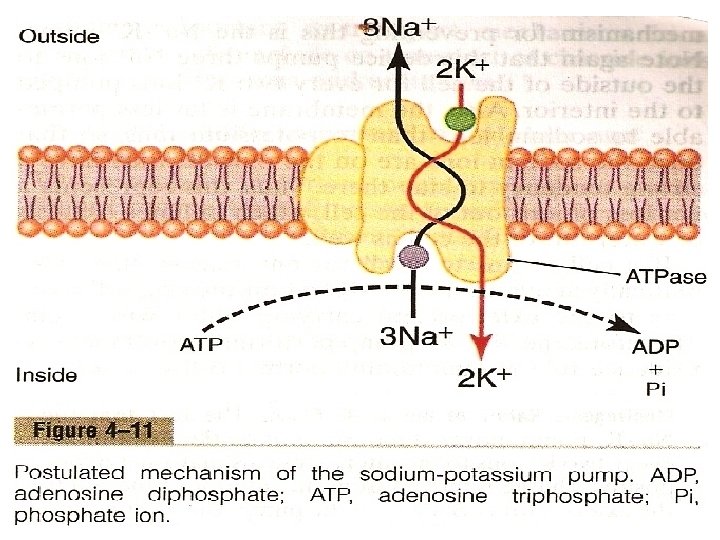
PRIMARY ACTIVE TRANSPORT Sodium-potassium pump It pumps sodium ions out of the cell and potassium ions into the cell. The pump contains a carrier protein which is a complex of two separate globular proteins, a larger one called the α-subunit (mol. wt. = 100, 000) and a smaller one called the β-subunit (mol. wt. =55, 000)
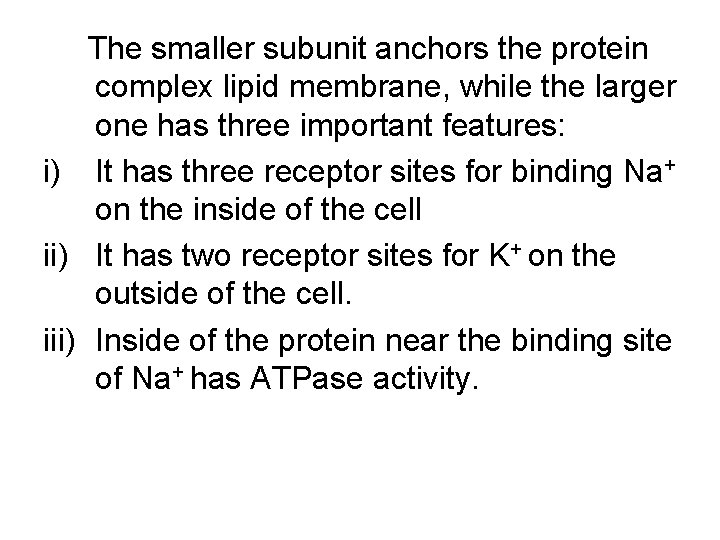
The smaller subunit anchors the protein complex lipid membrane, while the larger one has three important features: i) It has three receptor sites for binding Na+ on the inside of the cell ii) It has two receptor sites for K+ on the outside of the cell. iii) Inside of the protein near the binding site of Na+ has ATPase activity.
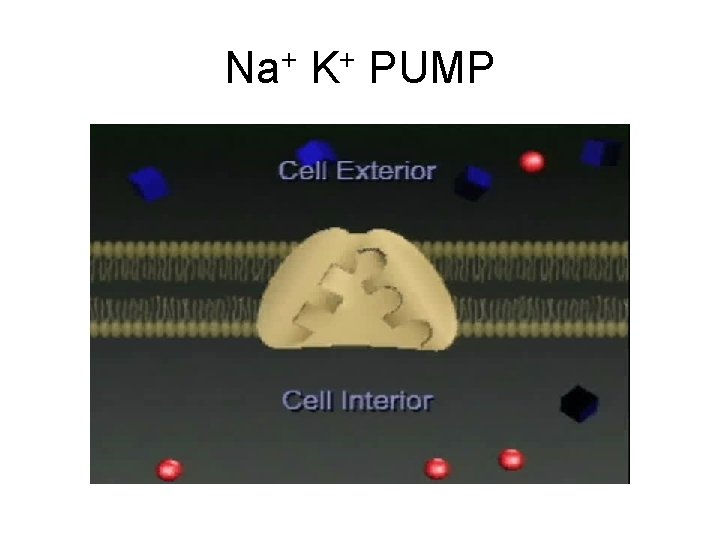
Na+ K+ PUMP
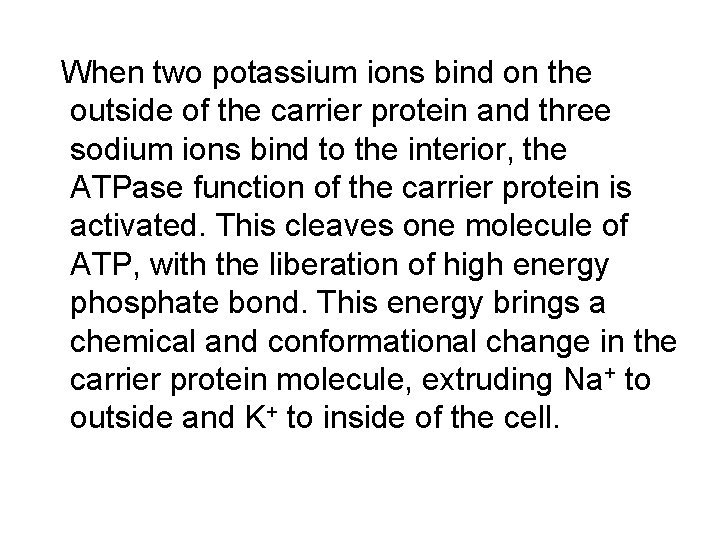
When two potassium ions bind on the outside of the carrier protein and three sodium ions bind to the interior, the ATPase function of the carrier protein is activated. This cleaves one molecule of ATP, with the liberation of high energy phosphate bond. This energy brings a chemical and conformational change in the carrier protein molecule, extruding Na+ to outside and K+ to inside of the cell.
Functions of Na+/K+ pump i) It establishes a Na+/K+ concentration difference across the cell membrane and makes a –ve electrical voltage inside the cell. ii) It regulates the cell volume by controlling the concentration of solutes. Thus, prevent the swelling or shrinking of the cell. iii) The energy stored during the transport of Na+/K+ is used for secondary active transport.
THANK YOU