
CONCEPT OF GENE Presented By NUPUR GUPTA CONTENTS
CONCEPT OF GENE Presented By: NUPUR GUPTA
CONTENTS Ø History Ø Definition of Gene Ø Structure of Gene Ø Pseudoallelism Ø Cis-Trans Test Ø Complementation Test Ø T 4 Bacteriophage Ø Benzer’s Experiment on r. II Locus
HISTORY Ø Term GENE was introduced by JOHANSSEN in 1909 based on Mendelian Factors. Ø Gene Concept was given by SUTTON. Ø Studied & Elaborated by MORGAN, BRIDGES, and MULLER.

SUMMARY OF EVOLUTION OF GENE CONCEPT YEAR SCIENTIST GENE CONCEPT 1866 G. J. MENDEL A UNIT FACTOR THAT CONTROLS SPECIFIC PHENOTYPIC TRAIT 1902 SIR A. E. GARROD ONE GENE –ONE METABOLIC BLOCK THEORY 1940 BEADLE & TATUM ONE GENE-ONE ENZYME THEORY 1957 U. M. INGRAM ONE GENE-ONE POLYPEPTIDE THEORY 1960 s C. YANOFSKY & CO GENE IS A UNIT OF -WORKERS RECOMBINATION Early 1970 s E. B. LEWIS COMPLEMENTATION TEST IN DROSOPHILA
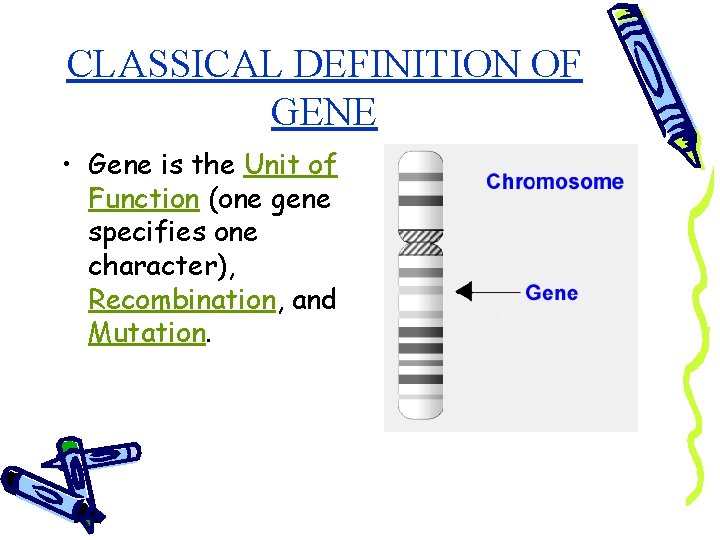
CLASSICAL DEFINITION OF GENE • Gene is the Unit of Function (one gene specifies one character), Recombination, and Mutation.
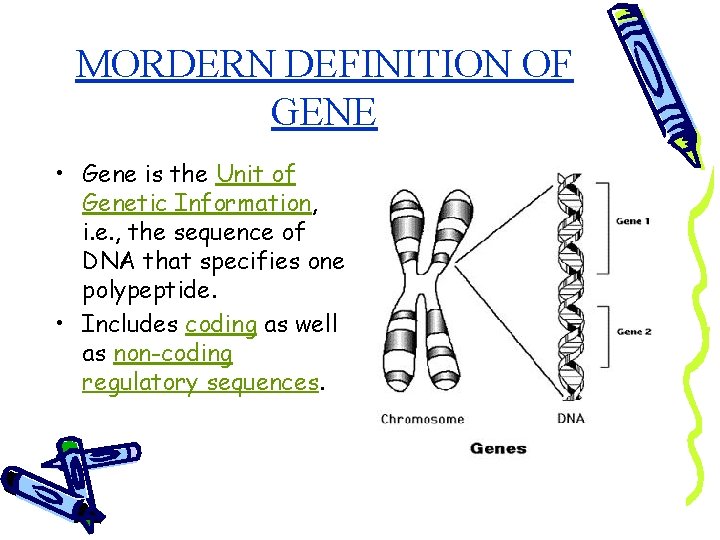
MORDERN DEFINITION OF GENE • Gene is the Unit of Genetic Information, i. e. , the sequence of DNA that specifies one polypeptide. • Includes coding as well as non-coding regulatory sequences.
ESSENTIAL FEATURES o Determines the physical as well as physiological characters. o Situated in the chromosome. o Occupies a specific position known as Locus. o Arranged in single linear order. o Occur in functional states called Alleles. o Some have more than 2 alleles known as Multiple Alleles.
o Some may undergo sudden change in expression called as Mutant Gene (Mutation). o May be transferred to its homologous (Cross-over) or nonhomologous counterpart (Translocation). o Can duplicate themselves very accurately (Replication). o Synthesizes a particular Protein. o Determines the sequence of amino acid in the polypeptide chain (The Genetic Code).
SOME TERMS RELATED TO GENE BENZA has coined new terms to denote the relationship between DNA molecule and genetic phenomenon.
v. RECON - It is the smallest unit of DNA capable of undergoing Crossing Over and Recombination. v. MUTON - It is the smallest unit of DNA which can undergo Mutation. v. CISTRON - It is the unit of Function. It is the Gene in real sense capable of synthesizing a Polypeptide chain of an Enzyme. v. COMPLON - It is the unit of Complementation.
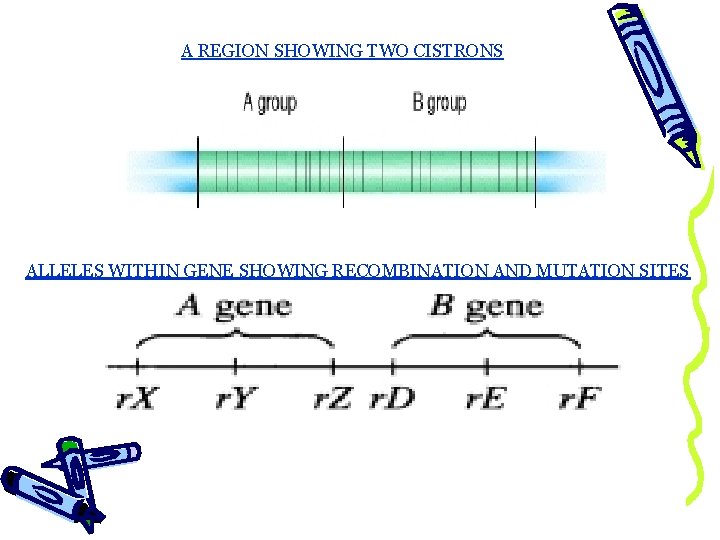
A REGION SHOWING TWO CISTRONS ALLELES WITHIN GENE SHOWING RECOMBINATION AND MUTATION SITES
PSEUDOALLELISM Ø It is the phenomenon shown by Pseudoalleles. Ø Term Pseudoalleles was given by MORGAN (1928) and LEWIS (1948). Ø These are located almost at same place on linkage map, interpreted as closely linked and functionally related genes. Ø Referred as any two or more mutations which are allelic (similar) in function but not in structure. Ø Cluster is called as Pseudoallelic series or Complex Loci.
CIS-TRANS TEST CIS HETEROZYGOTES o Both the mutant alleles are located in same chromosome, while Wild types are present in homologous chromosome. TRANS HETEROZYGOTES o One mutant allele is located in one chromosome, while other one in homologous chromosome.
o Produce wild type phenotype irrespective of whether the two mutant alleles are present in same gene or different ones. o Produce mutant phenotype if the two alleles are located in same gene and wild type phenotype if in two different genes. So, by comparing the phenotypes produced in cis and trans heterozygote, we can find if mutant alleles are present in same or two different genes.
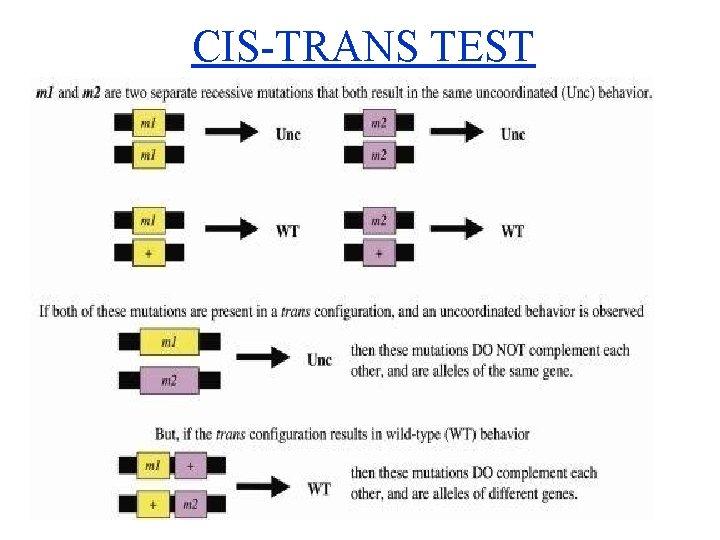
CIS-TRANS TEST
COMPLEMENTATION TEST o Production of wild type phenotype in a trans-heterozygote for two mutant alleles is known as Complementation. o Such a study is known as Complementation Test. o Results are highly precise, reliable and permit an operational demarcation of the gene.

INTRAGENIC COMPLEMENTATION v Complementation shown by mutant allele within the gene. v Their active products are multimers of homologous polypeptides, which may be either a homomultimer or a heteromultimer. v Can be inactive or partially active.
LIMITATIONS o Cannot be applied to dominant or co-dominant mutant alleles. o Applicable to non-polar mutations only. Mutants ideal for test are mainly deletion, non-sense mutants etc. o Cis-acting genes cannot show complementation. o Mutant alleles located in same gene may show complementation.
STUDY ON r. II LOCUS OF T 4 BACTERIOPHAGE A Great Contribution to recombination mapping by SEYMOUR BENZER in 1962.
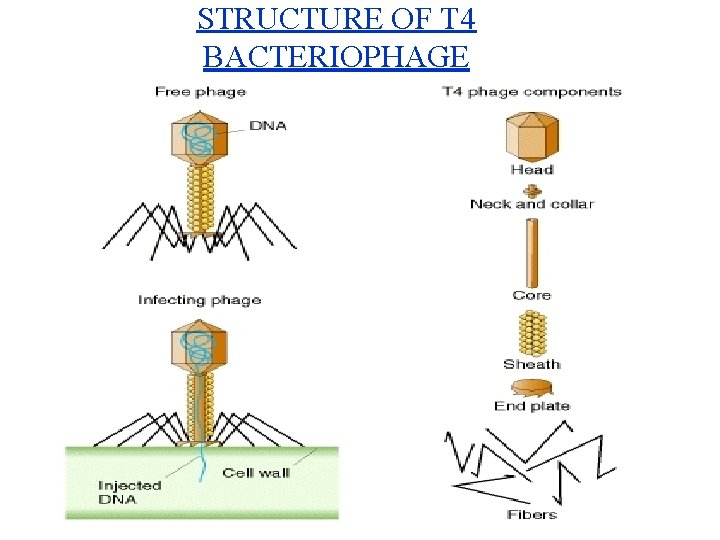
STRUCTURE OF T 4 BACTERIOPHAGE
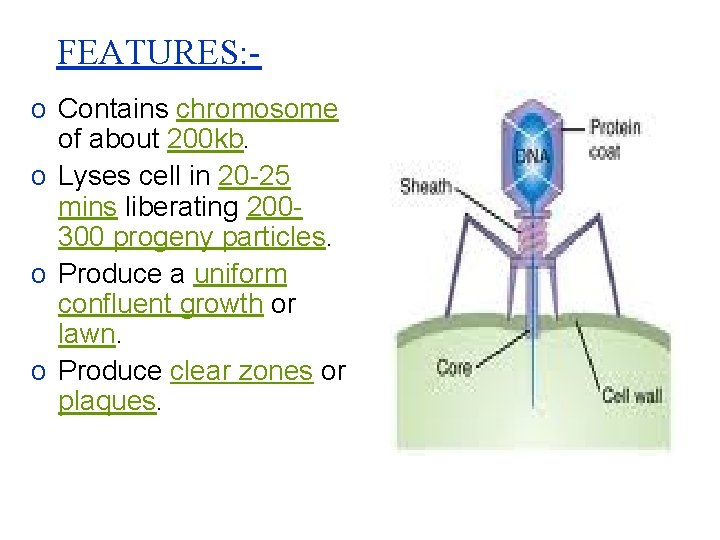
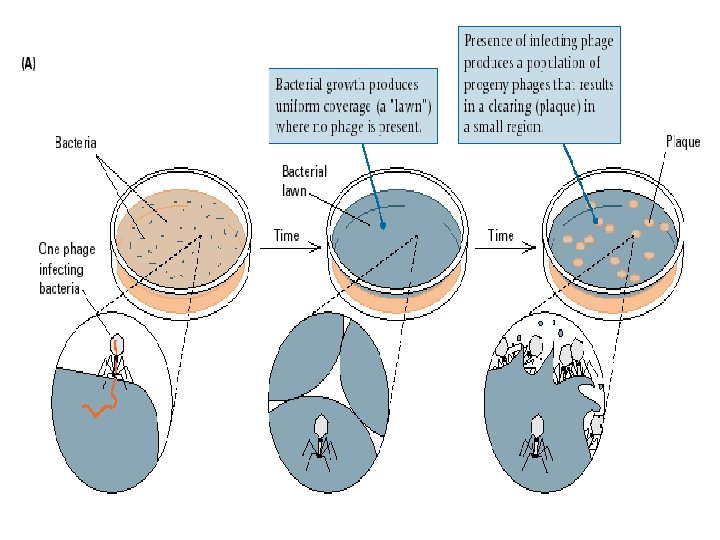
FEATURES: o Contains chromosome of about 200 kb. o Lyses cell in 20 -25 mins liberating 200300 progeny particles. o Produce a uniform confluent growth or lawn. o Produce clear zones or plaques.
r. II LOCUS OF T 4 PHAGE o Some phage produce larger plaques with clear margins, called as rapid lysis mutants, denoted by ‘r’. o It has 3 distinct loci called r. I, r. II, and r. III. o Mutants in r. II locus are recognized due to their inability to grow in E. coli strain K 12(λ). o These are conditional lethals, a property exploited by BENZER.
EXPERIMENT o Benzer isolated over 3000 independent mutants of r. II locus. o He infected the E. coli strain K 12(λ) cells with mixture of 2 r. II mutants – r. II mutant I & II. o Kept for about 90 -120 mins to permit phage multiplication and cell lysis. o Cells infected with both the mutants are selected. o Placed on E. coli strain B lawns to detect presence of phage particles and to study the complementation between them.
COMPLEMENTATION TEST o Benzer noticed 2 arbitrary groups within r. II locus and named as ‘A’ & ‘B’. o The mutants belonging to both A & B showed complementation, whereas those belonging to either A or B failed to complement each other.

COMPLEMENTATION TEST
RECOMBINATION MAPPING o Frequency of = 2 x No. ofplaqueson. K 12(λ) recombination No. of plaques on B o Highly efficient selection system for wild type phage particles. o Upto 108 phage particles can be plated in single petri -plate. o The number of plaques on K 12(λ) represents the number of wild type phage particles present in the lysate.
REFERENCES Ø Gupta P. K. (2009); “Genetics”; “Recombination and Resolution of Gene”; Edition IV; Rastogi Publications; Page no: 142 -153 Ø Singh B. D. (2009); “Genetics”; “Multiple Alleles”; Edition II; Kalyani Publishers; Page no: 274 -284 Ø Gupta P. K. (2004 -05); “Fine Structure of Gene at Genetic Level”; Edition III; Rastogi Publications; Page no: 141 -150 Ø Jain H. K. ; “Gene Structure & Concept”; Edition V; Page no: 192 -200 Ø Lewin Benjamin; “What is a Gene? A Genetic View”; Wiley Eastern Publications; Page no: 3 -20 Ø Verma P. S. and Agarwal V. K. (2006); “Fine Structure of Gene”; S. Chand Publication; Page no: 127 -133 Ø www. wikipedia. com


ANY QUESTIONS
- Slides: 30