
CONCEPT OF DISASTER MANAGEMENT PRESENTED BY DR AHMAD
CONCEPT OF DISASTER MANAGEMENT PRESENTED BY DR AHMAD HUSAINI B. DOLLAH SUPERVISED BY DR MUNAWWAR 19 June 2019
Outlines • Definitions • Classification of disater • Directive 20, National Security Council • Disaster level management • Phases of management • Roles of different agencies • Incident site management • Hospital management • References

Definition • A sudden ecologic phenomenon of sufficient magnitude to require external assistance. • An event that overwhelms the resources of the region or location in which it occurs. World Health Organization
Definition • An event that occurs suddenly • Complex in nature • Causes major loss of lives • Destruction of property and/or environment • Disruptions of community daily activities DIRECTIVE 20, NATIONAL SECURITY COUNCIL
Directive 20, National Security Council • was created on 11 May 1997 by the National Security Council (MKN), the Prime Minister 's Department following the collapse of the Tragedy of Highland Towers Apartments in Hulu Klang, Selangor on 11 December 1993. • aims to outline overall disaster management policies and mechanisms including the roles and responsibilities of Government Agencies, statutory bodies, private sector and voluntary bodies covering the pre -, during and post-disaster level

Definition • An event where the destructive effects of natural or man made forces overwhelm the ability of a given area or community to meet the demands for health care within their own capacity. American College of Emergency Physician
Definition An event or situation which overwhelms local capacity necessisating a request to national or international level for external assistance. Criteria, at least 1 in 4 • More than 10 people killed • At least 100 people affected • A call for international events • Decalaration of a state of emergency Center for Research on Epidemiology of Disaster ( CRED)
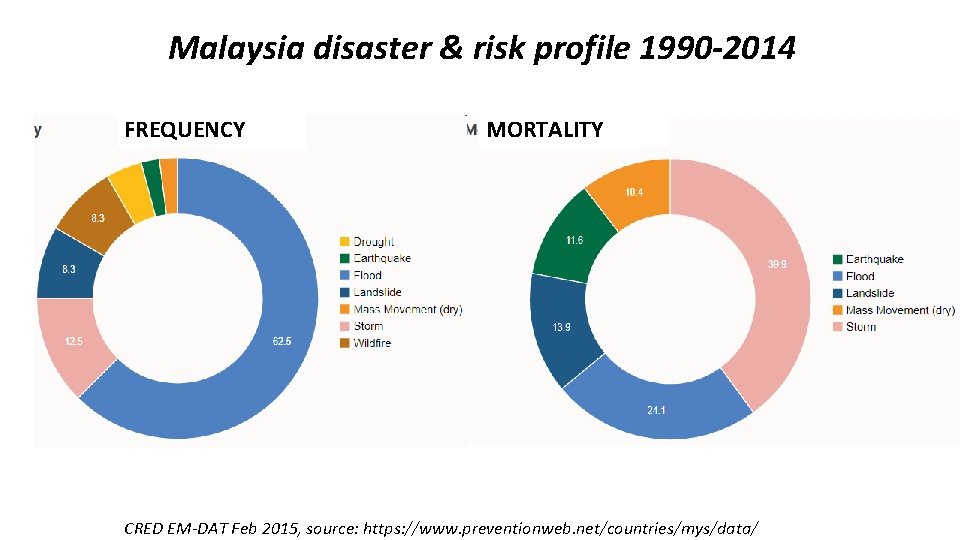
Malaysia disaster & risk profile 1990 -2014 FREQUENCY MORTALITY CRED EM-DAT Feb 2015, source: https: //www. preventionweb. net/countries/mys/data/

Classification of disaster Disaster Classification Degree of casualty load and capability to cope Compensated / Decompensated Infrastructure availability Causative agent Natural / Technological Civil / Special hazard Simple / Compound
Classification of disaster Degree of casualty load and capability to cope § Compensated The number of casualty (load) able to be handled by local or regional authorities § Decompensated The number of casualty (load) overwhelm the ability of the local or regional authorities to handle
Classification of disaster Causative agent 1. Natural Eg. Landslide, volcano eruption, tsunami, floods 2. Technological Hazardous material events eg. industrial accident Structural material events eg. building collapse Utility interuption ie. communication system Transportation events eg. road accidents, air crash, train derailment

Classification of disaster 3. Civil As a result related to human activity Criminal or terrorist event Civil disturbance – protest, demonstration Hostage event Arm conflict, war 4. Special hazard Disaster that disrupt services leading to potential harm to patient Critical supply shortage Large number of personnel under arrest VIP visits – closed roads and road block
Classification of disaster Infrastructure intactness § Simple Incident happened but structures like hospital, telephone, roads remain intact § Compound Infrastructures is damaged, roads disrupted, ineffective health services
Disaster Management Level • Level 1 • Local incident which are controllable and with no potentiality of spreading out. • It is not complex and could cause only small damage to life and property. • The form of disaster would not be a jeopardy to local daily activity in a large scale. • The District Level Authority is capable of controlling such incident through district level agencies without or with a limited assistance from outside.
• Level 2 • More serious incident covers a wide area or has exceeding 2 districts • Has a potential to spread out • Possibly would cause death and damage to a large number of property. • Affecting public daily activities. • Being more complex than Level 1 Disaster and difficult in aspect of search and rescue. • Need to and could be able to controlled by State Level Authority with or without a limited help from outside
Example : 1. The collapse of Highland Towers Condominium in Hulu Kelang, Selangor on December 11 th. 1993, where 48 people was killed. 2. A Tropical Storm ‘Greg� Esmashed West Coast Sabah on December 26 th. 1996, killed more than 230 people and destroyed more than 4925 houses. 3. An explosion and fire that ruined a fireworks factory belonging to Bright Sparkles Sdn. Bhd. at Sungai Buloh, Selangor on May 7 th. 1991 causing 22 death and 103 others injured.
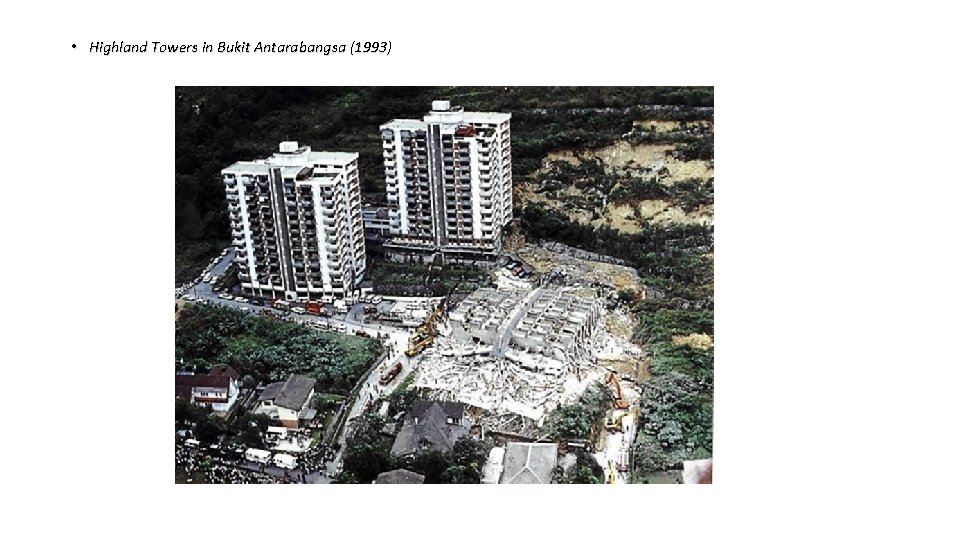
• Highland Towers in Bukit Antarabangsa (1993)
• Level 3 • Involves a very large area. • Loss of many lives • Total destruction of infrastructure and public facility • Complicated and complex • High risk to rescue workers • Complete disruption of daily community activities • Major destruction of resources • All local resources destroyed and required assistance from external resources
Examples • Tsunami - 26 th December 2004, a devastating tsunami claimed 76 lives and destroyed properties along the coastal areas of northwest peninsular Malaysia • December 2014, the changing climatic patterns and the adverse weather effects also bring a massive flood that inundated the largely rural northeastern state of Kelantan
AIM OF DISASTER MANAGEMENT 1. 2. 3. 4. Save lives Prevent escalation of catastrophe Relieve suffering – victims & relatives Protect the environment and property – what is left & as much as possible 5. Restore normality – a. s. a. p 6. Facilitates enquires – of loss victims, status of incidents, records, future plan
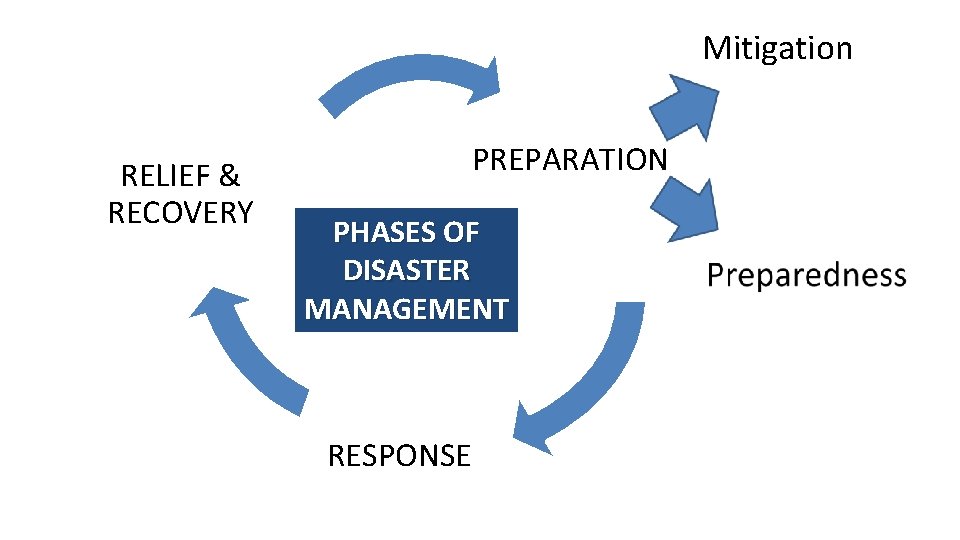
Mitigation RELIEF & RECOVERY PREPARATION PHASES OF DISASTER MANAGEMENT RESPONSE
Preparation § Period before disaster happen (pre disaster phase) § Activities during this period is aim to identify potential risks & take action to minimize impact of disaster § Hence, in preparation, there is Mitigation activites Preparedness activities Most of the time, this two phase usually goes together.
Mitigation phase § Focus on how to eliminate or minimize disaster effect § It involve measure that make public more resilient to effect of disaster § Inludes - doing hazard vulnerability analysis (HVA) and update findings for further action - Changing building codes to fortify buildings - Revised zoning and land use management - Regulation on building use and safety cods - Strenghtening of public infrastructure - Public education and preventive healthcare • An effective mitigation effort can break cycle of disaster damage
Preparedness phase § Focus on building the community ability to respond to disaster § It involve 3 main area which are planning, equipping and training
(a) Planning Include hospital contingency planning Ambulance contingency planning Planning of where to get extra resouces Plan should involve local, state and national level MKN arahan No. 20 is an example of local, regional and national planning • All the plan that involved pre hospital activities should be try out, reviewed and re try in order to improve the response. • • •
(b) Equipment • Equipping our PHC ambulance and providers with proper equipment that can function in any disaster situations • Eg: - Personal Protection Equipment - disaster supply kits - power and water source • Familiarization with the use of equipment is a very important aspect • Equipment should be regularly checked and undergo schedule maintainance in order to ensure functionality.
(c) Training • Regular practice and experience will make PHTC providers better prepared and improved in confidence. • Some of training modalilities in disaster training includes - Table top exercise Task drills Communication exercise Functional exercise ( physical exercise without casualty) Field simulation/hybrid field simulation • Training should be done not only at the level of intra agencies but also inter agencies.
RESPONSE PHASE § This phase started right after the impact of disaster § It is lasted up to 72 hours after the impact ( in some cases can be shorter or longer ) § Aim : to save as many life possible, minimize suffering & prevent escalation of damages. § Putting preparedness plan into action!!
RECOVERY PHASE § Start of at the end or towards the end of response phase § Aim : return the society back to it’s normal or near normal function § Usually involves great collaboration between government, NGOs & private sectors § Focuses on Ø Relieves – of suffering Ø Reunite – loss ones Ø Repair / replace – damage properties Ø Rebuild / reconstruct in order to start new life Ø Restore – situation back to normalities
Aim in disaster response • • • Save lies Relieve suffering – directly (victim), indirectly (family/friends) Prevent escalation of catastrophe Property preservation Restore normality and function Facilities enquires
Roles of different agencies

Special Malaysia Disaster Assistance and Rescue Team(SMART) • Find and rescue victims in a disaster event which requires the help of expertise, skills, equipment and special equipments
POLIS DIRAJA MALAYSIA (PDRM) • Lead and coordinate the Disaster Response movement at the scene and search and rescue operations. • Coordinate the communication system between Government Agencies. • Take care of public safety and order. • Traffic control.
JABATAN BOMBA DAN PENYELAMAT MALAYSIA (JBPM) • Find and rescue of trapped disaster victims • Preventing the disaster from being worsening by controlling fire, control of chemical leakage and other dangerous situations. • Collect information and assess disaster level • Collaboration with PDRM to create a border / zone of operation
Emergency and Rescue Services • To offer skill services on emergency treatment in rescue operation hand in hand with rescuer from other agencies • To give emergency treatment services to the trapped victims • To provide ambulance, pre hospital and transport services.
Medical Depot Service • To provide emergency treatment service to the victims and rescuers • To give forensic services including identification, placing of corpses and evidence documentation • To give medical supply • To give health services and to control infectious disease • To give psychological services such as post trauma disorder, psychotherapy, counselling and debrief
Pre hospital Phase (Disaster Activation Phase)
• Received call from i) Unverified : informed HOD and declare yellow alert ii) Verified (from BOMBA or police) : inform HOD and Hospital director to declare red alert
Unverified call • EP will send a mobile team (EMRT 1) for verification • Informed HOD and inform hospital director • Sent ambulance
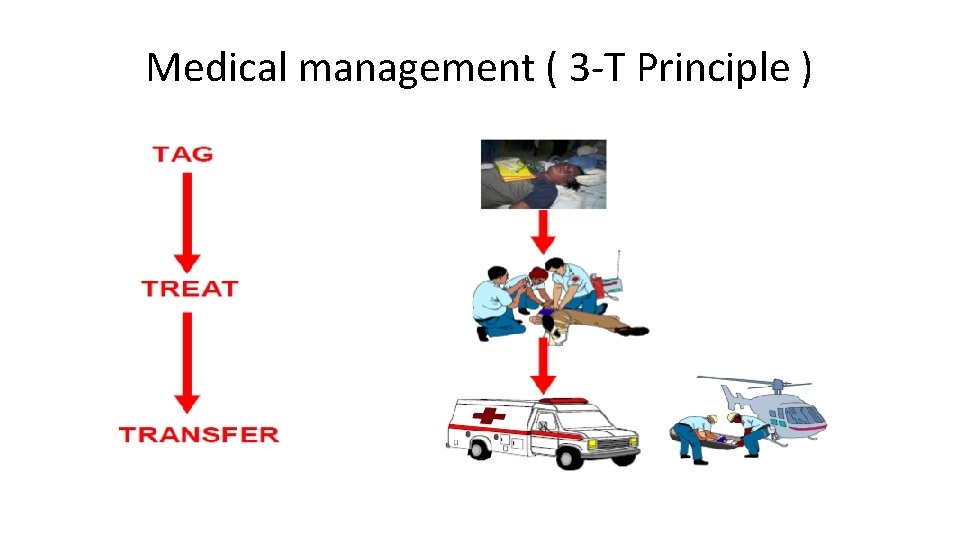
EMRT 1 1 ST team to be dispatched Act as recce team Responsibilities: To confirm the disaster at site and convey the message to MEOCC via GIRN using METHANE system and give updates from time to time - Triaging via START method and initiate treatment of the patient - Transportation of the patient to appropriate Hospital - Doing shift system if the SAR operation takes a long time. . • • • -
Scene management (5 S’s) • • • Safety ( physician, staff and scene) Scene size up (METHANE) Send information Set up base : Medical Comman Post and different zones START triage and early treatment to the patient
Safety • Should consider the scene characteristic and possible hazards. • Possible hazards can be anything that can cause harm to the team Eg: - smoke, gas, possible explosion, unstable ground etc • Safety should be ensure to self, team members, patients and bystanders.
Scene Size Up (METHANE) • • Nature of event – Major or minor incident? Exact location ( or guiding landmarks ) Type of incident – MVA, landslides , fire etc Present of any Hazards – leaking gas or fumes, electricity, fire Assessibility to the sites Estimated Number of casualty Present of other Emergency rescue services – BOMBA, JPAM
Send information • Send back the METHANE information to the base/hospital
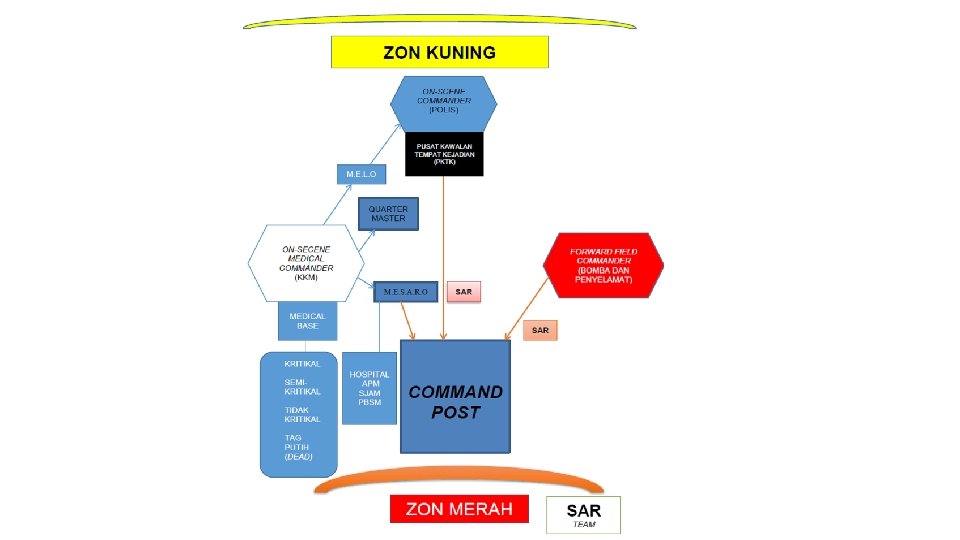
Set Up Base • • Inform the on scene incident commander (usually the police) Send a liaison officer to the control post Identify the codon Set up medical base at yellow codon Set up triage system Set up decontamination area Set up drop zone
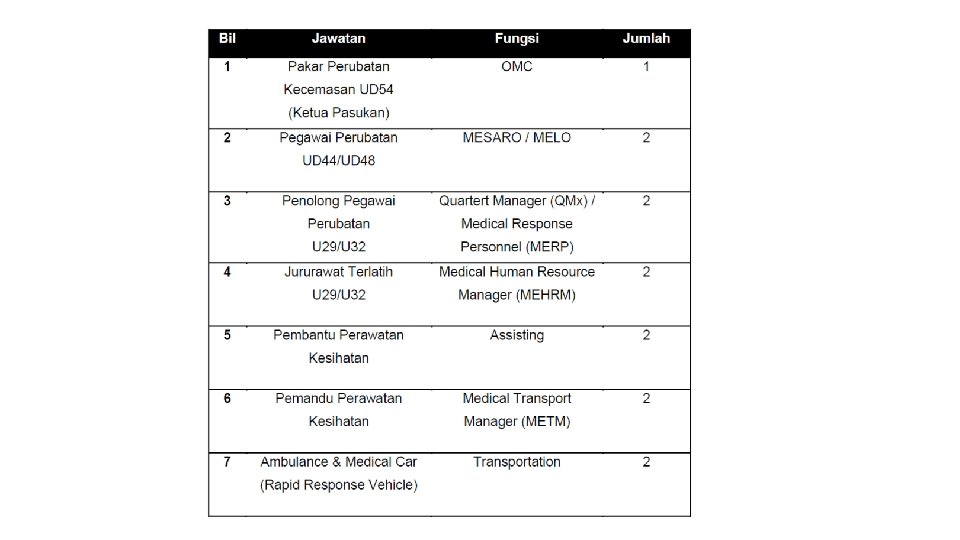
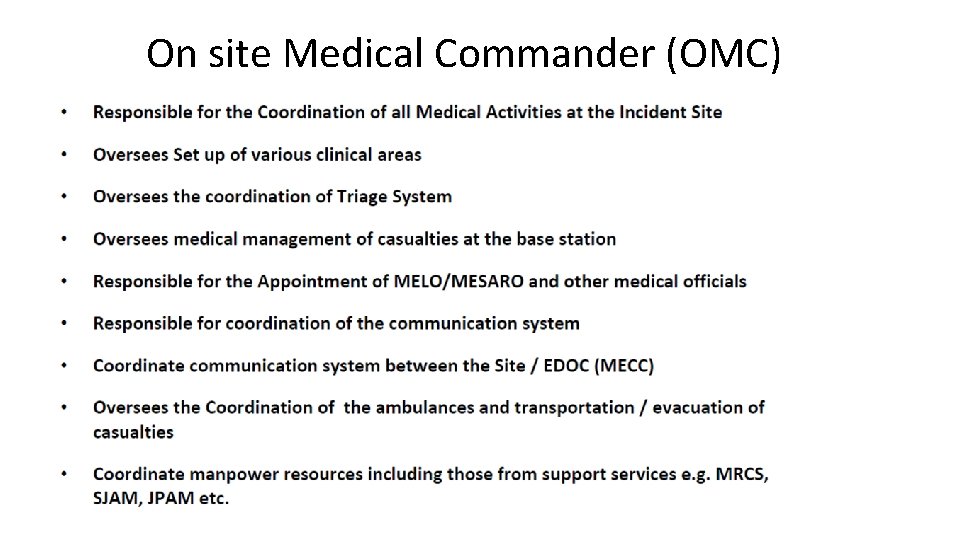
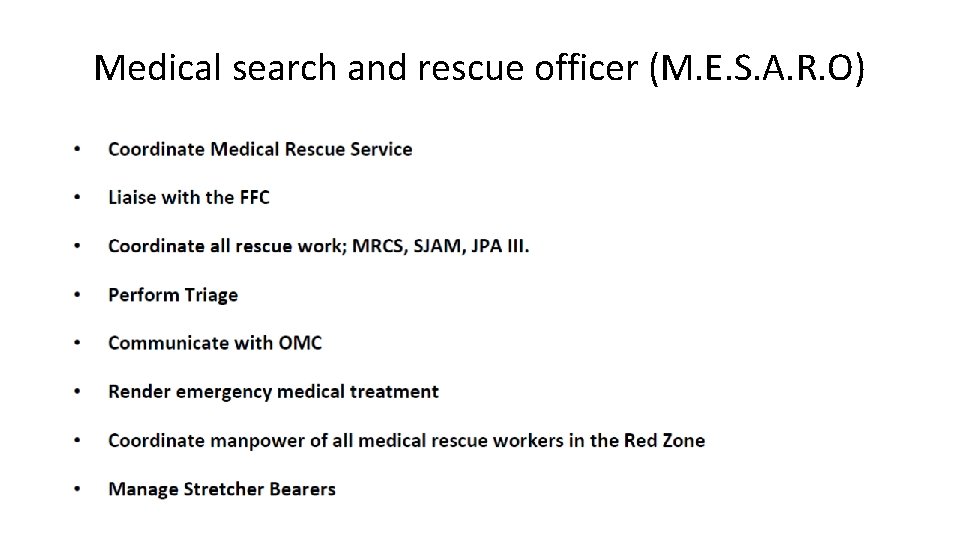
Organization of MOH staff at incident site 1. On site medical commander (OMC) 2. Medical search & Rescue officer (MESARO) 3. Medical liaison officer (MELO) 4. Triage officer 5. Logistic personnel 6. Transport personnel
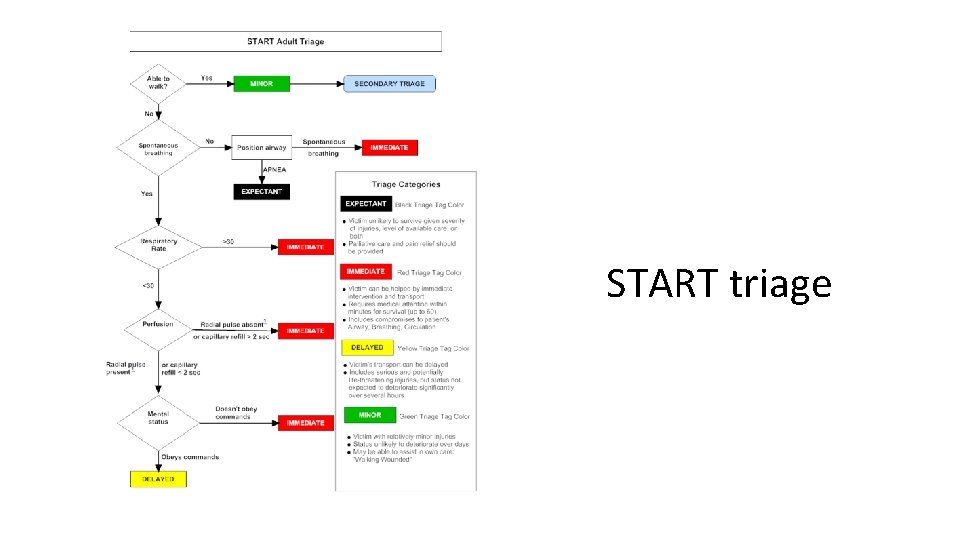
START triage
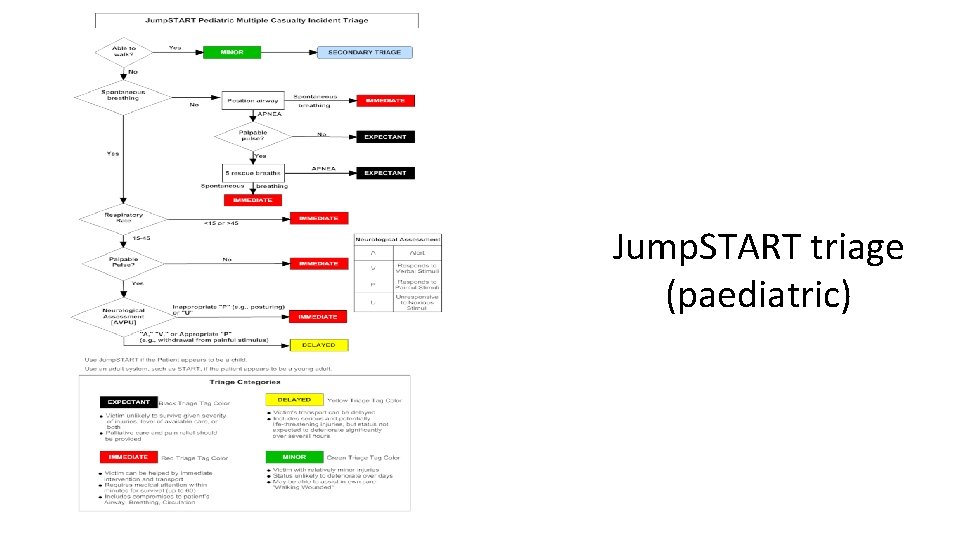
Jump. START triage (paediatric)

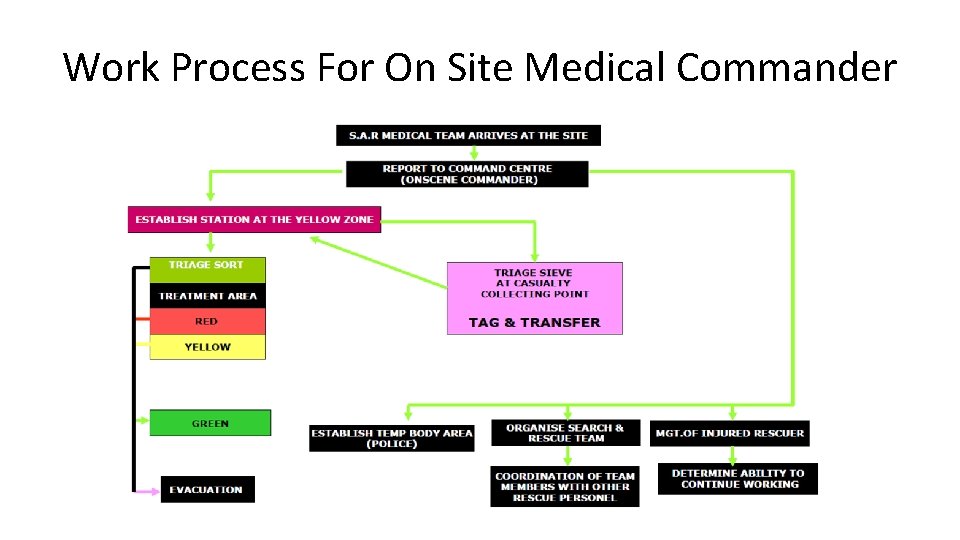
Work Process For On Site Medical Commander
Concept Of Zoning at Disaster Area
Red zone • • • Area surrounding the incident spots High risk areas Often about 50 to 100 meters radius For officers involved in search and rescue efforts For only suitable and secure clothes personnel are permitted to operate within this area.
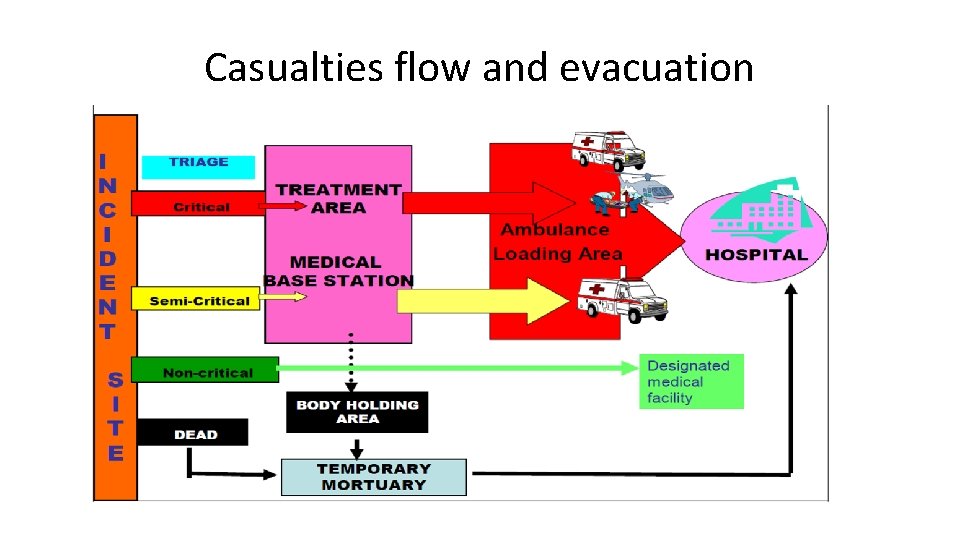
Yellow zone • Area surrounding the red zone • Placing support teams • Base Station for police, firemen and medical teams are set up in this area. • Triage and treatment of victims or injured officers are performed here. • Command Center • Eg: - SMART team, police, fire and rescue, emergency medical services, army, other rescue agencies.
Green zone • • • Is the most extensive area The safest area Journalists and media representatives are placed in this area. Temporary mortuary. Areas where all vehicles from each agency are placed
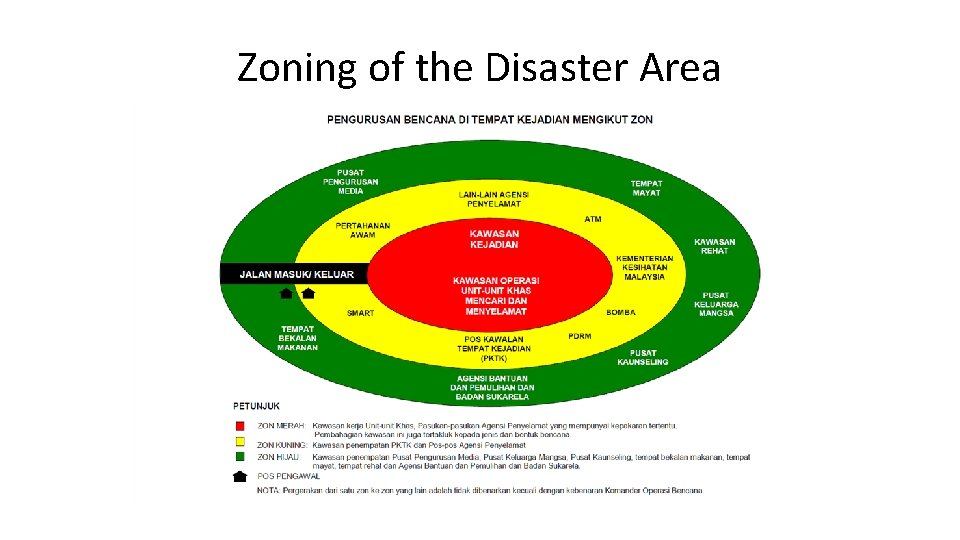
Zoning of the Disaster Area
On Site Management
Casualties flow and evacuation
Medical management ( 3 -T Principle )
Role of Emergency Medical Services Team
On site Medical Commander (OMC)
Medical search and rescue officer (M. E. S. A. R. O)
Medical Base Commander
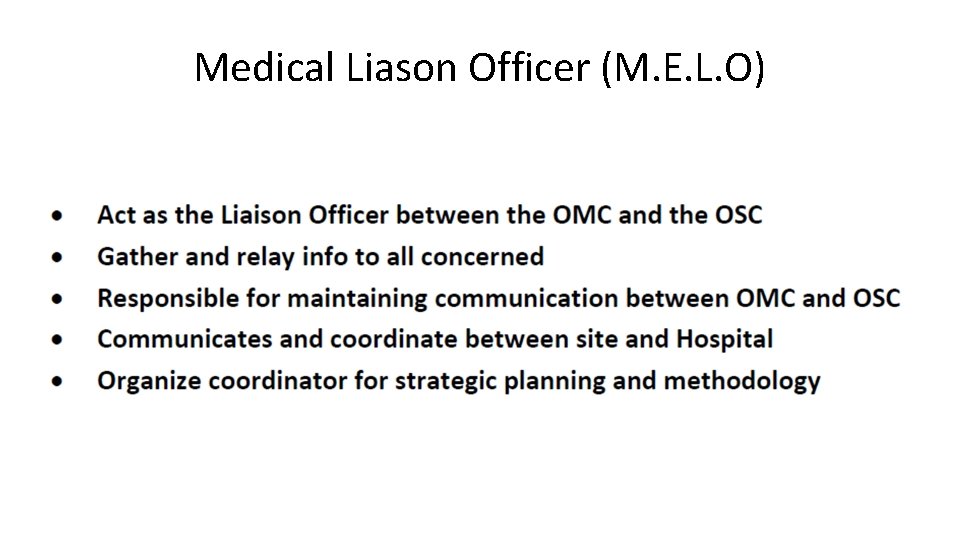
Medical Liason Officer (M. E. L. O)
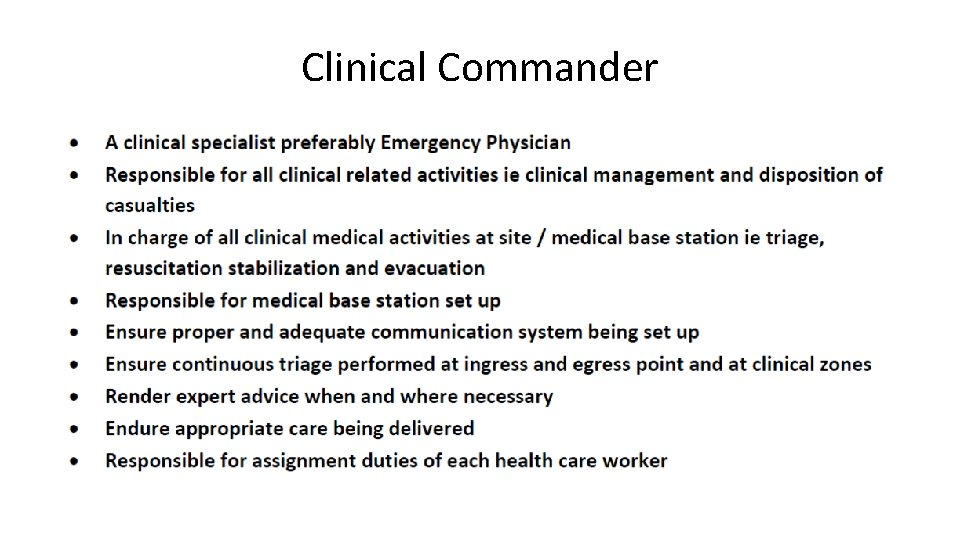
Clinical Commander
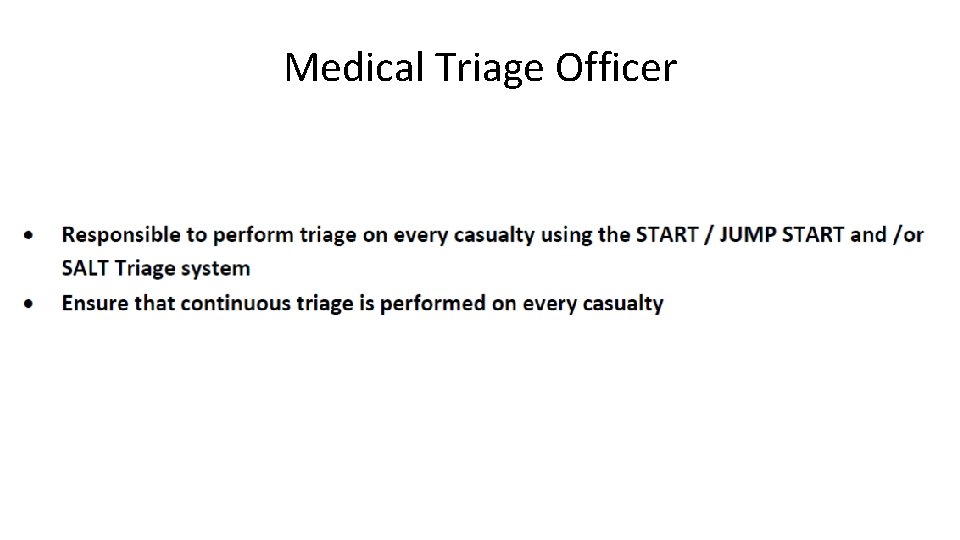
Medical Triage Officer
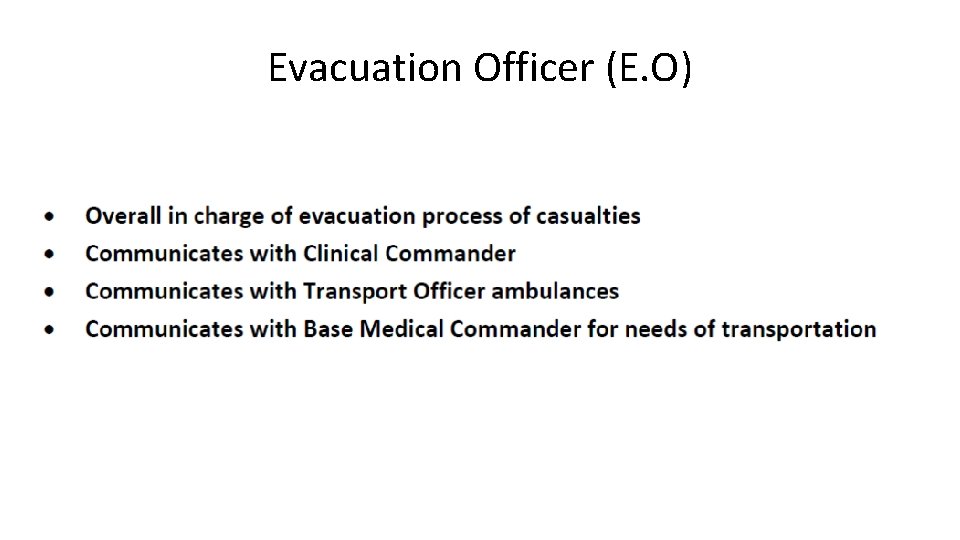
Evacuation Officer (E. O)
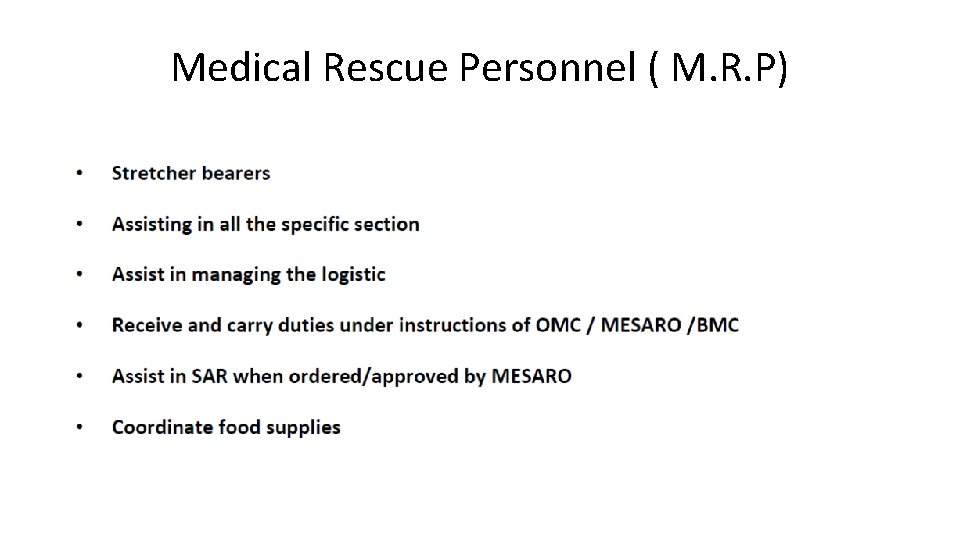
Medical Rescue Personnel ( M. R. P)
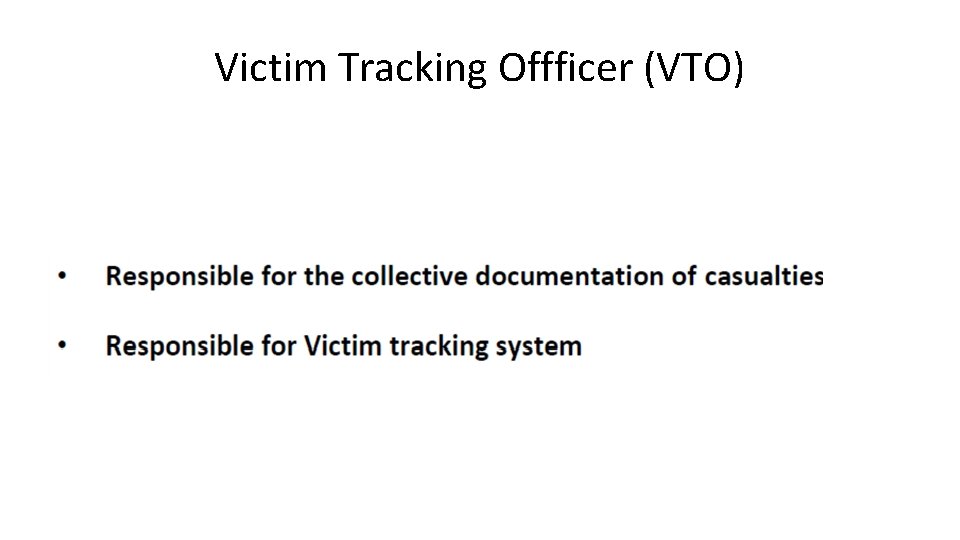
Victim Tracking Offficer (VTO)
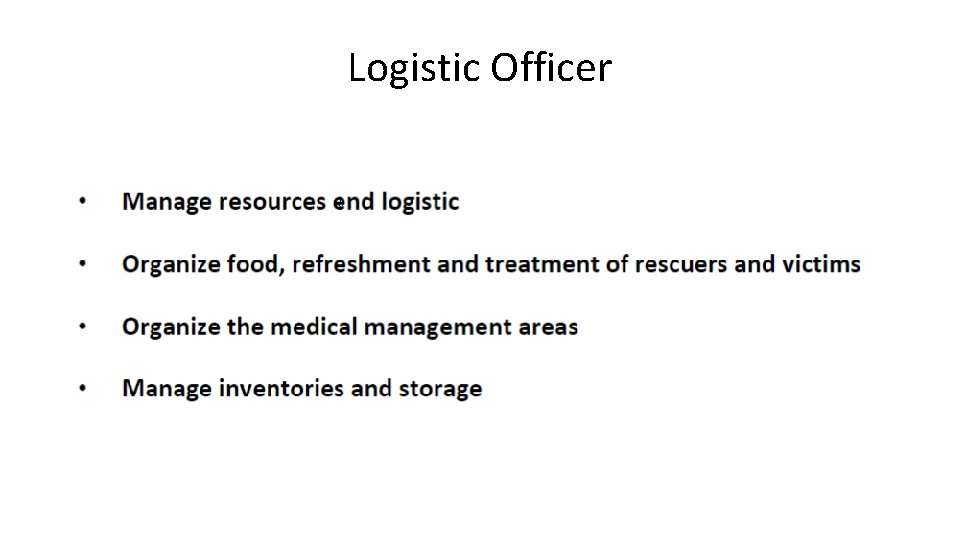
Logistic Officer
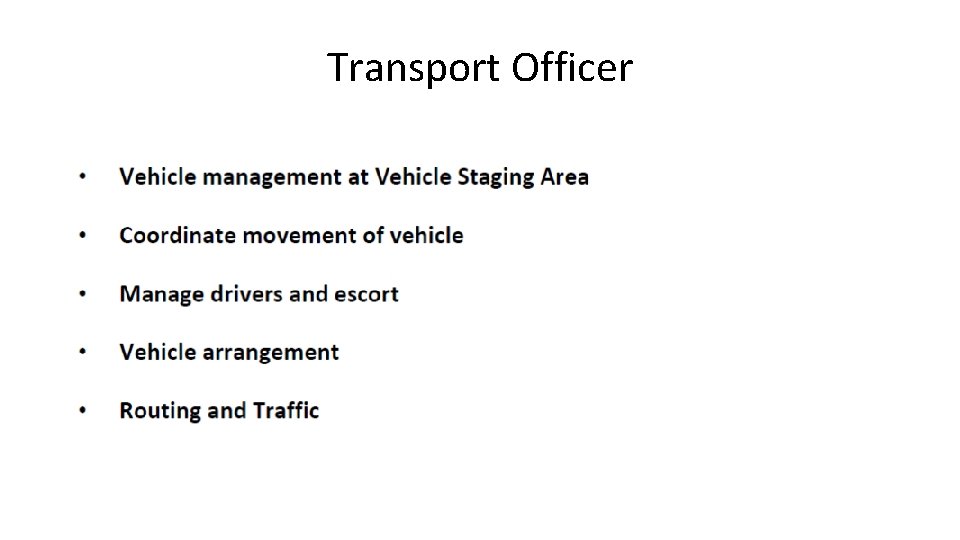
Transport Officer
Communication officer
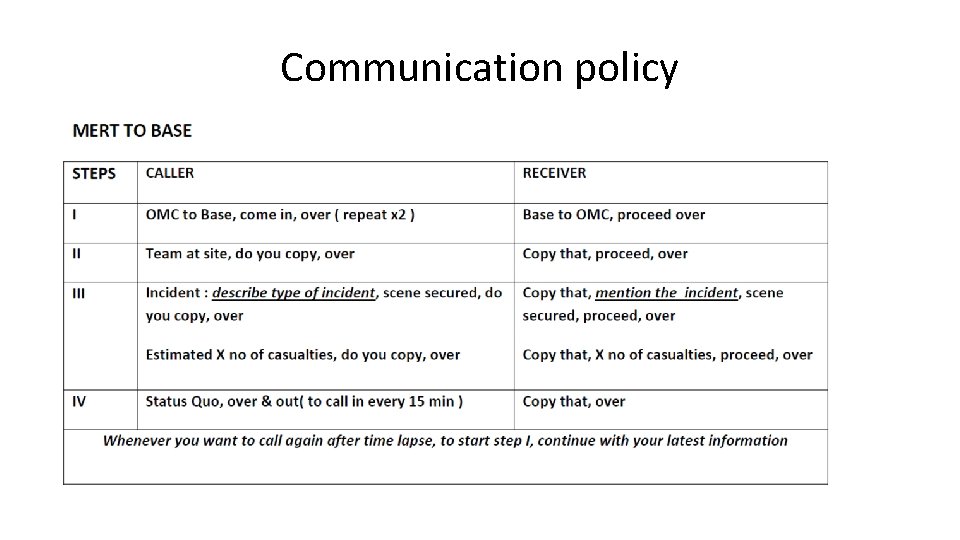
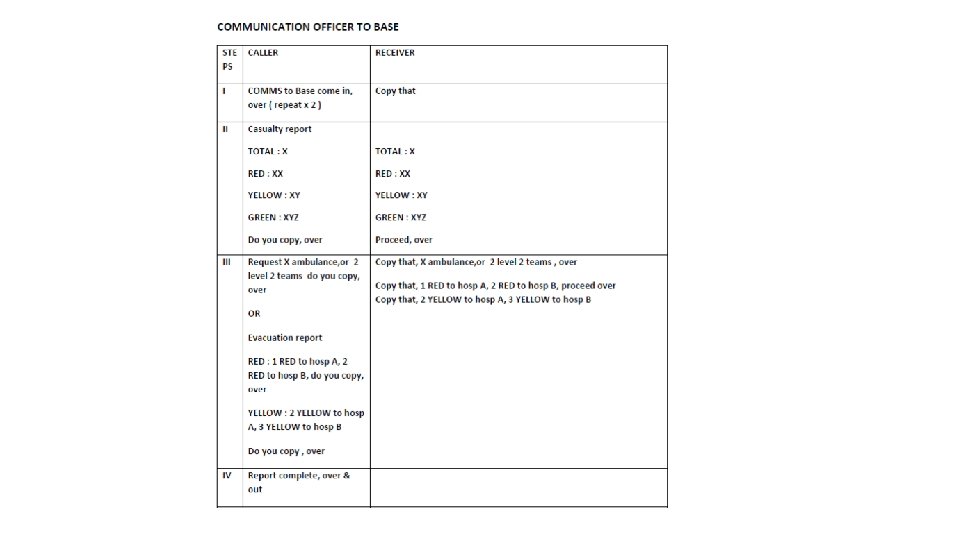
Communication policy
Hospital Phase – Clinical Zones During Disaster
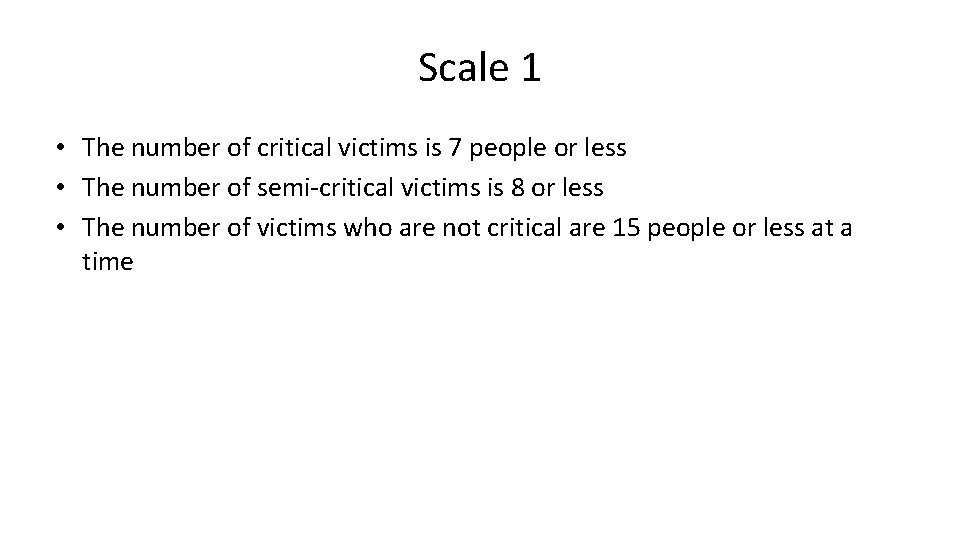
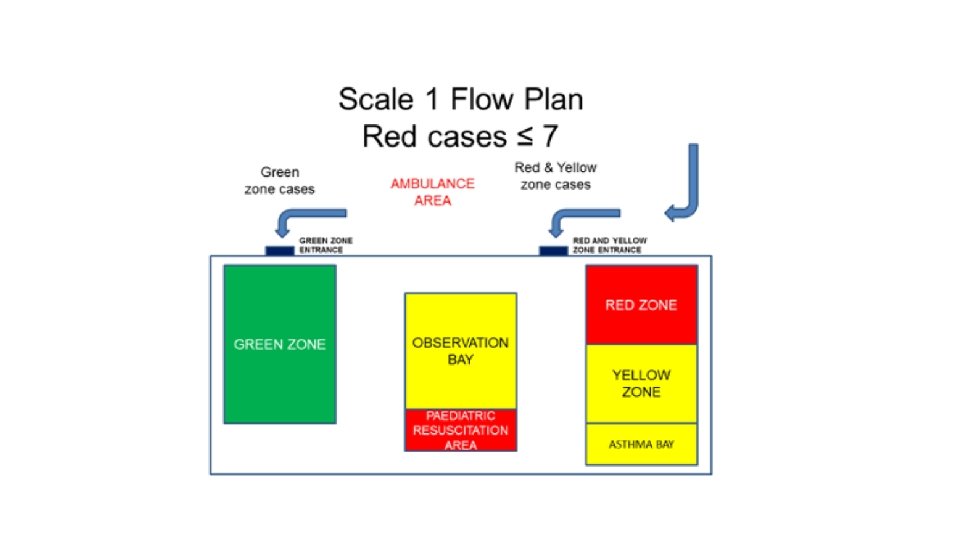
Scale 1 • The number of critical victims is 7 people or less • The number of semi-critical victims is 8 or less • The number of victims who are not critical are 15 people or less at a time
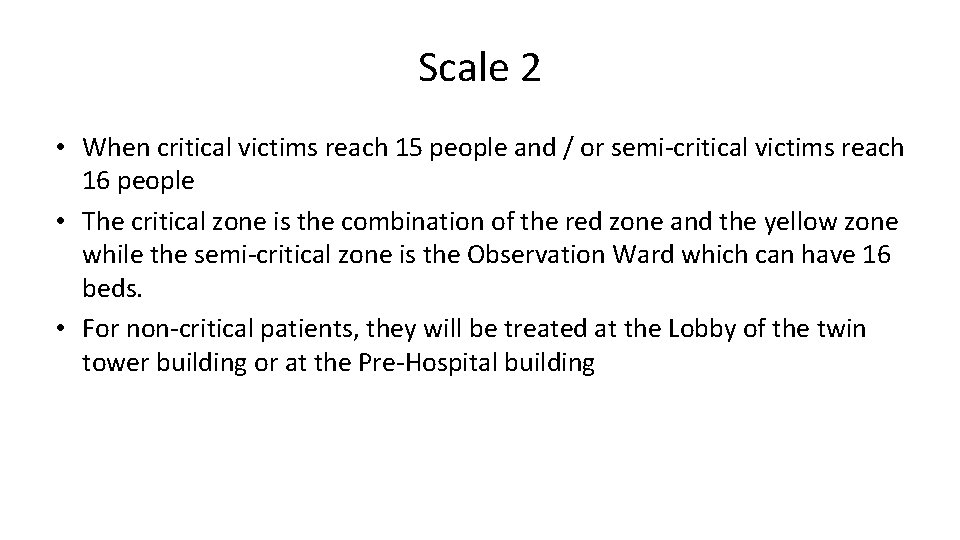
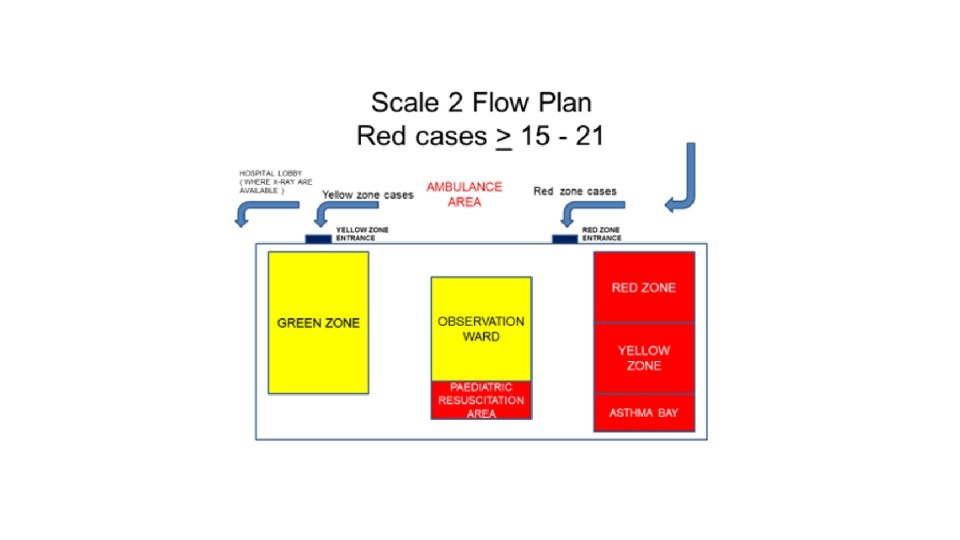
Scale 2 • When critical victims reach 15 people and / or semi-critical victims reach 16 people • The critical zone is the combination of the red zone and the yellow zone while the semi-critical zone is the Observation Ward which can have 16 beds. • For non-critical patients, they will be treated at the Lobby of the twin tower building or at the Pre-Hospital building
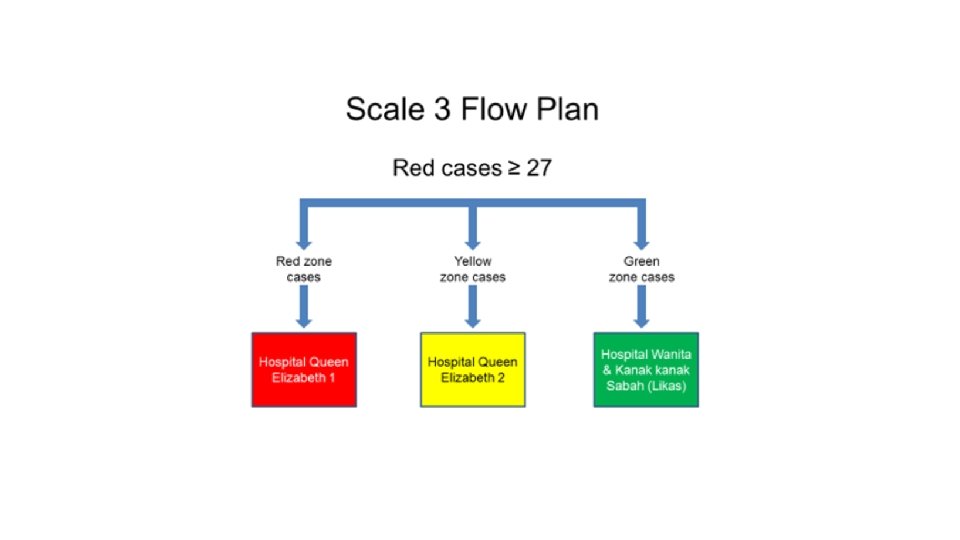
Scale 3 • Disaster involving many victims exceeding their capacity in terms of manpower and equipment or infrastructure of the HQE emergency department • The critical zone will be placed in the HQE emergency department • Semicritical zone created in HQE 2 Emergency Department • the non-critical zone will be placed at the Kota Kinabalu Children and Women's Hospital Emergency Department
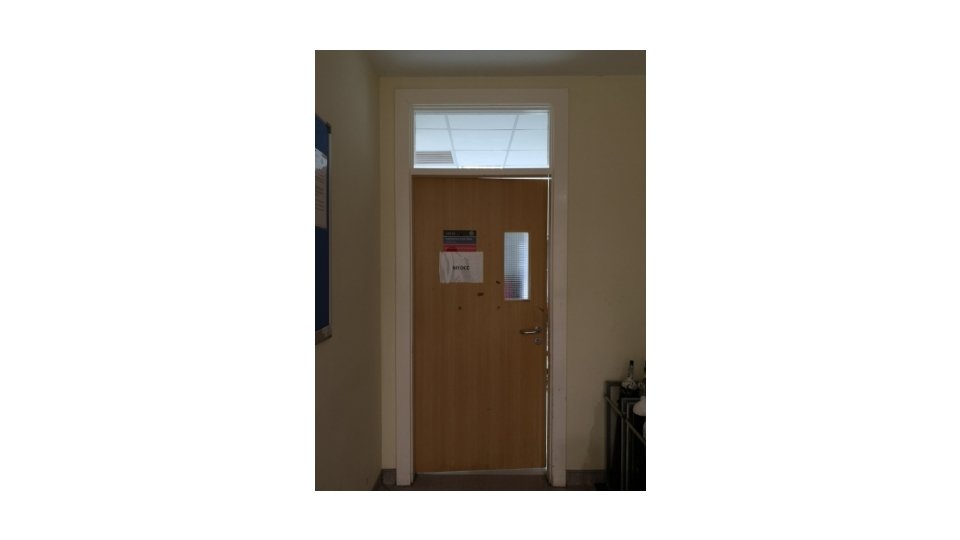
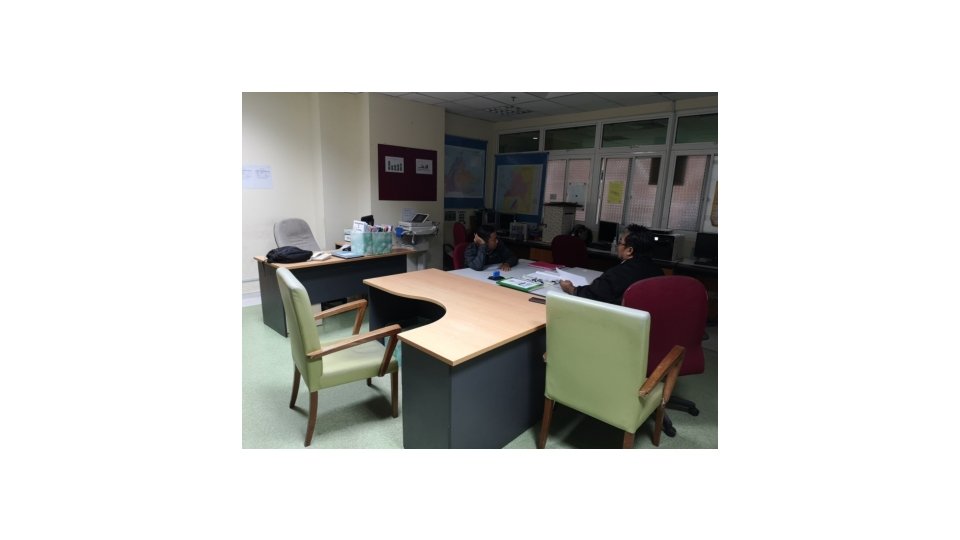
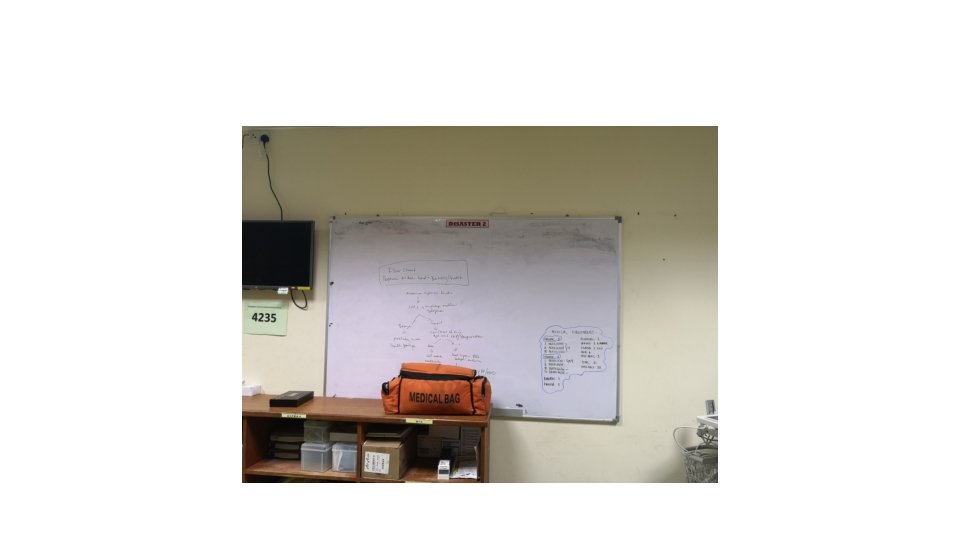
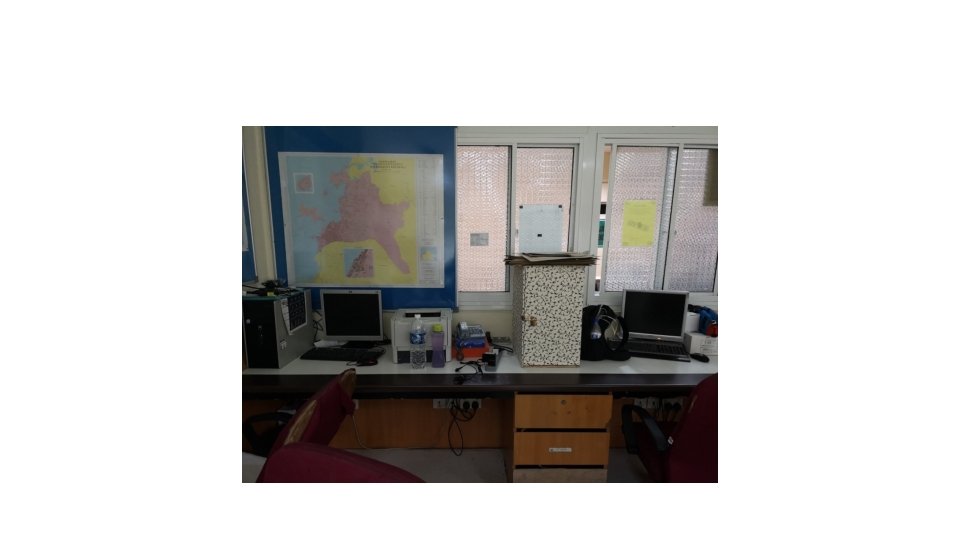
Disaster Operation Room Emergency Department HQE

References • • • Tintinnali emergency medicine (8 th edition) Arahan Majlis Keselamatan Negara No. 20 Pelan Tindakan Bencana HQE 2018 Handbook BMERT Update 2016 Practical Tips in Pre-Hospital Trauma Care by Prof Ismail Mohd Saiboon

• Thank you. .
- Slides: 91