
Concept of Business Environment Types of Business Environment
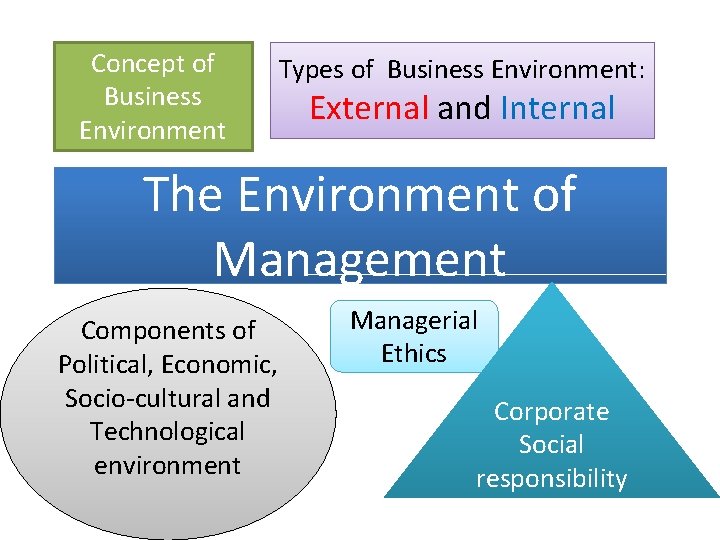
Concept of Business Environment Types of Business Environment: External and Internal The Environment of Management Components of Political, Economic, Socio-cultural and Technological environment Managerial Ethics Corporate Social responsibility
CONCEPT OF BUSINESS ENVIRONMENT Everything in and out of business organizations that affect , influence it.

CONCEPT OF BUSINESS ENVIRONMENT • Business environment consists of all components of the surroundings of a business organization, – which affect or influence its operations and – determine its effectiveness. • Environment is – dynamic and changes according to time, – it is also complex and difficult to forecast. • Therefore, management needs to estimate and forecast environmental influence to sustain.
CONCEPT OF BUSINESS ENVIRONMENT • The effectiveness depends upon the ability to deal and adjust with environmental forces. • It is necessary to maintain regular monitoring on environmental changes to grab opportunities and understand probable threats and challenges.
CONCEPT OF BUSINESS ENVIRONMENT • “Environment refers to institutions or forces that affect the organizations performance”. • S. P. Robbins & Mary Coulter • “Business environment is the aggregate of all conditions, events, and influences that surround affect it”. • Keith Devis
CONCEPT OF BUSINESS ENVIRONMENT • “Business environment encompasses the climate or set of conditions, economic, social, political or institutional in which business operations are conducted”. • Arthur M Weimer • “Business environment constitutes the factors or constraints that are largely if not totally, external and beyond the control of individual business enterprise and its management”. • Richman & Copen
CONCEPT OF BUSINESS ENVIRONMENT • Business organizations cannot exist and operate without environment. • It is beyond the control of individual. • These are internal or external forces that affect the organization’s performance. • Every business organization obtains – inputs from environment, – transforms them into outputs and again – supplies to the environment. • Broadly, there are two types of environment: – Internal environment and External environment.
TYPES OF BUSINESS ENVIRONMENT • INTERNAL ENVIRONMENT: – Conditions and forces within the organization. – Provides strengths and weakness to the organization. • EXTERNAL ENVIRONMENT – Everything outside an organization. • the general environment and • task environment. – Provides opportunity and threats to the organization.
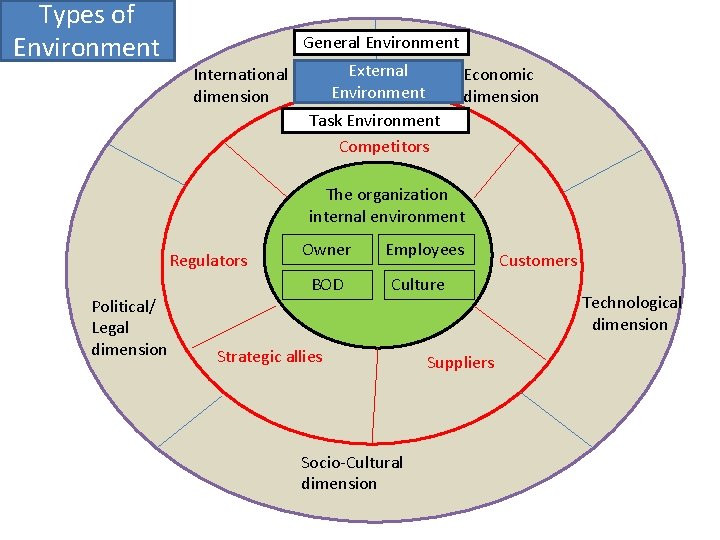
Types of Environment General Environment External Environment International dimension Economic dimension Task Environment Competitors The organization internal environment Regulators Political/ Legal dimension Owner BOD Employees Culture Strategic allies Socio-Cultural dimension Suppliers Customers Technological dimension

A business system and its environment Political Legal Environment Inputs • Human • Financial • Physical and information Processing • Planning • Decision making • Leadership • Control Feedback Economic Environment Output • Goods or Service • Profit or loss • Employee’s behavior Socio-cultural Environment Technological Environment •
INTERNAL ENVIRONMENT • An organization’s internal environment consists of conditions and forces within the organization. • The management has some control over these internal forces. • It provides strengths and weakness to the organizations. • Its major components include – its owners, – the board of directors, – employees and organized labor, and – the organization’s culture, structure.
INTERNAL ENVIRONMENT • Owners: • The owners of a business are the people who have a legal property right to the business. – proprietors, – partners and – shareholders. • Depending upon types of organizations and the nature of business, they are directly or indirectly involved in management of the business.
INTERNAL ENVIRONMENT • Board of Directors: • are the representatives of shareholders who are directly involves in the day to day operations of the company. • Their responsibility is to run the business in the best interest of the shareholders and other stakeholders. • involved in the preparation of long term plans and business strategies of the organization.

INTERNAL ENVIRONMENT • Employees: • An organization’s employees are also a major element of its internal environment. • When managers and employees hold the same values and have the same goals, everyone wines. • When managers and employees work toward different ends, everyone suffers.

INTERNAL ENVIRONMENT • Structure: • Structure is overall framework for organizational roles, rules, hierarchy, relations, and authority. • An organization’s structure keeps on changing. • The periodic adjustments made in the work or functions of individuals, groups or units changes the internal working of the organization.
INTERNAL ENVIRONMENT • Culture: • Culture means the “assumptions that members of an organization share in common”. • Every organization has its own culture. • In every organization there are systems of values, symbols, rituals, and practices that have evolved over time.
INTERNAL ENVIRONMENT • Union: • Labor unions represent the problems and feelings of their members to management. • In this process, labor and management interact with each other. • To negotiate wages, working conditions, hours of work, and so on, collective bargaining mechanisms are used. • To avoid unnecessary disturbances, the management institutionalizes grievance handling and collective bargaining systems in consultation with the unions.
INTERNAL ENVIRONMENT • All these internal factors put together define an organization’s strengths and weaknesses. • As the composition of people, resources, structure, culture, network of relations, nature of products or services, and shareholders changes, an organization’s internal environment also changes.
– stockholders are part of the organization, – but in another sense they are part of its environment. • The external environment is composed of two the general environment and task environment. layers: EXTERNAL ENVIRONMENT • The external environment is everything outside an organization that might affect it. • Boundary separates the organization from its external environment. • However, the boundary is not always clear and precise.
• General environment refers to broad external conditions that may affect business activities of an organization. – also known as macro environment. • It is uncontrollable and requires proper monitoring of the components to adapt on the basis of emerging changes. • General environment involves : – – political, economic, socio-cultural and technological components. • It creates opportunities and threats to the business organizations. EXTERNAL ENVIRONMENT General Environment:
• Political environment: • The political environment mainly refers to the political structure, composition of bureaucracy, philosophy of the ruling government, the political stability, public opinion, and government – business relations. • The degree of political risk existing in a country determines the investment climate in that country. EXTERNAL ENVIRONMENT General Environment:
• The legal environment refers to the framework of laws, regulations, and court decisions intended to encourage, guide, and control business activities. • Some are designed to protect workers, consumers, and communities. • Others are designed to regulate the behavior of managers and their subordinates in business and other enterprise. EXTERNAL ENVIRONMENT General Environment: • Legal environment:
• Components of Political and Legal environment: • Constitution: – fundamental laws acceptable to all people of the nation. It enables the government to impose statutory control over business. • Political philosophy: – is an ideology that a state has adopted. Can be democratic (more emphasize to privet sector), socialism (state holds all business activities) and mixed. • Political parties: – democratic countries can have many political parties. They might have different ideologies, proclamations and declaration regarding political and economical issues. When they form government they try to implement their declaration which may affect the business activities. EXTERNAL ENVIRONMENT General Environment:
• Components of Political and Legal environment: • Political institutions: – they consist of legislature, executive and judiciary. The legislature (parliament) enacts rules, regulations and laws. The executive (government) implement the decision of legislature. The judiciary (courts) ensures whether rules and laws are implemented or not. • International political events: – Business organizations are not only influenced by national political but also my international political events. Like change in Indian/ US government affects our business too. • Legal institutions: – it consists of different legal institutions that ensures customers right or defines what management can do or cannot do. District courts, Appeal courts, Supreme courts, Police, etc. EXTERNAL ENVIRONMENT General Environment:
• Economic environment: • Economic factors which affect the working of the business is known as economic environment. • It is largely determined by the economic system of the country. • Poor economic conditions make environment more complex and manager’s job more difficult and demanding. EXTERNAL ENVIRONMENT General Environment:
• Components of Economic environment: • Economic Systems: - i. ii. iii. – An Economic System of a country may be defined as a framework of rules, goals and incentives that controls economic relations among people in a society. Existing economic system in a country affect the business. Economic conditions of a nation can be of any one of the following type: - Capitalism: - business units or factors of production are privately owned. Government does not interfere in the economic activities of the country. Also known as free market economy. Examples of Capitalistic Economy: England, Japan, America etc. Socialism: - all the economic activities of the country are controlled and regulated by the Government in the interest of the public. The first country to adopt this concept was Soviet Russia. . Mixed Economy: - The economic system in which both public and private sectors co-exist. Some factors of production are privately owned and some are owned by Government. EXTERNAL ENVIRONMENT General Environment:
• Components of Economic environment: • Economic Conditions: – Economic Policies of a business unit are largely affected by the economic conditions of country. Any improvement in the economic conditions such as standard of living, purchasing power of public, demand supply, distribution of income etc. largely affects the size of the market. • Capital market: – Capital market plays important role in promoting economic activities. It involves central bank, finance companies, insurance companies, stock market. • Global/International Economic Environment: – Business enterprise involved in trade, is influenced by not only its own country economic environment but also the economic environment of foreign country. There are various rules and guidelines for these trades which are issued by many organizations like WB, WTO, UN etc. EXTERNAL ENVIRONMENT General Environment:
• Components of Economic environment: • Economic Policies: – Government frames economic policies. Economic Policies affects the different business units in different ways. The Government may grant subsidies to one business or decrease the rates of excise or custom duty for another business. Important economic policies of a country are as follows: Monetary Policy: The policy formulated by the central bank of a country to control the supply and the cost of money (rate of interest), in order to attain some specified objectives. Fiscal Policy or budgetary policy: It is related with the income and expenditure of a country. Fiscal Policy works as an instrument in economic and social growth of a country. It deals with taxation, government expenditure, borrowings, deficit financing etc. EXTERNAL ENVIRONMENT General Environment:
• Components of Economic environment: • Economic Policies: cntd… Foreign Trade Policy: It also affects the different business units differently. E. g. if restrictive import policy has been adopted by the government then it will prevent the domestic business units from foreign competition and if the liberal import policy has been adopted by the government then it will affect the domestic products in other way. Foreign Investment Policy: - The policy related to the investment by the foreigners in a country is known as Foreign Investment Policy. If the government has adopted liberal investment policy then it will lead to more inflow of foreign capital in the country which ultimately results in more industrialization and growth in the country. Industrial Policy: - Industrial policy of a country promotes and regulates the industrialization in the country. It is framed by government. EXTERNAL ENVIRONMENT General Environment:
• Socio-cultural environment: Social cultural environment includes values, norms, beliefs, lifestyles, accepted behavior patterns of people, family systems and customs of people in a given society. • These elements of society directly influence business organizations. • Managers must be responsive to changes in the social structures and national cultures of the country in which they operate. EXTERNAL ENVIRONMENT General Environment:
• Components of Socio-cultural environment: • Demography: • It deals with the population, age, gender, race & ethnicity that effects the buying & selling of goods & services. • Life style: – is the pattern and living standard of the people. It is affected by the change in level of income, education, media. • Social values: – are the beliefs and norms of the society that shapes our behavior. Managers need to know social values of the society so that they can • Social institutions: – it involves family, reference groups and social classes. EXTERNAL ENVIRONMENT General Environment:
• Components of Socio-cultural environment: • Religion: – Different religious people have different attitudes and behavior in the society. Their religious attitudes and behavior affects the need and demand of the product and services. • Language: – Language differs from one culture to another, business people need to understand their language if they want to promote business in these societies. EXTERNAL ENVIRONMENT General Environment:
• Technological environment: • Technical environment refers to all the technological surroundings that influence organization. • Technology consists of skills, methods, systems and equipment. • It is a means to transfer input into outputs. Technology influences organizations by bringing about changes in jobs, skills, life styles, production methods and processes. • Radical developments have occurred over the past several years in communication, information, and automation including robotics. • These developments not only present huge opportunities for business organizations in terms of enhanced effectiveness, but also place heavy demands on them in the ever increasing competitive markets. EXTERNAL ENVIRONMENT General Environment:
• Components of Technological environment: • Level of technology: The level of technology can be appropriate or sophisticated. It can be labor-based or capital-based. The level of technology influence organizations. – Labor based technology : Human labour is mainly used for the operations. – Capital based technology : Machinery is mainly used for operations. Technology is represented by automation, computerization, robotizing, etc. • Pace of technological change : – Technology is a dynamic force. Invention and diffusion increase its pace. Organizations should adapt to the changing technological forces. They should also upgrade the skills of their human resources to effectively cope with the demands of technological changes. EXTERNAL ENVIRONMENT General Environment:
• Components of Technological environment: • Research and development: – R&D is the essence of innovation. Expectation for improvement are increasing. Customers expect new products of superior quality which are safe, comfortable and environment friendly. This calls for increase research and development budget by organizations. Government and industry collaboration and spending in R&d efforts is also an important aspect of technology environment. • Technological transfer: – Sources of technology can be within the organization , within the country or foreign countries. Technology transfer implies technology import for organizations. Technological transfer implies technology imported from technologically advanced foreign countries. Its speed is important for organizations. EXTERNAL ENVIRONMENT General Environment:
• Global environment: • International developments have their effects on domestic business. • For certain category of business, global environment is very important. • For instant, the firms dealing with importexport business are most affected by the changes taking place in the international market. EXTERNAL ENVIRONMENT General Environment:
EXTERNAL ENVIRONMENT General Environment: • Though often beyond the control of a firm, the overall external environment within which it operates must be known by the manager. • The interaction of its many facets must be understood by him or her to ensure the continued survival and growth of the firm. • Managers must also pay attention to their causal interactions as well. That is because these set the stage for new opportunities as well as threats.
EXTERNAL ENVIRONMENT Task Environment: • Also called the competitive or operating environment. • Forces in the task environment result from the actions of suppliers, distributors, customers, and competitors. • These groups affect a manager’s ability to obtain resources and order of outputs. • The task environment can be influenced or controlled, to some extent, by an organization.
• Customers: • may be an individual, a family, a business house, or an institution. • These customers are also an important source of ideas, opinions, information, and reaction. • The managers, therefore, maintain close relationship with them for information. • An organization’s success depends on its response to customers. EXTERNAL ENVIRONMENT Task Environment:
• Suppliers: – A business firm buys raw materials from the suppliers who are an important part of the task environment. – As the quality and price of the raw materials received from the suppliers determine the quality of output. • Government: – The role of the government is to regulate business systems and to protect the interest of the consumers and the general public. – Its role is also to protect industries. EXTERNAL ENVIRONMENT Task Environment:
• Distributers: • Distributors are organizations that help other organizations sell their goods or services to customers. • If distributors are so large and powerful that they can control customer’s access to a particular organization’s goods and services. • In contrast, the power of a distributor may be weakened if there are many options. EXTERNAL ENVIRONMENT Task Environment:
• Special interest group: • The main special interest groups are – environmentalists, – unions, – consumer advocates, and – many other professional organizations. • These special interest groups exert pressure on the business firm to advance their position on issues like quality, service, price, waste management, environmental protection, etc. EXTERNAL ENVIRONMENT Task Environment:
• Financial institutions: • Business firms rely on the services of financial institutions. • The terms and conditions of loans and advances, and the quality and promptness of their services have an impact on the performance of a business. • Therefore, maintaining effective working relationship with these financial institutions is essential for a business firm. EXTERNAL ENVIRONMENT Task Environment:
• Media: – Managers, need to maintain good communication with the media and external audiences, and deal with them effectively and promptly. • Competitors: – A business firm faces competition in the market. – If set up properly, the marketing information system helps managers to catch the market signals in time. – Rivalry between competitors is potentially the most threatening force that managers must deal with. EXTERNAL ENVIRONMENT Task Environment:
MANAGERIAL ETHICS Concept Set of moral principles and rules. Guides an individual’s behavior. Basis of determining right or wrong in a given situation. • Personal perception and belief while taking a decision. • Ethical behavior of an individual depends upon the moral standard or codes of conduct determined by the society. • •
MANAGERIAL ETHICS • Stoner, Freeman, and Gilbert– “Ethics is the study of how our decisions affect other people. It is the study of people’s rights and duties, the moral rules that people apply in making decisions. ”
MANAGERIAL ETHICS • R. W. Griffin– “Ethics is an individual’s personal belief about whether a behavior, action, or decision is right or wrong. Managerial ethics are the standard of behavior that guides individual managers in their work. ”
MANAGERIAL ETHICS • Decenzo and Robbins– “Ethics commonly refers to a set of rules or principles that defines right and wrong conduct. ”
MANAGERIAL ETHICS • From the above definitions, it may be concluded that: – Ethics are personal beliefs of an individual about right or wrong. – Ethical behavior differs from person to person. For one person certain behavior may be ethical. For others, the same behavior may be unethical. – Ethical behavior conforms to generally accepted social norms and unethical behavior does not confirm to generally accepted social norms.
MANAGERIAL ETHICS • Managerial ethics is the standard of behavior that guides individual managers in their work. • Managerial ethics is the standard of social norms and values, truth and justice that is accepted by managers in the decision making process. • It is generally accepted that business should be conducted according to certain self-recognized moral standard of the managers.
Ethical Effects on Organizations: – Managerial ethics determines managementemployee relationships in an organization. – Employment issues are being affected by the ethical standards of managers. – Hiring, firing, promotion, rewards, welfare, and compensation are influenced by the ethical practice of managers.
Ethical Effects on Organizations: • The individual ethical standards of employees also affect organizations. • Employees are responsible for maintaining work standards, secrecy, honesty, and information. • They can use unethical methods in procurement, entertainment, travel and other expenses related in doing business.
Significance of Management Ethics: • Promotes goodwill and image. • Helps maintain better relation with stakeholders. • Less interference from government. • Promotes fair competition. • Promotes social responsibility. • Improve working environment. • Helps to increase market share.
SOCIAL RESPONSIBILITY • Social responsibility is the obligation of an organization to protect social norms and rule within which the organization is operating. • Business organizations are established, exist and perform functions in the society they also expand diversify their business activities in the society. • They utilize natural resources in production and distribution activities according to their convenience and facility. • It is the responsibility of business organization to perform their activities within the existing rules, regulations and norms of society.
SOCIAL RESPONSIBILITY • Davis and Blomtrom– “Social responsibility refers to the obligation of decision makers to take actions which protect and improve the welfare of society as a whole along with their own interest. ”
SOCIAL RESPONSIBILITY • R. W. Griffin– “Social responsibility is the set of obligations an organization has to protect and enhance the society in which it functions. ”
SOCIAL RESPONSIBILITY • Contrasting views: There are two contrasting views. • The first view holds that mangers act as agents for shareholders. Therefore, they are obliged to maximize the present value of the firm. This view mentions the social responsibility of business is business. This is profit maximization view. • The second view considers that organizations have a wider range of responsibilities that extend beyond the production of goods and services at a profit. As a member of society, organizations should actively and responsibly participate in the community and in the larger environment.
SOCIAL RESPONSIBILITY • Contrasting views: There are two contrasting views. • The first view holds that mangers act as agents for shareholders. Therefore, they are obliged to maximize the present value of the firm. This view mentions the social responsibility of business is business. This is profit maximization view. • The second view considers that organizations have a wider range of responsibilities that extend beyond the production of goods and services at a profit. As a member of society, organizations should actively and responsibly participate in the community and in the larger environment.
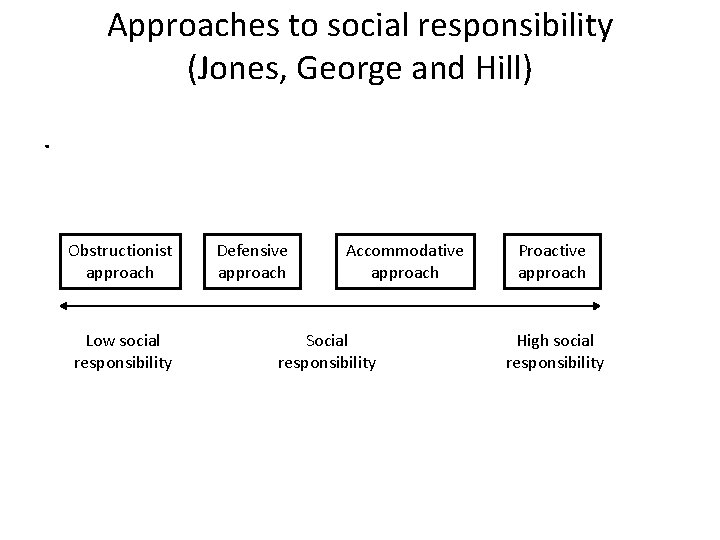
Approaches to social responsibility (Jones, George and Hill). Obstructionist approach Low social responsibility Defensive approach Accommodative approach Social responsibility Proactive approach High social responsibility
Approaches to Social Responsibility • Obstructional approach: – Not to behave in a socially responsible way. – No obligation to society. – Violate prevailing laws. – May not really care for the society. – They behave unethically and illegally. – Involvement in bribing, breaking pollution standards, ignoring employee safety standards.
Approaches to Social Responsibility • Defensive approach: – A defensive approach indicates at least a commitment to ethical behavior. – Defensive managers stay within the law and abide strictly with legal requirements. – But, they make no attempt to exercise social responsibility beyond what the law dictates.
Approaches to Social Responsibility • Accommodative approach: – An accommodative approach supports social responsibility. – Accommodative managers agree that organizational members should behave legally and ethically. – they try to balance the interests of different stakeholders against one another. – Managers adopting this approach want to make choices that are reasonable in the eyes of society.
Approaches to Social Responsibility • Proactive approach: • This is being both legal and responsible. • The position taken is that business firms have a responsibility not only to abide by legal constraints, but also to take a proactive position and support social causes or institutions. • Business firms are often involved in philanthropic activities such as supporting higher education, local sports clubs, health projects, etc.
Areas of Social Responsibility • The people and institutions have direct or indirect interest in business organizations which consists of shareholders, customers, suppliers and lenders, government, employees and community at large.
Areas of Social Responsibility • Towards investors (Shareholders): • To ensure safety of capital investment • To provide fair and regular return on investment in terms of dividend • To provide correct and regular information of financial and other transactions • To offer reasonable opportunities to shareholders for participating in planning and policy making • To maximize value of capital investment through optimum utilization of resources
Areas of Social Responsibility • Towards customers: A person who buys the commodities of a business firm is its consumer. Customers are the main source of revenue. They are basis of growth and development of business. • Supply better quality goods at the right time at reasonable price • Take necessary steps to improve quality, reduce price and development network for distribution • Provide after sale service • Truthful advertising • better quality and for new product • Avoid black marketing and adulteration • Health and safety of the consumer
Areas of Social Responsibility • Towards employees: Employees are vital components of a business firm. They are directly involved in production and distribution functions of the organization. The responsibilities of business towards employees are: • Provide job security • Provide fair wages, and other benefits like bonus, allowances, share of profit. • Ensure welfare facilities like further education, promotion, medical facilities, foreign visit, training • Provide favorable working environment and recognition of their performance • Provide opportunity to participate in management and career development
Areas of Social Responsibility • Towards government: Government is responsible for the administrative and developmental work of the country. It protects and controls all the business activities and creates business opportunities in new areas. The major responsibilities towards the government are: • Follow strictly the government rules, regulations and laws • Pay tax (VAT, Income tax, customs duty) to the government honestly and regularly • Avoid monopolistic and unfair trade practices • Support to solve national problems (unemployment, poverty, illiteracy, family planning) • Emphasize on fair dealing in import and export trade to maintain the reputation of the nation
Areas of Social Responsibility • Towards community (public): Business organizations have responsibilities towards the general public. The major responsibilities towards community are: • Check environmental pollution and maintain environmental ecology • Create employment opportunities for the people • Take necessary steps for maximum utilization of resources available in the society • Maintain and develop social and cultural values and norms • Involve in social welfare programs like education, health, and sports.
- Slides: 69