
Concept National Asbestos Awareness Strategy Asbestos Dialogue 24
Concept: National Asbestos Awareness Strategy Asbestos Dialogue 24 th of March 2017 Chemicals and Waste Management
PRESENTATION FRAMEWORK 1 Definition 2 Types and Uses of Asbestos 3 Legislative framework 4 Problem Statement 5 National Asbestos Strategy - Objectives 6 Concept – National Asbestos Awareness Strategy 7 Conclusions
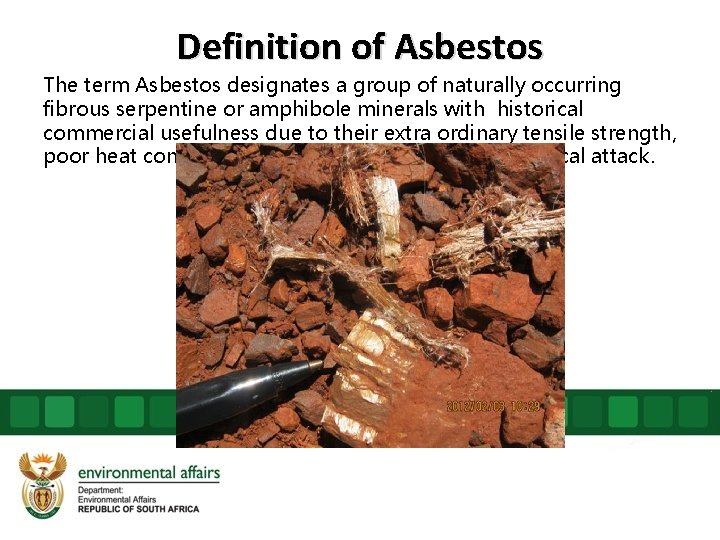
Definition of Asbestos The term Asbestos designates a group of naturally occurring fibrous serpentine or amphibole minerals with historical commercial usefulness due to their extra ordinary tensile strength, poor heat conduction and relative resistance to chemical attack.
Forms of Asbestos There has been three types of asbestos minerals mined in South Africa namely; Amosite, Chrysotile & Crocidolite. • Amosite-It is also known as brown asbestos and is like crocidolite, a member of the ampibole group. • Chrysotile- It is classified as a sheet silicate, that forms flat sheets of long, thin fibres. These fibres are the most flexible of all asbestos fibres; they can withstand the fiercest heat but are so soft and flexible that they can be spun and woven as easily as cotton. • Crocidolite- It is also known as colloquially as blue asbestos and is a member of the amphibole group. They are needle like fibres that are strongest of all asbestos fibres and have a high resistance to acids.
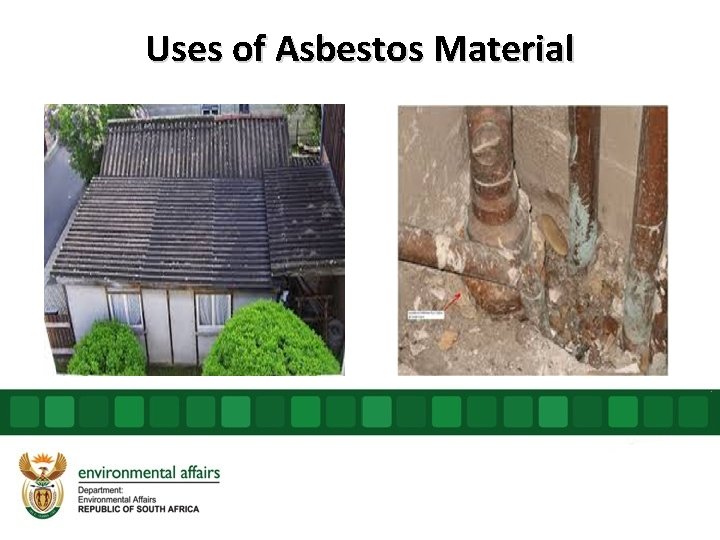
Uses of Asbestos Material
Legislative framework • • • OHSA, Asbestos Regulations. Mine Health and Safety Act Asbestos Related Diseases Compensation laws (e. g. COIDA) National Environmental Management Act National Environmental Management Waste Act • Policy on the handling and disposal of asbestos and asbestos containing waste in terms of section 20 of the Environmental Conservation Act, 1989 (No 73 of 1989). • The Regulations for the Prohibition of the Use, Manufacturing, Import and Export of Asbestos and Asbestos Containing Materials. • Framework for the Management of Contaminated Land in South Africa, Annexure C
Problem statement • Asbestos is a known carcinogen and causes a variety of lung diseases ultimately leading to death. • Secondary pollution effects • Legacy of mining asbestos (Mine dumps) • Compensation for victims • Citizens are still exposed to asbestos due to inadequate information and poor asbestos management practices. • Little or no coherent asbestos management awareness strategy
National Asbestos Strategy Aim of the strategy: This strategy aims to facilitate integration and sustainable management of asbestos in the country
Objectives of the National Asbestos Strategy • To facilitate integration of awareness, consultation and sustainable remediation on asbestos • Implement Risk Based Approach on asbestos in the country • Create a platform to exchange information on best practices on asbestos • To establish communication framework to eliminate silos and fragmentations among role players • To supplement existing approach on management of asbestos to strengthen asbestos management system in the country.
Concept- Asbestos Awareness Strategy Objectives: • Review existing material on asbestos awareness and campaigns • Improve awareness with respect to the risk of asbestos in homes, commercial buildings and secondary contamination • Integrate all asbestos related information • Develop a practical and evidence based asbestos awareness material • Identify industry needs and gaps in their asbestos awareness campaigns and programmes
Activities • One stop asbestos related information website • Advertise the website in government departments to increase its accessibility. • Publishing info on best practice with regards to asbestos removal, disposal and rehab of contaminated site. • Undertaking coordinated awareness campaigns targeting owners of asbestos buildings, removal contractors and citizens exposed to asbestos. • Collaboration amongst government, NGOs and community forums.
Expected Outcomes • Improved access to updated asbestos info. • Facilitated behavior and attitude change. • Enhanced awareness among the members of the public regarding the risk posed by asbestos containing material and its environmental, health and safety impacts.
The questions to be answered • • • What is the current asbestos awareness status in the country? Any notable achievement with respect to awareness to date? Who are we targeting on the strategy? How will we measure success of the intervention? Where to from here?
Conclusion “We must do what we conceive to be right and not bother our heads or burden our souls with whether we will be successful. Because if we don’t do the right thing, we`ll do the wrong thing and we`ll be part of the disease and not part of the cure. ” Fritz Schumacher
Takalani Telekisa Land Remediation Directorate Tel: 012 399 8549 Ttelekisa@environment. gov. za
- Slides: 15