
Concept Mapping to Understand How Work Impacts Health
- Slides: 2
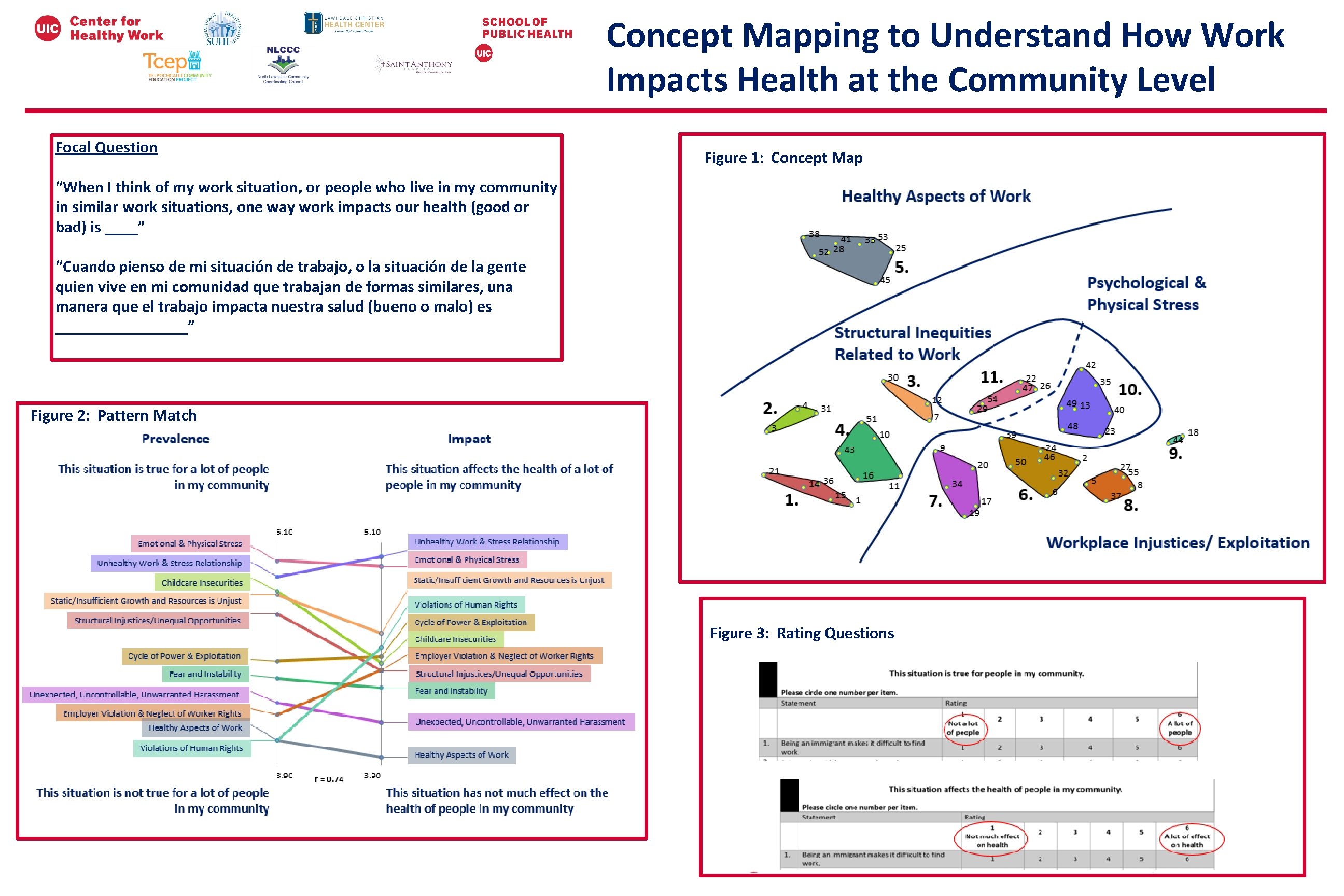
Concept Mapping to Understand How Work Impacts Health at the Community Level Focal Question Figure 1: Concept Map “When I think of my work situation, or people who live in my community in similar work situations, one way work impacts our health (good or bad) is ____” “Cuando pienso de mi situación de trabajo, o la situación de la gente quien vive en mi comunidad que trabajan de formas similares, una manera que el trabajo impacta nuestra salud (bueno o malo) es ________” Figure 2: Pattern Match Figure 3: Rating Questions
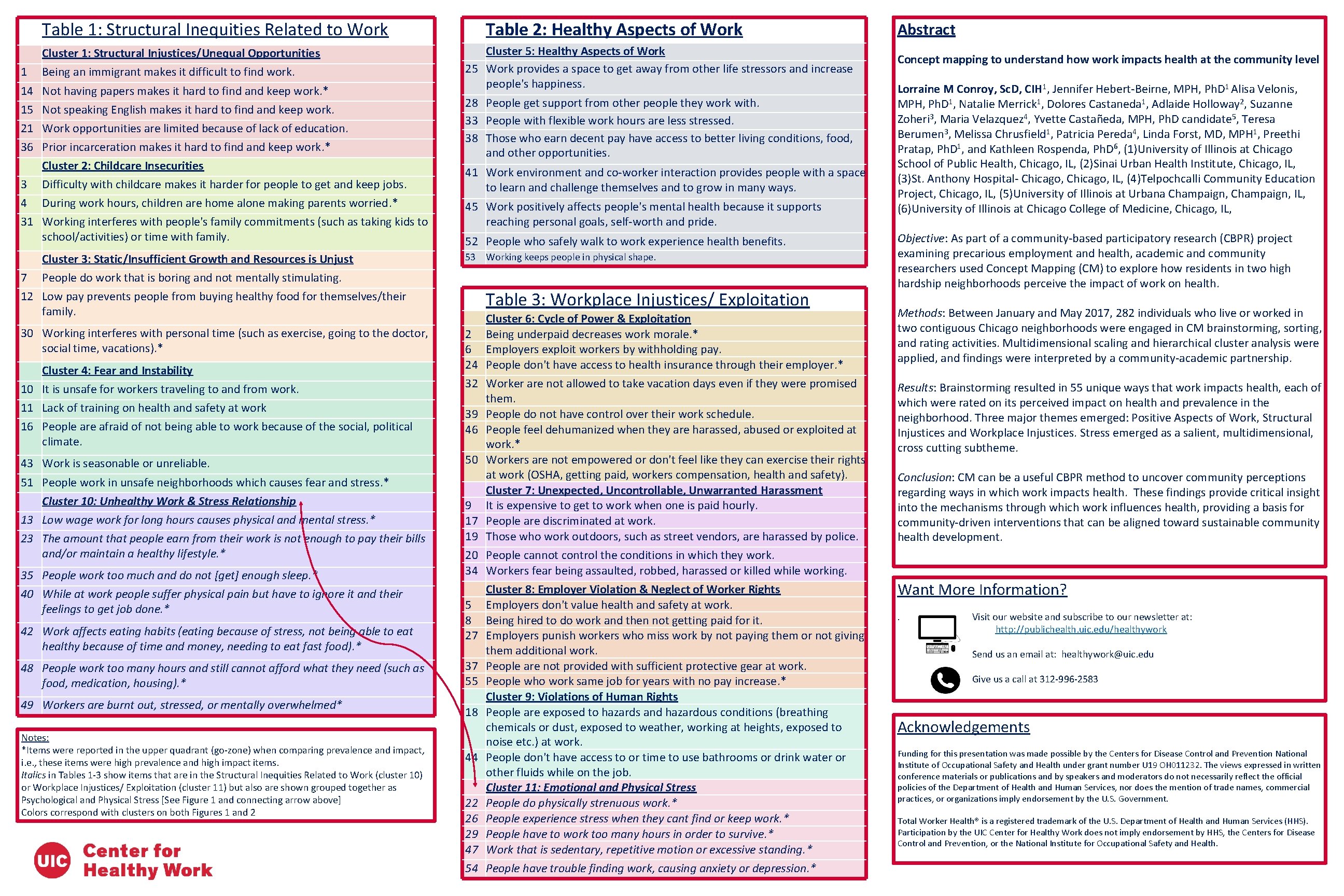
Table 1: Structural Inequities Related to Work Cluster 1: Structural Injustices/Unequal Opportunities 1 Being an immigrant makes it difficult to find work. 14 Not having papers makes it hard to find and keep work. * 15 Not speaking English makes it hard to find and keep work. 21 Work opportunities are limited because of lack of education. 36 Prior incarceration makes it hard to find and keep work. * Cluster 2: Childcare Insecurities 3 Difficulty with childcare makes it harder for people to get and keep jobs. 4 During work hours, children are home alone making parents worried. * 31 Working interferes with people's family commitments (such as taking kids to school/activities) or time with family. Cluster 3: Static/Insufficient Growth and Resources is Unjust 7 Table 2: Healthy Aspects of Work Cluster 5: Healthy Aspects of Work 25 Work provides a space to get away from other life stressors and increase people's happiness. 28 People get support from other people they work with. 33 People with flexible work hours are less stressed. 38 Those who earn decent pay have access to better living conditions, food, and other opportunities. 41 Work environment and co-worker interaction provides people with a space to learn and challenge themselves and to grow in many ways. 45 Work positively affects people's mental health because it supports reaching personal goals, self-worth and pride. 52 People who safely walk to work experience health benefits. 53 Working keeps people in physical shape. People do work that is boring and not mentally stimulating. 12 Low pay prevents people from buying healthy food for themselves/their family. 30 Working interferes with personal time (such as exercise, going to the doctor, social time, vacations). * Cluster 4: Fear and Instability 10 It is unsafe for workers traveling to and from work. 11 Lack of training on health and safety at work 16 People are afraid of not being able to work because of the social, political climate. 43 Work is seasonable or unreliable. 51 People work in unsafe neighborhoods which causes fear and stress. * Cluster 10: Unhealthy Work & Stress Relationship 13 Low wage work for long hours causes physical and mental stress. * 23 The amount that people earn from their work is not enough to pay their bills and/or maintain a healthy lifestyle. * 35 People work too much and do not [get] enough sleep. * 40 While at work people suffer physical pain but have to ignore it and their feelings to get job done. * 42 Work affects eating habits (eating because of stress, not being able to eat healthy because of time and money, needing to eat fast food). * 48 People work too many hours and still cannot afford what they need (such as food, medication, housing). * 49 Workers are burnt out, stressed, or mentally overwhelmed* Notes: *Items were reported in the upper quadrant (go-zone) when comparing prevalence and impact, i. e. , these items were high prevalence and high impact items. Italics in Tables 1 -3 show items that are in the Structural Inequities Related to Work (cluster 10) or Workplace Injustices/ Exploitation (cluster 11) but also are shown grouped together as Psychological and Physical Stress [See Figure 1 and connecting arrow above] Colors correspond with clusters on both Figures 1 and 2 Table 3: Workplace Injustices/ Exploitation Abstract Concept mapping to understand how work impacts health at the community level Lorraine M Conroy, Sc. D, CIH 1, Jennifer Hebert-Beirne, MPH, Ph. D 1 Alisa Velonis, MPH, Ph. D 1, Natalie Merrick 1, Dolores Castaneda 1, Adlaide Holloway 2, Suzanne Zoheri 3, Maria Velazquez 4, Yvette Castañeda, MPH, Ph. D candidate 5, Teresa Berumen 3, Melissa Chrusfield 1, Patricia Pereda 4, Linda Forst, MD, MPH 1, Preethi Pratap, Ph. D 1, and Kathleen Rospenda, Ph. D 6, (1)University of Illinois at Chicago School of Public Health, Chicago, IL, (2)Sinai Urban Health Institute, Chicago, IL, (3)St. Anthony Hospital- Chicago, IL, (4)Telpochcalli Community Education Project, Chicago, IL, (5)University of Illinois at Urbana Champaign, IL, (6)University of Illinois at Chicago College of Medicine, Chicago, IL, Objective: As part of a community-based participatory research (CBPR) project examining precarious employment and health, academic and community researchers used Concept Mapping (CM) to explore how residents in two high hardship neighborhoods perceive the impact of work on health. Cluster 6: Cycle of Power & Exploitation 2 Being underpaid decreases work morale. * 6 Employers exploit workers by withholding pay. 24 People don't have access to health insurance through their employer. * Methods: Between January and May 2017, 282 individuals who live or worked in two contiguous Chicago neighborhoods were engaged in CM brainstorming, sorting, and rating activities. Multidimensional scaling and hierarchical cluster analysis were applied, and findings were interpreted by a community-academic partnership. 32 Worker are not allowed to take vacation days even if they were promised them. 39 People do not have control over their work schedule. 46 People feel dehumanized when they are harassed, abused or exploited at work. * 50 Workers are not empowered or don't feel like they can exercise their rights at work (OSHA, getting paid, workers compensation, health and safety). Cluster 7: Unexpected, Uncontrollable, Unwarranted Harassment 9 It is expensive to get to work when one is paid hourly. 17 People are discriminated at work. 19 Those who work outdoors, such as street vendors, are harassed by police. Results: Brainstorming resulted in 55 unique ways that work impacts health, each of which were rated on its perceived impact on health and prevalence in the neighborhood. Three major themes emerged: Positive Aspects of Work, Structural Injustices and Workplace Injustices. Stress emerged as a salient, multidimensional, cross cutting subtheme. Conclusion: CM can be a useful CBPR method to uncover community perceptions regarding ways in which work impacts health. These findings provide critical insight into the mechanisms through which work influences health, providing a basis for community-driven interventions that can be aligned toward sustainable community health development. 20 People cannot control the conditions in which they work. 34 Workers fear being assaulted, robbed, harassed or killed while working. 5 8 27 37 55 18 44 22 26 29 47 Cluster 8: Employer Violation & Neglect of Worker Rights Employers don't value health and safety at work. Being hired to do work and then not getting paid for it. Employers punish workers who miss work by not paying them or not giving them additional work. People are not provided with sufficient protective gear at work. People who work same job for years with no pay increase. * Cluster 9: Violations of Human Rights People are exposed to hazards and hazardous conditions (breathing chemicals or dust, exposed to weather, working at heights, exposed to noise etc. ) at work. People don't have access to or time to use bathrooms or drink water or other fluids while on the job. Cluster 11: Emotional and Physical Stress People do physically strenuous work. * People experience stress when they cant find or keep work. * People have to work too many hours in order to survive. * Work that is sedentary, repetitive motion or excessive standing. * 54 People have trouble finding work, causing anxiety or depression. * Want More Information? . Visit our website and subscribe to our newsletter at: http: //publichealth. uic. edu/healthywork Send us an email at: healthywork@uic. edu Give us a call at 312 -996 -2583 Acknowledgements Funding for this presentation was made possible by the Centers for Disease Control and Prevention National Institute of Occupational Safety and Health under grant number U 19 OH 011232. The views expressed in written conference materials or publications and by speakers and moderators do not necessarily reflect the official policies of the Department of Health and Human Services, nor does the mention of trade names, commercial practices, or organizations imply endorsement by the U. S. Government. Total Worker Health® is a registered trademark of the U. S. Department of Health and Human Services (HHS). Participation by the UIC Center for Healthy Work does not imply endorsement by HHS, the Centers for Disease Control and Prevention, or the National Institute for Occupational Safety and Health.