
Concept Learning Berlin Chen Graduate Institute of Computer
Concept Learning Berlin Chen Graduate Institute of Computer Science & Information Engineering National Taiwan Normal University References: 1. Tom M. Mitchell, Machine Learning , Chapter 2 2. Tom M. Mitchell’s teaching materials
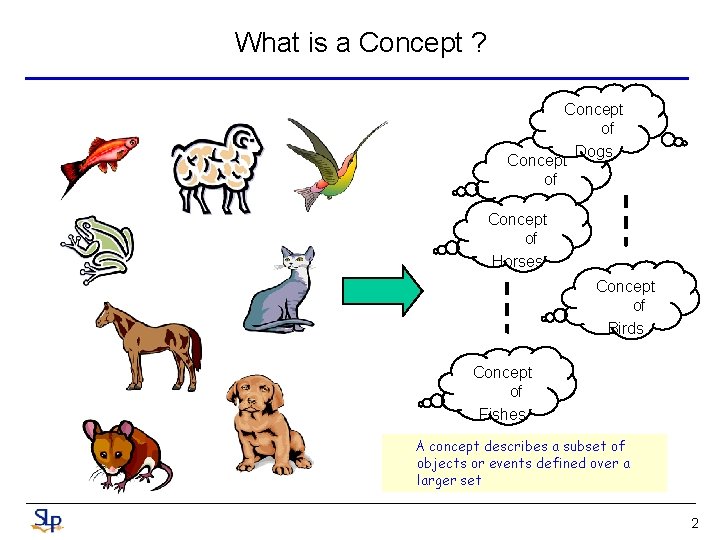
What is a Concept ? Concept of Dogs Concept of Cats Concept of Horses Concept of Birds Concept of Fishes A concept describes a subset of objects or events defined over a larger set 2
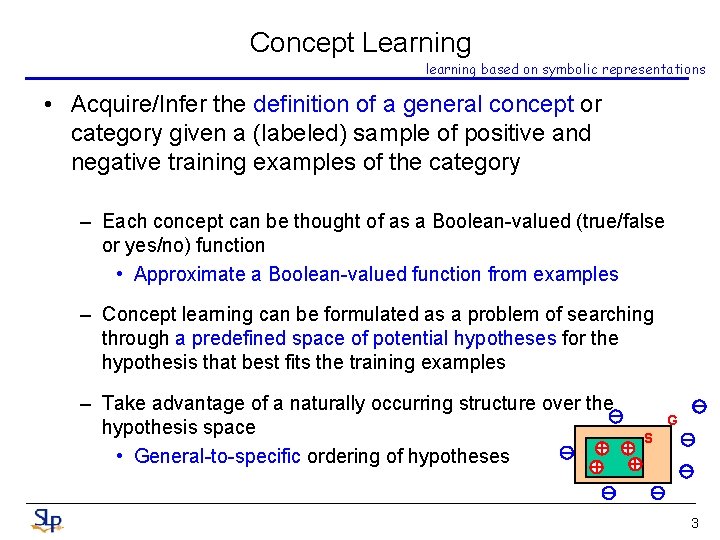
Concept Learning learning based on symbolic representations • Acquire/Infer the definition of a general concept or category given a (labeled) sample of positive and negative training examples of the category – Each concept can be thought of as a Boolean-valued (true/false or yes/no) function • Approximate a Boolean-valued function from examples – Concept learning can be formulated as a problem of searching through a predefined space of potential hypotheses for the hypothesis that best fits the training examples – Take advantage of a naturally occurring structure over the hypothesis space • General-to-specific ordering of hypotheses G S 3
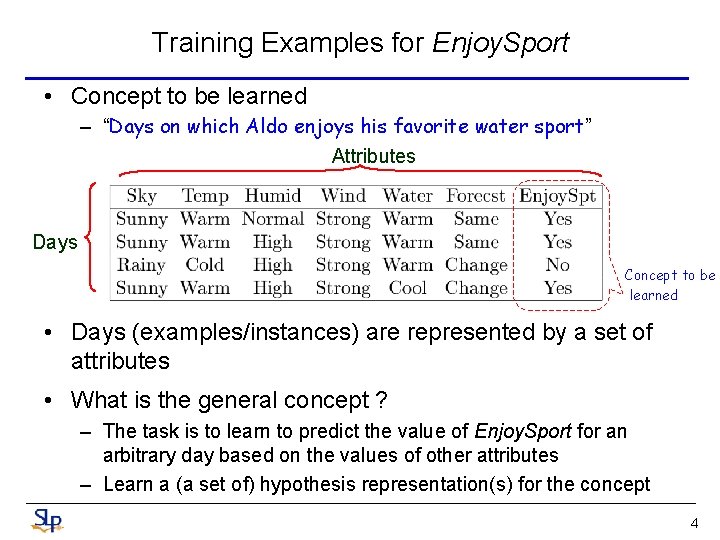
Training Examples for Enjoy. Sport • Concept to be learned – “Days on which Aldo enjoys his favorite water sport” Attributes Days Concept to be learned • Days (examples/instances) are represented by a set of attributes • What is the general concept ? – The task is to learn to predict the value of Enjoy. Sport for an arbitrary day based on the values of other attributes – Learn a (a set of) hypothesis representation(s) for the concept 4
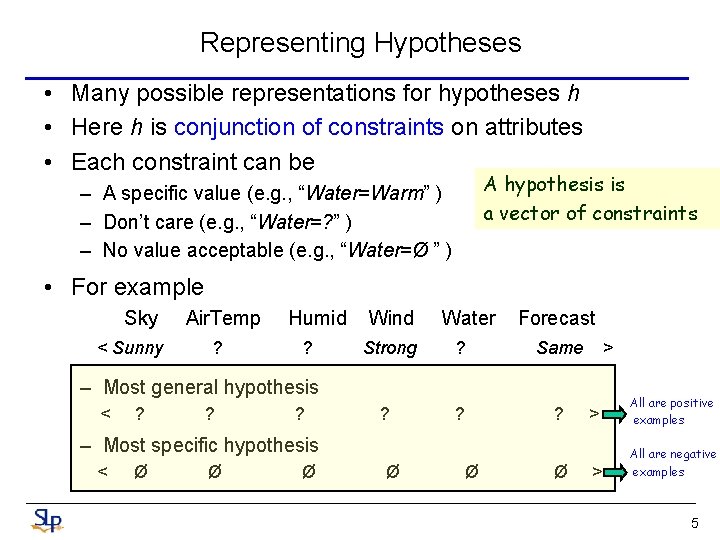
Representing Hypotheses • Many possible representations for hypotheses h • Here h is conjunction of constraints on attributes • Each constraint can be A hypothesis is a vector of constraints – A specific value (e. g. , “Water=Warm” ) – Don’t care (e. g. , “Water=? ” ) – No value acceptable (e. g. , “Water=Ø ” ) • For example Sky < Sunny Air. Temp ? Humid ? Wind Strong Water ? Forecast Same > – Most general hypothesis < ? ? ? > All are positive examples > All are negative examples – Most specific hypothesis < Ø Ø Ø 5
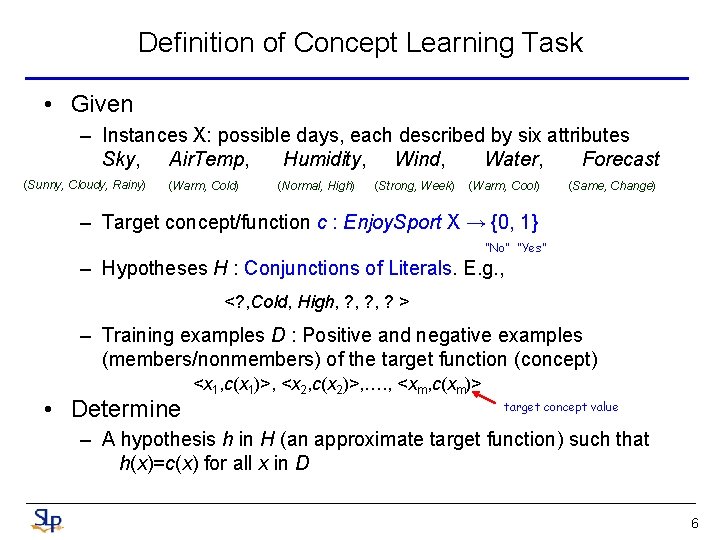
Definition of Concept Learning Task • Given – Instances X: possible days, each described by six attributes Sky, Air. Temp, Humidity, Wind, Water, Forecast (Sunny, Cloudy, Rainy) (Warm, Cold) (Normal, High) (Strong, Week) (Warm, Cool) (Same, Change) – Target concept/function c : Enjoy. Sport X → {0, 1} “No” “Yes” – Hypotheses H : Conjunctions of Literals. E. g. , <? , Cold, High, ? , ? > – Training examples D : Positive and negative examples (members/nonmembers) of the target function (concept) • Determine <x 1, c(x 1)>, <x 2, c(x 2)>, …. , <xm, c(xm)> target concept value – A hypothesis h in H (an approximate target function) such that h(x)=c(x) for all x in D 6
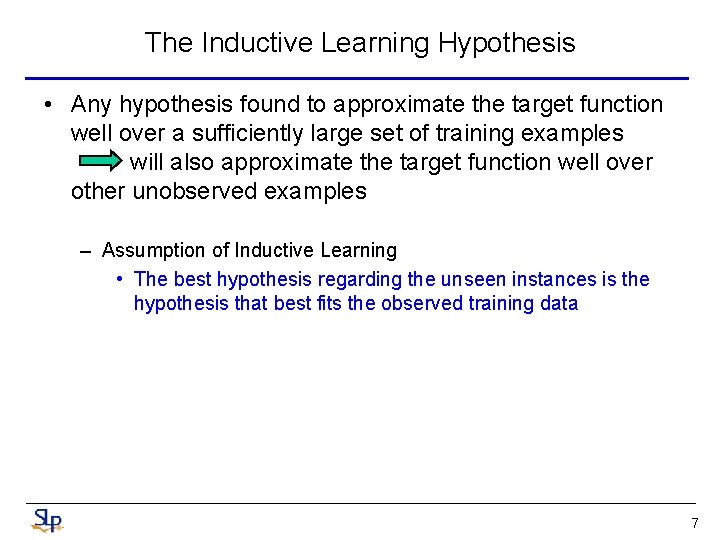
The Inductive Learning Hypothesis • Any hypothesis found to approximate the target function well over a sufficiently large set of training examples will also approximate the target function well over other unobserved examples – Assumption of Inductive Learning • The best hypothesis regarding the unseen instances is the hypothesis that best fits the observed training data 7
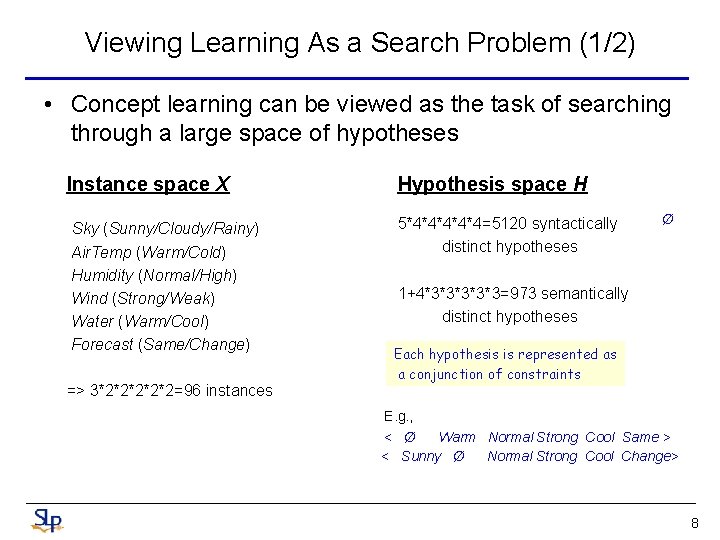
Viewing Learning As a Search Problem (1/2) • Concept learning can be viewed as the task of searching through a large space of hypotheses Instance space X Hypothesis space H Sky (Sunny/Cloudy/Rainy) Air. Temp (Warm/Cold) Humidity (Normal/High) Wind (Strong/Weak) Water (Warm/Cool) Forecast (Same/Change) 5*4*4*4=5120 syntactically distinct hypotheses => 3*2*2*2=96 instances Ø 1+4*3*3*3=973 semantically distinct hypotheses Each hypothesis is represented as a conjunction of constraints E. g. , < Ø Warm Normal Strong Cool Same > < Sunny Ø Normal Strong Cool Change> 8
Viewing Learning As a Search Problem (2/2) • Study of learning algorithms that examine different strategies for searching the hypothesis space, e. g. , – Find-S Algorithm – List-Then-Eliminate Algorithm – Candidate Elimination Algorithm • How to exploit the naturally occurring structure in the hypothesis apace ? – Relations among hypotheses , e. g. , • General-to-Specific-Ordering 9
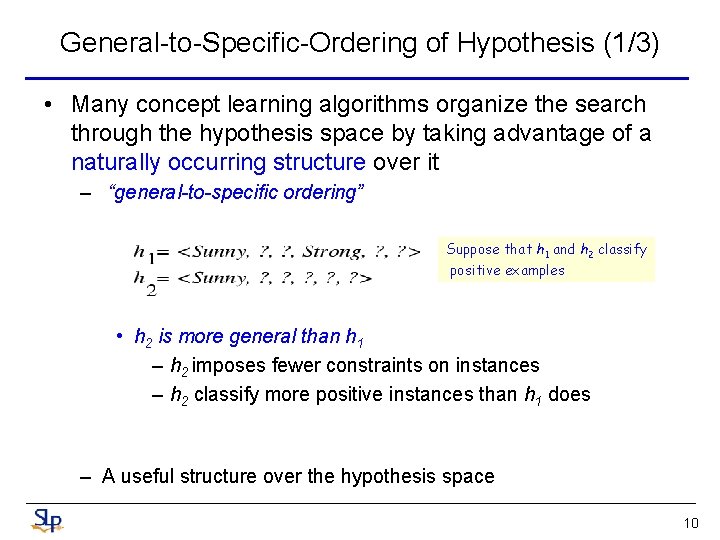
General-to-Specific-Ordering of Hypothesis (1/3) • Many concept learning algorithms organize the search through the hypothesis space by taking advantage of a naturally occurring structure over it – “general-to-specific ordering” Suppose that h 1 and h 2 classify positive examples • h 2 is more general than h 1 – h 2 imposes fewer constraints on instances – h 2 classify more positive instances than h 1 does – A useful structure over the hypothesis space 10
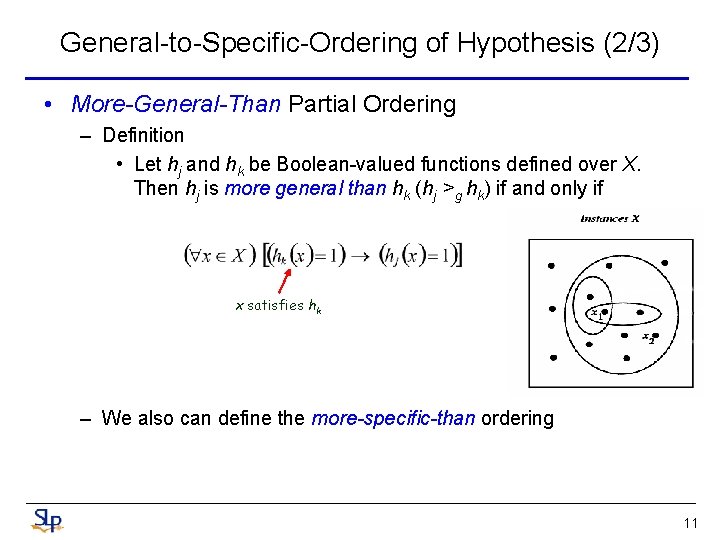
General-to-Specific-Ordering of Hypothesis (2/3) • More-General-Than Partial Ordering – Definition • Let hj and hk be Boolean-valued functions defined over X. Then hj is more general than hk (hj >g hk) if and only if x satisfies hk – We also can define the more-specific-than ordering 11
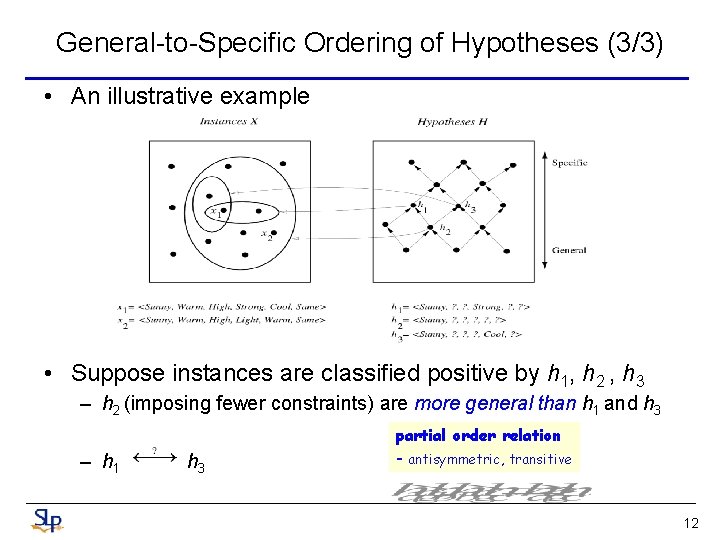
General-to-Specific Ordering of Hypotheses (3/3) • An illustrative example • Suppose instances are classified positive by h 1, h 2 , h 3 – h 2 (imposing fewer constraints) are more general than h 1 and h 3 – h 1 h 3 partial order relation - antisymmetric, transitive 12
Find-S Algorithm (1/3) • Find a maximally specific hypothesis by using the more-general-than partial ordering to organize the search for a hypothesis consistent with the observed training examples 1. Initialize h to the most specific hypothesis in H 2. For each positive training instance x – For each attribute constraint ai in h If the constraint ai in h is satisfied by x Then do nothing Else replace ai in h by the next more general constraint that is satisfied by x 3. Output hypothesis h 13
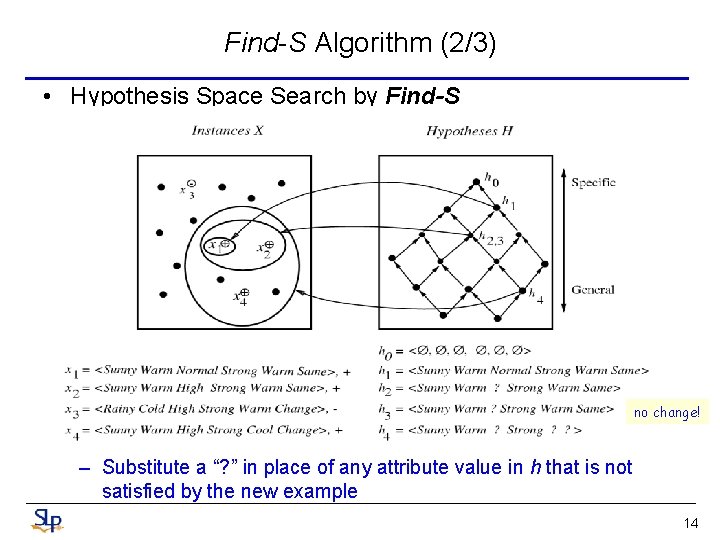
Find-S Algorithm (2/3) • Hypothesis Space Search by Find-S no change! – Substitute a “? ” in place of any attribute value in h that is not satisfied by the new example 14
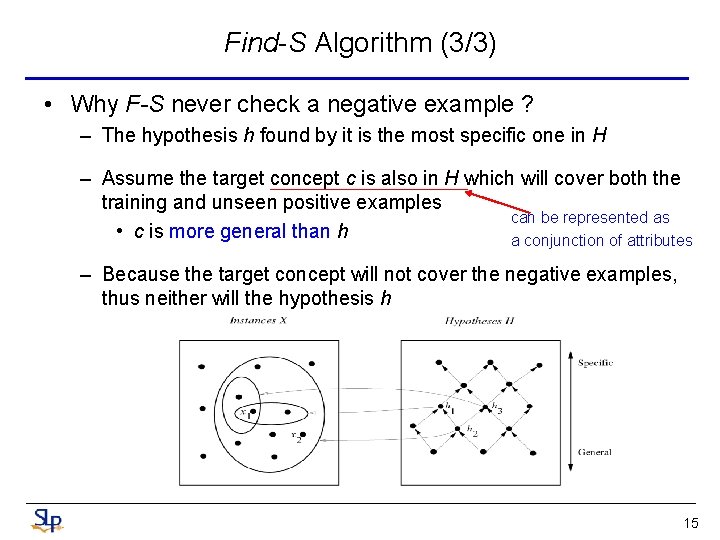
Find-S Algorithm (3/3) • Why F-S never check a negative example ? – The hypothesis h found by it is the most specific one in H – Assume the target concept c is also in H which will cover both the training and unseen positive examples can be represented as • c is more general than h a conjunction of attributes – Because the target concept will not cover the negative examples, thus neither will the hypothesis h 15
Complaints about Find-S • Can not tell whether it has learned concept (Output only one. Many other consistent hypotheses may exist!) • Picks a maximally specific h (why? ) (Find a most specific hypothesis consistent with the training data) • Can not tell when training data inconsistent – What if there are noises or errors contained in training examples • Depending on H, there might be several ! 16
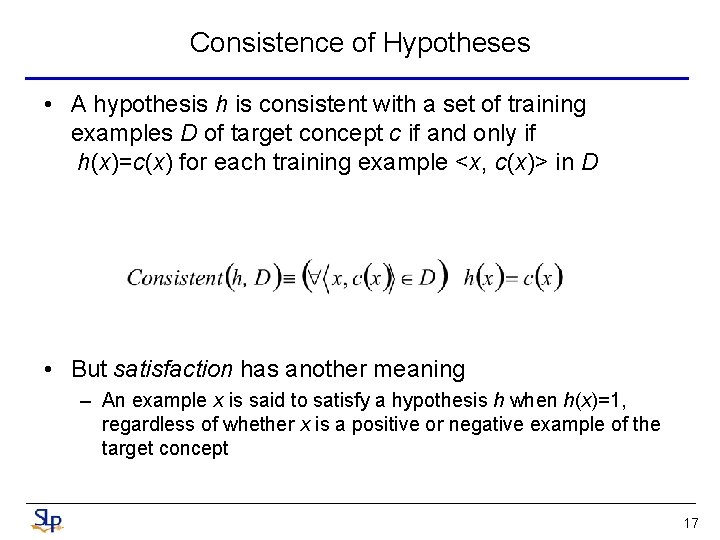
Consistence of Hypotheses • A hypothesis h is consistent with a set of training examples D of target concept c if and only if h(x)=c(x) for each training example <x, c(x)> in D • But satisfaction has another meaning – An example x is said to satisfy a hypothesis h when h(x)=1, regardless of whether x is a positive or negative example of the target concept 17
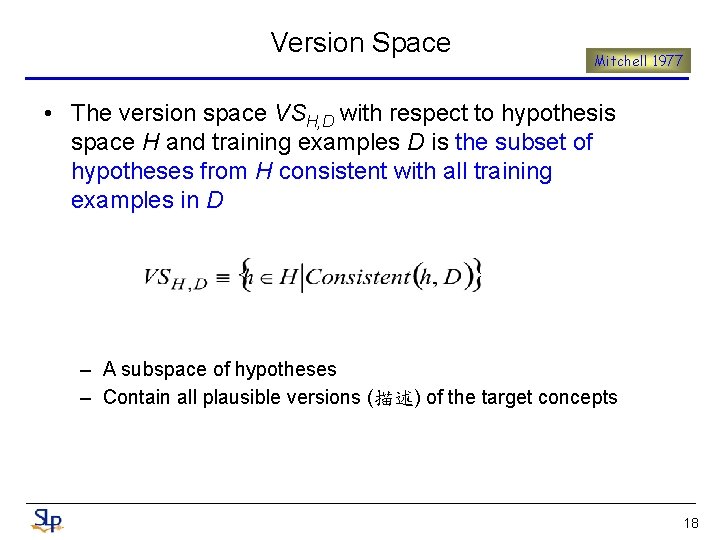
Version Space Mitchell 1977 • The version space VSH, D with respect to hypothesis space H and training examples D is the subset of hypotheses from H consistent with all training examples in D – A subspace of hypotheses – Contain all plausible versions (描述) of the target concepts 18
List-Then-Eliminate Algorithm 1. Version. Space ← a list containing all hypotheses in H 2. For each training example, <x, c(x)> remove from Version. Space any hypothesis h for which h(x)≠c(x) – i. e. , eliminate hypotheses inconsistent with any training examples – The Version. Space shrinks as more examples are observed 3. Output the list of hypotheses in Version. Space 19
Drawbacks of List-Then-Eliminate • The algorithm requires exhaustively enumerating all hypotheses in H – An unrealistic approach ! (full search) • If insufficient (training) data is available, the algorithm will output a huge set of hypotheses consistent with the observed data 20
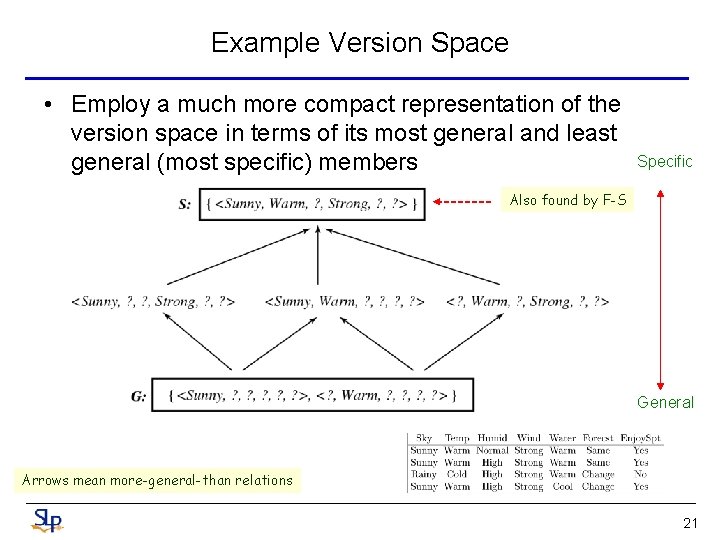
Example Version Space • Employ a much more compact representation of the version space in terms of its most general and least general (most specific) members Specific Also found by F-S General Arrows mean more-general-than relations 21
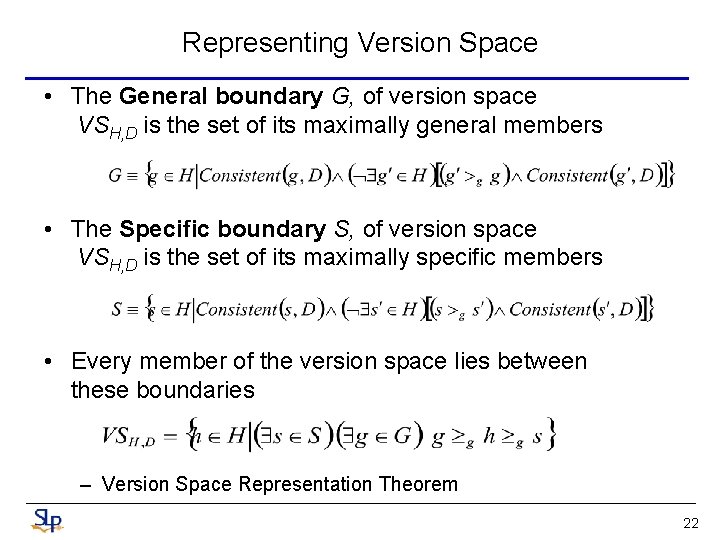
Representing Version Space • The General boundary G, of version space VSH, D is the set of its maximally general members • The Specific boundary S, of version space VSH, D is the set of its maximally specific members • Every member of the version space lies between these boundaries – Version Space Representation Theorem 22
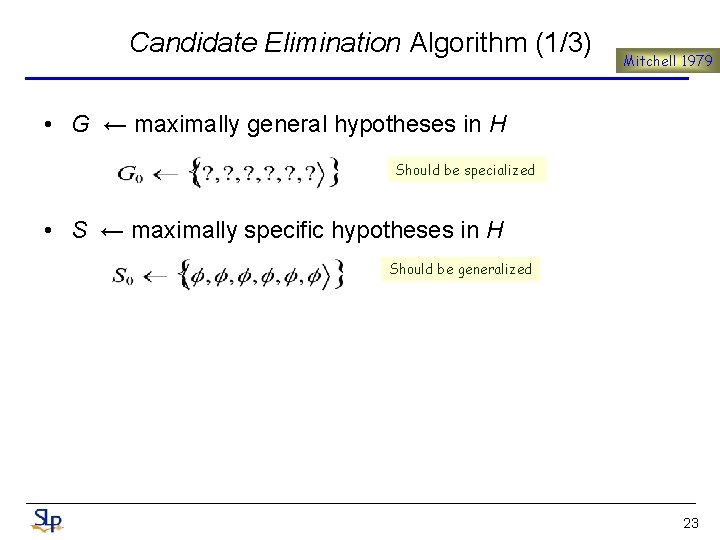
Candidate Elimination Algorithm (1/3) Mitchell 1979 • G ← maximally general hypotheses in H Should be specialized • S ← maximally specific hypotheses in H Should be generalized 23
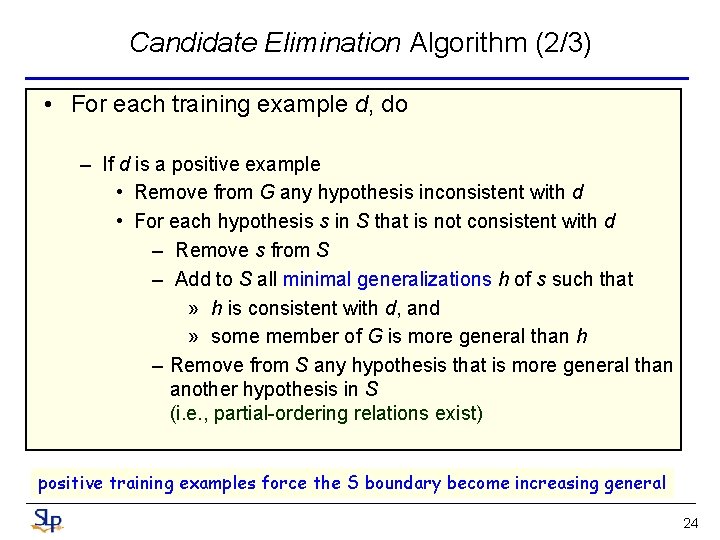
Candidate Elimination Algorithm (2/3) • For each training example d, do – If d is a positive example • Remove from G any hypothesis inconsistent with d • For each hypothesis s in S that is not consistent with d – Remove s from S – Add to S all minimal generalizations h of s such that » h is consistent with d, and » some member of G is more general than h – Remove from S any hypothesis that is more general than another hypothesis in S (i. e. , partial-ordering relations exist) positive training examples force the S boundary become increasing general 24
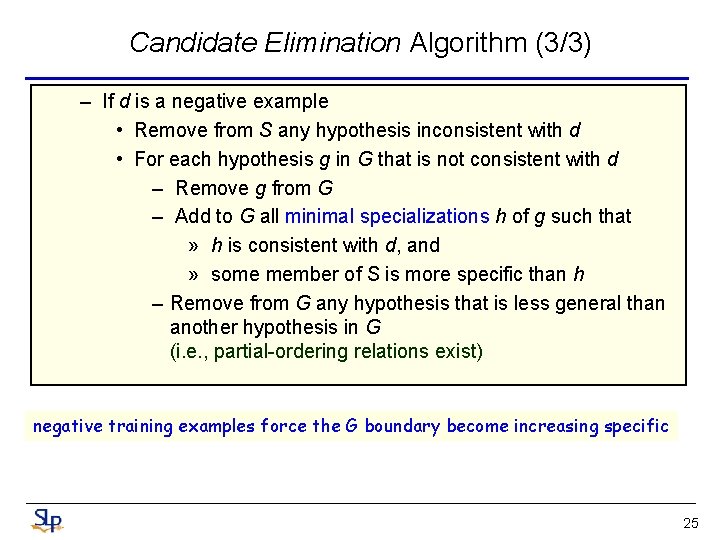
Candidate Elimination Algorithm (3/3) – If d is a negative example • Remove from S any hypothesis inconsistent with d • For each hypothesis g in G that is not consistent with d – Remove g from G – Add to G all minimal specializations h of g such that » h is consistent with d, and » some member of S is more specific than h – Remove from G any hypothesis that is less general than another hypothesis in G (i. e. , partial-ordering relations exist) negative training examples force the G boundary become increasing specific 25
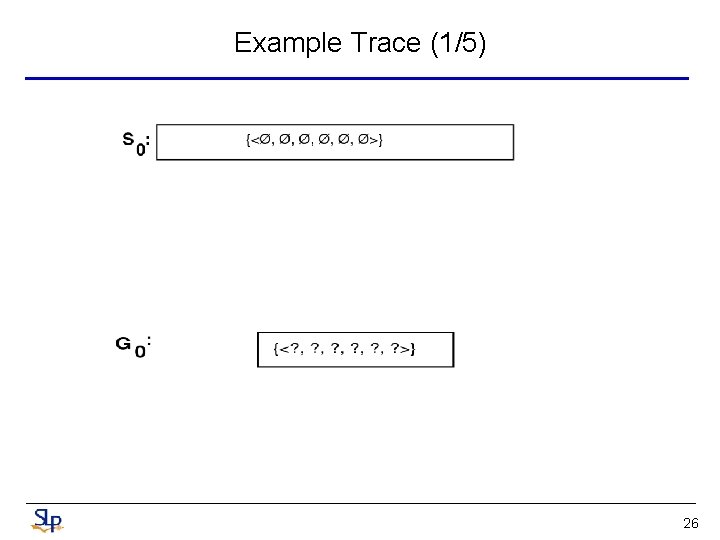
Example Trace (1/5) 26
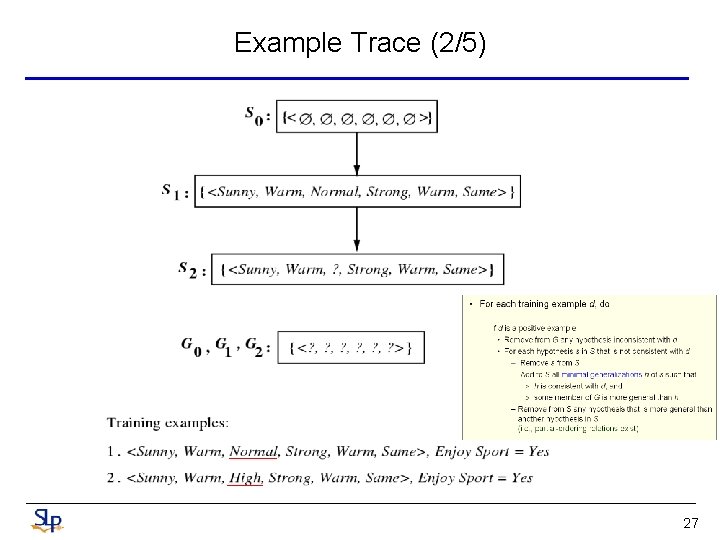
Example Trace (2/5) 27
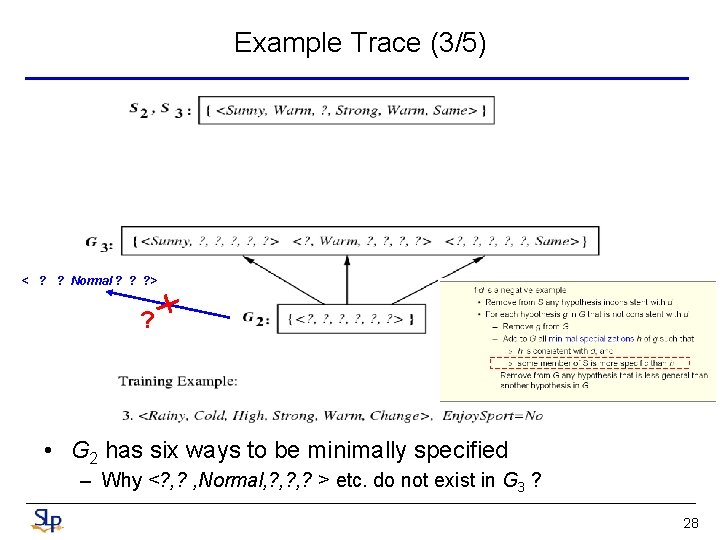
Example Trace (3/5) < ? ? Normal ? ? ? > ? • G 2 has six ways to be minimally specified – Why <? , Normal, ? , ? > etc. do not exist in G 3 ? 28
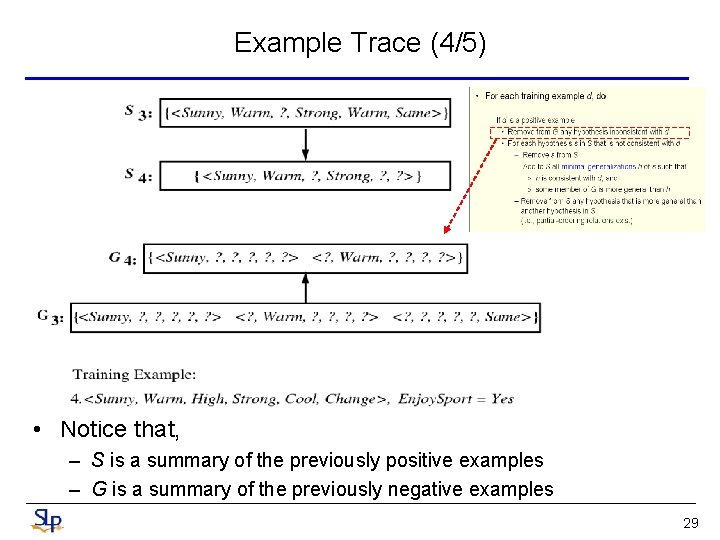
Example Trace (4/5) • Notice that, – S is a summary of the previously positive examples – G is a summary of the previously negative examples 29
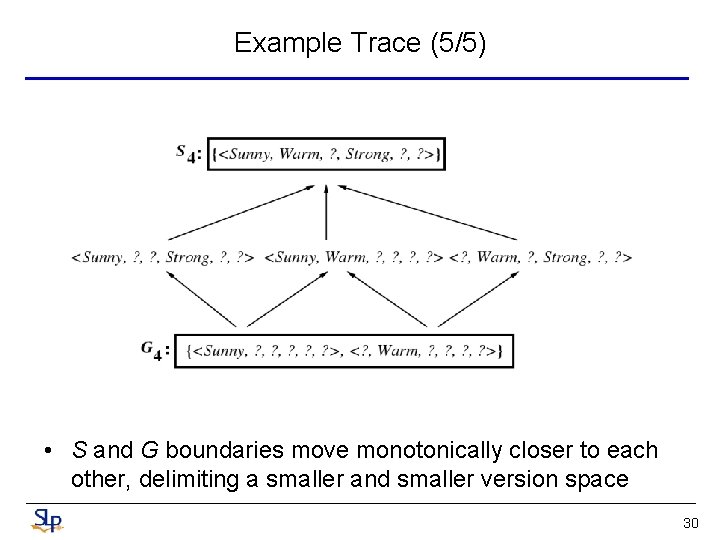
Example Trace (5/5) • S and G boundaries move monotonically closer to each other, delimiting a smaller and smaller version space 30
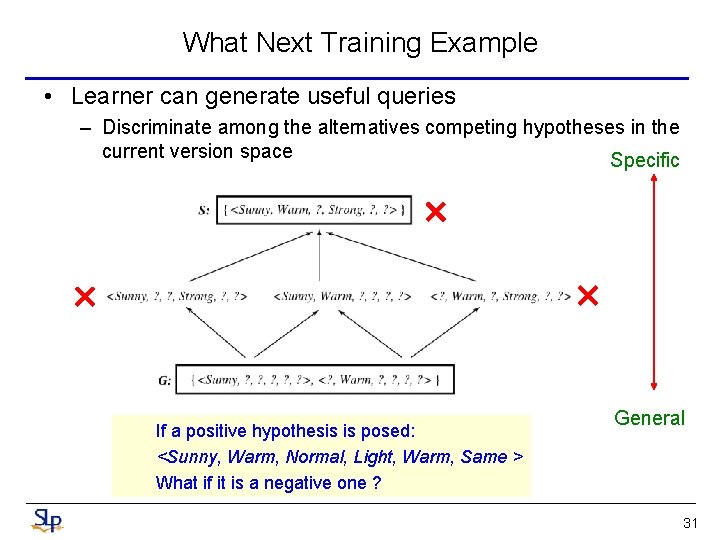
What Next Training Example • Learner can generate useful queries – Discriminate among the alternatives competing hypotheses in the current version space Specific If a positive hypothesis is posed: <Sunny, Warm, Normal, Light, Warm, Same > What if it is a negative one ? General 31
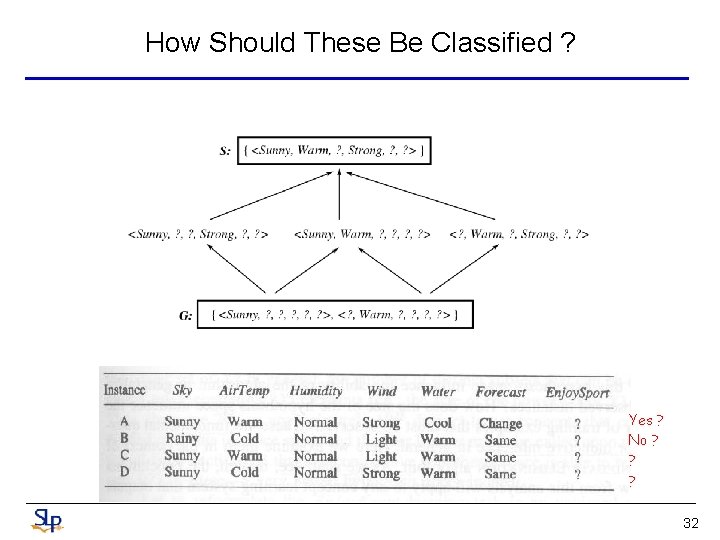
How Should These Be Classified ? Yes ? No ? ? ? 32
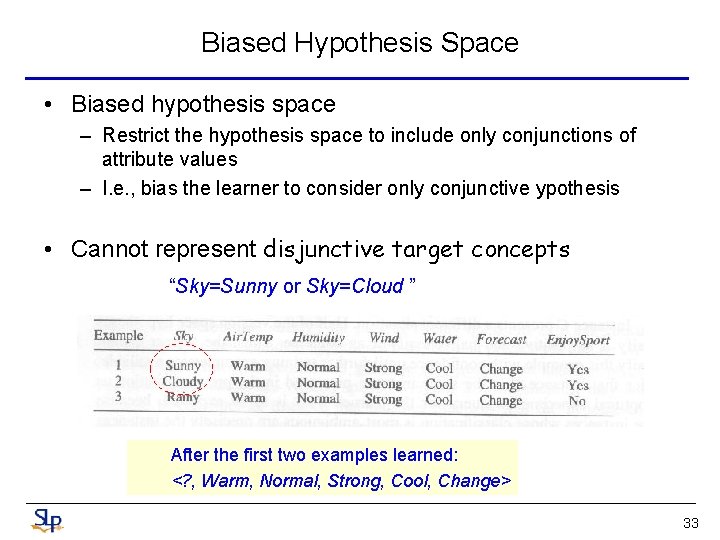
Biased Hypothesis Space • Biased hypothesis space – Restrict the hypothesis space to include only conjunctions of attribute values – I. e. , bias the learner to consider only conjunctive ypothesis • Cannot represent disjunctive target concepts “Sky=Sunny or Sky=Cloud ” After the first two examples learned: <? , Warm, Normal, Strong, Cool, Change> 33
Summary Points • Concept learning as search through H • General-to-specific ordering over H • Version space candidate elimination algorithm – S and G boundaries characterize learners uncertainty • Learner can generate useful queries 34
- Slides: 34