
Concept Development Selection prepared by Prof Margaret Bailey
Concept Development & Selection prepared by Prof. Margaret Bailey (ME) Copyright © 2006 Rochester Institute of Technology All rights reserved. EDGE™
Today’s Workshop Overview • 10 am – 11: 30 AM Interactive Exercise on Concept Development & Selection • 11: 30 – 1: 00 PM Concept Development & Selection on Team Project • 2: 00 – 3: 30 Continue Selection Process: Concept Scoring, Customer Feedback • 3: 30 – 4 PM Create Summary of Activities • By 4: 30 PM Review Team Concept Development and Selection Activities with Guide EDGE™
Session Overview • Introduce Concept Development & Selection Process • Explore Two-Stage Methodology • Demonstrate Above Steps on Example • Discuss Common Dysfunctions Associated with this Phase • Apply Concept Development & Selection Process to Team SD 1 Project EDGE™
Concept Development & Selection Session Learning Objectives 1. Understand concept selection matrix commonly used decision tool in product development 2. Reinforce importance of concept selection within product development process 3. Explore the application of a selection matrix method for selecting & developing product concepts – can be applied to sub-systems as well. EDGE™
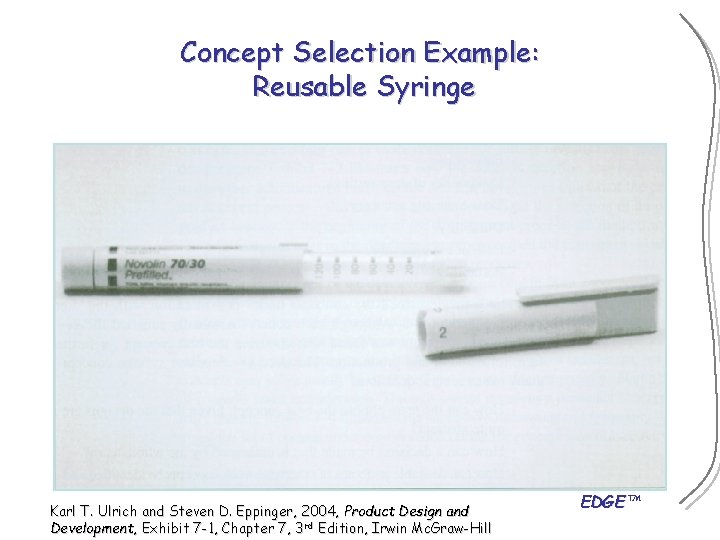
Concept Selection Example: Reusable Syringe Karl T. Ulrich and Steven D. Eppinger, 2004, Product Design and Development, Exhibit 7 -1, Chapter 7, 3 rd Edition, Irwin Mc. Graw-Hill EDGE™
Concept Selection Example: Reusable Syringe • Design an improved, reusable syringe with precise dosage control for outpatient use. – Current product was too costly and inaccurate • Seven criteria identified based on customer needs – – – Ease of handling, use and manufacture Readability of dose settings and accuracy Durability and portability • Seven overall product concepts proposed (Exhibit 7 -3) EDGE™
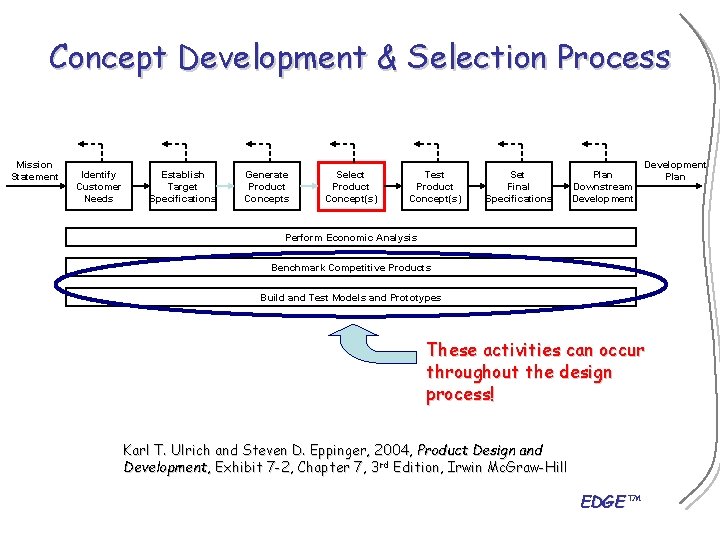
Concept Development & Selection Process Mission Statement Identify Customer Needs Establish Target Specifications Generate Product Concepts Select Product Concept(s) Test Product Concept(s) Set Final Specifications Plan Downstream Development Plan Perform Economic Analysis Benchmark Competitive Products Build and Test Models and Prototypes These activities can occur throughout the design process! Karl T. Ulrich and Steven D. Eppinger, 2004, Product Design and Development, Exhibit 7 -2, Chapter 7, 3 rd Edition, Irwin Mc. Graw-Hill EDGE™
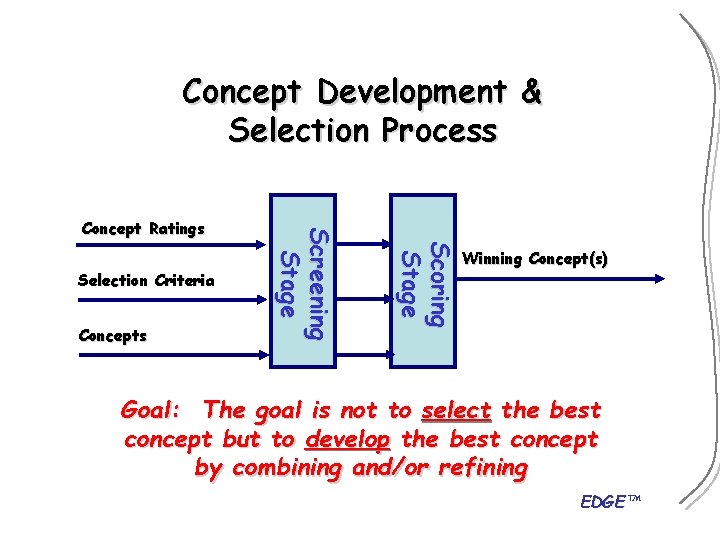
Concept Development & Selection Process Concepts S c o r in g S ta g e Selection Criteria S c r een i n g S ta g e Concept Ratings Winning Concept(s) Goal: The goal is not to select the best concept but to develop the best concept by combining and/or refining EDGE™
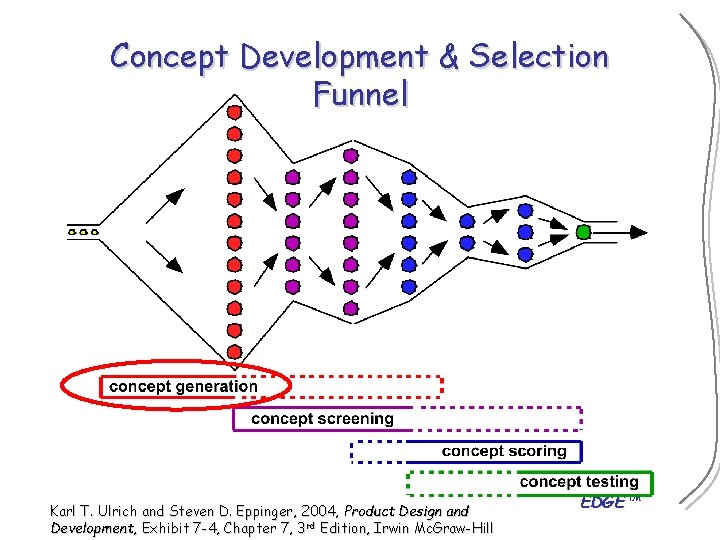
Concept Development & Selection Funnel Karl T. Ulrich and Steven D. Eppinger, 2004, Product Design and Development, Exhibit 7 -4, Chapter 7, 3 rd Edition, Irwin Mc. Graw-Hill EDGE™
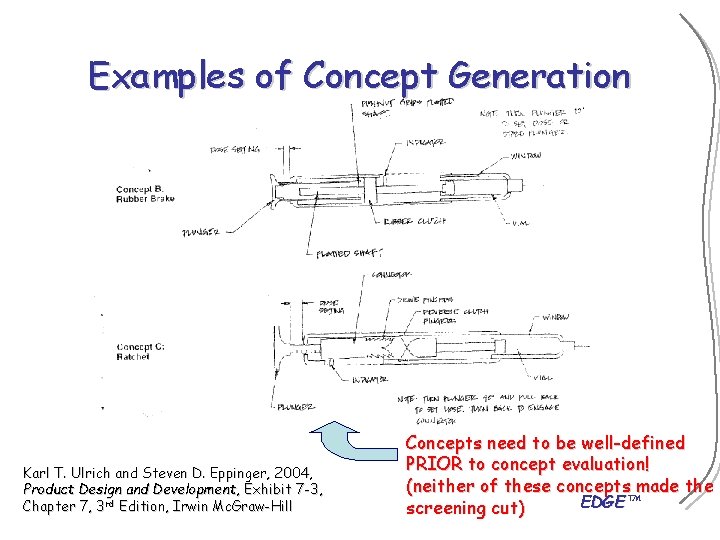
Examples of Concept Generation Karl T. Ulrich and Steven D. Eppinger, 2004, Product Design and Development, Exhibit 7 -3, Chapter 7, 3 rd Edition, Irwin Mc. Graw-Hill Concepts need to be well-defined PRIOR to concept evaluation! (neither of these concepts made the EDGE™ screening cut)

Concept Selection Process Screening Stage Prepare the Matrix Rate Concepts Rank Concepts Combine and Improve Select Best Concept Reflect on the Process Scoring Stage Prepare the Matrix Rate Concepts Rank Concepts Combine and Improve Select Best Concept Reflect on the Process EDGE™
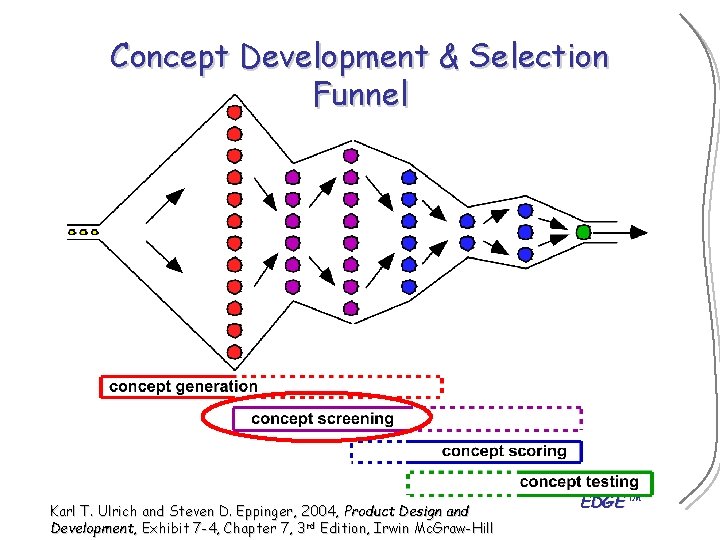
Concept Development & Selection Funnel Karl T. Ulrich and Steven D. Eppinger, 2004, Product Design and Development, Exhibit 7 -4, Chapter 7, 3 rd Edition, Irwin Mc. Graw-Hill EDGE™
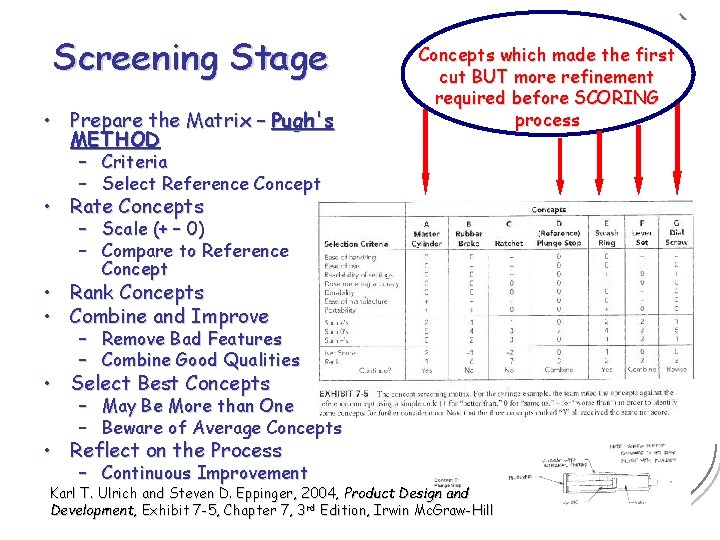
Screening Stage • Prepare the Matrix – Pugh's METHOD Concepts which made the first cut BUT more refinement required before SCORING process – Criteria – Select Reference Concept • Rate Concepts – Scale (+ – 0) – Compare to Reference Concept • Rank Concepts • Combine and Improve – Remove Bad Features – Combine Good Qualities • Select Best Concepts – May Be More than One – Beware of Average Concepts • Reflect on the Process – Continuous Improvement Karl T. Ulrich and Steven D. Eppinger, 2004, Product Design and Development, Exhibit 7 -5, Chapter 7, 3 rd Edition, Irwin Mc. Graw-Hill EDGE™
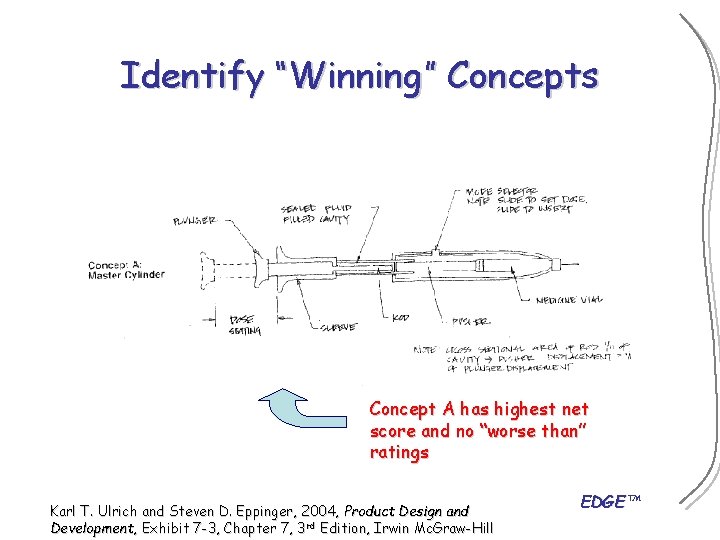
Identify “Winning” Concepts Concept A has highest net score and no “worse than” ratings Karl T. Ulrich and Steven D. Eppinger, 2004, Product Design and Development, Exhibit 7 -3, Chapter 7, 3 rd Edition, Irwin Mc. Graw-Hill EDGE™
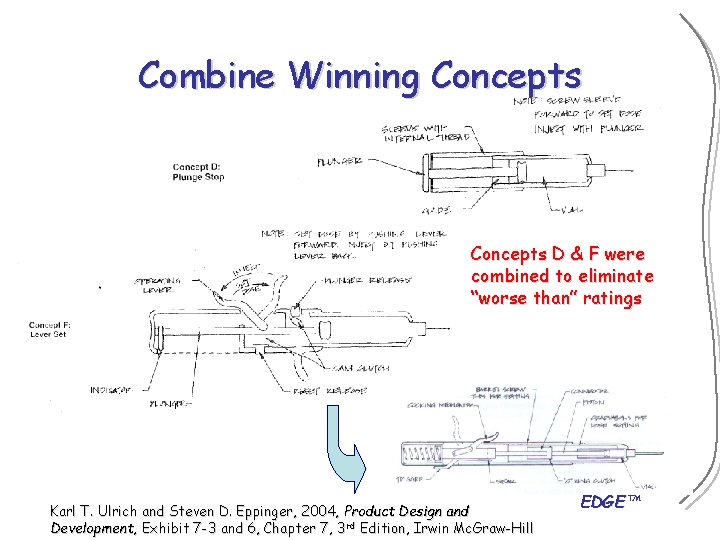
Combine Winning Concepts D & F were combined to eliminate “worse than” ratings Karl T. Ulrich and Steven D. Eppinger, 2004, Product Design and Development, Exhibit 7 -3 and 6, Chapter 7, 3 rd Edition, Irwin Mc. Graw-Hill EDGE™
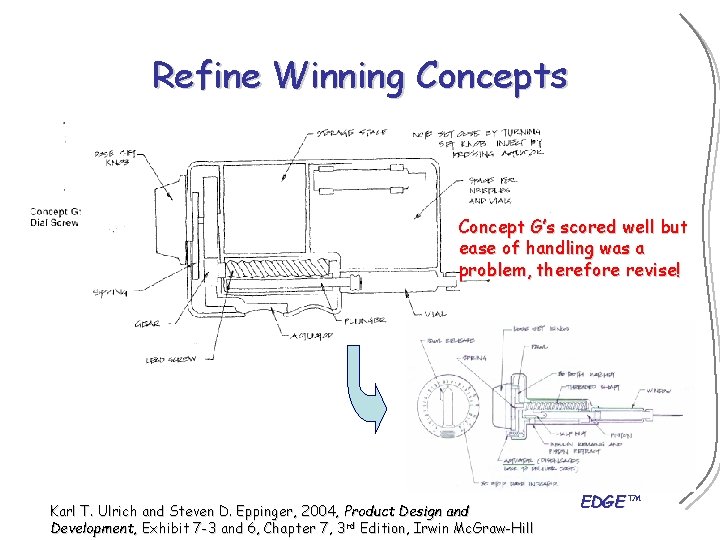
Refine Winning Concepts Concept G’s scored well but ease of handling was a problem, therefore revise! Karl T. Ulrich and Steven D. Eppinger, 2004, Product Design and Development, Exhibit 7 -3 and 6, Chapter 7, 3 rd Edition, Irwin Mc. Graw-Hill EDGE™
Screening Stage for SD 1 Project • NOW – Select a sub-system (or overall product if applicable) – Prepare the Matrix – Begin the following as time allows • This afternoon: – – – Rate Concepts Rank Concepts Combine and Improve Select Best Concept Reflect on the Process EDGE™
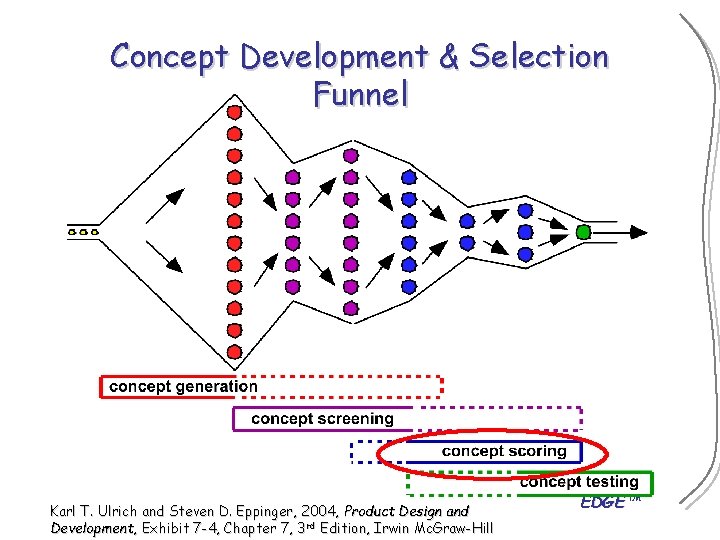
Concept Development & Selection Funnel Karl T. Ulrich and Steven D. Eppinger, 2004, Product Design and Development, Exhibit 7 -4, Chapter 7, 3 rd Edition, Irwin Mc. Graw-Hill EDGE™
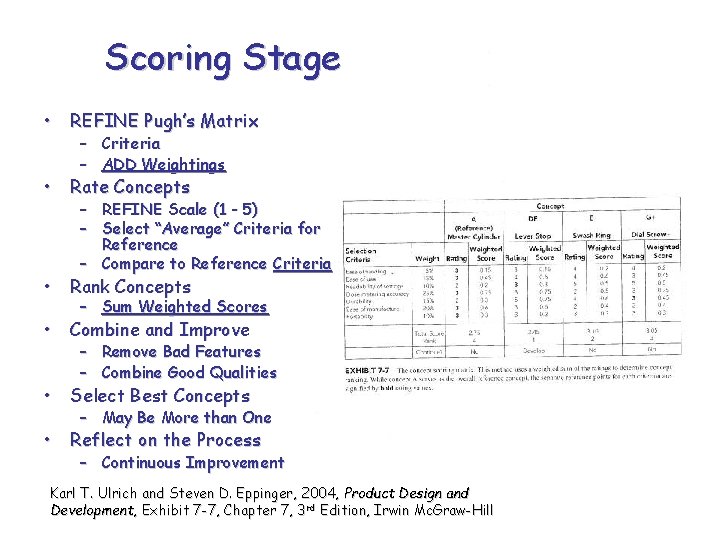
Scoring Stage • REFINE Pugh’s Matrix • Rate Concepts • Rank Concepts • Combine and Improve • Select Best Concepts • Reflect on the Process – Criteria – ADD Weightings – REFINE Scale (1 - 5) – Select “Average” Criteria for Reference – Compare to Reference Criteria – Sum Weighted Scores – Remove Bad Features – Combine Good Qualities – May Be More than One – Continuous Improvement Karl T. Ulrich and Steven D. Eppinger, 2004, Product Design and Development, Exhibit 7 -7, Chapter 7, 3 rd Edition, Irwin Mc. Graw-Hill EDGE™
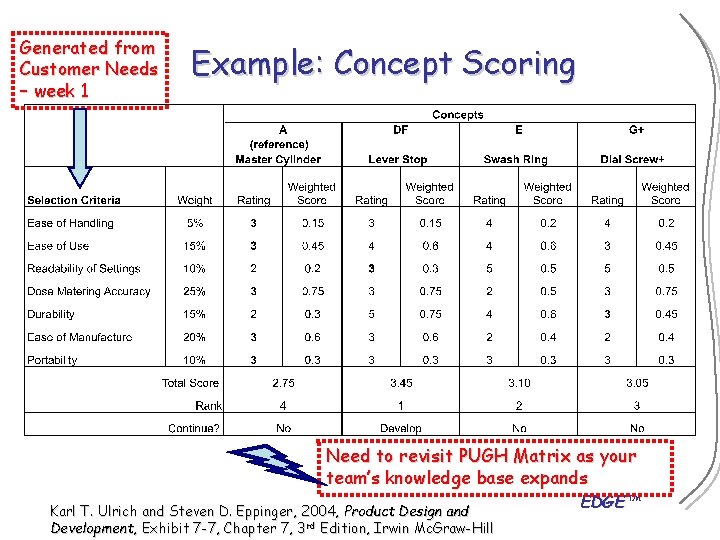
Generated from Customer Needs – week 1 Example: Concept Scoring Need to revisit PUGH Matrix as your team’s knowledge base expands Karl T. Ulrich and Steven D. Eppinger, 2004, Product Design and Development, Exhibit 7 -7, Chapter 7, 3 rd Edition, Irwin Mc. Graw-Hill EDGE™
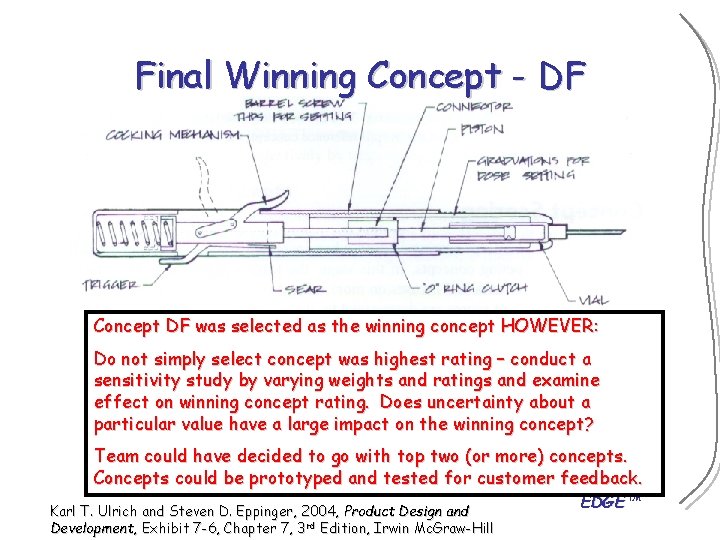
Final Winning Concept - DF Concept DF was selected as the winning concept HOWEVER: Do not simply select concept was highest rating – conduct a sensitivity study by varying weights and ratings and examine effect on winning concept rating. Does uncertainty about a particular value have a large impact on the winning concept? Team could have decided to go with top two (or more) concepts. Concepts could be prototyped and tested for customer feedback. Karl T. Ulrich and Steven D. Eppinger, 2004, Product Design and Development, Exhibit 7 -6, Chapter 7, 3 rd Edition, Irwin Mc. Graw-Hill EDGE™
Tips for Concept Development & Selection • When possible, use objective rather subjective criteria • Useful to identify strengths of concepts that do not make it through screening/scoring stages – could these be incorporated on winning concept(s)? • Include ease of manufacture, reduced liability, and/or cost as criteria • Use concept development & selection process throughout SD 1 and SD 2 EDGE™
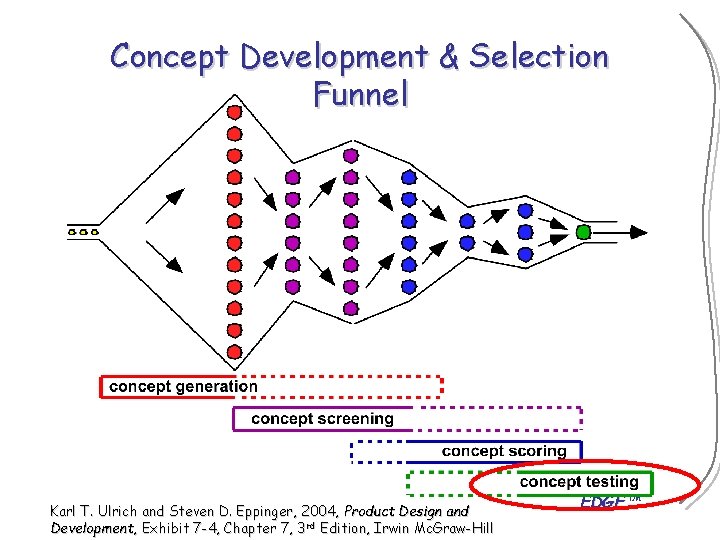
Concept Development & Selection Funnel Karl T. Ulrich and Steven D. Eppinger, 2004, Product Design and Development, Exhibit 7 -4, Chapter 7, 3 rd Edition, Irwin Mc. Graw-Hill EDGE™
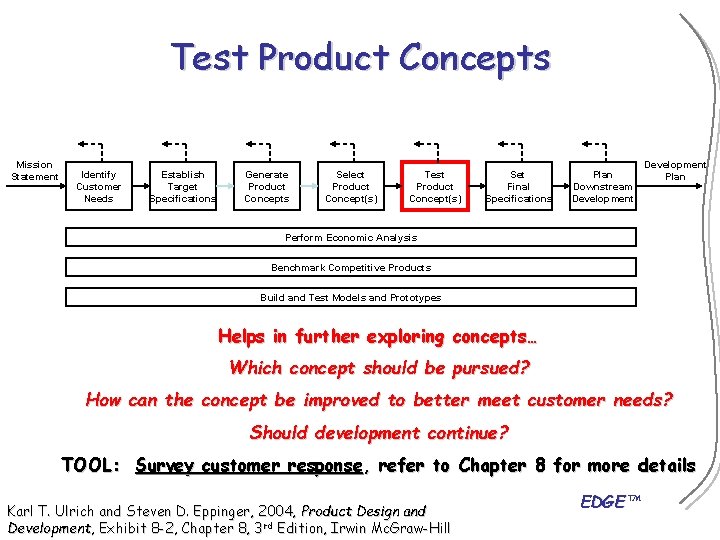
Test Product Concepts Mission Statement Identify Customer Needs Establish Target Specifications Generate Product Concepts Select Product Concept(s) Test Product Concept(s) Set Final Specifications Plan Downstream Development Plan Perform Economic Analysis Benchmark Competitive Products Build and Test Models and Prototypes Helps in further exploring concepts… Which concept should be pursued? How can the concept be improved to better meet customer needs? Should development continue? TOOL: Survey customer response, refer to Chapter 8 for more details Karl T. Ulrich and Steven D. Eppinger, 2004, Product Design and Development, Exhibit 8 -2, Chapter 8, 3 rd Edition, Irwin Mc. Graw-Hill EDGE™
Practice Concept Development & Selection on SD 1 Project • Continue Team Screening Stage and start Scoring Stage Screening or Scoring Stages Prepare/Refine the Matrix Rate Concepts Rank Concepts Combine and Improve Select Best Concept Reflect on the Process Sample Excel Spreadsheet Available for PUGH EDGE™
Rest of the Day…. • Start with Concepts Associated with Critical Sub-function(s) Identified During Week 3 – Develop Pugh's Matrix for SCREENING Process • Create Criteria, Select Reference Concept, Rate Concepts (Scale (+ – 0)), Compare to Reference Concepts, Rank Concepts, • Combine and Improve, Remove Bad Features, Combine Good Qualities, Select Best Concepts • Refer to Exhibit 7 -5 – Refine Pugh's Matrix during SCORING Process • Refine Criteria, ADD Weightings, Rate Concepts (Scale (1 - 5)), Select “Average” Criteria for Reference, Determine Sum Weighted Scores • Combine and Improve, Remove Bad Features, Combine Good Qualities, Select Best Concepts • Refer to Exhibit 7 -7 – Get customer feedback, if possible EDGE™
Next Week • Complete concept selection process (quickly) • Begin system level design: architecture, subsystem definition, interface definition • Schedule and prepare for Design Review I EDGE™
Weeks 5 - 7: Design Review I • 30% of SD 1 Grade • In-depth meeting(s) with Guide, Consultant(s), peers, customer(s), and appropriate experts • Minimize “presentation”, maximize valueadded discussion (see Guidelines on EDGE) EDGE™
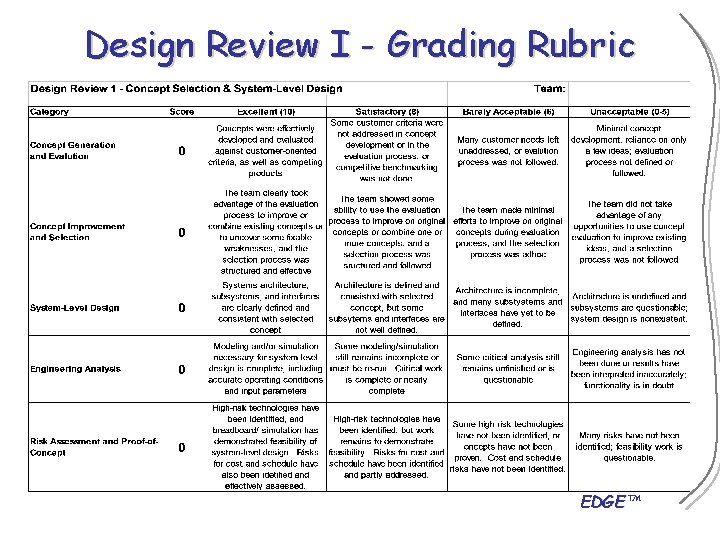
Design Review I - Grading Rubric EDGE™
Design Review I - Content • Discuss concept selection & improvement process • System-level design: architecture, subsystems, interfaces • Identify high-risk technologies and perform enough modeling and/or simulation (computer-based or physical mock-up) to demonstrate that the project can be successful – may include features such as new technology, previously untested technology, long-lead time or prohibitively expensive components • Additional specific requirements should be agreed on with Guide • TEAM Goal: get useful feedback from reviewers EDGE™
- Slides: 30